
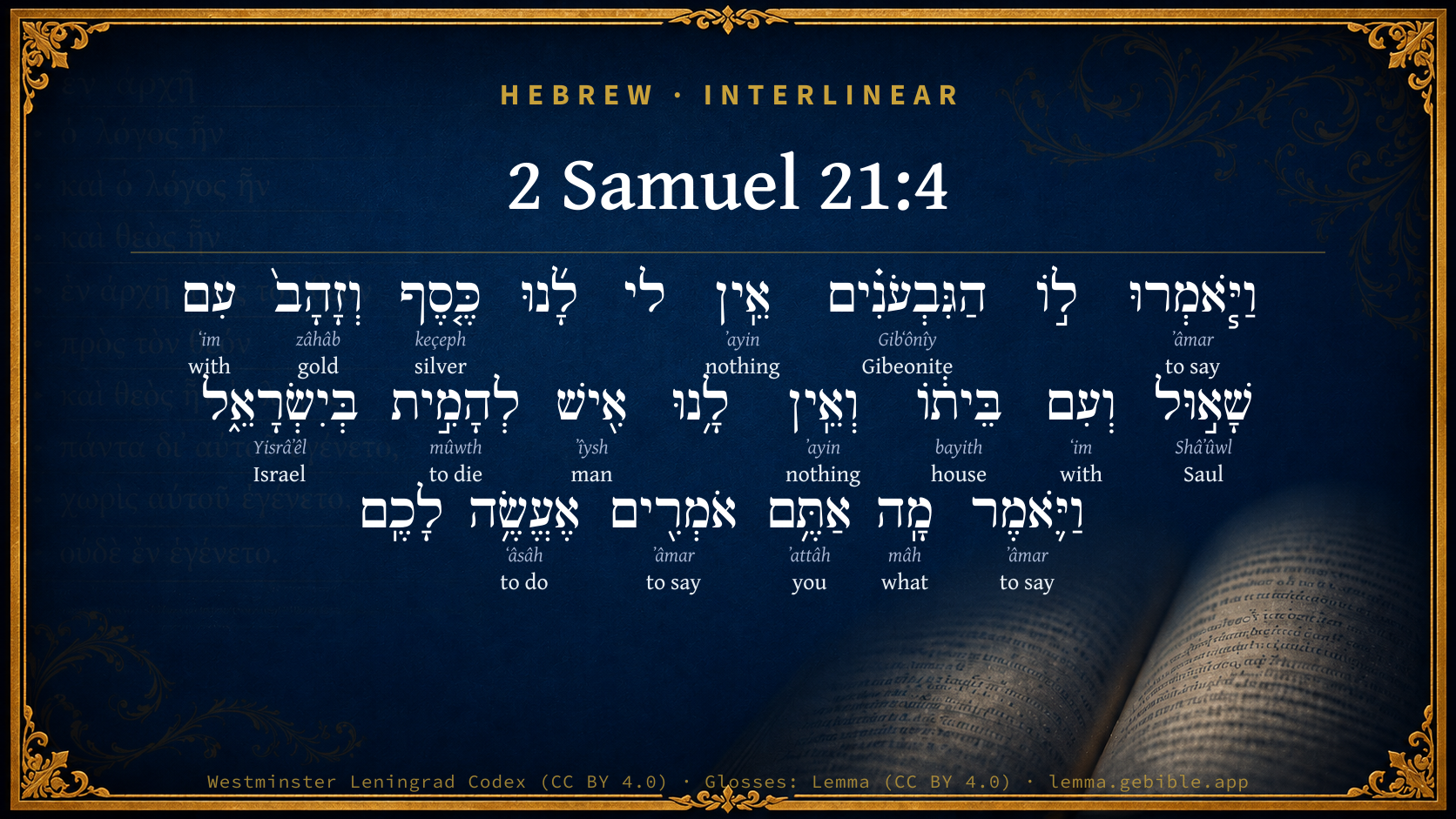
2 Samuel 21:4

Hebrew (Westminster Leningrad Codex) 2 Samuel 21:4 appears in the Hebrew Old Testament. The text above is from the Westminster Leningrad Codex. Each word links to its Strong’s number, a concise gloss, and parsing drawn from the Open Scriptures Hebrew Bible morphology. Click any word for its full Brown-Driver-Briggs (BDB) entry.
Download image
Cite this verse

2 Samuel 21:4 (World English Bible). Public Domain. Lemma interlinear Bible study tool, https://lemma.gebible.app/v/2-samuel/21/4.

Show BibTeX & RIS
BibTeX
RIS
English Translation
The Gibeonites said to him, It is no matter of silver or gold between us and Saul, or his house; neither is it for us to put any man to death in Israel. He said, What you shall say, that will I do for you.
World English Bible · Public Domain
Download a study sheet

One document with this verse’s original text, its word-by-word gloss line, the meaning frame, cross-references with their text, attributed commentary, and full source and license credits — printable, and it pastes into notes with its structure intact.

This verse Autodidact and up

Study sheet (.html) Plain text (.txt)

A passage Seminary Student

Up to 50 verses in one chapter. A passage sheet keeps up to 6 commentary sources and 12 cross-references per verse, in the order this page ranks them, and says so on the sheet whenever that leaves anything out. Ask for a single verse and you get the Autodidact verse sheet above.

Everything on this page stays free to read, with no account — the sheet is a download of what is already on screen, not access to it.

Want to remove ads? Support Godless Engineer
Compare translations 3

The same verse in 3 English versions, stacked beneath the original-language interlinear above. Click any original word for its lexicon entry.

Each is an independent rendering of the whole verse — the interlinear is not word-aligned to these translations.

Highlighted words mark where these versions differ — a whole-verse word diff, not a word-by-word alignment.

  • World English Bible Public Domain
    The Gibeonites said to him, It is no matter of silver or gold between us and Saul, or his house; neither is it for us to put any man to death in Israel. He said, What you shall say, that will I do for you.
  • King James Version Public Domain
    And the Gibeonites said unto him, We will have no silver nor gold of Saul, nor of his house; neither for us shalt thou kill any man in Israel. And he said, What ye shall say, that will I do for you.
  • unfoldingWord Literal Text CC BY-SA 4.0
    And the Gibeonites said to him, “ no silver or gold for us with Saul or with his house. And not for us a man to kill in Israel.” And he said, “What are you saying I shall do for you?”

unfoldingWord Literal Text — © unfoldingWord, licensed CC BY-SA 4.0. Word-aligned USFM3 via Door43 (git.door43.org/unfoldingWord/en_ult).

Versions to compare (up to 4)

3 of 4 selected

Show all 18 translations

Every available English version of this verse, each an independent rendering of the whole verse.

  • World English Bible Public Domain
    The Gibeonites said to him, It is no matter of silver or gold between us and Saul, or his house; neither is it for us to put any man to death in Israel. He said, What you shall say, that will I do for you.
  • Berean Standard Bible Public Domain
    The Gibeonites said to him, “We need no silver or gold from Saul or his house, nor should you put to death anyone in Israel for us.” “Whatever you ask, I will do for you,” he replied.
  • Majority Standard Bible Public Domain
    The Gibeonites said to him, “We need no silver or gold from Saul or his house, nor should you put to death anyone in Israel for us.” “Whatever you ask, I will do for you,” he replied.
  • King James Version Public Domain
    And the Gibeonites said unto him, We will have no silver nor gold of Saul, nor of his house; neither for us shalt thou kill any man in Israel. And he said, What ye shall say, that will I do for you.
  • American Standard Version (1901) Public Domain
    And the Gibeonites said unto him, It is no matter of silver or gold between us and Saul, or his house; neither is it for us to put any man to death in Israel. And he said, What ye shall say, that will I do for you.
  • Revised Version (1885) Public Domain
    And the Gibeonites said unto him, It is no matter of silver or gold between us and Saul, or his house; neither is it for us to put any man to death in Israel. And he said, What ye shall say, that will I do for you.
  • Geneva Bible (1599) Public Domain
    The Gibeonites then answered him, Wee will haue no siluer nor golde of Saul nor of his house, neither for vs shalt thou kill any man in Israel. And he said, What ye shall say, that will I doe for you.
  • Douay-Rheims (1899) Public Domain
    And the Gabaonites said to him: We have no contest about silver and gold, but against Saul and against his house: neither do we desire that any man be slain of Israel. And the king said to them: What will you then that I should do for you?
  • Young's Literal Translation Public Domain
    And the Gibeonites say to him, `We have no silver and gold by Saul and by his house, and we have no man to put to death in Israel;' and he saith, `What ye are saying I do to you.'
  • Literal Standard Version CC BY-SA 4.0
    And the Gibeonites say to him, “We have no silver and gold by Saul and by his house, and we have no man to put to death in Israel”; and he says, “What you are saying I do to you.”
  • Unlocked Literal Bible CC BY-SA 4.0
    The Gibeonites responded to him, “It is not a matter of silver or gold between us and Saul or his family. In the same way it is not for us to put to death any man in Israel.” David replied, “What are you saying that I should do for you?”
  • unfoldingWord Literal Text CC BY-SA 4.0
    And the Gibeonites said to him, “ no silver or gold for us with Saul or with his house. And not for us a man to kill in Israel.” And he said, “What are you saying I shall do for you?”
  • Darby Bible Public Domain
    And the Gibeonites said to him, As to Saul and his house, it is with us no question of receiving silver or gold, neither is it for us to have any man put to death in Israel. And he said, What ye say will I do for you.
  • World Messianic Bible Public Domain
    The Gibeonites said to him, “It is no matter of silver or gold between us and Saul or his house; neither is it for us to put any man to death in Israel.” He said, “I will do for you whatever you say.”
  • Webster's Bible Public Domain
    And the Gibeonites said to him, We will have no silver nor gold of Saul, nor of his house; neither for us shalt thou kill any man in Israel. And he said, What ye shall say, that will I do for you.
  • Free Bible Version CC BY-SA 4.0
    “This isn't a question of us receiving payment in silver or gold from Saul or his family,” the Gibeonites replied. “In addition we don't have the right to have anyone in Israel put to death for us.” “I'll do whatever you ask,” David answered.
  • Bible in Basic English Public Domain
    And the Gibeonites said to him, It is not a question of silver and gold between us and Saul or his family; and it is not in our power to put to death any man in Israel. And he said, Say, then, what am I to do for you?
  • JPS Tanakh (1917) Public Domain
    And the Gibeonites said unto him: 'It is no matter of silver or gold between us and Saul, or his house; neither is it for us to put any man to death in Israel.' And he said: 'What say ye that I should do for you?'

Literal Standard Version (2020), Covenant Press — licensed CC BY-SA 4.0. Text via the HelloAO Bible API (eBible.org). Unlocked Literal Bible (unfoldingWord) — licensed CC BY-SA 4.0. Text via the HelloAO Bible API (eBible.org). unfoldingWord Literal Text — © unfoldingWord, licensed CC BY-SA 4.0. Word-aligned USFM3 via Door43 (git.door43.org/unfoldingWord/en_ult). Free Bible Version, Dr. Jonathan Gallagher — licensed CC BY-SA 4.0. Text via the HelloAO Bible API (eBible.org).

Word by word

More ways to search: Search by grammar → Find every occurrence → Compare this word →

Practice this passage: Drill this verse → Learn its vocabulary →

הַגִּבְעֹנִ֗ים
Gibʻônîy
H1393
“the · Gibeonites”
Particle, Definite Article + Noun, Gentilic, Masculine, Plural, Absolute
Part of Speech
Particle + Noun
Type
Gentilic
Gender
Masculine
Number
Plural
State
Absolute
Full BDB Definition

Origin: patrial from H1391

TWOT: None

Gibeonite = "little hill: hilly" - an inhabitant of Gibeon
  1. וַיֹּ֧אמְרוּ ʼâmar H559 “and · to say” Conjunction + Verb, Qal, Sequential Imperfect, 3rd Person, Masculine, Plural
  2. אֵֽין ʼayin H369 “nothing” Particle, Negative
  3. כֶּ֤סֶף keçeph H3701 “silver” Noun, Common, Masculine, Singular, Absolute
  4. וְזָהָב֙ zâhâb H2091 “and · gold” Conjunction + Noun, Common, Masculine, Singular, Absolute
  5. עִם ʻim H5973 “with” Preposition
  6. שָׁא֣וּל Shâʼûwl H7586 “Saul” Noun, Proper
  7. וְעִם ʻim H5973 “and · with” Conjunction + Preposition
  8. בֵּית֔וֹ bayith H1004 “house · his” Noun, Common, Masculine, Singular, Construct + Suffix, Personal, 3rd Person, Masculine, Singular
  9. וְאֵֽין ʼayin H369 “and · nothing” Conjunction + Particle, Negative
  10. אִ֖ישׁ ʼîysh H376 “man” Noun, Common, Masculine, Singular, Absolute
  11. לְהָמִ֣ית mûwth H4191 “to die” Preposition + Verb, Hiphil, Infinitive Construct
  12. בְּיִשְׂרָאֵ֑ל Yisrâʼêl H3478 “in/at · Israel” Preposition + Noun, Proper
  13. וַיֹּ֛אמֶר ʼâmar H559 “and · to say” Conjunction + Verb, Qal, Sequential Imperfect, 3rd Person, Masculine, Singular
  14. מָֽה mâh H4100 “what” Particle, Interrogative
  15. אַתֶּ֥ם ʼattâh H859 “you” Pronoun, Personal, 2nd Person, Masculine, Plural
  16. אֹמְרִ֖ים ʼâmar H559 “saying” Verb, Qal, Participle Active, Masculine, Plural, Absolute
  17. אֶעֱשֶׂ֥ה ʻâsâh H6213 “to do” Verb, Qal, Imperfect, 1st Person, Common, Singular

About this verse

These counts appear in no published source. They are computed here, from the morphology-tagged text and Lemma’s own curated glosses. What Lemma adds →

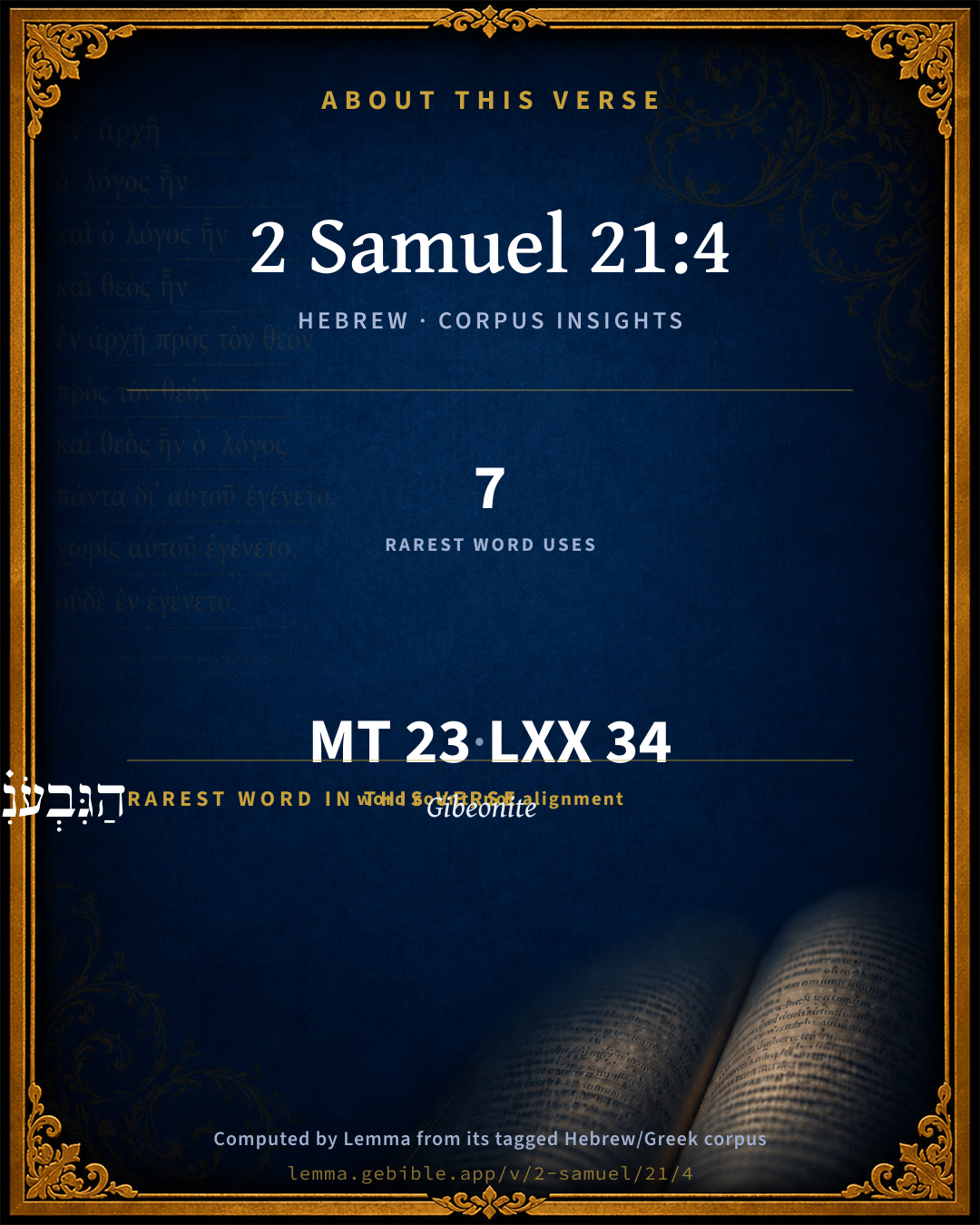
23
words
14
distinct lemmas
Historical
section

Notable vocabulary

The rarest word here is הַגִּבְעֹנִ֗ים Gibeonite H1393 — appearing just 7 times in the whole Hebrew Bible.

Shared distinctive vocabulary

הַגִּבְעֹנִ֗ים Gibeonite H1393 occurs in 6 verses of the Hebrew Bible. Also found in:

Grammatical profile

  • 5 verbs
  • 7 nouns
  • 1 pronoun
  • 7 prepositions
  • 3 particles

Verb forms

  • וַיֹּ֧אמְרוּ Qal · Sequential Imperfect
  • לְהָמִ֣ית Hiphil · Infinitive Construct
  • וַיֹּ֛אמֶר Qal · Sequential Imperfect
  • אֹמְרִ֖ים Qal · Participle Active
  • אֶעֱשֶׂ֥ה Qal · Imperfect

Repetition

Words recur within this verse — often emphatic in Hebrew:

  • וַיֹּ֧אמְרוּ to say H559 ×3
  • אֵֽין nothing H369 ×2
  • עִם with H5973 ×2

Hebrew & Septuagint length

In English translation the verse runs 45 words from the Hebrew and 33 from the Septuagint (LXX English) — closely comparable.

A rough comparison of the two English renderings, which tokenize alike — not a word-level alignment.

Word counts can differ between the Hebrew and the Greek without any difference in meaning — e.g. the Hebrew direct-object marker אֵת has no separate Greek word, and Greek often adds the article ὁ.

In the original languages it is 23 Hebrew tokens and 34 Greek tokens — but the two are counted differently (Hebrew bundles its prefixes and suffixes into one token; the Greek is in lemma form), so that isn’t a like-for-like length.

Cross-references

2

Topical passages linked to 2 Samuel 21:4 in the Treasury of Scripture Knowledge — connected by theme and wording, ordered by reader-vote popularity; previews shown in the World English Bible.

  • Psalms 49:6–8 Those who trust in their wealth, And boast in the multitude of their riches--
  • 1 Peter 1:18–19 knowing that you were redeemed, not with corruptible things, with silver or gold, from the useless way of life handed down from your fathers,

Cross-references courtesy of OpenBible.info (CC BY 4.0).

Hebrew and Greek witnesses Masoretic Hebrew ↔ Greek Septuagint

The same verse in the two great witnesses to the Old Testament, shown verse-for-verse.

These are two independent witnesses, not word-aligned to each other, and the Septuagint is shown in lemma (dictionary) form.

Hebrew 2 Samuel 21:4 Masoretic · Westminster Leningrad Codex

וַיֹּ֧אמְרוּ ל֣וֹ הַגִּבְעֹנִ֗ים אֵֽין לי לָ֜נוּ כֶּ֤סֶף וְזָהָב֙ עִם שָׁא֣וּל וְעִם בֵּית֔וֹ וְאֵֽין לָ֥נוּ אִ֖ישׁ לְהָמִ֣ית בְּיִשְׂרָאֵ֑ל וַיֹּ֛אמֶר מָֽה אַתֶּ֥ם אֹמְרִ֖ים אֶעֱשֶׂ֥ה לָכֶֽם

The Gibeonites said to him, It is no matter of silver or gold between us and Saul, or his house; neither is it for us to put any man to death in Israel. He said, What you shall say, that will I do for you.

World English Bible · Public Domain

Greek LXX 2 Samuel 21:4 Septuagint · lemma form

καί εἶπον αὐτός ὁ γαβαωνίτης οὐ εἰμί ἐγώ ἀργύριον καί χρυσίον μετά σαούλ καί μετά ὁ οἶκος αὐτός καί οὐ εἰμί ἐγώ ἀνήρ θανατόω ἐν ἰσραήλ καί εἶπον τίς σύ λέγω καί ποιέω σύ

And the Gabaonites said to him, We have no question about silver or gold with Saul and with his house; and there is no man for us to put to death in Israel.

LXX2012 (modern English Septuagint) · Public Domain

Hebrew: Westminster Leningrad Codex (CC BY 4.0). Greek: Septuagint (public domain); English from LXX2012 (modern English Septuagint) (Public Domain). How the Septuagint differs from the Hebrew →

Targum (Aramaic paraphrase)

1

The Targum is the ancient Jewish Aramaic paraphrase of the Hebrew Scriptures — an interpretive translation, not the Hebrew text itself. Onkelos (literal) and Pseudo-Jonathan (expansive) render the Torah, and Jonathan the Prophets. Coverage is partial: where no permissively-licensed English translation exists for a verse, only the Aramaic is shown. This is verse-level text, not a word-by-word alignment to the Hebrew.

  1. Targum Jonathan Prophets (Joshua–Malachi)
    וַאֲמַרוּ לֵיהּ גִבְעוֹנָאֵי לֵית אֲנַחְנָא צְרִיכִין לְמִיסַב כְּסַף וּדְהַב מִן שָׁאוּל וּמִן בֵּיתֵיהּ וְאַף לָא אֱנַשׁ לְמִקְטַל בְּיִשְׂרָאֵל וַאֲמַר מָה אַתּוּן אָמְרִין אַעְבֵּיד לְכוֹן:

    (no public-domain English translation for this verse)

    Targum Jonathan — Aramaic: “Mikraot Gedolot” (public domain). English: “Sefaria Community Translation” (CC0 1.0 (public-domain dedication)); “London "Chaldee Paraphrase," 1871” (public domain). Text via Sefaria.

Commentary

Notes on 2 Samuel 21:4 from classic Christian and Jewish commentators (each source and its license shown beneath its notes). The classic Christian expositions comment on the surrounding passage and are grouped to its opening verse, so a note may address several verses; the Jewish commentaries on the Tanakh (Rashi and others) are per-verse, so they appear only where the commentator wrote on this verse.

Lemma curates 59 commentaries, every one of them public domain or Creative Commons licensed, each selected and text-cleaned for this edition rather than reprinted as found. About our sources →

Trapp's Complete Commentary

John Trapp

2Sa 21:4 And the Gibeonites said unto him, We will have no silver nor gold of Saul, nor of his house; neither for us shalt thou kill any man in Israel. And he said, What ye shall say, [that] will I do for you.

Ver. 4. We will have no silver nor gold of Saul.] It is not pecuniary satisfaction that we seek, neither would we suck any man’s blood in way of private revenge, but only to make atonement unto the Lord, who is displeased, and hath declared that this way he will be pacified; and that the famine may be removed, we thus demand and desire.

John Trapp, A Commentary or Exposition upon All the Books of the Old and New Testament (1647–1656) — public domain. Text from a community e-Sword module.

Joseph Benson's Commentary

2Sa 21:4. We will have no silver nor gold of Saul, &c. — Neither silver nor gold was a just equivalent for the loss they had sustained by Saul and his bloody house. Neither for us shalt thou kill any man in Israel — Except of Saul’s family, as it here follows. The marginal reading, however, seems preferable, Neither pertains it to us to kill any man, &c. They were in such a state of servitude as did not allow them to take the only proper retribution, blood for blood. This appears to be the meaning, because David immediately replies, What you shall say, that will I do.

Joseph Benson's Commentary on the Old and New Testaments (1811–1818) — public domain. Text from a community e-Sword module.

Geneva Bible (1599)

Geneva Bible translators

Save only of Saul’s stock.

Geneva Bible (1599) marginal notes — public domain. Text via Bolls.life.

Ellicott's Commentary for English Readers

(4) No silver nor gold.—Money compensations for sins of blood were extremely common among all ancient nations, but were expressly forbidden in the Law of Moses (Num_35:31), and in this respect the Gibeonites appear to have accepted the teaching of the law of Israel.

Kill any man in Israel.—Notwithstanding that the guilt of Saul’s sin, until it should be expiated, rested upon all Israel, the Gibeonites recognise that it had been committed by him, and do not seek that, apart from their connection with him, any Israelite should suffer on their account. David appreciates the fairness of their view of the matter, and promises beforehand to do whatever they shall require.

A Bible Commentary for English Readers, edited by Charles John Ellicott (1878–1897) — public domain. Text from a community e-Sword module.

The Cambridge Bible for Schools and Colleges

gen. ed. J. J. S. Perowne

4. no silver nor gold] No money compensation could expiate Saul’s offence. Money-compensation for murder is allowed by the laws of most nations in a primitive stage, e.g. of the ancient Germans (Tac. Germ. 21); the Anglo-Saxons; and the Arabs of the present day. It was expressly forbidden by the Mosaic Law (Num_35:31-32), because a mere money fine is insufficient to enforce strict regard for life, and such a custom may easily be abused by the rich. See Mozley’s Lectures on the Old Testament, p. 207 ff.

neither for us shalt thou kill any man in Israel] Our cry for vengeance is against the house of Saul, and not against the nation at large.

The Cambridge Bible for Schools and Colleges (gen. ed. J. J. S. Perowne; Cambridge University Press, 1878–1918) — public domain. Text from a community e-Sword module.

John Gill's Exposition

And, the Gibeonites said unto him,.... In reply to his motion:

we will have no silver nor gold of Saul, nor of his house; this shall not be the ransom or atonement; it was not silver and gold Saul took from them, but the lives of their brethren, and therefore they insist upon life for life:

neither for us shall thou kill any man in Israel; who were not of the house of Saul; they did not desire any man should die, but who were of that family by whom they had suffered:

and he said, what you shall say, that will I do for you; whether by inflicting pecuniary fines, or punishing with death, which latter seems to be what they suggested, and afterwards insisted on; whatever, according to law and justice, was required, he was ready to do it for them.

John Gill's Exposition of the Whole Bible (1746–1763) — public domain (CC PDM 1.0). Text via the HelloAO Bible API.

Albert Barnes' Notes on the Bible

No silver, nor gold ... - Money payments as a compensation for blood-guilt were very common among many nations. The law, too, in Num 35:31-32, presupposes the existence of the custom which it prohibits. In like manner the speech of the Gibeonites implies that such a payment as they refuse would be a not unusual proceeding.

Neither ... shalt thou kill any man in Israel - They mean that it is not against the nation of Israel, but against the individual Saul, that they cry for vengeance. The demand for Saul’s sons is exactly similar to that which dictated David’s own expression in 2Sa 24:17, “against me, and against my father’s house.”

Albert Barnes' Notes on the Bible (1834–1885) — public domain. Text from a community e-Sword/MySword module.

Haydock's Catholic Bible Commentary

Gold. It is supposed that David made them an offer of some. (Salien, the year before Christ 1040.) --- Israel besides. At first they required all the progeny of Saul, nine in number, to be crucified: but, at David’s request, and intimation that he had sworn to protect the sons of Jonathan, Miphiboseth and Micha, (Haydock) they were content with the death of seven. (Menochius) --- They insisted upon the law of retaliation. (Salien) --- The custom of delivering up criminals to be executed by the relations of the injured dead, still subsists in the East. (Calmet)

George Leo Haydock (1774–1849), Haydock's Catholic Family Bible and Commentary, 1859 edition — public domain. Excludes Psalms (Douay-Rheims chapter numbering differs from Protestant) and Deuterocanonical books (Catholic canon only).

Matthew Poole's English Annotations

Any man in Israel; except Saul’s family, as it here follows.

What you shall say, to wit, in any reason, and as far as God’s law will permit.

Matthew Poole's English Annotations on the Holy Bible (1683–1685) — public domain. Text from a community e-Sword/MySword module.

Whedon's Commentary on the Bible

Daniel D. Whedon

4. No silver nor gold — The marginal reading is more liberal. The meaning is, The price of blood is not to be paid to us in silver or gold: we will have blood for blood. The law said: “Ye shall take no satisfaction for the life of a murderer.” Num_35:31.

Neither… any man in Israel — That is, We wish not to take innocent blood, but the blood of those who helped devise our destruction, and now live upon the lands they violently took from us.

Daniel D. Whedon (gen. ed.), Commentary on the Old and New Testaments (1874–1909) — public domain. Text from a community e-Sword module.

The Pulpit Commentary

No silver nor gold. It is a common practice in most semicivilized nations for a fine to be accepted as compensation for the shedding of blood. As no distinction was drawn between murder and homicide, and as the nearest relative was bound in every case to revenge the blood shed, the custom of receiving a money compensation gradually grew up to prevent the tribe or nation being torn to pieces by interminable revenge. The Arabs still retain this usage, but it was forbidden by the Levitical Law, (Num_35:31) and rightly so, because a distinction was there made between murder and accidental bloodshed, and precautions taken for the rescue of one who had not acted with malice. Neither for us shalt thou kill any turn in Israel. The singular is used at the beginning of their answer, in the same way as in 2Sa_19:42, 2Sa_19:43. Literally their words are, It is not to me a matter of silver and gold with Saul and his house, nor is it for us to put to death any one in Israel; that is, "We refuse a money compensation, and it is beyond our power to exact the blood penalty which would gratify our anger." They make it quite plain that they do want blood, while the Authorized Version makes them say that they do not. The Revised Version more correctly translates, "Neither is it for us to put any man to death in Israel."

The Pulpit Commentary (1880–1919), ed. H.D.M. Spence-Jones & Joseph S. Exell — public domain. Text from a community e-Sword module.

unfoldingWord translationNotes

Door43 World Missions Community

It is not a matter of silver or gold

"Money will not solve the problem"

translationWords

silver

gold

family

unfoldingWord translationNotes — © Distant Shores Media and the Door43 World Missions Community, licensed CC BY-SA 4.0. Source: git.door43.org/Door43/en_tn.

Rashi

Rabbi Shlomo Yitzchaki (Rashi)

We are not interested in silver or gold from Shaul. We are only interested in [retribution against] people. He [Dovid] wanted to appease them with money but they did not want [to accept it]. He [Dovid] said, "It may be that they are embarrassed of each other." [Therefore] he went and tried to appease each one individually [but] they [still] would not be appeased. That is why it is written here, "I am not interested in silver or gold etc" in singular form. This I saw in the Yerushalmi Talmud.

And we are interested in killing anyone. Among the rest of the Bnei Yisroel because they did not agrieve us.

Rashi on the Tanakh — English translations: “The Judaica Press complete Tanach with Rashi, translated by A. J. Rosenberg” (CC BY 4.0); “Pentateuch with Rashi's commentary by M. Rosenbaum and A.M. Silbermann, 1929-1934” (public domain); “The Metsudah Tanach series, Lakewood, N.J” (CC BY 4.0); and “The Book of Joshua, Metsudah Publications, 1997” (CC BY 4.0). Text via Sefaria.

Lesson kit

Teaching starters — assembled from the data on this page, not authored interpretation. Every prompt links to the verse data it draws on. Edit before teaching.

2 Samuel, in the Historical, opens this verse with 23 words (14 distinct Hebrew lemmas). Its most distinctive word is Gibʻônîy (“Gibeonite”). A historical commentator’s framing appears above. Read the whole chapter for the surrounding context.

Discussion questions

  1. What does “Gibeonite” (Gibʻônîy) contribute to the verse as a whole?
  2. 2 Samuel 21:1 shares the word «Gibeonite» with this verse. How do the two illuminate each other?
  3. “to say” occurs 3× in this one verse. What is the effect of the repetition?
  4. These translations render this verse differently; the difference is in the English rendering, not the original. What questions does that raise?
  5. The verb «וַיֹּ֧אמְרוּ» is Qal Sequential Imperfect. How does its form color the action?
  6. Reading how Trapp's Complete Commentary and Joseph Benson's Commentary read this verse, where do the two commentators agree and where do they part?

Things to notice

Reading settings

Reading text

Shown beneath each verse's original-language words.

Old Testament
Old Testament edition

Read the OT as the Masoretic Hebrew (MT) or the Greek Septuagint (LXX).

English shown for the Greek Septuagint (in the Hebrew ↔ Greek comparison).

Comparing translations? Open the Compare panel on any verse page to stack up to four side by side.