
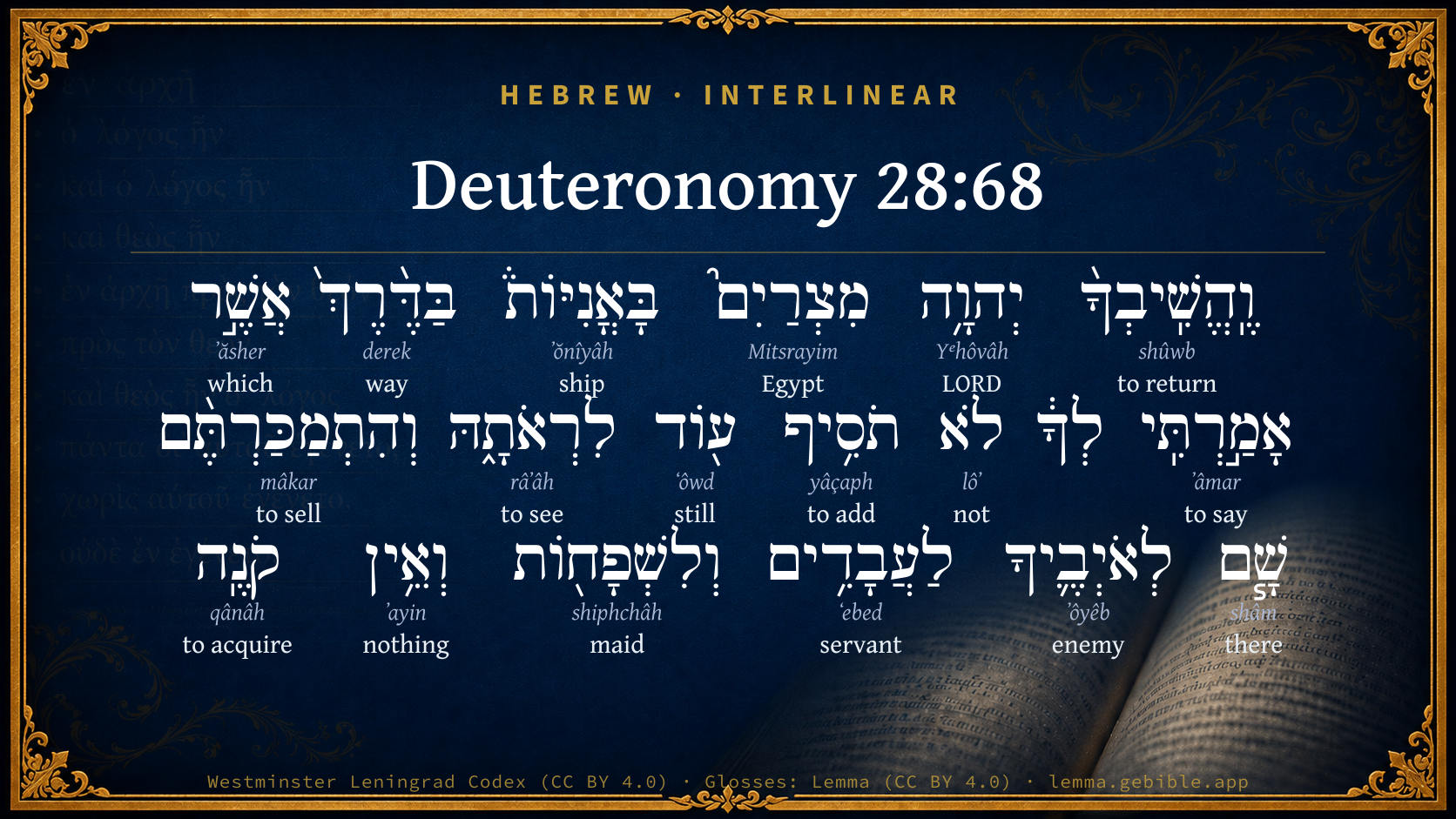
Deuteronomy 28:68

Hebrew (Westminster Leningrad Codex) Deuteronomy 28:68 appears in the Hebrew Old Testament. The text above is from the Westminster Leningrad Codex. Each word links to its Strong’s number, a concise gloss, and parsing drawn from the Open Scriptures Hebrew Bible morphology. Click any word for its full Brown-Driver-Briggs (BDB) entry.
Download image
Cite this verse

Deuteronomy 28:68 (World English Bible). Public Domain. Lemma interlinear Bible study tool, https://lemma.gebible.app/v/deuteronomy/28/68.

Show BibTeX & RIS
BibTeX
RIS
English Translation
Yahweh will bring you into Egypt again with ships, by the way of which I said to you, You shall see it no more again: and there you shall sell yourselves to your enemies for bondservants and for bondmaids, and no man shall buy you.
World English Bible · Public Domain
Download a study sheet

One document with this verse’s original text, its word-by-word gloss line, the meaning frame, cross-references with their text, attributed commentary, and full source and license credits — printable, and it pastes into notes with its structure intact.

This verse Autodidact and up

Study sheet (.html) Plain text (.txt)

A passage Seminary Student

Up to 50 verses in one chapter. A passage sheet keeps up to 6 commentary sources and 12 cross-references per verse, in the order this page ranks them, and says so on the sheet whenever that leaves anything out. Ask for a single verse and you get the Autodidact verse sheet above.

Everything on this page stays free to read, with no account — the sheet is a download of what is already on screen, not access to it.

Want to remove ads? Support Godless Engineer
Compare translations 3

The same verse in 3 English versions, stacked beneath the original-language interlinear above. Click any original word for its lexicon entry.

Each is an independent rendering of the whole verse — the interlinear is not word-aligned to these translations.

Highlighted words mark where these versions differ — a whole-verse word diff, not a word-by-word alignment.

  • World English Bible Public Domain
    Yahweh will bring you into Egypt again with ships, by the way of which I said to you, You shall see it no more again: and there you shall sell yourselves to your enemies for bondservants and for bondmaids, and no man shall buy you.
  • King James Version Public Domain
    And the LORD shall bring thee into Egypt again with ships, by the way whereof I spake unto thee, Thou shalt see it no more again: and there ye shall be sold unto your enemies for bondmen and bondwomen, and no man shall buy you.
  • unfoldingWord Literal Text CC BY-SA 4.0
    And Yahweh will bring you back Egypt by ships, by the route which I had said to you, ‘You will not continue to see it again.’ And there you will sell yourselves to your enemies as male slaves and female slaves, but there will be no buyers.”

unfoldingWord Literal Text — © unfoldingWord, licensed CC BY-SA 4.0. Word-aligned USFM3 via Door43 (git.door43.org/unfoldingWord/en_ult).

Versions to compare (up to 4)

3 of 4 selected

Show all 18 translations

Every available English version of this verse, each an independent rendering of the whole verse.

  • World English Bible Public Domain
    Yahweh will bring you into Egypt again with ships, by the way of which I said to you, You shall see it no more again: and there you shall sell yourselves to your enemies for bondservants and for bondmaids, and no man shall buy you.
  • Berean Standard Bible Public Domain
    The LORD will return you to Egypt in ships by a route that I said you should never see again. There you will sell yourselves to your enemies as male and female slaves, but no one will buy you.”
  • Majority Standard Bible Public Domain
    The LORD will return you to Egypt in ships by a route that I said you should never see again. There you will sell yourselves to your enemies as male and female slaves, but no one will buy you.”
  • King James Version Public Domain
    And the LORD shall bring thee into Egypt again with ships, by the way whereof I spake unto thee, Thou shalt see it no more again: and there ye shall be sold unto your enemies for bondmen and bondwomen, and no man shall buy you.
  • American Standard Version (1901) Public Domain
    And Jehovah will bring thee into Egypt again with ships, by the way whereof I said unto thee, Thou shalt see it no more again: and there ye shall sell yourselves unto your enemies for bondmen and for bondwomen, and no man shall buy you.
  • Revised Version (1885) Public Domain
    And the LORD shall bring thee into Egypt again with ships, by the way whereof I said unto thee, Thou shalt see it no more again: and there ye shall sell yourselves unto your enemies for bondmen and for bondwomen, and no man shall buy you.
  • Geneva Bible (1599) Public Domain
    And the Lord shall bring thee into Egypt againe with shippes by the way, whereof I saide vnto thee, Thou shalt see it no more againe: and there yee shall sell your selues vnto your enemies for bondmen and bondwomen, and there shalbe no byer.
  • Douay-Rheims (1899) Public Domain
    The Lord shall bring thee again with ships into Egypt, by the way whereof he said to thee that thou shouldst see it no more. There shalt thou be set to sale to thy enemies for bondmen and bondwomen, and no man shall buy you.
  • Young's Literal Translation Public Domain
    `And Jehovah hath brought thee back to Egypt with ships, by a way of which I said to thee, Thou dost not add any more to see it, and ye have sold yourselves there to thine enemies, for men-servants and for maid-servants, and there is no buyer.'
  • Literal Standard Version CC BY-SA 4.0
    And YHWH has brought you back to Egypt in ships, by the way of which I said to you, You do not add to see it anymore; and you have sold yourselves to your enemies there, for menservants and for maidservants, and there is no buyer.”
  • Unlocked Literal Bible CC BY-SA 4.0
    Yahweh will bring you into Egypt again by ships, by the route about which I had said to you, 'You will not see Egypt again.' There you will offer yourselves for sale to your enemies as male and female slaves, but no one will purchase you.”
  • unfoldingWord Literal Text CC BY-SA 4.0
    And Yahweh will bring you back Egypt by ships, by the route which I had said to you, ‘You will not continue to see it again.’ And there you will sell yourselves to your enemies as male slaves and female slaves, but there will be no buyers.”
  • Darby Bible Public Domain
    And Jehovah will bring thee into Egypt again with ships, by the way whereof I said unto thee, Thou shalt see it again no more; and there ye shall be sold unto your enemies for bondmen and bondwomen, and there shall be no man to buy [you].
  • World Messianic Bible Public Domain
    The LORD will bring you into Egypt again with ships, by the way of which I told you that you would never see it again. There you will offer yourselves to your enemies for male and female slaves, and nobody will buy you.
  • Webster's Bible Public Domain
    And the LORD shall bring thee into Egypt again with ships, by the way of which I have said to thee, Thou shalt see it no more again: and there ye shall be sold to your enemies for bond-men and bond-women, and no man shall buy you.
  • Free Bible Version CC BY-SA 4.0
    The Lord will send you back to Egypt in ships to a place that I said you weren't ever meant to see again. You will put yourselves on sale there to your enemies as male and female slaves, but nobody will want to buy you.
  • Bible in Basic English Public Domain
    And the Lord will take you back to Egypt again in ships, by the way of which I said to you, You will never see it again: there you will be offering yourselves as men-servants and women-servants to your haters for a price, and no man will take you.
  • JPS Tanakh (1917) Public Domain
    And the LORD shall bring thee back into Egypt in ships, by the way whereof I said unto thee: 'Thou shalt see it no more again'; and there ye shall sell yourselves unto your enemies for bondmen and for bondwoman, and no man shall buy you.

Literal Standard Version (2020), Covenant Press — licensed CC BY-SA 4.0. Text via the HelloAO Bible API (eBible.org). Unlocked Literal Bible (unfoldingWord) — licensed CC BY-SA 4.0. Text via the HelloAO Bible API (eBible.org). unfoldingWord Literal Text — © unfoldingWord, licensed CC BY-SA 4.0. Word-aligned USFM3 via Door43 (git.door43.org/unfoldingWord/en_ult). Free Bible Version, Dr. Jonathan Gallagher — licensed CC BY-SA 4.0. Text via the HelloAO Bible API (eBible.org).

Word by word

More ways to search: Search by grammar → Find every occurrence → Compare this word →

Practice this passage: Drill this verse → Learn its vocabulary →

בָּאֳנִיּוֹת֒
ʼŏnîyâh
H591
“in/at · ships”
Preposition + Noun, Common, Feminine, Plural, Absolute
Part of Speech
Preposition + Noun
Type
Common
Gender
Feminine
Number
Plural
State
Absolute
Full BDB Definition

Origin: from H590

TWOT: 125b

ship - men of ships, seamen
  1. וֶֽהֱשִֽׁיבְךָ֨ shûwb H7725 “and · to return · you” Conjunction + Verb, Hiphil, Sequential Perfect, 3rd Person, Masculine, Singular + Suffix, Personal, 2nd Person, Masculine, Singular
  2. יְהוָ֥ה Yᵉhôvâh H3068 “LORD” Noun, Proper
  3. מִצְרַיִם֮ Mitsrayim H4714 “Egypt” Noun, Proper
  4. בַּדֶּ֨רֶךְ֙ derek H1870 “in/at the · way” Preposition, Determined + Noun, Common, Both, Singular, Absolute
  5. אֲשֶׁ֣ר ʼăsher H834 “which” Particle, Relative
  6. אָמַ֣רְתִּֽי ʼâmar H559 “to say” Verb, Qal, Perfect, 1st Person, Common, Singular
  7. לֹא lôʼ H3808 “not” Particle, Negative
  8. תֹסִ֥יף yâçaph H3254 “to add” Verb, Hiphil, Imperfect, 2nd Person, Masculine, Singular
  9. ע֖וֹד ʻôwd H5750 “still” Adverb
  10. לִרְאֹתָ֑הּ râʼâh H7200 “to see · her” Preposition + Verb, Qal, Infinitive Construct + Suffix, Personal, 3rd Person, Feminine, Singular
  11. וְהִתְמַכַּרְתֶּ֨ם mâkar H4376 “and · to sell” Conjunction + Verb, Hithpael, Sequential Perfect, 2nd Person, Masculine, Plural
  12. שָׁ֧ם shâm H8033 “there” Adverb
  13. לְאֹיְבֶ֛יךָ ʼôyêb H341 “to/for · enemy · you” Preposition + Verb, Qal, Participle Active, Masculine, Plural, Construct + Suffix, Personal, 2nd Person, Masculine, Singular
  14. לַעֲבָדִ֥ים ʻebed H5650 “to/for · servants” Preposition + Noun, Common, Masculine, Plural, Absolute
  15. וְלִשְׁפָח֖וֹת shiphchâh H8198 “and · to/for · maids” Conjunction + Preposition + Noun, Common, Feminine, Plural, Absolute
  16. וְאֵ֥ין ʼayin H369 “and · nothing” Conjunction + Particle, Negative
  17. קֹנֶֽה qânâh H7069 “acquiring” Verb, Qal, Participle Active, Masculine, Singular, Absolute

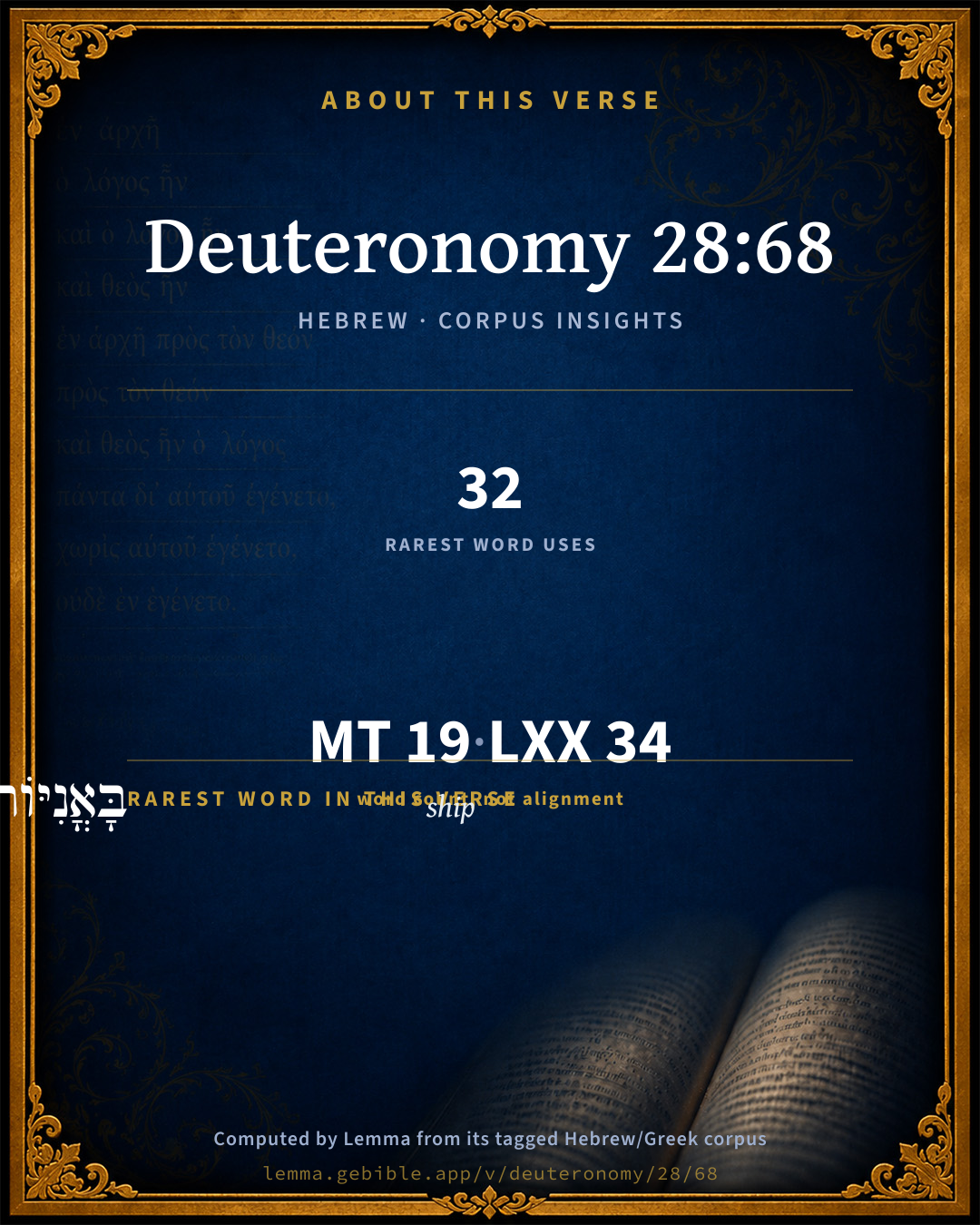
About this verse

These counts appear in no published source. They are computed here, from the morphology-tagged text and Lemma’s own curated glosses. What Lemma adds →

19
words
18
distinct lemmas
Pentateuch
section

Shared distinctive vocabulary

בָּאֳנִיּוֹת֒ ship H591 occurs in 28 verses of the Hebrew Bible. Also found in:

Grammatical profile

  • 7 verbs
  • 6 nouns
  • 1 preposition
  • 2 adverbs
  • 3 particles

Verb forms

  • וֶֽהֱשִֽׁיבְךָ֨ Hiphil · Sequential Perfect
  • אָמַ֣רְתִּֽי Qal · Perfect
  • תֹסִ֥יף Hiphil · Imperfect
  • לִרְאֹתָ֑הּ Qal · Infinitive Construct
  • וְהִתְמַכַּרְתֶּ֨ם Hithpael · Sequential Perfect
  • לְאֹיְבֶ֛יךָ Qal · Participle Active
  • קֹנֶֽה Qal · Participle Active

Hebrew & Septuagint length

In English translation the verse runs 45 words from the Hebrew and 42 from the Septuagint (LXX English) — closely comparable.

A rough comparison of the two English renderings, which tokenize alike — not a word-level alignment.

Word counts can differ between the Hebrew and the Greek without any difference in meaning — e.g. the Hebrew direct-object marker אֵת has no separate Greek word, and Greek often adds the article ὁ.

In the original languages it is 19 Hebrew tokens and 34 Greek tokens — but the two are counted differently (Hebrew bundles its prefixes and suffixes into one token; the Greek is in lemma form), so that isn’t a like-for-like length.

Cross-references

10

Topical passages linked to Deuteronomy 28:68 in the Treasury of Scripture Knowledge — connected by theme and wording, ordered by reader-vote popularity; previews shown in the World English Bible.

  • Jeremiah 44:12 I will take the remnant of Judah, that have set their faces to go into the land of Egypt to sojourn there, and they shall all be consumed; in the land of Egypt shall they fall; they shall be consumed by the sword and by the famine; they shall die, from the least even to the greatest, by the sword and by the famine; and they shall be an object of horror, [and] an astonishment, and a curse, and a reproach.
  • Jeremiah 43:7 and they came into the land of Egypt; for they didn't obey the voice of Yahweh: and they came to Tahpanhes.
  • Hosea 8:13 As for the sacrifices of my offerings, they sacrifice flesh and eat it; But Yahweh doesn't accept them. Now he will remember their iniquity, And punish their sins. They will return to Egypt.
  • Hosea 9:3 They won't dwell in Yahweh's land; But Ephraim will return to Egypt, And they will eat unclean food in Assyria.
  • Deuteronomy 17:16 Only he shall not multiply horses to himself, nor cause the people to return to Egypt, to the end that he may multiply horses; because Yahweh has said to you, You shall henceforth return no more that way.
  • Exodus 20:2 "I am Yahweh your God, who brought you out of the land of Egypt, out of the house of bondage.
  • Nehemiah 5:8 I said to them, We after our ability have redeemed our brothers the Jews, that were sold to the nations; and would you even sell your brothers, and should they be sold to us? Then held they their peace, and found never a word.
  • Esther 7:4 for we are sold, I and my people, to be destroyed, to be slain, and to perish. But if we had been sold for bondservants and bondmaids, I had held my peace, although the adversary could not have compensated for the king's damage.
  • Joel 3:3–7 And have cast lots for my people, And have given a boy for a prostitute, And sold a girl for wine, that they may drink.
  • Luke 21:24 They will fall by the edge of the sword, and will be led captive into all the nations. Jerusalem will be trampled down by the Gentiles, until the times of the Gentiles are fulfilled.

Cross-references courtesy of OpenBible.info (CC BY 4.0).

Hebrew and Greek witnesses Masoretic Hebrew ↔ Greek Septuagint

The same verse in the two great witnesses to the Old Testament, shown verse-for-verse.

These are two independent witnesses, not word-aligned to each other, and the Septuagint is shown in lemma (dictionary) form.

Hebrew Deuteronomy 28:68 Masoretic · Westminster Leningrad Codex

וֶֽהֱשִֽׁיבְךָ֨ יְהוָ֥ה מִצְרַיִם֮ בָּאֳנִיּוֹת֒ בַּדֶּ֨רֶךְ֙ אֲשֶׁ֣ר אָמַ֣רְתִּֽי לְךָ֔ לֹא תֹסִ֥יף ע֖וֹד לִרְאֹתָ֑הּ וְהִתְמַכַּרְתֶּ֨ם שָׁ֧ם לְאֹיְבֶ֛יךָ לַעֲבָדִ֥ים וְלִשְׁפָח֖וֹת וְאֵ֥ין קֹנֶֽה

Yahweh will bring you into Egypt again with ships, by the way of which I said to you, You shall see it no more again: and there you shall sell yourselves to your enemies for bondservants and for bondmaids, and no man shall buy you.

World English Bible · Public Domain

Greek LXX Deuteronomy 28:68 Septuagint · lemma form

καί ἀποστρέφω σύ κύριος εἰς αἴγυπτος ἐν πλοῖον καί ἐν ὁ ὁδός ὅς εἶπον οὐ προςτίθημι ἔτι ὁράω αὐτός καί πιπράσκω ἐκεῖ ὁ ἐχθρός σύ εἰς παῖς καί παιδίσκη καί οὐ εἰμί ὁ κτάομαι

And the Lord shall bring you back to Egypt in ships, by the way of which I said, You shall not see it again; and you⌃ shall be sold there to your enemies for bondmen and bondwomen, and none shall buy you.

LXX2012 (modern English Septuagint) · Public Domain

Hebrew: Westminster Leningrad Codex (CC BY 4.0). Greek: Septuagint (public domain); English from LXX2012 (modern English Septuagint) (Public Domain). How the Septuagint differs from the Hebrew →

Targum (Aramaic paraphrase)

2

The Targum is the ancient Jewish Aramaic paraphrase of the Hebrew Scriptures — an interpretive translation, not the Hebrew text itself. Onkelos (literal) and Pseudo-Jonathan (expansive) render the Torah, and Jonathan the Prophets. Coverage is partial: where no permissively-licensed English translation exists for a verse, only the Aramaic is shown. This is verse-level text, not a word-by-word alignment to the Hebrew.

  1. Targum Onkelos Torah (Genesis–Deuteronomy)
    וְיָתֵיבִנָךְ יְיָ מִצְרַיִם בִּסְפִינָן בְּאָרְחָא דִי אֲמָרִית לָךְ לָא תוֹסֵף עוֹד לְמֶחְזְיַהּ וְתִזְדַבְּנוּן תַּמָן לְבַעֲלֵי דְבָבָךְ לְעַבְדִין וּלְאַמְהָן וְלֵית דְקָנֵהּ

    (no public-domain English translation for this verse)

    Targum Onkelos — Aramaic: “Onkelos Genesis” (public domain); “Onkelos Exodus” (public domain); “Onkelos Leviticus” (public domain); “Onkelos Numbers” (public domain); “Onkelos Deuteronomy” (public domain). English: “Sefaria Community Translation” (CC0 1.0 (public-domain dedication)); “J.W. Etheridge. The Targums of Onkelos and Jonathan Ben Uzziel on the Pentateuch. London: Longmans, Green, 1862” (public domain). Text via Sefaria.

  2. Targum Pseudo-Jonathan Torah (Genesis–Deuteronomy)
    וְיַגְלִינְכוֹן מֵימְרָא דַיְיָ לְמִצְרַיִם בְּאִילְפַיָא בְּגוֹ יַמָא דְסוּף בְּאָרְחָא דַעֲבַרְתּוּן וַאֲמָרִית לְכוֹן לָא תֵיסְפוּן תּוּב לְמֶחֱמֵי יָתָהּ וְתִזְדַבְּנוּן תַּמָן בְּשֵׁירוּיָא לְבַעֲלֵי דְבָבֵיכוֹן בְּדָמִין יַקִירִין הֵיךְ מָרֵי אוּמְנָוָון וּמִן בָּתַר כְּדֵין בְּדָמִין זוֹלִין כְּעַבְדִין וְאַמְהָן עַד דְתִיזַלְזְלִין לְמִשְׁתַּעַבְּדָא מַגָן וְלֵית דְמַכְנִישׁ

    And the Word of the Lord will bring you captive to Mizraim in ships through the Sea of Suph, by the way you passed over, of which I said to you, No more shall you see it. And there will you be sold to your enemies, at the beginning for a dear price, as artificers, and afterward at a cheap price, as servants and handmaids, until you be worthless and (be consigned) to unpriced labour, and there be none who will take you.

    Targum Pseudo-Jonathan — Aramaic: “Targum Jonathan on Genesis” (public domain); “Targum Jonathan on Exodus” (public domain); “Targum Jonathan on Leviticus” (public domain); “Targum Jonathan on Numbers” (public domain); “Targum Jonathan on Deuteronomy” (public domain). English: “The Targum of Jonathan ben Uzziel, trans. J. W. Etheridge, London, 1862” (public domain). Text via Sefaria.

Commentary

Notes on Deuteronomy 28:68 from classic Christian and Jewish commentators (each source and its license shown beneath its notes). The classic Christian expositions comment on the surrounding passage and are grouped to its opening verse, so a note may address several verses; the Jewish commentaries on the Tanakh (Rashi and others) are per-verse, so they appear only where the commentator wrote on this verse.

Lemma curates 59 commentaries, every one of them public domain or Creative Commons licensed, each selected and text-cleaned for this edition rather than reprinted as found. About our sources →

Trapp's Complete Commentary

John Trapp

Deu 28:68 And the LORD shall bring thee into Egypt again with ships, by the way whereof I spake unto thee, Thou shalt see it no more again: and there ye shall be sold unto your enemies for bondmen and bondwomen, and no man shall buy [you].

Ver. 68. And the Lord shall bring thee into Egypt.] This is the last and greatest curse here threatened. Oh pray, pray, said that Dutch divine upon his deathbed, Pontifex enim Romanus, et Concilium Tridentinum mira moliuntur, for the Pope and his council are seeking to bring us all back into spiritual Egypt.

“ Ah ne diem illum posteri

Vivant meiquo pristinum

Vertantur in lutum aurea

Quae non bearunt saecula! ”

What long hath been the opinion and fear of some, not unconsiderable divines, that Antichrist, before his abolition, shall once again overflow the whole face of the west, and suppress the whole Protestant churches, I pray God to avert. {a}

{a} Mr Baylie’s Anabaptis. Unsealed, &c., pref.

John Trapp, A Commentary or Exposition upon All the Books of the Old and New Testament (1647–1656) — public domain. Text from a community e-Sword module.

Joseph Benson's Commentary

Deu 28:68. The Lord shall bring thee into Egypt — Which was literally fulfilled under Titus, when multitudes of them were carried thither and sold for slaves. With ships — This expression seems to be intended to remind them of that time when they went over the sea without ships, God miraculously drying up the sea before them, a time which now they would have occasion sadly to remember. By the way whereof — That is, to which place or part of the world, namely Egypt; I spake unto thee, thou shalt see it no more again — Referring to what he had said, Deu 17:16. This is also well illustrated by the bishop. “They had come out of Egypt triumphant, but now they should return thither as slaves. They had walked through the sea as dry land at their coming out, but now they should be carried thither in ships. They might be carried thither in the ships of the Tyrian or Sidonian merchants, or by the Romans, who had a fleet in the Mediterranean, and this was a much safer way of conveying so many prisoners than sending them by land. It appears from Josephus, that in the reigns of the first two Ptolemies many of the Jews were slaves in Egypt. And when Jerusalem was taken by Titus, of the captives who, as we have observed on Deu 28:62, were sent into Egypt, those under seventeen were sold: but so little care was taken of these captives, that eleven thousand of them perished for want. The markets were overstocked with them, so that Josephus says, in another place, they were sold with their wives and children at the lowest price, there being many to be sold, but few purchasers.” And we learn from St. Jerome, “that after their last overthrow by Adrian, many thousands of them were sold, and those who could not be sold were transported into Egypt, and perished by shipwreck or famine, or were massacred by the inhabitants.” Hegesipus also says, “There were many captives offered for sale, but few buyers, because the Romans disdained to take the Jews for slaves; and there were not Jews remaining to redeem their countrymen.”

We have quoted thus largely from Bishop Newton’s able exposition of these predictions of Moses, because we believe more clear and convincing proof cannot be given of their accomplishment, and are apprehensive that many of our readers have it not in their power to consult his excellent volumes on the prophecies, from which these extracts are taken. His concluding observation is worthy of peculiar attention. “Here are instances of prophecies delivered about three thousand years ago, and yet, as we see, fulfilling in the world at this very time: and what stronger proof can we desire of the divine legation of Moses? How these instances may affect others, I know not; but for myself I must acknowledge they not only convince but astonish me beyond expression. They are truly, as Moses foretold they would be, a sign and a wonder for ever.” “I have heard of a wicked man,” says Mr. Henry, “who, on reading these threatenings, was so enraged, that he tore the leaf out of his Bible.” But to what purpose is it to deface a copy, while the original remains upon record in the divine counsels, by which it is determined that the wages of sin is death, whether men will hear or whether they will forbear. Let us all learn from hence then to stand in awe and not sin.

Joseph Benson's Commentary on the Old and New Testaments (1811–1818) — public domain. Text from a community e-Sword module.

Tyndale Open Study Notes

Tyndale Open Resources

28:68 The threat of being sent back to Egypt referred to any future exile of God’s people, a reversal of the exodus from freedom to bondage. • no one will buy you: The disobedient and cursed Israelites would be so little esteemed that they would be unable to command any price as slaves. By contrast, the Lord had redeemed Israel from enslavement at great cost (see 9:26).

Tyndale Open Study Notes — © Tyndale Open Resources, licensed CC BY-SA 4.0. Text via the HelloAO Bible API.

Geneva Bible (1599)

Geneva Bible translators

Because they were unmindful of that miracle, when the Sea gave place for them to pass through.

Geneva Bible (1599) marginal notes — public domain. Text via Bolls.life.

Jamieson, Fausset & Brown

Robert Jamieson, A. R. Fausset & David Brown

The Lord shall bring thee into Egypt again with ships--The accomplishment of this prediction took place under Titus, when, according to JOSEPHUS, multitudes of Jews were transported in ships to the land of the Nile, and sold as slaves. "Here, then, are instances of prophecies delivered above three thousand years ago; and yet, as we see, being fulfilled in the world at this very time; and what stronger proofs can we desire of the divine legation of Moses? How these instances may affect others I know not; but for myself, I must acknowledge, they not only convince but amaze and astonish me beyond expression; they are truly, as Moses foretold (Deu 28:45-46) they would be, 'a sign and a wonder for ever'" [BISHOP NEWTON].

Next: Deuteronomy Chapter 29

Jamieson, Fausset & Brown — Commentary Critical and Explanatory on the Whole Bible (1871) — public domain (CC PDM 1.0). Text via the HelloAO Bible API.

Adam Clarke's Commentary

Verse 68. And the Lord shall bring thee into Egypt again] That is, into another state of slavery and bondage similar to that of Egypt, out of which they had been lately brought. And there ye shall be sold, that is, be exposed to sale, or expose yourself to sale as the word התמכרתם hithmaccartem may be rendered; they were vagrants, and wished to become slaves that they might be provided with the necessaries of life. And no man shall buy you; even the Romans thought it a reproach to have a Jew for a slave, they had become so despicable to all mankind. When Jerusalem was taken by Titus, many of the captives, which were above seventeen years of age, were sent into the works in Egypt. See Josephus, Antiq., b. xii, 100:1, 2, War b. vi., c. 9, s. 2; and above all, see Bp. Newton's Dissertations on the Prophecies.

THE first verse of the next chapter, in some of the most correct Hebrew Bibles, makes the 69th of this; and very properly, as the second verse of the following chapter begins a new subject.

This is an astonishing chapter: in it are prophecies delivered more than 3,000 years ago, and now fulfilling.

O God, how immense is thy wisdom, and how profound thy counsels! To thee alone are known all thy works from the beginning to the end. What an irrefragable proof does this chapter, compared with the past and present state of the Jewish people, afford of the truth and Divine origin of the Pentateuch!

Adam Clarke's Commentary on the Bible (1810–1826) — public domain. Text from a community e-Sword/MySword module.

Ellicott's Commentary for English Readers

(68) The Lord shall bring thee into Egypt again with ships.—Josephus says this was done with many of the Jews by Titus.

Thou shalt see it no more again.—Deu_17:16.

Ye shall be sold . . . and no man shall buy you.—Rashi explains thus: “Ye shall desire to be sold—ye shall offer yourselves as slaves to your enemies, and shall be refused, because you are appointed to slaughter and destruction. Or the sellers shall sell you to other sellers, and no one will care to keep you.” But the same word is used in the following passage by Nehemiah, “We after our ability have redeemed our brethren the Jews, which were sold to the heathen” (Neh_5:8). Probably the meaning in Deuteronomy is similar: “Ye shall be sold as slaves to your enemies, and there will be no one to redeem you.”

A Bible Commentary for English Readers, edited by Charles John Ellicott (1878–1897) — public domain. Text from a community e-Sword module.

The Cambridge Bible for Schools and Colleges

gen. ed. J. J. S. Perowne

68. into Egypt] A startling climax but one very natural to D, which has dwelt so frequently on the evils endured by Israel in the house of bondmen (see on Deu_6:12, and cp. Deu_17:16). Even Hosea (Hos_8:13) had predicted a return to Egypt as a punishment for Israel’s sins. Therefore here again there is no datum incompatible with a pre-exilic authorship. Vatke (Einl. 385) sees in this v. proof of a date subsequent to the defeat of Josiah by Egypt at Megiddo.

69. Editorial Note

This v. along with the next definitely divides the addresses which precede and follow it. To which does it belong? These may refer to either.

By some (Knob., Kuen., Westph., Dri., Moore, Robinson) it is taken as the subscription to the preceding discourse and original to D, on the grounds that words of the covenant = terms of the covenant, and is more applicable to the laws, Deu_28:12-26 (with the attached blessings and curses in 28) than to the general exhortations of Deu_28:29 f. By others (Ew., Dillm., Addis, Steuern., Berth., Oxf. Hex., Cullen) the v. is taken as the superscription to the following discourse on these grounds, that there are no subscriptions elsewhere in Deut., that the language is not D’s, that D does not use covenant of the law-giving in Moab, but that the idea of this as a covenant prevails in 29 (Deu_28:9; Deu_28:12; Deu_28:14).

Neither opinion is wholly right; for probably the v. belonged originally neither to what precedes nor to what follows it. Steuern.’s interpretation of words of the covenant as words spoken at the close or settlement of this—‘the sermon on the conclusion of the covenant’—is in itself forced and is contradicted by Deu_29:9, which says that Israel are to keep and to do the words of the covenant, vbs. applied elsewhere to the laws given in Moab, the statutes and judgements. Therefore Deu_29:1 clearly refers to the contents of D’s law-book, 12–26. But it cannot be original to this. For it has children of Israel (as has the editorial Deu_4:44 ff. q.v.) instead of D’s all Israel; and its word for besides is one which appears only in later Heb. writings, save for the doubtful exception of Deu_4:35 (which possibly is also late). Moreover the following discourse has already a superscription.

The Cambridge Bible for Schools and Colleges (gen. ed. J. J. S. Perowne; Cambridge University Press, 1878–1918) — public domain. Text from a community e-Sword module.

Haydock's Catholic Bible Commentary

With ships, so that thou wilt have no means of escaping by flight. (Menochius) --- The Romans had a fleet in the Mediterranean, with which thy would probably convey the captives into Egypt. Josephus (Antiquities xii. 2, &c., and Jewish Wars vii. 16) informs us, that many of the Jews had been conveyed into that country after Jerusalem had been ruined by the Chaldeans; (Calmet) and after it was at last destroyed by the Romans, some of "those who were above 17 years of age, were sent thither in chains to work at the public works;" others were reserved to grace the victor’s triumph, or "to be destroyed by the sword, or by wild beasts in the theatres, while those who were under 17, were sold. During the time that Fronto was making the selection, 12,000 were starved to death, either by the cruelty of their keepers, or because they refused food; the multitudes causing it to be very scarce. In the course of the war 97,000 were taken prisoners, and in the siege 1,100,000 perished. For then the whole nation was shut up in prison, as it were by fate, and the city was besieged when full of inhabitants," at the feast of the Passover; "so that the number of those whom the Romans slew publicly, or took prisoners, was greater than ever was destroyed," at once, "by the fury of man, or by the wrath of God." (Ibid.[Josephus, Jewish Wars?] chap. xvii.) Pompey had carried away many captives into Egypt about 120 years before. Pharao Sesac took and pillaged the city, under Roboam, 2 Paralipomenon xii. 2. --- That. Hebrew, "by the way, concerning which I spoke to thee (that is, by returning back, through this wilderness, as thou formerly desiredst,) thou shalt see it no more." --- Set to sale, (venderis,) literally, "shall be sold." After the Jews had been sold, their new masters could not find any to take them off their hands. (Haydock) --- Buy you. Protestants, "there ye shall be sold....and no man shall buy you." Can a man be sold without being bought? Whereas if the verb hithmaccartem was rendered, and ye shall offer yourselves to sale, the sense would be proper, and expressive of the most bitter sufferings. (Kennicott) --- Hegesippus (v. 47,) says, "there were many to be sold, but few purchasers; because the Romans disdained receiving the Jews as slaves, nor were there any Jews left to redeem their countrymen."

George Leo Haydock (1774–1849), Haydock's Catholic Family Bible and Commentary, 1859 edition — public domain. Excludes Psalms (Douay-Rheims chapter numbering differs from Protestant) and Deuterocanonical books (Catholic canon only).

Matthew Poole's English Annotations

Into Egypt again, whence he hath now so gloriously delivered thee, as repenting of all his kindness to thee, and resolved to undo what he hath done for thee. And the remembrance of what they endured in Egypt could not but make the thoughts of returning thither again very terrible to them.

With ships; which was literally fulfilled under Titus, when multitudes of them were carried thither in ships, and sold there for slaves, as Josephus relates. And this expression seems to mind them of that time when they went over the sea without ships, God miraculously drying up the sea before them, &c., which now they would have occasion sadly to remember. By the way, or, to the way; the Hebrew beth here signifying to, as it doth Gen 11:4; Lev 16:22; Psa 19:5; 91:12; Isa 9:8. And the

way seems not to be meant here of the usual road-way from Canaan to Egypt, which was wholly by land, but to be put for the end of the way or journey, even the land of Egypt; for to this, and not to the road-way between Canaan and Egypt, agree the words here following,

whereof I spake unto thee, Thou shalt see it (i.e. Egypt)

no more again. And so that way is put for to that land in a place parallel to this, where the very same words are used, Deu 17:16, to which this place palpably alludes.

No man shall buy you; either because the number of you captives shall be so great, that the market shall be glutted with you; or because you shall be so loathsome and contemptible that men shall not be willing to have you for slaves. And this was the condition of the Jews after the destruction of Jerusalem, as Josephus the Jew hath left upon record.

Matthew Poole's English Annotations on the Holy Bible (1683–1685) — public domain. Text from a community e-Sword/MySword module.

Whedon's Commentary on the Bible

Daniel D. Whedon

68. And the Lord shall bring thee into Egypt again — This is represented as the crowning calamity. The exodus from Egypt was the beginning of the nation’s life; this threatened return is a symbol of its death.

With ships — Their departure from Egypt had been by a highway that Jehovah opened for them. They marched through the Red Sea. They are to be sent back helpless slaves. Ewald (History of Israel, vol. iv, p. 221, note, English translation) says: “How could it be possible for the composer of Deuteronomy xxviii to conclude a long enumeration of the most various evils with the conveyance of the people back to Egypt in ships? So completely unique an idea could only have been suggested by experience.” But in the Records of the Past, vol. vi, p. 31, is a translation of an Egyptian document of the time of Rameses III., in which the king says: “I made thee galleys, transports, ships of war, with soldiers equipped with their arms on the Great Sea. I gave them captains of the bowmen, and captains of the galleys, provided with numerous crews without number, to bring the things of the land of Taha, and the hinder parts of the earth, to thy great treasuries.”

There ye shall be sold — After the capture of Jerusalem, Titus sent many thousands of captive Jews to Egypt to be sold as slaves. — JOSEPHUS’S Jewish War, Deu_11:9; Deu_11:2.

And no man shall buy you — The number would be so great that they would be comparatively worthless.

Daniel D. Whedon (gen. ed.), Commentary on the Old and New Testaments (1874–1909) — public domain. Text from a community e-Sword module.

The Pulpit Commentary

Worst of all, they should be again reduced to bondage, carried back to Egypt, put up for sale as slaves, and be so utterly despicable that no one would purchase them. Bring thee into Egypt again. "If the Exodus was the birth of the nation of God as such, the return would be its death". (Schultz; cf. Hos_8:13 Hos_9:3) With ships. They came out of Egypt by land, as free men; they should be carried back imprisoned and cooped up in slave-ships. By the way whereof I spake unto thee, Thou shalt see it no mere again. This does not refer to their being carried to Egypt in ships as different from the way by which they had come out from it, but simply to the fact that they should be carried back thither, contrary to what was expected when they so triumphantly came forth from it. There ye shall be sold; literally, shall sell yourselves; i.e. give yourselves up to be sold as slaves. Egypt may be here, as Hengstenberg suggests, "the type of future oppressors;" but there seems no reason why the passage should not be taken literally. It is a fact that, after the capture of Jerusalem by Titus, the Jews were in large numbers carried into Egypt, and there subjected to most ignominious bondage; and in the time of Hadrian, multitudes of Jews were sold into slavery (Josephus, "De Bell. Jud:," 6:9, 2; of. Philo, "Flacc." and "Leg. ad Caium.").

The Pulpit Commentary (1880–1919), ed. H.D.M. Spence-Jones & Joseph S. Exell — public domain. Text from a community e-Sword module.

John Wesley's Explanatory Notes

Into Egypt - Which was literally fulfilled under Titus, when multitudes of them were carried thither in ships, and sold for slaves. And this expression seems to mind them of that time when they went over the sea without ships, God miraculously drying up the sea before them, which now they would have occasion sadly to remember. By the way - Or, to the way. And the way seems not to be meant here of the usual road-way from Canaan to Egypt, which was wholly by land, but to be put for the end of the way or journey, even the land of Egypt, for to this, and not to the road- way between Canaan and Egypt, agree the words here following, whereof I speak unto thee, thou shalt see it, (that is, Egypt) no more again. No man shall buy you - Either because the number of your captives shall be so great, that the market shall be glutted with you; or because you shall be so loathsome and contemptible that men shall not be willing to have you for slaves. And this was the condition of the Jews after the destruction of Jerusalem, as Josephus the Jew hath left upon record. Let us all learn hence, to stand in awe and not to sin. I have heard of a wicked man (says Mr. Henry) who on reading these threatenings, was so enraged, that he tore the leaf out of his bible. But to what purpose is it, to deface a copy, while the original remains unchangeable? By which it is determined, that the wages of sin is death: yea, a death more dreadful than all that is here spoken!

John Wesley, Explanatory Notes Upon the Whole Bible (1754–1765) — public domain. Text via the GEBible commentary corpus.

Rashi

Rabbi Shlomo Yitzchaki (Rashi)

באניות [AND THE LORD WILL BRING THEE INTO EGYPT AGAIN] באניות — the latter word means, in ships, i.e. He will bring you again into captivity to Egypt.

והתמכרתם שם לאיביך means, you will seek to be sold to them for slaves and handmaids (i.e. YOU WILL OFFER YOURSELVES FOR SALE),

ואין קנה AND NO MAN WILL BUY YOU — because they will pass upon you the doom of death and extermination.

והתמכרתם — “et pour vendrez yous” in old French It would not, however, be correct to explain והתמכרתם in the sense of ונמכרתם “and you will be sold” — i.e. by sellers other than yourselves, for it adds afterwards: “but no one will buy you”.

Rashi on the Tanakh — English translations: “The Judaica Press complete Tanach with Rashi, translated by A. J. Rosenberg” (CC BY 4.0); “Pentateuch with Rashi's commentary by M. Rosenbaum and A.M. Silbermann, 1929-1934” (public domain); “The Metsudah Tanach series, Lakewood, N.J” (CC BY 4.0); and “The Book of Joshua, Metsudah Publications, 1997” (CC BY 4.0). Text via Sefaria.

Lesson kit

Teaching starters — assembled from the data on this page, not authored interpretation. Every prompt links to the verse data it draws on. Edit before teaching.

Deuteronomy, in the Pentateuch, opens this verse with 19 words (18 distinct Hebrew lemmas). Its most distinctive word is ʼŏnîyâh (“ship”). A historical commentator’s framing appears above. Read the whole chapter for the surrounding context.

Discussion questions

  1. How does “ship” (ʼŏnîyâh) shape what this verse is saying?
  2. How does Genesis 49:13, which shares the word «ship», read alongside this verse?
  3. These translations render this verse differently. What is at stake in choosing one wording over another?
  4. «וֶֽהֱשִֽׁיבְךָ֨» is a Hiphil Sequential Perfect verb. How does that grammatical form shape the action described?
  5. Compare how Trapp's Complete Commentary and Joseph Benson's Commentary read this verse. Where do they agree or differ?

Things to notice

Reading settings

Reading text

Shown beneath each verse's original-language words.

Old Testament
Old Testament edition

Read the OT as the Masoretic Hebrew (MT) or the Greek Septuagint (LXX).

English shown for the Greek Septuagint (in the Hebrew ↔ Greek comparison).

Comparing translations? Open the Compare panel on any verse page to stack up to four side by side.