Leviticus 26:17

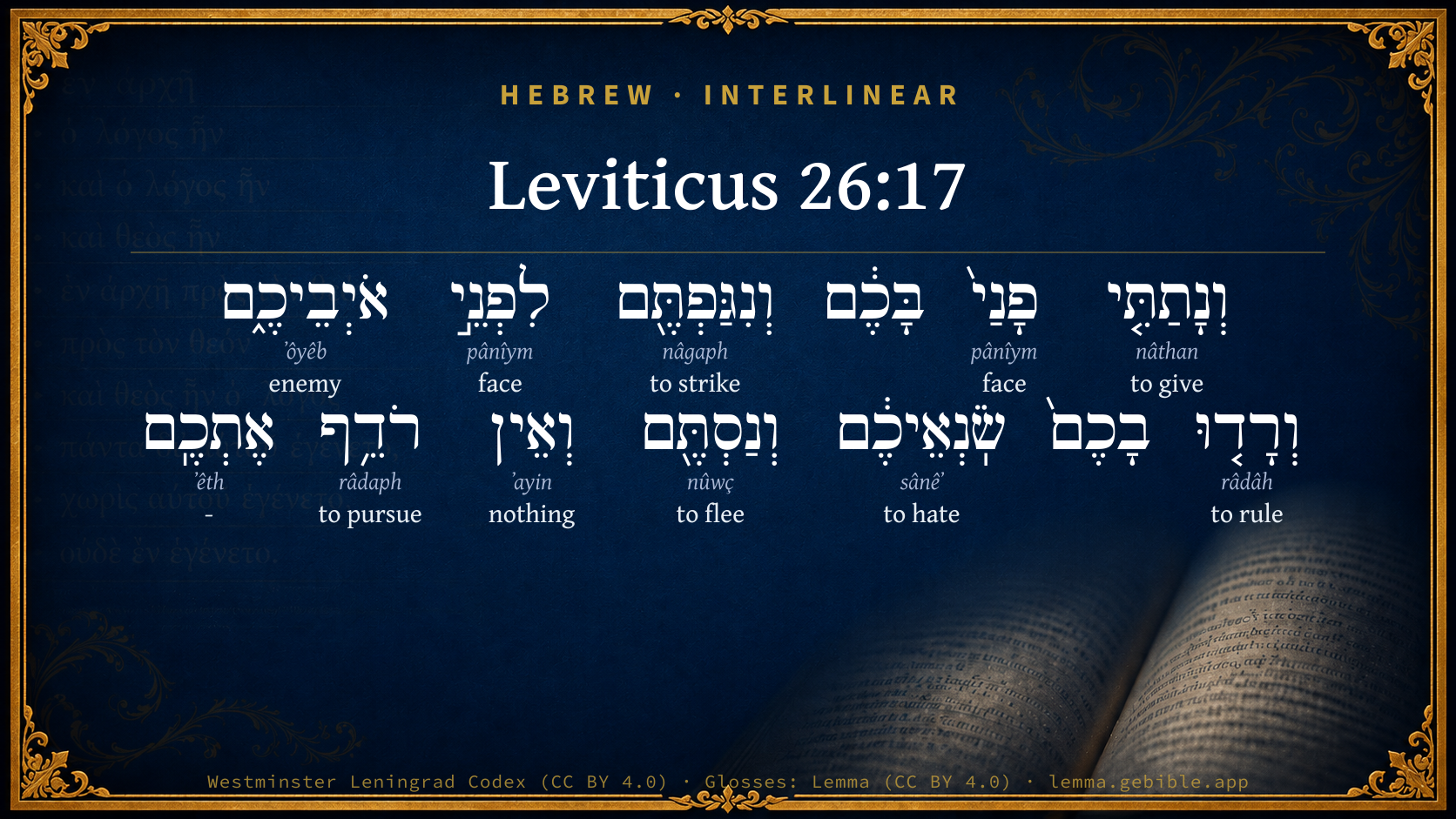
Hebrew (Westminster Leningrad Codex) Leviticus 26:17 appears in the Hebrew Old Testament. The text above is from the Westminster Leningrad Codex. Each word links to its Strong’s number, a concise gloss, and parsing drawn from the Open Scriptures Hebrew Bible morphology. Click any word for its full Brown-Driver-Briggs (BDB) entry.
Download image
Cite this verse

Leviticus 26:17 (World English Bible). Public Domain. Lemma interlinear Bible study tool, https://lemma.gebible.app/v/leviticus/26/17.

Show BibTeX & RIS
BibTeX
RIS
English Translation
I will set my face against you, and you will be struck before your enemies. Those who hate you will rule over you; and you will flee when no one pursues you.
World English Bible · Public Domain
Download a study sheet

One document with this verse’s original text, its word-by-word gloss line, the meaning frame, cross-references with their text, attributed commentary, and full source and license credits — printable, and it pastes into notes with its structure intact.

This verse Autodidact and up

Study sheet (.html) Plain text (.txt)

A passage Seminary Student

Up to 50 verses in one chapter. A passage sheet keeps up to 6 commentary sources and 12 cross-references per verse, in the order this page ranks them, and says so on the sheet whenever that leaves anything out. Ask for a single verse and you get the Autodidact verse sheet above.

Everything on this page stays free to read, with no account — the sheet is a download of what is already on screen, not access to it.

Want to remove ads? Support Godless Engineer
Compare translations 3

The same verse in 3 English versions, stacked beneath the original-language interlinear above. Click any original word for its lexicon entry.

Each is an independent rendering of the whole verse — the interlinear is not word-aligned to these translations.

Highlighted words mark where these versions differ — a whole-verse word diff, not a word-by-word alignment.

  • World English Bible Public Domain
    I will set my face against you, and you will be struck before your enemies. Those who hate you will rule over you; and you will flee when no one pursues you.
  • King James Version Public Domain
    And I will set my face against you, and ye shall be slain before your enemies: they that hate you shall reign over you; and ye shall flee when none pursueth you.
  • unfoldingWord Literal Text CC BY-SA 4.0
    And I will set my face against you, and you shall be struck down to the face of your enemies. And those who hate you shall rule over you, and you shall flee when no one pursues you.

unfoldingWord Literal Text — © unfoldingWord, licensed CC BY-SA 4.0. Word-aligned USFM3 via Door43 (git.door43.org/unfoldingWord/en_ult).

Versions to compare (up to 4)

3 of 4 selected

Show all 18 translations

Every available English version of this verse, each an independent rendering of the whole verse.

  • World English Bible Public Domain
    I will set my face against you, and you will be struck before your enemies. Those who hate you will rule over you; and you will flee when no one pursues you.
  • Berean Standard Bible Public Domain
    And I will set My face against you, so that you will be defeated by your enemies. Those who hate you will rule over you, and you will flee when no one pursues you.
  • Majority Standard Bible Public Domain
    And I will set My face against you, so that you will be defeated by your enemies. Those who hate you will rule over you, and you will flee when no one pursues you.
  • King James Version Public Domain
    And I will set my face against you, and ye shall be slain before your enemies: they that hate you shall reign over you; and ye shall flee when none pursueth you.
  • American Standard Version (1901) Public Domain
    And I will set my face against you, and ye shall be smitten before your enemies: they that hate you shall rule over you; and ye shall flee when none pursueth you.
  • Revised Version (1885) Public Domain
    And I will set my face against you, and ye shall be smitten before your enemies: they that hate you shall rule over you; and ye shall flee when none pursueth you.
  • Geneva Bible (1599) Public Domain
    And I will set my face against you, and ye shall fal before your enemies, and they that hate you, shall raigne ouer you, and yee shall flee when none pursueth you.
  • Douay-Rheims (1899) Public Domain
    I will set my face against you, and you shall fall down before your enemies, and shall be made subject to them that hate you, you shall flee when no man pursueth you.
  • Young's Literal Translation Public Domain
    and I have set My face against you, and ye have been smitten before your enemies; and those hating you have ruled over you, and ye have fled, and there is none pursuing you.
  • Literal Standard Version CC BY-SA 4.0
    and I have set My face against you, and you have been struck before your enemies; and those hating you have ruled over you, and you have fled when there is none pursuing you.
  • Unlocked Literal Bible CC BY-SA 4.0
    I will set my face against you, and you will be overpowered by your enemies. Men who hate you will rule over you, and you will run away, even when no one is chasing you.
  • unfoldingWord Literal Text CC BY-SA 4.0
    And I will set my face against you, and you shall be struck down to the face of your enemies. And those who hate you shall rule over you, and you shall flee when no one pursues you.
  • Darby Bible Public Domain
    And I will set my face against you, that ye may be routed before your enemies; they that hate you shall have dominion over you; and ye shall flee when none pursueth you.
  • World Messianic Bible Public Domain
    I will set my face against you, and you will be struck before your enemies. Those who hate you will rule over you; and you will flee when no one pursues you.
  • Webster's Bible Public Domain
    And I will set my face against you, and ye shall be slain before your enemies: they that hate you shall reign over you, and ye shall flee when none pursueth you.
  • Free Bible Version CC BY-SA 4.0
    I will turn against you, and you'll be defeated by your enemies. People who hate you will rule over you, and you'll run away even when there's no one chasing you!
  • Bible in Basic English Public Domain
    And my face will be turned from you, and you will be broken before those who are against you, and your haters will become your rulers, and you will go in flight when no man comes after you.
  • JPS Tanakh (1917) Public Domain
    And I will set My face against you, and ye shall be smitten before your enemies; they that hate you shall rule over you; and ye shall flee when none pursueth you.

Literal Standard Version (2020), Covenant Press — licensed CC BY-SA 4.0. Text via the HelloAO Bible API (eBible.org). Unlocked Literal Bible (unfoldingWord) — licensed CC BY-SA 4.0. Text via the HelloAO Bible API (eBible.org). unfoldingWord Literal Text — © unfoldingWord, licensed CC BY-SA 4.0. Word-aligned USFM3 via Door43 (git.door43.org/unfoldingWord/en_ult). Free Bible Version, Dr. Jonathan Gallagher — licensed CC BY-SA 4.0. Text via the HelloAO Bible API (eBible.org).

Word by word

More ways to search: Search by grammar → Find every occurrence → Compare this word →

Practice this passage: Drill this verse → Learn its vocabulary →

וְרָד֤וּ
râdâh
H7287
“and · to rule”
Conjunction + Verb, Qal, Sequential Perfect, 3rd Person, Common, Plural
Part of Speech
Conjunction + Verb
Stem
Qal
Form
Sequential Perfect
Person
3rd Person
Gender
Common
Number
Plural
Full BDB Definition

Origin: a primitive root

TWOT: 2121 , 2122

to rule, have dominion, dominate, tread down - (Qal) to have dominion, rule, subjugate - (Hiphil) to cause to dominate - to scrape out - (Qal) to scrape, scrape out
  1. וְנָתַתִּ֤י nâthan H5414 “and · to give” Conjunction + Verb, Qal, Sequential Perfect, 1st Person, Common, Singular
  2. פָנַי֙ pânîym H6440 “face(s) · my” Noun, Common, Both, Plural, Construct + Suffix, Personal, 1st Person, Common, Singular
  3. וְנִגַּפְתֶּ֖ם nâgaph H5062 “and · to strike” Conjunction + Verb, Niphal, Sequential Perfect, 2nd Person, Masculine, Plural
  4. לִפְנֵ֣י pânîym H6440 “to/for · face(s) of” Preposition + Noun, Common, Both, Plural, Construct
  5. אֹיְבֵיכֶ֑ם ʼôyêb H341 “enemy · you” Verb, Qal, Participle Active, Masculine, Plural, Construct + Suffix, Personal, 2nd Person, Masculine, Plural
  6. שֹֽׂנְאֵיכֶ֔ם sânêʼ H8130 “hating · you” Verb, Qal, Participle Active, Masculine, Plural, Construct + Suffix, Personal, 2nd Person, Masculine, Plural
  7. וְנַסְתֶּ֖ם nûwç H5127 “and · to flee” Conjunction + Verb, Qal, Sequential Perfect, 2nd Person, Masculine, Plural
  8. וְאֵין ʼayin H369 “and · nothing” Conjunction + Particle, Negative
  9. רֹדֵ֥ף râdaph H7291 “pursuing” Verb, Qal, Participle Active, Masculine, Singular, Absolute
  10. אֶתְכֶֽם ʼêth H853 “- · you” Particle, Direct Object + Suffix, Personal, 2nd Person, Masculine, Plural

About this verse

These counts appear in no published source. They are computed here, from the morphology-tagged text and Lemma’s own curated glosses. What Lemma adds →

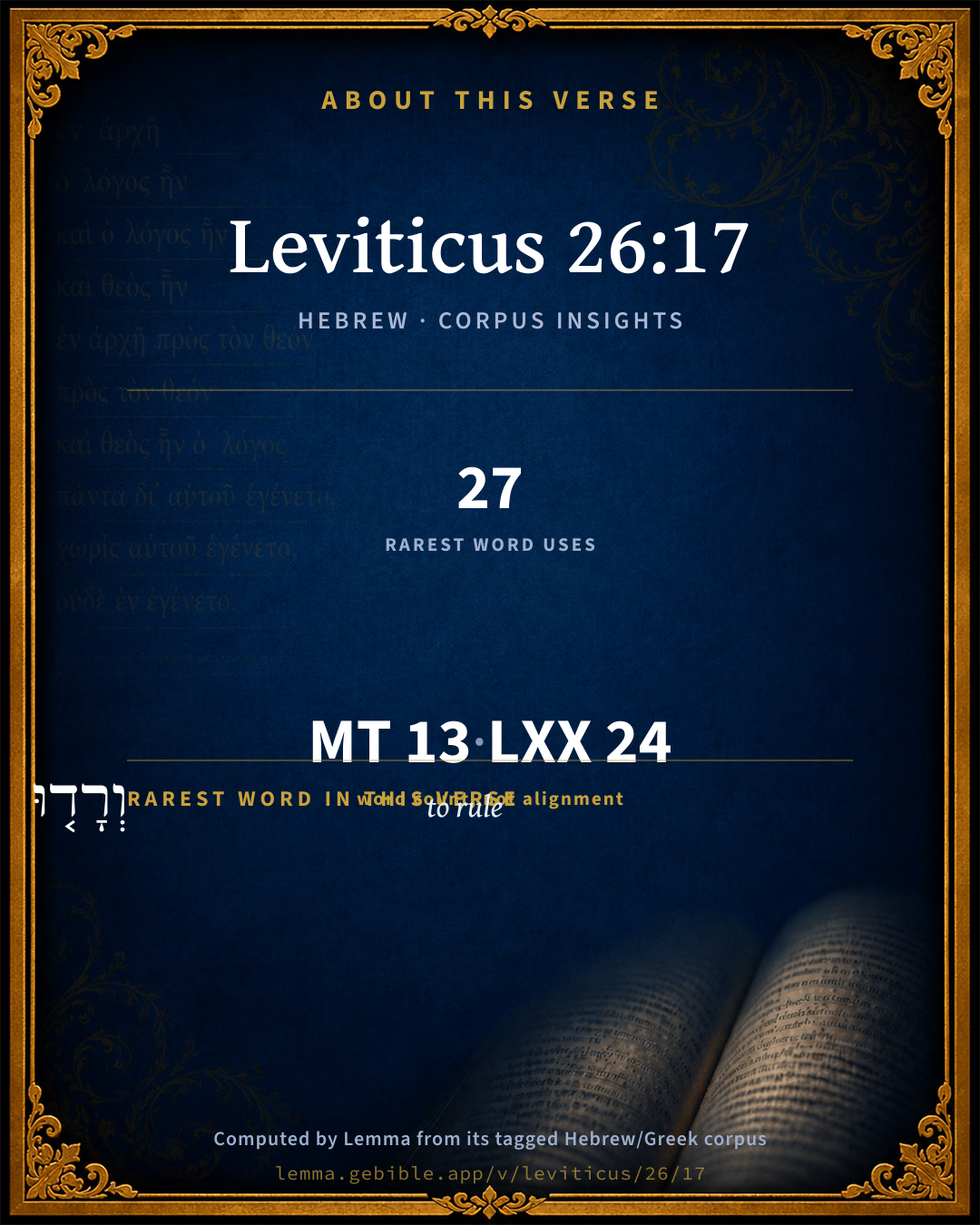
13
words
10
distinct lemmas
Pentateuch
section

Shared distinctive vocabulary

וְרָד֤וּ to rule H7287 occurs in 25 verses of the Hebrew Bible. Also found in:

Grammatical profile

  • 7 verbs
  • 2 nouns
  • 2 prepositions
  • 2 particles

Verb forms

  • וְנָתַתִּ֤י Qal · Sequential Perfect
  • וְנִגַּפְתֶּ֖ם Niphal · Sequential Perfect
  • אֹיְבֵיכֶ֑ם Qal · Participle Active
  • וְרָד֤וּ Qal · Sequential Perfect
  • שֹֽׂנְאֵיכֶ֔ם Qal · Participle Active
  • וְנַסְתֶּ֖ם Qal · Sequential Perfect
  • רֹדֵ֥ף Qal · Participle Active

Repetition

A word recurs within this verse — often emphatic in Hebrew:

  • פָנַי֙ face H6440 ×2

Hebrew & Septuagint length

In English translation the verse runs 32 words from the Hebrew and 31 from the Septuagint (LXX English) — closely comparable.

A rough comparison of the two English renderings, which tokenize alike — not a word-level alignment.

Word counts can differ between the Hebrew and the Greek without any difference in meaning — e.g. the Hebrew direct-object marker אֵת has no separate Greek word, and Greek often adds the article ὁ.

In the original languages it is 13 Hebrew tokens and 24 Greek tokens — but the two are counted differently (Hebrew bundles its prefixes and suffixes into one token; the Greek is in lemma form), so that isn’t a like-for-like length.

Cross-references

14

Topical passages linked to Leviticus 26:17 in the Treasury of Scripture Knowledge — connected by theme and wording, ordered by reader-vote popularity; previews shown in the World English Bible.

  • Leviticus 17:10 "'Any man of the house of Israel, or of the strangers who live as foreigners among them, who eats any kind of blood, I will set my face against that soul who eats blood, and will cut him off from among his people.
  • Proverbs 28:1 The wicked flee when no one pursues; But the righteous are as bold as a lion.
  • Leviticus 26:36–37 "'As for those of you who are left, I will send a faintness into their hearts in the lands of their enemies: and the sound of a driven leaf will put them to flight; and they shall flee, as one flees from the sword; and they will fall when no one pursues.
  • Deuteronomy 28:25 Yahweh will cause you to be struck before your enemies; you shall go out one way against them, and shall flee seven ways before them: and you shall be tossed back and forth among all the kingdoms of the earth.
  • Psalms 53:5 There they were in great fear, where no fear was, For God has scattered the bones of him who encamps against you. You have put them to shame, Because God has rejected them.
  • Judges 2:14 The anger of Yahweh was kindled against Israel, and he delivered them into the hands of spoilers who despoiled them; and he sold them into the hands of their enemies round about, so that they could not any longer stand before their enemies.
  • 1 Samuel 31:1 Now the Philistines fought against Israel: and the men of Israel fled from before the Philistines, and fell down slain on Mount Gilboa.
  • Psalms 106:41–42 He gave them into the hand of the nations. Those who hated them ruled over them.
  • Jeremiah 19:7 I will make void the counsel of Judah and Jerusalem in this place; and I will cause them to fall by the sword before their enemies, and by the hand of those who seek their life: and their dead bodies will I give to be food for the birds of the sky, and for the animals of the earth.
  • Leviticus 20:5–6 then I will set my face against that man, and against his family, and will cut him off, and all who play the prostitute after him, to play the prostitute with Molech, from among their people.
  • 1 Samuel 4:10 The Philistines fought, and Israel was struck, and they fled every man to his tent: and there was a very great slaughter; for there fell of Israel thirty thousand footmen.
  • Nehemiah 9:27–30 Therefore you delivered them into the hand of their adversaries, who distressed them: and in the time of their trouble, when they cried to you, you heard from heaven; and according to your manifold mercies you gave them saviors who saved them out of the hand of their adversaries.
  • Psalms 68:1–2 Let God arise! Let his enemies be scattered! Let them who hate him also flee before him.
  • Lamentations 1:5 Her adversaries are become the head, her enemies prosper; For Yahweh has afflicted her for the multitude of her transgressions: Her young children are gone into captivity before the adversary.

Cross-references courtesy of OpenBible.info (CC BY 4.0).

Hebrew and Greek witnesses Masoretic Hebrew ↔ Greek Septuagint

The same verse in the two great witnesses to the Old Testament, shown verse-for-verse.

These are two independent witnesses, not word-aligned to each other, and the Septuagint is shown in lemma (dictionary) form.

Hebrew Leviticus 26:17 Masoretic · Westminster Leningrad Codex

וְנָתַתִּ֤י פָנַי֙ בָּכֶ֔ם וְנִגַּפְתֶּ֖ם לִפְנֵ֣י אֹיְבֵיכֶ֑ם וְרָד֤וּ בָכֶם֙ שֹֽׂנְאֵיכֶ֔ם וְנַסְתֶּ֖ם וְאֵין רֹדֵ֥ף אֶתְכֶֽם

I will set my face against you, and you will be struck before your enemies. Those who hate you will rule over you; and you will flee when no one pursues you.

World English Bible · Public Domain

Greek LXX Leviticus 26:17 Septuagint · lemma form

καί ἐπιἵστημι ὁ πρόσωπον ἐγώ ἐπί σύ καί πίπτω ἐναντίον ὁ ἐχθρός σύ καί διώκω σύ ὁ μισέω σύ καί φεύγω οὐδείς διώκω σύ

And I will set my face against you, and you⌃ shall fall before your enemies, and they that hate you shall pursue you; and you⌃ shall flee, no one pursuing you.

LXX2012 (modern English Septuagint) · Public Domain

Hebrew: Westminster Leningrad Codex (CC BY 4.0). Greek: Septuagint (public domain); English from LXX2012 (modern English Septuagint) (Public Domain). How the Septuagint differs from the Hebrew →

Targum (Aramaic paraphrase)

2

The Targum is the ancient Jewish Aramaic paraphrase of the Hebrew Scriptures — an interpretive translation, not the Hebrew text itself. Onkelos (literal) and Pseudo-Jonathan (expansive) render the Torah, and Jonathan the Prophets. Coverage is partial: where no permissively-licensed English translation exists for a verse, only the Aramaic is shown. This is verse-level text, not a word-by-word alignment to the Hebrew.

  1. Targum Onkelos Torah (Genesis–Deuteronomy)
    וְאֶתֵּן רוּגְזִי בְּכוֹן וְתִתַּבְּרוּן קֳדָם בַּעֲלֵי דְבָבֵיכוֹן וְיִרְדוּן בְּכוֹן סַנְאֵכוֹן וְתֵעִירְקוּן וְלֵית דְרָדִיף יָתְכוֹן

    (no public-domain English translation for this verse)

    Targum Onkelos — Aramaic: “Onkelos Genesis” (public domain); “Onkelos Exodus” (public domain); “Onkelos Leviticus” (public domain); “Onkelos Numbers” (public domain); “Onkelos Deuteronomy” (public domain). English: “Sefaria Community Translation” (CC0 1.0 (public-domain dedication)); “J.W. Etheridge. The Targums of Onkelos and Jonathan Ben Uzziel on the Pentateuch. London: Longmans, Green, 1862” (public domain). Text via Sefaria.

  2. Targum Pseudo-Jonathan Torah (Genesis–Deuteronomy)
    וְאֶתֵּן פְּנִיוּתָא לְמֶעֱסוֹק בְּכוֹן וְתִיתְבְּרוּן קֳדָם בַּעֲלֵי דְבָבֵיכוֹן וְיִרְדוֹן בְּכוֹן סַנְאֵיכוֹן וּתְעַרְקוּן וְלֵית דְרָדִיף יַתְכוֹן

    And I will appoint a reverse to your affairs, and you shall be broken before your foes, and they who hate you shall rule over you; and you will flee when no one pursueth you.

    Targum Pseudo-Jonathan — Aramaic: “Targum Jonathan on Genesis” (public domain); “Targum Jonathan on Exodus” (public domain); “Targum Jonathan on Leviticus” (public domain); “Targum Jonathan on Numbers” (public domain); “Targum Jonathan on Deuteronomy” (public domain). English: “The Targum of Jonathan ben Uzziel, trans. J. W. Etheridge, London, 1862” (public domain). Text via Sefaria.

Commentary

Notes on Leviticus 26:17 from classic Christian and Jewish commentators (each source and its license shown beneath its notes). The classic Christian expositions comment on the surrounding passage and are grouped to its opening verse, so a note may address several verses; the Jewish commentaries on the Tanakh (Rashi and others) are per-verse, so they appear only where the commentator wrote on this verse.

Lemma curates 59 commentaries, every one of them public domain or Creative Commons licensed, each selected and text-cleaned for this edition rather than reprinted as found. About our sources →

Trapp's Complete Commentary

John Trapp

Lev 26:17 And I will set my face against you, and ye shall be slain before your enemies: they that hate you shall reign over you; and ye shall flee when none pursueth you.

Ver. 17. They that hate you.] A heavy curse to any people, to have mischievous, malicious princes set over them: odious to God, malignant to the people.

John Trapp, A Commentary or Exposition upon All the Books of the Old and New Testament (1647–1656) — public domain. Text from a community e-Sword module.

Geneva Bible (1599)

Geneva Bible translators

Read Lev. 17:10.

Geneva Bible (1599) marginal notes — public domain. Text via Bolls.life.

Ellicott's Commentary for English Readers

(17) And I will set my face against you.—That is, make them feel his anger. (See Note on Lev_17:10.)

Be slain before your enemies.—Better, be smitten before your enemies, as this phrase is rendered in the Authorised Version (Num_14:42; Deu_1:42; Deu_28:25).

Shall reign over you.—Better, shall rule over you, as the Authorised Version renders it in Isa_14:2; Eze_29:15; Eze_34:4, &c.

A Bible Commentary for English Readers, edited by Charles John Ellicott (1878–1897) — public domain. Text from a community e-Sword module.

The Cambridge Bible for Schools and Colleges

gen. ed. J. J. S. Perowne

17. ye shall flee when none pursueth you] Cp. Lev_26:36; Pro_28:1; also Psa_53:5.

The Cambridge Bible for Schools and Colleges (gen. ed. J. J. S. Perowne; Cambridge University Press, 1878–1918) — public domain. Text from a community e-Sword module.

John Gill's Exposition

And if ye will not for all this hearken unto me,.... If such corrections by diseases of body, and by giving them up into the hands of their enemies, should be ineffectual to reform them, and bring them to obedience to the statutes and commandments of God, but should continue in their disobedience to him, and rebellion against him:

then I will punish you seven times more for your sins; that is, abundantly more, with sorer punishments, and these more frequently repeated.

John Gill's Exposition of the Whole Bible (1746–1763) — public domain (CC PDM 1.0). Text via the HelloAO Bible API.

Whedon's Commentary on the Bible

Daniel D. Whedon

17. I will set my face — By direct interposition, in addition to those ministers of his wrath, will Jehovah vindicate his broken covenant and punish his refractory people.

Ye shall flee — So great is the contrast in war between those obedient to God and the disobedient, that instead of one chasing a thousand, a thousand godless Hebrews shall flee when not even one enemy pursues.

Daniel D. Whedon (gen. ed.), Commentary on the Old and New Testaments (1874–1909) — public domain. Text from a community e-Sword module.

Keil & Delitzsch

C. F. Keil & F. Delitzsch

Yea, the Lord would turn His face against them, so that they would be beaten by their enemies, and be so thoroughly humbled in consequence, that they would flee when no man pursued (cf. Lev 26:36).

But if these punishments did not answer their purpose, and bring Israel back to fidelity to its God, the Lord would punish the disobedient nation still more severely, and chasten the rebellious for their sin, not simply only, but sevenfold. This He would do, so long as Israel persevered in obstinate resistance, and to this end He would multiply His judgments by degrees. This graduated advance of the judgments of God is so depicted in the following passage, that four times in succession new and multiplied punishments are announced: (1) utter barrenness in their land, - that is to say, one heavier punishment (Lev 26:18-20); (2) the extermination of their cattle by beasts of prey, and childlessness, - two punishments (Lev 26:21, Lev 26:22); (3) war, plague, and famine, - three punishments (Lev 26:23-26); (4) the destruction of all idolatrous abominations, the overthrow of their towns and holy places, the devastation of the land, and the dispersion of the people among the heathen-four punishments which would bring the Israelites to the verge of destruction (Lev 26:27-33). In this way would the Lord punish the stiffneckedness of His people. - These divine threats embrace the whole of Israel's future. But the series of judgments mentioned is not to be understood historically, as a prediction of the temporal succession of the different punishments, but as an ideal account of the judgments of God, unfolding themselves with inward necessity in a manner answering to the progressive development of the sin. As the nation would not resist the Lord continually, but times of disobedience and apostasy would alternate with times of obedience and faithfulness, so the judgments of God would alternate with His blessings; and as the opposition would not increase in uniform progress, sometimes becoming weaker and then at other times gaining greater force again, so the punishments would not multiply continuously, but correspond in every case to the amount of the sin, and only burst in upon the incorrigible race in all the intensity foretold, when ungodliness gained the upper hand.

Keil & Delitzsch — Biblical Commentary on the Old Testament (1861–1891) — public domain (CC PDM 1.0). Text via the HelloAO Bible API. (Old Testament only.)

Rashi

Rabbi Shlomo Yitzchaki (Rashi)

ונתתי פני AND I WILL SET פני [AGAINST YOU] — i. e. פנאי שלי, My leisure, — I will turn away from all My other affairs in order to do you evil (cf. Rashi on Leviticus 17:20).

ורדו בכם שנאיכם — These words mean exactly what they imply: THEY THAT HATE YOU SHALL RULE OVER YOU. — The Agadic explanation of the Torat Cohanim (Sifra, Bechukotai, Chapter 4 1-5) on this section is as follows:

אף אני אעשה זאת — I speak to you only with the expression אף. Similarly it states, (v. 41) “So, too, (אף) I will walk contrary unto them”.

והפקדתי עליכם I WILL ORDER UPON YOU denotes that the calamities will come upon you from one to another — while the first will still be on visit to you (will afflict you) I will bring another and add it to that.

בהלה is a plague that causes terror upon people. And what is that? It is an epidemic plague of pestilence.

את השחפת THE CONSUMPTION — You may have a person that is sick and even confined to his bed, but his flesh is in a well-preserved state; therefore Scripture states, “I will visit you with שחפת” — that he will waste away. Or there are times that he may be wasting away but is calm and without fever, Scripture therefore states, “I will visit you with… קדחת” — that he will be in a fever. Or there are times that he may be in a fever but still cherishes the belief that he will recover (and therefore is easy in mind), Scripture therefore states, “I will visit you… with fever that shall make the eyes pine”. Or there may be the last stage when he cherishes no belief that he will recover, but others (his relatives) cherish the belief that he will recover, Scripture therefore states, “I will visit you with… fever… that shall cause sorrow of soul (utter despair).

וזרעתם לריק זרעכם — One shall sow it (the soil) but it shall not grow grain. Well, then, what does it mean when it states that your enemies will come and eat?. How is this possible? But the explanation is: One shall sow it (the soil) the first year and it will not yield; the next year, however, it will yield, and then the enemies will come and will find grain for the time of siege, whilst those within the beleaguered city will die of famine because they will have gathered no grain the year before. Another explanation of וזרעתם לריק זרעכם is: Scripture is speaking in reference to your sons and daughters — you will rear them only after much toil but sin, the enemy, will come and destroy them, as it is said, (i. e. a similar thought is expressed in the text) (Lamentations 2:22) “those that I have swaddled and brought up mine enemy hath consumed”.

ונתתי פני בכם — Even as it is stated in the case of the promise of good (v. 9), “I will turn (ופניתי) unto you” so is it stated also with regard to the threat of evil “I will set My face (פני) against you”. They (the Sages) illustrated this by a parable: it may be compared to the case of a king who said to his subjects, “I will turn away from all My other affairs and will devote myself to you alone — for evil”.

ונגפתם לפני איביכם — (This may signify: and ye shall be plagued in the presence of your enemies) — it means that death (pestilence — נגף) will kill you within the city whilst your enemies are besieging you outside (cf. the first Agadic comment on ‎וזרעתם לריק ).

‎ ורדו בכם שנאיכם — ‎(בכם is taken to signify: those who are amongst you) — this means that I will raise up haters of you only out of your own people and in your own midst. Internal enemies (שונאים) are a greater curse than external enemies (אויבים) for when the nations of the world rise against Israel they seek only what lies in the open, as it is said, (Judges 6:3, 4) “And so it was, when Israel had sown, that the Midianites came up, and the Amalekites, and the children of the east,… and they encamped against them, and destroyed the increase of the land”; but when I raise up against you those of your own people and in your own midst they search also after your hidden treasures. And thus it states, (Micah 3:1—3) “[Hear, O heads of Jacob, and ye princes of the house of Israel…] who also eat the flesh of my people and flay their skin from off them etc.”

ונסתם AND YE SHALL RUN AWAY — from sheer panic,

ואין רדף אתכם WHEN NONE PURSUETH YOU, since there is no strength in them to do so.

Rashi on the Tanakh — English translations: “The Judaica Press complete Tanach with Rashi, translated by A. J. Rosenberg” (CC BY 4.0); “Pentateuch with Rashi's commentary by M. Rosenbaum and A.M. Silbermann, 1929-1934” (public domain); “The Metsudah Tanach series, Lakewood, N.J” (CC BY 4.0); and “The Book of Joshua, Metsudah Publications, 1997” (CC BY 4.0). Text via Sefaria.

Lesson kit

Teaching starters — assembled from the data on this page, not authored interpretation. Every prompt links to the verse data it draws on. Edit before teaching.

Leviticus, in the Pentateuch, opens this verse with 13 words (10 distinct Hebrew lemmas). Its most distinctive word is râdâh (“to rule”). A historical commentator’s framing appears above. Read the whole chapter for the surrounding context.

Discussion questions

  1. How does “to rule” (râdâh) shape what this verse is saying?
  2. Genesis 1:26 shares the word «to rule» with this verse. How do the two illuminate each other?
  3. “face” occurs 2× in this one verse. What is the effect of the repetition?
  4. These translations render this verse differently; the difference is in the English rendering, not the original. What questions does that raise?
  5. The verb «וְנָתַתִּ֤י» is Qal Sequential Perfect. How does its form color the action?
  6. Reading how Trapp's Complete Commentary and Geneva Bible (1599) read this verse, where do the two commentators agree and where do they part?

Things to notice

Reading settings

Reading text

Shown beneath each verse's original-language words.

Old Testament
Old Testament edition

Read the OT as the Masoretic Hebrew (MT) or the Greek Septuagint (LXX).

English shown for the Greek Septuagint (in the Hebrew ↔ Greek comparison).

Comparing translations? Open the Compare panel on any verse page to stack up to four side by side.