Amos 3:4

Hebrew (Westminster Leningrad Codex) Amos 3:4 appears in the Hebrew Old Testament. The text above is from the Westminster Leningrad Codex. Each word links to its Strong’s number, a concise gloss, and parsing drawn from the Open Scriptures Hebrew Bible morphology. Click any word for its full Brown-Driver-Briggs (BDB) entry.
Download image
Cite this verse

Amos 3:4 (World English Bible). Public Domain. Lemma interlinear Bible study tool, https://lemma.gebible.app/v/amos/3/4.

Show BibTeX & RIS
BibTeX
RIS
English Translation
Will a lion roar in the thicket, When he has no prey? Does a young lion cry out of his den, If he has caught nothing?
World English Bible · Public Domain
Download a study sheet

One document with this verse’s original text, its word-by-word gloss line, the meaning frame, cross-references with their text, attributed commentary, and full source and license credits — printable, and it pastes into notes with its structure intact.

This verse Autodidact and up

Study sheet (.html) Plain text (.txt)

A passage Seminary Student

Up to 50 verses in one chapter. A passage sheet keeps up to 6 commentary sources and 12 cross-references per verse, in the order this page ranks them, and says so on the sheet whenever that leaves anything out. Ask for a single verse and you get the Autodidact verse sheet above.

Everything on this page stays free to read, with no account — the sheet is a download of what is already on screen, not access to it.

Want to remove ads? Support Godless Engineer
Compare translations 3

The same verse in 3 English versions, stacked beneath the original-language interlinear above. Click any original word for its lexicon entry.

Each is an independent rendering of the whole verse — the interlinear is not word-aligned to these translations.

Highlighted words mark where these versions differ — a whole-verse word diff, not a word-by-word alignment.

  • World English Bible Public Domain
    Will a lion roar in the thicket, When he has no prey? Does a young lion cry out of his den, If he has caught nothing?
  • King James Version Public Domain
    Will a lion roar in the forest, when he hath no prey? will a young lion cry out of his den, if he have taken nothing?
  • unfoldingWord Literal Text CC BY-SA 4.0
    Will a lion roar in the forest when he has no victim? Will a young lion growl from his den if he has caught nothing?

unfoldingWord Literal Text — © unfoldingWord, licensed CC BY-SA 4.0. Word-aligned USFM3 via Door43 (git.door43.org/unfoldingWord/en_ult).

Versions to compare (up to 4)

3 of 4 selected

Show all 18 translations

Every available English version of this verse, each an independent rendering of the whole verse.

  • World English Bible Public Domain
    Will a lion roar in the thicket, When he has no prey? Does a young lion cry out of his den, If he has caught nothing?
  • Berean Standard Bible Public Domain
    Does a lion roar in the forest when he has no prey? Does a young lion growl in his den if he has caught nothing?
  • Majority Standard Bible Public Domain
    Does a lion roar in the forest when he has no prey? Does a young lion growl in his den if he has caught nothing?
  • King James Version Public Domain
    Will a lion roar in the forest, when he hath no prey? will a young lion cry out of his den, if he have taken nothing?
  • American Standard Version (1901) Public Domain
    Will a lion roar in the forest, when he hath no prey? will a young lion cry out of his den, if he have taken nothing?
  • Revised Version (1885) Public Domain
    Will a lion roar in the forest, when he hath no prey? will a young lion cry out of his den, if he have taken nothing?
  • Geneva Bible (1599) Public Domain
    Will a lion roare in ye forest, when he hath no pray? or wil a lions whelpe cry out of his den, if he haue taken nothing?
  • Douay-Rheims (1899) Public Domain
    Will a lion roar in the forest, if he have no prey? will the lion's whelp cry out of his den, if he have taken nothing?
  • Young's Literal Translation Public Domain
    Roar doth a lion in a forest and prey he hath none? Give out doth a young lion his voice from his habitation, If he hath not caught?
  • Literal Standard Version CC BY-SA 4.0
    Does a lion roar in a forest and he has no prey? Does a young lion give out his voice from his habitation, || If he has not caught?
  • Unlocked Literal Bible CC BY-SA 4.0
    Will a lion roar in the forest when he has no victim? Will a young lion growl from his den if he has caught nothing?
  • unfoldingWord Literal Text CC BY-SA 4.0
    Will a lion roar in the forest when he has no victim? Will a young lion growl from his den if he has caught nothing?
  • Darby Bible Public Domain
    Will a lion roar in the forest when he hath no prey? Will a young lion cry out of his den if he have taken nothing?
  • World Messianic Bible Public Domain
    Will a lion roar in the thicket, when he has no prey? Does a young lion cry out of his den, if he has caught nothing?
  • Webster's Bible Public Domain
    Will a lion roar in the forest, when he hath no prey? will a young lion cry out of his den, if he hath taken nothing?
  • Free Bible Version CC BY-SA 4.0
    Does a lion roar in the forest before finding its prey? Does a young lion growl from its den if it has caught nothing?
  • Bible in Basic English Public Domain
    Will a lion give his loud cry in the woodland when no food is there? will the voice of the young lion be sounding from his hole if he has taken nothing?
  • JPS Tanakh (1917) Public Domain
    Will a lion roar in the forest, when he hath no prey? Will a young lion give forth his voice out of his den, if he have taken nothing?

Literal Standard Version (2020), Covenant Press — licensed CC BY-SA 4.0. Text via the HelloAO Bible API (eBible.org). Unlocked Literal Bible (unfoldingWord) — licensed CC BY-SA 4.0. Text via the HelloAO Bible API (eBible.org). unfoldingWord Literal Text — © unfoldingWord, licensed CC BY-SA 4.0. Word-aligned USFM3 via Door43 (git.door43.org/unfoldingWord/en_ult). Free Bible Version, Dr. Jonathan Gallagher — licensed CC BY-SA 4.0. Text via the HelloAO Bible API (eBible.org).

Word by word

More ways to search: Search by grammar → Find every occurrence → Compare this word →

Practice this passage: Drill this verse → Learn its vocabulary →

מִמְּעֹ֣נָת֔וֹ
mᵉʻôwnâh
H4585
“from · dwelling · his”
Preposition + Noun, Common, Both, Singular, Construct + Suffix, Personal, 3rd Person, Masculine, Singular
Part of Speech
Preposition + Noun
Type
Common
Gender
Both
Number
Singular
State
Construct
Full BDB Definition

Origin: from H4583

TWOT: 1581b

dwelling, habitation, refuge - den, lair (of animals) - dwelling-place (of God) (figuratively)
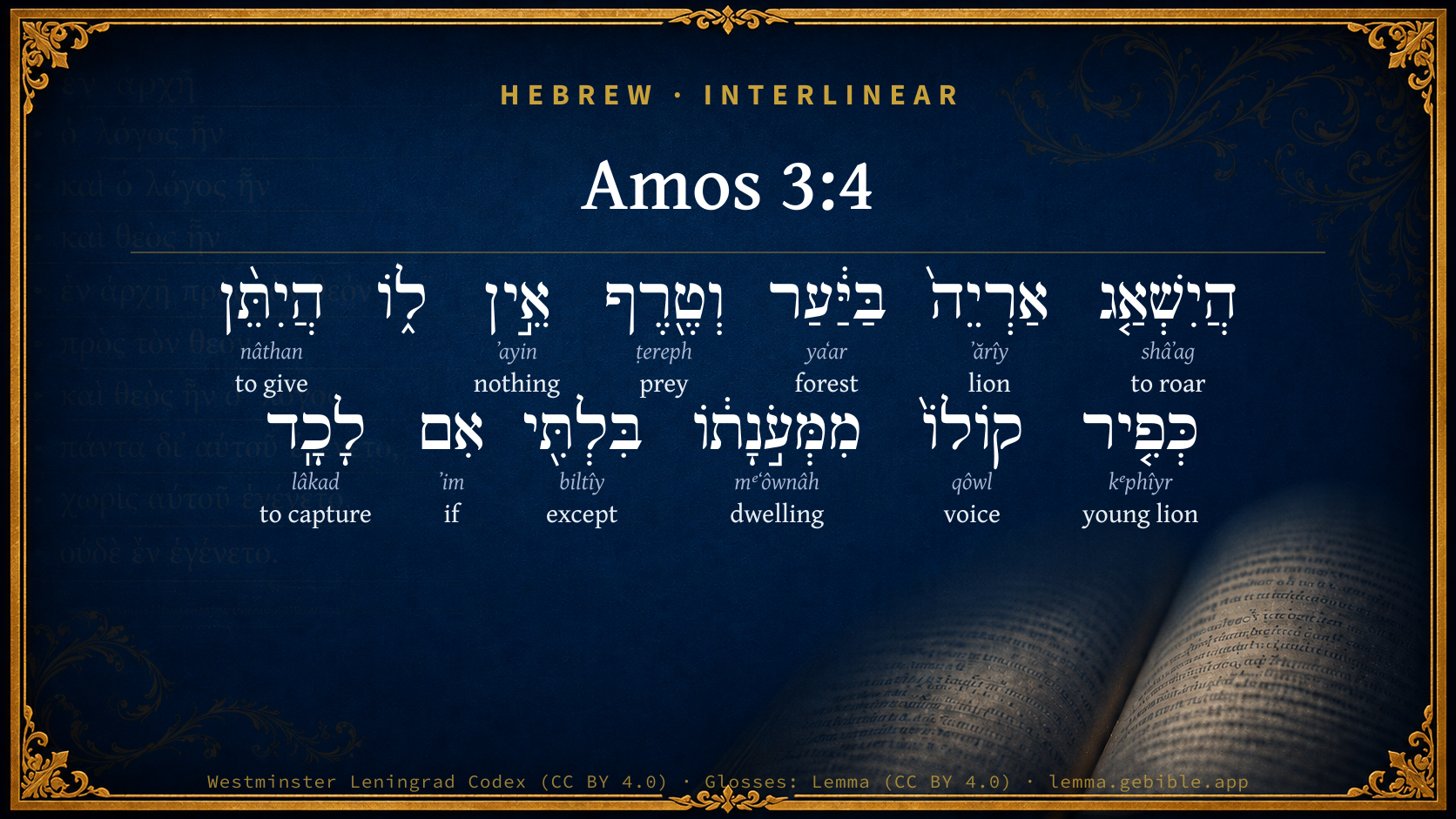
  1. הֲיִשְׁאַ֤ג shâʼag H7580 “to roar” Particle, Interrogative + Verb, Qal, Imperfect, 3rd Person, Masculine, Singular
  2. אַרְיֵה֙ ʼărîy H738 “lion” Noun, Common, Masculine, Singular, Absolute
  3. בַּיַּ֔עַר yaʻar H3293 “in/at the · forest” Preposition, Determined + Noun, Common, Masculine, Singular, Absolute
  4. וְטֶ֖רֶף ṭereph H2964 “and · prey” Conjunction + Noun, Common, Masculine, Singular, Absolute
  5. אֵ֣ין ʼayin H369 “nothing” Particle, Negative
  6. הֲיִתֵּ֨ן nâthan H5414 “to give” Particle, Interrogative + Verb, Qal, Imperfect, 3rd Person, Masculine, Singular
  7. כְּפִ֤יר kᵉphîyr H3715 “young lion” Noun, Common, Masculine, Singular, Absolute
  8. קוֹלוֹ֙ qôwl H6963 “voice · his” Noun, Common, Masculine, Singular, Construct + Suffix, Personal, 3rd Person, Masculine, Singular
  9. בִּלְתִּ֖י biltîy H1115 “except” Conjunction
  10. אִם ʼim H518 “if” Conjunction
  11. לָכָֽד lâkad H3920 “to capture” Verb, Qal, Perfect, 3rd Person, Masculine, Singular

About this verse

These counts appear in no published source. They are computed here, from the morphology-tagged text and Lemma’s own curated glosses. What Lemma adds →

13
words
12
distinct lemmas
Prophets
section

Notable vocabulary

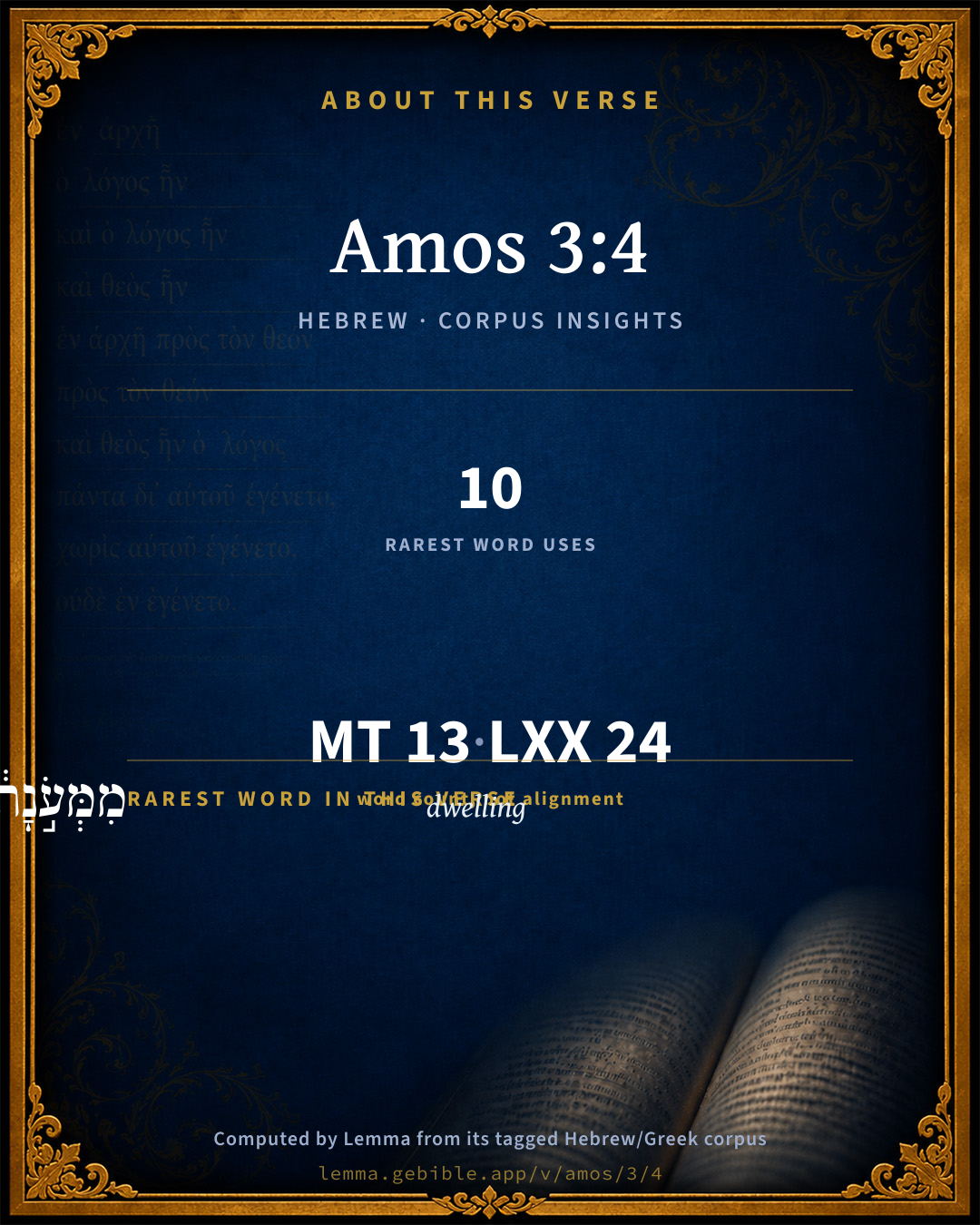
The rarest word here is מִמְּעֹ֣נָת֔וֹ dwelling H4585 — appearing just 10 times in the whole Hebrew Bible.

Shared distinctive vocabulary

מִמְּעֹ֣נָת֔וֹ dwelling H4585 occurs in 10 verses of the Hebrew Bible. Also found in:

Grammatical profile

  • 3 verbs
  • 6 nouns
  • 1 preposition
  • 2 conjunctions
  • 1 particle

Verb forms

  • הֲיִשְׁאַ֤ג Qal · Imperfect
  • הֲיִתֵּ֨ן Qal · Imperfect
  • לָכָֽד Qal · Perfect

Hebrew & Septuagint length

In English translation the verse runs 26 words from the Hebrew and 31 from the Septuagint (LXX English) — closely comparable.

A rough comparison of the two English renderings, which tokenize alike — not a word-level alignment.

Word counts can differ between the Hebrew and the Greek without any difference in meaning — e.g. the Hebrew direct-object marker אֵת has no separate Greek word, and Greek often adds the article ὁ.

In the original languages it is 13 Hebrew tokens and 24 Greek tokens — but the two are counted differently (Hebrew bundles its prefixes and suffixes into one token; the Greek is in lemma form), so that isn’t a like-for-like length.

Cross-references

5

Topical passages linked to Amos 3:4 in the Treasury of Scripture Knowledge — connected by theme and wording, ordered by reader-vote popularity; previews shown in the World English Bible.

  • Hosea 11:10 They will walk after Yahweh, Who will roar like a lion; For he will roar, and the children will come trembling from the west.
  • Psalms 104:21 The young lions roar after their prey, And seek their food from God.
  • Amos 1:2 He said: "Yahweh will roar from Zion, And utter his voice from Jerusalem; And the pastures of the shepherds will mourn, And the top of Carmel will wither."
  • Hosea 5:14 For I will be to Ephraim like a lion, And like a young lion to the house of Judah. I myself will tear in pieces and go away. I will carry off, and there will be no one to deliver.
  • Amos 3:8 The lion has roared. Who will not fear? The Lord Yahweh has spoken. Who can but prophesy?

Cross-references courtesy of OpenBible.info (CC BY 4.0).

Hebrew and Greek witnesses Masoretic Hebrew ↔ Greek Septuagint

The same verse in the two great witnesses to the Old Testament, shown verse-for-verse.

These are two independent witnesses, not word-aligned to each other, and the Septuagint is shown in lemma (dictionary) form.

Hebrew Amos 3:4 Masoretic · Westminster Leningrad Codex

הֲיִשְׁאַ֤ג אַרְיֵה֙ בַּיַּ֔עַר וְטֶ֖רֶף אֵ֣ין ל֑וֹ הֲיִתֵּ֨ן כְּפִ֤יר קוֹלוֹ֙ מִמְּעֹ֣נָת֔וֹ בִּלְתִּ֖י אִם לָכָֽד

Will a lion roar in the thicket, When he has no prey? Does a young lion cry out of his den, If he has caught nothing?

World English Bible · Public Domain

Greek LXX Amos 3:4 Septuagint · lemma form

εἰ ἐρεύγομαι λέων ἐκ ὁ δρυμός αὐτός θήρα οὐ ἔχω εἰ δίδωμι σκύμνος φωνή αὐτός ἐκ ὁ μάνδρα αὐτός καθόλου ἐάν μή ἁρπάζω τις

Will a lion roar out of his thicket if he has no prey? will a lion's whelp utter his voice at all out of his lair, if he have taken nothing?

LXX2012 (modern English Septuagint) · Public Domain

Hebrew: Westminster Leningrad Codex (CC BY 4.0). Greek: Septuagint (public domain); English from LXX2012 (modern English Septuagint) (Public Domain). How the Septuagint differs from the Hebrew →

Targum (Aramaic paraphrase)

1

The Targum is the ancient Jewish Aramaic paraphrase of the Hebrew Scriptures — an interpretive translation, not the Hebrew text itself. Onkelos (literal) and Pseudo-Jonathan (expansive) render the Torah, and Jonathan the Prophets. Coverage is partial: where no permissively-licensed English translation exists for a verse, only the Aramaic is shown. This is verse-level text, not a word-by-word alignment to the Hebrew.

  1. Targum Jonathan Prophets (Joshua–Malachi)
    הֲיִנְהוֹם אַרְיֵה בְּחוּרְשָׁה וְצֵידָה לֵית לֵיהּ הַיְרִים בַּר אַרְיְוָן קָלֵיהּ מִמַרְבּוּעָתֵיהּ אֱלָהֵין אִם אֲחָד:

    (no public-domain English translation for this verse)

    Targum Jonathan — Aramaic: “Mikraot Gedolot” (public domain). English: “Sefaria Community Translation” (CC0 1.0 (public-domain dedication)); “London "Chaldee Paraphrase," 1871” (public domain). Text via Sefaria.

Commentary

Notes on Amos 3:4 from classic Christian and Jewish commentators (each source and its license shown beneath its notes). The classic Christian expositions comment on the surrounding passage and are grouped to its opening verse, so a note may address several verses; the Jewish commentaries on the Tanakh (Rashi and others) are per-verse, so they appear only where the commentator wrote on this verse.

Lemma curates 59 commentaries, every one of them public domain or Creative Commons licensed, each selected and text-cleaned for this edition rather than reprinted as found. About our sources →

Trapp's Complete Commentary

John Trapp

Amo 3:4 Will a lion roar in the forest, when he hath no prey? will a young lion cry out of his den, if he have taken nothing?

Ver. 4. Will a lion roar in the forest, when, &c.] It is said of the lion, that he sets up a double roar; first, when he spies his prey, next, when he seizeth it; then, saith Plutarch, he roareth, or rather belloweth like a bull, that other beasts may come to him, and take part with him. It is not for nothing that the lion uttereth his voice; much less that Almighty God thundereth and threateneth by his prophets, your sins without repentance will be your ruin, according to those threatenings; though you are so sturdy, or at least so stupid, as to fear them no more than Behemoth doth the iron weapons, which are esteemed by him as straws, or bullrushes, Job 40:15. Shall the wrath of a king be as the roaring of a lion, Pro 19:12, and as the messengers of death, Pro 16:14, and shall God’s menaces be slighted? will vile men imagine him a God of clouts? One that howsoever he speaketh heavy words, will not do as he saith? intends them no otherwise than in terrorem, for spectres? Surely they will find it far otherwise; and it must be concluded, that being already sentenced, either their beds are very soft, or their hearts very hard, that can sleep securely in so deplorable a condition. Surely God’s predictions shall have their accomplishment, 1Sa 3:19; 1Sa 15:29. Believe them, therefore; stand in awe and sin not, since he that "despiseth the word shall be destroyed; but he that feareth the commandment shall be rewarded," Pro 13:13. {See Trapp on "Pro 13:13"}

Will a young lion cry out of his den] q.d. Is it for nothing that God so terribly threateneth? "Is there not a cause?" as David said in another case, 1Sa 17:29. Surely, as in the Revelation we never read that heaven opened, but some great matter followed; so here: Hath the Lord spoken it, and shall he not do it? Never think it. Oh think of God as of one not to be thought of; as one whose wisdom is his justice, whose justice is his power, whose power is his truth, and all himself. He is the God of Amen, Psa 31:6, faithful and true; he can as soon die as lie; neither can he be hindered or resisted, as angels, men, and devils may. In the creature there is an essence and a faculty whereby they work; as in fire is the substance and the quality of heat. Now between these God can separate, and so hinder their working, as in the Babylonish fire. In the angels there is an essence and an executive power: God comes between these often and hinders them from doing what they would. Not so in God, who is most simple and entire, armed with power irresistible to tame his rebels: "Every morning doth he bring his judgment to light, he faileth not; but the unjust knoweth no shame," Zep 3:5; the fool passeth on and is punished, Pro 22:3.

John Trapp, A Commentary or Exposition upon All the Books of the Old and New Testament (1647–1656) — public domain. Text from a community e-Sword module.

The Biblical Illustrator

Joseph S. Exell

Amo_3:4-6

Will a lion roar in the forest when he hath no prey?

Retribution

I. Retribution springs out of the nature of things. Poiset, in his travels, states that the lion has two different modes of hunting his prey. When not very hungry he contents himself with watching behind a bush for the animal which is the object of his attack till it approaches; when by a sudden leap he attacks it, and seldom misses his aim. But if he is famished he does not proceed so quietly; but impatient and full of rage, he leaves his den, and fills with his terrific roar the echoing forest. His voice inspires all beings with terror, no creature deems itself safe in its retreat; all flee they know not whither, and by this means some fall into his fangs. The naturalness of punishment is perhaps the prophets point. It is so with moral retribution. It springs from the constitution of things, Every sin carries with it its own penalty. No positive infliction is required; God has only to leave the sinner alone, and his sins will find him out.

II. Retribution is not accidental, but arranged. The bird is not taken in a snare by chance. The fowler has been there, and made preparation for its entanglement and ruin. Every sinner is a bird that must be caught.

III. Retribution always sounds a timely alarm. Heaven does not punish without warnings. Nature warns. Providence warns. Conscience warns.

IV. Retribution, however it comes, is always Divine. God is in all. He has established the connection between sin and suffering. He has planned and laid the snare. The everlasting destruction with which the sinner is punished comes from the presence of the Lord and the glory of His power. ( Homilist.)

The Biblical Illustrator, edited by Joseph S. Exell (c. 1880s–1900s) — public domain. Text from a community e-Sword module.

Joseph Benson's Commentary

Amo 3:4-6. Will a lion roar, &c., when he hath no prey? — “Naturalists assert that when the lion sees his prey, he roars before he rushes on it; and that at this roaring many animals show great fear. He likewise roars over his prey. The sense seems to be, As the lion roareth on account of his prey, so by my prophets I cry aloud against you, because ye are the objects of my vengeance.” — Newcome. Can a bird fall in a snare where no gin is for him — As a bird does not fall into a snare, unless one has been laid for him, so the people of Israel and Judah would not fall into the calamities coming upon them, had not God, for their ingratitude and other sins, brought these punishments upon them. Figuratively speaking, the Assyrians and Chaldeans were gins or snares which God had laid to take the Israelites. Shall one take up a snare and have taken nothing — As it is not usual for the fowler or hunter to take up the snares he has laid, till he has taken something in them; so neither will the enemies which God will bring upon Israel and Judah depart from them without executing the purpose for which they were brought, namely, making a conquest of the country, and spoiling its inhabitants. Or, God will not remove his judgments when they have begun to take place, till they have attained their proper end, the people’s repentance and reformation. Shall a trumpet be blown and the people not be afraid? — Will not the people of the city, when they first hear the alarm-trumpet blown, be affected with the danger, and run to their arms? and will not ye be moved by the warnings God gives you of approaching judgments? and will ye not be stirred up to repent and amend your ways? Shall there be evil — Such as famine, plague, and war; in a city — Or country; and the Lord hath not done it? — Either immediately by his own hand, or by the hands of those whom he employs. Whoever are the instruments of chastising a people, God is the principal agent. The meaning here is, You may be assured that the calamities you feel, or have just cause to fear, are not the effect of chance, but come upon you by the special direction of Providence.

Joseph Benson's Commentary on the Old and New Testaments (1811–1818) — public domain. Text from a community e-Sword module.

Tyndale Open Study Notes

Tyndale Open Resources

3:4 Amos’s messages have God behind them: What he says would, in fact, happen to Israel. God is the lion who roars, and he has already found his victim—the people of Israel who are ready for judgment.

Tyndale Open Study Notes — © Tyndale Open Resources, licensed CC BY-SA 4.0. Text via the HelloAO Bible API.

Geneva Bible (1599)

Geneva Bible translators

Will God threaten by his Prophet, except there be some great occasion?

Geneva Bible (1599) marginal notes — public domain. Text via Bolls.life.

Jamieson, Fausset & Brown

Robert Jamieson, A. R. Fausset & David Brown

The same idea as in Mat 24:28. Where a corrupt nation is, there God's instruments of punishment are sure also to be. The lion roars loudly only when he has prey in sight.

Will a young lion cry out . . . if he--the "lion," not the "young lion."

have taken nothing?--The young lion just weaned lies silent, until the old lion brings the prey near; then the scent rouses him. So, the prophet would not speak against Israel, if God did not reveal to him Israel's sins as requiring punishment.

Jamieson, Fausset & Brown — Commentary Critical and Explanatory on the Whole Bible (1871) — public domain (CC PDM 1.0). Text via the HelloAO Bible API.

Adam Clarke's Commentary

Verse 4. Will a lion roar] Should I threaten such a judgment without cause?

Adam Clarke's Commentary on the Bible (1810–1826) — public domain. Text from a community e-Sword/MySword module.

John Calvin's Commentaries

The second similitude follows, Will a lion roar in the forest without a prey? Will a lion send forth his voice from his den when he has caught nothing? By this verse he intimates that God does not cry out for nothing by his Prophets; for ungodly men supposed that the air was only made to reverberate by an empty sound, when the Prophets threatened, “These,” they said, “are mere words;” as though indeed they could not find that the necessity of crying arose from themselves, because they had provoked God by their vices. Hence the Prophet, meeting their objection, says, “If lions roar not, except when they have obtained a prey, shall God cry from heaven and send forth his voice as far as the earth, when there is no prey?” The meaning is, that the word of God was very shamefully despised by the Israelites, as though there was no reason for crying, as though God was trifling with them. His word is indeed precious, and is not thrown heedlessly into the air, as if it were a mere refuse; but it is an invaluable seed. Since the Lord cries, it is not, says Amos, without a lawful cause. How so? The lions do not indeed roar without prey; God then does not cry by his Prophets, except for the best reason. It hence follows that the Israelites were hitherto extremely stupid inasmuch as they did not listen with more earnestness and attention to the teaching of the Prophets, as though God had uttered only an empty sound.

John Calvin's Commentaries (1540-1563) — public domain. Text from the Calvin Translation Society English edition (1840s-50s) via the Christian Classics Ethereal Library (ccel.org). Calvin's coverage is partial (roughly two-thirds of the Bible); uncommented books and verses are honest gaps, never fabricated. The 19th-century editor's footnotes and remarks are omitted so the notes are faithfully Calvin's own voice.

Ellicott's Commentary for English Readers

(4) Lion.—The questions suggest that the prey is being seized. This is intimated by the lion’s roar, the loud roar of the lion in the forest, the growl of the famished young lions in the den. Aben-Ezra thus interprets; but G. Baur thinks that Caphir distinguishes a “hunting lion” from the beast that growls in his lair. (Comp. Amo_1:2.) Amos, by his graphic representation of the terrifying threat, signifies that nations, and kingdoms, and this family of Israel, are, at the present moment, trembling in the grasp of the great Avenger.

A Bible Commentary for English Readers, edited by Charles John Ellicott (1878–1897) — public domain. Text from a community e-Sword module.

The Cambridge Bible for Schools and Colleges

gen. ed. J. J. S. Perowne

4. when he hath no prey] i.e. when it is not within his reach: the roar is that with which the lion springs upon its prey: cf. Isa_5:29 a (not Isa_5:29 b, where the word used is a different one; see below); Psa_104:21, “roaring for prey”; Eze_22:25, “like a roaring lion, tearing the prey.”

cry out of his den, if he have taken nothing?] give forth his voice (Jer_2:15) out of his lair, &c.? the allusion is to the growl of satisfaction with which the animal consumes its prey when caught: hence ‘growl,’ would be a better paraphrase than ‘cry’: see Isa_5:29 b (where ‘roar’—nâham, not shâ’ag, as in clause a—should be rather growl: cf. W. R. Smith, The Prophets of Israel, pp. 129, 243).

An ancient Egyptian Bird-trap. (From Sir J. Gardner Wilkinson’s Ancient Egyptians, 1878, ii. 103).

The Cambridge Bible for Schools and Colleges (gen. ed. J. J. S. Perowne; Cambridge University Press, 1878–1918) — public domain. Text from a community e-Sword module.

John Gill's Exposition

Can a bird fall in a snare upon the earth, where no gin is for him?.... No, there must be a snare set, or a bird can never be taken in it; and that is done, not by chance, but with the design of the fowler; yea, with the knowledge and will of God himself, Mat 10:29; the design of this is to show, that no judgment or affliction comes upon a people, or they into one, by chance, or without the appointment of God; they are his nets and snares, which he on purpose spreads and sets for persons, to take them in; and unless he did do so, they would not fall into any; see Job 5:6;

shall one take up a snare from the earth; the Targum adds, out of its time:

and have taken nothing at all? when men set a snare to catch anything, do they take it up before anything is caught? they do not; they let it stand till something is ensnared in it, and so their end answered, and then they take it up, and not before. And thus when God denounces or brings a judgment, or an affliction, upon a people, does he remove it before the end is answered by it? he does not; if the end is to bring men to a sense of sin, and humiliation for it; or to bring near to God who have been wandering from him; or to try their graces, or take away their sin; when such an end is answered, then, and not till then, is the snare taken up, or the affliction removed; tilt such an end is brought about, the distress is continued, or the threatening of it; and of this Israel is hereby assured.

John Gill's Exposition of the Whole Bible (1746–1763) — public domain (CC PDM 1.0). Text via the HelloAO Bible API.

Albert Barnes' Notes on the Bible

Will a lion roar in the forest, when he hath no prey? - Then, further, each question by itself suggests its own thought. Amos had already, in repeating Joel’s words, spoken of God’s Voice, under the image of a lion roaring (Amo 1:2; Hos 11:10 (add Hos 5:14; Hos 6:1; Hos 13:7); Jer 25:30). Hosea had likened Israel to “a silly dove without heat Hos 7:11; on the other hand, he had likened God’s loud call to repentance to the roaring of the lion, the conversion of Israel to the return of the dove to its home Hos 11:10-11. As the roaring of the lion causeth terror, for he sendeth forth his terrible roar when he is about to spring on his prey , so God threatens by His prophets, only when He is about to punish. Yet the lion’s roar is a warning to escape. God’s threatening is a warning to betake them to repentance, and so to escape from all fear, by fleeing from their sins. If the season is neglected, wilt thou rescue the prey from the lion’s grasp, or thyself from the wrath of God?

Albert Barnes' Notes on the Bible (1834–1885) — public domain. Text from a community e-Sword/MySword module.

Haydock's Catholic Bible Commentary

Nothing? Thus, shall I inveigh against your crimes, if there were no need?

George Leo Haydock (1774–1849), Haydock's Catholic Family Bible and Commentary, 1859 edition — public domain. Excludes Psalms (Douay-Rheims chapter numbering differs from Protestant) and Deuterocanonical books (Catholic canon only).

Matthew Poole's English Annotations

In this verse, by a double similitude, Amos certifieth the Jews of near and inevitable punishment; first, by similitude of a lion roaring at sight of his prey, which seldom escapes when the lion roareth against it. The lion usually is so nigh to his prey when he roareth, that he leapeth on it presently, and teareth it: so here God would have sinning Israel know that their sins had provoked him to wrath, and that his judgments were near at hand. Nay, nearer yet; like a prey dragged by the old lion into the den for the young lions to feed on, so was their case, their enemies the Assyrians should as certainly devour them as the young lions in the den do devour the prey which is brought to them. If the departure of God from them affect them not, perhaps the fierceness of lion-like enemies may affect them.

Matthew Poole's English Annotations on the Holy Bible (1683–1685) — public domain. Text from a community e-Sword/MySword module.

The Pulpit Commentary

Will a lion roar, etc.? The lion roars when he has his pray in sight, and is about to spring upon it. So God makes the prophet utter his voice because he is ready to execute vengeance. The second clause expresses the same fact in different terms. The young lion (kephir) is not a whelp, but one able to provide for itself. He growls over the prey which he has in his lair. So Israel lies helpless as the words of God"s threatenings strike upon him.

Vers. 4-6.

Retribution.

a lion roar in the forest, when he hath no prey?" etc. These verses suggest certain remarks on retribution.

I RETRIBUTION SPRINGS OUT OF THE NATURE OF THINGS. The lion roars in the forest for prey; the young lion cries in his den from an instinct of nature. They are hungry, and they roar; they crave for food, and they cry; this is natural. The lion is quiet till he sees his prey, but roars at the sight of it, and thereby inspires it with such terror that it is deprived of the power of escape. In like manner the young lion which has been weaned and is just beginning to hunt for prey, will lie silent in the den till it is brought near, when the smell of it will rouse him from his quiet. Poiset, in his travels, states that the lion has two different modes of hunting his prey. When not very hungry, he contents himself with watching behind a bush for the animal which is the object of his attack, till it approaches; when by a sudden leap he springs at it, and seldom misses his aim. But if he is famished he does not proceed so quietly; but, impatient and full of rage, he leaves his den and fills with his terrific roar the echoing forest. His voice inspires all beings with terror; no creature deems itself safe in its retreat; all flee they know not whither, and by this means some fall into his fangs. The naturalness of punishment, perhaps, is the point at which the prophet aims in the similitude. It is so with moral retribution. It arises from the constitution of things. Punishment grows out of vice. Misery follows iniquity. Every sin carries with it its own penalty. It does not require the Almighty to inflict any positive suffering on the sinner. He has only to leave him alone, and his sins will find him out.

II RETRIBUTION IS NOT ACCIDENTAL, BUT ARRANGED. "Can a bird fall in a snare upon the earth, where no gin is for him? shall one take up a snare from the earth, and have taken nothing at all?" The bird is not taken in a snare by chance. The fowler has been there and made preparation for its entanglement and death. Every sinner is a bird that must be caught; the snare is laid in the constitution of things. Instruments were prepared by the providence of God for the capture of the Israelites, which would certainly do their work.

III RETRIBUTION ALWAYS SOUNDS A TIMELY ALARM. "Shall a trumpet be blown in the city, and the people not be afraid?" Heaven does not punish without warnings. Nature warns, providence warns, conscience warns; there is no sinful soul in which the trumpet of alarm does not sound.

IV RETRIBUTION, HOWEVER IT COMES, IS ALWAYS DIVINE. "Shall there be evil in a city, and the Lord hath not done it?" God is in all. He has established the connection between sin and suffering. He has planned and laid the snare. The everlasting destruction with which the sinner is punished comes from the presence of the Lord and the glory of his power. D.T.

The Pulpit Commentary (1880–1919), ed. H.D.M. Spence-Jones & Joseph S. Exell — public domain. Text from a community e-Sword module.

Rashi

Rabbi Shlomo Yitzchaki (Rashi)

Will a lion roar in the forest if he has no prey—When a lion lays hold of its prey, it customarily roars, and it does not roar unless it has taken [prey]. Similarly, Scripture states: (Isa. 5:29) “He will roar like the lion cubs, and he will growl and lay hold of prey.” Similarly, (ibid. 31:4) “As a lion or a young lion growls over his prey.”

Rashi on the Tanakh — English translations: “The Judaica Press complete Tanach with Rashi, translated by A. J. Rosenberg” (CC BY 4.0); “Pentateuch with Rashi's commentary by M. Rosenbaum and A.M. Silbermann, 1929-1934” (public domain); “The Metsudah Tanach series, Lakewood, N.J” (CC BY 4.0); and “The Book of Joshua, Metsudah Publications, 1997” (CC BY 4.0). Text via Sefaria.

Lesson kit

Teaching starters — assembled from the data on this page, not authored interpretation. Every prompt links to the verse data it draws on. Edit before teaching.

Amos, in the Prophets, opens this verse with 13 words (12 distinct Hebrew lemmas). Its most distinctive word is mᵉʻôwnâh (“dwelling”). A historical commentator’s framing appears above. Read the whole chapter for the surrounding context.

Discussion questions

  1. The word mᵉʻôwnâh carries the sense “dwelling.” How does it shape the verse?
  2. How does Deuteronomy 33:27, which shares the word «dwelling», read alongside this verse?
  3. The translations on this page render this verse differently — a whole-verse word diff, not a word-by-word alignment. What might account for the different wordings?
  4. «הֲיִשְׁאַ֤ג» is a Qal Imperfect verb. How does that grammatical form shape the action described?
  5. Compare how Trapp's Complete Commentary and The Biblical Illustrator read this verse. Where do they agree or differ?

Things to notice

Reading settings

Reading text

Shown beneath each verse's original-language words.

Old Testament
Old Testament edition

Read the OT as the Masoretic Hebrew (MT) or the Greek Septuagint (LXX).

English shown for the Greek Septuagint (in the Hebrew ↔ Greek comparison).

Comparing translations? Open the Compare panel on any verse page to stack up to four side by side.