
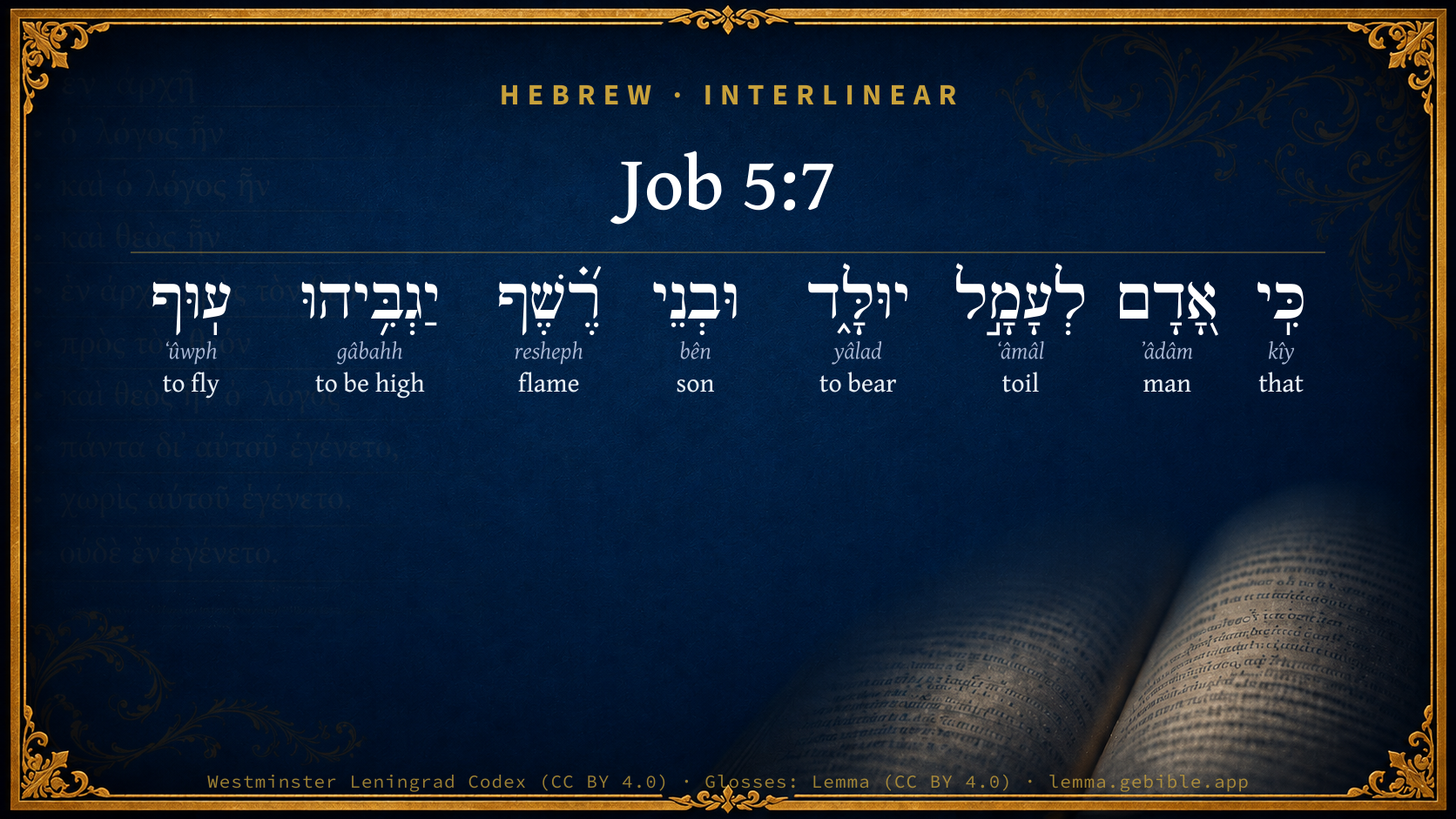
Job 5:7

Hebrew (Westminster Leningrad Codex) Job 5:7 appears in the Hebrew Old Testament. The text above is from the Westminster Leningrad Codex. Each word links to its Strong’s number, a concise gloss, and parsing drawn from the Open Scriptures Hebrew Bible morphology. Click any word for its full Brown-Driver-Briggs (BDB) entry.
Download image
Cite this verse

Job 5:7 (World English Bible). Public Domain. Lemma interlinear Bible study tool, https://lemma.gebible.app/v/job/5/7.

Show BibTeX & RIS
BibTeX
RIS
English Translation
But man is born to trouble, As the sparks fly upward.
World English Bible · Public Domain
Download a study sheet

One document with this verse’s original text, its word-by-word gloss line, the meaning frame, cross-references with their text, attributed commentary, and full source and license credits — printable, and it pastes into notes with its structure intact.

This verse Autodidact and up

Study sheet (.html) Plain text (.txt)

A passage Seminary Student

Up to 50 verses in one chapter. A passage sheet keeps up to 6 commentary sources and 12 cross-references per verse, in the order this page ranks them, and says so on the sheet whenever that leaves anything out. Ask for a single verse and you get the Autodidact verse sheet above.

Everything on this page stays free to read, with no account — the sheet is a download of what is already on screen, not access to it.

Want to remove ads? Support Godless Engineer
Compare translations 3

The same verse in 3 English versions, stacked beneath the original-language interlinear above. Click any original word for its lexicon entry.

Each is an independent rendering of the whole verse — the interlinear is not word-aligned to these translations.

Highlighted words mark where these versions differ — a whole-verse word diff, not a word-by-word alignment.

  • World English Bible Public Domain
    But man is born to trouble, As the sparks fly upward.
  • King James Version Public Domain
    Yet man is born unto trouble, as the sparks fly upward.
  • unfoldingWord Literal Text CC BY-SA 4.0
    For man is born to trouble, and sons of the flame soar to fly.

unfoldingWord Literal Text — © unfoldingWord, licensed CC BY-SA 4.0. Word-aligned USFM3 via Door43 (git.door43.org/unfoldingWord/en_ult).

Versions to compare (up to 4)

3 of 4 selected

Show all 18 translations

Every available English version of this verse, each an independent rendering of the whole verse.

  • World English Bible Public Domain
    But man is born to trouble, As the sparks fly upward.
  • Berean Standard Bible Public Domain
    Yet man is born to trouble as surely as sparks fly upward.
  • Majority Standard Bible Public Domain
    Yet man is born to trouble as surely as sparks fly upward.
  • King James Version Public Domain
    Yet man is born unto trouble, as the sparks fly upward.
  • American Standard Version (1901) Public Domain
    But man is born unto trouble, As the sparks fly upward.
  • Revised Version (1885) Public Domain
    But man is born unto trouble, as the sparks fly upward.
  • Geneva Bible (1599) Public Domain
    But man is borne vnto trauaile, as the sparkes flie vpwarde.
  • Douay-Rheims (1899) Public Domain
    Man is born to labour and the bird to fly.
  • Young's Literal Translation Public Domain
    For man to misery is born, And the sparks go high to fly.
  • Literal Standard Version CC BY-SA 4.0
    For man is born to misery, || And the sparks go high to fly.
  • Unlocked Literal Bible CC BY-SA 4.0
    Instead, mankind is born for trouble, just as sparks fly upward.
  • unfoldingWord Literal Text CC BY-SA 4.0
    For man is born to trouble, and sons of the flame soar to fly.
  • Darby Bible Public Domain
    For man is born to trouble, as the sparks fly upwards.
  • World Messianic Bible Public Domain
    but man is born to trouble, as the sparks fly upward.
  • Webster's Bible Public Domain
    Yet man is born to trouble, as the sparks fly upward.
  • Free Bible Version CC BY-SA 4.0
    But human beings are born for trouble just as certainly as sparks from a fire fly upwards.
  • Bible in Basic English Public Domain
    But trouble is man's fate from birth, as the flames go up from the fire.
  • JPS Tanakh (1917) Public Domain
    But man is born unto trouble, as the sparks fly upward.

Literal Standard Version (2020), Covenant Press — licensed CC BY-SA 4.0. Text via the HelloAO Bible API (eBible.org). Unlocked Literal Bible (unfoldingWord) — licensed CC BY-SA 4.0. Text via the HelloAO Bible API (eBible.org). unfoldingWord Literal Text — © unfoldingWord, licensed CC BY-SA 4.0. Word-aligned USFM3 via Door43 (git.door43.org/unfoldingWord/en_ult). Free Bible Version, Dr. Jonathan Gallagher — licensed CC BY-SA 4.0. Text via the HelloAO Bible API (eBible.org).

Word by word

More ways to search: Search by grammar → Find every occurrence → Compare this word →

Practice this passage: Drill this verse → Learn its vocabulary →

About this verse

These counts appear in no published source. They are computed here, from the morphology-tagged text and Lemma’s own curated glosses. What Lemma adds →

8
words
8
distinct lemmas
Wisdom
section

Notable vocabulary

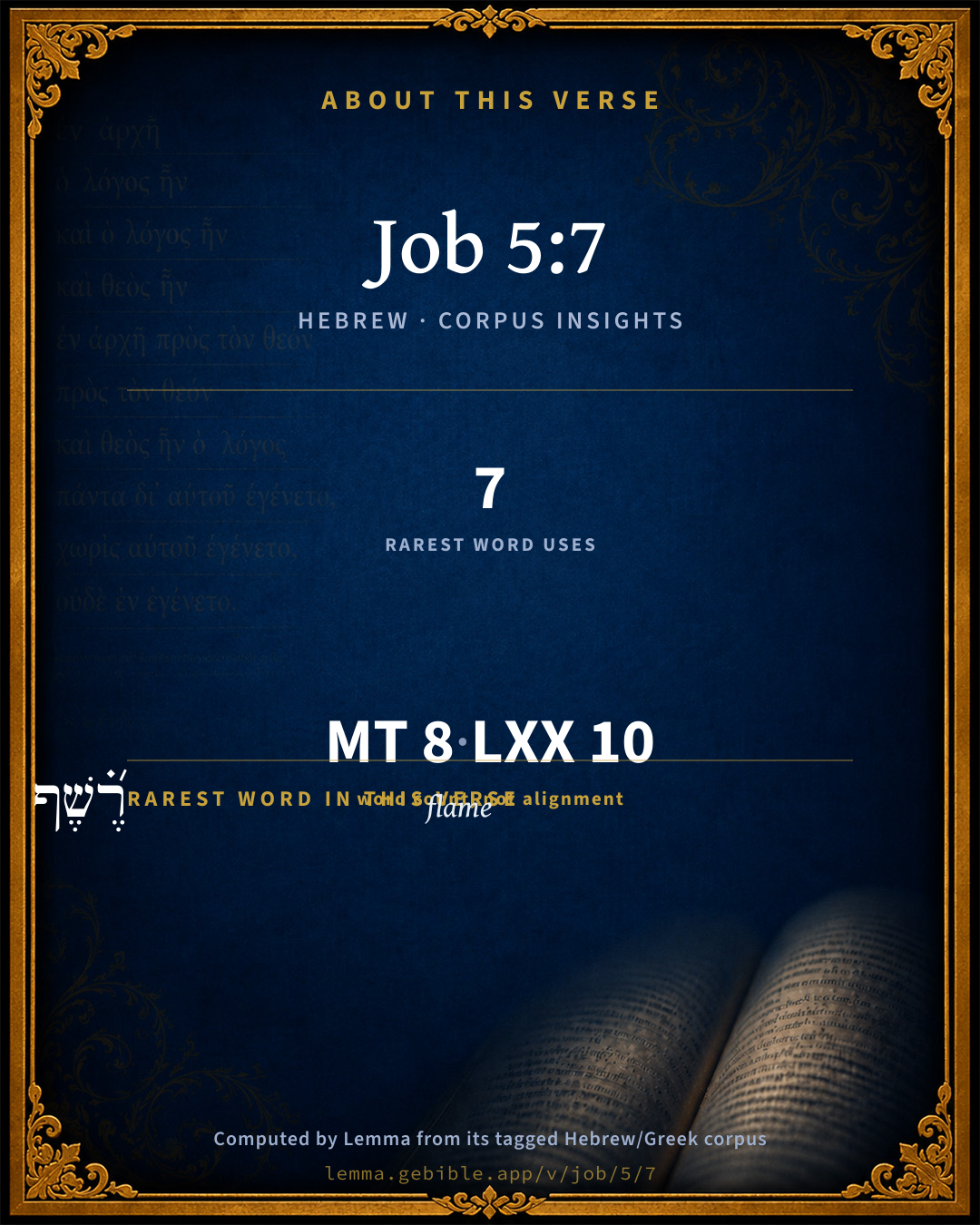
The rarest word here is רֶ֝֗שֶׁף flame H7565 — appearing just 7 times in the whole Hebrew Bible.

Shared distinctive vocabulary

רֶ֝֗שֶׁף flame H7565 occurs in 6 verses of the Hebrew Bible. Also found in:

Grammatical profile

  • 3 verbs
  • 4 nouns
  • 1 conjunction

Verb forms

  • יוּלָּ֑ד Pual · Perfect
  • יַגְבִּ֥יהוּ Hiphil · Imperfect
  • עֽוּף Qal · Infinitive Construct

Hebrew & Septuagint length

In English translation the verse runs 11 words from the Hebrew and 16 from the Septuagint (LXX English) — the Septuagint runs noticeably longer here. See the side-by-side →

A rough comparison of the two English renderings, which tokenize alike — not a word-level alignment.

Word counts can differ between the Hebrew and the Greek without any difference in meaning — e.g. the Hebrew direct-object marker אֵת has no separate Greek word, and Greek often adds the article ὁ.

In the original languages it is 8 Hebrew tokens and 10 Greek tokens — but the two are counted differently (Hebrew bundles its prefixes and suffixes into one token; the Greek is in lemma form), so that isn’t a like-for-like length.

Cross-references

7

Topical passages linked to Job 5:7 in the Treasury of Scripture Knowledge — connected by theme and wording, ordered by reader-vote popularity; previews shown in the World English Bible.

  • Job 14:1 "Man, who is born of a woman, Is of few days, and full of trouble.
  • Genesis 3:17–19 To Adam he said, "Because you have listened to your wife's voice, and have eaten of the tree, of which I commanded you, saying, 'You shall not eat of it,' cursed is the ground for your sake. In toil you will eat of it all the days of your life.
  • Ecclesiastes 5:15–17 As he came forth from his mother's womb, naked shall he go again as he came, and shall take nothing for his labor, which he may carry away in his hand.
  • 1 Corinthians 10:13 No temptation has taken you except what is common to man. God is faithful, who will not allow you to be tempted above what you are able, but will with the temptation also make the way of escape, that you may be able to endure it.
  • Psalms 90:8–9 You have set our iniquities before you, Our secret sins in the light of your presence.
  • Ecclesiastes 1:8 All things are full of weariness beyond uttering. The eye is not satisfied with seeing, nor the ear filled with hearing.
  • Ecclesiastes 2:22 For what has a man of all his labor, and of the striving of his heart, in which he labors under the sun?

Cross-references courtesy of OpenBible.info (CC BY 4.0).

Hebrew and Greek witnesses Masoretic Hebrew ↔ Greek Septuagint

The same verse in the two great witnesses to the Old Testament, shown verse-for-verse.

Here the Septuagint runs noticeably longer than the Hebrew — LXX2012 (modern English Septuagint) 16 words vs World English Bible 11. A rough length comparison of the two English translations, not a word-level alignment — read both below.

These are two independent witnesses, not word-aligned to each other, and the Septuagint is shown in lemma (dictionary) form.

Hebrew Job 5:7 Masoretic · Westminster Leningrad Codex

כִּֽי אָ֭דָם לְעָמָ֣ל יוּלָּ֑ד וּבְנֵי רֶ֝֗שֶׁף יַגְבִּ֥יהוּ עֽוּף

But man is born to trouble, As the sparks fly upward.

World English Bible · Public Domain

Greek LXX Job 5:7 Septuagint · lemma form

ἀλλά ἄνθρωπος γεννάω κόπος νεοσσός δέ γύψ ὁ ὑψηλός πέτομαι

yet man is born to labor, and even so the vulture's young seek the high places.

LXX2012 (modern English Septuagint) · Public Domain

On this verse, Trapp's Complete Commentary discusses the Septuagint’s reading. Read the note in Commentary ↓

Hebrew: Westminster Leningrad Codex (CC BY 4.0). Greek: Septuagint (public domain); English from LXX2012 (modern English Septuagint) (Public Domain). How the Septuagint differs from the Hebrew →

Commentary

Notes on Job 5:7 from classic Christian and Jewish commentators (each source and its license shown beneath its notes). The classic Christian expositions comment on the surrounding passage and are grouped to its opening verse, so a note may address several verses; the Jewish commentaries on the Tanakh (Rashi and others) are per-verse, so they appear only where the commentator wrote on this verse.

Lemma curates 59 commentaries, every one of them public domain or Creative Commons licensed, each selected and text-cleaned for this edition rather than reprinted as found. About our sources →

Trapp's Complete Commentary

John Trapp

Job 5:7 Yet man is born unto trouble, as the sparks fly upward.

Ver. 7. Yet man is born unto trouble] Which is the natural fruit of his sin; and a piece of the curse. He hath in him a πανσπερμια, a common seminary of all sin, and this he brings into the world with him; what wonder, then, though troubles come trooping in upon him on every side, as if he were born for no other end but to suffer, and that as naturally as fire ascendeth? Sure it is, that sin doth as naturally and ordinarily draw and suck judgments to it as the loedestone doth iron, or turpentine fire. Some read the words thus, Man is born to sin, and so consequently to trouble; for sin usually ends tragicly and troublesomely. Hence the same word, both here and that in the former verse, signifies both sin and sorrow; and man, by reason of his birth blot, hath a birthright to them both, he is even born to them. The devil, when he speaketh lies, speaketh of his own, Joh 8:44. And we, when either we do evil, we work de nostro et secundum hominem, of our own, and according to men, 1Co 3:3; or when we suffer evil, we suffer nothing but what is human and incident to men, 1Co 10:13. The very heathen could say as much; witness that of Xenophon, παν προσδοκαν δει ανθρωπον οντα, It behoveth him that is no more than a man to expect all sorts of troubles; and that of Demosthenes, It is fit for men to hope the best, but bravely to bear the worst, as that which is common to all mankind; and that of Isocrates, O μεμνημενος, &c., He that remembereth that he is a man will not be discontented at whatsoever trouble befalleth him; and that of Herodotus, πας εστιν ανθρωπος συμφορα, every man is miserable. For this it was likely that God, to keep Ezekiel lowly in the abundance of revelations, calleth him so oft son of man. And when the French king, being prisoner to Charles V, saw written upon the wall that emperor’s motto, plus ultra, more beyond, further yet, and underwrote, Hodie mihi, cras tibi, Today for me, tomorrow for you, I am now thy prisoner, thou mayest hereafter be mine; the emperor came after him, and subscribed, I confess I am a man, and may soon suffer anything incident to mankind, Homo sum, humani nihil a me alienum puto (J. Manl. loc. com. 175).

As the sparks fly upward] Heb. The sons of the quick or live coal lift up to fly. The Vulgate hath it, As the birds fly upward; the Septuagint, As the young vultures fly upward. Sparks and birds fly upward naturally, and by a principle of their own, they need not be taught it; so here. Birds, though they have more of the earth than of the other three elements, Gen 2:19, yet are light (which is a wonder), and delight in high flying, and this is innate to them; so is it to man, as man, to be in trouble, Job 14:1. Some of the Hebrews by sparks, or sons of the quick coal, here understand the devils, and make this to be the sense; like as sin is connatural to men, so doth God stir up the devils, to whom it is as natural to flutter up and down here for the punishment of such as sin; Sed hoc friget, but this is cold, saith Mercer; but this is not likely to be the meaning.

John Trapp, A Commentary or Exposition upon All the Books of the Old and New Testament (1647–1656) — public domain. Text from a community e-Sword module.

Joseph Benson's Commentary

Job 5:7. Yet man is born to trouble, &c. — He is so commonly exposed to various troubles, as if he were born to no other end: affliction is become natural to man, and is transmitted from parents to children, as their constant inheritance; God having allotted this portion to mankind for their sins. And therefore thou takest a wrong course in complaining so bitterly of that which thou shouldst patiently bear, as the common lot of mankind. As — As naturally, and as generally, as the sparks of fire fly upward — Why then should we be surprised at our afflictions, as strange, or quarrel with them, as hard? This last clause, literally translated from the Hebrew, is, As the sons of the burning coal raise themselves up to fly. Instead, however, of sparks, or the sons of the coal, the author of the Vulgate writes, Homo nascitur ad laborem, et avis ad volatum, man is born for labour, (or trouble,) and the bird for flying; reading, עוŠ, gnoph, a bird, for gnuph, to fly. To the same purpose is the interpretation of the LXX., Syr. and Arab.

Joseph Benson's Commentary on the Old and New Testaments (1811–1818) — public domain. Text from a community e-Sword module.

Geneva Bible (1599)

Geneva Bible translators

Which declareth that sin is ever in our corrupt nature: for before sin it was not subject to pain and affliction.

Geneva Bible (1599) marginal notes — public domain. Text via Bolls.life.

Jamieson, Fausset & Brown

Robert Jamieson, A. R. Fausset & David Brown

Yet--rather, "Truly," or, But affliction does not come from chance, but is the appointment of God for sin; that is, the original birth-sin of man. Eliphaz passes from the particular sin and consequent suffering of Job to the universal sin and suffering of mankind. Troubles spring from man's common sin by as necessary a law of natural consequences as sparks (Hebrew, "sons of coal") fly upward. Troubles are many and fiery, as sparks (Pe1 4:12; Isa 43:2). UMBREIT for "sparks" has "birds of prey;" literally, "sons of lightning," not so well.

Jamieson, Fausset & Brown — Commentary Critical and Explanatory on the Whole Bible (1871) — public domain (CC PDM 1.0). Text via the HelloAO Bible API.

Adam Clarke's Commentary

Verse 7. Yet man is born unto trouble] לעמל leamal, to labour. He must toil and be careful; and if in the course of his labour he meet with trials and difficulties, he should rise superior to them, and not sink as thou dost.

As the sparks By upward.] ובני רשף יגביהי עוף ubeney resheph yagbihu uph; And the sons of the coal lift up their flight, or dart upwards. And who are the sons of the coal? Are they not bold, intrepid, ardent, fearless men, who rise superior to all their trials; combat what are termed chance and occurrence; succumb under no difficulties; and rise superior to time, tide, fate, and fortune? I prefer this to all the various meanings of the place with which I have met. Coverdale translates, It is man that is borne unto mysery, like as the byrde for to fle. Most of the ancient versions give a similar sense.

Adam Clarke's Commentary on the Bible (1810–1826) — public domain. Text from a community e-Sword/MySword module.

The Cambridge Bible for Schools and Colleges

gen. ed. J. J. S. Perowne

7. Yet man is born unto trouble] Rather, but man. The true explanation of affliction is now given, as the false explanation was denied in Job_5:6. The words “man is born unto trouble” mean, it is his nature through his sin to bring trouble upon himself; evil rises up out of his heart as naturally as the sparks fly up out of the flame. Cf. the words of Christ, “Out of the heart proceed evil thoughts,” and the appalling list which follows. Eliphaz is severe on human nature, but the broad generality of his doctrine is fitted to enable Job to find himself in his history and let himself be led back to a more devout demeanour. See the concluding remark to ch. 4.

The Cambridge Bible for Schools and Colleges (gen. ed. J. J. S. Perowne; Cambridge University Press, 1878–1918) — public domain. Text from a community e-Sword module.

John Gill's Exposition

Yet man is born unto trouble,.... Or but (b), after the negative follows the positive part of the assertion; before we have what is denied as the cause of affliction, here what it is affirmed to be, or what it is to be ascribed unto, even to the appointment of God for sin: to be born to it is to be appointed to it, as all men are appointed to death, and to everything previous and that leads on to it; and it signifies that affliction or trouble springs from the birth sin of man, from original sin, the sin of the first parent, and of his nature; as all sins arise from hence, and are streams from this fountain of pollution, so all disorders and diseases of body, all distresses and anguish of mind, and death in every sense, corporeal, spiritual, and eternal; and these are the lot and portion, the estate and inheritance, of the sons of men by nature, what they are born unto, and are full of, see Job 14:1; the same word is here used as in Job 5:6, and signifies labour, mischief, the mischief of sin, improbity, wickedness, moral evil; and man may be said to be born to sin, inasmuch as he is conceived, shapen, and born in it; and as he is born at once into a sinful state, and sins as soon as born, goes astray from the womb, is a transgressor from thence, and the imagination of his heart evil from his infancy and youth upwards, he becomes a slave to sin, and is a homeborn one; not that he is laid under a necessity of force to sin, or his will compelled to it; for he sins most freely, is a voluntary slave to it; he serves various lusts as pleasures, and gives himself up to work all iniquity with greediness; but there is such a connection between his birth, the circumstances of it, and sin, that sin is the certain consequence of it, and immediately, naturally, and necessarily follows upon it; that is, by a necessity of consequence, though not of coaction or force; it is as natural for man to sin as it is for a thirsty man to covet and drink water; or as for an Ethiopian to be born black, and a leopard with spots; or, as it follows:

as the sparks fly upward; which they do naturally and necessarily when coals are blown, and which are here called "the sons of coals" (c); and to these, troubles and afflictions, the fruits and effects of sin, may be aptly compared; not only for the necessity of them, it is if needs be they are, but for the nature of them, being fiery and troublesome, hence called fiery trials, and signified by fires and flames of fire, Pe1 4:12; and also for the number of them, being many, and very grievous: some interpret this of flying fowls, of young vultures, as the Septuagint; of young eagles, as others; Aben Ezra makes mention of this sense, as if it was, as a fowl is born to fly, so man is born to labour; to labour in the law, according to the Targum; or to labour for his bread; or rather, to labour and sorrow; that is, to affliction and trouble: a learned man (d) thinks the phrase, according to the use of it in the Arabic language, designs the more rapid cast of a dart, of the vibration of it, which is very quick.

(b) "sed", Junius & Tremellius, Piscator, Cocceius Schmidt, so Broughton. (c) , "tilii prunae", Montanus, Vatablus, Piscator, Cocceius, Bolducius, Schmidt. (d) Hinckelman. Praefat. ad Alcoran. p. 29. So Schultens renders it, "tela corusea".

John Gill's Exposition of the Whole Bible (1746–1763) — public domain (CC PDM 1.0). Text via the HelloAO Bible API.

Albert Barnes' Notes on the Bible

Yet man is born unto trouble - All this is connected with the sentiment in Job 5:8 ff. The meaning is, that “since afflictions are ordered by an intelligent Being, and since man is born unto trouble as the sparks fly upward, therefore it is wise to commit our cause to God, and not to complain against him.” Margin, or labor. The word here (עמל ‛âmâl) rather means trouble, or affliction, than labor. The sense is, that as certainly as man is born, so sure is it that he will have trouble. It follows from the condition of our being, as certainly as that unconscious objects will follow the laws of their nature - that sparks will ascend. This seems to have a proverbial cast, and was doubtless regarded as a sentiment universally true. It is as true now as it was then; for it is still the great law of our being, that trouble as certainly comes sooner or later, as that material objects obey the laws of nature which God has impressed on them.

As the sparks fly upward - The Hebrew expression here is very beautiful - “as רשׁף בני benēy reshep - the sons of flame fly.” The word used (רשׁף reshep) means flame, lightning; the sons, or children of the flame, are that which it produces; that is, sparks. Gesenius strangely renders it, “sons of the lightning; that is, birds of prey which fly as swift as the lightning.” So Dr. Good, “As the bird-tribes are made to fly upwards.” So Umbreit renders it, Gleichwie die Brut des Raubgeflugels sich hoch in Fluge hebt - “as a flock of birds of prey elevate themselves on the wing.” Noyes adopts the construction of Gesenius; partly on the principle that man would be more likely to be compared to birds, living creatures, than to sparks. There is considerable variety in the interpretation of the passage. The Septuagint renders it, νεοσσοι δε γυπος neossoi de gupos - the young of the vulture. The Chaldee, מזיקי בני benēy mezēyqēy - “the sons of demons.” Syriac “Sons of birds.” Jerome, “Man is born to labor, and the bird to flight” - et avis ad volatum. Schultens renders it, “glittering javelins,” and Arius Montanus, “sons of the live coal.” It seems to me that our common version has expressed the true meaning. But the idea is not essentially varied whichever interpretation is adopted. It is, that as sparks ascend, or as birds fly upward - following the laws of their being - so is trouble the lot of man. It certainly comes; and comes under the direction of a Being who has fixed the laws of the inferior creation. It would be wise for man, therefore, to resign himself to God in the times when those troubles come. He should not sit down and complain at this condition of things, but should submit to it as the law of his being, and should have sufficient confidence in God to believe that he orders it aright.

Albert Barnes' Notes on the Bible (1834–1885) — public domain. Text from a community e-Sword/MySword module.

Haydock's Catholic Bible Commentary

Bird. Hebrew, "sparks fly up." (Haydock) --- You can no more then expect to pass unpunished, since it is impossible for man to be innocent! (Calmet) and, at any rate, labour is inevitable. (Menochius) --- We must gain our bread by the sweat of our brow. [Genesis iii. 19.] (Worthington)

George Leo Haydock (1774–1849), Haydock's Catholic Family Bible and Commentary, 1859 edition — public domain. Excludes Psalms (Douay-Rheims chapter numbering differs from Protestant) and Deuterocanonical books (Catholic canon only).

Matthew Poole's English Annotations

i.e. He is so commonly exposed to many and various troubles, as if he were born to no other end. Affliction is become in some sort natural and proper to man, and it is, together with sin, transmitted from parents to children, as their most certain and constant inheritance; God having allotted this portion to mankind for their sins. And therefore thou takest a wrong course in complaining so bitterly of that which thou shouldst patiently bear, as the common lot of mankind; and thy right method is to seek unto God, who inflicts it, and who only can remove it.

As the sparks fly upward, i.e. as naturally and as generally as the sparks of fire fly upward, which do so universally and constantly. Heb. and the sparks, &c. But the particle and is oft used comparatively for as, as Job 12:11; 14:11; 34:3; Pro 25:21; Mar 9:49.

Matthew Poole's English Annotations on the Holy Bible (1683–1685) — public domain. Text from a community e-Sword/MySword module.

Whedon's Commentary on the Bible

Daniel D. Whedon

7. Yet — Not an adversative, as Dillman, Hitzig, and others would read, but for; thus Conant, Evans, etc. This verse is also argumentative.

The sparks — Bene resheph — sons of fire, just as arrows are called sons of the bow. Umbreit translates: “Even as the bird of prey rises high in its flight.” Jerome beautifully expresses it, “Man is born to labour and the bird to flight.” The version of the text is better. That the evils of life are many, and “in close succession rise,” is implied in the figurative word “sparks.”

Daniel D. Whedon (gen. ed.), Commentary on the Old and New Testaments (1874–1909) — public domain. Text from a community e-Sword module.

The Pulpit Commentary

Yet man is born unto trouble. Yet still, in point of fact, man is born to trouble. He has a corrupt nature, and always sins more or less. Each sin brings him into trouble, since it entails on him a punishment. As the sparks fly upward; literally, the sons of flame. Some suppose "meteoric flashes" to be meant: others suggest, "ignited arrows." But many good Hebraists maintain the rendering of the Authorized Version (see Buxtorf, "Lexicon," p. 757; Rosenmuller, "Scholia," vol. 5. p. 165; Canon Cook, "Speaker"s Commentary," vol. 4. p. 34).

The Pulpit Commentary (1880–1919), ed. H.D.M. Spence-Jones & Joseph S. Exell — public domain. Text from a community e-Sword module.

John Wesley's Explanatory Notes

Is born - He is so commonly exposed to various troubles, as if he were born to no other end: affliction is become natural to man, and is transmitted from parents, to children, as their constant inheritance; God having allotted this portion to mankind for their sins. And therefore thou takest a wrong course in complaining so bitterly of that which thou shouldest patiently bear, as the common lot of mankind. As - As naturally, and as generally, as the sparks of fire fly upward. Why then should we be surprized at our afflictions as strange, or quarrel with them, as hard?

John Wesley, Explanatory Notes Upon the Whole Bible (1754–1765) — public domain. Text via the GEBible commentary corpus.

Rashi

Rabbi Shlomo Yitzchaki (Rashi)

Because man is born for trouble For it is impossible that he should not sin and receive trouble as punishment for sin. He is not like the flying creatures—the angels and spirits—who fly upward, and are not of the earthly creatures (other editions read: fly upward so as not to be among the earthly creatures), over whom the Adversary and temptation rule.

flying Heb. רשף, as in (Ps. 76:4), “arrows of (רשפי) a bow.” When the arrow flies, it is called רשפי, an expression of flying. This is what I heard.

Rashi on the Tanakh — English translations: “The Judaica Press complete Tanach with Rashi, translated by A. J. Rosenberg” (CC BY 4.0); “Pentateuch with Rashi's commentary by M. Rosenbaum and A.M. Silbermann, 1929-1934” (public domain); “The Metsudah Tanach series, Lakewood, N.J” (CC BY 4.0); and “The Book of Joshua, Metsudah Publications, 1997” (CC BY 4.0). Text via Sefaria.

Lesson kit

Teaching starters — assembled from the data on this page, not authored interpretation. Every prompt links to the verse data it draws on. Edit before teaching.

Job, in the Wisdom, opens this verse with 8 words (8 distinct Hebrew lemmas). Its most distinctive word is resheph (“flame”). The Greek Septuagint runs longer here. A historical commentator’s framing appears above. Read the whole chapter for the surrounding context.

Discussion questions

  1. What does “flame” (resheph) contribute to the verse as a whole?
  2. How does Deuteronomy 32:24, which shares the word «flame», read alongside this verse?
  3. The Septuagint runs longer here than the Hebrew. What might account for the difference?
  4. These translations render this verse differently; the difference is in the English rendering, not the original. What questions does that raise?
  5. «יוּלָּ֑ד» is a Pual Perfect verb. How does that grammatical form shape the action described?
  6. Compare how Trapp's Complete Commentary and Joseph Benson's Commentary read this verse. Where do they agree or differ?

Things to notice

Reading settings

Reading text

Shown beneath each verse's original-language words.

Old Testament
Old Testament edition

Read the OT as the Masoretic Hebrew (MT) or the Greek Septuagint (LXX).

English shown for the Greek Septuagint (in the Hebrew ↔ Greek comparison).

Comparing translations? Open the Compare panel on any verse page to stack up to four side by side.