
1 Samuel 20:21

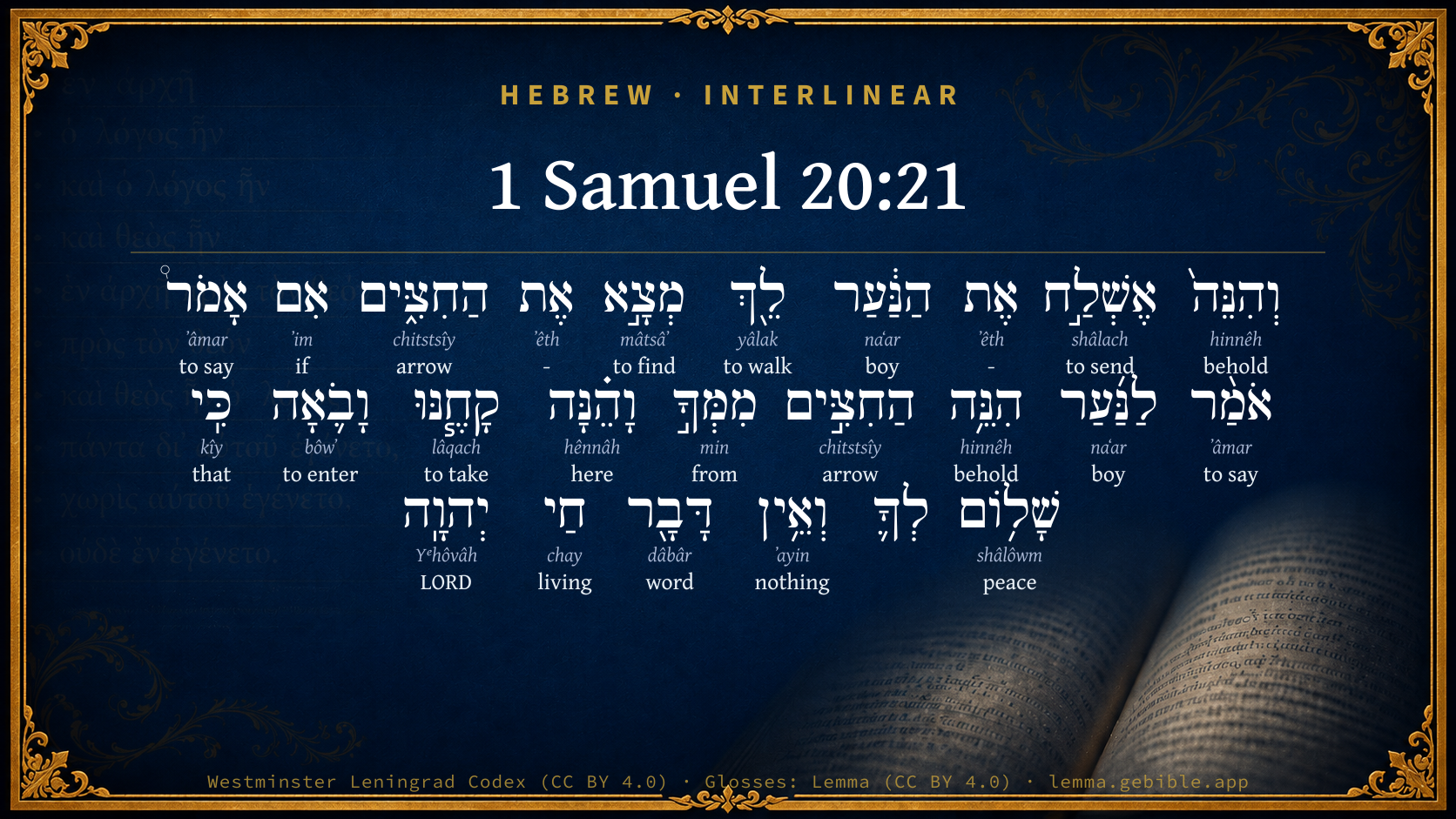
Hebrew (Westminster Leningrad Codex) 1 Samuel 20:21 appears in the Hebrew Old Testament. The text above is from the Westminster Leningrad Codex. Each word links to its Strong’s number, a concise gloss, and parsing drawn from the Open Scriptures Hebrew Bible morphology. Click any word for its full Brown-Driver-Briggs (BDB) entry.
Download image
Cite this verse

1 Samuel 20:21 (World English Bible). Public Domain. Lemma interlinear Bible study tool, https://lemma.gebible.app/v/1-samuel/20/21.

Show BibTeX & RIS
BibTeX
RIS
English Translation
Behold, I will send the boy, [saying], Go, find the arrows. If I tell the boy, Behold, the arrows are on this side of you; take them, and come; for there is peace to you and no hurt, as Yahweh lives.
World English Bible · Public Domain
Download a study sheet

One document with this verse’s original text, its word-by-word gloss line, the meaning frame, cross-references with their text, attributed commentary, and full source and license credits — printable, and it pastes into notes with its structure intact.

This verse Autodidact and up

Study sheet (.html) Plain text (.txt)

A passage Seminary Student

Up to 50 verses in one chapter. A passage sheet keeps up to 6 commentary sources and 12 cross-references per verse, in the order this page ranks them, and says so on the sheet whenever that leaves anything out. Ask for a single verse and you get the Autodidact verse sheet above.

Everything on this page stays free to read, with no account — the sheet is a download of what is already on screen, not access to it.

Want to remove ads? Support Godless Engineer
Compare translations 3

The same verse in 3 English versions, stacked beneath the original-language interlinear above. Click any original word for its lexicon entry.

Each is an independent rendering of the whole verse — the interlinear is not word-aligned to these translations.

Highlighted words mark where these versions differ — a whole-verse word diff, not a word-by-word alignment.

  • World English Bible Public Domain
    Behold, I will send the boy, [saying], Go, find the arrows. If I tell the boy, Behold, the arrows are on this side of you; take them, and come; for there is peace to you and no hurt, as Yahweh lives.
  • King James Version Public Domain
    And, behold, I will send a lad, saying, Go, find out the arrows. If I expressly say unto the lad, Behold, the arrows are on this side of thee, take them; then come thou: for there is peace to thee, and no hurt; as the LORD liveth.
  • unfoldingWord Literal Text CC BY-SA 4.0
    And behold, I will send a boy, ‘Go find the arrows.’ If saying, I say to the boy, ‘Behold, the arrows from you, and hither, get them,’ then come, for peace for you and there is no matter, the life of Yahweh.

unfoldingWord Literal Text — © unfoldingWord, licensed CC BY-SA 4.0. Word-aligned USFM3 via Door43 (git.door43.org/unfoldingWord/en_ult).

Versions to compare (up to 4)

3 of 4 selected

Show all 18 translations

Every available English version of this verse, each an independent rendering of the whole verse.

  • World English Bible Public Domain
    Behold, I will send the boy, [saying], Go, find the arrows. If I tell the boy, Behold, the arrows are on this side of you; take them, and come; for there is peace to you and no hurt, as Yahweh lives.
  • Berean Standard Bible Public Domain
    Then I will send a boy and say, ‘Go, find the arrows!’ Now, if I expressly say to him, ‘Look, the arrows are on this side of you; bring them,’ then come, because as surely as the LORD lives, it is safe for you and there is no danger.
  • Majority Standard Bible Public Domain
    Then I will send a boy and say, ‘Go, find the arrows!’ Now, if I expressly say to him, ‘Look, the arrows are on this side of you; bring them,’ then come, because as surely as the LORD lives, it is safe for you, and there is no danger.
  • King James Version Public Domain
    And, behold, I will send a lad, saying, Go, find out the arrows. If I expressly say unto the lad, Behold, the arrows are on this side of thee, take them; then come thou: for there is peace to thee, and no hurt; as the LORD liveth.
  • American Standard Version (1901) Public Domain
    And, behold, I will send the lad, `saying', Go, find the arrows. If I say unto the lad, Behold, the arrows are on this side of thee; take them, and come; for there is peace to thee and no hurt, as Jehovah liveth.
  • Revised Version (1885) Public Domain
    And, behold, I will send the lad, saying, Go, find the arrows. If I say unto the lad, Behold, the arrows are on this side of thee: take them, and come; for there is peace to thee and no hurt, as the LORD liveth.
  • Geneva Bible (1599) Public Domain
    And after I wil sende a boy, saying, Goe, seeke the arrowes. If I say vnto the boy, See, the arrowes are on this side thee, bring them, and come thou: for it is well with thee and no hurt, as the Lord liueth.
  • Douay-Rheims (1899) Public Domain
    And I will send a boy, saying to him: Go and fetch me the arrows.
  • Young's Literal Translation Public Domain
    and lo, I send the youth: Go, find the arrows. If I at all say to the youth, Lo, the arrows `are' on this side of thee -- take them, -- then come thou, for peace `is' for thee, and there is nothing; Jehovah liveth.
  • Literal Standard Version CC BY-SA 4.0
    and behold, I send the youth, [saying], Go, find the arrows. If I say to the youth at all, Behold, the arrows [are] on this side of you—take them and come, for [there is] peace for you, and there is no [adverse] word—[as] YHWH lives.
  • Unlocked Literal Bible CC BY-SA 4.0
    Then I will send my young man and say to him, 'Go find the arrows.' If I say to the young boy, 'Look, the arrows are on this side of you; get them,” then come; for there will be safety for you and not harm, as Yahweh lives.
  • unfoldingWord Literal Text CC BY-SA 4.0
    And behold, I will send a boy, ‘Go find the arrows.’ If saying, I say to the boy, ‘Behold, the arrows from you, and hither, get them,’ then come, for peace for you and there is no matter, the life of Yahweh.
  • Darby Bible Public Domain
    And behold, I will send the lad, [saying,] Go, find the arrows. If I expressly say to the lad, Behold, the arrows are on this side of thee, take them; then come, for there is peace for thee, and it is nothing; [as] Jehovah liveth.
  • World Messianic Bible Public Domain
    Behold, I will send the boy, saying, ‘Go, find the arrows!’ If I tell the boy, ‘Behold, the arrows are on this side of you. Take them;’ then come, for there is peace to you and no danger, as the LORD lives.
  • Webster's Bible Public Domain
    And behold, I will send a lad, saying, Go, find the arrows. If I expressly say to the lad, Behold, the arrows are on this side of thee, take them; then come thou: for there is peace to thee, and no hurt; as the LORD liveth.
  • Free Bible Version CC BY-SA 4.0
    Then I'll send a boy and tell him, ‘Go and find the arrows!’ Now, if I say to him specifically, ‘Look, the arrows are this side of you; bring them over here,’ then I swear on the life of the Lord it's safe for you to come out—there's no danger.
  • Bible in Basic English Public Domain
    And I will send my boy to have a look for the arrow. And if I say to him, See, the arrow is on this side of you; take it up! then you may come; for there is peace for you and no evil, by the living Lord.
  • JPS Tanakh (1917) Public Domain
    And, behold, I will send the lad: Go, find the arrows. If I say unto the lad: Behold, the arrows are on this side of thee; take them, and come; for there is peace to thee and no hurt, as the LORD liveth.

Literal Standard Version (2020), Covenant Press — licensed CC BY-SA 4.0. Text via the HelloAO Bible API (eBible.org). Unlocked Literal Bible (unfoldingWord) — licensed CC BY-SA 4.0. Text via the HelloAO Bible API (eBible.org). unfoldingWord Literal Text — © unfoldingWord, licensed CC BY-SA 4.0. Word-aligned USFM3 via Door43 (git.door43.org/unfoldingWord/en_ult). Free Bible Version, Dr. Jonathan Gallagher — licensed CC BY-SA 4.0. Text via the HelloAO Bible API (eBible.org).

Word by word

More ways to search: Search by grammar → Find every occurrence → Compare this word →

Practice this passage: Drill this verse → Learn its vocabulary →

הַחִצִּ֑ים
chitstsîy
H2678
“the · arrows”
Particle, Definite Article + Noun, Common, Masculine, Plural, Absolute
Part of Speech
Particle + Noun
Type
Common
Gender
Masculine
Number
Plural
State
Absolute
Full BDB Definition

Origin: prolongation from H2671

TWOT: 719c , 721b

arrow
  1. וְהִנֵּה֙ hinnêh H2009 “and · behold” Conjunction + Particle, Demonstrative
  2. אֶשְׁלַ֣ח shâlach H7971 “to send” Verb, Qal, Imperfect, 1st Person, Common, Singular
  3. אֶת ʼêth H853 “-” Particle, Direct Object
  4. הַנַּ֔עַר naʻar H5288 “the · boy” Particle, Definite Article + Noun, Common, Masculine, Singular, Absolute
  5. לֵ֖ךְ yâlak H3212 “walk” Verb, Qal, Imperative, 2nd Person, Masculine, Singular
  6. מְצָ֣א mâtsâʼ H4672 “find” Verb, Qal, Imperative, 2nd Person, Masculine, Singular
  7. אֶת ʼêth H853 “-” Particle, Direct Object
  8. אִם ʼim H518 “if” Conjunction
  9. אָמֹר֩ ʼâmar H559 “to say” Verb, Qal, Infinitive Absolute
  10. אֹמַ֨ר ʼâmar H559 “to say” Verb, Qal, Imperfect, 1st Person, Common, Singular
  11. לַנַּ֜עַר naʻar H5288 “to/for the · boy” Preposition, Determined + Noun, Common, Masculine, Singular, Absolute
  12. הִנֵּ֥ה hinnêh H2009 “behold” Particle, Demonstrative
  13. הַחִצִּ֣ים chitstsîy H2678 “the · arrows” Particle, Definite Article + Noun, Common, Masculine, Plural, Absolute
  14. מִמְּךָ֣ min H4480 “from · you” Preposition + Suffix, Personal, 2nd Person, Masculine, Singular
  15. וָהֵ֗נָּה hênnâh H2008 “and · here” Conjunction + Adverb
  16. קָחֶ֧נּוּ lâqach H3947 “take · him” Verb, Qal, Imperative, 2nd Person, Masculine, Singular + Suffix, Personal, 3rd Person, Masculine, Singular
  17. וָבֹ֛אָה bôwʼ H935 “and · enter” Conjunction + Verb, Qal, Imperative, 2nd Person, Masculine, Singular + Suffix, h
  18. כִּֽי kîy H3588 “that” Conjunction
  19. שָׁל֥וֹם shâlôwm H7965 “peace” Noun, Common, Masculine, Singular, Absolute
  20. וְאֵ֥ין ʼayin H369 “and · nothing” Conjunction + Particle, Negative
  21. דָּבָ֖ר dâbâr H1697 “word” Noun, Common, Masculine, Singular, Absolute
  22. חַי chay H2416 “living” Adjective, Adjective, Masculine, Singular, Absolute
  23. יְהוָֽה Yᵉhôvâh H3068 “LORD” Noun, Proper

About this verse

These counts appear in no published source. They are computed here, from the morphology-tagged text and Lemma’s own curated glosses. What Lemma adds →

25
words
19
distinct lemmas
Historical
section

Notable vocabulary

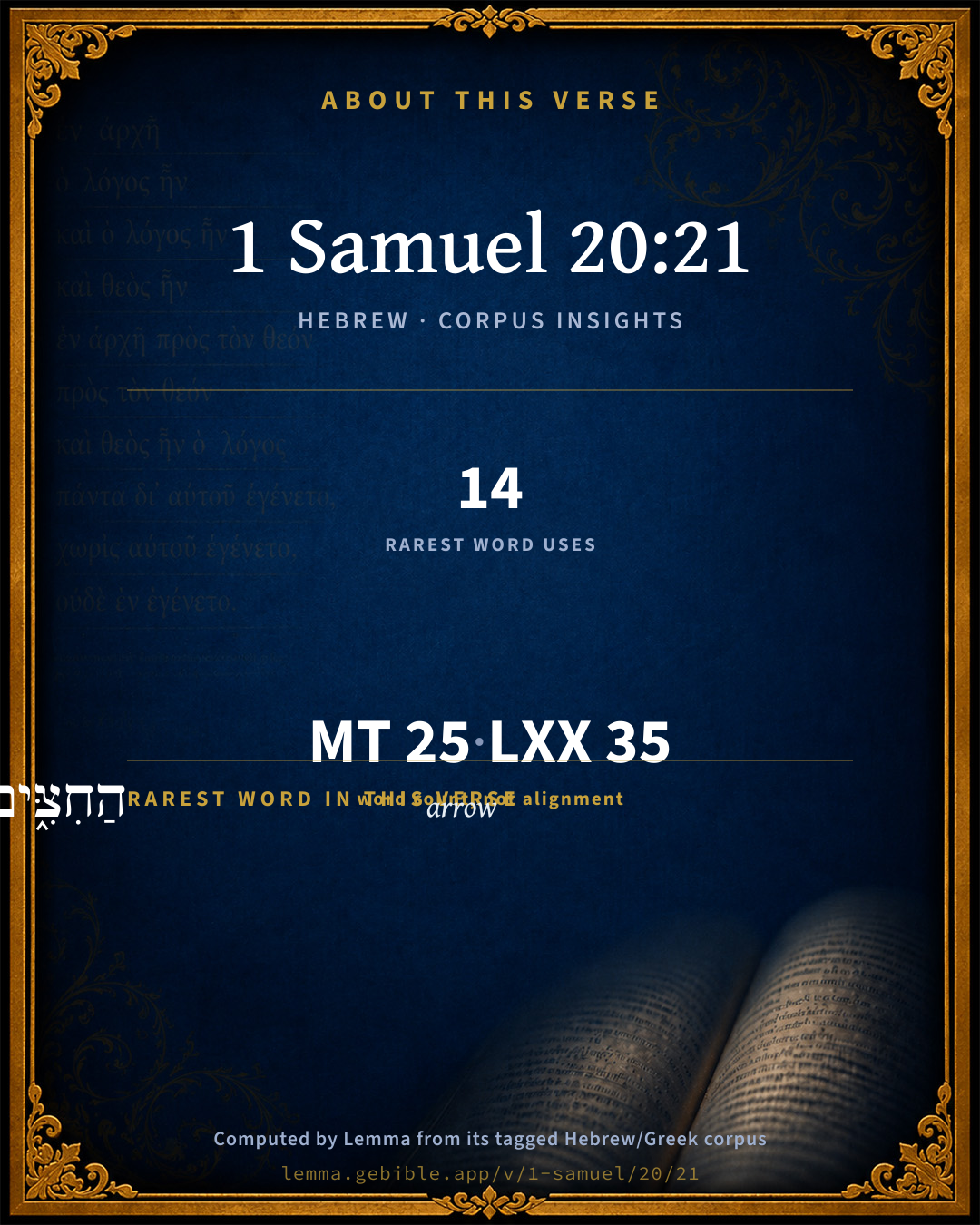
The rarest word here is הַחִצִּ֑ים arrow H2678 — appearing just 14 times in the whole Hebrew Bible.

Shared distinctive vocabulary

הַחִצִּ֑ים arrow H2678 occurs in 10 verses of the Hebrew Bible. Also found in:

Grammatical profile

  • 7 verbs
  • 7 nouns
  • 1 adjective
  • 2 prepositions
  • 2 conjunctions
  • 1 adverb
  • 5 particles

Verb forms

  • אֶשְׁלַ֣ח Qal · Imperfect
  • לֵ֖ךְ Qal · Imperative
  • מְצָ֣א Qal · Imperative
  • אָמֹר֩ Qal · Infinitive Absolute
  • אֹמַ֨ר Qal · Imperfect
  • קָחֶ֧נּוּ Qal · Imperative
  • וָבֹ֛אָה Qal · Imperative

Repetition

Words recur within this verse — often emphatic in Hebrew:

  • וְהִנֵּה֙ behold H2009 ×2
  • הַנַּ֔עַר boy H5288 ×2
  • הַחִצִּ֑ים arrow H2678 ×2
  • אָמֹר֩ to say H559 ×2

Hebrew & Septuagint length

In English translation the verse runs 41 words from the Hebrew and 13 from the Septuagint (LXX English) — the Septuagint runs noticeably shorter here. See the side-by-side →

A rough comparison of the two English renderings, which tokenize alike — not a word-level alignment.

Word counts can differ between the Hebrew and the Greek without any difference in meaning — e.g. the Hebrew direct-object marker אֵת has no separate Greek word, and Greek often adds the article ὁ.

In the original languages it is 25 Hebrew tokens and 35 Greek tokens — but the two are counted differently (Hebrew bundles its prefixes and suffixes into one token; the Greek is in lemma form), so that isn’t a like-for-like length.

Cross-references

4

Topical passages linked to 1 Samuel 20:21 in the Treasury of Scripture Knowledge — connected by theme and wording, ordered by reader-vote popularity; previews shown in the World English Bible.

  • Jeremiah 4:2 and you shall swear, As Yahweh lives, in truth, in justice, and in righteousness; and the nations shall bless themselves in him, and in him shall they glory.
  • Jeremiah 5:2 Though they say, As Yahweh lives; surely they swear falsely.
  • Jeremiah 12:16 It shall happen, if they will diligently learn the ways of my people, to swear by my name, As Yahweh lives; even as they taught my people to swear by Baal; then shall they be built up in the midst of my people.
  • Amos 8:14 Those who swear by the sin of Samaria, And say, 'As your god, Dan, lives;' And, 'As the way of Beersheba lives;' They will fall, and never rise up again."

Cross-references courtesy of OpenBible.info (CC BY 4.0).

Hebrew and Greek witnesses Masoretic Hebrew ↔ Greek Septuagint

The same verse in the two great witnesses to the Old Testament, shown verse-for-verse.

Here the Septuagint runs noticeably shorter than the Hebrew — LXX2012 (modern English Septuagint) 13 words vs World English Bible 41. A rough length comparison of the two English translations, not a word-level alignment — read both below.

These are two independent witnesses, not word-aligned to each other, and the Septuagint is shown in lemma (dictionary) form.

Hebrew 1 Samuel 20:21 Masoretic · Westminster Leningrad Codex

וְהִנֵּה֙ אֶשְׁלַ֣ח אֶת הַנַּ֔עַר לֵ֖ךְ מְצָ֣א אֶת הַחִצִּ֑ים אִם אָמֹר֩ אֹמַ֨ר לַנַּ֜עַר הִנֵּ֥ה הַחִצִּ֣ים מִמְּךָ֣ וָהֵ֗נָּה קָחֶ֧נּוּ וָבֹ֛אָה כִּֽי שָׁל֥וֹם לְךָ֛ וְאֵ֥ין דָּבָ֖ר חַי יְהוָֽה

Behold, I will send the boy, [saying], Go, find the arrows. If I tell the boy, Behold, the arrows are on this side of you; take them, and come; for there is peace to you and no hurt, as Yahweh lives.

World English Bible · Public Domain

Greek LXX 1 Samuel 20:21 Septuagint · lemma form

καί ἰδού ἀποστέλλω ὁ παιδάριον λέγω δεῦρο εὑρίσκω ἐγώ ὁ σχίζα ἐάν εἶπον λέγω ὁ παιδάριον ὧδε ὁ σχίζα ἀπό σύ καί ὧδε λαμβάνω αὐτός παραγίγνομαι ὅτι εἰρήνη σύ καί οὐ εἰμί λόγος ζάω κύριος

And behold, I will send a lad, saying, Go find me the arrow.

LXX2012 (modern English Septuagint) · Public Domain

Hebrew: Westminster Leningrad Codex (CC BY 4.0). Greek: Septuagint (public domain); English from LXX2012 (modern English Septuagint) (Public Domain). How the Septuagint differs from the Hebrew →

Targum (Aramaic paraphrase)

1

The Targum is the ancient Jewish Aramaic paraphrase of the Hebrew Scriptures — an interpretive translation, not the Hebrew text itself. Onkelos (literal) and Pseudo-Jonathan (expansive) render the Torah, and Jonathan the Prophets. Coverage is partial: where no permissively-licensed English translation exists for a verse, only the Aramaic is shown. This is verse-level text, not a word-by-word alignment to the Hebrew.

  1. Targum Jonathan Prophets (Joshua–Malachi)
    וְהָא אֶשְׁלַח יַת עוּלֵימָא אֱזֵיל וְאַיְתֵי יַת גִירַיָא אִם מֵימַר אֵימַר לְעוּלֵימָא הָא גִירַיָא מִנָךְ וּלְכָא סַבְהִי וְאַיְתָא אֲרֵי שְׁלָם לָךְ וְלֵית מִדַעַם בִּישׁ קַיָם הוּא יְיָ:

    (no public-domain English translation for this verse)

    Targum Jonathan — Aramaic: “Mikraot Gedolot” (public domain). English: “Sefaria Community Translation” (CC0 1.0 (public-domain dedication)); “London "Chaldee Paraphrase," 1871” (public domain). Text via Sefaria.

Commentary

Notes on 1 Samuel 20:21 from classic Christian and Jewish commentators (each source and its license shown beneath its notes). The classic Christian expositions comment on the surrounding passage and are grouped to its opening verse, so a note may address several verses; the Jewish commentaries on the Tanakh (Rashi and others) are per-verse, so they appear only where the commentator wrote on this verse.

Lemma curates 59 commentaries, every one of them public domain or Creative Commons licensed, each selected and text-cleaned for this edition rather than reprinted as found. About our sources →

Trapp's Complete Commentary

John Trapp

1Sa 20:21 And, behold, I will send a lad, [saying], Go, find out the arrows. If I expressly say unto the lad, Behold, the arrows [are] on this side of thee, take them; then come thou: for [there is] peace to thee, and no hurt; [as] the LORD liveth.

Ver. 21. Then come thou.] Along with the lad, as if thou camest thither by chance; and hold on thy course to the court without fear of evil.

John Trapp, A Commentary or Exposition upon All the Books of the Old and New Testament (1647–1656) — public domain. Text from a community e-Sword module.

Joseph Benson's Commentary

1Sa 20:21-23. I will send a lad, &c. — I will send him before I shoot, to find and take up the arrows which I shall shoot: and I shall shoot them either short of him or beyond him, as I shall see occasion. If I say, Behold the arrows are beyond thee — This signal seems to have been agreed on between them, in case Jonathan was so watched and followed, as not to have an opportunity of communing with David by word of mouth. The Lord be between thee and me — As a witness and a judge, and between our families for ever, if on either side this league of friendship be violated.

Joseph Benson's Commentary on the Old and New Testaments (1811–1818) — public domain. Text from a community e-Sword module.

Geneva Bible (1599)

Geneva Bible translators

Hebrew, peace.

Geneva Bible (1599) marginal notes — public domain. Text via Bolls.life.

John Gill's Exposition

And, behold, I will send a lad,.... That attended on him, and carried his bow and arrows, and fetched his arrows when he had shot them:

saying, go, find out the arrows; where they are fallen, and return them:

if I expressly say unto the lad, behold, the arrows are on this side of thee, take them; on one side of him, whether the one or the other, which he would bid him take up, and bring them to him:

then come thou; David, out of the place where he hid himself:

for there is peace to thee, and no hurt, as the Lord liveth; he might appear, and not be afraid of being seen by any, since by this sign he might be assured that Saul was well affected to him, and would show him favour, and do him no injury; and that he might promise himself prosperity and safety, and be assured of it for the present.

John Gill's Exposition of the Whole Bible (1746–1763) — public domain (CC PDM 1.0). Text via the HelloAO Bible API.

Matthew Poole's English Annotations

I will send him out before I shoot, to find out and take up the arrows which I shall shoot. And I shall shoot them either short of him, or beyond him, as I shall see occasion.

Matthew Poole's English Annotations on the Holy Bible (1683–1685) — public domain. Text from a community e-Sword/MySword module.

John Wesley's Explanatory Notes

I will send - I will send him out before I shoot, to find out, and take up the arrows which I shall shoot. And I shall shoot them either short of him, or beyond him, as I shall see occasion.

John Wesley, Explanatory Notes Upon the Whole Bible (1754–1765) — public domain. Text via the GEBible commentary corpus.

Rashi

Rabbi Shlomo Yitzchaki (Rashi)

Behold, I will then send… And it is customary for the one who is looking for a shot arrow to go to the place where he sees the arrow flying, but he cannot calculate exactly; sometimes he searches for it, and the arrow is beyond him, and sometimes he goes beyond the arrow and searches for it, and you shall divine with this [sign].

If I say to the lad…take [the arrows] and come. You should emerge from your hiding place, and take it, and come to me, for you have nothing to fear, for it is well with you. The Holy One, Blessed is He, desires that you be here, and do not fear, even if I have heard evil from [my] father.

Rashi on the Tanakh — English translations: “The Judaica Press complete Tanach with Rashi, translated by A. J. Rosenberg” (CC BY 4.0); “Pentateuch with Rashi's commentary by M. Rosenbaum and A.M. Silbermann, 1929-1934” (public domain); “The Metsudah Tanach series, Lakewood, N.J” (CC BY 4.0); and “The Book of Joshua, Metsudah Publications, 1997” (CC BY 4.0). Text via Sefaria.

Lesson kit

Teaching starters — assembled from the data on this page, not authored interpretation. Every prompt links to the verse data it draws on. Edit before teaching.

1 Samuel, in the Historical, opens this verse with 25 words (19 distinct Hebrew lemmas). Its most distinctive word is chitstsîy (“arrow”). The Greek Septuagint runs shorter here. A historical commentator’s framing appears above. Read the whole chapter for the surrounding context.

Discussion questions

  1. What does “arrow” (chitstsîy) contribute to the verse as a whole?
  2. How does 1 Samuel 20:20, which shares the word «arrow», read alongside this verse?
  3. What does the repetition of “behold” (2× in this one verse) do in this verse?
  4. The Septuagint runs shorter here than the Hebrew. What might account for the difference?
  5. These translations render this verse differently. What is at stake in choosing one wording over another?
  6. «אֶשְׁלַ֣ח» is a Qal Imperfect verb. How does that grammatical form shape the action described?
  7. Compare how Trapp's Complete Commentary and Joseph Benson's Commentary read this verse. Where do they agree or differ?

Things to notice

Reading settings

Reading text

Shown beneath each verse's original-language words.

Old Testament
Old Testament edition

Read the OT as the Masoretic Hebrew (MT) or the Greek Septuagint (LXX).

English shown for the Greek Septuagint (in the Hebrew ↔ Greek comparison).

Comparing translations? Open the Compare panel on any verse page to stack up to four side by side.