
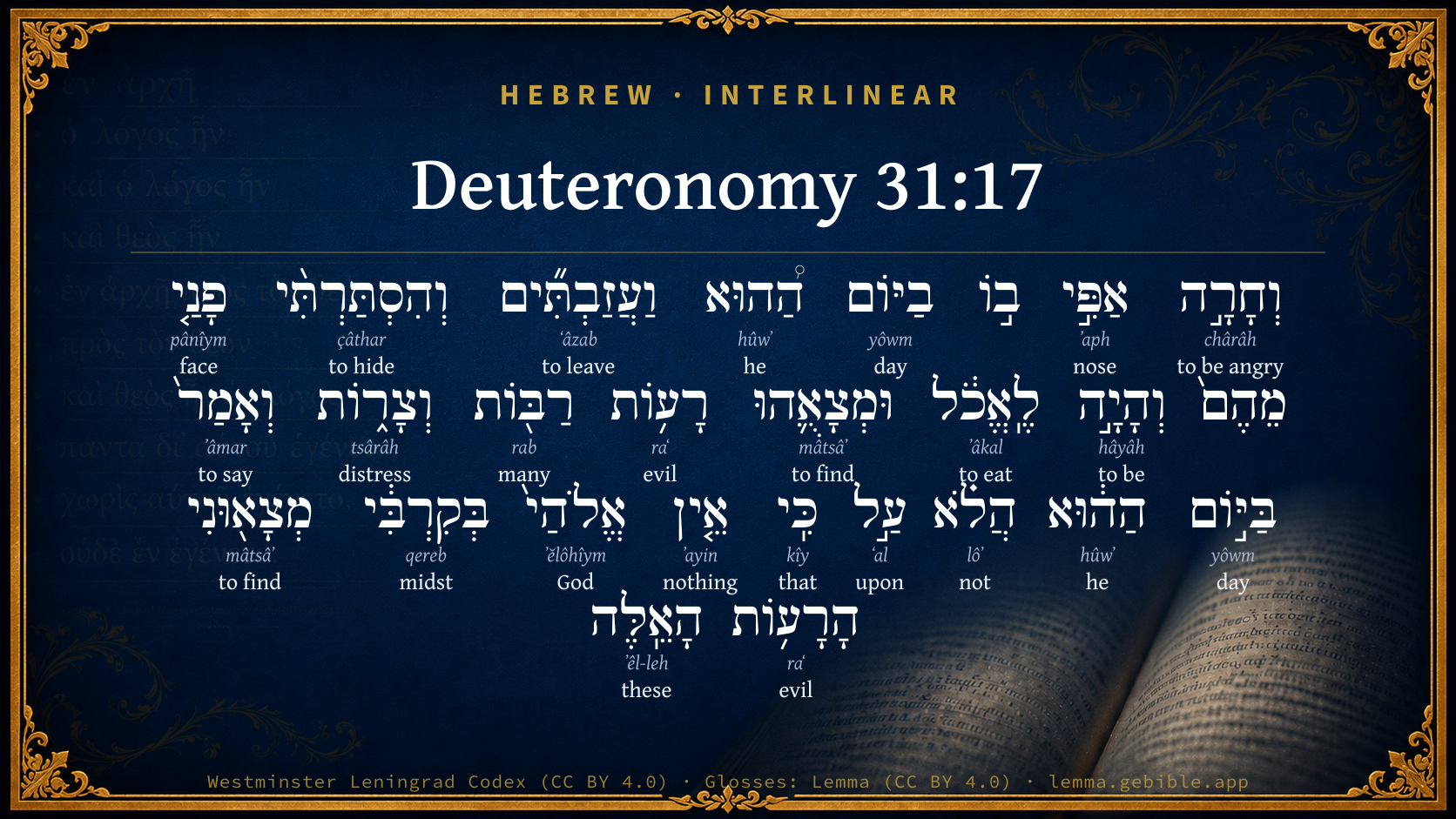
Deuteronomy 31:17

Hebrew (Westminster Leningrad Codex) Deuteronomy 31:17 appears in the Hebrew Old Testament. The text above is from the Westminster Leningrad Codex. Each word links to its Strong’s number, a concise gloss, and parsing drawn from the Open Scriptures Hebrew Bible morphology. Click any word for its full Brown-Driver-Briggs (BDB) entry.
Download image
Cite this verse

Deuteronomy 31:17 (World English Bible). Public Domain. Lemma interlinear Bible study tool, https://lemma.gebible.app/v/deuteronomy/31/17.

Show BibTeX & RIS
BibTeX
RIS
English Translation
Then my anger shall be kindled against them in that day, and I will forsake them, and I will hide my face from them, and they shall be devoured, and many evils and troubles shall come on them; so that they will say in that day, Haven't these evils come on us because our God is not among us?
World English Bible · Public Domain
Download a study sheet

One document with this verse’s original text, its word-by-word gloss line, the meaning frame, cross-references with their text, attributed commentary, and full source and license credits — printable, and it pastes into notes with its structure intact.

This verse Autodidact and up

Study sheet (.html) Plain text (.txt)

A passage Seminary Student

Up to 50 verses in one chapter. A passage sheet keeps up to 6 commentary sources and 12 cross-references per verse, in the order this page ranks them, and says so on the sheet whenever that leaves anything out. Ask for a single verse and you get the Autodidact verse sheet above.

Everything on this page stays free to read, with no account — the sheet is a download of what is already on screen, not access to it.

Want to remove ads? Support Godless Engineer
Compare translations 3

The same verse in 3 English versions, stacked beneath the original-language interlinear above. Click any original word for its lexicon entry.

Each is an independent rendering of the whole verse — the interlinear is not word-aligned to these translations.

Highlighted words mark where these versions differ — a whole-verse word diff, not a word-by-word alignment.

  • World English Bible Public Domain
    Then my anger shall be kindled against them in that day, and I will forsake them, and I will hide my face from them, and they shall be devoured, and many evils and troubles shall come on them; so that they will say in that day, Haven't these evils come on us because our God is not among us?
  • King James Version Public Domain
    Then my anger shall be kindled against them in that day, and I will forsake them, and I will hide my face from them, and they shall be devoured, and many evils and troubles shall befall them; so that they will say in that day, Are not these evils come upon us, because our God is not among us?
  • unfoldingWord Literal Text CC BY-SA 4.0
    And on that day, my nose will burn against him, and I will forsake them and hide my face from them, and he will be devoured, and many evils and troubles will find him. And he will say on that day, ‘Have not these evils found me because my God is not in my midst?’

unfoldingWord Literal Text — © unfoldingWord, licensed CC BY-SA 4.0. Word-aligned USFM3 via Door43 (git.door43.org/unfoldingWord/en_ult).

Versions to compare (up to 4)

3 of 4 selected

Show all 18 translations

Every available English version of this verse, each an independent rendering of the whole verse.

  • World English Bible Public Domain
    Then my anger shall be kindled against them in that day, and I will forsake them, and I will hide my face from them, and they shall be devoured, and many evils and troubles shall come on them; so that they will say in that day, Haven't these evils come on us because our God is not among us?
  • Berean Standard Bible Public Domain
    On that day My anger will burn against them, and I will abandon them and hide My face from them, so that they will be consumed, and many troubles and afflictions will befall them. On that day they will say, ‘Have not these disasters come upon us because our God is no longer with us?’
  • Majority Standard Bible Public Domain
    On that day My anger will burn against them, and I will abandon them and hide My face from them, so that they will be consumed, and many troubles and afflictions will befall them. On that day they will say, ‘Have not these disasters come upon us because our God is no longer with us?’
  • King James Version Public Domain
    Then my anger shall be kindled against them in that day, and I will forsake them, and I will hide my face from them, and they shall be devoured, and many evils and troubles shall befall them; so that they will say in that day, Are not these evils come upon us, because our God is not among us?
  • American Standard Version (1901) Public Domain
    Then my anger shall be kindled against them in that day, and I will forsake them, and I will hide my face from them, and they shall be devoured, and many evils and troubles shall come upon them; so that they will say in that day, Are not these evils come upon us because our God is not among us?
  • Revised Version (1885) Public Domain
    Then my anger shall be kindled against them in that day, and I will forsake them, and I will hide my face from them, and they shall be devoured, and many evils and troubles shall come upon them; so that they will say in that day, Are not these evils come upon us because our God is not among us?
  • Geneva Bible (1599) Public Domain
    Wherefore my wrath will waxe hote against them at that day, and I will forsake them, and will hide my face from them: then they shalbe consumed, and many aduersities and tribulations shall come vpon them: so then they will say, Are not these troubles come vpon me, because God is not with me?
  • Douay-Rheims (1899) Public Domain
    And my wrath shall be kindled against them in that day: and I will forsake them, and will hide my face from them, and they shall be devoured: all evils and afflictions shall find them, so that they shall say in that day: In truth it is because God is not with me, that these evils have found me.
  • Young's Literal Translation Public Domain
    and Mine anger hath burned against it in that day, and I have forsaken them, and hidden My face from them, and it hath been for consumption, and many evils and distresses have found it, and it hath said in that day, Is it not because that my God is not in my midst -- these evils have found me?
  • Literal Standard Version CC BY-SA 4.0
    and My anger has burned against it in that day, and I have forsaken them, and hidden My face from them, and it has been for consumption, and many evils and distresses have found it, and it has said in that day, [Is] it not because my God is not in my midst that these evils have found me?
  • Unlocked Literal Bible CC BY-SA 4.0
    Then, on that day, my anger will be kindled against them and I will abandon them. I will hide my face from them and they will be devoured. Many disasters and troubles will find them so that they will say on that day, 'Have these disasters not come upon us because our God is not in our midst?'
  • unfoldingWord Literal Text CC BY-SA 4.0
    And on that day, my nose will burn against him, and I will forsake them and hide my face from them, and he will be devoured, and many evils and troubles will find him. And he will say on that day, ‘Have not these evils found me because my God is not in my midst?’
  • Darby Bible Public Domain
    And my anger shall be kindled against them in that day, and I will forsake them, and I will hide my face from them, and they shall be devoured, and many evils and troubles shall befall them, and they will say in that day, Have not these evils befallen me because my God is not in my midst?
  • World Messianic Bible Public Domain
    Then my anger shall be kindled against them in that day, and I will forsake them, and I will hide my face from them, and they shall be devoured, and many evils and troubles shall come on them; so that they will say in that day, ‘Haven’t these evils come on us because our God is not among us?’
  • Webster's Bible Public Domain
    Then my anger shall be kindled against them in that day, and I will forsake them, and I will hide my face from them, and they shall be devoured, and many evils and troubles shall befall them, so that they will say in that day, Have not these evils come upon us, because our God is not among us?
  • Free Bible Version CC BY-SA 4.0
    Then I will abandon them and turn away from them, so they will be destroyed, and they will experience many disasters and problems. At that time they'll say, ‘We're suffering these disasters because our God has abandoned us!’
  • Bible in Basic English Public Domain
    In that day my wrath will be moved against them, and I will be turned away from them, veiling my face from them, and destruction will overtake them, and unnumbered evils and troubles will come on them; so that in that day they will say, Have not these evils come on us because our God is not with us?
  • JPS Tanakh (1917) Public Domain
    Then My anger shall be kindled against them in that day, and I will forsake them, and I will hide My face from them, and they shall be devoured, and many evils and troubles shall come upon them; so that they will say in that day: Are not these evils come upon us because our God is not among us?

Literal Standard Version (2020), Covenant Press — licensed CC BY-SA 4.0. Text via the HelloAO Bible API (eBible.org). Unlocked Literal Bible (unfoldingWord) — licensed CC BY-SA 4.0. Text via the HelloAO Bible API (eBible.org). unfoldingWord Literal Text — © unfoldingWord, licensed CC BY-SA 4.0. Word-aligned USFM3 via Door43 (git.door43.org/unfoldingWord/en_ult). Free Bible Version, Dr. Jonathan Gallagher — licensed CC BY-SA 4.0. Text via the HelloAO Bible API (eBible.org).

Word by word

More ways to search: Search by grammar → Find every occurrence → Compare this word →

Practice this passage: Drill this verse → Learn its vocabulary →

וְצָר֑וֹת
tsârâh
H6869
“and · distresses”
Conjunction + Noun, Common, Feminine, Plural, Absolute
Part of Speech
Conjunction + Noun
Type
Common
Gender
Feminine
Number
Plural
State
Absolute
Full BDB Definition

Origin: from H6862

TWOT: 1973c , 1974b

straits, distress, trouble - vexer, rival wife
  1. וְחָרָ֣ה chârâh H2734 “and · to be angry” Conjunction + Verb, Qal, Sequential Perfect, 3rd Person, Masculine, Singular
  2. אַפִּ֣י ʼaph H639 “nose · my” Noun, Common, Masculine, Singular, Construct + Suffix, Personal, 1st Person, Common, Singular
  3. בַיּוֹם yôwm H3117 “in/at the · day” Preposition, Determined + Noun, Common, Masculine, Singular, Absolute
  4. הַ֠הוּא hûwʼ H1931 “the · he” Particle, Definite Article + Pronoun, Personal, 3rd Person, Masculine, Singular
  5. וַעֲזַבְתִּ֞ים ʻâzab H5800 “and · to leave · them” Conjunction + Verb, Qal, Sequential Perfect, 1st Person, Common, Singular + Suffix, Personal, 3rd Person, Masculine, Plural
  6. וְהִסְתַּרְתִּ֨י çâthar H5641 “and · to hide” Conjunction + Verb, Hiphil, Sequential Perfect, 1st Person, Common, Singular
  7. פָנַ֤י pânîym H6440 “face(s) · my” Noun, Common, Both, Plural, Construct + Suffix, Personal, 1st Person, Common, Singular
  8. וְהָיָ֣ה hâyâh H1961 “and · to be” Conjunction + Verb, Qal, Sequential Perfect, 3rd Person, Masculine, Singular
  9. לֶֽאֱכֹ֔ל ʼâkal H398 “to eat” Preposition + Verb, Qal, Infinitive Construct
  10. וּמְצָאֻ֛הוּ mâtsâʼ H4672 “and · to find · him” Conjunction + Verb, Qal, Sequential Perfect, 3rd Person, Common, Plural + Suffix, Personal, 3rd Person, Masculine, Singular
  11. רָע֥וֹת raʻ H7451 “evils” Noun, Common, Feminine, Plural, Absolute
  12. רַבּ֖וֹת rab H7227 “many” Adjective, Adjective, Feminine, Plural, Absolute
  13. וְאָמַר֙ ʼâmar H559 “and · to say” Conjunction + Verb, Qal, Sequential Perfect, 3rd Person, Masculine, Singular
  14. בַּיּ֣וֹם yôwm H3117 “in/at the · day” Preposition, Determined + Noun, Common, Masculine, Singular, Absolute
  15. הַה֔וּא hûwʼ H1931 “the · he” Particle, Definite Article + Pronoun, Personal, 3rd Person, Masculine, Singular
  16. הֲלֹ֗א lôʼ H3808 “not” Particle, Interrogative + Particle, Negative
  17. עַ֣ל ʻal H5921 “upon” Preposition
  18. כִּֽי kîy H3588 “that” Conjunction
  19. אֵ֤ין ʼayin H369 “nothing” Particle, Negative
  20. אֱלֹהַי֙ ʼĕlôhîym H430 “God(s) · my” Noun, Common, Masculine, Plural, Construct + Suffix, Personal, 1st Person, Common, Singular
  21. בְּקִרְבִּ֔י qereb H7130 “in/at · midst · my” Preposition + Noun, Common, Masculine, Singular, Construct + Suffix, Personal, 1st Person, Common, Singular
  22. מְצָא֖וּנִי mâtsâʼ H4672 “to find · me” Verb, Qal, Perfect, 3rd Person, Common, Plural + Suffix, Personal, 1st Person, Common, Singular
  23. הָרָע֥וֹת raʻ H7451 “the · evils” Particle, Definite Article + Noun, Common, Feminine, Plural, Absolute
  24. הָאֵֽלֶּה ʼêl-leh H428 “the · these” Particle, Definite Article + Pronoun, Demonstrative, Common, Plural

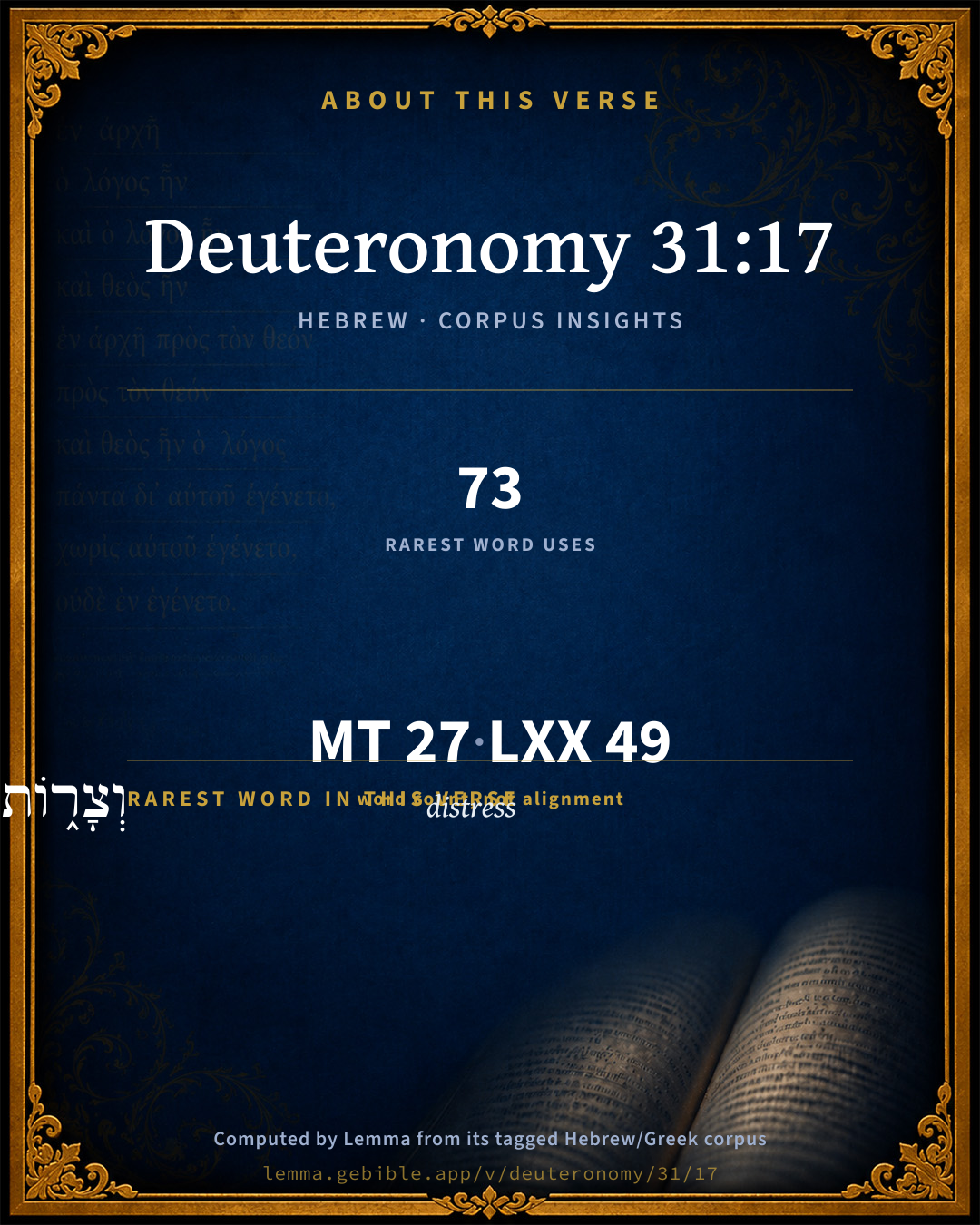
About this verse

These counts appear in no published source. They are computed here, from the morphology-tagged text and Lemma’s own curated glosses. What Lemma adds →

27
words
21
distinct lemmas
Pentateuch
section

Grammatical profile

  • 8 verbs
  • 9 nouns
  • 1 adjective
  • 3 pronouns
  • 3 prepositions
  • 1 conjunction
  • 2 particles

Verb forms

  • וְחָרָ֣ה Qal · Sequential Perfect
  • וַעֲזַבְתִּ֞ים Qal · Sequential Perfect
  • וְהִסְתַּרְתִּ֨י Hiphil · Sequential Perfect
  • וְהָיָ֣ה Qal · Sequential Perfect
  • לֶֽאֱכֹ֔ל Qal · Infinitive Construct
  • וּמְצָאֻ֛הוּ Qal · Sequential Perfect
  • וְאָמַר֙ Qal · Sequential Perfect
  • מְצָא֖וּנִי Qal · Perfect

Repetition

Words recur within this verse — often emphatic in Hebrew:

  • בַיּוֹם day H3117 ×2
  • וּמְצָאֻ֛הוּ to find H4672 ×2
  • רָע֥וֹת evil H7451 ×2
  • הַ֠הוּא he H1931 ×2

Hebrew & Septuagint length

In English translation the verse runs 59 words from the Hebrew and 59 from the Septuagint (LXX English) — the same length.

A rough comparison of the two English renderings, which tokenize alike — not a word-level alignment.

Word counts can differ between the Hebrew and the Greek without any difference in meaning — e.g. the Hebrew direct-object marker אֵת has no separate Greek word, and Greek often adds the article ὁ.

In the original languages it is 27 Hebrew tokens and 49 Greek tokens — but the two are counted differently (Hebrew bundles its prefixes and suffixes into one token; the Greek is in lemma form), so that isn’t a like-for-like length.

Cross-references

26

Topical passages linked to Deuteronomy 31:17 in the Treasury of Scripture Knowledge — connected by theme and wording, ordered by reader-vote popularity; previews shown in the World English Bible.

  • Numbers 14:42 Don't go up, for Yahweh isn't among you; that you not be struck down before your enemies.
  • Judges 6:13 Gideon said to him, Oh, my lord, if Yahweh is with us, why then has all this happened to us? and where are all his wondrous works which our fathers told us of, saying, Did not Yahweh bring us up from Egypt? but now Yahweh has cast us off, and delivered us into the hand of Midian.
  • 2 Chronicles 15:2 and he went out to meet Asa, and said to him, Hear you me, Asa, and all Judah and Benjamin: Yahweh is with you, while you are with him; and if you seek him, he will be found of you; but if you forsake him, he will forsake you.
  • Psalms 104:29 You hide your face: they are troubled; You take away their breath: they die, and return to the dust.
  • Isaiah 8:17 I will wait for Yahweh, who hides his face from the house of Jacob, and I will look for him.
  • Deuteronomy 29:24–27 even all the nations shall say, Why has Yahweh done thus to this land? what means the heat of this great anger?
  • 1 Chronicles 28:9 You, Solomon my son, know the God of your father, and serve him with a perfect heart and with a willing mind; for Yahweh searches all hearts, and understands all the imaginations of the thoughts: if you seek him, he will be found of you; but if you forsake him, he will cast you off forever.
  • Psalms 30:7 You, Yahweh, when you favored me, made my mountain to stand strong. But when you hid your face, I was troubled.
  • Isaiah 64:7 There is none who calls on your name, who stirs up himself to take hold of you; for you have hid your face from us, and have consumed us by means of our iniquities.
  • Jeremiah 23:33 When this people, or the prophet, or a priest, shall ask you, saying, What is the burden of Yahweh? then shall you tell them, What burden! I will cast you off, says Yahweh.
  • Deuteronomy 29:20 Yahweh will not pardon him, but then the anger of Yahweh and his jealousy will smoke against that man, and all the curse that is written in this book shall lie on him, and Yahweh will blot out his name from under the sky.
  • Deuteronomy 32:20–22 He said, I will hide my face from them, I will see what their end shall be: For they are a very perverse generation, Children in whom is no faithfulness.
  • Judges 2:14–15 The anger of Yahweh was kindled against Israel, and he delivered them into the hands of spoilers who despoiled them; and he sold them into the hands of their enemies round about, so that they could not any longer stand before their enemies.
  • 2 Chronicles 24:20 The Spirit of God came on Zechariah the son of Jehoiada the priest; and he stood above the people, and said to them, Thus says God, Why disobey you the commandments of Yahweh, so that you can't prosper? because you have forsaken Yahweh, he has also forsaken you.
  • Nehemiah 9:32 Now therefore, our God, the great, the mighty, and the awesome God, who keep covenant and loving kindness, don't let all the travail seem little before you, that has come on us, on our kings, on our princes, and on our priests, and on our prophets, and on our fathers, and on all your people, since the time of the kings of Assyria to this day.
  • Job 13:24 Why hide you your face, And hold me for your enemy?
  • Job 34:11 For the work of a man will he render to him, And cause every man to find according to his ways.
  • Psalms 2:12 Kiss the son, lest he be angry, and you perish in the way, For his wrath will soon be kindled. Blessed are all those who take refuge in him.
  • Psalms 27:9 Don't hide your face from me. Don't put your servant away in anger. You have been my help. Don't abandon me, Neither forsake me, God of my salvation.
  • Psalms 89:46 How long, Yahweh? Will you hide yourself forever? Will your wrath burn like fire?
  • Psalms 90:11 Who knows the power of your anger, Your wrath according to the fear that is due to you?
  • Isaiah 63:17 O Yahweh, why do you make us to err from your ways, and harden our heart from your fear? Return for your servants' sake, the tribes of your inheritance.
  • Jeremiah 23:39 therefore, behold, I will utterly forget you, and I will cast you off, and the city that I gave to you and to your fathers, away from my presence:
  • Ezekiel 39:23–24 The nations shall know that the house of Israel went into captivity for their iniquity; because they trespassed against me, and I hid my face from them: so I gave them into the hand of their adversaries, and they fell all of them by the sword.
  • Ezekiel 39:29 neither will I hide my face any more from them; for I have poured out my Spirit on the house of Israel, says the Lord Yahweh.
  • Hosea 9:12 Though they bring up their children, Yet I will bereave them, so that not a man shall be left. Indeed, woe also to them when I depart from them!

Cross-references courtesy of OpenBible.info (CC BY 4.0).

Hebrew and Greek witnesses Masoretic Hebrew ↔ Greek Septuagint

The same verse in the two great witnesses to the Old Testament, shown verse-for-verse.

These are two independent witnesses, not word-aligned to each other, and the Septuagint is shown in lemma (dictionary) form.

Hebrew Deuteronomy 31:17 Masoretic · Westminster Leningrad Codex

וְחָרָ֣ה אַפִּ֣י ב֣וֹ בַיּוֹם הַ֠הוּא וַעֲזַבְתִּ֞ים וְהִסְתַּרְתִּ֨י פָנַ֤י מֵהֶם֙ וְהָיָ֣ה לֶֽאֱכֹ֔ל וּמְצָאֻ֛הוּ רָע֥וֹת רַבּ֖וֹת וְצָר֑וֹת וְאָמַר֙ בַּיּ֣וֹם הַה֔וּא הֲלֹ֗א עַ֣ל כִּֽי אֵ֤ין אֱלֹהַי֙ בְּקִרְבִּ֔י מְצָא֖וּנִי הָרָע֥וֹת הָאֵֽלֶּה

Then my anger shall be kindled against them in that day, and I will forsake them, and I will hide my face from them, and they shall be devoured, and many evils and troubles shall come on them; so that they will say in that day, Haven't these evils come on us because our God is not among us?

World English Bible · Public Domain

Greek LXX Deuteronomy 31:17 Septuagint · lemma form

καί ὀργίζω θυμός εἰς αὐτός ἐν ὁ ἡμέρα ἐκεῖνος καί καταλείπω αὐτός καί ἀποστρέφω ὁ πρόσωπον ἐγώ ἀπό αὐτός καί εἰμί κατάβρωμα καί εὑρίσκω αὐτός κακός πολύς καί θλῖψις καί εἶπον ἐν ὁ ἡμέρα ἐκεῖνος διότι οὐ εἰμί κύριος ὁ θεός ἐγώ ἐν ἐγώ εὑρίσκω ἐγώ ὁ κακός οὗτος

And I will be very angry with them in that day, and I will leave them and turn my face away from them, and they shall be devoured; and many evils and afflictions shall come upon them; and they shall say in that day, Because the Lord my God is not with me, these evils have come upon me.

LXX2012 (modern English Septuagint) · Public Domain

On this verse, The Cambridge Bible for Schools and Colleges discusses the Septuagint’s reading. Read the note in Commentary ↓

Hebrew: Westminster Leningrad Codex (CC BY 4.0). Greek: Septuagint (public domain); English from LXX2012 (modern English Septuagint) (Public Domain). How the Septuagint differs from the Hebrew →

Targum (Aramaic paraphrase)

2

The Targum is the ancient Jewish Aramaic paraphrase of the Hebrew Scriptures — an interpretive translation, not the Hebrew text itself. Onkelos (literal) and Pseudo-Jonathan (expansive) render the Torah, and Jonathan the Prophets. Coverage is partial: where no permissively-licensed English translation exists for a verse, only the Aramaic is shown. This is verse-level text, not a word-by-word alignment to the Hebrew.

  1. Targum Onkelos Torah (Genesis–Deuteronomy)
    וְיִתְקוֹף רָגְזִי בְהוֹן בְּיוֹמָא הַהוּא וְאַרְחֵקִנוּן וֶאֱסַלֵק שְׁכִנְתִּי מִנְהוֹן וִיהוֹן לְמִבַּז וִיעָרְעַן יָתְהוֹן בִּישָׁן סַגִיאָן וְעָקָן וְיֵימַר בְּיוֹמָא הַהוּא הֲלָא מִדְלֵית שְׁכִינַת אֱלָהַי בֵּינִי עָרְעוּנִי בִּישַׁיָא הָאִלֵין

    (no public-domain English translation for this verse)

    Targum Onkelos — Aramaic: “Onkelos Genesis” (public domain); “Onkelos Exodus” (public domain); “Onkelos Leviticus” (public domain); “Onkelos Numbers” (public domain); “Onkelos Deuteronomy” (public domain). English: “Sefaria Community Translation” (CC0 1.0 (public-domain dedication)); “J.W. Etheridge. The Targums of Onkelos and Jonathan Ben Uzziel on the Pentateuch. London: Longmans, Green, 1862” (public domain). Text via Sefaria.

  2. Targum Pseudo-Jonathan Torah (Genesis–Deuteronomy)
    וְיִתְקוֹף רוּגְזִי בְּהוֹן בְּיוֹמָא הַהוּא וְאַרְחִיקִינוּן וַאֲסַלֵק שְׁכִינְתִּי מִנְהוֹן וִיהוֹן לְבִיזָא וִיאַרְעָן יַתְהוֹן בִּישָׁן סַגִיאִין וְעָקָן וְיֵימְרוּן בְּעִידָנָא הַהִיא בִּשְׁבוּעָא מְטוֹל דְלֵית שְׁכִינַת אֱלָהַי שַׁרְיָא בְּמִצְעִי אִירְעוּנִי בִּישָׁתָא הָאִלֵין

    Then My anger will be kindled against them in that day, and I shall abhor them, and remove My Shekinah from them, and they will become a prey, and many evils and troubles shall befall them. And they will say at that time, with adjuration, Is it not because the Shekinah of my God dwelleth not among me, that all these evils have befallen me?

    Targum Pseudo-Jonathan — Aramaic: “Targum Jonathan on Genesis” (public domain); “Targum Jonathan on Exodus” (public domain); “Targum Jonathan on Leviticus” (public domain); “Targum Jonathan on Numbers” (public domain); “Targum Jonathan on Deuteronomy” (public domain). English: “The Targum of Jonathan ben Uzziel, trans. J. W. Etheridge, London, 1862” (public domain). Text via Sefaria.

Commentary

Notes on Deuteronomy 31:17 from classic Christian and Jewish commentators (each source and its license shown beneath its notes). The classic Christian expositions comment on the surrounding passage and are grouped to its opening verse, so a note may address several verses; the Jewish commentaries on the Tanakh (Rashi and others) are per-verse, so they appear only where the commentator wrote on this verse.

Lemma curates 59 commentaries, every one of them public domain or Creative Commons licensed, each selected and text-cleaned for this edition rather than reprinted as found. About our sources →

Trapp's Complete Commentary

John Trapp

Deu 31:17 Then my anger shall be kindled against them in that day, and I will forsake them, and I will hide my face from them, and they shall be devoured, and many evils and troubles shall befall them; so that they will say in that day, Are not these evils come upon us, because our God [is] not among us?

Ver. 17. And many evils and troubles.] As it befell Samson and Saul, when God was gone; πονος πονω πονον φερει, all miseries came trooping and treading one in the heels of another. So Eze 9:10-11. God makes many moves, and as he goes out, some judgment comes in upon the land.

John Trapp, A Commentary or Exposition upon All the Books of the Old and New Testament (1647–1656) — public domain. Text from a community e-Sword module.

Joseph Benson's Commentary

Deu 31:17. Then my anger shall be kindled against them — So it was upon their first defection to idolatry, (Jdg 2:14,) and so it continued to be in all ages, as we read in that and the following sacred books. I will hide my face from them — A metaphor borrowed from kings, who will not allow those who have offended them to come into their presence and see their face. It signifies, I will withdraw my favour and my help. Whatever outward troubles we are in, if we have but the light of God’s countenance, we are safe. But if God hide his face from us, then we are undone. Are not these evils come upon us because God is not among us? — Here we see the true source of most national, domestic, and personal troubles, the absence of God, or his withdrawing his power, protection, and blessing. This made so remarkable a change in their affairs, that it could not but at last make them reflect on the cause of it. See Jdg 3:9-15; Jdg 4:3.

Joseph Benson's Commentary on the Old and New Testaments (1811–1818) — public domain. Text from a community e-Sword module.

Geneva Bible (1599)

Geneva Bible translators

That is, I will take my favor from them: as to turn his face toward us, is to show us his favor.

Geneva Bible (1599) marginal notes — public domain. Text via Bolls.life.

Jamieson, Fausset & Brown

Robert Jamieson, A. R. Fausset & David Brown

Then my anger shall be kindled, . . . and I will hide my face from them--an announcement of the withdrawal of the divine favor and protection of which the Shekinah was the symbol and pledge. It never appeared in the second temple; and its non-appearance was a prelude of "all the evils that came upon them, because their God was not among them."

Jamieson, Fausset & Brown — Commentary Critical and Explanatory on the Whole Bible (1871) — public domain (CC PDM 1.0). Text via the HelloAO Bible API.

Ellicott's Commentary for English Readers

(17) Are not these evils come upon us, because our God is not among us?—A confession made freely by them at this present day.

A Bible Commentary for English Readers, edited by Charles John Ellicott (1878–1897) — public domain. Text from a community e-Sword module.

The Cambridge Bible for Schools and Colleges

gen. ed. J. J. S. Perowne

17. None of the clauses in this v. is characteristic of Deut. My anger shall be kindled against it, JE, Num_11:10; for in that day, as Dillm. points out, Deut. has elsewhere at that time; I will forsake them, contrast Deu_31:6; Deu_31:8, Deu_4:31; hide my face from them, in Pent. only here and Deu_31:18; it shall be devoured, cp. Deu_7:16; come upon me because my God is not in my midst, Deu_1:42. Note that in Deu_31:16-18; Deu_31:20 Israel is referred to in the Sg. Yet Sam. and LXX have many plurals here.

The Cambridge Bible for Schools and Colleges (gen. ed. J. J. S. Perowne; Cambridge University Press, 1878–1918) — public domain. Text from a community e-Sword module.

John Gill's Exposition

I will surely hide my face in that day,.... Which is repeated for the certainty of it, and that it might be taken notice of; that he was the spring and source of all their good things, their sun and their shield, who being withdrawn from them, they would be deprived of every thing that was good, and be liable to all evil; and this he would do:

for all the evils which they shall have wrought; for all the immoralities they should be guilty of, every transgression of his law, whether of the first or second table, and especially idolatry:

in that they are turned unto other gods; to the worship and service of them, which of all evils would be the most provoking to God; and the way of speaking suggests as if all evils were included in idolatry, and sprang from it, or were committed with it.

John Gill's Exposition of the Whole Bible (1746–1763) — public domain (CC PDM 1.0). Text via the HelloAO Bible API.

Haydock's Catholic Bible Commentary

My face, as one indignant and much displeased. (Calmet) --- I will withdraw my special protection and favours from them. (Menochius)

George Leo Haydock (1774–1849), Haydock's Catholic Family Bible and Commentary, 1859 edition — public domain. Excludes Psalms (Douay-Rheims chapter numbering differs from Protestant) and Deuterocanonical books (Catholic canon only).

Matthew Poole's English Annotations

Hide my face, i.e. withdraw my favour and help.

Matthew Poole's English Annotations on the Holy Bible (1683–1685) — public domain. Text from a community e-Sword/MySword module.

The Pulpit Commentary

I will hide my face from them; will not look on them with complacency, will withdraw from them my favor and help. (cf. Deu_32:20; Isa_8:17 Isa_64:7; Eze_39:23)

The Pulpit Commentary (1880–1919), ed. H.D.M. Spence-Jones & Joseph S. Exell — public domain. Text from a community e-Sword module.

John Wesley's Explanatory Notes

Hide my face - Withdraw my favour and help. Whatever outward troubles we are in if we have but the light of God's countenance, we are safe. But if God hide his face from us then we are undone.

John Wesley, Explanatory Notes Upon the Whole Bible (1754–1765) — public domain. Text via the GEBible commentary corpus.

unfoldingWord translationNotes

Door43 World Missions Community

General Information:

Yahweh continues speaking to Moses.

my anger will be kindled against them

Yahweh compares his anger to someone starting a fire. This emphasizes God's power to destroy whatever makes him angry. This can be stated in active form. AT: "I will kindle my anger against them" or "I will become angry with them" (See: Metaphor and Active or Passive)

I will hide my face from them

This is an idiom. AT: "I will not help them" (See: Idiom)

they will be devoured

This can be stated in active form. AT: "I will devour them" or "I will allow their enemies to devour them" (See: Active or Passive)

devoured

This is a metaphor for "completely destroyed." (See: Metaphor)

Many disasters and troubles will find them

This describes the disasters and troubles as if they were human. AT: "They will experience many disasters and troubles" (See: Personification)

Have these disasters not come upon us ... midst?

This describes the disasters and troubles as if they were human. This rhetorical question can be translated as a statement. AT: "These disasters are destroying me ... midst." (See: Personification and Rhetorical Question)

our God is not in our midst

"God is no longer protecting us" or "God has left us alone"

translationWords

anger

face

devour

trouble

God

evil

false god

unfoldingWord translationNotes — © Distant Shores Media and the Door43 World Missions Community, licensed CC BY-SA 4.0. Source: git.door43.org/Door43/en_tn.

Rashi

Rabbi Shlomo Yitzchaki (Rashi)

והסתרתי פני AND I WILL HIDE MY FACE FROM THEM, as though I do not see their distress.

Rashi on the Tanakh — English translations: “The Judaica Press complete Tanach with Rashi, translated by A. J. Rosenberg” (CC BY 4.0); “Pentateuch with Rashi's commentary by M. Rosenbaum and A.M. Silbermann, 1929-1934” (public domain); “The Metsudah Tanach series, Lakewood, N.J” (CC BY 4.0); and “The Book of Joshua, Metsudah Publications, 1997” (CC BY 4.0). Text via Sefaria.

Ramban (Nachmanides)

Rabbi Moshe ben Nachman (Ramban / Nachmanides)

AND THEY WILL SAY IN THAT DAY: ARE NOT THESE EVILS COME UPON US BECAUSE OUR G-D IS NOT AMONG US? This is not a total confession like [the confession in the verse] And they shall confess their iniquity, but it is a reflection and a regret. They will feel sorry for their iniquity and recognize that they are guilty.

Ramban (Nachmanides) on the Tanakh — English translation: “Commentary on the Torah by Ramban (Nachmanides). Translated and annotated by Charles B. Chavel. New York, Shilo Pub. House, 1971-1976” (CC BY 4.0). Text via Sefaria.

Sforno

Rabbi Ovadia Sforno

And I will forsake them. To those who will destroy the Beis HaMikdosh, who will overpower them.

And I shall conceal My face from them. I will close My eyes of mercy from them, as if I do not see their suffering.

Because my God is not within me. This has happened to us because He has removed His Divine Presence from our midst. When they realize this they will not turn to Him in prayer, nor repent before Him.

Sforno on the Tanakh — English translation: “Yalkut, Sifsei Chachomim Chumash, Metsudah Publications, 2009” (CC BY 4.0). Text via Sefaria.

Lesson kit

Teaching starters — assembled from the data on this page, not authored interpretation. Every prompt links to the verse data it draws on. Edit before teaching.

Deuteronomy, in the Pentateuch, opens this verse with 27 words (21 distinct Hebrew lemmas). Its most distinctive word is tsârâh (“distress”). A historical commentator’s framing appears above. Read the whole chapter for the surrounding context.

Discussion questions

  1. How does “distress” (tsârâh) shape what this verse is saying?
  2. How does Numbers 14:42, which shares this passage’s theme, read alongside this verse?
  3. What does the repetition of “day” (2× in this one verse) do in this verse?
  4. The translations on this page render this verse differently — a whole-verse word diff, not a word-by-word alignment. What might account for the different wordings?
  5. «וְחָרָ֣ה» is a Qal Sequential Perfect verb. How does that grammatical form shape the action described?
  6. Compare how Trapp's Complete Commentary and Joseph Benson's Commentary read this verse. Where do they agree or differ?

Things to notice

Reading settings

Reading text

Shown beneath each verse's original-language words.

Old Testament
Old Testament edition

Read the OT as the Masoretic Hebrew (MT) or the Greek Septuagint (LXX).

English shown for the Greek Septuagint (in the Hebrew ↔ Greek comparison).

Comparing translations? Open the Compare panel on any verse page to stack up to four side by side.