
1 Samuel 19:11

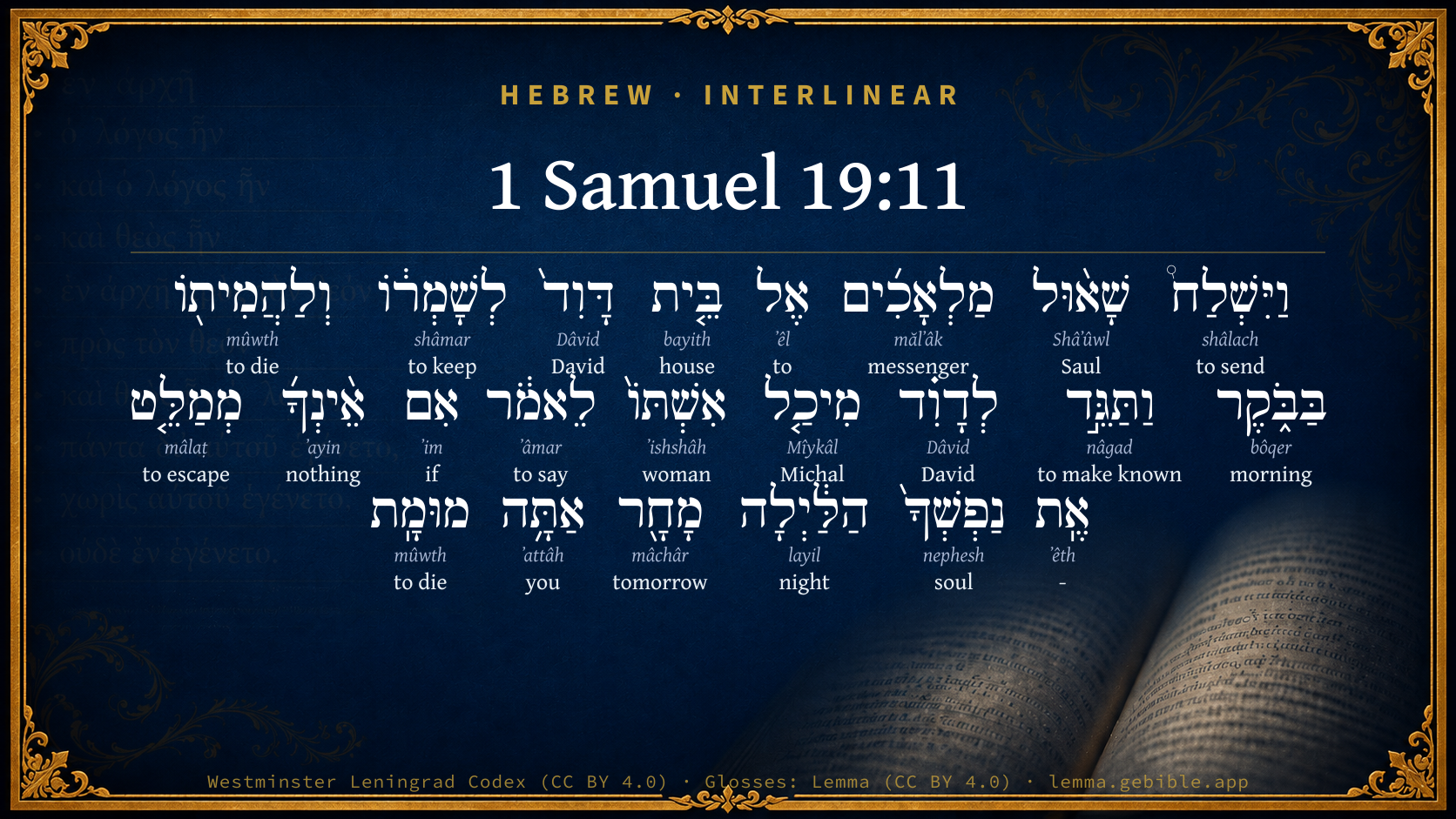
Hebrew (Westminster Leningrad Codex) 1 Samuel 19:11 appears in the Hebrew Old Testament. The text above is from the Westminster Leningrad Codex. Each word links to its Strong’s number, a concise gloss, and parsing drawn from the Open Scriptures Hebrew Bible morphology. Click any word for its full Brown-Driver-Briggs (BDB) entry.
Download image
Cite this verse

1 Samuel 19:11 (World English Bible). Public Domain. Lemma interlinear Bible study tool, https://lemma.gebible.app/v/1-samuel/19/11.

Show BibTeX & RIS
BibTeX
RIS
English Translation
Saul sent messengers to David's house, to watch him, and to kill him in the morning: and Michal, David's wife, told him, saying, If you don't save your life tonight, tomorrow you will be slain.
World English Bible · Public Domain
Download a study sheet

One document with this verse’s original text, its word-by-word gloss line, the meaning frame, cross-references with their text, attributed commentary, and full source and license credits — printable, and it pastes into notes with its structure intact.

This verse Autodidact and up

Study sheet (.html) Plain text (.txt)

A passage Seminary Student

Up to 50 verses in one chapter. A passage sheet keeps up to 6 commentary sources and 12 cross-references per verse, in the order this page ranks them, and says so on the sheet whenever that leaves anything out. Ask for a single verse and you get the Autodidact verse sheet above.

Everything on this page stays free to read, with no account — the sheet is a download of what is already on screen, not access to it.

Want to remove ads? Support Godless Engineer
Compare translations 3

The same verse in 3 English versions, stacked beneath the original-language interlinear above. Click any original word for its lexicon entry.

Each is an independent rendering of the whole verse — the interlinear is not word-aligned to these translations.

Highlighted words mark where these versions differ — a whole-verse word diff, not a word-by-word alignment.

  • World English Bible Public Domain
    Saul sent messengers to David's house, to watch him, and to kill him in the morning: and Michal, David's wife, told him, saying, If you don't save your life tonight, tomorrow you will be slain.
  • King James Version Public Domain
    Saul also sent messengers unto David's house, to watch him, and to slay him in the morning: and Michal David's wife told him, saying, If thou save not thy life to night, to morrow thou shalt be slain.
  • unfoldingWord Literal Text CC BY-SA 4.0
    And Saul sent messengers to the house of David to watch him and to kill him in the morning. And Michal his wife declared to David, saying, “If you are not rescuing your life tonight, tomorrow you will be being killed.”

unfoldingWord Literal Text — © unfoldingWord, licensed CC BY-SA 4.0. Word-aligned USFM3 via Door43 (git.door43.org/unfoldingWord/en_ult).

Versions to compare (up to 4)

3 of 4 selected

Show all 18 translations

Every available English version of this verse, each an independent rendering of the whole verse.

  • World English Bible Public Domain
    Saul sent messengers to David's house, to watch him, and to kill him in the morning: and Michal, David's wife, told him, saying, If you don't save your life tonight, tomorrow you will be slain.
  • Berean Standard Bible Public Domain
    Then Saul sent messengers to David’s house to watch him and kill him in the morning. But David’s wife Michal warned him, “If you do not run for your life tonight, tomorrow you will be dead!”
  • Majority Standard Bible Public Domain
    Then Saul sent messengers to David’s house to watch him and kill him in the morning. But David’s wife Michal warned him, “If you do not run for your life tonight, tomorrow you will be dead!”
  • King James Version Public Domain
    Saul also sent messengers unto David's house, to watch him, and to slay him in the morning: and Michal David's wife told him, saying, If thou save not thy life to night, to morrow thou shalt be slain.
  • American Standard Version (1901) Public Domain
    And Saul sent messengers unto David's house, to watch him, and to slay him in the morning: and Michal, David's wife, told him, saying, If thou save not thy life to-night, to-morrow thou wilt be slain.
  • Revised Version (1885) Public Domain
    And Saul sent messengers unto David’s house, to watch him, and to slay him in the morning: and Michal David’s wife told him, saying, If thou save not thy life to-night, tomorrow thou shalt be slain.
  • Geneva Bible (1599) Public Domain
    Saul also sent messengers vnto Dauids house, to watch him, and to slay him in the morning: and Michal Dauids wife told it him, saying, If thou saue not thy selfe this night, to morowe thou shalt be slayne.
  • Douay-Rheims (1899) Public Domain
    Saul therefore sent his guards to David's house to watch him, that he might be killed in the morning. And when Michol David's wife had told him this, saying: Unless thou save thyself this night, to morrow thou wilt die,
  • Young's Literal Translation Public Domain
    And Saul sendeth messengers unto the house of David to watch him, and to put him to death in the morning; and Michal his wife declareth to David, saying, `If thou art not delivering thy life to-night -- tomorrow thou art put to death.'
  • Literal Standard Version CC BY-SA 4.0
    And Saul sends messengers to the house of David to watch him, and to put him to death in the morning; and his wife Michal declares [it] to David, saying, “If you are not delivering your life tonight—tomorrow you are put to death.”
  • Unlocked Literal Bible CC BY-SA 4.0
    Saul sent messengers to David's house to watch him that he might kill him in the morning. Michal, David's wife, told him, “If you do not save your life tonight, tomorrow you will be killed.”
  • unfoldingWord Literal Text CC BY-SA 4.0
    And Saul sent messengers to the house of David to watch him and to kill him in the morning. And Michal his wife declared to David, saying, “If you are not rescuing your life tonight, tomorrow you will be being killed.”
  • Darby Bible Public Domain
    And Saul sent messengers to David's house, to watch him, and to slay him in the morning; and Michal David's wife told him, saying, If thou save not thy life to-night, to-morrow thou wilt be put to death.
  • World Messianic Bible Public Domain
    Saul sent messengers to David’s house to watch him and to kill him in the morning. Michal, David’s wife, told him, saying, “If you don’t save your life tonight, tomorrow you will be killed.”
  • Webster's Bible Public Domain
    Saul also sent messengers to David's house, to watch him, and to slay him in the morning: and Michal, David's wife, told him, saying, If thou dost not save thy life to-night, to-morrow thou wilt be slain.
  • Free Bible Version CC BY-SA 4.0
    Saul sent some messengers to David's house to keep watch and kill him in the morning. But Michal, David's wife, warned him, “If you don't get away tonight, tomorrow you'll be killed.”
  • Bible in Basic English Public Domain
    Then in that night Saul sent men to David's house to keep watch on him so as to put him to death in the morning: and David's wife Michal said to him, If you do not go away to a safe place tonight you will be put to death in the morning.
  • JPS Tanakh (1917) Public Domain
    And Saul sent messengers unto David's house, to watch him, and to slay him in the morning; and Michal David's wife told him, saying: 'If thou save not thy life to-night, to-morrow thou shalt be slain.'

Literal Standard Version (2020), Covenant Press — licensed CC BY-SA 4.0. Text via the HelloAO Bible API (eBible.org). Unlocked Literal Bible (unfoldingWord) — licensed CC BY-SA 4.0. Text via the HelloAO Bible API (eBible.org). unfoldingWord Literal Text — © unfoldingWord, licensed CC BY-SA 4.0. Word-aligned USFM3 via Door43 (git.door43.org/unfoldingWord/en_ult). Free Bible Version, Dr. Jonathan Gallagher — licensed CC BY-SA 4.0. Text via the HelloAO Bible API (eBible.org).

Word by word

More ways to search: Search by grammar → Find every occurrence → Compare this word →

Practice this passage: Drill this verse → Learn its vocabulary →

מִיכַ֤ל
Mîykâl
H4324
“Michal”
Noun, Proper
Part of Speech
Noun
Type
Proper
Full BDB Definition

Origin: apparently the same as H4323

TWOT: None

Michal = "who is like God" - daughter of king Saul, sister of Jonathan, wife of king David, and mother of five; given to David as wife for the bride price of 100 Philistine foreskins; while still married to David, her father gave her in marriage to another, Phaltiel; at the death of Saul, David forced her to return
  1. וַיִּשְׁלַח֩ shâlach H7971 “and · to send” Conjunction + Verb, Qal, Sequential Imperfect, 3rd Person, Masculine, Singular
  2. שָׁא֨וּל Shâʼûwl H7586 “Saul” Noun, Proper
  3. מַלְאָכִ֜ים mălʼâk H4397 “messengers” Noun, Common, Masculine, Plural, Absolute
  4. אֶל ʼêl H413 “to” Preposition
  5. בֵּ֤ית bayith H1004 “house of” Noun, Common, Masculine, Singular, Construct
  6. דָּוִד֙ Dâvid H1732 “David” Noun, Proper
  7. לְשָׁמְר֔וֹ shâmar H8104 “to keep · him” Preposition + Verb, Qal, Infinitive Construct + Suffix, Personal, 3rd Person, Masculine, Singular
  8. וְלַהֲמִית֖וֹ mûwth H4191 “and · to die · him” Conjunction + Preposition + Verb, Hiphil, Infinitive Construct + Suffix, Personal, 3rd Person, Masculine, Singular
  9. בַּבֹּ֑קֶר bôqer H1242 “in/at the · morning” Preposition, Determined + Noun, Common, Masculine, Singular, Absolute
  10. וַתַּגֵּ֣ד nâgad H5046 “and · to make known” Conjunction + Verb, Hiphil, Sequential Imperfect, 3rd Person, Feminine, Singular
  11. לְדָוִ֗ד Dâvid H1732 “to/for · David” Preposition + Noun, Proper
  12. אִשְׁתּוֹ֙ ʼishshâh H802 “woman · his” Noun, Common, Feminine, Singular, Construct + Suffix, Personal, 3rd Person, Masculine, Singular
  13. לֵאמֹ֔ר ʼâmar H559 “to say” Preposition + Verb, Qal, Infinitive Construct
  14. אִם ʼim H518 “if” Conjunction
  15. אֵ֨ינְךָ֜ ʼayin H369 “nothing · you” Particle, Negative + Suffix, Personal, 2nd Person, Masculine, Singular
  16. מְמַלֵּ֤ט mâlaṭ H4422 “escaping” Verb, Piel, Participle Active, Masculine, Singular, Absolute
  17. אֶֽת ʼêth H853 “-” Particle, Direct Object
  18. נַפְשְׁךָ֙ nephesh H5315 “soul · your” Noun, Common, Both, Singular, Construct + Suffix, Personal, 2nd Person, Masculine, Singular
  19. הַלַּ֔יְלָה layil H3915 “the · night” Particle, Definite Article + Noun, Common, Masculine, Singular, Absolute
  20. מָחָ֖ר mâchâr H4279 “tomorrow” Noun, Common, Masculine, Singular, Absolute
  21. אַתָּ֥ה ʼattâh H859 “you” Pronoun, Personal, 2nd Person, Masculine, Singular
  22. מוּמָֽת mûwth H4191 “died” Verb, Hophal, Participle Passive, Masculine, Singular, Absolute

About this verse

These counts appear in no published source. They are computed here, from the morphology-tagged text and Lemma’s own curated glosses. What Lemma adds →

23
words
21
distinct lemmas
Historical
section

Notable vocabulary

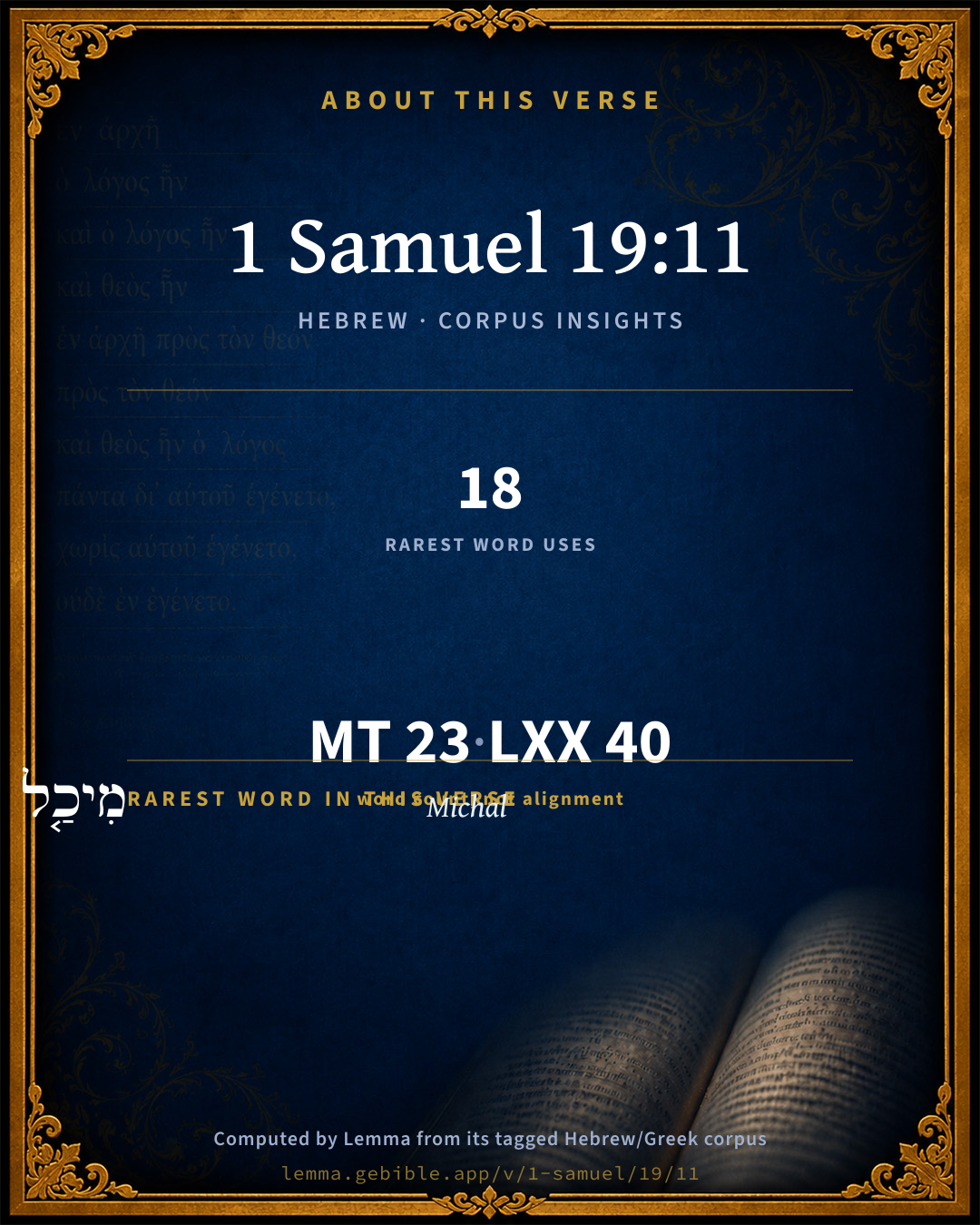
The rarest word here is מִיכַ֤ל Michal H4324 — appearing just 18 times in the whole Hebrew Bible.

Shared distinctive vocabulary

מִיכַ֤ל Michal H4324 occurs in 17 verses of the Hebrew Bible. Also found in:

Grammatical profile

  • 7 verbs
  • 11 nouns
  • 1 pronoun
  • 1 preposition
  • 1 conjunction
  • 2 particles

Verb forms

  • וַיִּשְׁלַח֩ Qal · Sequential Imperfect
  • לְשָׁמְר֔וֹ Qal · Infinitive Construct
  • וְלַהֲמִית֖וֹ Hiphil · Infinitive Construct
  • וַתַּגֵּ֣ד Hiphil · Sequential Imperfect
  • לֵאמֹ֔ר Qal · Infinitive Construct
  • מְמַלֵּ֤ט Piel · Participle Active
  • מוּמָֽת Hophal · Participle Passive

Repetition

Words recur within this verse — often emphatic in Hebrew:

  • דָּוִד֙ David H1732 ×2
  • וְלַהֲמִית֖וֹ to die H4191 ×2

Hebrew & Septuagint length

In English translation the verse runs 35 words from the Hebrew and 47 from the Septuagint (LXX English) — closely comparable.

A rough comparison of the two English renderings, which tokenize alike — not a word-level alignment.

Word counts can differ between the Hebrew and the Greek without any difference in meaning — e.g. the Hebrew direct-object marker אֵת has no separate Greek word, and Greek often adds the article ὁ.

In the original languages it is 23 Hebrew tokens and 40 Greek tokens — but the two are counted differently (Hebrew bundles its prefixes and suffixes into one token; the Greek is in lemma form), so that isn’t a like-for-like length.

Cross-references

2

Topical passages linked to 1 Samuel 19:11 in the Treasury of Scripture Knowledge — connected by theme and wording, ordered by reader-vote popularity; previews shown in the World English Bible.

  • Psalms 59:1–17 Deliver me from my enemies, my God. Set me on high from those who rise up against me.
  • Judges 16:2 [It was told] the Gazites, saying, Samson is come here. They compassed him in, and laid wait for him all night in the gate of the city, and were quiet all the night, saying, [Let be] until morning light, then we will kill him.

Cross-references courtesy of OpenBible.info (CC BY 4.0).

Hebrew and Greek witnesses Masoretic Hebrew ↔ Greek Septuagint

The same verse in the two great witnesses to the Old Testament, shown verse-for-verse.

These are two independent witnesses, not word-aligned to each other, and the Septuagint is shown in lemma (dictionary) form.

Hebrew 1 Samuel 19:11 Masoretic · Westminster Leningrad Codex

וַיִּשְׁלַח֩ שָׁא֨וּל מַלְאָכִ֜ים אֶל בֵּ֤ית דָּוִד֙ לְשָׁמְר֔וֹ וְלַהֲמִית֖וֹ בַּבֹּ֑קֶר וַתַּגֵּ֣ד לְדָוִ֗ד מִיכַ֤ל אִשְׁתּוֹ֙ לֵאמֹ֔ר אִם אֵ֨ינְךָ֜ מְמַלֵּ֤ט אֶֽת נַפְשְׁךָ֙ הַלַּ֔יְלָה מָחָ֖ר אַתָּ֥ה מוּמָֽת

Saul sent messengers to David's house, to watch him, and to kill him in the morning: and Michal, David's wife, told him, saying, If you don't save your life tonight, tomorrow you will be slain.

World English Bible · Public Domain

Greek LXX 1 Samuel 19:11 Septuagint · lemma form

καί γίγνομαι ἐν ὁ νύξ ἐκεῖνος καί ἀποστέλλω σαούλ ἄγγελος εἰς οἶκος δαυίδ φυλάσσω αὐτός ὁ θανατόω αὐτός πρωΐ καί ἀποἀγγέλλω ὁ δαυίδ μελχολ ὁ γυνή αὐτός λέγω ἐάν μή σύ σώζω ὁ ψυχή σεαυτοῦ ὁ νύξ οὗτος αὔριον θανατόω

And it came to pass in that night, that Saul sent messengers to the house of David to watch him, in order to kill him in the morning; and Melchol David's wife told him, saying, Unless you save your life this night, to-morrow you shall be slain.

LXX2012 (modern English Septuagint) · Public Domain

Hebrew: Westminster Leningrad Codex (CC BY 4.0). Greek: Septuagint (public domain); English from LXX2012 (modern English Septuagint) (Public Domain). How the Septuagint differs from the Hebrew →

Targum (Aramaic paraphrase)

1

The Targum is the ancient Jewish Aramaic paraphrase of the Hebrew Scriptures — an interpretive translation, not the Hebrew text itself. Onkelos (literal) and Pseudo-Jonathan (expansive) render the Torah, and Jonathan the Prophets. Coverage is partial: where no permissively-licensed English translation exists for a verse, only the Aramaic is shown. This is verse-level text, not a word-by-word alignment to the Hebrew.

  1. Targum Jonathan Prophets (Joshua–Malachi)
    וּשְׁלַח שָׁאוּל אִזְגַדִין לְוַת בֵּית דָוִד לְמִטְרֵיהּ וּלְמִקְטְלֵיהּ בְּצַפְרָא וְחַוִיאַת לְדָוִד מִיכַל אִתְּתֵיהּ לְמֵימַר אִם לֵיתָךְ מְשֵׁיזִיב יַת נַפְשָׁךְ בְּלֵילְיָא מְחָר אַתְּ מִתְקְטֵל:

    (no public-domain English translation for this verse)

    Targum Jonathan — Aramaic: “Mikraot Gedolot” (public domain). English: “Sefaria Community Translation” (CC0 1.0 (public-domain dedication)); “London "Chaldee Paraphrase," 1871” (public domain). Text via Sefaria.

Commentary

Notes on 1 Samuel 19:11 from classic Christian and Jewish commentators (each source and its license shown beneath its notes). The classic Christian expositions comment on the surrounding passage and are grouped to its opening verse, so a note may address several verses; the Jewish commentaries on the Tanakh (Rashi and others) are per-verse, so they appear only where the commentator wrote on this verse.

Lemma curates 59 commentaries, every one of them public domain or Creative Commons licensed, each selected and text-cleaned for this edition rather than reprinted as found. About our sources →

Matthew Henry's Commentary

Here is, I. Saul's further design of mischief to David. When David had escaped the javelin, supposing he went straight to his own house, as indeed he did, Saul sent some of his guards after him to lay wait at the door of his house, and to assassinate him in the morning as soon as he stirred out, Sa1 19:11. Josephus says the design was to seize him and to hurry him before a court of justice that was ordered to condemn him and put him to death as a traitor; but we are here told it was a shorter way they were to take with him: they were ordered to slay him. Well might David complain that his enemies were bloody men, as he did in the psalm which he penned at this time, and upon this occasion (Ps. 59), when Saul sent, and they watched the house to kill him. See Sa1 19:2, Sa1 19:3, and Sa1 19:7. He complains that swords were in their lips.

II. David's wonderful deliverance out of this danger. Michal was the instrument of it, whom Saul gave him to be a snare to him, but she proved to be his protector and helper. Often is the devil out-shot with his own bow. How Michal came to know the danger her husband was in does not appear; perhaps she had notice sent her from court, or rather was herself aware of the soldiers about the house, when they were going to bed, though they kept so still and silent that they said, Who dost hear? which David takes notice of, Psa 59:7. She, knowing her father's great indignation at David, soon suspected the design, and bestirred herself for her husband's safety. 1. She got David out of the danger. She told him how imminent the peril was (Sa1 19:11): Tomorrow thou wilt be slain. As Josephus paraphrases it, she told him that if the sun saw him there next morning it would never see him more; and then put him in a way of escape. David himself was better versed in the art of fighting than of flying, and had it been lawful it would have been easy for him to have cleared his house, by dint of sword, from those that haunted it; but Michal let him down through a window (Sa1 19:12), all the doors being guarded; and so he fled and escaped. And now it was that, either in his own closet before he went or in the hiding-place to which he fled, he penned that fifty-ninth Psalm, which shows that, in his fright and hurry, his mind was composed, and, in this great danger, his faith was strong and fixed on God; and, whereas the plot was to slay him in the morning, he speaks there with the greatest assurance (Sa1 19:16), I will sing aloud of thy mercy in the morning. 2. She practised a deception upon Saul and those whom he employed to be the instruments of his cruelty. When the doors of the house were opened in the morning, and David did not appear, the messengers would search the house for him, and did so. But Michal told them he was sick in bed (Sa1 19:14), and, if they would not believe her, they might see, for (Sa1 19:13) she had put a wooden image in the bed, and wrapped it up close and warm as if it had been David asleep, not in a condition to be spoken to; the goats' hair about the image was to resemble David's hair, the better to impose upon them. Michal can by no means be justified in telling a lie, and covering it thus with a cheat. God's truth needed not her lie. But she intended hereby to keep Saul in suspense for a while, that David might have some time to secure himself, not doubting but those messengers would pursue him if they found he had gone. The messengers had so much humanity as not to offer him any disturbance when they heard he was sick; for to those that are in this misery pity should be shown; but Saul, when he heard it, gave positive orders that he should be brought to him sick or well: Bring him to me in the bed, that I may slay him, Sa1 19:15. It was base and barbarous thus to triumph over a sick man; and to vow the death of one who for aught that he knew was dying by the hand of nature. So earnestly did he thirst after his blood, and so greedy was his revenge, that he could not be pleased to see him dead, unless he himself was the death of him; though awhile ago he had said, Let not my hand be upon him. Thus when men lay the reins on the neck of their passions they grow more and more outrageous. When the messengers were sent again, the cheat was discovered, Sa1 19:16. But by this time it was to be hoped that David was safe, and therefore Michal was not then much concerned at the discovery. Saul chid her for helping David to escape (Sa1 19:17): Why hast thou deceived me so? What a base spirit was Saul of, to expect that, because Michal was his daughter, she must therefore betray her own husband to him unjustly. Ought she not to forsake and forget her father and her father's house, to cleave to her husband? Those that themselves will be held by no bonds of reason or religion are ready to think that others should as easily break those bonds. In answer to Saul's chiding, Michal is not so careful of her husband's reputation as she had been of his person, when she makes this her excuse: He said, Let me go, why should I kill thee? As her insinuating that she would have hindered his flight was false (it was she that put him upon it and furthered it), so it was an unjust unworthy reflection upon him to suggest that he threatened to kill her if she would not let him go, and might confirm Saul in his rage against him. David was far from being so barbarous a man and so imperious a husband, so brutish in his resolves and so haughty in his menaces, as she here represented him. But David suffered both from friends and foes, and so did the son of David.

Matthew Henry's Commentary on the Whole Bible (1708–1710) — public domain (CC PDM 1.0). Text via the HelloAO Bible API.

Trapp's Complete Commentary

John Trapp

1Sa 19:11 Saul also sent messengers unto David’s house, to watch him, and to slay him in the morning: and Michal David’s wife told him, saying, If thou save not thy life to night, to morrow thou shalt be slain.

Ver. 11. To watch him, and to slay him in the morning.] When he thought they might do it with less noise and less resistance than in the night. Josephus saith {a} that Saul had appointed judges to sit upon him that morning, and to condemn him for a traitor: as our Richard III dealt by the Lord Hastings, whom he hastily executed.

And Michal, David’s wife, told him.] She might haply hear of that murderous design by some friend: or she might see the assassins about the house by night. And although she had little religion in her, yet nature had taught her to prefer a husband to a father. Man and wife are as the two branches in the prophet Ezekiel’s hand, enclosed in one bark, and so closing together that they make but one piece: they should therefore mutually seek the preservation and good one of another. Mary, queen of Hungary, showed the like kindness to her husband Sigismund, who was afterwards chosen Emperor of Germany, A.D. 1411, but so did not Mary, queen of Scots.

{a} Lib. v. cap. 14.

John Trapp, A Commentary or Exposition upon All the Books of the Old and New Testament (1647–1656) — public domain. Text from a community e-Sword module.

Joseph Benson's Commentary

1Sa 19:11. To slay him in the morning — As he went out of the door of his house. By this it is apparent, when Saul missed his blow, he was the more enraged, and implacably pursued David’s destruction. And Michal, David’s wife, told him — She had intelligence either from her brother Jonathan, or some other friend at court: or, perhaps, she saw suspicious persons hovering about the house.

Joseph Benson's Commentary on the Old and New Testaments (1811–1818) — public domain. Text from a community e-Sword module.

Tyndale Open Study Notes

Tyndale Open Resources

19:11 See Ps 59:title.

Tyndale Open Study Notes — © Tyndale Open Resources, licensed CC BY-SA 4.0. Text via the HelloAO Bible API.

Jamieson, Fausset & Brown

Robert Jamieson, A. R. Fausset & David Brown

Saul sent messengers unto David's house, to watch him, and to slay him--The fear of causing a commotion in the town, or favoring his escape in the darkness, seemed to have influenced the king in ordering them to patrol till the morning. This infatuation was overruled by Providence to favor David's escape; for his wife, secretly apprised by Jonathan, who was aware of the design, or by spying persons in court livery watching the gate, let him down through a window (see on Jos 2:15).

Jamieson, Fausset & Brown — Commentary Critical and Explanatory on the Whole Bible (1871) — public domain (CC PDM 1.0). Text via the HelloAO Bible API.

Adam Clarke's Commentary

Verse 11. To slay him in the morning] When they might be able to distinguish between him and Michal his wife; for, had they attempted his life in the night season, there would have been some danger to Michal's life. Besides, Saul wished to represent him as a traitor; and consequently an attack upon him was justifiable at any time, even in the fullest daylight.

Adam Clarke's Commentary on the Bible (1810–1826) — public domain. Text from a community e-Sword/MySword module.

The Cambridge Bible for Schools and Colleges

gen. ed. J. J. S. Perowne

11. in the morning] As he left his house. Cp. Jdg_16:2. “We may guess that only the fear of alarming the town, and of rousing the people to rescue their favourite hero, prevented him from directing them to break into the house, and to slay David there.” Kitto’s Bibl. Illustr.

Psalms 59 is referred by its title to the present occasion. If this is correct, the Psalm supplements the history, shewing that David was in danger not from Saul only, but from ruffians among Saul’s followers who prowled about the streets of Gibeah threatening his life.

The Cambridge Bible for Schools and Colleges (gen. ed. J. J. S. Perowne; Cambridge University Press, 1878–1918) — public domain. Text from a community e-Sword module.

John Gill's Exposition

And Saul sent messengers unto David's house,.... Supposing that he was gone thither; where this was is not said, very likely in Gibeah, where Saul lived:

to watch him; that he might not get out from thence in the night:

and to slay him in the morning; the reason why he did not order them to break into the house, and slay him at once, but wait till morning, seems to be, lest should he be alarmed by their breaking in, he might take the advantage of the night, and easily escape, or another person through mistake might be slain for him; and therefore, that they might be sure of him, they were to watch till it was broad daylight, when they could not well miss him. Josephus (d) says, the orders to watch him until morning were, that he might be taken and brought to a court of judicature, and be condemned and put to death, which was usually held in a morning; but Saul's orders to the messengers were to put him to death themselves, and he had no notion of dealing with him according to a formal process of judgment:

and Michal, David's wife, told him, saying, if thou save not thy life tonight, tomorrow thou shalt be slain; meaning, if he did not take the benefit and advantage of the night to make his escape, he would not be able to do it in the morning; the house being so beset, as she perceived, by persons whom she might suspect were sent by Saul to destroy him, knowing the ill will her father bore to him, or a messenger at the same time might be dispatched to her, either from her brother Jonathan, or from one of her friends at court, acquainting her with the design against David, and the danger he was in. Upon this occasion David penned the fifty ninth psalm, see Psa 59:1.

(d) Antiqu. l. 6. c. 11. sect. 4.

John Gill's Exposition of the Whole Bible (1746–1763) — public domain (CC PDM 1.0). Text via the HelloAO Bible API.

Albert Barnes' Notes on the Bible

Saul’s plan was to surround the house at night, and to have David killed as soon as he came abroad unsuspectingly in the morning.

Albert Barnes' Notes on the Bible (1834–1885) — public domain. Text from a community e-Sword/MySword module.

Haydock's Catholic Bible Commentary

Morning, fearing lest they might miss him in the night, (Salien) and perhaps desiring to see his execution, after he had been tried. (Josephus) --- The Philistines would not attack Samson at night. See Judges xvi. 2., and Exodus xiv. 20. The Parthians and Mahometans will do nothing at that time; moved perhaps by some superstitious notion. (Calmet)

George Leo Haydock (1774–1849), Haydock's Catholic Family Bible and Commentary, 1859 edition — public domain. Excludes Psalms (Douay-Rheims chapter numbering differs from Protestant) and Deuterocanonical books (Catholic canon only).

Matthew Poole's English Annotations

To slay him in the morning: why not in the night?

Answ. Partly, because it would have been barbarous, and most dishonourable to Saul, to break into David’s house by night, and kill him in his own house and bed; and it seemed more expedient to kill him as he came out of his house in the morning; partly, because the night might give David some opportunity of escaping, which the day-light would prevent; and principally, by God’s singular providence, infatuating Saul’s mind to take the worst course, that David might be delivered from him. Tomorrow thou shalt be slain; which she might learn, either by information from Jonathan, or some other courtier that was privy to rite design; or from her own observation of some suspicious or dangerous persons hovering about the house.

Matthew Poole's English Annotations on the Holy Bible (1683–1685) — public domain. Text from a community e-Sword/MySword module.

Whedon's Commentary on the Bible

Daniel D. Whedon

11. Sent messengers unto David’s house — Whither he had fled immediately after his escape from the king’s presence. See David’s psalm on this occasion. Psalms 59.

To slay him in the morning — When he came forth, unsuspicious of assault and unprepared to defend himself.

Daniel D. Whedon (gen. ed.), Commentary on the Old and New Testaments (1874–1909) — public domain. Text from a community e-Sword module.

The Pulpit Commentary

Vers. 11-17. (GIBEAH.)

Michal.

The women mentioned in the Books of Samuel are, for the most part, distinguished for their eminent piety. But what shall be said of Michal, the wife of David? She was a daughter of Saul, inherited much of his temperament and disposition, and (unlike Jonathan) was without the religious principle by which they might have been controlled and sanctified. She was

1. Impressionable and impulsive. Fascinated by his personal appearance and popularity, the young princess "loved David," and made no secret of her affection; but she does not appear to have perceived anything of his highest qualities. The relation of husband and wife, no less than that of friends, is firmest when sanctified by common faith and love toward God.

2. Capable of a noble action. Under the influence of strong feeling she warned David of his danger and aided his escape, at the risk of her own life.

3. Designing and deceptive. Her quick wittedness devised the means of escape, deceived the messengers of Saul to gain time, and invented a ready story to disarm her father"s wrath. Her fear of her father was greater than her love for truth; and her love for her husband greater than her hatred of sin. "She could tell lies for David, but she had not the courage and the faith to go with him into suffering, or to tell the truth for him" (W. M. Taylor).

4. Superstitious. Teraphim. (1Sa_15:23) See Bible Dictionaries. It is not said that David knew of her possession of these idolatrous objects.

5. Changeable and wayward. During the wanderings of David she was given in marriage to Phalti, apparently without reluctance; (1Sa_25:44) and (as appears when restored to David) "she had evidently gained his affections; he most likely had won hers". (2Sa_3:16)

6. Proud, jealous, and scornful. Proud of her birth and rank, jealous of her rivals, Abigail and Ahinoam (2Sa_6:16, 2Sa_6:20-23; Blunt, "Script. Coincidences," p. 126), and scornful toward her husband. "She despised him in her heart.

Preceding the blest vessel, onward came, With light dance leaping, girt in humble guise, Israel"s sweet harper; in that hap he seemed Less and yet more kingly. Opposite At a great palace, from the lattice forth Looked Michal, like a lady full of scorn And sorrow (Dante, "Purg." 10. ).

7. Unspiritual, and destitute of sympathy with the feelings of boundless gratitude, joy, and adoration expressed before the Lord. D.

The Pulpit Commentary (1880–1919), ed. H.D.M. Spence-Jones & Joseph S. Exell — public domain. Text from a community e-Sword module.

Keil & Delitzsch

C. F. Keil & F. Delitzsch

"Saul sent messengers to David's house," to which David had first fled, "to watch him (that he might not get away again), and to put him to death in the (next) morning." Michal made him acquainted with this danger, and then let him down through the window, so that he escaped. The danger in which David was at that time is described by him in Ps 59, from which we may see how Saul was surrounded by a number of cowardly courtiers, who stirred up his hatred against David, and were busily engaged in getting the dreaded rival out of the way.

Keil & Delitzsch — Biblical Commentary on the Old Testament (1861–1891) — public domain (CC PDM 1.0). Text via the HelloAO Bible API. (Old Testament only.)

Lesson kit

Teaching starters — assembled from the data on this page, not authored interpretation. Every prompt links to the verse data it draws on. Edit before teaching.

1 Samuel, in the Historical, opens this verse with 23 words (21 distinct Hebrew lemmas). Its most distinctive word is Mîykâl (“Michal”). A historical commentator’s framing appears above. Read the whole chapter for the surrounding context.

Discussion questions

  1. How does “Michal” (Mîykâl) shape what this verse is saying?
  2. 1 Samuel 14:49 shares the word «Michal» with this verse. How do the two illuminate each other?
  3. “David” occurs 2× in this one verse. What is the effect of the repetition?
  4. These translations render this verse differently; the difference is in the English rendering, not the original. What questions does that raise?
  5. The verb «וַיִּשְׁלַח֩» is Qal Sequential Imperfect. How does its form color the action?
  6. Reading how Matthew Henry's Commentary and Trapp's Complete Commentary read this verse, where do the two commentators agree and where do they part?

Things to notice

Reading settings

Reading text

Shown beneath each verse's original-language words.

Old Testament
Old Testament edition

Read the OT as the Masoretic Hebrew (MT) or the Greek Septuagint (LXX).

English shown for the Greek Septuagint (in the Hebrew ↔ Greek comparison).

Comparing translations? Open the Compare panel on any verse page to stack up to four side by side.