Deuteronomy 21:20

Hebrew (Westminster Leningrad Codex) Deuteronomy 21:20 appears in the Hebrew Old Testament. The text above is from the Westminster Leningrad Codex. Each word links to its Strong’s number, a concise gloss, and parsing drawn from the Open Scriptures Hebrew Bible morphology. Click any word for its full Brown-Driver-Briggs (BDB) entry.
Download image
Cite this verse

Deuteronomy 21:20 (World English Bible). Public Domain. Lemma interlinear Bible study tool, https://lemma.gebible.app/v/deuteronomy/21/20.

Show BibTeX & RIS
BibTeX
RIS
English Translation
and they shall tell the elders of his city, This our son is stubborn and rebellious, he will not obey our voice; he is a glutton, and a drunkard.
World English Bible · Public Domain
Highlights
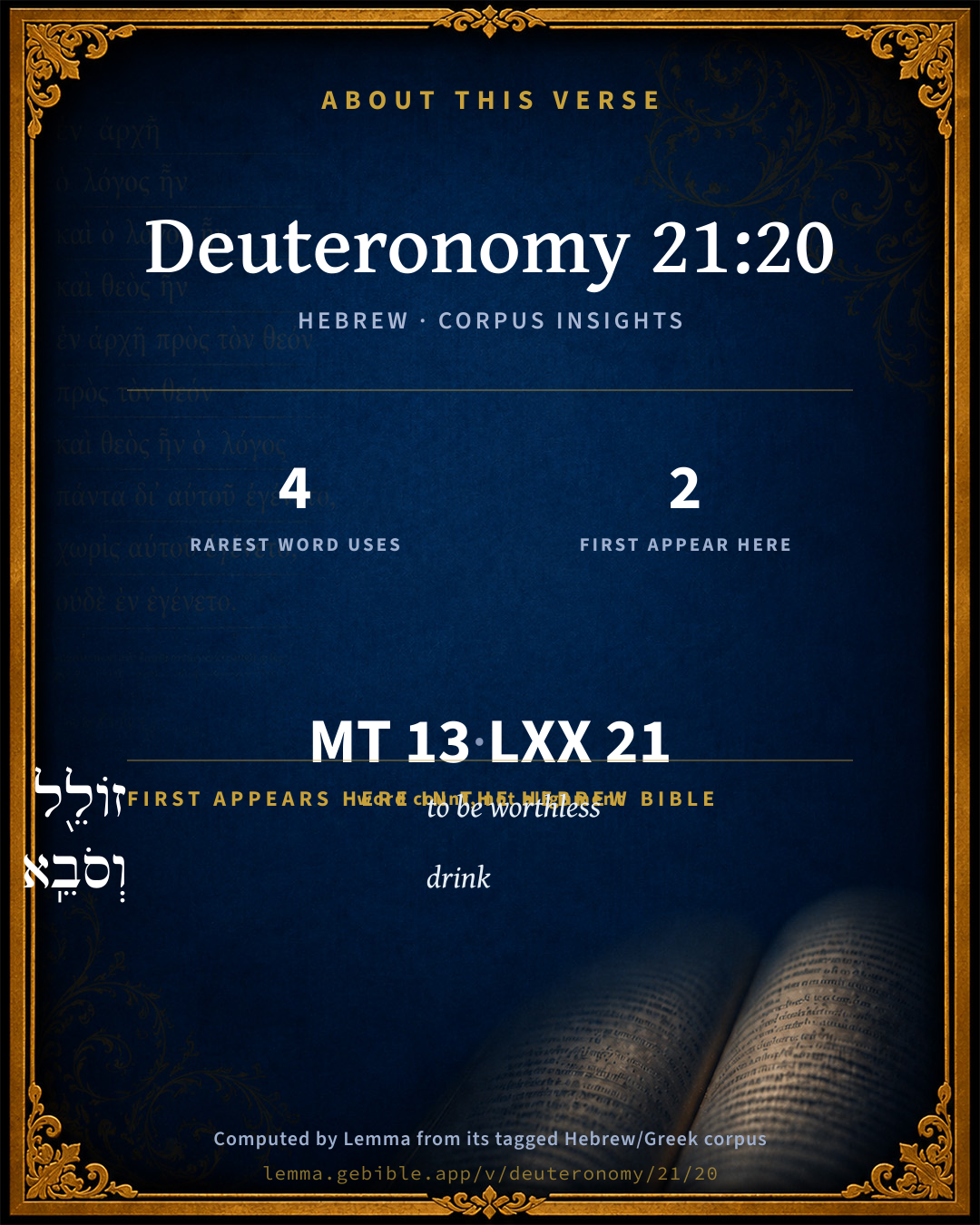
  • 2 first appearances in the Hebrew Bible
Full analysis ↓
Download a study sheet

One document with this verse’s original text, its word-by-word gloss line, the meaning frame, cross-references with their text, attributed commentary, and full source and license credits — printable, and it pastes into notes with its structure intact.

This verse Autodidact and up

Study sheet (.html) Plain text (.txt)

A passage Seminary Student

Up to 50 verses in one chapter. A passage sheet keeps up to 6 commentary sources and 12 cross-references per verse, in the order this page ranks them, and says so on the sheet whenever that leaves anything out. Ask for a single verse and you get the Autodidact verse sheet above.

Everything on this page stays free to read, with no account — the sheet is a download of what is already on screen, not access to it.

Want to remove ads? Support Godless Engineer
Compare translations 3

The same verse in 3 English versions, stacked beneath the original-language interlinear above. Click any original word for its lexicon entry.

Each is an independent rendering of the whole verse — the interlinear is not word-aligned to these translations.

Highlighted words mark where these versions differ — a whole-verse word diff, not a word-by-word alignment.

  • World English Bible Public Domain
    and they shall tell the elders of his city, This our son is stubborn and rebellious, he will not obey our voice; he is a glutton, and a drunkard.
  • King James Version Public Domain
    And they shall say unto the elders of his city, This our son is stubborn and rebellious, he will not obey our voice; he is a glutton, and a drunkard.
  • unfoldingWord Literal Text CC BY-SA 4.0
    And they shall say to the elders of his city, ‘This son of ours stubborn and rebellious; he will not listen to our voice; a glutton and a drunkard.’

unfoldingWord Literal Text — © unfoldingWord, licensed CC BY-SA 4.0. Word-aligned USFM3 via Door43 (git.door43.org/unfoldingWord/en_ult).

Versions to compare (up to 4)

3 of 4 selected

Show all 18 translations

Every available English version of this verse, each an independent rendering of the whole verse.

  • World English Bible Public Domain
    and they shall tell the elders of his city, This our son is stubborn and rebellious, he will not obey our voice; he is a glutton, and a drunkard.
  • Berean Standard Bible Public Domain
    and say to the elders, “This son of ours is stubborn and rebellious; he does not obey us. He is a glutton and a drunkard.”
  • Majority Standard Bible Public Domain
    and say to the elders, “This son of ours is stubborn and rebellious; he does not obey us. He is a glutton and a drunkard.”
  • King James Version Public Domain
    And they shall say unto the elders of his city, This our son is stubborn and rebellious, he will not obey our voice; he is a glutton, and a drunkard.
  • American Standard Version (1901) Public Domain
    and they shall say unto the elders of his city, This our son is stubborn and rebellious, he will not obey our voice; he is a glutton, and a drunkard.
  • Revised Version (1885) Public Domain
    and they shall say unto the elders of his city, This our son is stubborn and rebellious, he will not obey our voice; he is a riotous liver, and a drunkard.
  • Geneva Bible (1599) Public Domain
    And shall say vnto the Elders of his citie, This our sonne is stubburne and disobedient, and he wil not obey our admonition: he is a riotour, and a drunkard.
  • Douay-Rheims (1899) Public Domain
    And shall say to them: This our son is rebellious and stubborn, he slighteth hearing our admonitions, he giveth himself to revelling, and to debauchery and banquetings:
  • Young's Literal Translation Public Domain
    and have said unto the elders of his city, Our son -- this one -- is apostatizing and rebellious; he is not hearkening to our voice -- a glutton and drunkard;
  • Literal Standard Version CC BY-SA 4.0
    and have said to [the] elderly of his city, Our son—this one—is apostatizing and being rebellious; he is not listening to our voice—a glutton and drunkard.
  • Unlocked Literal Bible CC BY-SA 4.0
    They must say to the elders of his city, 'This son of ours is stubborn and rebellious; he will not obey our voice; he is a glutton and a drunkard.'
  • unfoldingWord Literal Text CC BY-SA 4.0
    And they shall say to the elders of his city, ‘This son of ours stubborn and rebellious; he will not listen to our voice; a glutton and a drunkard.’
  • Darby Bible Public Domain
    and they shall say unto the elders of his city, This our son is unmanageable and rebellious, he hearkeneth not unto our voice; he is a profligate and a drunkard.
  • World Messianic Bible Public Domain
    They shall tell the elders of his city, “This our son is stubborn and rebellious. He will not obey our voice. He is a glutton and a drunkard.”
  • Webster's Bible Public Domain
    And they shall say to the elders of his city, This our son is stubborn and rebellious, he will not obey our voice; he is a glutton, and a drunkard.
  • Free Bible Version CC BY-SA 4.0
    and tell them, “Our son is obstinate and rebellious, He doesn't obey us. He's a worthless drunk!”
  • Bible in Basic English Public Domain
    And say to them, This son of ours is hard-hearted and uncontrolled, he will not give attention to us; he gives himself up to pleasure and strong drink.
  • JPS Tanakh (1917) Public Domain
    and they shall say unto the elders of his city: 'This our son is stubborn and rebellious, he doth not hearken to our voice; he is a glutton, and a drunkard.'

Literal Standard Version (2020), Covenant Press — licensed CC BY-SA 4.0. Text via the HelloAO Bible API (eBible.org). Unlocked Literal Bible (unfoldingWord) — licensed CC BY-SA 4.0. Text via the HelloAO Bible API (eBible.org). unfoldingWord Literal Text — © unfoldingWord, licensed CC BY-SA 4.0. Word-aligned USFM3 via Door43 (git.door43.org/unfoldingWord/en_ult). Free Bible Version, Dr. Jonathan Gallagher — licensed CC BY-SA 4.0. Text via the HelloAO Bible API (eBible.org).

Word by word

More ways to search: Search by grammar → Find every occurrence → Compare this word →

Practice this passage: Drill this verse → Learn its vocabulary →

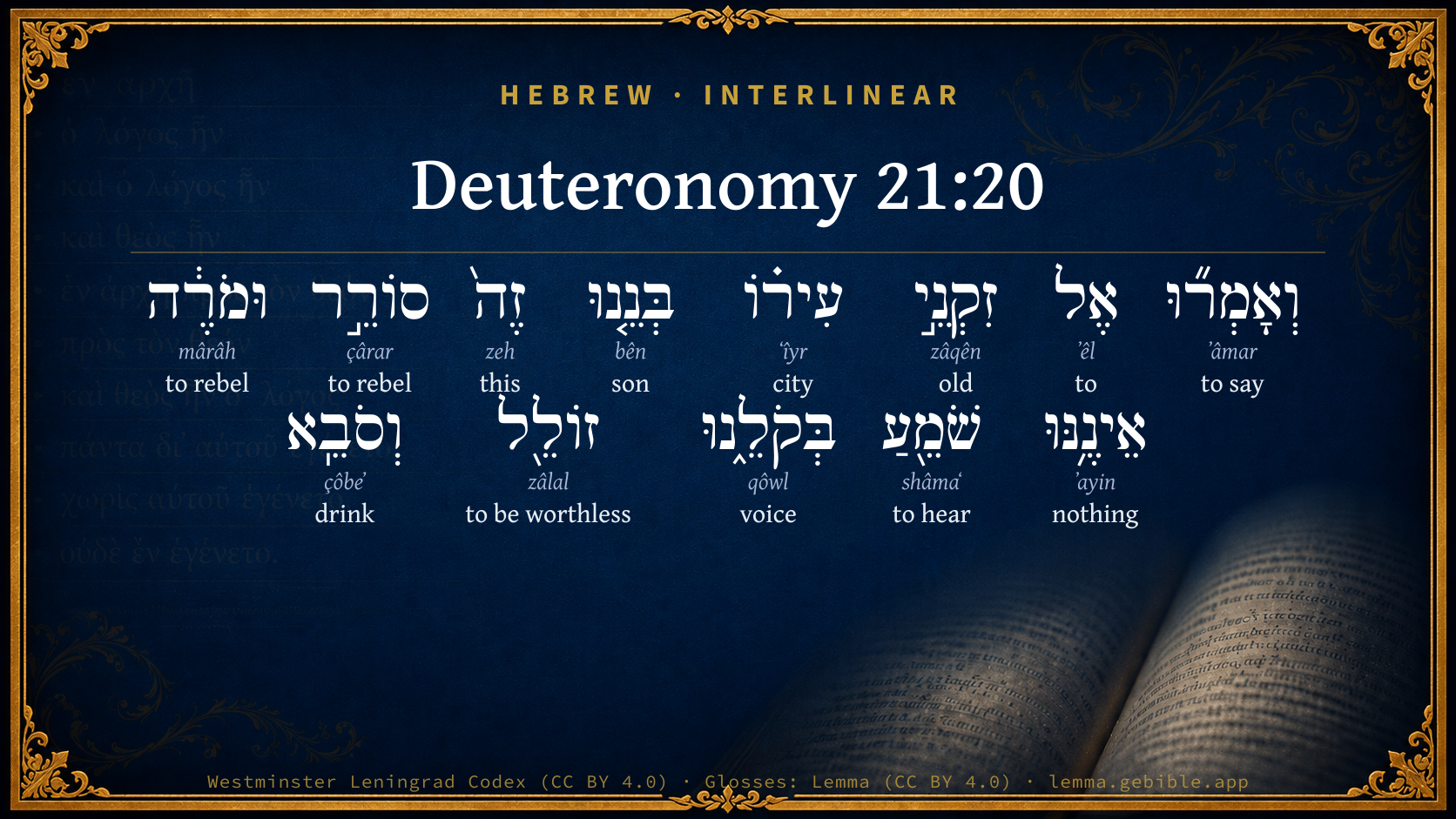
וְסֹבֵֽא
çôbeʼ
H5435
“and · drink”
Conjunction + Verb, Qal, Participle Active, Masculine, Singular, Absolute
Part of Speech
Conjunction + Verb
Stem
Qal
Form
Participle Active
Gender
Masculine
Number
Singular
State
Absolute
Full BDB Definition

Origin: from H5433

TWOT: 1455a

drink, liquor, wine
  1. וְאָמְר֞וּ ʼâmar H559 “and · to say” Conjunction + Verb, Qal, Sequential Perfect, 3rd Person, Common, Plural
  2. אֶל ʼêl H413 “to” Preposition
  3. זִקְנֵ֣י zâqên H2205 “old of” Adjective, Adjective, Masculine, Plural, Construct
  4. עִיר֗וֹ ʻîyr H5892 “city · his” Noun, Common, Feminine, Singular, Construct + Suffix, Personal, 3rd Person, Masculine, Singular
  5. בְּנֵ֤נוּ bên H1121 “son · our” Noun, Common, Masculine, Singular, Construct + Suffix, Personal, 1st Person, Common, Plural
  6. זֶה֙ zeh H2088 “this” Pronoun, Demonstrative, Masculine, Singular
  7. סוֹרֵ֣ר çârar H5637 “rebelling” Verb, Qal, Participle Active, Masculine, Singular, Absolute
  8. וּמֹרֶ֔ה mârâh H4784 “and · rebelling” Conjunction + Verb, Qal, Participle Active, Masculine, Singular, Absolute
  9. אֵינֶ֥נּוּ ʼayin H369 “nothing · him” Particle, Negative + Suffix, Personal, 3rd Person, Masculine, Singular
  10. שֹׁמֵ֖עַ shâmaʻ H8085 “hearing” Verb, Qal, Participle Active, Masculine, Singular, Absolute
  11. בְּקֹלֵ֑נוּ qôwl H6963 “in/at · voice · our” Preposition + Noun, Common, Masculine, Singular, Construct + Suffix, Personal, 1st Person, Common, Plural
  12. זוֹלֵ֖ל zâlal H2151 “being worthless” Verb, Qal, Participle Active, Masculine, Singular, Absolute

About this verse

These counts appear in no published source. They are computed here, from the morphology-tagged text and Lemma’s own curated glosses. What Lemma adds →

13
words
13
distinct lemmas
Pentateuch
section

Notable vocabulary

The rarest word here is וְסֹבֵֽא drink H5435 — appearing just 4 times in the whole Hebrew Bible.

First appearance in Scripture

These words make their first canonical appearance in the Hebrew Bible here:

  • זוֹלֵ֖ל to be worthless H2151
  • וְסֹבֵֽא drink H5435

Shared distinctive vocabulary

וְסֹבֵֽא drink H5435 occurs in 4 verses of the Hebrew Bible. Also found in:

Grammatical profile

  • 6 verbs
  • 3 nouns
  • 1 adjective
  • 1 pronoun
  • 1 preposition
  • 1 particle

Verb forms

  • וְאָמְר֞וּ Qal · Sequential Perfect
  • סוֹרֵ֣ר Qal · Participle Active
  • וּמֹרֶ֔ה Qal · Participle Active
  • שֹׁמֵ֖עַ Qal · Participle Active
  • זוֹלֵ֖ל Qal · Participle Active
  • וְסֹבֵֽא Qal · Participle Active

Hebrew & Septuagint length

In English translation the verse runs 29 words from the Hebrew and 30 from the Septuagint (LXX English) — closely comparable.

A rough comparison of the two English renderings, which tokenize alike — not a word-level alignment.

Word counts can differ between the Hebrew and the Greek without any difference in meaning — e.g. the Hebrew direct-object marker אֵת has no separate Greek word, and Greek often adds the article ὁ.

In the original languages it is 13 Hebrew tokens and 21 Greek tokens — but the two are counted differently (Hebrew bundles its prefixes and suffixes into one token; the Greek is in lemma form), so that isn’t a like-for-like length.

Cross-references

5

Topical passages linked to Deuteronomy 21:20 in the Treasury of Scripture Knowledge — connected by theme and wording, ordered by reader-vote popularity; previews shown in the World English Bible.

  • Proverbs 20:1 Wine is a mocker, and beer is a brawler; Whoever is led astray by them is not wise.
  • Proverbs 23:29–35 Who has woe? Who has sorrow? Who has strife? Who has complaints? Who has needless bruises? Who has bloodshot eyes?
  • Proverbs 23:19–21 Listen, my son, and be wise, And keep your heart on the right path!
  • Proverbs 29:17 Correct your son, and he will give you peace; Yes, he will bring delight to your soul.
  • Proverbs 19:26 He who robs his father and drives away his mother, Is a son who causes shame and brings reproach.

Cross-references courtesy of OpenBible.info (CC BY 4.0).

Hebrew and Greek witnesses Masoretic Hebrew ↔ Greek Septuagint

The same verse in the two great witnesses to the Old Testament, shown verse-for-verse.

These are two independent witnesses, not word-aligned to each other, and the Septuagint is shown in lemma (dictionary) form.

Hebrew Deuteronomy 21:20 Masoretic · Westminster Leningrad Codex

וְאָמְר֞וּ אֶל זִקְנֵ֣י עִיר֗וֹ בְּנֵ֤נוּ זֶה֙ סוֹרֵ֣ר וּמֹרֶ֔ה אֵינֶ֥נּוּ שֹׁמֵ֖עַ בְּקֹלֵ֑נוּ זוֹלֵ֖ל וְסֹבֵֽא

and they shall tell the elders of his city, This our son is stubborn and rebellious, he will not obey our voice; he is a glutton, and a drunkard.

World English Bible · Public Domain

Greek LXX Deuteronomy 21:20 Septuagint · lemma form

καί εἶπον ὁ ἀνήρ ὁ πόλις αὐτός ὁ υἱός ἐγώ οὗτος ἀπειθέω καί ἐρεθίζω οὐ ὑποἀκούω ὁ φωνή ἐγώ συνβολοκοπέω οἰνοφλυγέω

and they shall say to the men of their city, This our son is disobedient and contentious, he hearkens not to our voice, he is a reveler and a drunkard.

LXX2012 (modern English Septuagint) · Public Domain

On this verse, The Cambridge Bible for Schools and Colleges discusses the Septuagint’s reading. Read the note in Commentary ↓

Hebrew: Westminster Leningrad Codex (CC BY 4.0). Greek: Septuagint (public domain); English from LXX2012 (modern English Septuagint) (Public Domain). How the Septuagint differs from the Hebrew →

Targum (Aramaic paraphrase)

2

The Targum is the ancient Jewish Aramaic paraphrase of the Hebrew Scriptures — an interpretive translation, not the Hebrew text itself. Onkelos (literal) and Pseudo-Jonathan (expansive) render the Torah, and Jonathan the Prophets. Coverage is partial: where no permissively-licensed English translation exists for a verse, only the Aramaic is shown. This is verse-level text, not a word-by-word alignment to the Hebrew.

  1. Targum Onkelos Torah (Genesis–Deuteronomy)
    וְיֵימְרוּן לְסָבֵי קַרְתֵּהּ בְּנָנָא דֵין סָטֵי וּמָרֵי לֵיתוֹהִי מְקַבֵּל לְמֵימְרָנָא זָלֵל בְּסָר וְסָבֵי חֲמַר

    (no public-domain English translation for this verse)

    Targum Onkelos — Aramaic: “Onkelos Genesis” (public domain); “Onkelos Exodus” (public domain); “Onkelos Leviticus” (public domain); “Onkelos Numbers” (public domain); “Onkelos Deuteronomy” (public domain). English: “Sefaria Community Translation” (CC0 1.0 (public-domain dedication)); “J.W. Etheridge. The Targums of Onkelos and Jonathan Ben Uzziel on the Pentateuch. London: Longmans, Green, 1862” (public domain). Text via Sefaria.

  2. Targum Pseudo-Jonathan Torah (Genesis–Deuteronomy)
    וְיֵימְרוּן לְחַכִּימֵי קַרְתָּא עַבְרִינָן עַל גְּזֵירַת מֵימְרָא דַיְיָ בְּגִין כֵּן אִתְיְלִיד לָנָא בְּרָנָא דֵין דְּהוּא סוּרְהֲבָן וּמְרוֹד לֵיתוֹי צְיָית לְמֵימְרָנָא גַּרְגְּרָן בְּבִשְרָא וְשֵׁתָאֵי בְּחַמְרָא

    and say to the sages of the city, We had transgressed the decree of the Word of the Lord; therefore was born to us this son, who is presumptuous and disorderly; he will not hear our word, but is a glutton and a drunkard.

    Targum Pseudo-Jonathan — Aramaic: “Targum Jonathan on Genesis” (public domain); “Targum Jonathan on Exodus” (public domain); “Targum Jonathan on Leviticus” (public domain); “Targum Jonathan on Numbers” (public domain); “Targum Jonathan on Deuteronomy” (public domain). English: “The Targum of Jonathan ben Uzziel, trans. J. W. Etheridge, London, 1862” (public domain). Text via Sefaria.

Commentary

Notes on Deuteronomy 21:20 from classic Christian and Jewish commentators (each source and its license shown beneath its notes). The classic Christian expositions comment on the surrounding passage and are grouped to its opening verse, so a note may address several verses; the Jewish commentaries on the Tanakh (Rashi and others) are per-verse, so they appear only where the commentator wrote on this verse.

Lemma curates 59 commentaries, every one of them public domain or Creative Commons licensed, each selected and text-cleaned for this edition rather than reprinted as found. About our sources →

Trapp's Complete Commentary

John Trapp

Deu 21:20 And they shall say unto the elders of his city, This our son [is] stubborn and rebellious, he will not obey our voice; [he is] a glutton, and a drunkard.

Ver. 20. He is a glutton.] The same word is used for a vile person in Jer 15:19. And indeed belly-gods {Php 3:19} are dungy-gods. {Hab 2:18 Eze 4:12-13} A scavenger, whose office is to empty, is to be preferred before him that liveth but to fill, privies.

John Trapp, A Commentary or Exposition upon All the Books of the Old and New Testament (1647–1656) — public domain. Text from a community e-Sword module.

Joseph Benson's Commentary

Deu 21:20. A glutton and a drunkard — Under which two offences others of a like or worse nature are comprehended.

Joseph Benson's Commentary on the Old and New Testaments (1811–1818) — public domain. Text from a community e-Sword module.

Tyndale Open Study Notes

Tyndale Open Resources

21:20 Calling someone a glutton and a drunkard was probably a proverbial cliché suggesting self-indulgence and laziness. Such a son was a good-for-nothing who rebelled against his parents and thus also against the community and divine authority (see Prov 23:20-21).

Tyndale Open Study Notes — © Tyndale Open Resources, licensed CC BY-SA 4.0. Text via the HelloAO Bible API.

The Cambridge Bible for Schools and Colleges

gen. ed. J. J. S. Perowne

20. elders] Sam. LXX, men.

riotous liver] Better, prodigal, lit. one who lavishes or squanders, Pro_23:20 (with flesh, a glutton) and 21, parallel to drunkard as here; Deu_28:7 : a companion of prodigals shameth his father.

The Cambridge Bible for Schools and Colleges (gen. ed. J. J. S. Perowne; Cambridge University Press, 1878–1918) — public domain. Text from a community e-Sword module.

John Gill's Exposition

And they shall say unto the elders of his city,.... In open court, what follows, at the same time, according to the Targum of Jonathan, acknowledging their own sins, for which such a calamity had befallen them, saying,"we have transgressed the decree of the word of the Lord, because is born unto us a son that is stubborn, &c.''see Joh 9:2.

this our son is stubborn and rebellious, he will not obey our voice; one of an obstinate disposition, will have his own will and way, is perverse and refractory; honours not, but despises his parents, and is disobedient to their commands, unruly and ungovernable: the Jews gather (a) many things from hence, for which there is little foundation, as that they must be neither dumb, nor blind, nor deaf; though what they further observe is not much amiss, concerning this rebellious child, that the law respects a son and not a daughter, because a daughter generally is more tractable; and less capable of doing mischief than a son; and a son and not a man, for if at man's estate, and for himself, he is not under the power of his parents; and yet not a child or a little one, for that is not comprehended in the commands; he must be according to them thirteen years of age and one day, and he must be a son and not a father (b):

he is a glutton and a drunkard; which, according to the Misnah (c), is one that eats half a pound of flesh, and drinks half a log of Italian wine; R. Jose says, a pound of flesh and a log of wine; but the decision was not according to him; the first rule stood: now half a pound of flesh, and half a log of wine, which was about three egg shells, or a quarter of a pint, would be at this day reckoned very little by our grandsons of Bacchus, as Schickard observes (d); but in an age of severer discipline, as he says, in the tender candidates of temperance, it was reckoned too much, and was a presage of a future glutton: and it must be further observed to denominate him a rebellious son, what he ate and drank was to be what he stole from his parents, and did not eat and drink it at home, but abroad, and in bad company; so Jarchi remarks on the text, he is not guilty until he steals, and eats half a pound of flesh, and drinks half a log of wine; in which he seems to have respect to the Jewish canon (e),"if he steals from his father and eats it in a place in his father's power, or from others and eats it in a place in their power, or from others and eats it in a place in his father's power; he is not reckoned a stubborn and rebellious son, unless he steals from his father, and eats it in a place in the power of others,''see Pro 23:20, the Jews seem to refer to this when they charged Christ with being a glutton and a winebibber, Mat 11:19 being desirous of having him thought as such an one.

(a) Misn. Sanhedrin, c. 8. sect. 4. (b) Ut supra, (Misn. Bava Bathra, c. 8.) sect. 1. Maimon. & Bartenora in ib. (c) Ib. sect. 2. (d) Jus Regium Heb. c. 5. Theor. 17. p. 364. (e) Misn. Sanhedrin, c. 8. sect. 3.

John Gill's Exposition of the Whole Bible (1746–1763) — public domain (CC PDM 1.0). Text via the HelloAO Bible API.

Haydock's Catholic Bible Commentary

CHAPTER XXI.

George Leo Haydock (1774–1849), Haydock's Catholic Family Bible and Commentary, 1859 edition — public domain. Excludes Psalms (Douay-Rheims chapter numbering differs from Protestant) and Deuterocanonical books (Catholic canon only).

Matthew Poole's English Annotations

Stubborn and rebellious, adds incorrigibleness to all his wickedness.

A glutton and a drunkard; under which two offences others of a like or worse nature are comprehended by a synecdoche.

Matthew Poole's English Annotations on the Holy Bible (1683–1685) — public domain. Text from a community e-Sword/MySword module.

The Pulpit Commentary

He will not obey our voice; he is a glutton, and a drunkard. Gluttony and drunkenness were regarded by the Hebrews as highly criminal. The word rendered by "glutton," however (llwOz, from llz to shake, to shake out, to squander), includes other kinds of excess besides eating. It designates one who is prodigal, who wastes his means or wastes his person by indulgence in Pro_23:30, the whole phrase (rcB ylelwOz) is given squanderers of flesh, i.e. wasters of their own body, debauchees in Pro_28:7, the word is translated "riotous men" in the Authorized Version. Disobedience to parents was deemed an offense, which struck at the roots of the whole social institute.

The Pulpit Commentary (1880–1919), ed. H.D.M. Spence-Jones & Joseph S. Exell — public domain. Text from a community e-Sword module.

John Wesley's Explanatory Notes

A glutton and a drunkard - Under which two offenses others of a like or worse nature are comprehended.

John Wesley, Explanatory Notes Upon the Whole Bible (1754–1765) — public domain. Text via the GEBible commentary corpus.

Keil & Delitzsch

C. F. Keil & F. Delitzsch

Here they were to accuse the son as being unmanageable, refractory, disobedient, as "a glutton and a drunkard." These last accusations show the reason for the unmanageableness and refractoriness.

Keil & Delitzsch — Biblical Commentary on the Old Testament (1861–1891) — public domain (CC PDM 1.0). Text via the HelloAO Bible API. (Old Testament only.)

unfoldingWord translationNotes

Door43 World Missions Community

General Information:

Moses continues speaking to the people of Israel as if they were one man, so all instances of "you" are singular. (See: Forms of You)

This son of ours

"Our son"

he will not obey our voice

Here "voice" is a metonym for what a person says or a synecdoche for the whole person. AT: "he will not do what we tell him to do" or "he will not obey us" (See: Metonymy and Synecdoche)

a glutton

a person who eats and drinks too much

a drunkard

a person who drinks too much alcohol and gets drunk often

stone him to death with stones

"throw stones at him until he dies"

you will remove the evil from among you

The adjective "evil" can be translated as a noun phrase. AT: "you must remove from among the Israelites the person who does this evil thing" or "you must execute this evil person" (See: Nominal Adjectives)

All Israel

The word "Israel" is a metonym for the people of Israel. AT: "All the people of Israel" (See: Metonymy)

will hear of it and fear

The full meaning of this statement can be made explicit. AT: "will hear about what happened to the son and be afraid that the people will punish them also" (See: Assumed Knowledge and Implicit Information)

translationWords

stone

die

evil

Israel

fear

unfoldingWord translationNotes — © Distant Shores Media and the Door43 World Missions Community, licensed CC BY-SA 4.0. Source: git.door43.org/Door43/en_tn.

Ibn Ezra

Rabbi Abraham ibn Ezra

Gluttonous. This means that he is gluttonous with meat, but it also includes anything that a person has a desire for.

And drunken: He drinks too much and gets inebriated. This is like Epicurus, whose only desire in the physical world was to take pleasure in as many kinds of food and drink as possible.

Ibn Ezra on the Tanakh — English translations: “Sefaria Community Translation” (CC0 1.0 (public-domain dedication)); “Yalkut, Sifsei Chachomim Chumash, Metsudah Publications, 2009” (CC BY 4.0); and “Commentary of Ibn Ezra on Isaiah - trans. by M. Friedlander, 1873” (public domain). Text via Sefaria.

Lesson kit

Teaching starters — assembled from the data on this page, not authored interpretation. Every prompt links to the verse data it draws on. Edit before teaching.

Deuteronomy, in the Pentateuch, opens this verse with 13 words (13 distinct Hebrew lemmas). Its most distinctive word is çôbeʼ (“drink”). A historical commentator’s framing appears above. Read the whole chapter for the surrounding context.

Discussion questions

  1. How does “drink” (çôbeʼ) shape what this verse is saying?
  2. 2 words here appear for the first time in Scripture. What is being introduced at this debut?
  3. Isaiah 1:22 shares the word «drink» with this verse. How do the two illuminate each other?
  4. These translations render this verse differently; the difference is in the English rendering, not the original. What questions does that raise?
  5. The verb «וְאָמְר֞וּ» is Qal Sequential Perfect. How does its form color the action?
  6. Reading how Trapp's Complete Commentary and Joseph Benson's Commentary read this verse, where do the two commentators agree and where do they part?

Things to notice

Reading settings

Reading text

Shown beneath each verse's original-language words.

Old Testament
Old Testament edition

Read the OT as the Masoretic Hebrew (MT) or the Greek Septuagint (LXX).

English shown for the Greek Septuagint (in the Hebrew ↔ Greek comparison).

Comparing translations? Open the Compare panel on any verse page to stack up to four side by side.