
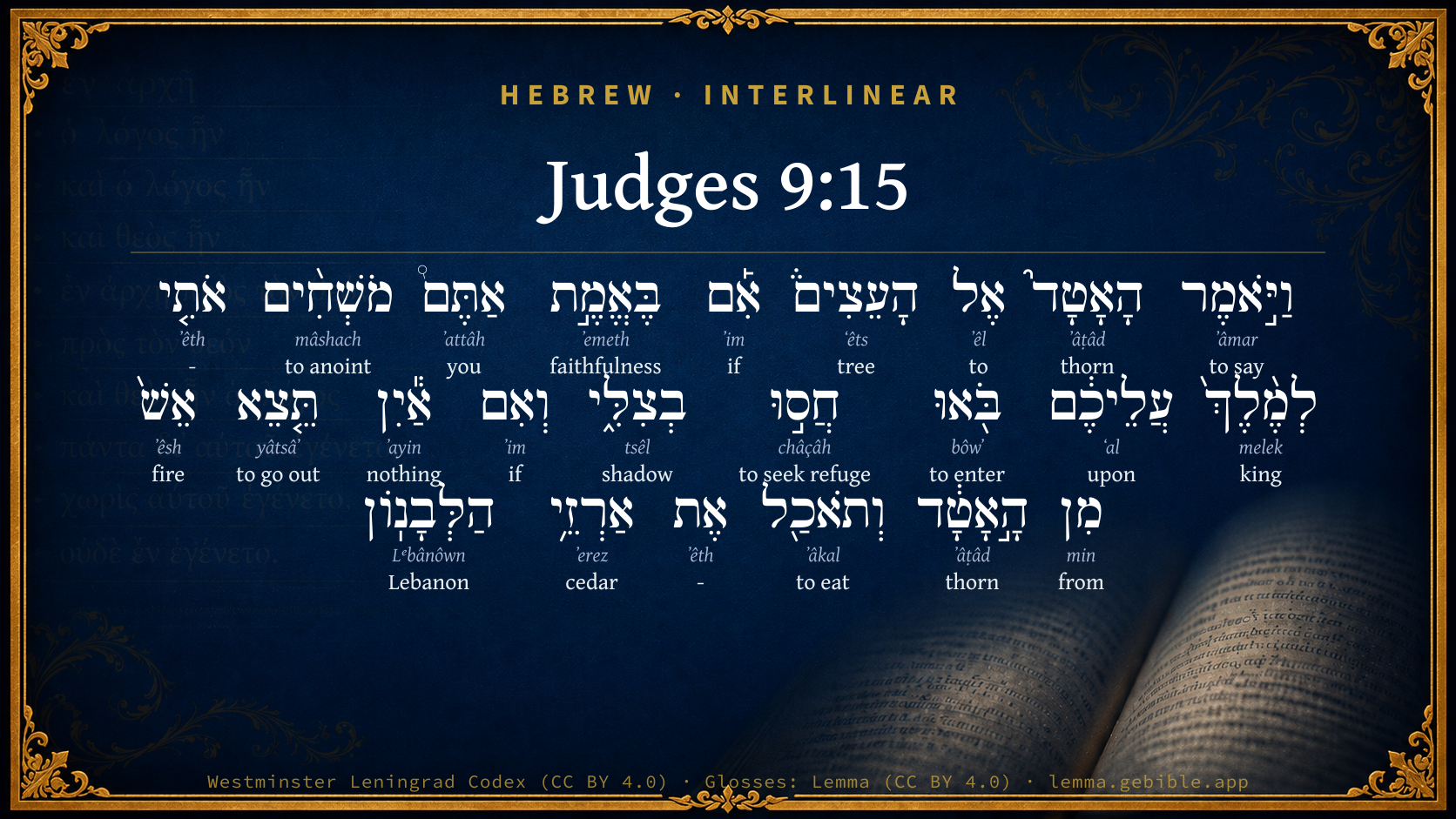
Judges 9:15

Hebrew (Westminster Leningrad Codex) Judges 9:15 appears in the Hebrew Old Testament. The text above is from the Westminster Leningrad Codex. Each word links to its Strong’s number, a concise gloss, and parsing drawn from the Open Scriptures Hebrew Bible morphology. Click any word for its full Brown-Driver-Briggs (BDB) entry.
Download image
Cite this verse

Judges 9:15 (World English Bible). Public Domain. Lemma interlinear Bible study tool, https://lemma.gebible.app/v/judges/9/15.

Show BibTeX & RIS
BibTeX
RIS
English Translation
The bramble said to the trees, If in truth you anoint me king over you, then come and take refuge in my shade; and if not, let fire come out of the bramble, and devour the cedars of Lebanon.
World English Bible · Public Domain
Download a study sheet

One document with this verse’s original text, its word-by-word gloss line, the meaning frame, cross-references with their text, attributed commentary, and full source and license credits — printable, and it pastes into notes with its structure intact.

This verse Autodidact and up

Study sheet (.html) Plain text (.txt)

A passage Seminary Student

Up to 50 verses in one chapter. A passage sheet keeps up to 6 commentary sources and 12 cross-references per verse, in the order this page ranks them, and says so on the sheet whenever that leaves anything out. Ask for a single verse and you get the Autodidact verse sheet above.

Everything on this page stays free to read, with no account — the sheet is a download of what is already on screen, not access to it.

Want to remove ads? Support Godless Engineer
Compare translations 3

The same verse in 3 English versions, stacked beneath the original-language interlinear above. Click any original word for its lexicon entry.

Each is an independent rendering of the whole verse — the interlinear is not word-aligned to these translations.

Highlighted words mark where these versions differ — a whole-verse word diff, not a word-by-word alignment.

  • World English Bible Public Domain
    The bramble said to the trees, If in truth you anoint me king over you, then come and take refuge in my shade; and if not, let fire come out of the bramble, and devour the cedars of Lebanon.
  • King James Version Public Domain
    And the bramble said unto the trees, If in truth ye anoint me king over you, then come and put your trust in my shadow: and if not, let fire come out of the bramble, and devour the cedars of Lebanon.
  • unfoldingWord Literal Text CC BY-SA 4.0
    And the thornbush said to the trees, ‘If in truth you are anointing me as king over you, come, shelter in my shade. But if not, may fire go forth from the thornbush and consume the cedars of Lebanon!’

unfoldingWord Literal Text — © unfoldingWord, licensed CC BY-SA 4.0. Word-aligned USFM3 via Door43 (git.door43.org/unfoldingWord/en_ult).

Versions to compare (up to 4)

3 of 4 selected

Show all 18 translations

Every available English version of this verse, each an independent rendering of the whole verse.

  • World English Bible Public Domain
    The bramble said to the trees, If in truth you anoint me king over you, then come and take refuge in my shade; and if not, let fire come out of the bramble, and devour the cedars of Lebanon.
  • Berean Standard Bible Public Domain
    But the thornbush replied, ‘If you really are anointing me as king over you, come and find refuge in my shade. But if not, may fire come out of the thornbush and consume the cedars of Lebanon.’
  • Majority Standard Bible Public Domain
    But the thornbush replied, ‘If you really are anointing me as king over you, come and find refuge in my shade. But if not, may fire come out of the thornbush and consume the cedars of Lebanon.’
  • King James Version Public Domain
    And the bramble said unto the trees, If in truth ye anoint me king over you, then come and put your trust in my shadow: and if not, let fire come out of the bramble, and devour the cedars of Lebanon.
  • American Standard Version (1901) Public Domain
    And the bramble said unto the trees, If in truth ye anoint me king over you, then come and take refuge in my shade; and if not, let fire come out of the bramble, and devour the cedars of Lebanon.
  • Revised Version (1885) Public Domain
    And the bramble said unto the trees, If in truth ye anoint me king over you, then come and put your trust in my shadow: and if not, let fire come out of the bramble, and devour the cedars of Lebanon.
  • Geneva Bible (1599) Public Domain
    And the bramble said vnto the trees, If ye will in deede anoynt me King ouer you, come, and put your trust vnder my shadowe: and if not, the fire shall come out of the bramble, and consume the Cedars of Lebanon.
  • Douay-Rheims (1899) Public Domain
    And it answered them: If indeed you mean to make me king, come ye and rest under my shadow: but if you mean it not, let fire come out from the bramble, and devour the cedars of Libanus.
  • Young's Literal Translation Public Domain
    And the bramble saith unto the trees, If in truth ye are anointing me for king over you, come, take refuge in my shadow; and if not -- fire cometh out from the bramble, and devoureth the cedars of Lebanon.
  • Literal Standard Version CC BY-SA 4.0
    And the bramble says to the trees, If in truth you are anointing me for king over you, come, take refuge in my shadow; and if not—fire comes out from the bramble, and devours the cedars of Lebanon.
  • Unlocked Literal Bible CC BY-SA 4.0
    The thornbush said to the trees, 'If you truly want to anoint me as king over you, then come and find safety under my shade. If not, then let fire come out of the thornbush and let it burn up the cedars of Lebanon.'
  • unfoldingWord Literal Text CC BY-SA 4.0
    And the thornbush said to the trees, ‘If in truth you are anointing me as king over you, come, shelter in my shade. But if not, may fire go forth from the thornbush and consume the cedars of Lebanon!’
  • Darby Bible Public Domain
    And the bramble said to the trees, 'If in good faith you are anointing me king over you, then come and take refuge in my shade; but if not, let fire come out of the bramble and devour the cedars of Lebanon.'
  • World Messianic Bible Public Domain
    “The bramble said to the trees, ‘If in truth you anoint me king over you, then come and take refuge in my shade; and if not, let fire come out of the bramble, and devour the cedars of Lebanon.’
  • Webster's Bible Public Domain
    And the bramble said to the trees, If in truth ye anoint me king over you, then come and put your trust in my shadow: and if not, let fire come out of the bramble, and devour the cedars of Lebanon.
  • Free Bible Version CC BY-SA 4.0
    The thorn bush replied to the trees, ‘If you're really sincere about anointing me as your king, come and find shelter in my shade. But if not, may fire flame out of the thorn bush and burn up the cedars of Lebanon!’
  • Bible in Basic English Public Domain
    And the thorn said to the trees, If it is truly your desire to make me your king, then come and put your faith in my shade; and if not, may fire come out of the thorn, burning up the cedars of Lebanon.
  • JPS Tanakh (1917) Public Domain
    And the bramble said unto the trees: If in truth ye anoint me king over you, then come and take refuge in my shadow; and if not, let fire come out of the bramble, and devour the cedars of Lebanon.

Literal Standard Version (2020), Covenant Press — licensed CC BY-SA 4.0. Text via the HelloAO Bible API (eBible.org). Unlocked Literal Bible (unfoldingWord) — licensed CC BY-SA 4.0. Text via the HelloAO Bible API (eBible.org). unfoldingWord Literal Text — © unfoldingWord, licensed CC BY-SA 4.0. Word-aligned USFM3 via Door43 (git.door43.org/unfoldingWord/en_ult). Free Bible Version, Dr. Jonathan Gallagher — licensed CC BY-SA 4.0. Text via the HelloAO Bible API (eBible.org).

Word by word

More ways to search: Search by grammar → Find every occurrence → Compare this word →

Practice this passage: Drill this verse → Learn its vocabulary →

הָאָטָד֮
ʼâṭâd
H329
“the · thorn”
Particle, Definite Article + Noun, Common, Masculine, Singular, Absolute
Part of Speech
Particle + Noun
Type
Common
Gender
Masculine
Number
Singular
State
Absolute
Full BDB Definition

Origin: from an unused root probably meaning to pierce or make fast

TWOT: 71a

bramble, thorn, buckthorn - the threshing Atad, meaning thorn, also called Abelmizraim and afterwards called Bethhogla was located on the west of Jordan between the Jordan and Jericho
  1. וַיֹּ֣אמֶר ʼâmar H559 “and · to say” Conjunction + Verb, Qal, Sequential Imperfect, 3rd Person, Masculine, Singular
  2. אֶל ʼêl H413 “to” Preposition
  3. הָעֵצִים֒ ʻêts H6086 “the · trees” Particle, Definite Article + Noun, Common, Masculine, Plural, Absolute
  4. אִ֡ם ʼim H518 “if” Conjunction
  5. בֶּאֱמֶ֣ת ʼemeth H571 “in/at · faithfulness” Preposition + Noun, Common, Feminine, Singular, Absolute
  6. אַתֶּם֩ ʼattâh H859 “you” Pronoun, Personal, 2nd Person, Masculine, Plural
  7. מֹשְׁחִ֨ים mâshach H4886 “anointing” Verb, Qal, Participle Active, Masculine, Plural, Absolute
  8. אֹתִ֤י ʼêth H853 “- · me” Particle, Direct Object + Suffix, Personal, 1st Person, Common, Singular
  9. לְמֶ֨לֶךְ֙ melek H4428 “to/for · king” Preposition + Noun, Common, Masculine, Singular, Absolute
  10. עֲלֵיכֶ֔ם ʻal H5921 “upon · you” Preposition + Suffix, Personal, 2nd Person, Masculine, Plural
  11. בֹּ֖אוּ bôwʼ H935 “enter” Verb, Qal, Imperative, 2nd Person, Masculine, Plural
  12. חֲס֣וּ châçâh H2620 “seek refuge” Verb, Qal, Imperative, 2nd Person, Masculine, Plural
  13. בְצִלִּ֑י tsêl H6738 “in/at · shadow · my” Preposition + Noun, Common, Masculine, Singular, Construct + Suffix, Personal, 1st Person, Common, Singular
  14. וְאִם ʼim H518 “and · if” Conjunction + Conjunction
  15. אַ֕יִן ʼayin H369 “nothing” Particle, Negative
  16. תֵּ֤צֵא yâtsâʼ H3318 “to go out” Verb, Qal, Imperfect, 3rd Person, Feminine, Singular
  17. אֵשׁ֙ ʼêsh H784 “fire” Noun, Common, Both, Singular, Absolute
  18. מִן min H4480 “from” Preposition
  19. הָ֣אָטָ֔ד ʼâṭâd H329 “the · thorn” Particle, Definite Article + Noun, Common, Masculine, Singular, Absolute
  20. וְתֹאכַ֖ל ʼâkal H398 “and · to eat” Conjunction + Verb, Qal, Imperfect, 3rd Person, Feminine, Singular
  21. אֶת ʼêth H853 “-” Particle, Direct Object
  22. אַרְזֵ֥י ʼerez H730 “cedars of” Noun, Common, Masculine, Plural, Construct
  23. הַלְּבָנֽוֹן Lᵉbânôwn H3844 “the · Lebanon” Particle, Definite Article + Noun, Proper

About this verse

These counts appear in no published source. They are computed here, from the morphology-tagged text and Lemma’s own curated glosses. What Lemma adds →

24
words
21
distinct lemmas
Historical
section

Notable vocabulary

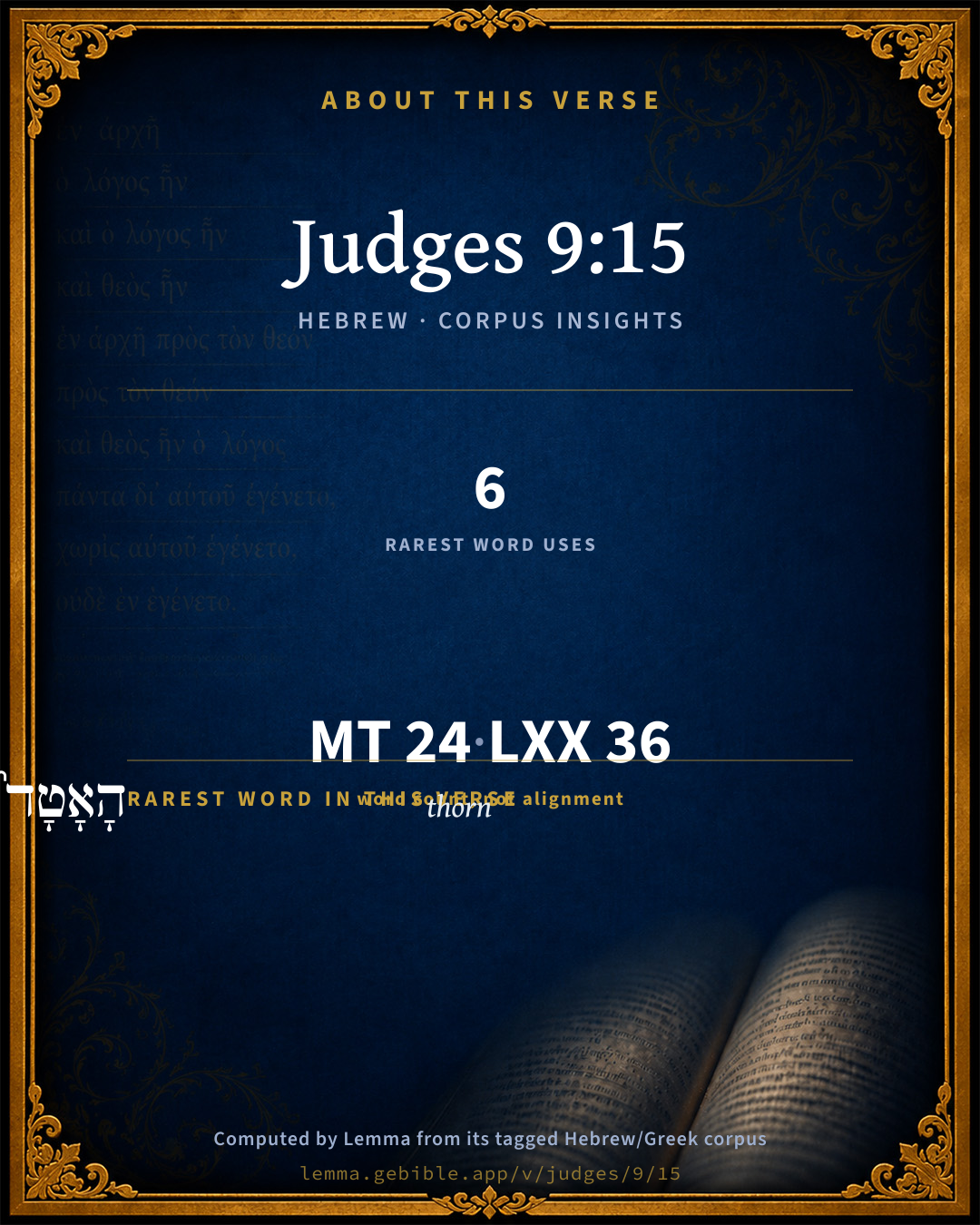
The rarest word here is הָאָטָד֮ thorn H329 — appearing just 6 times in the whole Hebrew Bible.

Shared distinctive vocabulary

הָאָטָד֮ thorn H329 occurs in 5 verses of the Hebrew Bible. Also found in:

Grammatical profile

  • 6 verbs
  • 9 nouns
  • 1 pronoun
  • 3 prepositions
  • 2 conjunctions
  • 3 particles

Verb forms

  • וַיֹּ֣אמֶר Qal · Sequential Imperfect
  • מֹשְׁחִ֨ים Qal · Participle Active
  • בֹּ֖אוּ Qal · Imperative
  • חֲס֣וּ Qal · Imperative
  • תֵּ֤צֵא Qal · Imperfect
  • וְתֹאכַ֖ל Qal · Imperfect

Repetition

Words recur within this verse — often emphatic in Hebrew:

  • הָאָטָד֮ thorn H329 ×2
  • אִ֡ם if H518 ×2

Hebrew & Septuagint length

In English translation the verse runs 39 words from the Hebrew and 37 from the Septuagint (LXX English) — closely comparable.

A rough comparison of the two English renderings, which tokenize alike — not a word-level alignment.

Word counts can differ between the Hebrew and the Greek without any difference in meaning — e.g. the Hebrew direct-object marker אֵת has no separate Greek word, and Greek often adds the article ὁ.

In the original languages it is 24 Hebrew tokens and 36 Greek tokens — but the two are counted differently (Hebrew bundles its prefixes and suffixes into one token; the Greek is in lemma form), so that isn’t a like-for-like length.

Cross-references

14

Topical passages linked to Judges 9:15 in the Treasury of Scripture Knowledge — connected by theme and wording, ordered by reader-vote popularity; previews shown in the World English Bible.

  • Isaiah 30:2 that set out to go down into Egypt, and have not asked at my mouth; to strengthen themselves in the strength of Pharaoh, and to take refuge in the shadow of Egypt!
  • Judges 9:20 but if not, let fire come out from Abimelech, and devour the men of Shechem, and the house of Millo; and let fire come out from the men of Shechem, and from the house of Millo, and devour Abimelech.
  • Isaiah 2:13 For all the cedars of Lebanon, that are high and lifted up, For all the oaks of Bashan,
  • Hosea 14:7 Men will dwell in his shade. They will revive like the grain, And blossom like the vine. Their fragrance will be like the wine of Lebanon.
  • Numbers 21:28 For a fire is gone out of Heshbon, A flame from the city of Sihon: It has devoured Ar of Moab, The lords of the high places of the Arnon.
  • 2 Kings 14:9 Jehoash the king of Israel sent to Amaziah king of Judah, saying, The thistle that was in Lebanon sent to the cedar that was in Lebanon, saying, Give your daughter to my son as wife: and there passed by a wild animal that was in Lebanon, and trod down the thistle.
  • Psalms 104:16 Yahweh's trees are well watered, The cedars of Lebanon, which he has planted;
  • Isaiah 37:24 By your servants have you defied the Lord, and have said, With the multitude of my chariots am I come up to the height of the mountains, to the innermost parts of Lebanon; and I will cut down the tall cedars of it, and the choice fir trees of it; and I will enter into its farthest height, the forest of its fruitful field;
  • Ezekiel 19:14 Fire is gone out of the rods of its branches, it has devoured its fruit, so that there is in it no strong rod to be a scepter to rule. This is a lamentation, and shall be for a lamentation.
  • Daniel 4:12 The leaves of it were beautiful, and the fruit of it much, and in it was food for all: the animals of the field had shadow under it, and the birds of the sky lived in the branches of it, and all flesh was fed from it.
  • Isaiah 1:31 The strong will be like tinder, And his work like a spark. They will both burn together, And no one will quench them."
  • Ezekiel 31:3 Behold, the Assyrian was a cedar in Lebanon with beautiful branches, and with a forest-like shade, and of high stature; and its top was among the thick boughs.
  • Matthew 13:32 which indeed is smaller than all seeds. But when it is grown, it is greater than the herbs, and becomes a tree, so that the birds of the air come and lodge in its branches."
  • Judges 9:49 All the people likewise cut down every man his bough, and followed Abimelech, and put them to the stronghold, and set the stronghold on fire on them; so that all the men of the tower of Shechem died also, about a thousand men and women.

Cross-references courtesy of OpenBible.info (CC BY 4.0).

Hebrew and Greek witnesses Masoretic Hebrew ↔ Greek Septuagint

The same verse in the two great witnesses to the Old Testament, shown verse-for-verse.

These are two independent witnesses, not word-aligned to each other, and the Septuagint is shown in lemma (dictionary) form.

Hebrew Judges 9:15 Masoretic · Westminster Leningrad Codex

וַיֹּ֣אמֶר הָאָטָד֮ אֶל הָעֵצִים֒ אִ֡ם בֶּאֱמֶ֣ת אַתֶּם֩ מֹשְׁחִ֨ים אֹתִ֤י לְמֶ֨לֶךְ֙ עֲלֵיכֶ֔ם בֹּ֖אוּ חֲס֣וּ בְצִלִּ֑י וְאִם אַ֕יִן תֵּ֤צֵא אֵשׁ֙ מִן הָ֣אָטָ֔ד וְתֹאכַ֖ל אֶת אַרְזֵ֥י הַלְּבָנֽוֹן

The bramble said to the trees, If in truth you anoint me king over you, then come and take refuge in my shade; and if not, let fire come out of the bramble, and devour the cedars of Lebanon.

World English Bible · Public Domain

Greek LXX Judges 9:15 Septuagint · lemma form

καί εἶπον ὁ ῥάμνος πρός ὁ ξύλον εἰ ἐν ἀλήθεια χρίω ἐγώ σύ ὁ βασιλεύω ἐπί σύ δεῦτε ὑποἵστημι ἐν ὁ σκιά ἐγώ καί εἰ μή ἐκἔρχομαι πῦρ ἀπό ἐγώ καί καταἐσθίω ὁ κέδρος ὁ λίβανος

And the bramble said to the trees, If you⌃ in truth anoint me to reign over you, come, stand under my shadow; and if not, let fire come out from me and devour the cedars of Libanus.

LXX2012 (modern English Septuagint) · Public Domain

Hebrew: Westminster Leningrad Codex (CC BY 4.0). Greek: Septuagint (public domain); English from LXX2012 (modern English Septuagint) (Public Domain). How the Septuagint differs from the Hebrew →

Targum (Aramaic paraphrase)

1

The Targum is the ancient Jewish Aramaic paraphrase of the Hebrew Scriptures — an interpretive translation, not the Hebrew text itself. Onkelos (literal) and Pseudo-Jonathan (expansive) render the Torah, and Jonathan the Prophets. Coverage is partial: where no permissively-licensed English translation exists for a verse, only the Aramaic is shown. This is verse-level text, not a word-by-word alignment to the Hebrew.

  1. Targum Jonathan Prophets (Joshua–Malachi)
    וַאֲמַר אֲטָדָא לְאִילָנַיָא אִם בִּקְשׁוֹט אַתּוּן מָשְׁחִין יָתִי לְמֶהֱוֵי מַלְכָּא עֲלֵיכוֹן עוּלוּ שְׁרוֹ בְטוּלִי וְאִם לָא תִפּוֹק אֶשְׁתָּא מִן אֲטָדָא וְתֵיכוּל יַת אַרְזֵי לִבְנָן:

    (no public-domain English translation for this verse)

    Targum Jonathan — Aramaic: “Mikraot Gedolot” (public domain). English: “Sefaria Community Translation” (CC0 1.0 (public-domain dedication)); “London "Chaldee Paraphrase," 1871” (public domain). Text via Sefaria.

Commentary

Notes on Judges 9:15 from classic Christian and Jewish commentators (each source and its license shown beneath its notes). The classic Christian expositions comment on the surrounding passage and are grouped to its opening verse, so a note may address several verses; the Jewish commentaries on the Tanakh (Rashi and others) are per-verse, so they appear only where the commentator wrote on this verse.

Lemma curates 59 commentaries, every one of them public domain or Creative Commons licensed, each selected and text-cleaned for this edition rather than reprinted as found. About our sources →

Trapp's Complete Commentary

John Trapp

Jdg 9:15 And the bramble said unto the trees, If in truth ye anoint me king over you, [then] come [and] put your trust in my shadow: and if not, let fire come out of the bramble, and devour the cedars of Lebanon.

Ver. 15. If in truth ye anoint me king over you.] Whereunto he also must be entreated for fashionsake: like as Richard III was by the Londoners at the solicitation of Buckingham, who knew his mind and factored for him, as here Abimelech’s uncles did. This base bramble, a dry, empty, sapless kex and weed, apt and able only to scratch, tear, and vex, must needs be up, and hoised into a high room, and domineer over others. Men of most prostituted consciences are, for most part, the most pragmatical prawlers, saith a grave divine, {a} after undeserved preferments, and the only men to serve themselves viis et modis, as they say, into offices, honours, and places of advancement.

Then come and put your trust in my shadow.] At umbra rhamni non est commendabilis. The bramble bush yieldeth no very good shade; the silly sheep flying to it for shelter and defence in weather, is sure to lose part of his fleece, if not of his flesh.

Let fire come out of the bramble.] Isidore and many other learned men {b} say, that the bramble being much shaken by the wind, is thereby set on fire, whereby both itself and all the trees about it are consumed. Jotham might allude to this. The counsel is good that one here giveth; Let not the bramble be king; let not earthly things bear rule over thine affections. Fire will arise out of them that will consume thy cedars, emasculate all the powers of thy soul. One bastard will destroy all the true born sons.

{a} Bishop Hall.

{b} Testatus, Mercer, Forster, Carthusian, Moller.

John Trapp, A Commentary or Exposition upon All the Books of the Old and New Testament (1647–1656) — public domain. Text from a community e-Sword module.

Geneva Bible (1599)

Geneva Bible translators

Abimelech shall destroy the nobles of Shechem.

Geneva Bible (1599) marginal notes — public domain. Text via Bolls.life.

Adam Clarke's Commentary

Verse 15. Come and put your trust in any shadow] The vain boast of the would-be sovereign; and of the man who is seeking to be put into power by the suffrages of the people. All promise, no performance.

Let fire come out of the bramble] A strong catachresis. The bramble was too low to give shelter to any tree; and so far from being able to consume others, that the smallest fire will reduce it to ashes, and that in the shortest time. Hence the very transitory mirth of fools is said to be like the cracking of thorns under a pot. Abimelech was the bramble; and the ceders of Lebanon, all the nobles and people of Israel. Could they therefore suppose that such a low-born, uneducated, cruel, and murderous man, could be a proper protector, or a humane governor? He who could imbrue his hands in the blood of his brethren in order to get into power, was not likely to stop at any means to retain that power when possessed. If, therefore, they took him for their king, they might rest assured that desolation and blood would mark the whole of his reign.

The condensed moral of the whole fable is this: Weak, worthless, and wicked men, will ever be foremost to thrust themselves into power; and, in the end, to bring ruin upon themselves, and on the unhappy people over whom they preside.

Adam Clarke's Commentary on the Bible (1810–1826) — public domain. Text from a community e-Sword/MySword module.

Ellicott's Commentary for English Readers

(15) If in truth—i.e., with serious purpose. The bramble can hardly believe in the infatuation of the trees.

Put your trust in my shadow.—The mean leaves and bristling thorns of the rhamnus could afford no shadow to speak of, and even such as they could afford would be dangerous; but the fable is full of fine and biting irony.

If not.—The bramble is not only eager to be king, but has spiteful and dangerous threats—the counterpart of those, doubtless, which had been used by Abimelech—to discourage any withdrawal of the offer.

Let fire come out of the bramble.—Some suppose that there is a reference to the ancient notions of the spontaneous ignition of the boughs of the bramble when rubbed together by the wind. The allusion is far more probably to the use of thorns for fuel: Exo_22:6, “If fire break out, and catch in thorns, so that the stacks of corn . . . be consumed;” Psa_58:9, “Or ever your pots be made hot with thorns;” Ecc_7:6, “the crackling of thorns under a pot.”

A Bible Commentary for English Readers, edited by Charles John Ellicott (1878–1897) — public domain. Text from a community e-Sword module.

The Cambridge Bible for Schools and Colleges

gen. ed. J. J. S. Perowne

15. put your trust in my shadow] take refuge in …: an absurdity which sharpens the point of the moral.

let fire come out] A fire will sometimes spread from a thornbush to the monarchs of the forest (cf. Isa_9:18); the base bramble thus becomes the starting-point of all the ruin.

So the fable points a contrast: on the one hand were those who naturally would have been the men to rule, Gideon and his sons, or (generally) more than one able member of the community, but they would have nothing to do with the proposal; on the other hand was the worthless Abimelech, who not only seized power with avidity but threatened those who refused to submit to him. Here the fable is dropped, though an echo of it is heard in Jdg_9:20; what follows is not strictly an application of it, but a couple of fresh topics: a stern reproof of the Shechemites for ingratitude, and a warning that they and their upstart chief are doomed to destroy one another.

The Cambridge Bible for Schools and Colleges (gen. ed. J. J. S. Perowne; Cambridge University Press, 1878–1918) — public domain. Text from a community e-Sword module.

John Gill's Exposition

And the bramble said unto the trees,.... Accepting of their offer at once:

if ye in trust anoint me king over you; suspecting they were not hearty and cordial in their choice and call to the kingly authority over them:

then come and put your trust in my shadow; promising protection to them as his subjects, requiring their confidence in him, and boasting of the good they should receive from him, as is common with wicked princes at their first entering on their office; but, alas! what shadow or protection can there be in a bramble? if a man attempts: to put himself under it for shelter, he will find it will be of no use to him, but harmful, since, the nearer and closer he comes to it, the more he will be scratched and torn by it:

and if not, let fire come out of the bramble, and devour the cedars of Lebanon; signifying, that if they did not heartily submit to his government, and put confidence in him, and prove faithful to him, they should smart for it, and feel his wrath and vengeance, even the greatest men among them, comparable to the cedars of Lebanon; for thorns and brambles catching fire, as they easily do, or fire being put to them, as weak as they are, and placed under the tallest and strongest cedars, will soon fetch them down to the ground; and the words of the bramble, or Abimelech, proved true to the Shechemites, he is made to speak in this parable.

John Gill's Exposition of the Whole Bible (1746–1763) — public domain (CC PDM 1.0). Text via the HelloAO Bible API.

Haydock's Catholic Bible Commentary

Shadow or protection, Psalm xvi. 8., and Baruch i. 12. (Calmet) --- Joatham hints at the insolence of Abimelech, (Haydock) and foretels that he and his foolish subjects will soon be at variance, and destroy each other. Fire is often put for war. The people of Sichem began soon to despise their new king, and he made war upon them, and destroyed their city; though the people afterwards took ample revenge, ver. 20. (Calmet) --- Tyrants promise much, but their rage soon falls upon the more wealthy and powerful citizens, (Haydock) here signified by the cedars. (Menochius)

George Leo Haydock (1774–1849), Haydock's Catholic Family Bible and Commentary, 1859 edition — public domain. Excludes Psalms (Douay-Rheims chapter numbering differs from Protestant) and Deuterocanonical books (Catholic canon only).

Matthew Poole's English Annotations

If in truth you anoint me king over you; if you deal truly and justly in making me king.

Put your trust in my shadow; then you may expect protection under my government.

Let fire come out of the bramble; instead of protection, you shall receive destruction by me; especially you cedars, i.e. nobles, such as the house of Millo, who have been most forward in this work.

Matthew Poole's English Annotations on the Holy Bible (1683–1685) — public domain. Text from a community e-Sword/MySword module.

Whedon's Commentary on the Bible

Daniel D. Whedon

15. Put your trust in my shadow — The bramble has no shadow worthy of the name, and the language here is a biting irony upon those who had chosen a worthless man for a king. A thorn bush give shade and protection to the olive or the fig tree! As well might one expect to gather grapes of thorns or figs of thistles.

Let fire come out of the bramble — Thorn-bushes are commonly used for fuel in the East. They easily catch fire and soon burn out, and yet they may kindle a fire that will burn and destroy the greatest of trees, even the noble cedars of Lebanon. So a weak and worthless ruler may provoke civil discords, or incur foreign wars, which in their fiery progress swallow up and devour the brave, the virtuous, and the noble. So it was in the case of Abimelech.

Daniel D. Whedon (gen. ed.), Commentary on the Old and New Testaments (1874–1909) — public domain. Text from a community e-Sword module.

The Pulpit Commentary

If in truth, i.e. truly, as the same phrase is rendered in vers. 16, 19, with integrity of purpose and sincerity of heart. The English would be less ambiguous if it ran, "If ye anoint me king over you in truth." The speech of the bramble indicates the grounds for suspicion already existing between Abimelech and the men of Shechem. Let fire come out, etc. keeping up the propriety of the image, as the natural function of the bramble was to kindle a fire, and as it had no other use; showing, too, how a base bramble could destroy a noble cedar, and the base-born Abimelech could bring ruin upon the lords of Shechem.

The Pulpit Commentary (1880–1919), ed. H.D.M. Spence-Jones & Joseph S. Exell — public domain. Text from a community e-Sword module.

John Wesley's Explanatory Notes

If in truth - If you deal truly and justly in making me king. Then trust - Then you may expect protection under my government. Devour the cedars - In stead of protection, you shall receive destruction by me; especially you cedars, that is, nobles, such as the house of Millo, who have been most forward in this work.

John Wesley, Explanatory Notes Upon the Whole Bible (1754–1765) — public domain. Text via the GEBible commentary corpus.

Scofield Reference Notes

C. I. Scofield

trust

(See Scofield "Psa 2:12")

The Scofield Reference Bible (1917 edition), notes by C. I. Scofield — public domain. Text from a community e-Sword module.

unfoldingWord translationNotes

Door43 World Missions Community

General Information:

Jotham continues telling his parable, where trees represent various people groups, and makes the application.

The thornbush said to the trees

In this parable, Jotham describes the thornbush and the trees as doing things that humans do. (See: Parables and Personification)

to anoint me as king over you

To anoint someone with oil is a symbolic action that appoints a person to be king. AT: "to appoint me as your king" (See: Symbolic Action)

find safety

The word "safety" is an abstract noun that can be expressed as an adjective. AT: "be safe" (See: Abstract Nouns)

fire come out of the thornbush and let it burn up the cedars of Lebanon

This means to let the thornbush burn so that it will burn the cedars.

then let fire come out of the thornbush

The thornbush refers to itself as "the thornbush." AT: "then may fire come out from me, the thornbush" (See: First, Second, or Third Person)

Now

This does not mean "at this moment," but is used to draw attention to the important point that follows.

if you have done well concerning Jerub Baal and his house, and if you have punished him as he deserves

Jotham offered the possibility that what they did was good, but Jotham does not actually believe what they did was good. AT: "if you have done what is right and Jerub Baal deserved for you to kill all of his sons" (See: Hypothetical Situations)

Jerub Baal

This is another name for Gideon. See how you translated this in Judges 6:32.

his house

Here "house" represents Gideon's family. (See: Metonymy)

translationWords

amen

anoint

king

cedar

Lebanon

true

Abimelech

house

punish

unfoldingWord translationNotes — © Distant Shores Media and the Door43 World Missions Community, licensed CC BY-SA 4.0. Source: git.door43.org/Door43/en_tn.

Rashi

Rabbi Shlomo Yitzchaki (Rashi)

If you genuinely. Because I qualify as a sovereign.

Rashi on the Tanakh — English translations: “The Judaica Press complete Tanach with Rashi, translated by A. J. Rosenberg” (CC BY 4.0); “Pentateuch with Rashi's commentary by M. Rosenbaum and A.M. Silbermann, 1929-1934” (public domain); “The Metsudah Tanach series, Lakewood, N.J” (CC BY 4.0); and “The Book of Joshua, Metsudah Publications, 1997” (CC BY 4.0). Text via Sefaria.

Lesson kit

Teaching starters — assembled from the data on this page, not authored interpretation. Every prompt links to the verse data it draws on. Edit before teaching.

Judges, in the Historical, opens this verse with 24 words (21 distinct Hebrew lemmas). Its most distinctive word is ʼâṭâd (“thorn”). A historical commentator’s framing appears above. Read the whole chapter for the surrounding context.

Discussion questions

  1. What does “thorn” (ʼâṭâd) contribute to the verse as a whole?
  2. How does Genesis 50:10, which shares the word «thorn», read alongside this verse?
  3. What does the repetition of “thorn” (2× in this one verse) do in this verse?
  4. These translations render this verse differently. What is at stake in choosing one wording over another?
  5. «וַיֹּ֣אמֶר» is a Qal Sequential Imperfect verb. How does that grammatical form shape the action described?
  6. Compare how Trapp's Complete Commentary and Geneva Bible (1599) read this verse. Where do they agree or differ?

Things to notice

Reading settings

Reading text

Shown beneath each verse's original-language words.

Old Testament
Old Testament edition

Read the OT as the Masoretic Hebrew (MT) or the Greek Septuagint (LXX).

English shown for the Greek Septuagint (in the Hebrew ↔ Greek comparison).

Comparing translations? Open the Compare panel on any verse page to stack up to four side by side.