Deuteronomy 4:39

Hebrew (Westminster Leningrad Codex) Deuteronomy 4:39 appears in the Hebrew Old Testament. The text above is from the Westminster Leningrad Codex. Each word links to its Strong’s number, a concise gloss, and parsing drawn from the Open Scriptures Hebrew Bible morphology. Click any word for its full Brown-Driver-Briggs (BDB) entry.
Download image
Cite this verse

Deuteronomy 4:39 (World English Bible). Public Domain. Lemma interlinear Bible study tool, https://lemma.gebible.app/v/deuteronomy/4/39.

Show BibTeX & RIS
BibTeX
RIS
English Translation
Know therefore this day, and lay it to your heart, that Yahweh he is God in heaven above and on the earth beneath; there is none else.
World English Bible · Public Domain
Download a study sheet

One document with this verse’s original text, its word-by-word gloss line, the meaning frame, cross-references with their text, attributed commentary, and full source and license credits — printable, and it pastes into notes with its structure intact.

This verse Autodidact and up

Study sheet (.html) Plain text (.txt)

A passage Seminary Student

Up to 50 verses in one chapter. A passage sheet keeps up to 6 commentary sources and 12 cross-references per verse, in the order this page ranks them, and says so on the sheet whenever that leaves anything out. Ask for a single verse and you get the Autodidact verse sheet above.

Everything on this page stays free to read, with no account — the sheet is a download of what is already on screen, not access to it.

Want to remove ads? Support Godless Engineer
Compare translations 3

The same verse in 3 English versions, stacked beneath the original-language interlinear above. Click any original word for its lexicon entry.

Each is an independent rendering of the whole verse — the interlinear is not word-aligned to these translations.

Highlighted words mark where these versions differ — a whole-verse word diff, not a word-by-word alignment.

  • World English Bible Public Domain
    Know therefore this day, and lay it to your heart, that Yahweh he is God in heaven above and on the earth beneath; there is none else.
  • King James Version Public Domain
    Know therefore this day, and consider it in thine heart, that the LORD he is God in heaven above, and upon the earth beneath: there is none else.
  • unfoldingWord Literal Text CC BY-SA 4.0
    And you shall know today, and you shall return to your heart, that Yahweh, he is God in the heavens above and on the earth beneath. There is none else.

unfoldingWord Literal Text — © unfoldingWord, licensed CC BY-SA 4.0. Word-aligned USFM3 via Door43 (git.door43.org/unfoldingWord/en_ult).

Versions to compare (up to 4)

3 of 4 selected

Show all 18 translations

Every available English version of this verse, each an independent rendering of the whole verse.

  • World English Bible Public Domain
    Know therefore this day, and lay it to your heart, that Yahweh he is God in heaven above and on the earth beneath; there is none else.
  • Berean Standard Bible Public Domain
    Know therefore this day and take to heart that the LORD is God in heaven above and on the earth below; there is no other.
  • Majority Standard Bible Public Domain
    Know therefore this day and take to heart that the LORD is God in heaven above and on the earth below; there is no other.
  • King James Version Public Domain
    Know therefore this day, and consider it in thine heart, that the LORD he is God in heaven above, and upon the earth beneath: there is none else.
  • American Standard Version (1901) Public Domain
    Know therefore this day, and lay it to thy heart, that Jehovah he is God in heaven above and upon the earth beneath; there is none else.
  • Revised Version (1885) Public Domain
    Know therefore this day, and lay it to thine heart, that the LORD he is God in heaven above and upon the earth beneath: there is none else.
  • Geneva Bible (1599) Public Domain
    Vnderstande therefore this day, and consider in thine heart, that the Lord, he is God in heauen aboue, and vpon the earth beneath: there is none other.
  • Douay-Rheims (1899) Public Domain
    Know therefore this day, and think in thy heart that the Lord he is God in heaven above, and in the earth beneath, and there is no other.
  • Young's Literal Translation Public Domain
    `And thou hast known to-day, and hast turned `it' back unto thy heart, that Jehovah He `is' God, in the heavens above, and on the earth beneath -- there is none else;
  • Literal Standard Version CC BY-SA 4.0
    And you have known today, and have turned [it] back to your heart, that He, YHWH, [is] God in the heavens above and on the earth below—there is none else;
  • Unlocked Literal Bible CC BY-SA 4.0
    Know therefore today, and lay it on your heart, that Yahweh is God in heaven above and on the earth beneath; there is no one else.
  • unfoldingWord Literal Text CC BY-SA 4.0
    And you shall know today, and you shall return to your heart, that Yahweh, he is God in the heavens above and on the earth beneath. There is none else.
  • Darby Bible Public Domain
    Thou shalt know therefore this day, and consider it in thy heart, that Jehovah, he is God in the heavens above, and on the earth beneath: [there is] none else.
  • World Messianic Bible Public Domain
    Know therefore today, and take it to heart, that the LORD himself is God in heaven above and on the earth beneath. There is no one else.
  • Webster's Bible Public Domain
    Know therefore this day, and consider it in thy heart, that the LORD he is God in heaven above, and upon the earth beneath: there is none else.
  • Free Bible Version CC BY-SA 4.0
    So today be sure about this and never forget: the Lord is the only God in heaven above and on the earth below.
  • Bible in Basic English Public Domain
    So today be certain, and keep the knowledge deep in your hearts, that the Lord is God, in heaven on high and here on earth; there is no other God.
  • JPS Tanakh (1917) Public Domain
    know this day, and lay it to thy heart, that the LORD, He is God in heaven above and upon the earth beneath; there is none else.

Literal Standard Version (2020), Covenant Press — licensed CC BY-SA 4.0. Text via the HelloAO Bible API (eBible.org). Unlocked Literal Bible (unfoldingWord) — licensed CC BY-SA 4.0. Text via the HelloAO Bible API (eBible.org). unfoldingWord Literal Text — © unfoldingWord, licensed CC BY-SA 4.0. Word-aligned USFM3 via Door43 (git.door43.org/unfoldingWord/en_ult). Free Bible Version, Dr. Jonathan Gallagher — licensed CC BY-SA 4.0. Text via the HelloAO Bible API (eBible.org).

Word by word

More ways to search: Search by grammar → Find every occurrence → Compare this word →

Practice this passage: Drill this verse → Learn its vocabulary →

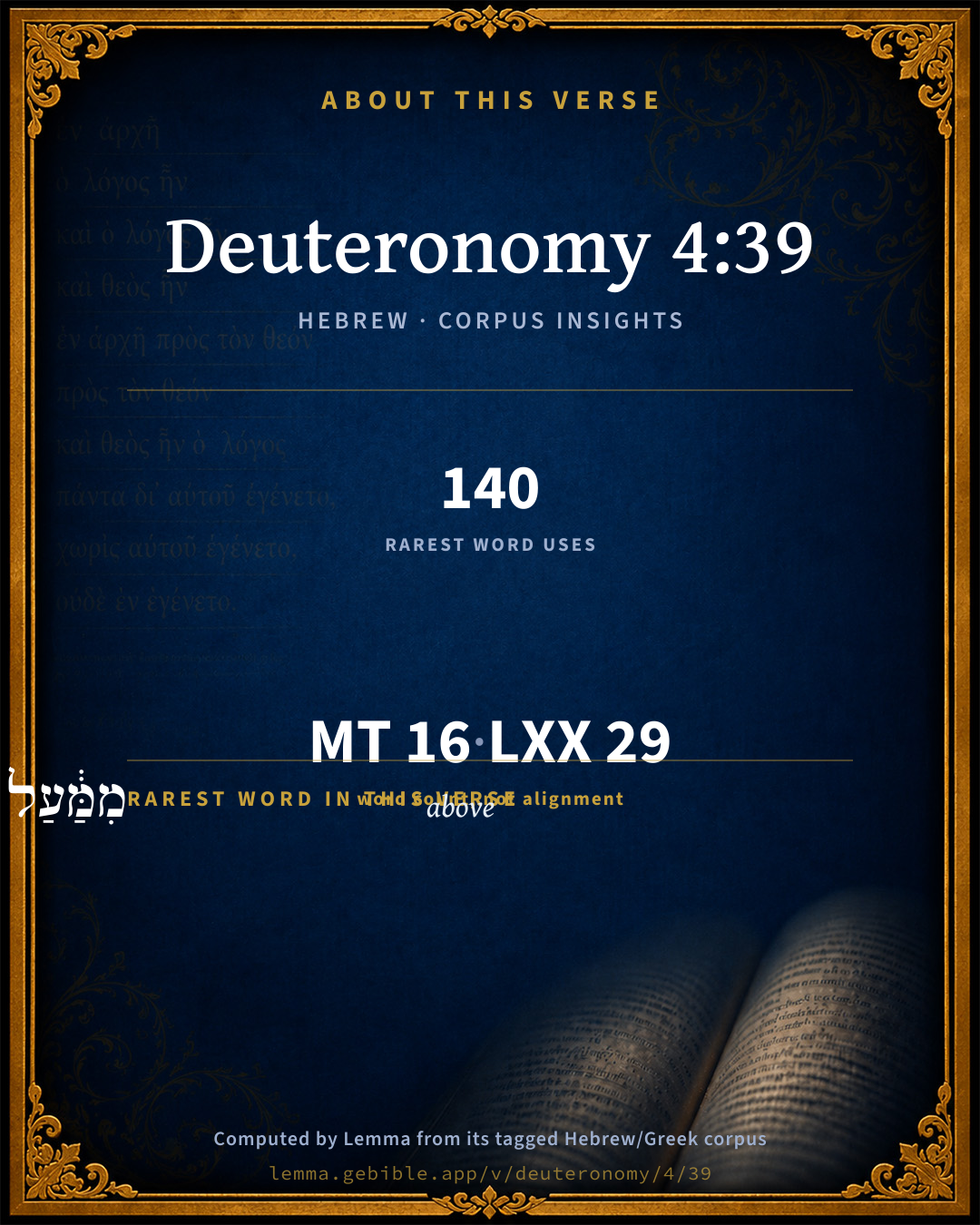
מִמַּ֔עַל
maʻal
H4605
“from · above”
Preposition + Adverb
Part of Speech
Preposition + Adverb
Full BDB Definition

Origin: from H5927

TWOT: 1624k

higher part, upper part (substantive) - above (adverb) - on the top of, above, on higher ground than (preposition) - upwards, higher, above (with locative)
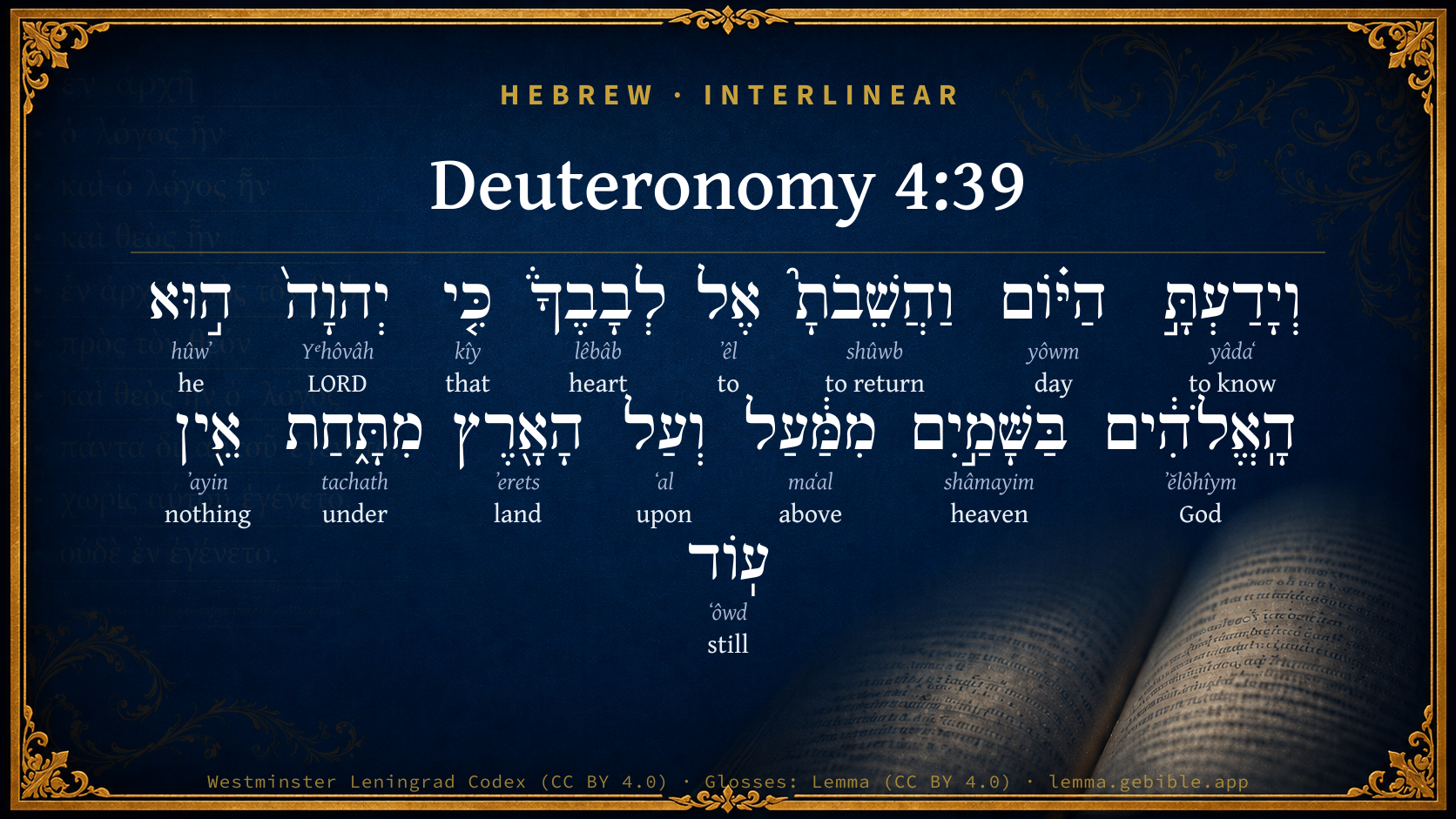
  1. וְיָדַעְתָּ֣ yâdaʻ H3045 “and · to know” Conjunction + Verb, Qal, Sequential Perfect, 2nd Person, Masculine, Singular
  2. הַיּ֗וֹם yôwm H3117 “the · day” Particle, Definite Article + Noun, Common, Masculine, Singular, Absolute
  3. וַהֲשֵׁבֹתָ֮ shûwb H7725 “and · to return” Conjunction + Verb, Hiphil, Sequential Perfect, 2nd Person, Masculine, Singular
  4. אֶל ʼêl H413 “to” Preposition
  5. לְבָבֶךָ֒ lêbâb H3824 “heart · your” Noun, Common, Masculine, Singular, Construct + Suffix, Personal, 2nd Person, Masculine, Singular
  6. כִּ֤י kîy H3588 “that” Conjunction
  7. יְהוָה֙ Yᵉhôvâh H3068 “LORD” Noun, Proper
  8. ה֣וּא hûwʼ H1931 “he” Pronoun, Personal, 3rd Person, Masculine, Singular
  9. הָֽאֱלֹהִ֔ים ʼĕlôhîym H430 “the · God(s)” Particle, Definite Article + Noun, Common, Masculine, Plural, Absolute
  10. בַּשָּׁמַ֣יִם shâmayim H8064 “in/at the · heaven(s)” Preposition, Determined + Noun, Common, Masculine, Plural, Absolute
  11. וְעַל ʻal H5921 “and · upon” Conjunction + Preposition
  12. הָאָ֖רֶץ ʼerets H776 “the · land” Particle, Definite Article + Noun, Common, Both, Singular, Absolute
  13. מִתָּ֑חַת tachath H8478 “from · under” Preposition + Preposition
  14. אֵ֖ין ʼayin H369 “nothing” Particle, Negative
  15. עֽוֹד ʻôwd H5750 “still” Adverb

About this verse

These counts appear in no published source. They are computed here, from the morphology-tagged text and Lemma’s own curated glosses. What Lemma adds →

16
words
16
distinct lemmas
Pentateuch
section

Grammatical profile

  • 2 verbs
  • 6 nouns
  • 1 pronoun
  • 3 prepositions
  • 1 conjunction
  • 2 adverbs
  • 1 particle

Verb forms

  • וְיָדַעְתָּ֣ Qal · Sequential Perfect
  • וַהֲשֵׁבֹתָ֮ Hiphil · Sequential Perfect

Hebrew & Septuagint length

In English translation the verse runs 27 words from the Hebrew and 35 from the Septuagint (LXX English) — closely comparable.

A rough comparison of the two English renderings, which tokenize alike — not a word-level alignment.

Word counts can differ between the Hebrew and the Greek without any difference in meaning — e.g. the Hebrew direct-object marker אֵת has no separate Greek word, and Greek often adds the article ὁ.

In the original languages it is 16 Hebrew tokens and 29 Greek tokens — but the two are counted differently (Hebrew bundles its prefixes and suffixes into one token; the Greek is in lemma form), so that isn’t a like-for-like length.

Cross-references

12

Topical passages linked to Deuteronomy 4:39 in the Treasury of Scripture Knowledge — connected by theme and wording, ordered by reader-vote popularity; previews shown in the World English Bible.

  • Joshua 2:11 As soon as we had heard it, our hearts did melt, neither did there remain any more spirit in any man, because of you: for Yahweh your God, he is God in heaven above, and on earth beneath.
  • Deuteronomy 4:35 To you it was shown, that you might know that Yahweh he is God; there is none else besides him.
  • 1 Chronicles 29:11 Yours, Yahweh, is the greatness, the power, the glory, the victory, and the majesty: for all that is in the heavens and in the earth is yours. Yours is the kingdom, Yahweh, and you are exalted as head above all.
  • Hosea 7:2 They don't consider in their hearts that I remember all their wickedness. Now their own deeds have engulfed them. They are before my face.
  • 1 Chronicles 28:9 You, Solomon my son, know the God of your father, and serve him with a perfect heart and with a willing mind; for Yahweh searches all hearts, and understands all the imaginations of the thoughts: if you seek him, he will be found of you; but if you forsake him, he will cast you off forever.
  • Psalms 135:6 Whatever Yahweh pleased, that he has done, In heaven and in earth, in the seas and in all deeps;
  • 2 Chronicles 20:6 and he said, Yahweh, the God of our fathers, aren't you God in heaven? and aren't you ruler over all the kingdoms of the nations? and in your hand is power and might, so that none is able to withstand you.
  • Deuteronomy 32:29 Oh that they were wise, that they understood this, That they would consider their latter end!
  • Psalms 115:3 But our God is in the heavens. He does whatever he pleases.
  • Daniel 4:35 All the inhabitants of the earth are reputed as nothing; and he does according to his will in the army of heaven, and among the inhabitants of the earth; and none can stay his hand, or tell him, What do you?
  • Isaiah 5:12 The harp, lyre, tambourine, and flute, with wine, are at their feasts; But they don't regard the work of Yahweh, Neither have they considered the operation of his hands.
  • Isaiah 1:3 The ox knows his owner, And the donkey his master's crib; But Israel doesn't know, My people don't consider.

Cross-references courtesy of OpenBible.info (CC BY 4.0).

Hebrew and Greek witnesses Masoretic Hebrew ↔ Greek Septuagint

The same verse in the two great witnesses to the Old Testament, shown verse-for-verse.

These are two independent witnesses, not word-aligned to each other, and the Septuagint is shown in lemma (dictionary) form.

Hebrew Deuteronomy 4:39 Masoretic · Westminster Leningrad Codex

וְיָדַעְתָּ֣ הַיּ֗וֹם וַהֲשֵׁבֹתָ֮ אֶל לְבָבֶךָ֒ כִּ֤י יְהוָה֙ ה֣וּא הָֽאֱלֹהִ֔ים בַּשָּׁמַ֣יִם מִמַּ֔עַל וְעַל הָאָ֖רֶץ מִתָּ֑חַת אֵ֖ין עֽוֹד

Know therefore this day, and lay it to your heart, that Yahweh he is God in heaven above and on the earth beneath; there is none else.

World English Bible · Public Domain

Greek LXX Deuteronomy 4:39 Septuagint · lemma form

καί γιγνώσκω σήμερον καί ἐπιστρέφω ὁ διάνοια ὅτι κύριος ὁ θεός σύ οὗτος θεός ἐν ὁ οὐρανός ἄνω καί ἐπί ὁ γῆ κάτω καί οὐ εἰμί ἔτι πλήν αὐτός

And you shall know this day, and shall consider in your heart, that the Lord your God he is God in heaven above, and on the earth beneath, and there is none else but he.

LXX2012 (modern English Septuagint) · Public Domain

Hebrew: Westminster Leningrad Codex (CC BY 4.0). Greek: Septuagint (public domain); English from LXX2012 (modern English Septuagint) (Public Domain). How the Septuagint differs from the Hebrew →

Targum (Aramaic paraphrase)

2

The Targum is the ancient Jewish Aramaic paraphrase of the Hebrew Scriptures — an interpretive translation, not the Hebrew text itself. Onkelos (literal) and Pseudo-Jonathan (expansive) render the Torah, and Jonathan the Prophets. Coverage is partial: where no permissively-licensed English translation exists for a verse, only the Aramaic is shown. This is verse-level text, not a word-by-word alignment to the Hebrew.

  1. Targum Onkelos Torah (Genesis–Deuteronomy)
    וְתִדַע יוֹמָא דֵין וּתְתוּב לְלִבָּךְ אֲרֵי יְיָ הוּא אֱלָהָא דִשְׁכִנְתֵּהּ בִּשְׁמַיָא מִ לְעֵלָא וְשַׁלִיט עַל אַרְעָא מִלְרָע לֵית עוֹד

    (no public-domain English translation for this verse)

    Targum Onkelos — Aramaic: “Onkelos Genesis” (public domain); “Onkelos Exodus” (public domain); “Onkelos Leviticus” (public domain); “Onkelos Numbers” (public domain); “Onkelos Deuteronomy” (public domain). English: “Sefaria Community Translation” (CC0 1.0 (public-domain dedication)); “J.W. Etheridge. The Targums of Onkelos and Jonathan Ben Uzziel on the Pentateuch. London: Longmans, Green, 1862” (public domain). Text via Sefaria.

  2. Targum Pseudo-Jonathan Torah (Genesis–Deuteronomy)
    וְתִנְדְּעוּן יוֹמָא דֵין וּתְתוּבוּן עַל לִבְּכוֹן אֲרוּם יְיָ אֱלהִים דִּשְׁכִינְתֵּיהּ שַׁרְיָא בִּשְׁמַיָא מִלְעֵילָא וְשַׁלִּיט עַל אַרְעָא מִלְרַע לֵית חוֹרָן בַּר מִנֵיהּ

    Know therefore today, and set your heart upon it, that the Lord is God, whose Shekinah dwelleth in the heavens above, and reigneth on the earth beneath, neither is there any other beside Him.

    Targum Pseudo-Jonathan — Aramaic: “Targum Jonathan on Genesis” (public domain); “Targum Jonathan on Exodus” (public domain); “Targum Jonathan on Leviticus” (public domain); “Targum Jonathan on Numbers” (public domain); “Targum Jonathan on Deuteronomy” (public domain). English: “The Targum of Jonathan ben Uzziel, trans. J. W. Etheridge, London, 1862” (public domain). Text via Sefaria.

Commentary

Notes on Deuteronomy 4:39 from classic Christian and Jewish commentators (each source and its license shown beneath its notes). The classic Christian expositions comment on the surrounding passage and are grouped to its opening verse, so a note may address several verses; the Jewish commentaries on the Tanakh (Rashi and others) are per-verse, so they appear only where the commentator wrote on this verse.

Lemma curates 59 commentaries, every one of them public domain or Creative Commons licensed, each selected and text-cleaned for this edition rather than reprinted as found. About our sources →

Trapp's Complete Commentary

John Trapp

Deu 4:39 Know therefore this day, and consider [it] in thine heart, that the LORD he [is] God in heaven above, and upon the earth beneath: [there is] none else.

Ver. 39. That the Lord he is God in heaven.] A philosopher {a} could say, that God is a circle, whose centre is everywhere, whose circumference is nowhere; ubi est Deus? quid dixi miser? sed ubi non est? Where is God? or rather, where is not God? He is higher than heaven, lower than hell, broader than the sea, longer than the earth. Nusquam est et ubique est, quia nec abest ulli, nec ullo capitur loco. {b} He is nowhere, and yet everywhere; far from no place, and yet not contained in any place.

{a} Empedocles.

{b} Bernard.

John Trapp, A Commentary or Exposition upon All the Books of the Old and New Testament (1647–1656) — public domain. Text from a community e-Sword module.

The Biblical Illustrator

Joseph S. Exell

Deu_4:39

Consider it in thine heart, that the Lord He is God in heaven above, and upon the earth beneath.

The relation of man to God

We must have God before we can understand Him. We must receive Him into our loving trust before we can make any advance in knowing what He is, what are His qualities and His attributes, and what is all the meaning that is written in His infinite heart. I am delighted to tell again and again of the poor woman who, upon being interrogated by her minister concerning formal divinity, before she could be admitted as a guest at the Lords table, was utterly unable to answer a single question; whereupon the minister informed her that she was not fit to be admitted to the table of the Lord. Sir, said she, with womanly feeling and pathos, I cant answer these questions, but I could die for Him. That is religion! Not answering questions only, not being able to enter into critical disquisitions, but sending the heart out to receive God into its trust and love. Hence the exhortation of the text, Consider it in thine heart. You may consider the question in the intellectual region, and get little or nothing out of the considerations. When the heart knows its own hunger and its own bitterness, then, in that sad but holy hour, the heart may get some hold upon the idea of God. I can imagine the man of average education and intelligence, whom I am imaginatively addressing, asking me some such question as this, How is it that God does not show Himself more clearly to us than He does, and so put an end to all uncertainty concerning Himself? I answer, Are we capable of understanding what is and what is not the proper degree and method of Divine manifestation? Is it becoming in men, who cannot certainly tell what will happen in one single hour, that they should write a programme for God, and appoint the way of the Almighty? These things cause me to say that religious questions, if they are to be profitably considered at all, must be considered in a deeply religious spirit. You can make no advancement in this learning unless you bring a right heart with you. That is the beginning. There was a peculiar controversy or conversation in my garden the other day; it quite entertained me. There were, after those heavy rains, two worms that had struggled out of the earth, and found their way upon the wet green grass; and they began to talk in a very decided and mocking manner about myself. One, the elder and better-to-do of the two, said, Eh, eh, eh! We have been told that this garden has an owner or somebody that takes care of it, that nourishes the roots of things, and that altogether presides over the affair. Eh, eh, eh, I never saw him. If there is such an owner, why doesnt he show himself more clearly?--why doesnt he come to the front and let us see him, eh? And the leaner one of the two said, That is an unanswerable argument. I never saw him. There may be such a being, but I care nothing about him; only, if he is alive, why dont he show himself? They quite wriggled in contemptuous triumph; yet all the while I was standing there, looking at the poor creatures, and hearing them! I could have set my foot upon them and crushed them; but I did not. There is a way of wasting strength; there is also a way of showing patience. But the worms could not understand my nature. I was standing there, and they knew me not! What if it be so with ourselves in the greater questions? Proceeding with our statement respecting the revelation of God, I have now to ask you to believe with me, as a matter of fact--

1. That we stand to God in the relation of dependants. That is our actual position in life. What hast thou, that thou hast not received? Let a man begin his studies there, and he will become correspondingly reverent. Have you genius? Who lighted the lamp? Have you health? Who gave you your constitution? Do you find the earth productive? Yes. Who made it productive? I did. I till it: I supply all the elements of nourishment needful; I did. Did you? Can you make it rain? Can you make the sun shine? If a man once be started on that course of reflection, the probability is, that he who begins as a reverent inquirer will end as a devout worshipper.

2. Then I ask you to believe, in the next place, that the very fact of being dependent should lead us to be very careful how we measure the sovereignty and the government of God. He has made us servants, not masters. We are little children, not old beings, in His household and universe. We are mysteries to ourselves. We need not go from home to seek mysteries.

3. I have to ask you, in the third place, to believe that the very fact of the mystery of our own life should be the beginning and the defence of our faith in God. Reason from yourself upwards. There is a way out of the human to the Divine. It is a commendable course of procedure to reason from the known to the unknown. If you are such a mystery to your own child, if the philosopher is such a mystery to the uninstructed man, if you are such a mystery to yourself--why may there not be a power around more mysterious still, higher and nobler yet? Reason from yourselves--from your own capacities and your own resources. Is not the maker greater than the thing made? Take away the idea of God from human thinking, and mark the immediate and necessary consequences. This is a method of reasoning which I commend to the attention of young inquirers who are earnest about this business. The method, namely, of withdrawment. If a man doubts concerning God, I shall withdraw the idea of God from human thinking, and see the necessary consequences. If a man has any argument to adduce against Christianity, take Christianity out of the country, and see what will be left. Take out the doctrine, take out the practice, take out not only Christian theology, but Christian morality, and see how many hospitals would be left, and how many penitentiaries, infirmaries, schools, and asylums for the deaf and the dumb and the blind and the idiotic. So take away the idea of God from human thinking, and see the immediate and inevitable consequences. There is no God; then there is no supreme supervision of human life as a whole; for none could have the eye that could see the whole orbit of things. We see points, not circumferences. There is no God; then there is no final judgment by which the wrongs of centuries can be avenged; there is no heart brooding over us to which we can confide the story of our sorrow, or tell the anguish of our pain. Set God again on the throne, and all that makes life worth having, even imaginatively, comes back again. Set God upon the throne, and all things take upon them a new, true, beautiful meaning; there is hope of judgment, and a certainty that right will eventually be done. Shall I ask you to remember--observe, I still speak to my scholar whom I assume to be diligent and earnest--that our little day has been too short to know the full mystery of God? When an infant of yours has gone to school, do you expect the little one to come back at twelve oclock on the first day and be able to read you a chapter even out of the simplest book? You are an old man; yes, but a young being, an infantile being. Very old indeed, if you think of insuring yourself, or buying another estate, or laying out a great sum of money--very, very old indeed; but if you are talking of the universe, you are the insect of a moment--hardly born! But you wish to read the book called the Universe through at one sitting, like a cheap novel. Thou art of yesterday, and knowest nothing; and I, thy teacher, what am I but a man who, having seen one ray of light amid thick and terrible gloom, come to thee and stand here that you may see the same beautiful revelation! All this shows us what our spirit ought to be. He who comes to school with this spirit will learn most and learn it most quickly. And this let me tell you young man, the greatest men I have ever known have been the most humble, docile, self-distrustful. (Dr. Parker, D. D.)

The Biblical Illustrator, edited by Joseph S. Exell (c. 1880s–1900s) — public domain. Text from a community e-Sword module.

Joseph Benson's Commentary

Deu 4:39. Know and consider it in thy heart — From all that thou hast seen, heard, and experienced. That the Lord he is God, &c. — Settle it in thy heart that none but the Creator of all things could perform those mighty acts.

Joseph Benson's Commentary on the Old and New Testaments (1811–1818) — public domain. Text from a community e-Sword module.

Tyndale Open Study Notes

Tyndale Open Resources

4:39 The Lord is unique, and there is no other besides him. This instruction reaffirms the first two commandments (5:6-8; Exod 20:2-4) and foreshadows the Shema (Deut 6:4-5). God’s uniqueness had to be underscored because Israel’s neighbors worshiped many gods.

Tyndale Open Study Notes — © Tyndale Open Resources, licensed CC BY-SA 4.0. Text via the HelloAO Bible API.

Ellicott's Commentary for English Readers

(39) Know therefore . . . and consider.—“Consider,” i.e., reckon (the word for “impute” and “account” in St. Paul’s argument to the Romans). Do not indulge any polytheistic notions regarding the Deity. “To us there is but One God.” If every nation has its separate deity, how is it that Jehovah controls them all? His various dealings with Egyptians, Moabites, Ammonites, Edomites, Amorites, as well as with Israelites and Canaanites, mark Him as Lord of all. “There is none else.” There are no more gods; if you desire to leave Him behind, there is no one else to serve. Compare Isa_44:8 : “Is there a God beside me? yea, there is no Rock. I know not any.”

A Bible Commentary for English Readers, edited by Charles John Ellicott (1878–1897) — public domain. Text from a community e-Sword module.

The Cambridge Bible for Schools and Colleges

gen. ed. J. J. S. Perowne

39. Know therefore] The apodosis in the long sentence Deu_4:37-39 begins here and not as the R.V. gives it with chose in Deu_4:37. See on Deu_7:9.

lay it to thine heart] Heb. bring back to thy heart, i.e. mind or memory. See on. Deu_4:29, and Deu_4:6.

The Cambridge Bible for Schools and Colleges (gen. ed. J. J. S. Perowne; Cambridge University Press, 1878–1918) — public domain. Text from a community e-Sword module.

John Gill's Exposition

Know therefore this day, and consider it in thine heart,.... Own and acknowledge it now with thy mouth, and lay it up and consider it in thine heart hereafter, as a truth of the greatest importance to be professed and held fast, and to be thought of and meditated upon continually, and never to be forgotten:

that the Lord he is God in heaven above, and upon the earth beneath; that he has made both, and is the possessor and Lord of them, and does what he pleases with them; that the one is his throne, his dwelling place, and the other his footstool; and that the inhabitants of both are his creatures, and under his authority and command, and he can dispose of them as he pleases:

there is none else; no God in heaven or in earth beside him.

John Gill's Exposition of the Whole Bible (1746–1763) — public domain (CC PDM 1.0). Text via the HelloAO Bible API.

Haydock's Catholic Bible Commentary

Other. The power of the true and only God is not confined to the sea, or to the land, &c., (Calmet) as the pagans believed that of their various idols was. (Haydock)

George Leo Haydock (1774–1849), Haydock's Catholic Family Bible and Commentary, 1859 edition — public domain. Excludes Psalms (Douay-Rheims chapter numbering differs from Protestant) and Deuterocanonical books (Catholic canon only).

The Pulpit Commentary

Know therefore this day, and consider it in thine heart, etc.; literally, bring back into thy heart. "Because we cannot lay hold of spiritual things in thought instantly in a moment, God commands to make them to revert, i.e. again and again to recall them to the mind" (Bechai, fol. 194 b).

Vers. 39, 40. Loyalty to God the basis of national prosperity and of family happiness. (See Homiletics, Deu_4:1-4 and 5-9.)

The Pulpit Commentary (1880–1919), ed. H.D.M. Spence-Jones & Joseph S. Exell — public domain. Text from a community e-Sword module.

Keil & Delitzsch

C. F. Keil & F. Delitzsch

By this the Israelites were to know and lay it to heart, that Jehovah alone was God in heaven and on earth, and were to keep His commandments, in order that (אשׁר) it might be well with them and their descendants, and they might have long life in Canaan. כּל־היּמים, "all time," for all the future (cf. Exo 20:12).

Keil & Delitzsch — Biblical Commentary on the Old Testament (1861–1891) — public domain (CC PDM 1.0). Text via the HelloAO Bible API. (Old Testament only.)

unfoldingWord translationNotes

Door43 World Missions Community

General Information:

Moses continues to speak to the people of Israel if they were one man, so all instances of "you" and "your" are singular. (See: Forms of You)

lay it on your heart

This is an idiom. AT: "remember it" (See: Idiom)

in heaven above and on the earth beneath

The two phrases "in heaven" and "on the earth" show two extremes and mean "everywhere." AT: "over everything" (See: Merism)

prolong your days

Long days are a metaphor for a long life. See how you translated these words in Deuteronomy 4:26. AT: "be able to live a long time" (See: Metaphor)

translationWords

know

heart

Yahweh

God

heaven

earth

statute

command

eternity

unfoldingWord translationNotes — © Distant Shores Media and the Door43 World Missions Community, licensed CC BY-SA 4.0. Source: git.door43.org/Door43/en_tn.

Lesson kit

Teaching starters — assembled from the data on this page, not authored interpretation. Every prompt links to the verse data it draws on. Edit before teaching.

Deuteronomy, in the Pentateuch, opens this verse with 16 words (16 distinct Hebrew lemmas). Its most distinctive word is maʻal (“above”). A historical commentator’s framing appears above. Read the whole chapter for the surrounding context.

Discussion questions

  1. How does “above” (maʻal) shape what this verse is saying?
  2. How does Joshua 2:11, which shares this passage’s theme, read alongside this verse?
  3. These translations render this verse differently. What is at stake in choosing one wording over another?
  4. «וְיָדַעְתָּ֣» is a Qal Sequential Perfect verb. How does that grammatical form shape the action described?
  5. Compare how Trapp's Complete Commentary and The Biblical Illustrator read this verse. Where do they agree or differ?

Things to notice

Reading settings

Reading text

Shown beneath each verse's original-language words.

Old Testament
Old Testament edition

Read the OT as the Masoretic Hebrew (MT) or the Greek Septuagint (LXX).

English shown for the Greek Septuagint (in the Hebrew ↔ Greek comparison).

Comparing translations? Open the Compare panel on any verse page to stack up to four side by side.