Genesis 45:6

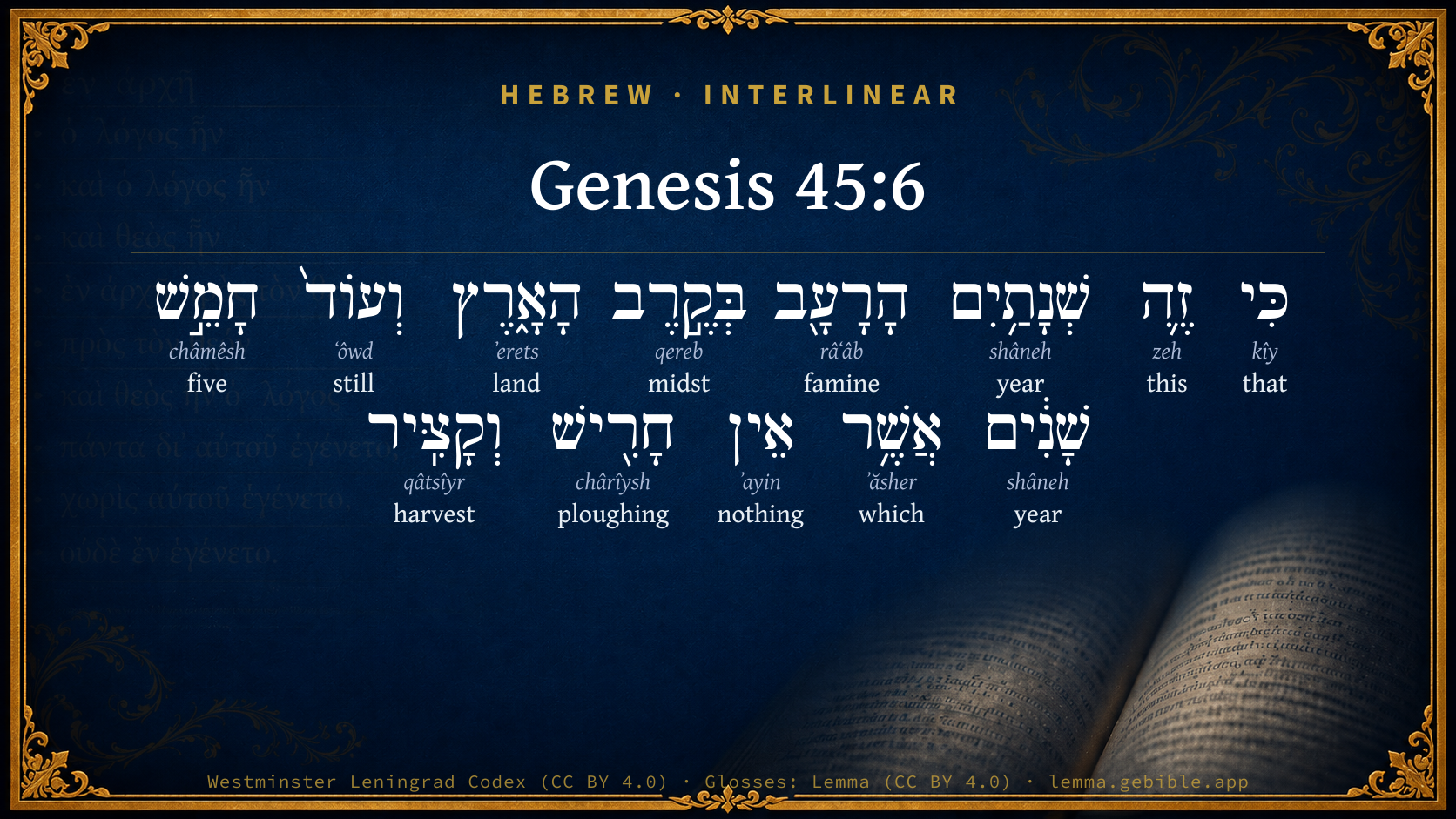
Hebrew (Westminster Leningrad Codex) Genesis 45:6 appears in the Hebrew Old Testament. The text above is from the Westminster Leningrad Codex. Each word links to its Strong’s number, a concise gloss, and parsing drawn from the Open Scriptures Hebrew Bible morphology. Click any word for its full Brown-Driver-Briggs (BDB) entry.
Download image
Cite this verse

Genesis 45:6 (World English Bible). Public Domain. Lemma interlinear Bible study tool, https://lemma.gebible.app/v/genesis/45/6.

Show BibTeX & RIS
BibTeX
RIS
English Translation
For these two years the famine has been in the land, and there are yet five years, in which there will be neither plowing nor harvest.
World English Bible · Public Domain
Highlights
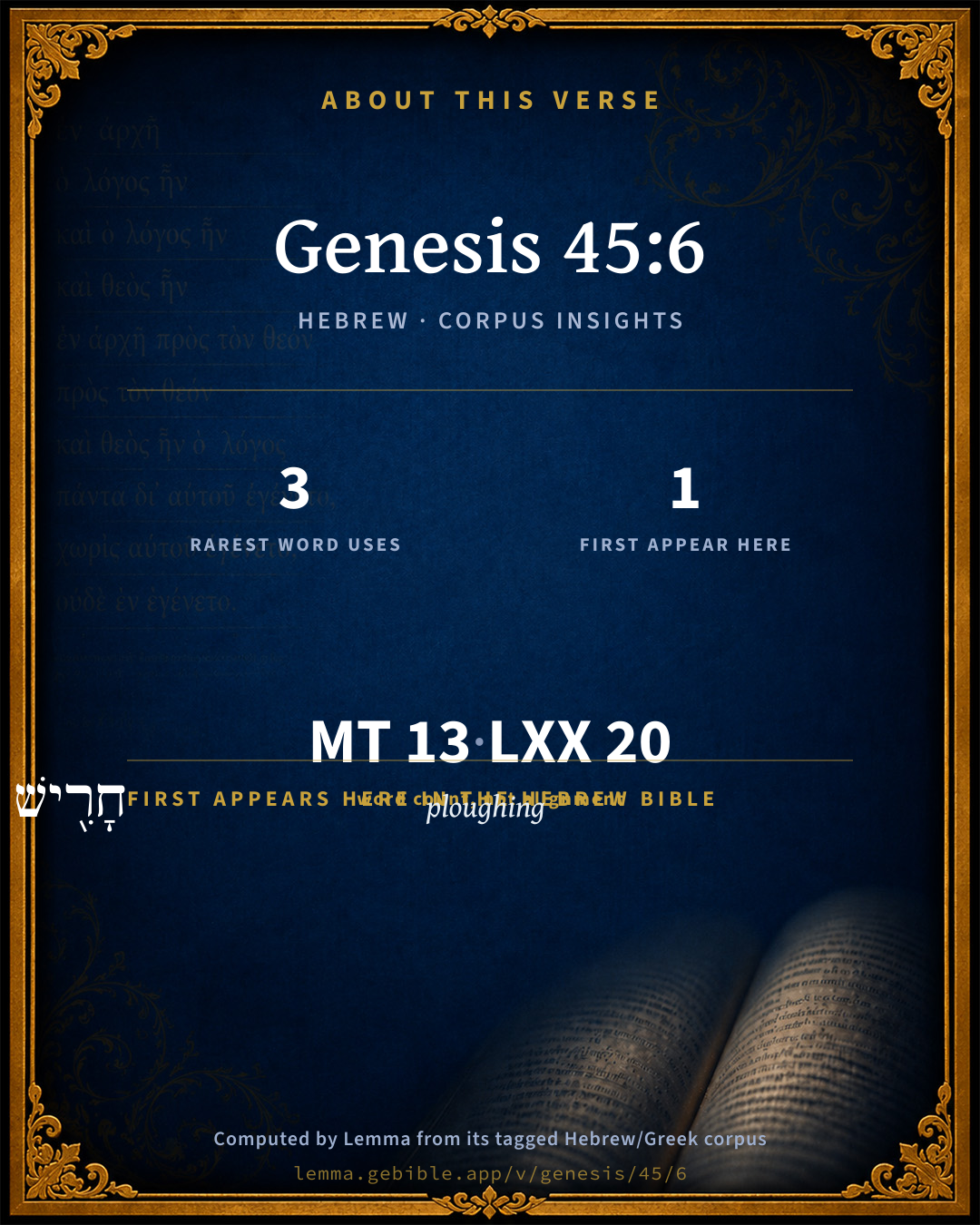
  • 1 first appearance in the Hebrew Bible
Full analysis ↓
Download a study sheet

One document with this verse’s original text, its word-by-word gloss line, the meaning frame, cross-references with their text, attributed commentary, and full source and license credits — printable, and it pastes into notes with its structure intact.

This verse Autodidact and up

Study sheet (.html) Plain text (.txt)

A passage Seminary Student

Up to 50 verses in one chapter. A passage sheet keeps up to 6 commentary sources and 12 cross-references per verse, in the order this page ranks them, and says so on the sheet whenever that leaves anything out. Ask for a single verse and you get the Autodidact verse sheet above.

Everything on this page stays free to read, with no account — the sheet is a download of what is already on screen, not access to it.

Want to remove ads? Support Godless Engineer
Compare translations 3

The same verse in 3 English versions, stacked beneath the original-language interlinear above. Click any original word for its lexicon entry.

Each is an independent rendering of the whole verse — the interlinear is not word-aligned to these translations.

Highlighted words mark where these versions differ — a whole-verse word diff, not a word-by-word alignment.

  • World English Bible Public Domain
    For these two years the famine has been in the land, and there are yet five years, in which there will be neither plowing nor harvest.
  • King James Version Public Domain
    For these two years hath the famine been in the land: and yet there are five years, in the which there shall neither be earing nor harvest.
  • unfoldingWord Literal Text CC BY-SA 4.0
    For this two years the famine in the midst of the land, and still five years which not be plowing and harvesting.

unfoldingWord Literal Text — © unfoldingWord, licensed CC BY-SA 4.0. Word-aligned USFM3 via Door43 (git.door43.org/unfoldingWord/en_ult).

Versions to compare (up to 4)

3 of 4 selected

Show all 18 translations

Every available English version of this verse, each an independent rendering of the whole verse.

  • World English Bible Public Domain
    For these two years the famine has been in the land, and there are yet five years, in which there will be neither plowing nor harvest.
  • Berean Standard Bible Public Domain
    For the famine has covered the land these two years, and there will be five more years without plowing or harvesting.
  • Majority Standard Bible Public Domain
    For the famine has covered the land these two years, and there will be five more years without plowing or harvesting.
  • King James Version Public Domain
    For these two years hath the famine been in the land: and yet there are five years, in the which there shall neither be earing nor harvest.
  • American Standard Version (1901) Public Domain
    For these two years hath the famine been in the land: and there are yet five years, in which there shall be neither plowing nor harvest.
  • Revised Version (1885) Public Domain
    For these two years hath the famine been in the land: and there are yet five years, in the which there shall be neither plowing nor harvest.
  • Geneva Bible (1599) Public Domain
    For nowe two yeeres of famine haue bene through ye land, and fiue yeeres are behind, wherein neither shalbe earing nor haruest.
  • Douay-Rheims (1899) Public Domain
    For it is two years since the famine began to be upon the land, and five years more remain, wherein there can be neither ploughing nor reaping.
  • Young's Literal Translation Public Domain
    `Because these two years the famine `is' in the heart of the land, and yet `are' five years, `in' which there is neither ploughing nor harvest;
  • Literal Standard Version CC BY-SA 4.0
    Because these two years the famine [is] in the heart of the land, and yet five years [remain in] which there is neither plowing nor harvest;
  • Unlocked Literal Bible CC BY-SA 4.0
    For these two years the famine has been in the land, and there are still five years in which there will be neither plowing nor harvest.
  • unfoldingWord Literal Text CC BY-SA 4.0
    For this two years the famine in the midst of the land, and still five years which not be plowing and harvesting.
  • Darby Bible Public Domain
    For the famine has been these two years in the land; and yet there are five years in which there will be neither ploughing nor harvest.
  • World Messianic Bible Public Domain
    For these two years the famine has been in the land, and there are yet five years, in which there will be no plowing and no harvest.
  • Webster's Bible Public Domain
    For these two years hath the famine been in the land: and yet there are five years, in which there shall neither be tillage nor harvest.
  • Free Bible Version CC BY-SA 4.0
    The country has suffered from famine for two years already, but there will be five more years with no plowing or reaping.
  • Bible in Basic English Public Domain
    For these two years have been years of need, and there are still five more years to come in which there will be no ploughing or cutting of grain.
  • JPS Tanakh (1917) Public Domain
    For these two years hath the famine been in the land; and there are yet five years, in which there shall be neither plowing nor harvest.

Literal Standard Version (2020), Covenant Press — licensed CC BY-SA 4.0. Text via the HelloAO Bible API (eBible.org). Unlocked Literal Bible (unfoldingWord) — licensed CC BY-SA 4.0. Text via the HelloAO Bible API (eBible.org). unfoldingWord Literal Text — © unfoldingWord, licensed CC BY-SA 4.0. Word-aligned USFM3 via Door43 (git.door43.org/unfoldingWord/en_ult). Free Bible Version, Dr. Jonathan Gallagher — licensed CC BY-SA 4.0. Text via the HelloAO Bible API (eBible.org).

Word by word

More ways to search: Search by grammar → Find every occurrence → Compare this word →

Practice this passage: Drill this verse → Learn its vocabulary →

חָרִ֖ישׁ
chârîysh
H2758
“ploughing”
Noun, Common, Masculine, Singular, Absolute
Part of Speech
Noun
Type
Common
Gender
Masculine
Number
Singular
State
Absolute
Full BDB Definition

Origin: from H2790

TWOT: 760c

ploughing, ploughing time
  1. כִּי kîy H3588 “that” Conjunction
  2. זֶ֛ה zeh H2088 “this” Pronoun, Demonstrative, Masculine, Singular
  3. שְׁנָתַ֥יִם shâneh H8141 “years” Noun, Common, Feminine, Dual, Absolute
  4. הָרָעָ֖ב râʻâb H7458 “the · famine” Particle, Definite Article + Noun, Common, Masculine, Singular, Absolute
  5. בְּקֶ֣רֶב qereb H7130 “in/at · midst of” Preposition + Noun, Common, Masculine, Singular, Construct
  6. הָאָ֑רֶץ ʼerets H776 “the · land” Particle, Definite Article + Noun, Common, Both, Singular, Absolute
  7. וְעוֹד֙ ʻôwd H5750 “and · still” Conjunction + Adverb
  8. חָמֵ֣שׁ châmêsh H2568 “five” Adjective, Cardinal number, Feminine, Singular, Absolute
  9. שָׁנִ֔ים shâneh H8141 “years” Noun, Common, Feminine, Plural, Absolute
  10. אֲשֶׁ֥ר ʼăsher H834 “which” Particle, Relative
  11. אֵין ʼayin H369 “nothing” Particle, Negative
  12. וְקָצִּֽיר qâtsîyr H7105 “and · harvest” Conjunction + Noun, Common, Masculine, Singular, Absolute

About this verse

These counts appear in no published source. They are computed here, from the morphology-tagged text and Lemma’s own curated glosses. What Lemma adds →

13
words
12
distinct lemmas
Pentateuch
section

Notable vocabulary

The rarest word here is חָרִ֖ישׁ ploughing H2758 — appearing just 3 times in the whole Hebrew Bible.

First appearance in Scripture

This word makes its first canonical appearance in the Hebrew Bible here:

  • חָרִ֖ישׁ ploughing H2758

Shared distinctive vocabulary

חָרִ֖ישׁ ploughing H2758 occurs in 3 verses of the Hebrew Bible. Also found in:

Grammatical profile

  • 7 nouns
  • 1 adjective
  • 1 pronoun
  • 1 conjunction
  • 1 adverb
  • 2 particles

Repetition

A word recurs within this verse — often emphatic in Hebrew:

  • שְׁנָתַ֥יִם year H8141 ×2

Hebrew & Septuagint length

In English translation the verse runs 26 words from the Hebrew and 27 from the Septuagint (LXX English) — closely comparable.

A rough comparison of the two English renderings, which tokenize alike — not a word-level alignment.

Word counts can differ between the Hebrew and the Greek without any difference in meaning — e.g. the Hebrew direct-object marker אֵת has no separate Greek word, and Greek often adds the article ὁ.

In the original languages it is 13 Hebrew tokens and 20 Greek tokens — but the two are counted differently (Hebrew bundles its prefixes and suffixes into one token; the Greek is in lemma form), so that isn’t a like-for-like length.

Cross-references

9

Topical passages linked to Genesis 45:6 in the Treasury of Scripture Knowledge — connected by theme and wording, ordered by reader-vote popularity; previews shown in the World English Bible.

  • Genesis 47:23 Then Joseph said to the people, "Behold, I have bought you and your land today for Pharaoh. Behold, here is seed for you, and you shall sow the land.
  • Genesis 41:29–31 Behold, there come seven years of great plenty throughout all the land of Egypt.
  • Genesis 41:54 The seven years of famine began to come, just as Joseph had said. There was famine in all lands, but in all the land of Egypt there was bread.
  • Genesis 41:56 The famine was over all the surface of the earth. Joseph opened all the store-houses, and sold to the Egyptians. The famine was severe in the land of Egypt.
  • Genesis 47:18 When that year was ended, they came to him the second year, and said to him, "We will not hide from my lord how our money is all spent, and the herds of cattle are my lord's. There is nothing left in the sight of my lord, but our bodies, and our lands.
  • Exodus 34:21 Six days you shall work, but on the seventh day you shall rest: in plowing time and in harvest you shall rest.
  • Deuteronomy 21:4 and the elders of that city shall bring down the heifer to a valley with running water, which is neither plowed nor sown, and shall break the heifer's neck there in the valley.
  • 1 Samuel 8:12 and he will appoint them to him for captains of thousands, and captains of fifties; and [he will set some] to plow his ground, and to reap his harvest, and to make his instruments of war, and the instruments of his chariots.
  • Isaiah 30:24 the oxen likewise and the young donkeys that till the ground shall eat savory provender, which has been winnowed with the shovel and with the fork.

Cross-references courtesy of OpenBible.info (CC BY 4.0).

Hebrew and Greek witnesses Masoretic Hebrew ↔ Greek Septuagint

The same verse in the two great witnesses to the Old Testament, shown verse-for-verse.

These are two independent witnesses, not word-aligned to each other, and the Septuagint is shown in lemma (dictionary) form.

Hebrew Genesis 45:6 Masoretic · Westminster Leningrad Codex

כִּי זֶ֛ה שְׁנָתַ֥יִם הָרָעָ֖ב בְּקֶ֣רֶב הָאָ֑רֶץ וְעוֹד֙ חָמֵ֣שׁ שָׁנִ֔ים אֲשֶׁ֥ר אֵין חָרִ֖ישׁ וְקָצִּֽיר

For these two years the famine has been in the land, and there are yet five years, in which there will be neither plowing nor harvest.

World English Bible · Public Domain

Greek LXX Genesis 45:6 Septuagint · lemma form

οὗτος γάρ δεύτερος ἔτος λιμός ἐπί ὁ γῆ καί ἔτι λοιπός πέντε ἔτος ἐν ὅς οὐ εἰμί ἀροτρίασις οὐδέ ἄμητος

For this second year there is famine on the earth, and there are yet five years remaining, in which there is to be neither plowing, nor mowing.

LXX2012 (modern English Septuagint) · Public Domain

Hebrew: Westminster Leningrad Codex (CC BY 4.0). Greek: Septuagint (public domain); English from LXX2012 (modern English Septuagint) (Public Domain). How the Septuagint differs from the Hebrew →

Targum (Aramaic paraphrase)

2

The Targum is the ancient Jewish Aramaic paraphrase of the Hebrew Scriptures — an interpretive translation, not the Hebrew text itself. Onkelos (literal) and Pseudo-Jonathan (expansive) render the Torah, and Jonathan the Prophets. Coverage is partial: where no permissively-licensed English translation exists for a verse, only the Aramaic is shown. This is verse-level text, not a word-by-word alignment to the Hebrew.

  1. Targum Onkelos Torah (Genesis–Deuteronomy)
    אֲרֵי דְנַן תַּרְתֵּין שְׁנִין כַּפְנָא בְּגוֹ אַרְעָא וְעוֹד חָמֵשׁ שְׁנִין דִּי לֵית זְרוֹעָא וַחֲצָדָא

    (no public-domain English translation for this verse)

    Targum Onkelos — Aramaic: “Onkelos Genesis” (public domain); “Onkelos Exodus” (public domain); “Onkelos Leviticus” (public domain); “Onkelos Numbers” (public domain); “Onkelos Deuteronomy” (public domain). English: “Sefaria Community Translation” (CC0 1.0 (public-domain dedication)); “J.W. Etheridge. The Targums of Onkelos and Jonathan Ben Uzziel on the Pentateuch. London: Longmans, Green, 1862” (public domain). Text via Sefaria.

  2. Targum Pseudo-Jonathan Torah (Genesis–Deuteronomy)
    אֲרוּם דֵין תַּרְתֵּין שְׁנִין כַּפְנָא בְּגוֹ אַרְעָא וְעוֹד חֲמֵשׁ שְׁנִין דְלָא רַדְיַין וְלָא חַצְדִין

    For these two years hath the famine been in the midst of the land, and there are yet five years in which there will be neither ploughing nor harvest.

    Targum Pseudo-Jonathan — Aramaic: “Targum Jonathan on Genesis” (public domain); “Targum Jonathan on Exodus” (public domain); “Targum Jonathan on Leviticus” (public domain); “Targum Jonathan on Numbers” (public domain); “Targum Jonathan on Deuteronomy” (public domain). English: “The Targum of Jonathan ben Uzziel, trans. J. W. Etheridge, London, 1862” (public domain). Text via Sefaria.

Commentary

Notes on Genesis 45:6 from classic Christian and Jewish commentators (each source and its license shown beneath its notes). The classic Christian expositions comment on the surrounding passage and are grouped to its opening verse, so a note may address several verses; the Jewish commentaries on the Tanakh (Rashi and others) are per-verse, so they appear only where the commentator wrote on this verse.

Lemma curates 59 commentaries, every one of them public domain or Creative Commons licensed, each selected and text-cleaned for this edition rather than reprinted as found. About our sources →

Trapp's Complete Commentary

John Trapp

Gen 45:6 For these two years [hath] the famine [been] in the land: and yet [there are] five years, in the which [there shall] neither [be] earing nor harvest.

Ver. 6. {See Trapp on "Gen 41:54"}

John Trapp, A Commentary or Exposition upon All the Books of the Old and New Testament (1647–1656) — public domain. Text from a community e-Sword module.

Joseph Benson's Commentary

Gen 45:6-7. Five years there shall be neither earing (an old English word for ploughing, which is the meaning of the Hebrew) nor harvest — That is, except in a few places near the river Nile; for, understanding from Joseph that the famine would be of long continuance, and that their labour and seed, which they could ill spare, would be lost, people would neither plough nor sow, and, of course, could not reap. To preserve you a posterity in the earth — That you and your children might be sustained in this time of famine, and afterward abundantly multiplied as God hath promised. To save your lives by a great deliverance — Or, according to the Hebrew, for a great escaping, or, a great remnant; — that is, that you, who are now but a handful, escaping this danger, might grow into a vast multitude; the word evasion, or escaping, being put for the persons that escape, as 2Ch 30:6, and Isa 10:20. Joseph reckoned that his advancement was not so much designed to save a whole kingdom of Egyptians, as to preserve a small family of Israelites; for the Lord’s portion is his people: whatever goes with others, they shall be secured. How admirable are the projects of Providence! How remote their tendencies! What wheels are there within wheels; and yet all directed by the eyes in the wheels, and the spirit of the living creature!

Joseph Benson's Commentary on the Old and New Testaments (1811–1818) — public domain. Text from a community e-Sword module.

Jamieson, Fausset & Brown

Robert Jamieson, A. R. Fausset & David Brown

and yet there are five years, in the which there shall neither be earing nor harvest--"Ear" is an old English word, meaning "to plough" (compare Sa1 8:12; Isa 30:24). This seems to confirm the view given (Gen 41:57) that the famine was caused by an extraordinary drought, which prevented the annual overflowing of the Nile; and of course made the land unfit to receive the seed of Egypt.

Jamieson, Fausset & Brown — Commentary Critical and Explanatory on the Whole Bible (1871) — public domain (CC PDM 1.0). Text via the HelloAO Bible API.

Adam Clarke's Commentary

Verse 6. There shall neither be earing nor harvest.] EARING has been supposed to mean collecting the ears of corn, which would confound it with harvest: the word, however, means ploughing or seed-time, from the Anglo-Saxon [A.S.] erian, probably borrowed from the Latin aro, to plough, and plainly means that there should be no seed-time, and consequently no harvest; and why? Because there should be a total want of rain in other countries, and the Nile should not rise above twelve cubits in Egypt; See Clarke on Ge 41:31. But the expressions here must be qualified a little, as we find from Ge 47:19, that the Egyptians came to Joseph to buy seed; and it is probable that even during this famine they sowed some of the ground, particularly on the borders of the river, from which a crop, though not an abundant one, might be produced. The passage, however, in the above chapter may refer to the last year of the famine, when they came to procure seed for the ensuing year.

Adam Clarke's Commentary on the Bible (1810–1826) — public domain. Text from a community e-Sword/MySword module.

Ellicott's Commentary for English Readers

(6) Earing.—An old English word for ploughing, derived from the Latin arare, Anglo-Saxon erian, to plough.

A Bible Commentary for English Readers, edited by Charles John Ellicott (1878–1897) — public domain. Text from a community e-Sword module.

The Cambridge Bible for Schools and Colleges

gen. ed. J. J. S. Perowne

6. yet five years] Cf. Gen_41:30.

neither plowing nor harvest] A general phrase for agricultural operations, as in Exo_34:21; Deu_21:4; 1Sa_8:12. There was not even corn enough for sowing purposes. The drought made the ground too hard for ploughing. A.V. has the Old English “earing” = “plowing.” Cf. A.V. Exo_34:21, “in earing time and in harvest.” “Let them go to ear the land,” Shakespeare, Rich. II, iii. 2.

The Cambridge Bible for Schools and Colleges (gen. ed. J. J. S. Perowne; Cambridge University Press, 1878–1918) — public domain. Text from a community e-Sword module.

John Gill's Exposition

For these two years hath the famine been, in the land,.... In the land of Egypt and in the countries round about:

and yet there are five years; still remaining, which he knew by the above dreams and the interpretation of them:

in the which there shall neither be earing nor harvest; that is, no tillage of land, neither ploughing nor sowing, and so no reaping, or gathering in of the fruits of the earth, as used to be in harvest; at least, there would be very little ground tilled, only it may be on the banks of the Nile, since they had no corn to spare for seed; and besides, as the Egyptians knew by Joseph's prediction that the Nile would not overflow, it was to no purpose to attempt to plough their land, which through seven years of drought was become very difficult, or to sow, could they get the seed into the ground, since there was no likelihood of its springing up again.

John Gill's Exposition of the Whole Bible (1746–1763) — public domain (CC PDM 1.0). Text via the HelloAO Bible API.

Haydock's Catholic Bible Commentary

Reaping, as in common years, thought he places near the Nile might produce some little; (Menochius) and hence the Egyptians ask Joseph for seed, chap. xlvii. 19. (Calmet)

George Leo Haydock (1774–1849), Haydock's Catholic Family Bible and Commentary, 1859 edition — public domain. Excludes Psalms (Douay-Rheims chapter numbering differs from Protestant) and Deuterocanonical books (Catholic canon only).

Matthew Poole's English Annotations

Neither sowing nor reaping, except in a few places near Nilus, because the people could not spare seed-corn, and would not lose it; understanding from Joseph that their cost and labour would be lost, and that the famine would be of long continuance.

Matthew Poole's English Annotations on the Holy Bible (1683–1685) — public domain. Text from a community e-Sword/MySword module.

Rashi

Rabbi Shlomo Yitzchaki (Rashi)

כי זה שנתים הרעב means FOR THESE TWO YEARS OF FAMINE have passed of the years of famine that are to come in the land.

Rashi on the Tanakh — English translations: “The Judaica Press complete Tanach with Rashi, translated by A. J. Rosenberg” (CC BY 4.0); “Pentateuch with Rashi's commentary by M. Rosenbaum and A.M. Silbermann, 1929-1934” (public domain); “The Metsudah Tanach series, Lakewood, N.J” (CC BY 4.0); and “The Book of Joshua, Metsudah Publications, 1997” (CC BY 4.0). Text via Sefaria.

Ramban (Nachmanides)

Rabbi Moshe ben Nachman (Ramban / Nachmanides)

FOR THESE TWO YEARS HATH THE FAMINE BEEN IN THE LAND. The reason why he mentioned to them what had transpired, which they themselves also knew, was to state that a land which has gone through two years of famine, in which the people had consumed all which they possessed, resulting in exceedingly high prices, and which was destined to experience five more years of famine, could offer them no sustenance whatsoever — had G-d not dispatched me before you.

Ramban (Nachmanides) on the Tanakh — English translation: “Commentary on the Torah by Ramban (Nachmanides). Translated and annotated by Charles B. Chavel. New York, Shilo Pub. House, 1971-1976” (CC BY 4.0). Text via Sefaria.

Lesson kit

Teaching starters — assembled from the data on this page, not authored interpretation. Every prompt links to the verse data it draws on. Edit before teaching.

Genesis, in the Pentateuch, opens this verse with 13 words (12 distinct Hebrew lemmas). Its most distinctive word is chârîysh (“ploughing”). A historical commentator’s framing appears above. Read the whole chapter for the surrounding context.

Discussion questions

  1. How does “ploughing” (chârîysh) shape what this verse is saying?
  2. This is the first place “ploughing” appears in Scripture (first appears here). What does its debut here establish?
  3. How does Exodus 34:21, which shares the word «ploughing», read alongside this verse?
  4. What does the repetition of “year” (2× in this one verse) do in this verse?
  5. The translations on this page render this verse differently — a whole-verse word diff, not a word-by-word alignment. What might account for the different wordings?
  6. Compare how Trapp's Complete Commentary and Joseph Benson's Commentary read this verse. Where do they agree or differ?

Things to notice

Reading settings

Reading text

Shown beneath each verse's original-language words.

Old Testament
Old Testament edition

Read the OT as the Masoretic Hebrew (MT) or the Greek Septuagint (LXX).

English shown for the Greek Septuagint (in the Hebrew ↔ Greek comparison).

Comparing translations? Open the Compare panel on any verse page to stack up to four side by side.