Genesis 41:39

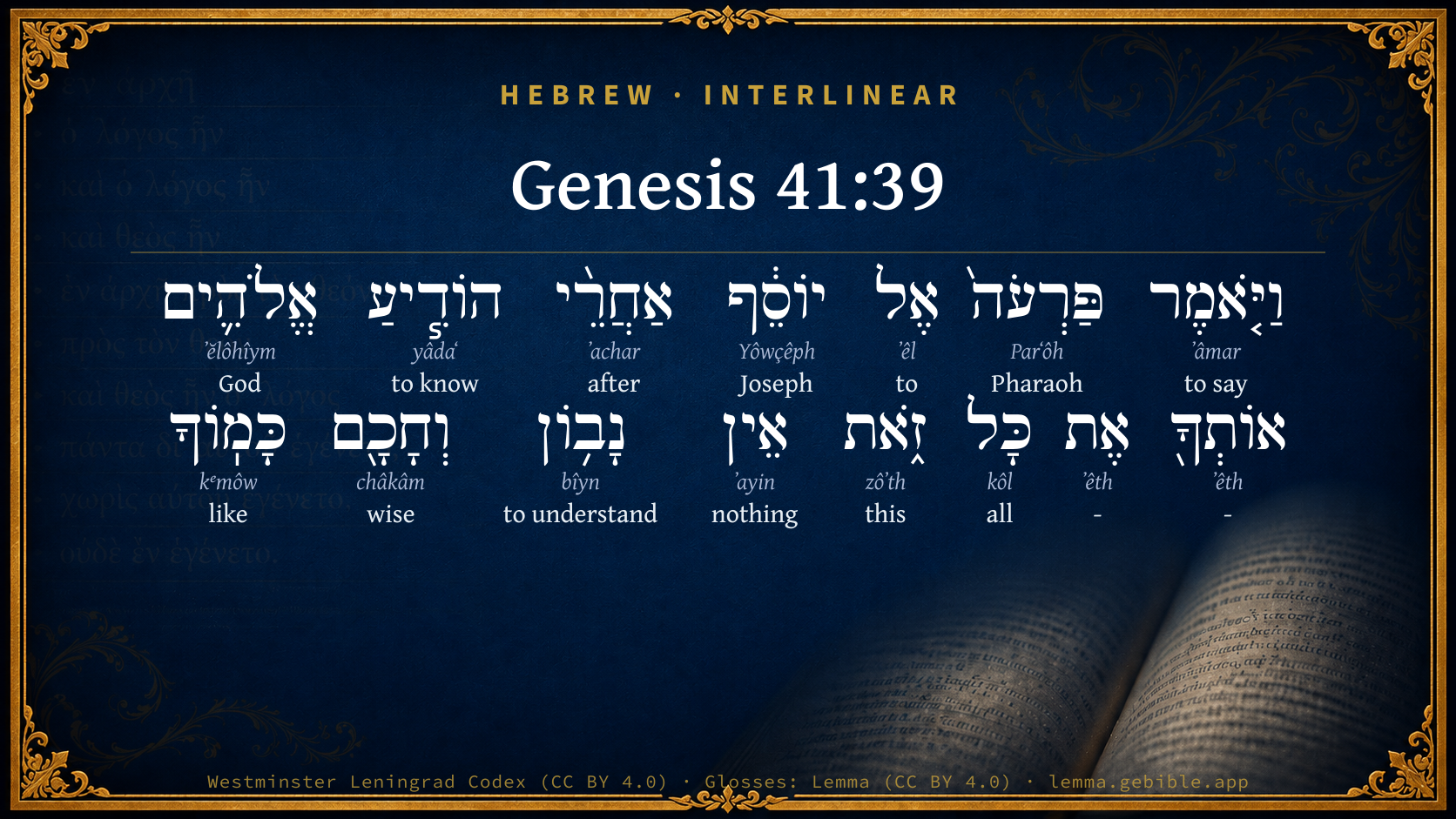
Hebrew (Westminster Leningrad Codex) Genesis 41:39 appears in the Hebrew Old Testament. The text above is from the Westminster Leningrad Codex. Each word links to its Strong’s number, a concise gloss, and parsing drawn from the Open Scriptures Hebrew Bible morphology. Click any word for its full Brown-Driver-Briggs (BDB) entry.
Download image
Cite this verse

Genesis 41:39 (World English Bible). Public Domain. Lemma interlinear Bible study tool, https://lemma.gebible.app/v/genesis/41/39.

Show BibTeX & RIS
BibTeX
RIS
English Translation
Pharaoh said to Joseph, "Because God has shown you all of this, there is none so discreet and wise as you.
World English Bible · Public Domain
Download a study sheet

One document with this verse’s original text, its word-by-word gloss line, the meaning frame, cross-references with their text, attributed commentary, and full source and license credits — printable, and it pastes into notes with its structure intact.

This verse Autodidact and up

Study sheet (.html) Plain text (.txt)

A passage Seminary Student

Up to 50 verses in one chapter. A passage sheet keeps up to 6 commentary sources and 12 cross-references per verse, in the order this page ranks them, and says so on the sheet whenever that leaves anything out. Ask for a single verse and you get the Autodidact verse sheet above.

Everything on this page stays free to read, with no account — the sheet is a download of what is already on screen, not access to it.

Want to remove ads? Support Godless Engineer
Compare translations 3

The same verse in 3 English versions, stacked beneath the original-language interlinear above. Click any original word for its lexicon entry.

Each is an independent rendering of the whole verse — the interlinear is not word-aligned to these translations.

Highlighted words mark where these versions differ — a whole-verse word diff, not a word-by-word alignment.

  • World English Bible Public Domain
    Pharaoh said to Joseph, "Because God has shown you all of this, there is none so discreet and wise as you.
  • King James Version Public Domain
    And Pharaoh said unto Joseph, Forasmuch as God hath showed thee all this, there is none so discreet and wise as thou art:
  • unfoldingWord Literal Text CC BY-SA 4.0
    Then Pharaoh said to Joseph, “Since God has shown all this to you, no one discerning and wise as you.

unfoldingWord Literal Text — © unfoldingWord, licensed CC BY-SA 4.0. Word-aligned USFM3 via Door43 (git.door43.org/unfoldingWord/en_ult).

Versions to compare (up to 4)

3 of 4 selected

Show all 18 translations

Every available English version of this verse, each an independent rendering of the whole verse.

  • World English Bible Public Domain
    Pharaoh said to Joseph, "Because God has shown you all of this, there is none so discreet and wise as you.
  • Berean Standard Bible Public Domain
    Then Pharaoh said to Joseph, “Since God has made all this known to you, there is no one as discerning and wise as you.
  • Majority Standard Bible Public Domain
    Then Pharaoh said to Joseph, “Since God has made all this known to you, there is no one as discerning and wise as you.
  • King James Version Public Domain
    And Pharaoh said unto Joseph, Forasmuch as God hath showed thee all this, there is none so discreet and wise as thou art:
  • American Standard Version (1901) Public Domain
    And Pharaoh said unto Joseph, Forasmuch as God hath showed thee all of this, there is none so discreet and wise as thou:
  • Revised Version (1885) Public Domain
    And Pharaoh said unto Joseph, Forasmuch as God hath shewed thee all this, there is none so discreet and wise as thou:
  • Geneva Bible (1599) Public Domain
    The Pharaoh said to Ioseph, For as much as God hath shewed thee all this, there is no man of vnderstanding, or of wisedome like vnto thee.
  • Douay-Rheims (1899) Public Domain
    The counsel pleased Pharao and all his servants.
  • Young's Literal Translation Public Domain
    and Pharaoh saith unto Joseph, `After God's causing thee to know all this, there is none intelligent and wise as thou;
  • Literal Standard Version CC BY-SA 4.0
    And Pharaoh says to Joseph, “After God’s causing you to know all this, there is none intelligent and wise as you;
  • Unlocked Literal Bible CC BY-SA 4.0
    So Pharaoh said to Joseph, “Since God has shown you all this, there is none so discerning and wise as you.
  • unfoldingWord Literal Text CC BY-SA 4.0
    Then Pharaoh said to Joseph, “Since God has shown all this to you, no one discerning and wise as you.
  • Darby Bible Public Domain
    And Pharaoh said to Joseph, Since God has made all this known to thee, there is none [so] discreet and wise as thou.
  • World Messianic Bible Public Domain
    Pharaoh said to Joseph, “Because God has shown you all of this, there is no one so discreet and wise as you.
  • Webster's Bible Public Domain
    And Pharaoh said to Joseph, Forasmuch as God hath shown thee all this, there is none so discreet and wise as thou art:
  • Free Bible Version CC BY-SA 4.0
    Then Pharaoh spoke to Joseph, telling him, “Since God has revealed to you all this, and there's no one like you with such insight and wisdom,
  • Bible in Basic English Public Domain
    And Pharaoh said to Joseph, Seeing that God has made all this clear to you, there is no other man of such wisdom and good sense as you:
  • JPS Tanakh (1917) Public Domain
    And Pharaoh said unto Joseph: 'Forasmuch as God hath shown thee all this, there is none so discreet and wise as thou.

Literal Standard Version (2020), Covenant Press — licensed CC BY-SA 4.0. Text via the HelloAO Bible API (eBible.org). Unlocked Literal Bible (unfoldingWord) — licensed CC BY-SA 4.0. Text via the HelloAO Bible API (eBible.org). unfoldingWord Literal Text — © unfoldingWord, licensed CC BY-SA 4.0. Word-aligned USFM3 via Door43 (git.door43.org/unfoldingWord/en_ult). Free Bible Version, Dr. Jonathan Gallagher — licensed CC BY-SA 4.0. Text via the HelloAO Bible API (eBible.org).

Word by word

More ways to search: Search by grammar → Find every occurrence → Compare this word →

Practice this passage: Drill this verse → Learn its vocabulary →

וְחָכָ֖ם
châkâm
H2450
“and · wise”
Conjunction + Adjective, Adjective, Masculine, Singular, Absolute
Part of Speech
Conjunction + Adjective
Type
Adjective
Gender
Masculine
Number
Singular
State
Absolute
Full BDB Definition

Origin: from H2449

TWOT: 647b

wise, wise (man) - skilful (in technical work) - wise (in administration) - shrewd, crafty, cunning, wily, subtle - learned, shrewd (class of men) - prudent - wise (ethically and religiously)
  1. וַיֹּ֤אמֶר ʼâmar H559 “and · to say” Conjunction + Verb, Qal, Sequential Imperfect, 3rd Person, Masculine, Singular
  2. פַּרְעֹה֙ Parʻôh H6547 “Pharaoh” Noun, Proper
  3. אֶל ʼêl H413 “to” Preposition
  4. יוֹסֵ֔ף Yôwçêph H3130 “Joseph” Noun, Proper
  5. אַחֲרֵ֨י ʼachar H310 “after” Preposition
  6. הוֹדִ֧יעַ yâdaʻ H3045 “to know” Verb, Hiphil, Infinitive Construct
  7. אֱלֹהִ֛ים ʼĕlôhîym H430 “God(s)” Noun, Common, Masculine, Plural, Absolute
  8. אוֹתְךָ֖ ʼêth H853 “- · you” Particle, Direct Object + Suffix, Personal, 2nd Person, Masculine, Singular
  9. אֶת ʼêth H853 “-” Particle, Direct Object
  10. כָּל kôl H3605 “all of” Noun, Common, Masculine, Singular, Construct
  11. זֹ֑את zôʼth H2063 “this” Pronoun, Demonstrative, Feminine, Singular
  12. אֵין ʼayin H369 “nothing” Particle, Negative
  13. נָב֥וֹן bîyn H995 “understanding” Verb, Niphal, Participle Active, Masculine, Singular, Absolute
  14. כָּמֽוֹךָ kᵉmôw H3644 “like · you” Preposition + Suffix, Personal, 2nd Person, Masculine, Singular

About this verse

These counts appear in no published source. They are computed here, from the morphology-tagged text and Lemma’s own curated glosses. What Lemma adds →

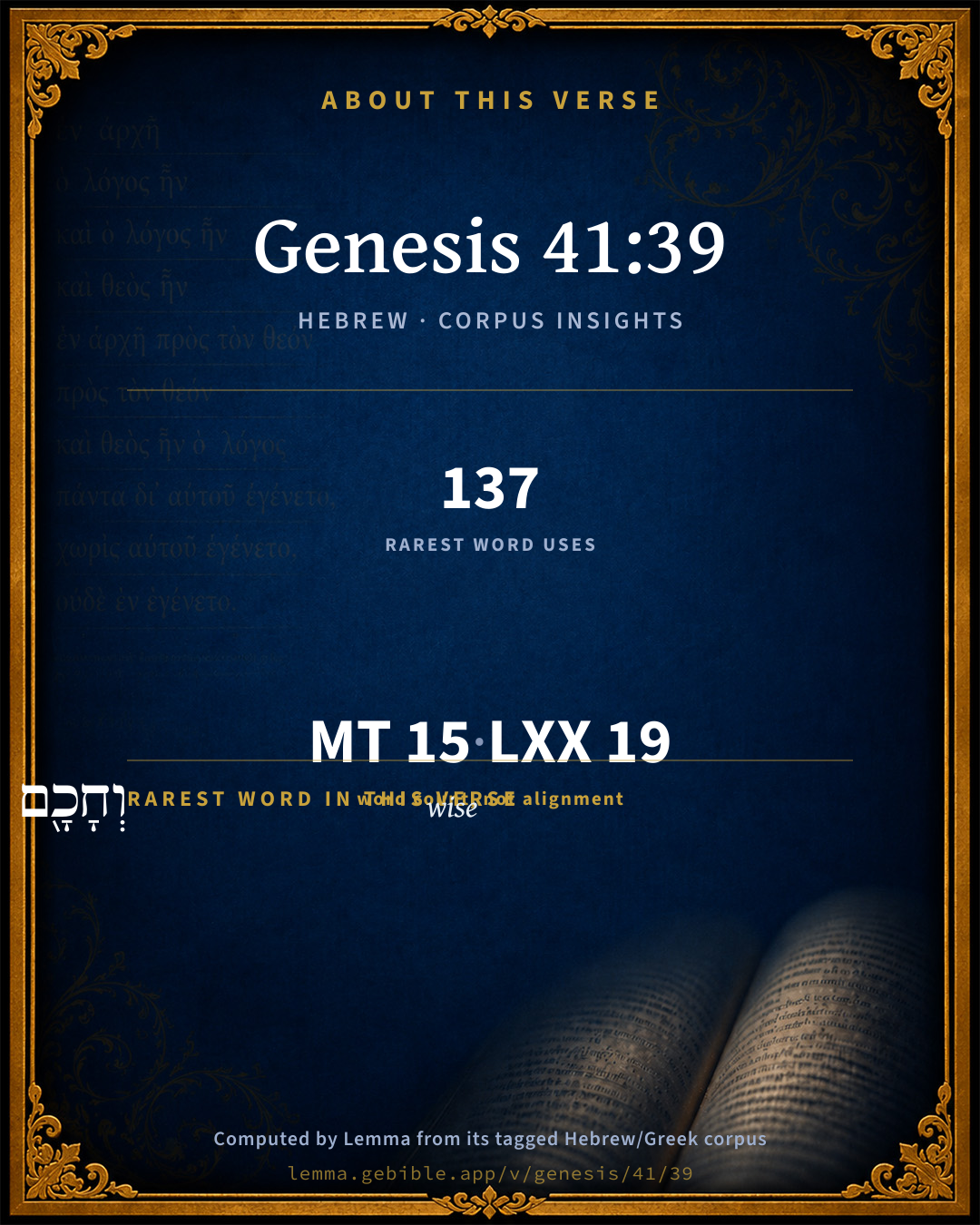
15
words
14
distinct lemmas
Pentateuch
section

Grammatical profile

  • 3 verbs
  • 4 nouns
  • 1 adjective
  • 1 pronoun
  • 3 prepositions
  • 3 particles

Verb forms

  • וַיֹּ֤אמֶר Qal · Sequential Imperfect
  • הוֹדִ֧יעַ Hiphil · Infinitive Construct
  • נָב֥וֹן Niphal · Participle Active

Hebrew & Septuagint length

In English translation the verse runs 21 words from the Hebrew and 24 from the Septuagint (LXX English) — closely comparable.

A rough comparison of the two English renderings, which tokenize alike — not a word-level alignment.

Word counts can differ between the Hebrew and the Greek without any difference in meaning — e.g. the Hebrew direct-object marker אֵת has no separate Greek word, and Greek often adds the article ὁ.

In the original languages it is 15 Hebrew tokens and 19 Greek tokens — but the two are counted differently (Hebrew bundles its prefixes and suffixes into one token; the Greek is in lemma form), so that isn’t a like-for-like length.

Cross-references

4

Topical passages linked to Genesis 41:39 in the Treasury of Scripture Knowledge — connected by theme and wording, ordered by reader-vote popularity; previews shown in the World English Bible.

  • Genesis 41:28 That is the thing which I spoke to Pharaoh. What God is about to do he has shown to Pharaoh.
  • Genesis 41:33 Now therefore let Pharaoh look for a discreet and wise man, and set him over the land of Egypt.
  • Genesis 41:25 Joseph said to Pharaoh, "The dream of Pharaoh is one. What God is about to do he has declared to Pharaoh.
  • Genesis 41:16 Joseph answered Pharaoh, saying, "It isn't in me. God will give Pharaoh an answer of peace."

Cross-references courtesy of OpenBible.info (CC BY 4.0).

Hebrew and Greek witnesses Masoretic Hebrew ↔ Greek Septuagint

The same verse in the two great witnesses to the Old Testament, shown verse-for-verse.

These are two independent witnesses, not word-aligned to each other, and the Septuagint is shown in lemma (dictionary) form.

Hebrew Genesis 41:39 Masoretic · Westminster Leningrad Codex

וַיֹּ֤אמֶר פַּרְעֹה֙ אֶל יוֹסֵ֔ף אַחֲרֵ֨י הוֹדִ֧יעַ אֱלֹהִ֛ים אוֹתְךָ֖ אֶת כָּל זֹ֑את אֵין נָב֥וֹן וְחָכָ֖ם כָּמֽוֹךָ

Pharaoh said to Joseph, "Because God has shown you all of this, there is none so discreet and wise as you.

World English Bible · Public Domain

Greek LXX Genesis 41:39 Septuagint · lemma form

εἶπον δέ φαραώ ὁ ιωσηφ ἐπειδή δεικνύω ὁ θεός σύ πᾶς οὗτος οὐ εἰμί ἄνθρωπος φρόνιμος καί συνετός σύ

And Pharao said to Joseph, Since God has showed you all these things, there is not a wiser or more prudent man than you.

LXX2012 (modern English Septuagint) · Public Domain

On this verse, The Pulpit Commentary discusses the Septuagint’s reading. Read the note in Commentary ↓

Hebrew: Westminster Leningrad Codex (CC BY 4.0). Greek: Septuagint (public domain); English from LXX2012 (modern English Septuagint) (Public Domain). How the Septuagint differs from the Hebrew →

Targum (Aramaic paraphrase)

2

The Targum is the ancient Jewish Aramaic paraphrase of the Hebrew Scriptures — an interpretive translation, not the Hebrew text itself. Onkelos (literal) and Pseudo-Jonathan (expansive) render the Torah, and Jonathan the Prophets. Coverage is partial: where no permissively-licensed English translation exists for a verse, only the Aramaic is shown. This is verse-level text, not a word-by-word alignment to the Hebrew.

  1. Targum Onkelos Torah (Genesis–Deuteronomy)
    וַאֲמַר פַּרְעֹה לְיוֹסֵף בָּתַר דְּאוֹדַע יְיָ יָתָךְ יָת כָּל דָּא לֵית סָכְלְתָן וְחַכִּים כְּוָתָךְ

    (no public-domain English translation for this verse)

    Targum Onkelos — Aramaic: “Onkelos Genesis” (public domain); “Onkelos Exodus” (public domain); “Onkelos Leviticus” (public domain); “Onkelos Numbers” (public domain); “Onkelos Deuteronomy” (public domain). English: “Sefaria Community Translation” (CC0 1.0 (public-domain dedication)); “J.W. Etheridge. The Targums of Onkelos and Jonathan Ben Uzziel on the Pentateuch. London: Longmans, Green, 1862” (public domain). Text via Sefaria.

  2. Targum Pseudo-Jonathan Torah (Genesis–Deuteronomy)
    וַאֲמַר פַּרְעה לִיוֹסֵף בָּתַר דְאוֹדַע יְיָ יָתָךְ יַת כָּל דָא לֵית סוּכְלָתָן וְחַכִּים כְּוָותָךְ

    And Pharoh said to Joseph, Since the Lord Hath made known all this to thee, there is no one so prudent and wise as thou art.

    Targum Pseudo-Jonathan — Aramaic: “Targum Jonathan on Genesis” (public domain); “Targum Jonathan on Exodus” (public domain); “Targum Jonathan on Leviticus” (public domain); “Targum Jonathan on Numbers” (public domain); “Targum Jonathan on Deuteronomy” (public domain). English: “The Targum of Jonathan ben Uzziel, trans. J. W. Etheridge, London, 1862” (public domain). Text via Sefaria.

Commentary

Notes on Genesis 41:39 from classic Christian and Jewish commentators (each source and its license shown beneath its notes). The classic Christian expositions comment on the surrounding passage and are grouped to its opening verse, so a note may address several verses; the Jewish commentaries on the Tanakh (Rashi and others) are per-verse, so they appear only where the commentator wrote on this verse.

Lemma curates 59 commentaries, every one of them public domain or Creative Commons licensed, each selected and text-cleaned for this edition rather than reprinted as found. About our sources →

Trapp's Complete Commentary

John Trapp

Gen 41:39 And Pharaoh said unto Joseph, Forasmuch as God hath shewed thee all this, [there is] none so discreet and wise as thou [art]:

Ver. 39. Forasmuch as God hath showed thee all this.] Pharaoh at first took him for no other than a cunning soothsayer and conjecturer of dreams. Now he finds better worth in him, a spirit of wisdom and discretion: he took him to be a man spiritually rational, and rationally spiritual; one that seemed to see the insides of nature and grace, and the world and heaven, by those perfect anatomies he had made of them all. Briefly, such a heart so well headed, nor such a head better hearted, he had never met with. Wherefore he resolves to set him at the head of the state; there being not anything that makes a man so good a patriot, as true religion; which admits not of that distinction between a good man and a good citizen.

{a} Val. Max., lib. ix. cap. 5.

{b} Dan., Hist. of England, contin. by Trussel, 207.

John Trapp, A Commentary or Exposition upon All the Books of the Old and New Testament (1647–1656) — public domain. Text from a community e-Sword module.

The Cambridge Bible for Schools and Colleges

gen. ed. J. J. S. Perowne

39. Forasmuch as] Lit. “after that.”

The Cambridge Bible for Schools and Colleges (gen. ed. J. J. S. Perowne; Cambridge University Press, 1878–1918) — public domain. Text from a community e-Sword module.

John Gill's Exposition

And Pharaoh took off his ring from his hand, and put it upon Joseph's hand,.... Which, as it was expressive of the interest he had in his royal favour, so was a token of that high office and great dignity to which he was promoted: thus among the Romans, in later times, when anyone was put into the equestrian order, a ring was given to him (w); for originally none but knights were allowed to wear rings; and it was sometimes used to design a successor in the kingdom, as, when Alexander was dying, he took his ring from off his finger, and gave it to Perdicca (x), which was understood, though he did not express it, that he should be his successor, in the Apocrypha:"14 Then called he for Philip, one of his friends, who he made ruler over all his realm, 15 And gave him the crown, and his robe, and his signet, to the end he should bring up his son Antiochus, and nourish him up for the kingdom.'' (1 Maccabees 6)Now, though Pharaoh did not by this intend to point out Joseph for his successor in the kingdom, yet he gave him his ring as a mark of honour, and as being in place next unto his viceroy or deputy: and besides, as it is observed by many, this might be his signet, or the ring which had his seal upon it, by which he sealed patents and public deeds, and which he gave to Joseph to make use of in his name; though Schmidt doubts whether this was such a ring, since kings and princes have been used to have larger for such purposes, than what are wore on the finger: by this it appears, that Pliny (y) was mistaken that there were no rings in and before the time of Troy:

and arrayed him in vestures of fine linen; of which there was the best sort in Egypt, and which great personages used to wear:

and put a gold chain about his neck; another badge of honour and dignity, see Dan 5:16.

(w) Plin. Nat. Hist. l. 33. c. 1. (x) Diodor. Sic. Bibliothec. l. 18. p. 587. Justin. e. Trogo, l. 12. c. 15. (y) Nat. Hist. l. 33. c. 1.

John Gill's Exposition of the Whole Bible (1746–1763) — public domain (CC PDM 1.0). Text via the HelloAO Bible API.

Matthew Poole's English Annotations

God hath showed thee all this, i.e. hath given thee this extraordinary gift of foreseeing and foretelling things to come, and of giving such sage advice for the future.

Matthew Poole's English Annotations on the Holy Bible (1683–1685) — public domain. Text from a community e-Sword/MySword module.

The Pulpit Commentary

Vers. 39, 40. And Pharaoh said unto Joseph, Forasmuch as (literally, after) God (Elohim) hath showed thee (literally, hath caused thee to know) all this, there is none so discreet and wise as thou art: thou shalt be over my house, and according unto thy word shall all my people be ruled literally, according to thy mouth shall all my people dispose themselves, i.e. they shall render obedience to thy commands (LXX, Vulgate, Onkelos, Saadias, Pererius, Dathius, Rosenm Keil, Kalisch, Lange, Murphy, and others); though by many competent authorities (Calvin, Schultens, Knobel, Ainsworth, Gesenius, Furst, Wordsworth, et alii) the rendering is preferred, "upon thy mouth shall all my people kiss," against which, however, is the fact that not even then were governors accustomed to be kissed on the lips by their subjects in token of allegiance. The suggestion that the verb should be taken in the sense of "arm themselves," as in 2Ch_17:17 (Aben Ezra) does not meet with general acceptance. Only in the throne (or, more accurately, only as to the throne) will I be greater than thou.

The Pulpit Commentary (1880–1919), ed. H.D.M. Spence-Jones & Joseph S. Exell — public domain. Text from a community e-Sword module.

unfoldingWord translationNotes

Door43 World Missions Community

there is none so discerning

"no one else is as capable in making decisions." See how you translated "discerning" in Genesis 41:33.

You will be over my house

Here "house" stands for Pharaoh's palace and the people in the palace. The phrase "will be over" means Joseph will have authority over. AT: "You will be in charge of everyone in my palace" (See: Metonymy and Idiom)

according to your word will all my people be ruled

This can be stated in active form. AT: "you will rule over my people and they will do what you command" (See: Active or Passive)

Only in the throne

Here "throne" stands for Pharaoh's rule as king. AT: "Only in my role as king"

See, I have put you

The word "See" adds emphasis to what Pharaoh says next. AT: "Look, I have put you"

I have put you over all the land of Egypt

The phrase "put you over" means to give authority. Here "land" refers to the people. AT: "I put you in charge of everyone in Egypt" (See: Idiom and Metonymy)

translationWords

Pharaoh

Joseph (OT)

God

discern

wise

house

word

rule

throne

Egypt

unfoldingWord translationNotes — © Distant Shores Media and the Door43 World Missions Community, licensed CC BY-SA 4.0. Source: git.door43.org/Door43/en_tn.

Rashi

Rabbi Shlomo Yitzchaki (Rashi)

אין נבון וחכם כמוך THERE IS NONE SO DISCREET AND WISE AS THOU ART — If we do seek for a discreet and wise man as you suggested (v. 33) we shall find none like you).

Rashi on the Tanakh — English translations: “The Judaica Press complete Tanach with Rashi, translated by A. J. Rosenberg” (CC BY 4.0); “Pentateuch with Rashi's commentary by M. Rosenbaum and A.M. Silbermann, 1929-1934” (public domain); “The Metsudah Tanach series, Lakewood, N.J” (CC BY 4.0); and “The Book of Joshua, Metsudah Publications, 1997” (CC BY 4.0). Text via Sefaria.

Lesson kit

Teaching starters — assembled from the data on this page, not authored interpretation. Every prompt links to the verse data it draws on. Edit before teaching.

Genesis, in the Pentateuch, opens this verse with 15 words (14 distinct Hebrew lemmas). Its most distinctive word is châkâm (“wise”). A historical commentator’s framing appears above. Read the whole chapter for the surrounding context.

Discussion questions

  1. How does “wise” (châkâm) shape what this verse is saying?
  2. How does Genesis 41:28, which shares this passage’s theme, read alongside this verse?
  3. The translations on this page render this verse differently — a whole-verse word diff, not a word-by-word alignment. What might account for the different wordings?
  4. «וַיֹּ֤אמֶר» is a Qal Sequential Imperfect verb. How does that grammatical form shape the action described?
  5. Compare how Trapp's Complete Commentary and The Cambridge Bible for Schools and Colleges read this verse. Where do they agree or differ?

Things to notice

Reading settings

Reading text

Shown beneath each verse's original-language words.

Old Testament
Old Testament edition

Read the OT as the Masoretic Hebrew (MT) or the Greek Septuagint (LXX).

English shown for the Greek Septuagint (in the Hebrew ↔ Greek comparison).

Comparing translations? Open the Compare panel on any verse page to stack up to four side by side.