
Daniel 8:4

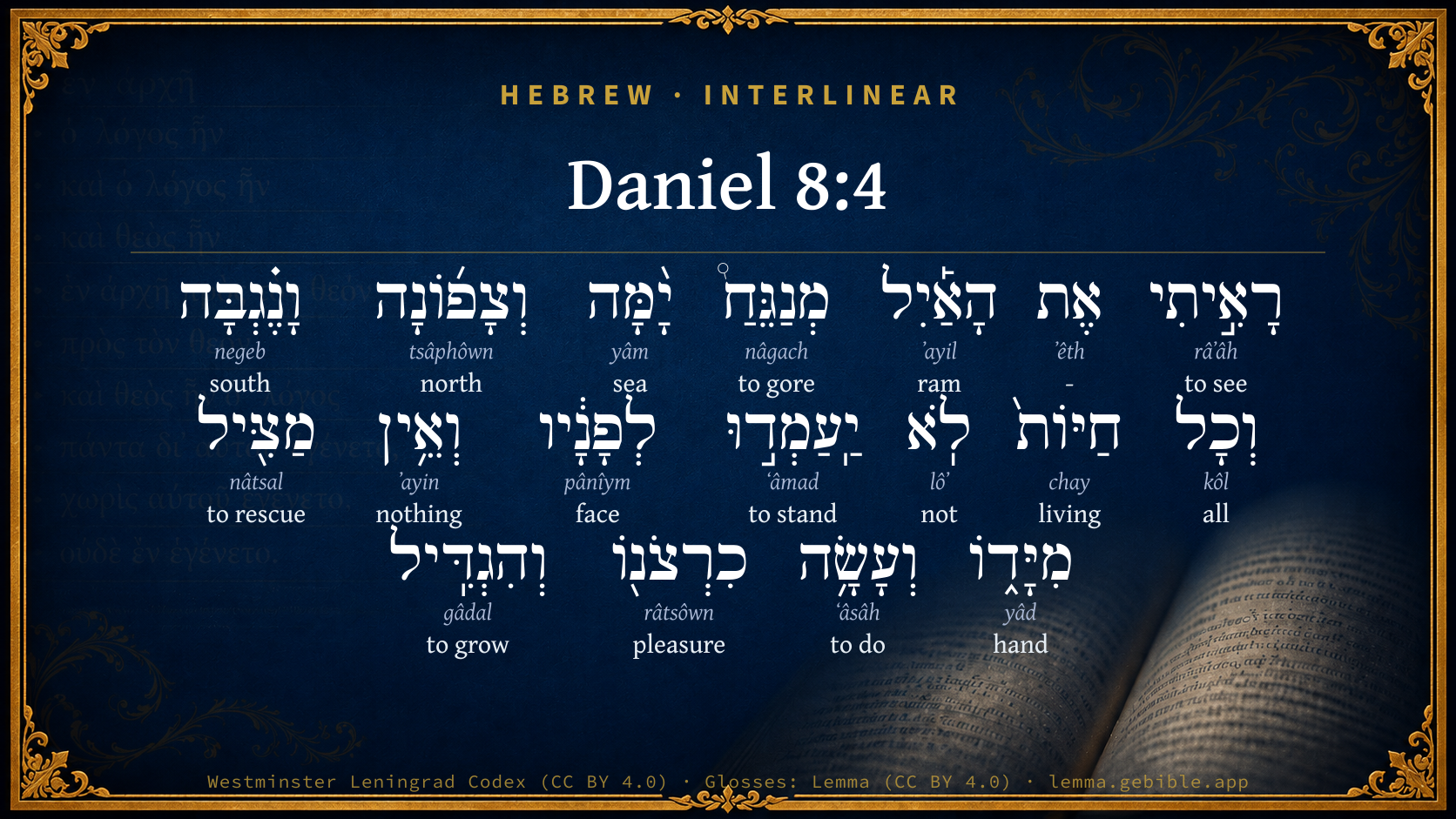
Hebrew (Westminster Leningrad Codex) Daniel 8:4 appears in the Hebrew Old Testament. The text above is from the Westminster Leningrad Codex. Each word links to its Strong’s number, a concise gloss, and parsing drawn from the Open Scriptures Hebrew Bible morphology. Click any word for its full Brown-Driver-Briggs (BDB) entry.
Download image
Cite this verse

Daniel 8:4 (World English Bible). Public Domain. Lemma interlinear Bible study tool, https://lemma.gebible.app/v/daniel/8/4.

Show BibTeX & RIS
BibTeX
RIS
English Translation
I saw the ram pushing westward, and northward, and southward; and no animals could stand before him, neither was there any who could deliver out of his hand; but he did according to his will, and magnified himself.
World English Bible · Public Domain
Download a study sheet

One document with this verse’s original text, its word-by-word gloss line, the meaning frame, cross-references with their text, attributed commentary, and full source and license credits — printable, and it pastes into notes with its structure intact.

This verse Autodidact and up

Study sheet (.html) Plain text (.txt)

A passage Seminary Student

Up to 50 verses in one chapter. A passage sheet keeps up to 6 commentary sources and 12 cross-references per verse, in the order this page ranks them, and says so on the sheet whenever that leaves anything out. Ask for a single verse and you get the Autodidact verse sheet above.

Everything on this page stays free to read, with no account — the sheet is a download of what is already on screen, not access to it.

Want to remove ads? Support Godless Engineer
Compare translations 3

The same verse in 3 English versions, stacked beneath the original-language interlinear above. Click any original word for its lexicon entry.

Each is an independent rendering of the whole verse — the interlinear is not word-aligned to these translations.

Highlighted words mark where these versions differ — a whole-verse word diff, not a word-by-word alignment.

  • World English Bible Public Domain
    I saw the ram pushing westward, and northward, and southward; and no animals could stand before him, neither was there any who could deliver out of his hand; but he did according to his will, and magnified himself.
  • King James Version Public Domain
    I saw the ram pushing westward, and northward, and southward; so that no beasts might stand before him, neither was there any that could deliver out of his hand; but he did according to his will, and became great.
  • unfoldingWord Literal Text CC BY-SA 4.0
    I saw the ram charging westward, and northward, and southward; no animal could stand before him. There was no one to rescue out of his hand. He did as he pleased and magnified himself.

unfoldingWord Literal Text — © unfoldingWord, licensed CC BY-SA 4.0. Word-aligned USFM3 via Door43 (git.door43.org/unfoldingWord/en_ult).

Versions to compare (up to 4)

3 of 4 selected

Show all 18 translations

Every available English version of this verse, each an independent rendering of the whole verse.

  • World English Bible Public Domain
    I saw the ram pushing westward, and northward, and southward; and no animals could stand before him, neither was there any who could deliver out of his hand; but he did according to his will, and magnified himself.
  • Berean Standard Bible Public Domain
    I saw the ram charging toward the west and the north and the south. No animal could stand against him, and there was no deliverance from his power. He did as he pleased and became great.
  • Majority Standard Bible Public Domain
    I saw the ram charging toward the west and the north and the south. No animal could stand against him, and there was no deliverance from his power. He did as he pleased and became great.
  • King James Version Public Domain
    I saw the ram pushing westward, and northward, and southward; so that no beasts might stand before him, neither was there any that could deliver out of his hand; but he did according to his will, and became great.
  • American Standard Version (1901) Public Domain
    I saw the ram pushing westward, and northward, and southward; and no beasts could stand before him, neither was there any that could deliver out of his hand; but he did according to his will, and magnified himself.
  • Revised Version (1885) Public Domain
    I saw the ram pushing westward, and northward, and southward; and no beasts could stand before him, neither was there any that could deliver out of his hand; but he did according to his will, and magnified himself.
  • Geneva Bible (1599) Public Domain
    I sawe the ramme pusshing against ye West, and against the North, and against the South: so that no beastes might stande before him, nor could deliuer out of his hand, but he did what he listed, and became great.
  • Douay-Rheims (1899) Public Domain
    I saw the ram pushing with his horns against the west, and against the north, and against the south: and no beasts could withstand him, nor be delivered out of his hand: and he did according to his own will, and became great.
  • Young's Literal Translation Public Domain
    I have seen the ram pushing westward, and northward, and southward, and no living creatures do stand before it, and there is none delivering out of its hand, and it hath done according to its pleasure, and hath exerted itself.
  • Literal Standard Version CC BY-SA 4.0
    I have seen the ram pushing westward, and northward, and southward, and no living creatures stand before it, and there is none delivering out of its hand, and it has done according to its pleasure, and has exerted itself.
  • Unlocked Literal Bible CC BY-SA 4.0
    I saw the ram charging west, then north, and then south; no other animal could stand before him. None of them was able to rescue anyone out of his hand. He did whatever he wanted, and he became great.
  • unfoldingWord Literal Text CC BY-SA 4.0
    I saw the ram charging westward, and northward, and southward; no animal could stand before him. There was no one to rescue out of his hand. He did as he pleased and magnified himself.
  • Darby Bible Public Domain
    I saw the ram pushing westward, and northward, and southward, and no beast could stand before him, neither was there any that could deliver out of his hand; and he did according to his will, and became great.
  • World Messianic Bible Public Domain
    I saw the ram pushing westward, northward, and southward. No animals could stand before him. There wasn’t any who could deliver out of his hand, but he did according to his will, and magnified himself.
  • Webster's Bible Public Domain
    I saw the ram pushing westward, and northward, and southward; so that no beasts might stand before him, neither was there any that could deliver out of his hand; but he did according to his will, and became great.
  • Free Bible Version CC BY-SA 4.0
    I watched the ram charging west, north, and south. No animal could stand up to it—nor was there any chance of rescue from its power. It did whatever it wanted and grew powerful.
  • Bible in Basic English Public Domain
    I saw the sheep pushing to the west and to the north and to the south; and no beasts were able to keep their place before him, and no one was able to get people out of his power; but he did whatever his pleasure was and made himself great.
  • JPS Tanakh (1917) Public Domain
    I saw the ram pushing westward, and northward, and southward; and no beasts could stand before him, neither was there any that could deliver out of his hand; but he did according to his will, and magnified himself.

Literal Standard Version (2020), Covenant Press — licensed CC BY-SA 4.0. Text via the HelloAO Bible API (eBible.org). Unlocked Literal Bible (unfoldingWord) — licensed CC BY-SA 4.0. Text via the HelloAO Bible API (eBible.org). unfoldingWord Literal Text — © unfoldingWord, licensed CC BY-SA 4.0. Word-aligned USFM3 via Door43 (git.door43.org/unfoldingWord/en_ult). Free Bible Version, Dr. Jonathan Gallagher — licensed CC BY-SA 4.0. Text via the HelloAO Bible API (eBible.org).

Word by word

More ways to search: Search by grammar → Find every occurrence → Compare this word →

Practice this passage: Drill this verse → Learn its vocabulary →

מְנַגֵּחַ֩
nâgach
H5055
“goring”
Verb, Piel, Participle Active, Masculine, Singular, Absolute
Part of Speech
Verb
Stem
Piel
Form
Participle Active
Gender
Masculine
Number
Singular
State
Absolute
Full BDB Definition

Origin: a primitive root

TWOT: 1291

to push, thrust, gore - (Qal) to gore - (Piel) to push or thrust at - (Hithpael) to engage in thrusting, wage war
  1. רָאִ֣יתִי râʼâh H7200 “to see” Verb, Qal, Perfect, 1st Person, Common, Singular
  2. אֶת ʼêth H853 “-” Particle, Direct Object
  3. הָאַ֡יִל ʼayil H352 “the · ram” Particle, Definite Article + Noun, Common, Masculine, Singular, Absolute
  4. יָ֨מָּה yâm H3220 “sea · toward” Noun, Common, Masculine, Singular, Absolute + Suffix, Demonstrative
  5. וְצָפ֜וֹנָה tsâphôwn H6828 “and · north · toward” Conjunction + Noun, Common, Feminine, Singular, Absolute + Suffix, Demonstrative
  6. וָנֶ֗גְבָּה negeb H5045 “and · south · toward” Conjunction + Noun, Common, Masculine, Singular, Absolute + Suffix, Demonstrative
  7. וְכָל kôl H3605 “and · all of” Conjunction + Noun, Common, Masculine, Singular, Construct
  8. חַיּוֹת֙ chay H2416 “living things” Noun, Common, Feminine, Plural, Absolute
  9. לֹֽא lôʼ H3808 “not” Particle, Negative
  10. יַֽעַמְד֣וּ ʻâmad H5975 “to stand” Verb, Qal, Imperfect, 3rd Person, Masculine, Plural
  11. לְפָנָ֔יו pânîym H6440 “to/for · face(s) · his” Preposition + Noun, Common, Both, Plural, Construct + Suffix, Personal, 3rd Person, Masculine, Singular
  12. וְאֵ֥ין ʼayin H369 “and · nothing” Conjunction + Particle, Negative
  13. מַצִּ֖יל nâtsal H5337 “rescuing” Verb, Hiphil, Participle Active, Masculine, Singular, Absolute
  14. מִיָּד֑וֹ yâd H3027 “from · hand · his” Preposition + Noun, Common, Both, Singular, Construct + Suffix, Personal, 3rd Person, Masculine, Singular
  15. וְעָשָׂ֥ה ʻâsâh H6213 “and · to do” Conjunction + Verb, Qal, Sequential Perfect, 3rd Person, Masculine, Singular
  16. כִרְצֹנ֖וֹ râtsôwn H7522 “like/as · pleasure · his” Preposition + Noun, Common, Masculine, Singular, Construct + Suffix, Personal, 3rd Person, Masculine, Singular
  17. וְהִגְדִּֽיל gâdal H1431 “and · to grow” Conjunction + Verb, Hiphil, Sequential Perfect, 3rd Person, Masculine, Singular

About this verse

These counts appear in no published source. They are computed here, from the morphology-tagged text and Lemma’s own curated glosses. What Lemma adds →

18
words
18
distinct lemmas
Prophets
section

Notable vocabulary

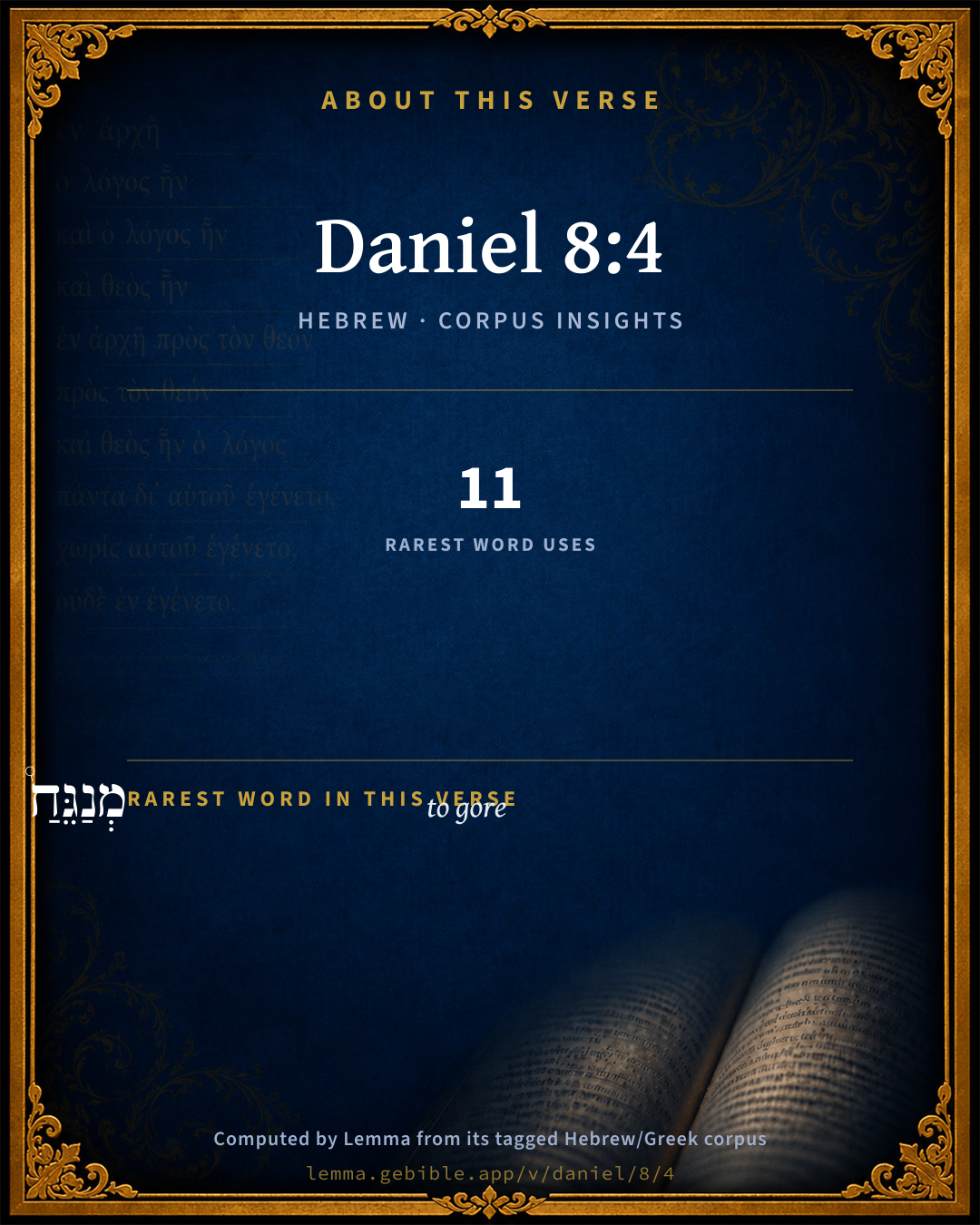
The rarest word here is מְנַגֵּחַ֩ to gore H5055 — appearing just 11 times in the whole Hebrew Bible.

Shared distinctive vocabulary

מְנַגֵּחַ֩ to gore H5055 occurs in 10 verses of the Hebrew Bible. Also found in:

Grammatical profile

  • 6 verbs
  • 9 nouns
  • 3 particles

Verb forms

  • רָאִ֣יתִי Qal · Perfect
  • מְנַגֵּחַ֩ Piel · Participle Active
  • יַֽעַמְד֣וּ Qal · Imperfect
  • מַצִּ֖יל Hiphil · Participle Active
  • וְעָשָׂ֥ה Qal · Sequential Perfect
  • וְהִגְדִּֽיל Hiphil · Sequential Perfect

Hebrew & Septuagint length

In English translation the verse runs 38 words from the Hebrew and 39 from the Septuagint (LXX English) — closely comparable.

A rough comparison of the two English renderings, which tokenize alike — not a word-level alignment.

Word counts can differ between the Hebrew and the Greek without any difference in meaning — e.g. the Hebrew direct-object marker אֵת has no separate Greek word, and Greek often adds the article ὁ.

Cross-references

16

Topical passages linked to Daniel 8:4 in the Treasury of Scripture Knowledge — connected by theme and wording, ordered by reader-vote popularity; previews shown in the World English Bible.

  • Daniel 11:16 But he who comes against him shall do according to his own will, and none shall stand before him; and he shall stand in the glorious land, and in his hand shall be destruction.
  • Daniel 8:7 I saw him come close to the ram, and he was moved with anger against him, and struck the ram, and broke his two horns; and there was no power in the ram to stand before him; but he cast him down to the ground, and trampled on him; and there was none who could deliver the ram out of his hand.
  • Daniel 11:36 The king shall do according to his will; and he shall exalt himself, and magnify himself above every god, and shall speak marvelous things against the God of gods; and he shall prosper until the indignation be accomplished; for that which is determined shall be done.
  • Deuteronomy 33:17 The firstborn of his herd, majesty is his; His horns are the horns of the wild-ox: With them he shall push the peoples all of them, [even] the ends of the earth: They are the ten thousands of Ephraim, They are the thousands of Manasseh.
  • Job 10:7 Although you know that I am not wicked, There is no one who can deliver out of your hand.
  • Psalms 7:2 Lest they tear apart my soul like a lion, Ripping it in pieces, while there is none to deliver.
  • Psalms 50:22 "Now consider this, you who forget God, Lest I tear you into pieces, and there be none to deliver.
  • Isaiah 10:13–14 For he has said, By the strength of my hand I have done it, and by my wisdom; for I have understanding: and I have removed the bounds of the peoples, and have robbed their treasures, and like a valiant man I have brought down those who sit [on thrones]:
  • Isaiah 45:1–5 Thus says Yahweh to his anointed, to Cyrus, whose right hand I have held, to subdue nations before him, and I will loose the loins of kings; to open the doors before him, and the gates shall not be shut:
  • Jeremiah 50:1–46 The word that Yahweh spoke concerning Babylon, concerning the land of the Chaldeans, by Jeremiah the prophet.
  • Ezekiel 34:21 Because you thrust with side and with shoulder, and push all the diseased with your horns, until you have scattered them abroad;
  • Daniel 5:19 and because of the greatness that he gave him, all the peoples, nations, and languages trembled and feared before him: whom he would he killed, and whom he would he kept alive; and whom he would he raised up, and whom he would he put down.
  • Daniel 5:30 In that night Belshazzar the Chaldean King was slain.
  • Daniel 7:5 Behold, another animal, a second, like a bear; and it was raised up on one side, and three ribs were in its mouth between its teeth: and they said thus to it, Arise, devour much flesh.
  • Daniel 11:2–3 Now will I show you the truth. Behold, there shall stand up yet three kings in Persia; and the fourth shall be far richer than they all: and when he has grown strong through his riches, he shall stir up all against the realm of Greece.
  • Micah 5:8 The remnant of Jacob will be among the nations, In the midst of many peoples, Like a lion among the animals of the forest, Like a young lion among the flocks of sheep; Who, if he goes through, treads down and tears in pieces, And there is no one to deliver.

Cross-references courtesy of OpenBible.info (CC BY 4.0).

Hebrew and Greek witnesses Masoretic Hebrew ↔ Greek Septuagint

The same verse in the two great witnesses to the Old Testament, shown verse-for-verse.

These are two independent witnesses, not word-aligned to each other, and the Septuagint is shown in lemma (dictionary) form.

Hebrew Daniel 8:4 Masoretic · Westminster Leningrad Codex

רָאִ֣יתִי אֶת הָאַ֡יִל מְנַגֵּחַ֩ יָ֨מָּה וְצָפ֜וֹנָה וָנֶ֗גְבָּה וְכָל חַיּוֹת֙ לֹֽא יַֽעַמְד֣וּ לְפָנָ֔יו וְאֵ֥ין מַצִּ֖יל מִיָּד֑וֹ וְעָשָׂ֥ה כִרְצֹנ֖וֹ וְהִגְדִּֽיל

I saw the ram pushing westward, and northward, and southward; and no animals could stand before him, neither was there any who could deliver out of his hand; but he did according to his will, and magnified himself.

World English Bible · Public Domain

Greek LXX Daniel 8:4 Septuagint · lemma form

μετά δέ οὗτος ὁράω ὁ κριός κερατίζω πρός ἀνατολή καί πρός βορέας καί πρός δυσμή καί μεσημβρία καί πᾶς ὁ θηρίον οὐ ἵστημι ἐνώπιον αὐτός καί οὐ εἰμί ὁ ῥύομαι ἐκ ὁ χείρ αὐτός καί ποιέω ὡς θέλω καί ὑψόω

And I saw the ram butting westward, and northward, and southward; and no beast could stand before him, and there was none that could deliver out of his hand; and he did according to his will, and became great.

LXX2012 (modern English Septuagint) · Public Domain

On this verse, The Pulpit Commentary discusses the Septuagint’s reading. Read the note in Commentary ↓

Hebrew: Westminster Leningrad Codex (CC BY 4.0). Greek: Septuagint (public domain); English from LXX2012 (modern English Septuagint) (Public Domain). How the Septuagint differs from the Hebrew →

Commentary

Notes on Daniel 8:4 from classic Christian and Jewish commentators (each source and its license shown beneath its notes). The classic Christian expositions comment on the surrounding passage and are grouped to its opening verse, so a note may address several verses; the Jewish commentaries on the Tanakh (Rashi and others) are per-verse, so they appear only where the commentator wrote on this verse.

Lemma curates 59 commentaries, every one of them public domain or Creative Commons licensed, each selected and text-cleaned for this edition rather than reprinted as found. About our sources →

Trapp's Complete Commentary

John Trapp

Dan 8:4 I saw the ram pushing westward, and northward, and southward; so that no beasts might stand before him, neither [was there any] that could deliver out of his hand; but he did according to his will, and became great.

Ver. 4. And I saw the ram pushing westward, &c.] Hereby are set forth the Persian wars, and especially those waged by Cyrus, who subdued many nations and grew very great, as did also his successors, but especially Darius Hystaspes.

Neither was there any.] None could resist his rage, nor escape his reach.

John Trapp, A Commentary or Exposition upon All the Books of the Old and New Testament (1647–1656) — public domain. Text from a community e-Sword module.

Joseph Benson's Commentary

Dan 8:4. I saw the ram pushing westward, &c. — Under Cyrus himself the Persians pushed their conquests westward, as far as the Ægean sea, subduing Babylonia, Syria, and Asia Minor; and extended them to part of Greece under his successors, Darius the son of Hystaspes, and Xerxes: northward they subdued the Lydians, Iberians, Albanians, Armenians, Cappadocians, and the adjacent countries: southward they conquered Arabia, Egypt, and Ethiopia, if not under Cyrus, as Xenophon affirms, yet most certainly under Cambyses, the son and successor of Cyrus. Under Darius they subdued India; but in the prophecy no mention is made of their conquests in the East, because those countries lay very remote from the Jews, and were of little concern or consequence to them.

Joseph Benson's Commentary on the Old and New Testaments (1811–1818) — public domain. Text from a community e-Sword module.

Geneva Bible (1599)

Geneva Bible translators

That is, no kings or nations.

Geneva Bible (1599) marginal notes — public domain. Text via Bolls.life.

Jamieson, Fausset & Brown

Robert Jamieson, A. R. Fausset & David Brown

ram pushing westward--Persia conquered westward Babylon, Mesopotamia, Syria, Asia Minor.

northward--Colchis, Armenia, Iberia, and the dwellers on the Caspian Sea.

southward--Judea, Egypt, Ethiopia, Libya; also India, under Darius. He does not say eastward, for the Persians themselves came from the east (Isa 46:11).

did according to his will-- (Dan 11:3, Dan 11:16; compare Dan 5:19).

Jamieson, Fausset & Brown — Commentary Critical and Explanatory on the Whole Bible (1871) — public domain (CC PDM 1.0). Text via the HelloAO Bible API.

Adam Clarke's Commentary

Verse 4. I saw the ram pushing westward] The Persians, who are signified by the ram, as well as their founder Cyrus, pushed their conquests west, north and south. The principal theatre of their wars, says Calmet, was against the SCYTHIANS, northward; against the GREEKS, westward; and against the EGYPTIANS, southward.

He did according to his will] There was no other nation at that time that could stay the progress of the Persian arms.

Adam Clarke's Commentary on the Bible (1810–1826) — public domain. Text from a community e-Sword/MySword module.

John Calvin's Commentaries

The Prophet, now shortly sketches the great success which should attend this double kingdom. He says, The ram struck all the nations towards the west, and north, and south. The Persian and Median territory lay to the east of Babylon and Egypt, Syria, Asia Minor, and Greece. This, without doubt, is extended to all the successors of Cyrus, who are recorded as having convulsed the whole world. Cyrus himself was shortly afterwards cruelly and basely slain, according to many historians, although Xenophon affirms that he died in his bed. But I have before warned you not to put your trust in that writer, although most excellent, since, under the image of that king, he wished to set before us an example of perfect manliness; and hence he brings him forward as discoursing on his deathbed, and exhorting his sons to kingly virtues. Whichever is the true account, Cyrus was clearly overtaken in the midst of his career. In this way God wished to chastise his insatiable cupidity, a vice in which he resembled Alexander. As to his successors, they excited such commotion in the whole world as to stir up heaven and earth. Xerxes alone said he could bind the sea with fetters! and we know the greatness of the army which he commanded; and this passage treats not only of one king, but of all those of Persia. As they obtained a dominion so far and wide, their ambition and pride always inflamed them, and there was no end to their warfare till they had subdued the distant boundaries of the world. We are acquainted too with their numerous attempts to destroy the liberty of Greece. All this the Prophet embraces in but few words. God also wished to give his Prophet a short glance into futurity, as far as such knowledge could be useful. I saw, then, says he, a ram, namely, a beast which possessed a double horn, representing the Medes and Persians united in the same sovereignty.

He struck the west, and the north, and the south, so that no beasts could stand before him. As the Persian kingdom is here depicted under the, image of a ram, all kings and people are called “beasts.” Thus, no beast stood before him, and no one could deliver out of his hand It is well known, indeed, how Xerxes and others failed in their attacks, and how many wars the Monarchs of Persia attempted in which they were conquered by the Greeks; but still their conquerors were in no better condition, as they were compelled to seek peace like suppliants. So great became the power of the Persians, that they inspired all nations with fear. For this reason the Prophet says, he did according to his pleasure, not implying the complete success of these Monarchs according to their utmost wishes, for their desires were often frustrated, as we have already narrated on the testimony of historical evidence. Still they were always formidable, not only to their neighbors who submitted to their yoke, but to the most distant nations, as they crossed the sea and descended from Asia upon Greece. In the last word, he expresses this fact, — the ram became mighty. For the Persian king became the greatest of all Monarchs in the world, and it is sufficiently notorious that no one could add to his dignity and strength. It follows: —

John Calvin's Commentaries (1540-1563) — public domain. Text from the Calvin Translation Society English edition (1840s-50s) via the Christian Classics Ethereal Library (ccel.org). Calvin's coverage is partial (roughly two-thirds of the Bible); uncommented books and verses are honest gaps, never fabricated. The 19th-century editor's footnotes and remarks are omitted so the notes are faithfully Calvin's own voice.

Ellicott's Commentary for English Readers

(4) I saw the ram pushing.—The ram pushes in three different directions. This corresponds to the three ribs in the mouth of the bear. The animal does not push towards the east, as it is presumed that he has already made conquests in those quarters.

A Bible Commentary for English Readers, edited by Charles John Ellicott (1878–1897) — public domain. Text from a community e-Sword module.

The Cambridge Bible for Schools and Colleges

gen. ed. J. J. S. Perowne

4. pushing] i.e. butting: cf. Exo_21:28 (‘gore’); and applied figuratively to peoples, Deu_33:17; Psa_44:5 (‘push down,’ properly ‘butt’).

stand before him] so Dan_8:7. For the expression cf. 2Ki_10:4.

did according to his will] did exactly what he pleased; cf. Dan_11:3; Dan_11:16; Dan_11:36, Neh_9:24, Est_1:8; Est_9:5 (the Heb. in all being the same).

and became great] and did greatly, or (R.V.) magnified himself. The verb (in the conjug. here used) means to shew greatness, to do greatly, usually in a bad sense; e.g. Psa_55:12; Jer_48:26; Jer_48:42; Lam_1:9. So Dan_8:8; Dan_8:11; Dan_8:25. The verse describes the irresistible advances of the Persian arms, especially in the direction of Palestine, Asia Minor, and Egypt, with particular allusion to the conquests of Cyrus and Cambyses.

The Cambridge Bible for Schools and Colleges (gen. ed. J. J. S. Perowne; Cambridge University Press, 1878–1918) — public domain. Text from a community e-Sword module.

John Gill's Exposition

I saw the ram pushing westward, and northward, and southward,.... That is, with his horns, as rams do; these kingdoms using all their power and strength, wealth and riches, in fighting with and subduing nations, and pushing on their conquests in all parts here mentioned; to the west, Babylon, Syria, Asia, and part of Greece; to the north, Iberia, Albania, Armenia, Scythia, Colchis, and the inhabitants of the Caspian sea; and to the south, Arabia, Ethiopia, Egypt, and India; all which places were conquered by Cyrus and his successors. No mention is made of the east, because this ram stood in the east, facing the west; and at the right and left were the north and south; and so Cyrus is said to come from the east, Isa 46:11.

So that no beast might stand before him: no, not the first beast, the Babylonian monarchy, which; fell into the hands of Cyrus; nor any other king or kingdom he and his successors fought against:

neither was there any that could deliver out of his hand; or power; Croesus, the rich king of Lydia, and other allies of the king of Babylon, assisted him against Cyrus, and endeavoured to prevent his falling into his hands, but all in vain:

but he did according to his will, and became great; none being able to oppose him, he carried his arms where he pleased, and imposed what tribute he thought fit, and obliged them to do whatever was his will; and so became great in power and dignity, in riches and wealth: this monarchy was very large and extensive, and very rich and wealthy, in the times of Cyrus and his successors; and especially in the times of Darius, the last monarch of it, conquered by Alexander, who is described as follows:

John Gill's Exposition of the Whole Bible (1746–1763) — public domain (CC PDM 1.0). Text via the HelloAO Bible API.

Albert Barnes' Notes on the Bible

I saw the ram pushing westward, and northward, and southward - Denoting the conquests of the united kingdom. The east is not mentioned, for none of the conquests of the Medo-Persian empire extended in that direction: Yet nothing could better express the conquests actually made by the Medo-Persian empire than this representation. On the west the conquests embraced Babylonia, Mesopotamia, Syria, and Asia Minor; on the north, Colchis, Armenia, Iberia, and the regions around the Caspian Sea; and on the south, Palestine, Ethiopia, Egypt, and Lybia. - Lengerke. This Medo-Persian power is represented as coming from the east. Isa 41:2 : “who raised up the righteous man from the east, etc.” Isa 46:11 : “calling a ravenous bird from the east, etc.”

He did according to his will, and became great - This expresses well also the character of the Medo-Persian empire. It extended over a great part of the known world, subduing to itself a large portion of the earth. In its early conquests it met with no successful opposition, nor was it stayed until it was subdued by Greece - as at Leuctra and Marathon, and then as it was finally overthrown by Alexander the Great.

Albert Barnes' Notes on the Bible (1834–1885) — public domain. Text from a community e-Sword/MySword module.

Haydock's Catholic Bible Commentary

South. Codomannus reigned in peace for two years, when he was invaded. But his predecessors had made war chiefly in Greece, Scythia, and Egypt. The stupendous preparations of Xerxes against Greece only accelerated the fall of his own kingdom, by irritating the two nations. (Calmet)

George Leo Haydock (1774–1849), Haydock's Catholic Family Bible and Commentary, 1859 edition — public domain. Excludes Psalms (Douay-Rheims chapter numbering differs from Protestant) and Deuterocanonical books (Catholic canon only).

Matthew Poole's English Annotations

Westward, i.e. towards Babylon, Syria, Cappadocia. Asia the Less, and Greece, all westward from Media and Persia; for the Persians under Darius and Xerxes made war against Greece.

Northward, i.e. against the Armenians, Iberians, Lydians, Colchi, Cusptans.

Southward, i.e. against Ethiopia, Arabia, Egypt, which Cambyses invaded.

No beasts might stand before him; they prospered and conquered all, as did Cyrus.

He did according to his will, and became great; he prevailed against all that opposed, and did what he would without control, and became the greatest king of the earth then.

Matthew Poole's English Annotations on the Holy Bible (1683–1685) — public domain. Text from a community e-Sword/MySword module.

Whedon's Commentary on the Bible

Daniel D. Whedon

4. This Medo-Persian beast became great (rather, “magnified himself,” R.V.) as he pushed his conquests through Syria and Mesopotamia toward the Mediterranean on the west, Armenia and Scythia on the north, Libya, Egypt, and Arabia on the south. It has been supposed that conquests in the East are not mentioned because such victories had no vital interest to the Jews, or because they were comparatively unimportant in the development of the Medo-Persian empire, or perhaps because this threefold conquest bears some analogy to the “three ribs” in the mouth of the bear (Dan_7:5). The Greek version, however, adds “eastward.”

Daniel D. Whedon (gen. ed.), Commentary on the Old and New Testaments (1874–1909) — public domain. Text from a community e-Sword module.

The Pulpit Commentary

I saw the ram pushing westward, and northward, and southward; so that no beasts might stand before him, neither was there any that could deliver out of his hand: but he did according to his will, and became great. The opening words of the Septuagint appear to be a translation of the last word of the preceding verse, ha"aheronah. being rendered, "after these things a change that is not defensible. It is more important to note that in the LXX we have the four points of the compass mentioned, not merely three as in the Massoretic, "I saw the ram butting eastward, and northward, and westward, and southward." Had a falsarius been wishful to supply the missing direction, he would have inserted "eastward" between "northward" and "southward," only if he had begun with "eastward" would he have gone on as it at present stands in the Septuagint. What could make him change "west" to "east"? Our opinion is that the LXX represents the original text. It is confirmatory of this that Theodotion. in strict agreement with the text of the Massoretes, renders the first direction "seaward" (katalassan). The Peshitta renders "westward," not by yammah, but by the term for "west" that became common in Exilic and post-Exilic Hebrew, maarab the word that is used in the next verse. Ezekiel uses yammah for "west," when in vision he places himself in Palestine, otherwise it is not used for "west" by Exilic and post-Exilic writers. If we take the statement of the next verse as fixing what was "the west" to the author of Daniel, where would "seaward" be? If we draw a line from Tress, where Alexander landed, and continue it through Babylon, it reaches the Persian Gulf. "Seaward" would mean consequently "eastward," or approximately so, to one writing in Babylon. A great number of suggestions have been offered to explain the singular omission of "eastward" from the direction in which the ram pushes with his horns, Havernick, and following him Moses Stuart, assert that "eastward" is not mentioned because the Persians made no conquests to the east until the days of Darius Hystaspis, and then not permanent ones. Against this is the fact that Elam and Media were mainly east of Ansan. Further, the picture here given of the Persian Empire is not restricted to the days of Cyrus and Cambyses, but all through its course. As to the permanence of these Eastern conquests, the territories of Darius Codomannus east of Arbela embraced modern Persia and other territories to the confines of India. Keil assumes that the ram stands on the western bank of the Shapur, so, if he pushed eastward, it would be against his own capital; but if oobal means "a river," then the only meaning possible for liphnee is "eastward." He would then be butting towards the river across which the enemy was likely to come, moreover, against his own capital, unless the ram is supposed to be between the river and the city an unlikely supposition, as Shushan was on the river Eulaeus. He further maintains that the unfolding of the power of Persia was towards these three named directions, and not towards the last, whatever that may mean. Ewald declares the ram does not butt towards the east, because that already belongs to him. As a matter of fact, and, as exhibited by the Book of Esther, welt known to the Jews, the Persian Empire did conquer towards the east. Behrmann says, "The ram does not push towards the east, because he comes from the east a delicacy the Septuagint overlooked." In point of fact, there is no word in the vision of the ram coming from anywhere this delicacy (feinheit) Professor Behrmann has overlooked. Kranich-fold and Zockler follow this. The view of Bishop Newton, followed by Archdeacon Rose, is that the east had no importance to the Jews; but north and south had just a little. Jephet-ihn-Ali and several modern commentators think the three directions, as the three ribs, imply the limitation of the Persian Empire. It certainly was recognized by the Jews to be little, if at all, less than that of Alexander the Great Hitzig propounds in all gravity an absurd view; he assumes that the ram was standing on the west bank of the river, and faced west, and argues that he did not butt eastward because he could not butt backwards. His preliminary assumption is groundless, as we have seen, and rams can change their position. The true explanation is that a direction has dropped out. While seaward" had ceased to mean "west" to the Jews in Babylon, it did not take long residence in Palestine to recover this name for "west." A copyist living in Palestine, finding yammah, in the first place would translate it "westward;" then after "northward" he would, in the third place, come upon msarab, which also meant west;" so naturally he dropped the second of what seemed to him synonymous terms. If we are correct in our supposition, we have here demonstrative proof that Daniel was written by one living in Babylon Are beasts might stand before him. All the powers round Persia had to submit to him. And be became great affords proof, if proof were needed, that the vision applies to the whole of the history of Persia. There is little necessity for Moses Stuart"s translation, "became haughty."

The Pulpit Commentary (1880–1919), ed. H.D.M. Spence-Jones & Joseph S. Exell — public domain. Text from a community e-Sword module.

John Wesley's Explanatory Notes

West-ward - Toward Babylon, Syria, Cappadocia, Asia the less, and Greece, all westward from Media and Persia. North-ward - Against the Armenians, Iberians, Lydians, Colchi Caspians. South-ward - Against Ethiopia, Arabia, Egypt.

John Wesley, Explanatory Notes Upon the Whole Bible (1754–1765) — public domain. Text via the GEBible commentary corpus.

Lesson kit

Teaching starters — assembled from the data on this page, not authored interpretation. Every prompt links to the verse data it draws on. Edit before teaching.

Daniel, in the Prophets, opens this verse with 18 words (18 distinct Hebrew lemmas). Its most distinctive word is nâgach (“to gore”). A historical commentator’s framing appears above. Read the whole chapter for the surrounding context.

Discussion questions

  1. How does “to gore” (nâgach) shape what this verse is saying?
  2. How does Exodus 21:28, which shares the word «to gore», read alongside this verse?
  3. The translations on this page render this verse differently — a whole-verse word diff, not a word-by-word alignment. What might account for the different wordings?
  4. «רָאִ֣יתִי» is a Qal Perfect verb. How does that grammatical form shape the action described?
  5. Compare how Trapp's Complete Commentary and Joseph Benson's Commentary read this verse. Where do they agree or differ?

Things to notice

Reading settings

Reading text

Shown beneath each verse's original-language words.

Old Testament
Old Testament edition

Read the OT as the Masoretic Hebrew (MT) or the Greek Septuagint (LXX).

English shown for the Greek Septuagint (in the Hebrew ↔ Greek comparison).

Comparing translations? Open the Compare panel on any verse page to stack up to four side by side.