
Numbers 27:17

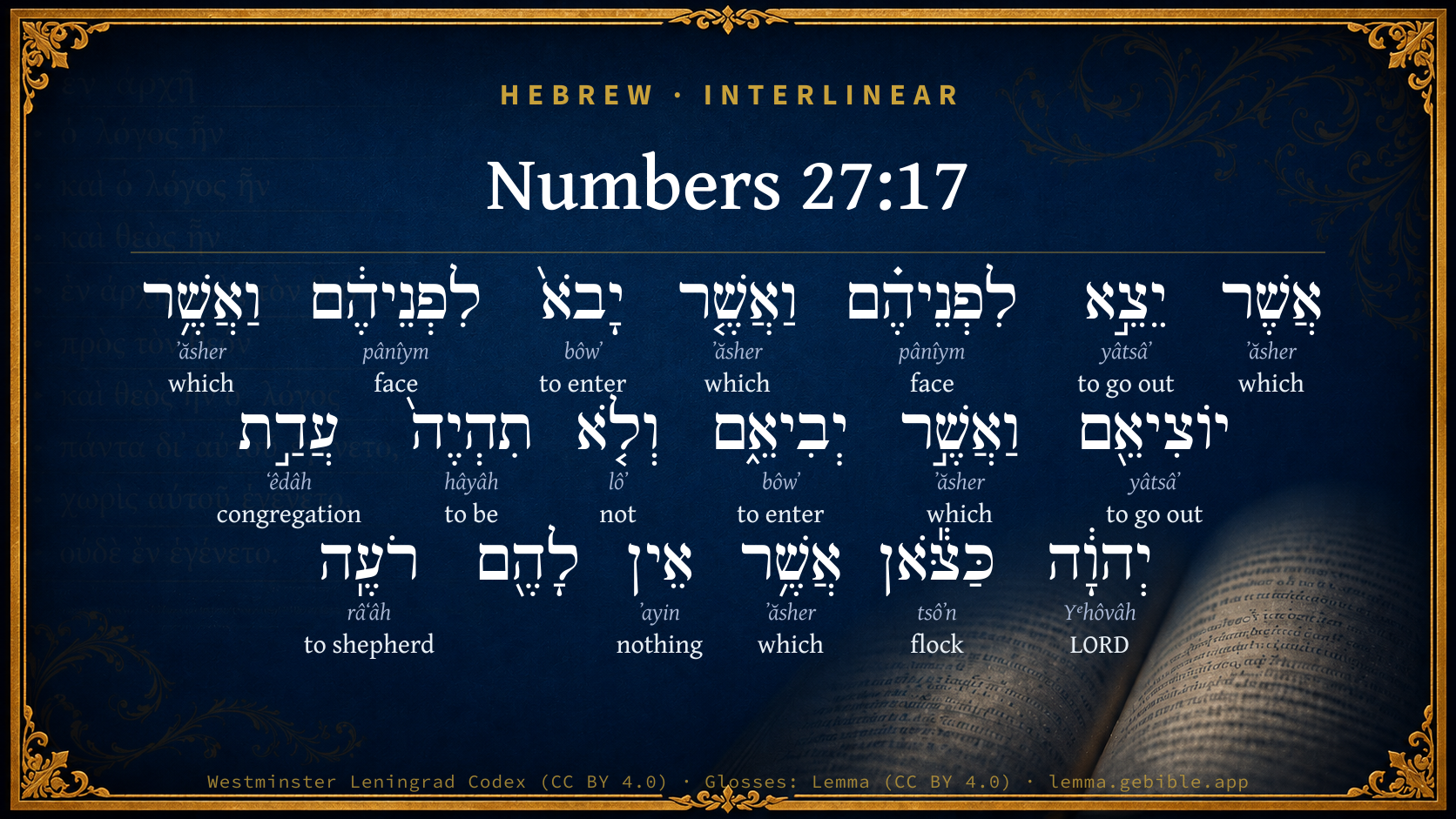
Hebrew (Westminster Leningrad Codex) Numbers 27:17 appears in the Hebrew Old Testament. The text above is from the Westminster Leningrad Codex. Each word links to its Strong’s number, a concise gloss, and parsing drawn from the Open Scriptures Hebrew Bible morphology. Click any word for its full Brown-Driver-Briggs (BDB) entry.
Download image
Cite this verse

Numbers 27:17 (World English Bible). Public Domain. Lemma interlinear Bible study tool, https://lemma.gebible.app/v/numbers/27/17.

Show BibTeX & RIS
BibTeX
RIS
English Translation
who may go out before them, and who may come in before them, and who may lead them out, and who may bring them in; that the congregation of Yahweh not be as sheep which have no shepherd.
World English Bible · Public Domain
Download a study sheet

One document with this verse’s original text, its word-by-word gloss line, the meaning frame, cross-references with their text, attributed commentary, and full source and license credits — printable, and it pastes into notes with its structure intact.

This verse Autodidact and up

Study sheet (.html) Plain text (.txt)

A passage Seminary Student

Up to 50 verses in one chapter. A passage sheet keeps up to 6 commentary sources and 12 cross-references per verse, in the order this page ranks them, and says so on the sheet whenever that leaves anything out. Ask for a single verse and you get the Autodidact verse sheet above.

Everything on this page stays free to read, with no account — the sheet is a download of what is already on screen, not access to it.

Want to remove ads? Support Godless Engineer
Compare translations 3

The same verse in 3 English versions, stacked beneath the original-language interlinear above. Click any original word for its lexicon entry.

Each is an independent rendering of the whole verse — the interlinear is not word-aligned to these translations.

Highlighted words mark where these versions differ — a whole-verse word diff, not a word-by-word alignment.

  • World English Bible Public Domain
    who may go out before them, and who may come in before them, and who may lead them out, and who may bring them in; that the congregation of Yahweh not be as sheep which have no shepherd.
  • King James Version Public Domain
    Which may go out before them, and which may go in before them, and which may lead them out, and which may bring them in; that the congregation of the LORD be not as sheep which have no shepherd.
  • unfoldingWord Literal Text CC BY-SA 4.0
    who will go out before the face of them and who will come before the face of them, and who will take them out and who will bring them in, and the congregation of Yahweh will not be like sheep that have no shepherd for them.”

unfoldingWord Literal Text — © unfoldingWord, licensed CC BY-SA 4.0. Word-aligned USFM3 via Door43 (git.door43.org/unfoldingWord/en_ult).

Versions to compare (up to 4)

3 of 4 selected

Show all 18 translations

Every available English version of this verse, each an independent rendering of the whole verse.

  • World English Bible Public Domain
    who may go out before them, and who may come in before them, and who may lead them out, and who may bring them in; that the congregation of Yahweh not be as sheep which have no shepherd.
  • Berean Standard Bible Public Domain
    who will go out and come in before them, and who will lead them out and bring them in, so that the congregation of the LORD will not be like sheep without a shepherd.”
  • Majority Standard Bible Public Domain
    who will go out and come in before them, and who will lead them out and bring them in, so that the congregation of the LORD will not be like sheep without a shepherd.”
  • King James Version Public Domain
    Which may go out before them, and which may go in before them, and which may lead them out, and which may bring them in; that the congregation of the LORD be not as sheep which have no shepherd.
  • American Standard Version (1901) Public Domain
    who may go out before them, and who may come in before them, and who may lead them out, and who may bring them in; that the congregation of Jehovah be not as sheep which have no shepherd.
  • Revised Version (1885) Public Domain
    which may go out before them, and which may come in before them, and which may lead them out, and which may bring them in; that the congregation of the LORD be not as sheep which have no shepherd.
  • Geneva Bible (1599) Public Domain
    Who may goe out and in before them, and leade them out and in, that the Congregation of the Lord be not as sheepe, which haue not a shepheard.
  • Douay-Rheims (1899) Public Domain
    And may go out and in before them, and may lead them out, or bring them in: lest the people of the Lord be as sheep without a shepherd.
  • Young's Literal Translation Public Domain
    who goeth out before them, and who cometh in before them, and who taketh them out, and who bringeth them in, and the company of Jehovah is not as sheep which have no shepherd.'
  • Literal Standard Version CC BY-SA 4.0
    who goes out before them, and who comes in before them, and who takes them out, and who brings them in, and the congregation of YHWH is not as sheep which have no shepherd.”
  • Unlocked Literal Bible CC BY-SA 4.0
    a man who may go out and come in before them and lead them out and bring them in, so that your community is not like sheep that have no shepherd.”
  • unfoldingWord Literal Text CC BY-SA 4.0
    who will go out before the face of them and who will come before the face of them, and who will take them out and who will bring them in, and the congregation of Yahweh will not be like sheep that have no shepherd for them.”
  • Darby Bible Public Domain
    who may go out before them, and who may come in before them, and who may lead them out, and who may bring them in, that the assembly of Jehovah be not as sheep that have no shepherd.
  • World Messianic Bible Public Domain
    who may go out before them, and who may come in before them, and who may lead them out, and who may bring them in, that the congregation of the LORD may not be as sheep which have no shepherd.”
  • Webster's Bible Public Domain
    Who may go out before them, and who may go in before them, and who may lead them out, and who may bring them in; that the congregation of the LORD be not as sheep which have no shepherd.
  • Free Bible Version CC BY-SA 4.0
    who will tell them what to do and show them where to go, so that the people of the Lord won't be like sheep without a shepherd.”
  • Bible in Basic English Public Domain
    To go out and come in before them and be their guide; so that the people of the Lord may not be like sheep without a keeper.
  • JPS Tanakh (1917) Public Domain
    who may go out before them, and who may come in before them, and who may lead them out, and who may bring them in; that the congregation of the LORD be not as sheep which have no shepherd.'

Literal Standard Version (2020), Covenant Press — licensed CC BY-SA 4.0. Text via the HelloAO Bible API (eBible.org). Unlocked Literal Bible (unfoldingWord) — licensed CC BY-SA 4.0. Text via the HelloAO Bible API (eBible.org). unfoldingWord Literal Text — © unfoldingWord, licensed CC BY-SA 4.0. Word-aligned USFM3 via Door43 (git.door43.org/unfoldingWord/en_ult). Free Bible Version, Dr. Jonathan Gallagher — licensed CC BY-SA 4.0. Text via the HelloAO Bible API (eBible.org).

Word by word

More ways to search: Search by grammar → Find every occurrence → Compare this word →

Practice this passage: Drill this verse → Learn its vocabulary →

עֲדַ֣ת
ʻêdâh
H5712
“congregation of”
Noun, Common, Feminine, Singular, Construct
Part of Speech
Noun
Type
Common
Gender
Feminine
Number
Singular
State
Construct
Full BDB Definition

Origin: from H5707 in the original sense of fixture

TWOT: 878a

congregation, gathering
  1. אֲשֶׁר ʼăsher H834 “which” Particle, Relative
  2. יֵצֵ֣א yâtsâʼ H3318 “to go out” Verb, Qal, Imperfect, 3rd Person, Masculine, Singular
  3. לִפְנֵיהֶ֗ם pânîym H6440 “to/for · face(s) · their” Preposition + Noun, Common, Both, Plural, Construct + Suffix, Personal, 3rd Person, Masculine, Plural
  4. וַאֲשֶׁ֤ר ʼăsher H834 “and · which” Conjunction + Particle, Relative
  5. יָבֹא֙ bôwʼ H935 “to enter” Verb, Qal, Imperfect, 3rd Person, Masculine, Singular
  6. לִפְנֵיהֶ֔ם pânîym H6440 “to/for · face(s) · their” Preposition + Noun, Common, Both, Plural, Construct + Suffix, Personal, 3rd Person, Masculine, Plural
  7. וַאֲשֶׁ֥ר ʼăsher H834 “and · which” Conjunction + Particle, Relative
  8. יוֹצִיאֵ֖ם yâtsâʼ H3318 “to go out · them” Verb, Hiphil, Imperfect, 3rd Person, Masculine, Singular + Suffix, Personal, 3rd Person, Masculine, Plural
  9. וַאֲשֶׁ֣ר ʼăsher H834 “and · which” Conjunction + Particle, Relative
  10. יְבִיאֵ֑ם bôwʼ H935 “to enter · them” Verb, Hiphil, Imperfect, 3rd Person, Masculine, Singular + Suffix, Personal, 3rd Person, Masculine, Plural
  11. וְלֹ֤א lôʼ H3808 “and · not” Conjunction + Particle, Negative
  12. תִהְיֶה֙ hâyâh H1961 “to be” Verb, Qal, Imperfect, 3rd Person, Feminine, Singular
  13. יְהוָ֔ה Yᵉhôvâh H3068 “LORD” Noun, Proper
  14. כַּצֹּ֕אן tsôʼn H6629 “like/as the · flock” Preposition, Determined + Noun, Common, Both, Singular, Absolute
  15. אֲשֶׁ֥ר ʼăsher H834 “which” Particle, Relative
  16. אֵין ʼayin H369 “nothing” Particle, Negative
  17. רֹעֶֽה râʻâh H7462 “shepherding” Verb, Qal, Participle Active, Masculine, Singular, Absolute

About this verse

These counts appear in no published source. They are computed here, from the morphology-tagged text and Lemma’s own curated glosses. What Lemma adds →

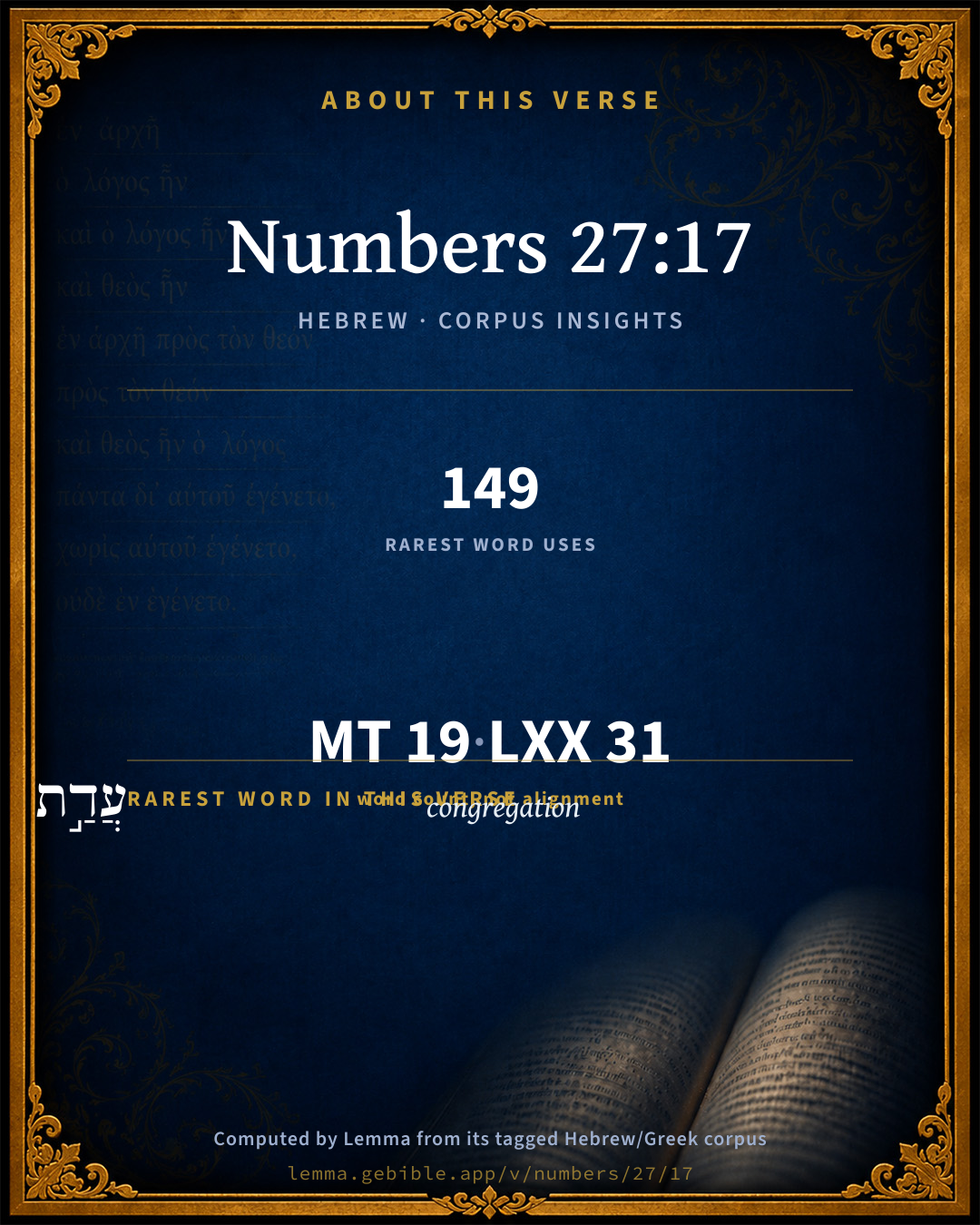
19
words
11
distinct lemmas
Pentateuch
section

Grammatical profile

  • 6 verbs
  • 5 nouns
  • 1 preposition
  • 7 particles

Verb forms

  • יֵצֵ֣א Qal · Imperfect
  • יָבֹא֙ Qal · Imperfect
  • יוֹצִיאֵ֖ם Hiphil · Imperfect
  • יְבִיאֵ֑ם Hiphil · Imperfect
  • תִהְיֶה֙ Qal · Imperfect
  • רֹעֶֽה Qal · Participle Active

Repetition

Words recur within this verse — often emphatic in Hebrew:

  • יֵצֵ֣א to go out H3318 ×2
  • לִפְנֵיהֶ֗ם face H6440 ×2
  • יָבֹא֙ to enter H935 ×2
  • אֲשֶׁר which H834 ×5

Hebrew & Septuagint length

In English translation the verse runs 38 words from the Hebrew and 39 from the Septuagint (LXX English) — closely comparable.

A rough comparison of the two English renderings, which tokenize alike — not a word-level alignment.

Word counts can differ between the Hebrew and the Greek without any difference in meaning — e.g. the Hebrew direct-object marker אֵת has no separate Greek word, and Greek often adds the article ὁ.

In the original languages it is 19 Hebrew tokens and 31 Greek tokens — but the two are counted differently (Hebrew bundles its prefixes and suffixes into one token; the Greek is in lemma form), so that isn’t a like-for-like length.

Cross-references

18

Topical passages linked to Numbers 27:17 in the Treasury of Scripture Knowledge — connected by theme and wording, ordered by reader-vote popularity; previews shown in the World English Bible.

  • Ezekiel 34:5 They were scattered, because there was no shepherd; and they became food to all the animals of the field, and were scattered.
  • 1 Kings 22:17 He said, I saw all Israel scattered on the mountains, as sheep that have no shepherd: and Yahweh said, These have no master; let them return every man to his house in peace.
  • Mark 6:34 Jesus came out, saw a great multitude, and he had compassion on them, because they were like sheep without a shepherd, and he began to teach them many things.
  • Deuteronomy 31:2 He said to them, I am one hundred twenty years old this day; I can no more go out and come in: and Yahweh has said to me, You shall not go over this Jordan.
  • 2 Chronicles 1:10 Give me now wisdom and knowledge, that I may go out and come in before this people; for who can judge this your people, that is so great?
  • Zechariah 10:2 For the teraphim have spoken vanity, and the diviners have seen a lie; And they have told false dreams. They comfort in vain. Therefore they go their way like sheep. They are oppressed, because there is no shepherd.
  • Matthew 9:36 But when he saw the multitudes, he was moved with compassion for them, because they were harassed and scattered, like sheep without a shepherd.
  • 1 Samuel 8:20 that we also may be like all the nations, and that our king may judge us, and go out before us, and fight our battles.
  • 1 Samuel 18:13 Therefore Saul removed him from him, and made him his captain over a thousand; and he went out and came in before the people.
  • 1 Kings 3:7 Now, Yahweh my God, you have made your servant king instead of David my father: and I am but a little child; I don't know how to go out or come in.
  • 2 Samuel 5:2 In times past, when Saul was king over us, it was you who led out and brought in Israel: and Yahweh said to you, You shall be shepherd of my people Israel, and you shall be prince over Israel.
  • 2 Chronicles 18:16 He said, I saw all Israel scattered on the mountains, as sheep that have no shepherd: and Yahweh said, These have no master; let them return every man to his house in peace.
  • Zechariah 13:7 "Awake, sword, against my shepherd, And against the man who is close to me," says Yahweh of Hosts. Strike the shepherd, and the sheep will be scattered; And I will turn my hand against the little ones.
  • Matthew 10:6 Rather, go to the lost sheep of the house of Israel.
  • Matthew 15:24 But he answered, "I wasn't sent to anyone but the lost sheep of the house of Israel."
  • John 10:3–4 The gatekeeper opens the gate for him, and the sheep listen to his voice. He calls his own sheep by name, and leads them out.
  • John 10:9 I am the door. If anyone enters in by me, he will be saved, and will go in and go out, and will find pasture.
  • 1 Peter 2:25 For you were going astray like sheep; but are now returned to the Shepherd and Overseer of your souls.

Cross-references courtesy of OpenBible.info (CC BY 4.0).

Hebrew and Greek witnesses Masoretic Hebrew ↔ Greek Septuagint

The same verse in the two great witnesses to the Old Testament, shown verse-for-verse.

These are two independent witnesses, not word-aligned to each other, and the Septuagint is shown in lemma (dictionary) form.

Hebrew Numbers 27:17 Masoretic · Westminster Leningrad Codex

אֲשֶׁר יֵצֵ֣א לִפְנֵיהֶ֗ם וַאֲשֶׁ֤ר יָבֹא֙ לִפְנֵיהֶ֔ם וַאֲשֶׁ֥ר יוֹצִיאֵ֖ם וַאֲשֶׁ֣ר יְבִיאֵ֑ם וְלֹ֤א תִהְיֶה֙ עֲדַ֣ת יְהוָ֔ה כַּצֹּ֕אן אֲשֶׁ֥ר אֵין לָהֶ֖ם רֹעֶֽה

who may go out before them, and who may come in before them, and who may lead them out, and who may bring them in; that the congregation of Yahweh not be as sheep which have no shepherd.

World English Bible · Public Domain

Greek LXX Numbers 27:17 Septuagint · lemma form

ὅστις ἐκἔρχομαι πρό πρόσωπον αὐτός καί ὅστις εἰςἔρχομαι πρό πρόσωπον αὐτός καί ὅστις ἐκἄγω αὐτός καί ὅστις εἰςἄγω αὐτός καί οὐ εἰμί ὁ συναγωγή κύριος ὡσεί πρόβατον ὅς οὐ εἰμί ποιμήν

who shall go out before them, and who shall come in before them, and who shall lead them out, and who shall bring them in; so the congregation of the Lord shall not be as sheep without a shepherd.

LXX2012 (modern English Septuagint) · Public Domain

Hebrew: Westminster Leningrad Codex (CC BY 4.0). Greek: Septuagint (public domain); English from LXX2012 (modern English Septuagint) (Public Domain). How the Septuagint differs from the Hebrew →

Targum (Aramaic paraphrase)

2

The Targum is the ancient Jewish Aramaic paraphrase of the Hebrew Scriptures — an interpretive translation, not the Hebrew text itself. Onkelos (literal) and Pseudo-Jonathan (expansive) render the Torah, and Jonathan the Prophets. Coverage is partial: where no permissively-licensed English translation exists for a verse, only the Aramaic is shown. This is verse-level text, not a word-by-word alignment to the Hebrew.

  1. Targum Onkelos Torah (Genesis–Deuteronomy)
    דִי יִפּוֹק קֳדָמֵיהוֹן וְדִי יֵעוֹל קֳדָמֵיהוֹן וְדִי יַפֵּקִנוּן וְדִי יָעֵלִינוּן וְלָא תְהֵי כְּנִשְׁתָּא דַיְיָ כְּעָנָא דִי לֵית לְהֵן רָעֵי

    (no public-domain English translation for this verse)

    Targum Onkelos — Aramaic: “Onkelos Genesis” (public domain); “Onkelos Exodus” (public domain); “Onkelos Leviticus” (public domain); “Onkelos Numbers” (public domain); “Onkelos Deuteronomy” (public domain). English: “Sefaria Community Translation” (CC0 1.0 (public-domain dedication)); “J.W. Etheridge. The Targums of Onkelos and Jonathan Ben Uzziel on the Pentateuch. London: Longmans, Green, 1862” (public domain). Text via Sefaria.

  2. Targum Pseudo-Jonathan Torah (Genesis–Deuteronomy)
    דִי הֲוֵי נְפַק קֳדָמֵיהוֹן לְסִדְרֵי קְרָבָא וְדִי הֲוָה עָלֵיל קֳדָמֵיהוֹן מִן סִדְרֵי קְרָבָא וּדְיִפּוֹק יַתְהוֹן מִן יַד בַּעֲלֵי דְבָבֵיהוֹן וּדְיֵעוּל יַתְהוֹן לְאַרְעָא דְיִשְרָאֵל וְלָא תְהֵי כְנִישְׁתָּא דַיְיָ בְּלָא חַכִּימִין מִן בִּגְלַל דְלָא יִטְעוֹן בֵּינֵי עַמְמַיָא כַּעֲנָא דְטָעַן וְלֵית לְהוֹן רוֹעֵי

    who may go out before them to set battle in array, and may come in before them from the he battle who may bring them out from the hands of their enemies, and bring them into the land of Israel; that the congregation of the Lord may not be without the wise, nor go astray among the nations as sheep who go astray, having no shepherd.

    Targum Pseudo-Jonathan — Aramaic: “Targum Jonathan on Genesis” (public domain); “Targum Jonathan on Exodus” (public domain); “Targum Jonathan on Leviticus” (public domain); “Targum Jonathan on Numbers” (public domain); “Targum Jonathan on Deuteronomy” (public domain). English: “The Targum of Jonathan ben Uzziel, trans. J. W. Etheridge, London, 1862” (public domain). Text via Sefaria.

Commentary

Notes on Numbers 27:17 from classic Christian and Jewish commentators (each source and its license shown beneath its notes). The classic Christian expositions comment on the surrounding passage and are grouped to its opening verse, so a note may address several verses; the Jewish commentaries on the Tanakh (Rashi and others) are per-verse, so they appear only where the commentator wrote on this verse.

Lemma curates 59 commentaries, every one of them public domain or Creative Commons licensed, each selected and text-cleaned for this edition rather than reprinted as found. About our sources →

Joseph Benson's Commentary

Num 27:17. Go out before them — That is, who may wisely conduct them in all their affairs, both when they go forth to war, or upon other occasions, and when they return home and live in peace. A metaphor from shepherds, who in those places used not to go behind their sheep, as ours now do, but before them, and to lead them forth to their pasture, and, in due time, to lead them home again.

Joseph Benson's Commentary on the Old and New Testaments (1811–1818) — public domain. Text from a community e-Sword module.

Geneva Bible (1599)

Geneva Bible translators

That is, govern them and do his duty, as 2 Chron. 1:10.

Geneva Bible (1599) marginal notes — public domain. Text via Bolls.life.

Adam Clarke's Commentary

Verse 17. That the congregation of the Lord be not as sheep which have no shepherd.] This is a beautiful expression, and shows us in what light Moses viewed himself among his people. He was their shepherd; he sought no higher place; he fed and guided the flock of God under the direction of the Divine Spirit, and was faithful in all his Master's house. To this saying of Moses our Lord alludes, Mt 9:36.

Adam Clarke's Commentary on the Bible (1810–1826) — public domain. Text from a community e-Sword/MySword module.

Ellicott's Commentary for English Readers

(17) Which may go out before them . . . —The expression going out and coming in is used here, as in many other places, to denote the ordinary life of man (Deu_28:6; Deu_31:2). Leading out and bringing in (literally, causing to go out and to come in), as a shepherd in respect of his flock (Joh_10:3-9), denotes the direction of the conduct of others.

A Bible Commentary for English Readers, edited by Charles John Ellicott (1878–1897) — public domain. Text from a community e-Sword module.

The Cambridge Bible for Schools and Colleges

gen. ed. J. J. S. Perowne

17. as sheep which have no shepherd] Cf. 1Ki_22:17; Mat_9:36 = Mar_6:34.

The Cambridge Bible for Schools and Colleges (gen. ed. J. J. S. Perowne; Cambridge University Press, 1878–1918) — public domain. Text from a community e-Sword module.

John Gill's Exposition

And the Lord said unto Moses,.... In answer to his request:

take thou Joshua the son of Nun, who had been a servant of his near forty years, and of whose humility, diligence, faithfulness and integrity he had sufficient proof, as well as of his skill and courage in military affairs, particularly at the battle with Amalek, Exo 17:9,

a man in whom is the Spirit: not only in whom is a spirit or soul, which is in every man; but the Spirit of God, and that not only as a spirit of grace and sanctification, which is in every good man; but as a spirit of prophecy, as the Targums of Onkelos and Jonathan; or rather it respects the more than ordinary gifts of the Spirit qualifying him for government, as courage and conduct, wisdom, prudence, and greatness of mind:

and lay thine hand upon him; thereby transferring the government to him, pointing him out to the people as his successor; to show to the children of Israel that he was in his place, as Aben Ezra notes; upon which followed a larger measure of the gifts of the Spirit of God; see Deu 34:9.

John Gill's Exposition of the Whole Bible (1746–1763) — public domain (CC PDM 1.0). Text via the HelloAO Bible API.

Haydock's Catholic Bible Commentary

Shepherd. Christ makes use of the same comparison, John x. 1. Kings are often styled shepherds in Homer. Moses begs that his successor may be enabled to conduct the multitude in both peace and war. --- To go in and out, means to govern, (3 Kings iii. 7,) and includes all the occurrences of life, Acts i. 21., and Psalm cxx. 8. (Calmet) --- Thus, temporal princes are the shepherds of the people. But they are not, on that account, supreme in spiritual causes. For here Josue only receives part of the glory of Moses, while Eleazar is appointed to consult the Lord for him, and to direct him in all matters of importance, ver. 20, 21. (Worthington)

George Leo Haydock (1774–1849), Haydock's Catholic Family Bible and Commentary, 1859 edition — public domain. Excludes Psalms (Douay-Rheims chapter numbering differs from Protestant) and Deuterocanonical books (Catholic canon only).

Matthew Poole's English Annotations

i.e. Which may wisely conduct them in all their affairs, both when they go forth to war, or upon other occasions, and when they return home and live in peace. A metaphor from shepherds, as it here follows, which in those places used not to go behind their sheep, as ours now do, but before them, and to lead them forth to their pasture, and in due time to lead them home again. Of this phrase see Deu 28:6; Act 1:21.

Matthew Poole's English Annotations on the Holy Bible (1683–1685) — public domain. Text from a community e-Sword/MySword module.

Whedon's Commentary on the Bible

Daniel D. Whedon

17. Go out… go in — This describes conduct in every-day life. Jos_14:11, note.

Lead… out,… bring… in — Superintend the affairs of the nation. The imagery of the shepherd’s life is in the mind of Moses. Joh_10:1-16, notes.

Daniel D. Whedon (gen. ed.), Commentary on the Old and New Testaments (1874–1909) — public domain. Text from a community e-Sword module.

John Wesley's Explanatory Notes

Go out before them - That is, who may wisely conduct them in all their affairs, both when they go forth to war, or upon other occasions, and when they return home and live in peace. A metaphor from shepherds, who in those places used not to go behind their sheep, as ours now do, but before them, and to lead them forth to their pasture, and in due time to lead them home again.

John Wesley, Explanatory Notes Upon the Whole Bible (1754–1765) — public domain. Text via the GEBible commentary corpus.

Rashi

Rabbi Shlomo Yitzchaki (Rashi)

אשר יצא לפניהם ONE WHO MAY GO BEFORE THEM — not as is the way of the kings of the nations who sit at home and send their armies to battle, but as “I” have done — I who fought against Sihon and against Og, as it is said, (Numbers 21:34) “Do not fear him: “[for I have delivered him into thy hand … and thou shall do to him as thou didst unto Sihon, etc.]” and as is the way that Joshua followed, as it is said, (Joshua 5:3) “And Joshua went to him and said, Art thou for us [or for our adversaries]”. And so, too, in the case of David, it says, (I Samuel 18:16) “For he went out and came in before them” — went out at their head, and came in at their head (Sifrei Bamidbar 139:2).

ואשר יוציאם AND WHO WILL LEAD THEM OUT, safely through his merits,

ואשר יביאם AND WHO WILL BRING THEM IN, safely through his merits (Siphre). Another explanation: ואשר יביאם AND WHO WILL BRING THEM IN — I ask that You should not do to him, as You have done to me' for I may not bring them into the Land. (cf. Yalkut Shimoni on Torah 776).

Rashi on the Tanakh — English translations: “The Judaica Press complete Tanach with Rashi, translated by A. J. Rosenberg” (CC BY 4.0); “Pentateuch with Rashi's commentary by M. Rosenbaum and A.M. Silbermann, 1929-1934” (public domain); “The Metsudah Tanach series, Lakewood, N.J” (CC BY 4.0); and “The Book of Joshua, Metsudah Publications, 1997” (CC BY 4.0). Text via Sefaria.

Lesson kit

Teaching starters — assembled from the data on this page, not authored interpretation. Every prompt links to the verse data it draws on. Edit before teaching.

Numbers, in the Pentateuch, opens this verse with 19 words (11 distinct Hebrew lemmas). Its most distinctive word is ʻêdâh (“congregation”). A historical commentator’s framing appears above. Read the whole chapter for the surrounding context.

Discussion questions

  1. How does “congregation” (ʻêdâh) shape what this verse is saying?
  2. How does Ezekiel 34:5, which shares this passage’s theme, read alongside this verse?
  3. What does the repetition of “to go out” (2× in this one verse) do in this verse?
  4. These translations render this verse differently. What is at stake in choosing one wording over another?
  5. «יֵצֵ֣א» is a Qal Imperfect verb. How does that grammatical form shape the action described?
  6. Compare how Joseph Benson's Commentary and Geneva Bible (1599) read this verse. Where do they agree or differ?

Things to notice

Reading settings

Reading text

Shown beneath each verse's original-language words.

Old Testament
Old Testament edition

Read the OT as the Masoretic Hebrew (MT) or the Greek Septuagint (LXX).

English shown for the Greek Septuagint (in the Hebrew ↔ Greek comparison).

Comparing translations? Open the Compare panel on any verse page to stack up to four side by side.