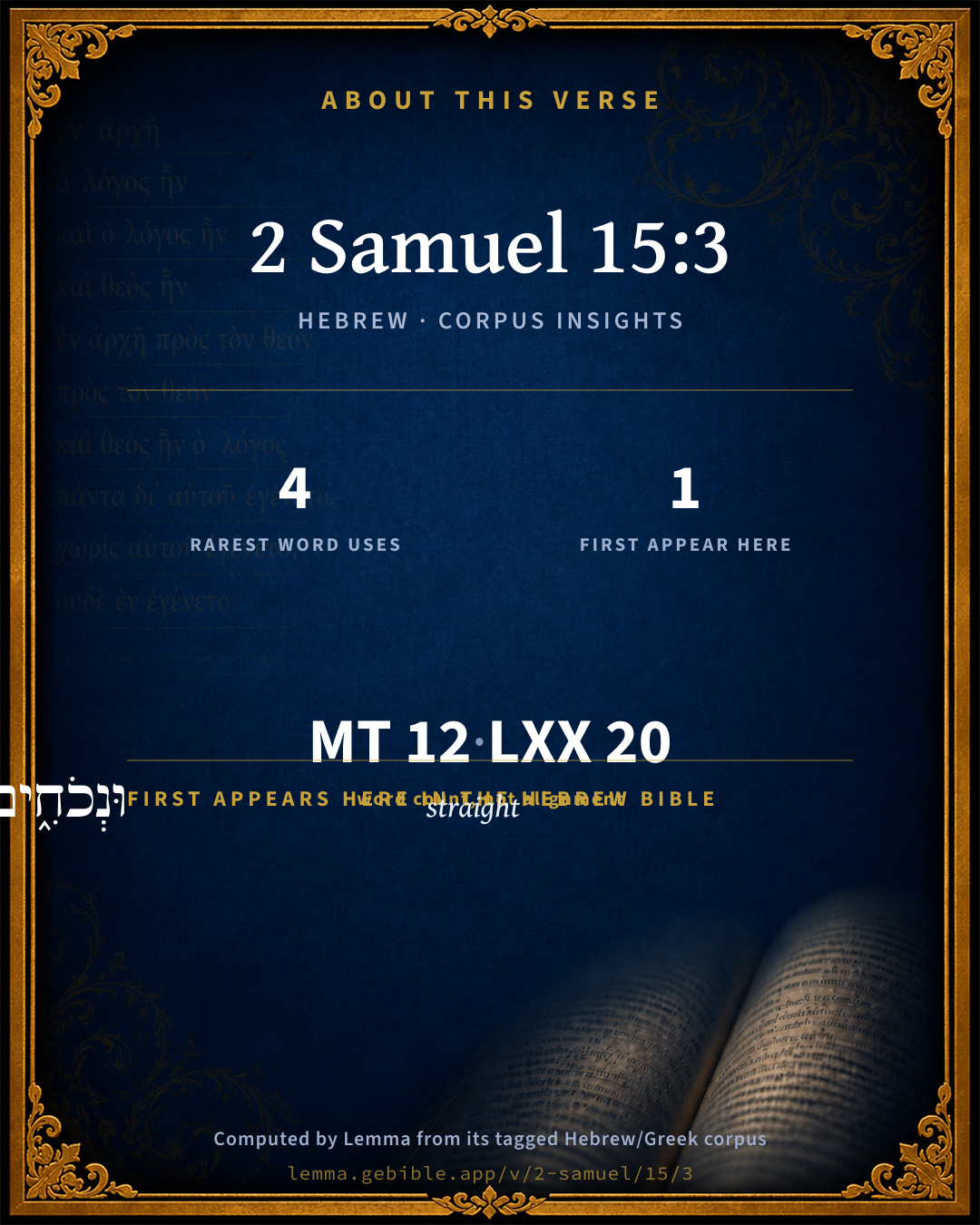
2 Samuel 15:3

Hebrew (Westminster Leningrad Codex) 2 Samuel 15:3 appears in the Hebrew Old Testament. The text above is from the Westminster Leningrad Codex. Each word links to its Strong’s number, a concise gloss, and parsing drawn from the Open Scriptures Hebrew Bible morphology. Click any word for its full Brown-Driver-Briggs (BDB) entry.
Download image
Cite this verse

2 Samuel 15:3 (World English Bible). Public Domain. Lemma interlinear Bible study tool, https://lemma.gebible.app/v/2-samuel/15/3.

Show BibTeX & RIS
BibTeX
RIS
English Translation
Absalom said to him, Behold, your matters are good and right; but there is no man deputized of the king to hear you.
World English Bible · Public Domain
Highlights
  • 1 first appearance in the Hebrew Bible
Full analysis ↓
Download a study sheet

One document with this verse’s original text, its word-by-word gloss line, the meaning frame, cross-references with their text, attributed commentary, and full source and license credits — printable, and it pastes into notes with its structure intact.

This verse Autodidact and up

Study sheet (.html) Plain text (.txt)

A passage Seminary Student

Up to 50 verses in one chapter. A passage sheet keeps up to 6 commentary sources and 12 cross-references per verse, in the order this page ranks them, and says so on the sheet whenever that leaves anything out. Ask for a single verse and you get the Autodidact verse sheet above.

Everything on this page stays free to read, with no account — the sheet is a download of what is already on screen, not access to it.

Want to remove ads? Support Godless Engineer
Compare translations 3

The same verse in 3 English versions, stacked beneath the original-language interlinear above. Click any original word for its lexicon entry.

Each is an independent rendering of the whole verse — the interlinear is not word-aligned to these translations.

Highlighted words mark where these versions differ — a whole-verse word diff, not a word-by-word alignment.

  • World English Bible Public Domain
    Absalom said to him, Behold, your matters are good and right; but there is no man deputized of the king to hear you.
  • King James Version Public Domain
    And Absalom said unto him, See, thy matters are good and right; but there is no man deputed of the king to hear thee.
  • unfoldingWord Literal Text CC BY-SA 4.0
    Then Absalom would say to him, “See, your matter good and right, but there is not a hearer for you from with the king.”

unfoldingWord Literal Text — © unfoldingWord, licensed CC BY-SA 4.0. Word-aligned USFM3 via Door43 (git.door43.org/unfoldingWord/en_ult).

Versions to compare (up to 4)

3 of 4 selected

Show all 18 translations

Every available English version of this verse, each an independent rendering of the whole verse.

  • World English Bible Public Domain
    Absalom said to him, Behold, your matters are good and right; but there is no man deputized of the king to hear you.
  • Berean Standard Bible Public Domain
    Absalom would say, “Look, your claims are good and right, but the king has no deputy to hear you.”
  • Majority Standard Bible Public Domain
    Absalom would say, “Look, your claims are good and right, but the king has no deputy to hear you.”
  • King James Version Public Domain
    And Absalom said unto him, See, thy matters are good and right; but there is no man deputed of the king to hear thee.
  • American Standard Version (1901) Public Domain
    And Absalom said unto him, See, thy matters are good and right; but there is no man deputed of the king to hear thee.
  • Revised Version (1885) Public Domain
    And Absalom said unto him, See, thy matters are good and right; but there is no man deputed of the king to hear thee.
  • Geneva Bible (1599) Public Domain
    Then Absalom said vnto him, See, thy matters are good and righteous, but there is no man deputed of the King to heare thee.
  • Douay-Rheims (1899) Public Domain
    And Absalom answered him: Thy words seem to me good and just. But there is no man appointed by the king to hear thee. And Absalom said:
  • Young's Literal Translation Public Domain
    And Absalom saith unto him, `See, thy matters `are' good and straightforward -- and there is none hearkening to thee from the king.'
  • Literal Standard Version CC BY-SA 4.0
    And Absalom says to him, “See, your matters [are] good and straightforward—and there is none listening to you from the king.”
  • Unlocked Literal Bible CC BY-SA 4.0
    So Absalom would say to him, “Look, your case is good and right, but there is no one empowered by the king to hear your case.”
  • unfoldingWord Literal Text CC BY-SA 4.0
    Then Absalom would say to him, “See, your matter good and right, but there is not a hearer for you from with the king.”
  • Darby Bible Public Domain
    And Absalom said to him, See, thy matters are good and right; but there is no man to hear thee [appointed] by the king.
  • World Messianic Bible Public Domain
    Absalom said to him, “Behold, your matters are good and right; but there is no man deputized by the king to hear you.”
  • Webster's Bible Public Domain
    And Absalom said to him, See, thy matters are good and right; but there is no man deputed by the king to hear thee.
  • Free Bible Version CC BY-SA 4.0
    Absalom would tell them, “Look, you're in the right and you've got a good case. It's such a shame there's no one from the king to hear you.”
  • Bible in Basic English Public Domain
    And Absalom would say to him, See, your cause is true and right; but no man has been named by the king to give you a hearing.
  • JPS Tanakh (1917) Public Domain
    And Absalom said unto him: 'See, thy matters are good and right; but there is no man deputed of the king to hear thee.'

Literal Standard Version (2020), Covenant Press — licensed CC BY-SA 4.0. Text via the HelloAO Bible API (eBible.org). Unlocked Literal Bible (unfoldingWord) — licensed CC BY-SA 4.0. Text via the HelloAO Bible API (eBible.org). unfoldingWord Literal Text — © unfoldingWord, licensed CC BY-SA 4.0. Word-aligned USFM3 via Door43 (git.door43.org/unfoldingWord/en_ult). Free Bible Version, Dr. Jonathan Gallagher — licensed CC BY-SA 4.0. Text via the HelloAO Bible API (eBible.org).

Word by word

More ways to search: Search by grammar → Find every occurrence → Compare this word →

Practice this passage: Drill this verse → Learn its vocabulary →

וּנְכֹחִ֑ים
nâkôach
H5228
“and · straight”
Conjunction + Adjective, Adjective, Masculine, Plural, Absolute
Part of Speech
Conjunction + Adjective
Type
Adjective
Gender
Masculine
Number
Plural
State
Absolute
Full BDB Definition

Origin: from the same as H5226

TWOT: 1365a

straight, right, straightness, be in front of
  1. וַיֹּ֤אמֶר ʼâmar H559 “and · to say” Conjunction + Verb, Qal, Sequential Imperfect, 3rd Person, Masculine, Singular
  2. אֵלָיו֙ ʼêl H413 “to · him” Preposition + Suffix, Personal, 3rd Person, Masculine, Singular
  3. אַבְשָׁל֔וֹם ʼĂbîyshâlôwm H53 “Absalom” Noun, Proper
  4. רְאֵ֥ה râʼâh H7200 “see” Verb, Qal, Imperative, 2nd Person, Masculine, Singular
  5. דְבָרֶ֖ךָ dâbâr H1697 “word · your” Noun, Common, Masculine, Singular, Construct + Suffix, Personal, 2nd Person, Masculine, Singular
  6. טוֹבִ֣ים ṭôwb H2896 “good” Adjective, Adjective, Masculine, Plural, Absolute
  7. וְשֹׁמֵ֥עַ shâmaʻ H8085 “and · hearing” Conjunction + Verb, Qal, Participle Active, Masculine, Singular, Absolute
  8. אֵין ʼayin H369 “nothing” Particle, Negative
  9. מֵאֵ֥ת ʼêth H854 “from · with” Preposition + Preposition
  10. הַמֶּֽלֶךְ melek H4428 “the · king” Particle, Definite Article + Noun, Common, Masculine, Singular, Absolute

About this verse

These counts appear in no published source. They are computed here, from the morphology-tagged text and Lemma’s own curated glosses. What Lemma adds →

12
words
11
distinct lemmas
Historical
section

Notable vocabulary

The rarest word here is וּנְכֹחִ֑ים straight H5228 — appearing just 4 times in the whole Hebrew Bible.

First appearance in Scripture

This word makes its first canonical appearance in the Hebrew Bible here:

  • וּנְכֹחִ֑ים straight H5228

Shared distinctive vocabulary

וּנְכֹחִ֑ים straight H5228 occurs in 4 verses of the Hebrew Bible. Also found in:

Grammatical profile

  • 3 verbs
  • 3 nouns
  • 2 adjectives
  • 3 prepositions
  • 1 particle

Verb forms

  • וַיֹּ֤אמֶר Qal · Sequential Imperfect
  • רְאֵ֥ה Qal · Imperative
  • וְשֹׁמֵ֥עַ Qal · Participle Active

Hebrew & Septuagint length

In English translation the verse runs 23 words from the Hebrew and 24 from the Septuagint (LXX English) — closely comparable.

A rough comparison of the two English renderings, which tokenize alike — not a word-level alignment.

Word counts can differ between the Hebrew and the Greek without any difference in meaning — e.g. the Hebrew direct-object marker אֵת has no separate Greek word, and Greek often adds the article ὁ.

In the original languages it is 12 Hebrew tokens and 20 Greek tokens — but the two are counted differently (Hebrew bundles its prefixes and suffixes into one token; the Greek is in lemma form), so that isn’t a like-for-like length.

Cross-references

15

Topical passages linked to 2 Samuel 15:3 in the Treasury of Scripture Knowledge — connected by theme and wording, ordered by reader-vote popularity; previews shown in the World English Bible.

  • Exodus 20:12 "Honor your father and your mother, that your days may be long in the land which Yahweh your God gives you.
  • Exodus 21:17 "Anyone who curses his father or his mother shall surely be put to death.
  • Numbers 16:3 and they assembled themselves together against Moses and against Aaron, and said to them, You take too much on you, seeing all the congregation are holy, everyone of them, and Yahweh is among them: why then lift yourselves up above the assembly of Yahweh?
  • Numbers 16:13–14 is it a small thing that you have brought us up out of a land flowing with milk and honey, to kill us in the wilderness, but you must needs make yourself also a prince over us?
  • 2 Samuel 8:15 David reigned over all Israel; and David executed justice and righteousness to all his people.
  • Psalms 12:2 Everyone lies to his neighbor. They speak with flattering lips, and with a double heart.
  • Proverbs 12:2 A good man shall obtain favor from Yahweh, But he will condemn a man of wicked devices.
  • Proverbs 30:11 There is a generation that curses their father, And doesn't bless their mother.
  • Proverbs 30:17 The eye that mocks at his father, And scorns obedience to his mother: The ravens of the valley shall pick it out, The young eagles shall eat it.
  • Ezekiel 22:7 In you have they set light by father and mother; in the midst of you have they dealt by oppression with the foreigner; in you have they wronged the fatherless and the widow.
  • Daniel 11:21 In his place shall stand up a contemptible person, to whom they had not given the honor of the kingdom: but he shall come in time of security, and shall obtain the kingdom by flatteries.
  • Matthew 15:4 For God commanded, 'Honor your father and your mother,' and, 'He who speaks evil of father or mother, let him be put to death.'
  • Acts 23:5 Paul said, "I didn't know, brothers, that he was high priest. For it is written, 'You shall not speak evil of a ruler of your people.'"
  • 1 Peter 2:17 Honor all men. Love the brotherhood. Fear God. Honor the king.
  • 2 Peter 2:10 but chiefly those who walk after the flesh in the lust of defilement, and despise authority. Daring, self-willed, they are not afraid to speak evil of dignitaries;

Cross-references courtesy of OpenBible.info (CC BY 4.0).

Hebrew and Greek witnesses Masoretic Hebrew ↔ Greek Septuagint

The same verse in the two great witnesses to the Old Testament, shown verse-for-verse.

These are two independent witnesses, not word-aligned to each other, and the Septuagint is shown in lemma (dictionary) form.

Hebrew 2 Samuel 15:3 Masoretic · Westminster Leningrad Codex

וַיֹּ֤אמֶר אֵלָיו֙ אַבְשָׁל֔וֹם רְאֵ֥ה דְבָרֶ֖ךָ טוֹבִ֣ים וּנְכֹחִ֑ים וְשֹׁמֵ֥עַ אֵין לְךָ֖ מֵאֵ֥ת הַמֶּֽלֶךְ

Absalom said to him, Behold, your matters are good and right; but there is no man deputized of the king to hear you.

World English Bible · Public Domain

Greek LXX 2 Samuel 15:3 Septuagint · lemma form

καί εἶπον πρός αὐτός αβεσσαλωμ ἰδού ὁ λόγος σύ ἀγαθός καί εὔκολος καί ἀκούω οὐ εἰμί σύ παρά ὁ βασιλεύς

And Abessalom said to him, See, your affairs are right and clear, yet you have no one appointed of the king to hear you.

LXX2012 (modern English Septuagint) · Public Domain

Hebrew: Westminster Leningrad Codex (CC BY 4.0). Greek: Septuagint (public domain); English from LXX2012 (modern English Septuagint) (Public Domain). How the Septuagint differs from the Hebrew →

Targum (Aramaic paraphrase)

1

The Targum is the ancient Jewish Aramaic paraphrase of the Hebrew Scriptures — an interpretive translation, not the Hebrew text itself. Onkelos (literal) and Pseudo-Jonathan (expansive) render the Torah, and Jonathan the Prophets. Coverage is partial: where no permissively-licensed English translation exists for a verse, only the Aramaic is shown. This is verse-level text, not a word-by-word alignment to the Hebrew.

  1. Targum Jonathan Prophets (Joshua–Malachi)
    וַאֲמַר לֵיהּ אַבְשָׁלוֹם חֲזֵי פִתְגָמָךְ תַּקְנִין וְיָאָן וְשָׁמַע לֵית לָךְ מִן קֳדָם מַלְכָּא:

    (no public-domain English translation for this verse)

    Targum Jonathan — Aramaic: “Mikraot Gedolot” (public domain). English: “Sefaria Community Translation” (CC0 1.0 (public-domain dedication)); “London "Chaldee Paraphrase," 1871” (public domain). Text via Sefaria.

Commentary

Notes on 2 Samuel 15:3 from classic Christian and Jewish commentators (each source and its license shown beneath its notes). The classic Christian expositions comment on the surrounding passage and are grouped to its opening verse, so a note may address several verses; the Jewish commentaries on the Tanakh (Rashi and others) are per-verse, so they appear only where the commentator wrote on this verse.

Lemma curates 59 commentaries, every one of them public domain or Creative Commons licensed, each selected and text-cleaned for this edition rather than reprinted as found. About our sources →

Trapp's Complete Commentary

John Trapp

2Sa 15:3 And Absalom said unto him, See, thy matters [are] good and right; but [there is] no man [deputed] of the king to hear thee.

Ver. 3. See, thy matters are good and right.] Right or wrong, he, to steal away their hearts, smoothed them up with fair words, which are light cheap: telling them that their cause was very good, and condemning the judges as corrupt, saith Josephus, who had given sentence against them. This was very taking with the rude multitude.

But there is no man deputed of the king to hear thee.] This was a base slander, as appeareth from 2Sa 8:15. But that is a small matter with graceless ambitionists.

John Trapp, A Commentary or Exposition upon All the Books of the Old and New Testament (1647–1656) — public domain. Text from a community e-Sword module.

Joseph Benson's Commentary

2Sa 15:3. Absalom said, See, thy matters are good and right — Upon some very slight hearing of any man’s cause he approved of it, that he might oblige him; flattering all that they had right on their side, so that, if their causes should go against them, they might conclude, if Absalom had been judge, it would have been otherwise. There is no man deputed of the king to hear thee — None that will do thee justice. The other sons and relations of the king, and the rest of the judges and rulers under him and them, are wholly corrupt; or, at least, not careful and diligent as they should be, and my father, being grown in years, is negligent of public affairs. So Absalom said, or insinuated. And it is always the way of turbulent, aspiring men, to reproach the government they are under. Even David, we see, one of the best of kings, could not escape the worst of censures, and that even from his own son; for what could be worse than that which is here thrown out against him, that he neglected to administer true and impartial justice and judgment to his people? It is marvellous that David did not observe and nip this growing insurrection in its bud. But Delaney is of opinion that he was dangerously ill at this time, and that therefore Absalom seized this as a fit opportunity to take the steps here mentioned to increase his popularity, and draw the people after him.

Joseph Benson's Commentary on the Old and New Testaments (1811–1818) — public domain. Text from a community e-Sword module.

Ellicott's Commentary for English Readers

(3) There is no man deputed of the king.—There is no official hearer appointed. It was impossible for the king to hear every case in detail; certain persons were therefore appointed to hear causes and report the facts to the king, who thereupon pronounced his judgment. Absalom uses the same arts which have been used by the demagogue in all ages. He does not accuse the king himself of wrong, but insinuates that the system of government is detective, and expresses his own earnest wish to set things right.

A Bible Commentary for English Readers, edited by Charles John Ellicott (1878–1897) — public domain. Text from a community e-Sword module.

The Cambridge Bible for Schools and Colleges

gen. ed. J. J. S. Perowne

3. See, thy matters, &c.] He artfully flatters each suitor by pronouncing a favourable decision on his case, condoles with him on the improbability of his obtaining a hearing, and hints how differently matters would be managed if he were in power.

there is no man, &c.] This and not the marginal alternative none will hear thee from the king downward is the correct rendering. There was no one appointed to investigate the evidence and lay it before the king. He implies that decisions were given hastily and arbitrarily, and that his father needed assessors to help him. There is no reason to suppose that David was neglecting his duty as a judge; but the task was growing too heavy for one man to perform it. See Ewald’s Hist. iii. 176.

The Cambridge Bible for Schools and Colleges (gen. ed. J. J. S. Perowne; Cambridge University Press, 1878–1918) — public domain. Text from a community e-Sword module.

John Gill's Exposition

And Absalom said unto him,.... After some further talk, and finding he had a suit at law to bring on, and either seeing it drawn up in writing, or hearing his account of it, at once declared, without hearing the other party:

see, thy matters are good and right; thy cause is a good cause, and if it could be heard by proper persons there is no doubt but things would go on thy side, and thou wouldest carry thy cause:

but there is no man deputed of the king to hear thee; the king is grown old himself and his sons are negligent, and do not attend to business, and there are none besides them appointed to hear causes; and he suggested, as appears by what follows, that he was not in commission, but if he was, or should he appointed a judge, he would attend to business, and people should not go away after this manner, without having justice administered unto them,

John Gill's Exposition of the Whole Bible (1746–1763) — public domain (CC PDM 1.0). Text via the HelloAO Bible API.

Albert Barnes' Notes on the Bible

To flatter each man by pronouncing a favorable verdict in his case, to excite a sense of grievance and discontent by censuring the king for remissness in trying the causes brought before him by his subjects, and to suggest a sure and easy remedy for all such grievances, namely, to make Absalom king; all this, coupled with great affability and courtesy, which his personal beauty and high rank made all the more effective, were the arts by which Absalom worked his way into favor with the people, who were light and fickle as himself.

Albert Barnes' Notes on the Bible (1834–1885) — public domain. Text from a community e-Sword/MySword module.

Matthew Poole's English Annotations

Thy matters are good and right: upon some very slight hearing of their case he approved it, that he might oblige all.

No man deputed of the king to hear thee, to wit, none such as will do thee justice. The other sons and relations of the king, and the rest of the judges and rulers under him and them, are wholly corrupted, and swayed by favour or bribes; or, at least, not careful and diligent, as they should be; and my father being grown in years, is negligent of public affairs, leaving them wholly to their conduct.

Matthew Poole's English Annotations on the Holy Bible (1683–1685) — public domain. Text from a community e-Sword/MySword module.

Whedon's Commentary on the Bible

Daniel D. Whedon

3. Thy matters are good and right — Thy case is a worthy and righteous one, and ought to be tried, and all thy grievances redressed.

No man deputed of the king to hear thee — This was a charge against his father’s administration, and calculated to spread dissatisfaction among the people, The marginal reading, none will hear thee, from the king downward, is untenable.

Daniel D. Whedon (gen. ed.), Commentary on the Old and New Testaments (1874–1909) — public domain. Text from a community e-Sword module.

John Wesley's Explanatory Notes

See - Upon some very slight hearing of their cause, he approved it, that he might oblige all. No man - None such as will do thee justice. The other sons and relations of the king, and the rest of the Judges and rulers under him and them, are wholly corrupted; or, at least not careful and diligent as they should be: and my father being grown in years, is negligent of publick affairs. It is the way of turbulent, aspiring men, to reproach the government they are under. Even David himself, the best of kings, could not escape the worst of censures.

John Wesley, Explanatory Notes Upon the Whole Bible (1754–1765) — public domain. Text via the GEBible commentary corpus.

unfoldingWord translationNotes

Door43 World Missions Community

So Absalom would say to him

It is implied that the person told his case to Absalom. This can be stated clearly. AT: "Absalom would ask him what his problem was, and the man would then explain to Absalom why he sought justice. Absalom would then say to him" (See: Assumed Knowledge and Implicit Information)

good and right

These words have basically the same meaning and are used together to emphasize that his case is good. (See: Doublet)

to hear your case

"Hearing" a case means to listen to it and to make a judgement decision over it. AT: "to judge your case" or "to oversee your case" (See: Metonymy)

translationWords

good

judge, judges

just

unfoldingWord translationNotes — © Distant Shores Media and the Door43 World Missions Community, licensed CC BY-SA 4.0. Source: git.door43.org/Door43/en_tn.

Lesson kit

Teaching starters — assembled from the data on this page, not authored interpretation. Every prompt links to the verse data it draws on. Edit before teaching.

2 Samuel, in the Historical, opens this verse with 12 words (11 distinct Hebrew lemmas). Its most distinctive word is nâkôach (“straight”). A historical commentator’s framing appears above. Read the whole chapter for the surrounding context.

Discussion questions

  1. What does “straight” (nâkôach) contribute to the verse as a whole?
  2. The word “straight” first appears here in Scripture. What is being introduced at this debut?
  3. Proverbs 8:9 shares the word «straight» with this verse. How do the two illuminate each other?
  4. These translations render this verse differently; the difference is in the English rendering, not the original. What questions does that raise?
  5. The verb «וַיֹּ֤אמֶר» is Qal Sequential Imperfect. How does its form color the action?
  6. Reading how Trapp's Complete Commentary and Joseph Benson's Commentary read this verse, where do the two commentators agree and where do they part?

Things to notice

Reading settings

Reading text

Shown beneath each verse's original-language words.

Old Testament
Old Testament edition

Read the OT as the Masoretic Hebrew (MT) or the Greek Septuagint (LXX).

English shown for the Greek Septuagint (in the Hebrew ↔ Greek comparison).

Comparing translations? Open the Compare panel on any verse page to stack up to four side by side.