Exodus 32:18

Hebrew (Westminster Leningrad Codex) Exodus 32:18 appears in the Hebrew Old Testament. The text above is from the Westminster Leningrad Codex. Each word links to its Strong’s number, a concise gloss, and parsing drawn from the Open Scriptures Hebrew Bible morphology. Click any word for its full Brown-Driver-Briggs (BDB) entry.
Download image
Cite this verse

Exodus 32:18 (World English Bible). Public Domain. Lemma interlinear Bible study tool, https://lemma.gebible.app/v/exodus/32/18.

Show BibTeX & RIS
BibTeX
RIS
English Translation
He said, "It isn't the voice of those who shout for victory, neither is it the voice of those who cry for being overcome; but the noise of those who sing that I hear."
World English Bible · Public Domain
Highlights
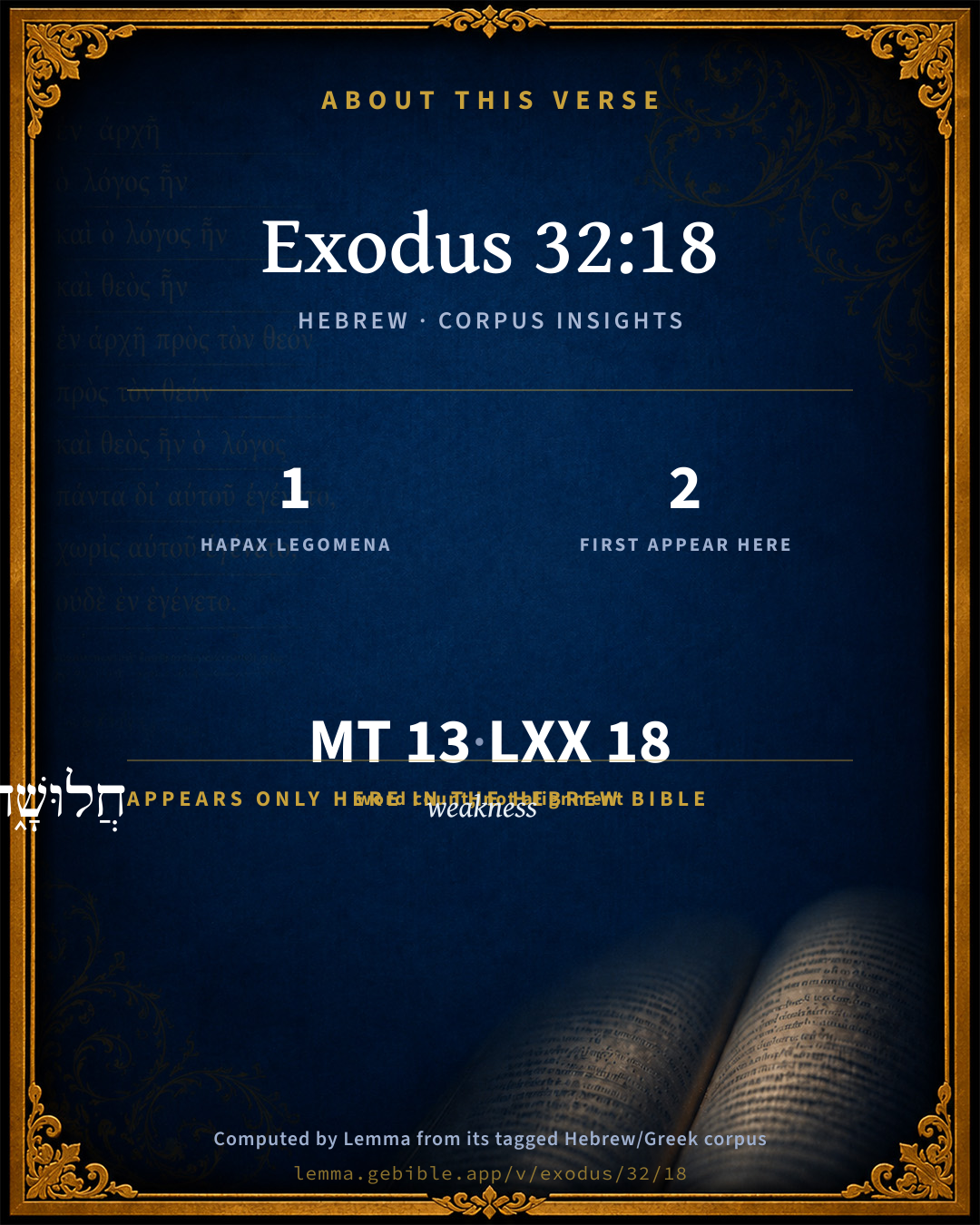
  • 1 hapax legomenon — only here in the Hebrew Bible
  • 2 first appearances in the Hebrew Bible
Full analysis ↓
Download a study sheet

One document with this verse’s original text, its word-by-word gloss line, the meaning frame, cross-references with their text, attributed commentary, and full source and license credits — printable, and it pastes into notes with its structure intact.

This verse Autodidact and up

Study sheet (.html) Plain text (.txt)

A passage Seminary Student

Up to 50 verses in one chapter. A passage sheet keeps up to 6 commentary sources and 12 cross-references per verse, in the order this page ranks them, and says so on the sheet whenever that leaves anything out. Ask for a single verse and you get the Autodidact verse sheet above.

Everything on this page stays free to read, with no account — the sheet is a download of what is already on screen, not access to it.

Want to remove ads? Support Godless Engineer
Compare translations 3

The same verse in 3 English versions, stacked beneath the original-language interlinear above. Click any original word for its lexicon entry.

Each is an independent rendering of the whole verse — the interlinear is not word-aligned to these translations.

Highlighted words mark where these versions differ — a whole-verse word diff, not a word-by-word alignment.

  • World English Bible Public Domain
    He said, "It isn't the voice of those who shout for victory, neither is it the voice of those who cry for being overcome; but the noise of those who sing that I hear."
  • King James Version Public Domain
    And he said, It is not the voice of them that shout for mastery, neither is it the voice of them that cry for being overcome: but the noise of them that sing do I hear.
  • unfoldingWord Literal Text CC BY-SA 4.0
    But Moses said, “There is not the sound of singing of strength, and there is not the sound of singing of weakness, the sound of singing I am hearing.”

unfoldingWord Literal Text — © unfoldingWord, licensed CC BY-SA 4.0. Word-aligned USFM3 via Door43 (git.door43.org/unfoldingWord/en_ult).

Versions to compare (up to 4)

3 of 4 selected

Show all 18 translations

Every available English version of this verse, each an independent rendering of the whole verse.

  • World English Bible Public Domain
    He said, "It isn't the voice of those who shout for victory, neither is it the voice of those who cry for being overcome; but the noise of those who sing that I hear."
  • Berean Standard Bible Public Domain
    But Moses replied: “It is neither the cry of victory nor the cry of defeat; I hear the sound of singing!”
  • Majority Standard Bible Public Domain
    But Moses replied: “It is neither the cry of victory nor the cry of defeat; I hear the sound of singing!”
  • King James Version Public Domain
    And he said, It is not the voice of them that shout for mastery, neither is it the voice of them that cry for being overcome: but the noise of them that sing do I hear.
  • American Standard Version (1901) Public Domain
    And he said, It is not the voice of them that shout for mastery, neither is it the voice of them that cry for being overcome; but the noise of them that sing do I hear.
  • Revised Version (1885) Public Domain
    And he said, It is not the voice of them that shout for mastery, neither is it the voice of them that cry for being overcome: but the noise of them that sing do I hear.
  • Geneva Bible (1599) Public Domain
    Who answered, It is not the noyse of them that haue the victorie, nor the noyse of them that are ouercome: but I do heare ye noyse of singing.
  • Douay-Rheims (1899) Public Domain
    But he answered: It is not the cry of men encouraging to fight, nor the shout of men compelling to flee: but I hear the voice of singers.
  • Young's Literal Translation Public Domain
    and he saith, `It is not the voice of the crying of might, nor is it the voice of the crying of weakness -- a voice of singing I am hearing.'
  • Literal Standard Version CC BY-SA 4.0
    And he says, “It is not the voice of the crying of might, nor is it the voice of the crying of weakness—I am hearing a voice of singing.”
  • Unlocked Literal Bible CC BY-SA 4.0
    But Moses said, “It is not the sound of a victor, and not the sound of defeated people, but the sound of singing that I hear.”
  • unfoldingWord Literal Text CC BY-SA 4.0
    But Moses said, “There is not the sound of singing of strength, and there is not the sound of singing of weakness, the sound of singing I am hearing.”
  • Darby Bible Public Domain
    And he said, It is not the sound of a shout of victory, neither is it the sound of a shout of defeat: it is the noise of alternate singing I hear.
  • World Messianic Bible Public Domain
    He said, “It isn’t the voice of those who shout for victory. It is not the voice of those who cry for being overcome; but the noise of those who sing that I hear.”
  • Webster's Bible Public Domain
    And he said, It is not the voice of them that shout for mastery, neither is it the voice of them that cry for being overcome: but the noise of them that sing do I hear.
  • Free Bible Version CC BY-SA 4.0
    But Moses replied, “These are not the shouts of victory or of defeat. What I'm hearing is people partying!”
  • Bible in Basic English Public Domain
    And Moses said, It is not the voice of men who are overcoming in the fight, or the cry of those who have been overcome; it is the sound of songs which comes to my ear.
  • JPS Tanakh (1917) Public Domain
    And he said: 'It is not the voice of them that shout for mastery, neither is it the voice of them that cry for being overcome, but the noise of them that sing do I hear.'

Literal Standard Version (2020), Covenant Press — licensed CC BY-SA 4.0. Text via the HelloAO Bible API (eBible.org). Unlocked Literal Bible (unfoldingWord) — licensed CC BY-SA 4.0. Text via the HelloAO Bible API (eBible.org). unfoldingWord Literal Text — © unfoldingWord, licensed CC BY-SA 4.0. Word-aligned USFM3 via Door43 (git.door43.org/unfoldingWord/en_ult). Free Bible Version, Dr. Jonathan Gallagher — licensed CC BY-SA 4.0. Text via the HelloAO Bible API (eBible.org).

Word by word

More ways to search: Search by grammar → Find every occurrence → Compare this word →

Practice this passage: Drill this verse → Learn its vocabulary →

חֲלוּשָׁ֑ה
chălûwshâh
H2476
“weakness”
Noun, Common, Feminine, Singular, Absolute
Part of Speech
Noun
Type
Common
Gender
Feminine
Number
Singular
State
Absolute
Full BDB Definition

Origin: pass. participle of H2522

TWOT: 671b

weakness, defeat, prostration
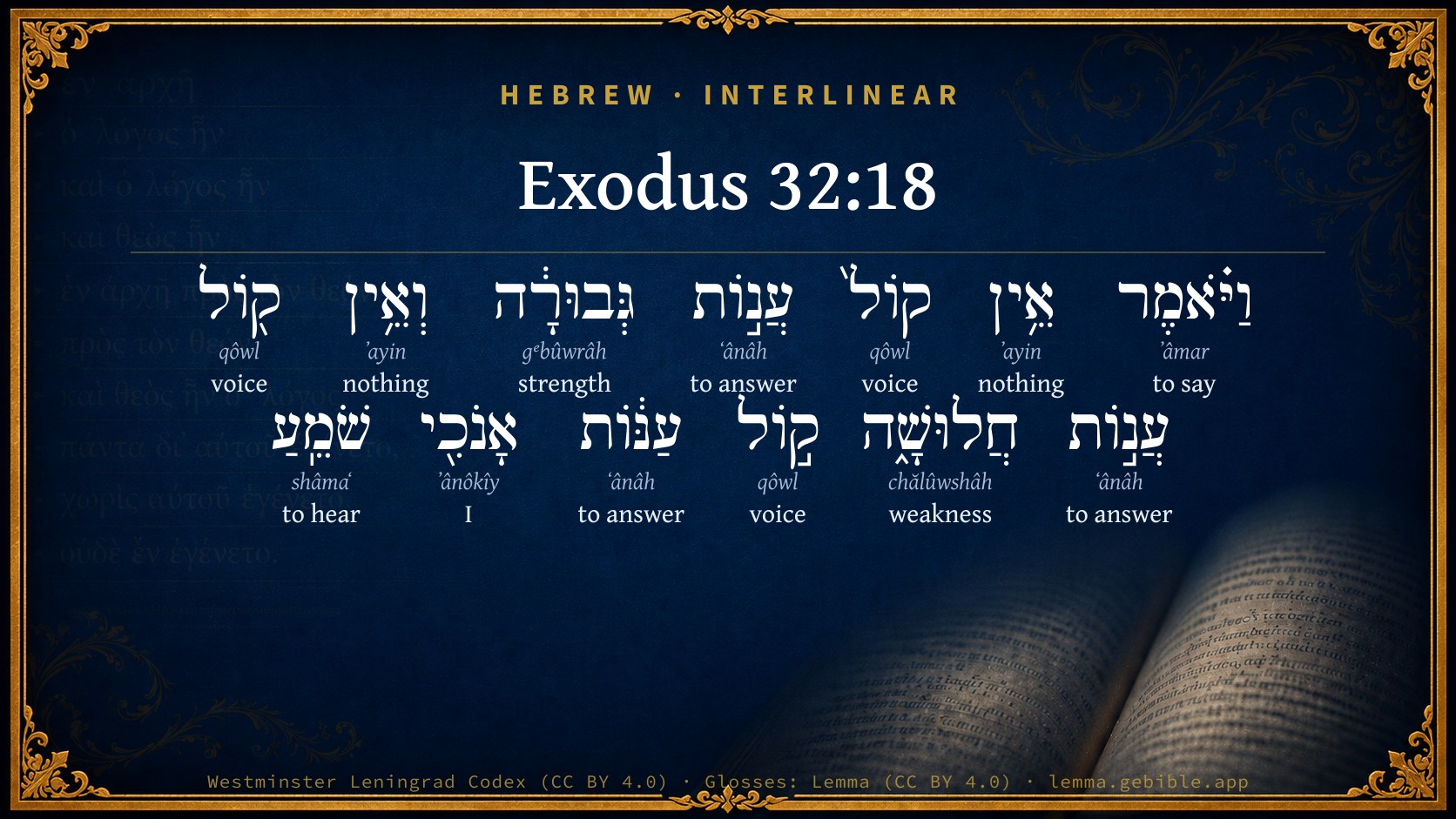
  1. וַיֹּ֗אמֶר ʼâmar H559 “and · to say” Conjunction + Verb, Qal, Sequential Imperfect, 3rd Person, Masculine, Singular
  2. אֵ֥ין ʼayin H369 “nothing” Particle, Negative
  3. קוֹל֙ qôwl H6963 “voice of” Noun, Common, Masculine, Singular, Construct
  4. עֲנ֣וֹת ʻânâh H6030 “to answer” Verb, Qal, Infinitive Construct
  5. גְּבוּרָ֔ה gᵉbûwrâh H1369 “strength” Noun, Common, Feminine, Singular, Absolute
  6. וְאֵ֥ין ʼayin H369 “and · nothing” Conjunction + Particle, Negative
  7. ק֖וֹל qôwl H6963 “voice of” Noun, Common, Masculine, Singular, Construct
  8. עֲנ֣וֹת ʻânâh H6030 “to answer” Verb, Qal, Infinitive Construct
  9. ק֣וֹל qôwl H6963 “voice of” Noun, Common, Masculine, Singular, Construct
  10. עַנּ֔וֹת ʻânâh H6030 “to answer” Verb, Piel, Infinitive Construct
  11. אָנֹכִ֖י ʼânôkîy H595 “I” Pronoun, Personal, 1st Person, Common, Singular
  12. שֹׁמֵֽעַ shâmaʻ H8085 “hearing” Verb, Qal, Participle Active, Masculine, Singular, Absolute

About this verse

These counts appear in no published source. They are computed here, from the morphology-tagged text and Lemma’s own curated glosses. What Lemma adds →

13
words
8
distinct lemmas
Pentateuch
section

Notable vocabulary

1 hapax legomenon — a word that appears only here in the entire Hebrew Bible:

  • חֲלוּשָׁ֑ה weakness H2476

First appearance in Scripture

These words make their first canonical appearance in the Hebrew Bible here:

  • גְּבוּרָ֔ה strength H1369
  • חֲלוּשָׁ֑ה weakness H2476

Grammatical profile

  • 5 verbs
  • 5 nouns
  • 1 pronoun
  • 2 particles

Verb forms

  • וַיֹּ֗אמֶר Qal · Sequential Imperfect
  • עֲנ֣וֹת Qal · Infinitive Construct
  • עֲנ֣וֹת Qal · Infinitive Construct
  • עַנּ֔וֹת Piel · Infinitive Construct
  • שֹׁמֵֽעַ Qal · Participle Active

Repetition

Words recur within this verse — often emphatic in Hebrew:

  • קוֹל֙ voice H6963 ×3
  • עֲנ֣וֹת to answer H6030 ×3
  • אֵ֥ין nothing H369 ×2

Hebrew & Septuagint length

In English translation the verse runs 34 words from the Hebrew and 39 from the Septuagint (LXX English) — closely comparable.

A rough comparison of the two English renderings, which tokenize alike — not a word-level alignment.

Word counts can differ between the Hebrew and the Greek without any difference in meaning — e.g. the Hebrew direct-object marker אֵת has no separate Greek word, and Greek often adds the article ὁ.

In the original languages it is 13 Hebrew tokens and 18 Greek tokens — but the two are counted differently (Hebrew bundles its prefixes and suffixes into one token; the Greek is in lemma form), so that isn’t a like-for-like length.

Cross-references

3

Topical passages linked to Exodus 32:18 in the Treasury of Scripture Knowledge — connected by theme and wording, ordered by reader-vote popularity; previews shown in the World English Bible.

  • Exodus 15:1–18 Then Moses and the children of Israel sang this song to Yahweh, and said, "I will sing to Yahweh, for he has triumphed gloriously: The horse and his rider he has thrown into the sea.
  • Daniel 5:4 They drank wine, and praised the gods of gold, and of silver, of brass, of iron, of wood, and of stone.
  • Daniel 5:23 but have lifted up yourself against the Lord of heaven; and they have brought the vessels of his house before you, and you and your lords, your wives and your concubines, have drunk wine from them; and you have praised the gods of silver and gold, of brass, iron, wood, and stone, which don't see, nor hear, nor know; and the God in whose hand your breath is, and whose are all your ways, you have not glorified.

Cross-references courtesy of OpenBible.info (CC BY 4.0).

Hebrew and Greek witnesses Masoretic Hebrew ↔ Greek Septuagint

The same verse in the two great witnesses to the Old Testament, shown verse-for-verse.

These are two independent witnesses, not word-aligned to each other, and the Septuagint is shown in lemma (dictionary) form.

Hebrew Exodus 32:18 Masoretic · Westminster Leningrad Codex

וַיֹּ֗אמֶר אֵ֥ין קוֹל֙ עֲנ֣וֹת גְּבוּרָ֔ה וְאֵ֥ין ק֖וֹל עֲנ֣וֹת חֲלוּשָׁ֑ה ק֣וֹל עַנּ֔וֹת אָנֹכִ֖י שֹׁמֵֽעַ

He said, "It isn't the voice of those who shout for victory, neither is it the voice of those who cry for being overcome; but the noise of those who sing that I hear."

World English Bible · Public Domain

Greek LXX Exodus 32:18 Septuagint · lemma form

καί λέγω οὐ εἰμί φωνή ἐκἄρχω κατά ἰσχύς οὐδέ φωνή ἐκἄρχω τροπή ἀλλά φωνή ἐκἄρχω οἶνος ἐγώ ἀκούω

And Moses says, It is not the voice of them that begin the battle, nor the voice of them that begin the cry of defeat, but the voice of them that begin the banquet of wine do I hear.

LXX2012 (modern English Septuagint) · Public Domain

On this verse, Haydock's Catholic Bible Commentary discusses the Septuagint’s reading. Read the note in Commentary ↓

Hebrew: Westminster Leningrad Codex (CC BY 4.0). Greek: Septuagint (public domain); English from LXX2012 (modern English Septuagint) (Public Domain). How the Septuagint differs from the Hebrew →

Targum (Aramaic paraphrase)

2

The Targum is the ancient Jewish Aramaic paraphrase of the Hebrew Scriptures — an interpretive translation, not the Hebrew text itself. Onkelos (literal) and Pseudo-Jonathan (expansive) render the Torah, and Jonathan the Prophets. Coverage is partial: where no permissively-licensed English translation exists for a verse, only the Aramaic is shown. This is verse-level text, not a word-by-word alignment to the Hebrew.

  1. Targum Onkelos Torah (Genesis–Deuteronomy)
    וַאֲמַר לָא קַל גִבָּרִין דְנַצְחִין בִּקְרָבָא וְאַף לָא קַל חַלָשִׁין דְמִתַּבְּרִין קַל דִמְחַיְכִין אֲנָא שְׁמָע:

    (no public-domain English translation for this verse)

    Targum Onkelos — Aramaic: “Onkelos Genesis” (public domain); “Onkelos Exodus” (public domain); “Onkelos Leviticus” (public domain); “Onkelos Numbers” (public domain); “Onkelos Deuteronomy” (public domain). English: “Sefaria Community Translation” (CC0 1.0 (public-domain dedication)); “J.W. Etheridge. The Targums of Onkelos and Jonathan Ben Uzziel on the Pentateuch. London: Longmans, Green, 1862” (public domain). Text via Sefaria.

  2. Targum Pseudo-Jonathan Torah (Genesis–Deuteronomy)
    וַאֲמַר לָא קַל גִּיבָּרִין דְּנַצְחִין בְּסִידְרֵי קְרָבָא וְלָא קַל חֲלָשִׁין דְּמִתְנַצְחִין מִן בַּעֲלֵי דְבָבֵיהוֹן בְּסִדְרֵי קְרָבָא קַל פַּלְחֵי פּוּלְחָנָא נוּכְרָאָה וּמְגַחֲכָן קַדְמָאָה אֲנָא שְׁמַע

    But he said, It is not the voice of the strong, who are victorious in battle, nor the voice of the weak, who are overcome by their adversaries in the fight; but the voice of them who serve with strange service, and who make merriment before it, that I hear.

    Targum Pseudo-Jonathan — Aramaic: “Targum Jonathan on Genesis” (public domain); “Targum Jonathan on Exodus” (public domain); “Targum Jonathan on Leviticus” (public domain); “Targum Jonathan on Numbers” (public domain); “Targum Jonathan on Deuteronomy” (public domain). English: “The Targum of Jonathan ben Uzziel, trans. J. W. Etheridge, London, 1862” (public domain). Text via Sefaria.

Commentary

Notes on Exodus 32:18 from classic Christian and Jewish commentators (each source and its license shown beneath its notes). The classic Christian expositions comment on the surrounding passage and are grouped to its opening verse, so a note may address several verses; the Jewish commentaries on the Tanakh (Rashi and others) are per-verse, so they appear only where the commentator wrote on this verse.

Lemma curates 59 commentaries, every one of them public domain or Creative Commons licensed, each selected and text-cleaned for this edition rather than reprinted as found. About our sources →

Trapp's Complete Commentary

John Trapp

Exo 32:18 And he said, [It is] not the voice of [them that] shout for mastery, neither [is it] the voice of [them that] cry for being overcome: [but] the noise of [them that] sing do I hear.

Ver. 18. It is not the voice of them that shout for mastery.] As Joshua, a man of a warlike spirit, was ready to imagine. Non est vox clamoris fortitudinis, vel clamandi fortitudinem: so the original hath it.

John Trapp, A Commentary or Exposition upon All the Books of the Old and New Testament (1647–1656) — public domain. Text from a community e-Sword module.

Adam Clarke's Commentary

Verse 18. And he said] That is, Moses returned this answer to the observations of Joshua.

Adam Clarke's Commentary on the Bible (1810–1826) — public domain. Text from a community e-Sword/MySword module.

Ellicott's Commentary for English Readers

(18) Shout . . . cry . . . sing.—The Hebrew verb is the same in all three clauses. Translate: It is not the voice of them that cry for victory, nor is it the voice of them that cry for defeat; the voice of them that cry do I hear. Moses’ sense of hearing conveys to him no positive result. We must remember that the camp was still distant, and that the sound was conveyed circuitously, since the descent from the Ras Sufsafeh is by a side valley, from which the sight of the plain is shut out (Stanley, Sinai and Palestine, p. 44).

A Bible Commentary for English Readers, edited by Charles John Ellicott (1878–1897) — public domain. Text from a community e-Sword module.

The Cambridge Bible for Schools and Colleges

gen. ed. J. J. S. Perowne

18. Lit. It is not the sound of the answering of might, neither is it the sound of the answering of weakness; the sound of answering-in-song do I hear; i.e. not the answering cries of victors and vanquished, but the answering voices of singers, are what Moses hears. The passage (Di.) ‘has a highly peculiar, almost poetical character’ (cf. v. 25); and there is a play on the double sense of the word ‘answer.’ For the sense of answering responsively in song, see on Exo_15:21.

The Cambridge Bible for Schools and Colleges (gen. ed. J. J. S. Perowne; Cambridge University Press, 1878–1918) — public domain. Text from a community e-Sword module.

John Gill's Exposition

And it came to pass, as soon, as he came nigh unto the camp,.... To the bottom of the mountain, and pretty near where the people were encamped:

that he saw the calf, and the dancing; the golden image of the calf, and the people dancing about it, in honour of it, and as glad they had got a symbol and representation of God to go before them; and so the Egyptians did before the golden ox; as Philo says, before observed:

and Moses's anger waxed hot: he fell into a passion of indignation at the sight of such execrable idolatry, though he was so meek a man, and though he had himself expostulated with the Lord why his wrath should wax hot against this people; but, when he saw it with his own eyes he could not contain himself, but his spirit was raised to a very great pitch of anger, and could not forbear showing it in some way or another, and particularly in the following manner:

and he cast the tables out of his hands, and brake them beneath the mount; of Sinai; at the foot of it: he brought the tables, though he knew what they had done, and no doubt showed them to them, told them what they were, and enlarged on the wonderful condescension and goodness of God in giving them such laws, and writing them with his own hand, engraving them himself on such tables of stone; and then broke them to pieces, to denote that they had broken these laws, and deserved to be broke in pieces and destroyed themselves; and this he did before their eyes, that they might be the more affected with it, and be the more sensible of their loss; and this was not the mere effect of passion, at least a sinful one, but was under the influence and direction of God himself; since we never read he was blamed for this action, though afterwards ordered to make two tables like them: the Jews say (k), this was done on the seventeenth day of Tammuz, which answers to part of June and part of July, and is observed by them as a fast on account of it.

(k) Misn. Taanith, c. 4. sect. 7.

John Gill's Exposition of the Whole Bible (1746–1763) — public domain (CC PDM 1.0). Text via the HelloAO Bible API.

Haydock's Catholic Bible Commentary

CHAPTER XXXII.

Cry, &c. Hebrew, "the cry answering strength....or....weakness," which the Vulgate elucidates. --- Singers. Septuagint, "I hear the cry of those who contend for pre-eminence in wine," or over their cups. (Haydock)

George Leo Haydock (1774–1849), Haydock's Catholic Family Bible and Commentary, 1859 edition — public domain. Excludes Psalms (Douay-Rheims chapter numbering differs from Protestant) and Deuterocanonical books (Catholic canon only).

Matthew Poole's English Annotations

The voice of them that shout for mastery, Heb. of a cry of strength, i.e. of strong men, or of the stronger and victorious party, who use to express themselves with triumphant shouts.

The voice of them that cry for being overcome, Heb. of a cry of weakness, i.e. of weak, and wounded, and vanquished men, who use to break forth into doleful cries.

Matthew Poole's English Annotations on the Holy Bible (1683–1685) — public domain. Text from a community e-Sword/MySword module.

The Pulpit Commentary

This verse is difficult to translate, being markedly antithetical and at the same time idiomatic. Perhaps it would be best to render is not the voice of them who raise the cry of victory, nor is it the voice of them who raise the cry of defeat the voice of them who raise a cry do I hear." The verb is the same in all the three clauses; and it would seem that Moses simply denied that there was any sound of war without making any clear suggestion as to the real character of the disturbance.

The Pulpit Commentary (1880–1919), ed. H.D.M. Spence-Jones & Joseph S. Exell — public domain. Text from a community e-Sword module.

Rashi

Rabbi Shlomo Yitzchaki (Rashi)

אין קול ענות גבורה IT IS NOT THE VOICE OF THE CRY OF MASTERY —This sound does not seem to be the sound of the utterance of victors who cry, “Victory!” nor is it the sound of the defeated who cry, “Alas — let me flee!”.

קול ענות means, the sound of blasphemy and cursing (Shemot Rabbah 41:1) which distress (עַנֵּה to vex, to grieve) the soul of him who hears them — even when they are only related to him.

Rashi on the Tanakh — English translations: “The Judaica Press complete Tanach with Rashi, translated by A. J. Rosenberg” (CC BY 4.0); “Pentateuch with Rashi's commentary by M. Rosenbaum and A.M. Silbermann, 1929-1934” (public domain); “The Metsudah Tanach series, Lakewood, N.J” (CC BY 4.0); and “The Book of Joshua, Metsudah Publications, 1997” (CC BY 4.0). Text via Sefaria.

Ramban (Nachmanides)

Rabbi Moshe ben Nachman (Ramban / Nachmanides)

THE NOISE OF THEM THAT SING DO I HEAR. The meaning of this is not that Moses knew the matter to be so, for in that case he would have said, “It is the noise of them that sing” [instead of saying, “do I hear”]. Rather, its meaning is that since Moses was the father of wisdom, 1. See also in Vol. I, pp. 9-10. and recognized the musical character of all sounds, he said that it was a noise of singing which was being heard by him. The Rabbis have likewise said in an Agadah that Moses told Joshua, “Is it possible that one who is destined to be the leader of Israel cannot distinguish between the different kinds of sounds?” Now Moses in his great humility did not tell Joshua the cause of the noise, as he did not want to speak of the disgrace of Israel, and so instead he told him that it was a noise of merriment.

Ramban (Nachmanides) on the Tanakh — English translation: “Commentary on the Torah by Ramban (Nachmanides). Translated and annotated by Charles B. Chavel. New York, Shilo Pub. House, 1971-1976” (CC BY 4.0). Text via Sefaria.

Ibn Ezra

Rabbi Abraham ibn Ezra

But (or, “And”) he said. According to Rabbi Sadyah Gaon these are still the words of Yehoshua. However, since the following verse is clearly speaking of Moshe it seems more likely that this one is as well.

Ibn Ezra on the Tanakh — English translations: “Sefaria Community Translation” (CC0 1.0 (public-domain dedication)); “Yalkut, Sifsei Chachomim Chumash, Metsudah Publications, 2009” (CC BY 4.0); and “Commentary of Ibn Ezra on Isaiah - trans. by M. Friedlander, 1873” (public domain). Text via Sefaria.

Lesson kit

Teaching starters — assembled from the data on this page, not authored interpretation. Every prompt links to the verse data it draws on. Edit before teaching.

Exodus, in the Pentateuch, opens this verse with 13 words (8 distinct Hebrew lemmas). Its most distinctive word is chălûwshâh (“weakness”). A historical commentator’s framing appears above. Read the whole chapter for the surrounding context.

Discussion questions

  1. What does “weakness” (chălûwshâh) contribute to the verse as a whole?
  2. This verse holds 1 word here found nowhere else in the Hebrew Bible. What might the rare word draw attention to?
  3. 2 words here appear for the first time in Scripture. What is being introduced at this debut?
  4. Exodus 15:1–18 shares this passage’s theme. How do the two illuminate each other?
  5. “voice” occurs 3× in this one verse. What is the effect of the repetition?
  6. These translations render this verse differently; the difference is in the English rendering, not the original. What questions does that raise?
  7. The verb «וַיֹּ֗אמֶר» is Qal Sequential Imperfect. How does its form color the action?
  8. Reading how Trapp's Complete Commentary and Adam Clarke's Commentary read this verse, where do the two commentators agree and where do they part?

Things to notice

  • 1 word in this verse appears nowhere else in the Hebrew Bible.
  • 2 words make their first canonical appearance in Scripture here.
  • This verse counts 13 Hebrew ↔ 18 Greek words.
  • These translations choose different wording for 22 words in this verse.
  • “voice” occurs 3× in this single verse.

Reading settings

Reading text

Shown beneath each verse's original-language words.

Old Testament
Old Testament edition

Read the OT as the Masoretic Hebrew (MT) or the Greek Septuagint (LXX).

English shown for the Greek Septuagint (in the Hebrew ↔ Greek comparison).

Comparing translations? Open the Compare panel on any verse page to stack up to four side by side.