
1 Samuel 9:2

Hebrew (Westminster Leningrad Codex) 1 Samuel 9:2 appears in the Hebrew Old Testament. The text above is from the Westminster Leningrad Codex. Each word links to its Strong’s number, a concise gloss, and parsing drawn from the Open Scriptures Hebrew Bible morphology. Click any word for its full Brown-Driver-Briggs (BDB) entry.
Download image
Cite this verse

1 Samuel 9:2 (World English Bible). Public Domain. Lemma interlinear Bible study tool, https://lemma.gebible.app/v/1-samuel/9/2.

Show BibTeX & RIS
BibTeX
RIS
English Translation
He had a son, whose name was Saul, an impressive young man; and there was not among the children of Israel a better person than he. From his shoulders and upward he was higher than any of the people.
World English Bible · Public Domain
Download a study sheet

One document with this verse’s original text, its word-by-word gloss line, the meaning frame, cross-references with their text, attributed commentary, and full source and license credits — printable, and it pastes into notes with its structure intact.

This verse Autodidact and up

Study sheet (.html) Plain text (.txt)

A passage Seminary Student

Up to 50 verses in one chapter. A passage sheet keeps up to 6 commentary sources and 12 cross-references per verse, in the order this page ranks them, and says so on the sheet whenever that leaves anything out. Ask for a single verse and you get the Autodidact verse sheet above.

Everything on this page stays free to read, with no account — the sheet is a download of what is already on screen, not access to it.

Want to remove ads? Support Godless Engineer
Compare translations 3

The same verse in 3 English versions, stacked beneath the original-language interlinear above. Click any original word for its lexicon entry.

Each is an independent rendering of the whole verse — the interlinear is not word-aligned to these translations.

Highlighted words mark where these versions differ — a whole-verse word diff, not a word-by-word alignment.

  • World English Bible Public Domain
    He had a son, whose name was Saul, an impressive young man; and there was not among the children of Israel a better person than he. From his shoulders and upward he was higher than any of the people.
  • King James Version Public Domain
    And he had a son, whose name was Saul, a choice young man, and a goodly: and there was not among the children of Israel a goodlier person than he: from his shoulders and upward he was higher than any of the people.
  • unfoldingWord Literal Text CC BY-SA 4.0
    And a son was to him, and his name Saul, a youth and good, and no man from the sons of Israel better than him. From his shoulder and upward taller than all of the people.

unfoldingWord Literal Text — © unfoldingWord, licensed CC BY-SA 4.0. Word-aligned USFM3 via Door43 (git.door43.org/unfoldingWord/en_ult).

Versions to compare (up to 4)

3 of 4 selected

Show all 18 translations

Every available English version of this verse, each an independent rendering of the whole verse.

  • World English Bible Public Domain
    He had a son, whose name was Saul, an impressive young man; and there was not among the children of Israel a better person than he. From his shoulders and upward he was higher than any of the people.
  • Berean Standard Bible Public Domain
    And he had a son named Saul, choice and handsome, without equal among the Israelites—a head taller than any of the people.
  • Majority Standard Bible Public Domain
    And he had a son named Saul, choice and handsome, without equal among the Israelites—a head taller than any of the people.
  • King James Version Public Domain
    And he had a son, whose name was Saul, a choice young man, and a goodly: and there was not among the children of Israel a goodlier person than he: from his shoulders and upward he was higher than any of the people.
  • American Standard Version (1901) Public Domain
    And he had a son, whose name was Saul, a young man and a goodly: and there was not among the children of Israel a goodlier person than he: from his shoulders and upward he was higher than any of the people.
  • Revised Version (1885) Public Domain
    And he had a son, whose name was Saul, a young man and a goodly: and there was not among the children of Israel a goodlier person than he: from his shoulders and upward he was higher than any of the people.
  • Geneva Bible (1599) Public Domain
    And he had a sonne called Saul, a goodly yong man and a faire: so that among the children of Israel there was none goodlier then he: from the shoulders vpwarde he was hier then any of the people.
  • Douay-Rheims (1899) Public Domain
    And he had a son whose name was Saul, a choice and goodly man, and there was not among the children of Israel a goodlier person than he: from his shoulders and upward he appeared above all the people.
  • Young's Literal Translation Public Domain
    and he hath a son, and his name `is' Saul, a choice youth and goodly, and there is not a man among the sons of Israel goodlier than he -- from his shoulder and upward, higher than any of the people.
  • Literal Standard Version CC BY-SA 4.0
    and he has a son, and his name [is] Saul, a choice youth and handsome, and there is not a man among the sons of Israel more handsome than he—from his shoulder and upward, higher than any of the people.
  • Unlocked Literal Bible CC BY-SA 4.0
    He had a son named Saul, a handsome young man. There was no man among the people of Israel who was a more handsome person than he. From his shoulders upward he was taller than any of the people.
  • unfoldingWord Literal Text CC BY-SA 4.0
    And a son was to him, and his name Saul, a youth and good, and no man from the sons of Israel better than him. From his shoulder and upward taller than all of the people.
  • Darby Bible Public Domain
    And he had a son whose name was Saul, choice and comely; and there was not among the children of Israel a comelier person than he; from his shoulders and upward he was higher than any of the people.
  • World Messianic Bible Public Domain
    He had a son whose name was Saul, an impressive young man; and there was not among the children of Israel a more handsome person than he. From his shoulders and upward he was taller than any of the people.
  • Webster's Bible Public Domain
    And he had a son, whose name was Saul, a choice young man, and a goodly: and there was not among the children of Israel a more handsome person than he: from his shoulders and upward he was higher than any of the people.
  • Free Bible Version CC BY-SA 4.0
    Kish had a son called Saul, the most handsome young man in all of Israel. He was head and shoulders taller than anyone else.
  • Bible in Basic English Public Domain
    He had a son named Saul, a specially good-looking young man; there was no one better-looking among the children of Israel: he was taller by a head than any other of the people.
  • JPS Tanakh (1917) Public Domain
    And he had a son, whose name was Saul, young and goodly, and there was not among the children of Israel a goodlier person than he: from his shoulders and upward he was higher than any of the people.

Literal Standard Version (2020), Covenant Press — licensed CC BY-SA 4.0. Text via the HelloAO Bible API (eBible.org). Unlocked Literal Bible (unfoldingWord) — licensed CC BY-SA 4.0. Text via the HelloAO Bible API (eBible.org). unfoldingWord Literal Text — © unfoldingWord, licensed CC BY-SA 4.0. Word-aligned USFM3 via Door43 (git.door43.org/unfoldingWord/en_ult). Free Bible Version, Dr. Jonathan Gallagher — licensed CC BY-SA 4.0. Text via the HelloAO Bible API (eBible.org).

Word by word

More ways to search: Search by grammar → Find every occurrence → Compare this word →

Practice this passage: Drill this verse → Learn its vocabulary →

מִשִּׁכְמ֣וֹ
shᵉkem
H7926
“from · shoulder · his”
Preposition + Noun, Common, Masculine, Singular, Construct + Suffix, Personal, 3rd Person, Masculine, Singular
Part of Speech
Preposition + Noun
Type
Common
Gender
Masculine
Number
Singular
State
Construct
Full BDB Definition

Origin: from H7925

TWOT: 2386a

shoulder, back - shoulder, shoulder-blade - back (in general)
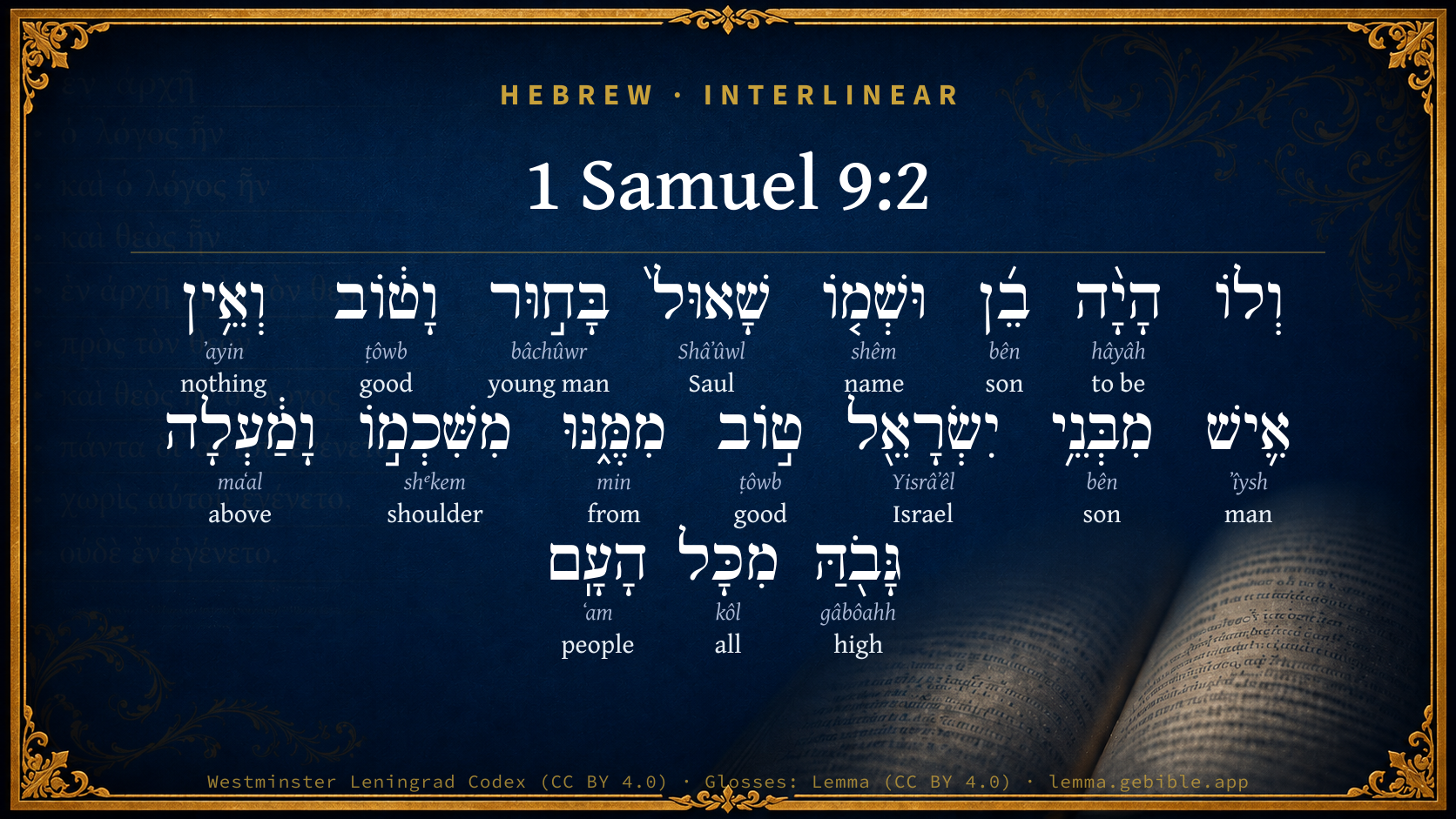
  1. הָיָ֨ה hâyâh H1961 “to be” Verb, Qal, Perfect, 3rd Person, Masculine, Singular
  2. בֵ֜ן bên H1121 “son” Noun, Common, Masculine, Singular, Absolute
  3. וּשְׁמ֤וֹ shêm H8034 “and · name · his” Conjunction + Noun, Common, Masculine, Singular, Construct + Suffix, Personal, 3rd Person, Masculine, Singular
  4. שָׁאוּל֙ Shâʼûwl H7586 “Saul” Noun, Proper
  5. בָּח֣וּר bâchûwr H970 “young man” Noun, Common, Masculine, Singular, Absolute
  6. וָט֔וֹב ṭôwb H2896 “and · good” Conjunction + Adjective, Adjective, Masculine, Singular, Absolute
  7. וְאֵ֥ין ʼayin H369 “and · nothing” Conjunction + Particle, Negative
  8. אִ֛ישׁ ʼîysh H376 “man” Noun, Common, Masculine, Singular, Absolute
  9. מִבְּנֵ֥י bên H1121 “from · sons of” Preposition + Noun, Common, Masculine, Plural, Construct
  10. יִשְׂרָאֵ֖ל Yisrâʼêl H3478 “Israel” Noun, Proper
  11. ט֣וֹב ṭôwb H2896 “good” Adjective, Adjective, Masculine, Singular, Absolute
  12. מִמֶּ֑נּוּ min H4480 “from · us” Preposition + Suffix, Personal, 1st Person, Common, Plural
  13. וָמַ֔עְלָה maʻal H4605 “and · above · toward” Conjunction + Adverb + Suffix, Demonstrative
  14. גָּבֹ֖הַּ gâbôahh H1364 “high” Adjective, Adjective, Masculine, Singular, Absolute
  15. מִכָּל kôl H3605 “from · all of” Preposition + Noun, Common, Masculine, Singular, Construct
  16. הָעָֽם ʻam H5971 “the · people” Particle, Definite Article + Noun, Common, Masculine, Singular, Absolute

About this verse

These counts appear in no published source. They are computed here, from the morphology-tagged text and Lemma’s own curated glosses. What Lemma adds →

18
words
15
distinct lemmas
Historical
section

Notable vocabulary

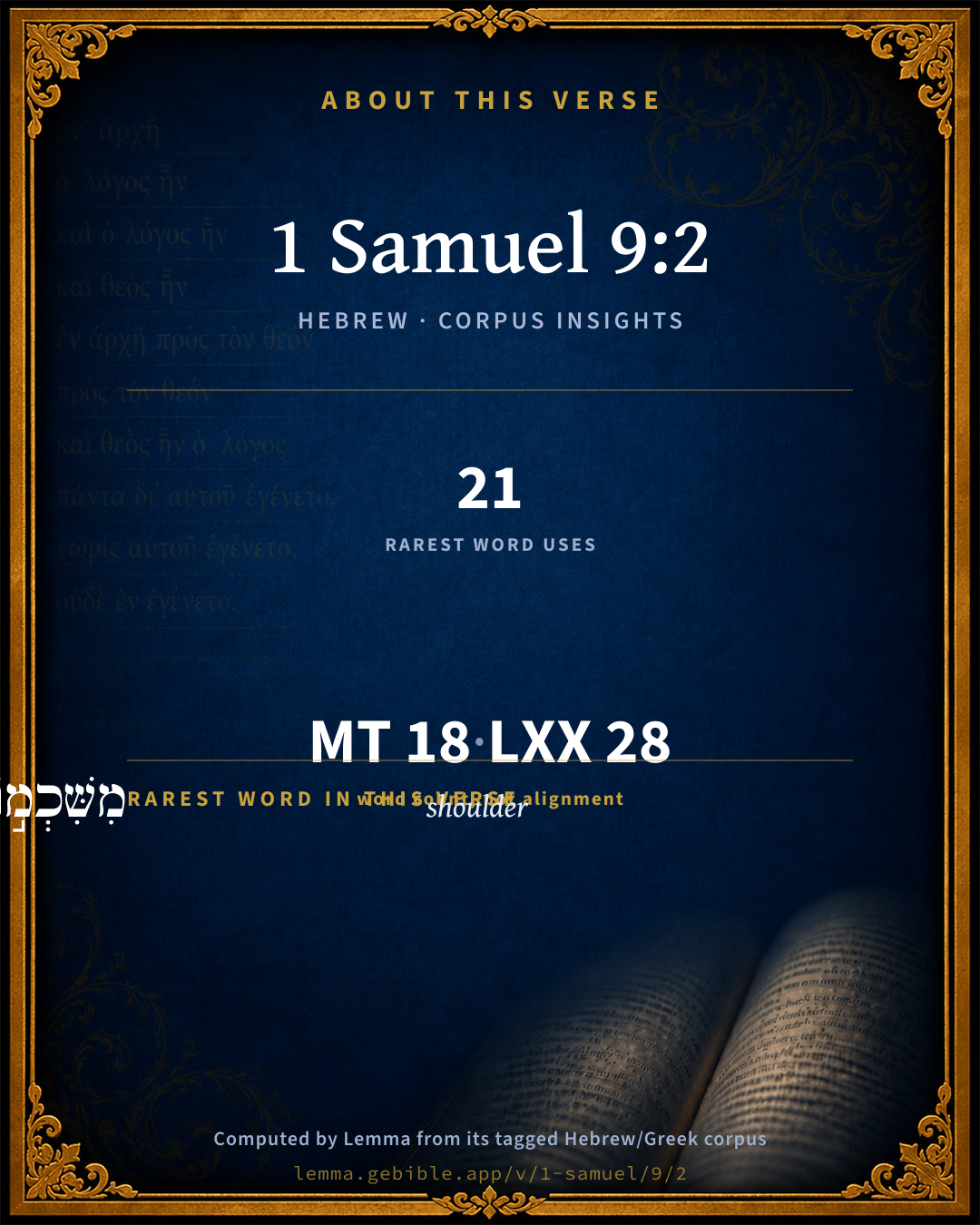
The rarest word here is מִשִּׁכְמ֣וֹ shoulder H7926 — appearing just 21 times in the whole Hebrew Bible.

Shared distinctive vocabulary

מִשִּׁכְמ֣וֹ shoulder H7926 occurs in 21 verses of the Hebrew Bible. Also found in:

Grammatical profile

  • 1 verb
  • 10 nouns
  • 3 adjectives
  • 2 prepositions
  • 1 adverb
  • 1 particle

Verb forms

  • הָיָ֨ה Qal · Perfect

Repetition

Words recur within this verse — often emphatic in Hebrew:

  • בֵ֜ן son H1121 ×2
  • וָט֔וֹב good H2896 ×2

Hebrew & Septuagint length

In English translation the verse runs 39 words from the Hebrew and 40 from the Septuagint (LXX English) — closely comparable.

A rough comparison of the two English renderings, which tokenize alike — not a word-level alignment.

Word counts can differ between the Hebrew and the Greek without any difference in meaning — e.g. the Hebrew direct-object marker אֵת has no separate Greek word, and Greek often adds the article ὁ.

In the original languages it is 18 Hebrew tokens and 28 Greek tokens — but the two are counted differently (Hebrew bundles its prefixes and suffixes into one token; the Greek is in lemma form), so that isn’t a like-for-like length.

Cross-references

7

Topical passages linked to 1 Samuel 9:2 in the Treasury of Scripture Knowledge — connected by theme and wording, ordered by reader-vote popularity; previews shown in the World English Bible.

  • Genesis 6:2 that God's sons saw that men's daughters were beautiful, and they took for themselves wives of all that they chose.
  • Numbers 13:33 There we saw the Nephilim, the sons of Anak, who come of the Nephilim: and we were in our own sight as grasshoppers, and so we were in their sight.
  • 1 Samuel 16:7 But Yahweh said to Samuel, "Don't look on his face, or on the height of his stature; because I have rejected him: for [Yahweh sees] not as man sees; for man looks at the outward appearance, but Yahweh looks at the heart."
  • 2 Samuel 14:25–26 Now in all Israel there was none to be so much praised as Absalom for his beauty: from the sole of his foot even to the crown of his head there was no blemish in him.
  • 1 Samuel 17:4 There went out a champion out of the camp of the Philistines, named Goliath, of Gath, whose height was six cubits and a span.
  • Jeremiah 9:23 Thus says Yahweh, Don't let the wise man glory in his wisdom, neither let the mighty man glory in his might, don't let the rich man glory in his riches;
  • 1 Samuel 10:23–24 They ran and fetched him there; and when he stood among the people, he was higher than any of the people from his shoulders and upward.

Cross-references courtesy of OpenBible.info (CC BY 4.0).

Hebrew and Greek witnesses Masoretic Hebrew ↔ Greek Septuagint

The same verse in the two great witnesses to the Old Testament, shown verse-for-verse.

These are two independent witnesses, not word-aligned to each other, and the Septuagint is shown in lemma (dictionary) form.

Hebrew 1 Samuel 9:2 Masoretic · Westminster Leningrad Codex

וְלוֹ הָיָ֨ה בֵ֜ן וּשְׁמ֤וֹ שָׁאוּל֙ בָּח֣וּר וָט֔וֹב וְאֵ֥ין אִ֛ישׁ מִבְּנֵ֥י יִשְׂרָאֵ֖ל ט֣וֹב מִמֶּ֑נּוּ מִשִּׁכְמ֣וֹ וָמַ֔עְלָה גָּבֹ֖הַּ מִכָּל הָעָֽם

He had a son, whose name was Saul, an impressive young man; and there was not among the children of Israel a better person than he. From his shoulders and upward he was higher than any of the people.

World English Bible · Public Domain

Greek LXX 1 Samuel 9:2 Septuagint · lemma form

καί οὗτος υἱός καί ὄνομα αὐτός σαούλ εὐμεγέθης ἀνήρ ἀγαθός καί οὐ εἰμί ἐν υἱός ἰσραήλ ἀγαθός ὑπέρ αὐτός ὑπέρ ὠμία καί ἐπάνω ὑψηλός ὑπέρ πᾶς ὁ γῆ

And this man had a son, and his name was Saul, of great stature, a goodly man; and there was not among the sons of Israel a goodlier than he, high above all the people from his shoulders and upward.

LXX2012 (modern English Septuagint) · Public Domain

On this verse, The Pulpit Commentary discusses the Septuagint’s reading. Read the note in Commentary ↓

Hebrew: Westminster Leningrad Codex (CC BY 4.0). Greek: Septuagint (public domain); English from LXX2012 (modern English Septuagint) (Public Domain). How the Septuagint differs from the Hebrew →

Targum (Aramaic paraphrase)

1

The Targum is the ancient Jewish Aramaic paraphrase of the Hebrew Scriptures — an interpretive translation, not the Hebrew text itself. Onkelos (literal) and Pseudo-Jonathan (expansive) render the Torah, and Jonathan the Prophets. Coverage is partial: where no permissively-licensed English translation exists for a verse, only the Aramaic is shown. This is verse-level text, not a word-by-word alignment to the Hebrew.

  1. Targum Jonathan Prophets (Joshua–Malachi)
    וְלֵיהּ הֲוָה בַּר וּשְׁמֵיהּ שָׁאוּל עוּלֵים וְשַׁפִּיר וְלֵית גַבְרָא מִבְּנֵי יִשְׂרָאֵל שַׁפִּיר מִנֵיהּ מִכַּתְפֵיהּ וּלְעֵלָא רָם מִכָּל עַמָא:

    (no public-domain English translation for this verse)

    Targum Jonathan — Aramaic: “Mikraot Gedolot” (public domain). English: “Sefaria Community Translation” (CC0 1.0 (public-domain dedication)); “London "Chaldee Paraphrase," 1871” (public domain). Text via Sefaria.

Commentary

Notes on 1 Samuel 9:2 from classic Christian and Jewish commentators (each source and its license shown beneath its notes). The classic Christian expositions comment on the surrounding passage and are grouped to its opening verse, so a note may address several verses; the Jewish commentaries on the Tanakh (Rashi and others) are per-verse, so they appear only where the commentator wrote on this verse.

Lemma curates 59 commentaries, every one of them public domain or Creative Commons licensed, each selected and text-cleaned for this edition rather than reprinted as found. About our sources →

Trapp's Complete Commentary

John Trapp

1Sa 9:2 And he had a son, whose name [was] Saul, a choice young man, and a goodly: and [there was] not among the children of Israel a goodlier person than he: from his shoulders and upward [he was] higher than any of the people.

Ver. 2. And he had a son, whose name was Saul.] Which signifieth desired or sought after: Nomen, Omen.

A choice young man, and a goodly.] Heb., Good. That is of a good nature and disposition, saith Lyra. So perhaps he was at first: as was also Nero for the first five years of his reign, so that Seneca sets him forth for a singular example of clemency. Saul proved to be the reigning hypocrite, by whom "the people were ensnared." {Job 34:30} It is threatened as a heavy curse, "If you still trespass against me, I will set princes over you that shall hate you." {Lev 26:17}

There was none … a goodlier person than he.] This won him much respect with the vulgar, that he was Os humerosque Deo similis, proper and comely, looking like a prince, {a} as the tragedian noteth of Priamus: for want of which, Agesilaus, that gallant man, was much slighted by the Persians. The French had a Philip the Fair: and Artaxerxes Longimanus was omnium hominum pulcherrimus, saith Emilius Probus, the comliest man alive.

{a} αξιον ειδος τυραννιδος - Eurip.

John Trapp, A Commentary or Exposition upon All the Books of the Old and New Testament (1647–1656) — public domain. Text from a community e-Sword module.

Tyndale Open Study Notes

Tyndale Open Resources

9:2 Saul’s mere appearance—most handsome . . . taller than anyone else—inspired loyalty among the people (see 10:23; cp. 16:12; 2 Sam 14:25-26).

Tyndale Open Study Notes — © Tyndale Open Resources, licensed CC BY-SA 4.0. Text via the HelloAO Bible API.

Geneva Bible (1599)

Geneva Bible translators

So that it might seem that God approved their request in appointing out such a person.

Geneva Bible (1599) marginal notes — public domain. Text via Bolls.life.

Jamieson, Fausset & Brown

Robert Jamieson, A. R. Fausset & David Brown

Saul, a choice young man, and a goodly--He had a fine appearance; for it is evident that he must have been only a little under seven feet tall. A gigantic stature and an athletic frame must have been a popular recommendation at that time in that country.

Jamieson, Fausset & Brown — Commentary Critical and Explanatory on the Whole Bible (1871) — public domain (CC PDM 1.0). Text via the HelloAO Bible API.

Adam Clarke's Commentary

Verse 2. From his shoulders and upwards] It was probably from this very circumstance that he was chosen for king; for, where kings were elective, in all ancient times great respect was paid to personal appearance.

Adam Clarke's Commentary on the Bible (1810–1826) — public domain. Text from a community e-Sword/MySword module.

Ellicott's Commentary for English Readers

(2) A choice young man, and a goodly.—The Hebrew word which is rendered in English by “a choice young man” cannot signify both these epithets. The translators were probably influenced by the Vulg. (Latin) Version, which translates the Hebrew word by electus, “chosen, or choice,” the more common signification of the Hebrew word being avoided, owing to the fact that at this time Saul appears to have had a son (Jonathan) who must have well-nigh reached his maturity. But the term young was not inappropriate to Saul, who was still in the full vigour of manhood as contrasted with the old age of Samuel, being about forty to forty-five years old. Translate then simply, “a young man,” &c. In the childhood of nations heroic proportions were highly valued, and the gigantic stature and the remarkable beauty of the king, no doubt contributed to the ready acceptance on the part of the still semi-barbarous Israel of the young man Saul. (Comp. Herodotus, 3:20, 7:187; Aristotle, Polit., 4:29; and Virgil’s description of Turnus, Æneid, 7:650, 783; and Homer’s words about Ajax, Iliad, iii. 226.)

The asses.—Literally, And the she-asses. At this period of Jewish history asses were much used by the people. The horse was forbidden by the Law. Asses were used not only for purposes of agriculture, but also for riding; so in the song of Deborah we find, “Speak, ye that ride on white asses” (Jdg_5:10); and again we read of the thirty sons of Jair, the Gileadite judge, each one ruler of a city, who rode on thirty ass colts (Jdg_10:4). These belonging to the farm of Kish, being probably kept for breeding purposes, were untethered, and so strayed from the immediate neighbourhood, and were lost.

The whole of this chapter and part of the following is full of picturesque details of the pastoral life of the people. In many of the little pictures we see how strongly at this early period the religion of the Eternal coloured almost all parts of the every-day life of Israel.

One of the servants.—The “servant,” not “slave;” the Hebrew word for the latter would be different. The servant was evidently a trusty dependant of the house of Saul’s father, and was on familiar terms with his young master. We hear of his giving wise advice in the course of the search (1Sa_9:6); he was the one in charge of the money (1Sa_9:8); and this servant, we are especially told, was treated by Samuel the judge as an honoured guest at the sacrificial feast at Ramah. He was traditionally believed to have been Doeg the Edomite, afterwards so famous as one of the most ruthless of the great captains of King Saul. (See 1Sa_22:18.)

A Bible Commentary for English Readers, edited by Charles John Ellicott (1878–1897) — public domain. Text from a community e-Sword module.

The Cambridge Bible for Schools and Colleges

gen. ed. J. J. S. Perowne

2. whose name was Saul] Heb. Shâûl = “asked.” It occurs as the name (a) of an Edomite prince (Gen_36:37-38); (b) of a son of Simeon (Gen_46:10); (c) of a Kohathite in the genealogy of Samuel (1Ch_6:24); (d) of Saul of Tarsus, “who is also called Paul” (Act_7:58, &c.); and thus it became “the most distinguished name in the genealogies of the tribe of Benjamin,” in the N.T. as well as in the O.T. (Php_3:5).

a choice young man, and a goodly] Choice and goodly. Cp. 1Sa_10:24. Physical qualifications of stature, strength and beauty are a natural commendation for the dignity of a king, especially in warlike ages. Euripides speaks of εῖδος ἄξιον τυραννίδος, ‘form worthy to rule.’

Ajax appears in Homer (Il. III. 227) as

“Towering o’er all with head and shoulders broads;”

and Turnus, in Virgil (Aen. VII. 784),

“Out-tops the foremost chieftains by a head.”

The Cambridge Bible for Schools and Colleges (gen. ed. J. J. S. Perowne; Cambridge University Press, 1878–1918) — public domain. Text from a community e-Sword module.

John Gill's Exposition

And he had a son whose name was Saul,.... Of this name was the great apostle of the Gentiles before his conversion, and was of the same tribe also; but very different in stature; he was a little man, this a large tall man, like his father perhaps:

a choice young man, and a goodly; Sa1 2:1 of a goodly aspect, a comely man, tall and well shaped, in the prime of his age, a very agreeable person, one among a thousand:

and there was not among the children of Israel a goodlier person than he; meaning not for the endowments of his mind, or his moral character and behaviour. There might be as good, or better men than he, on such accounts, but for his outward appearance, his bodily shape, and the dignity of his person:

from his shoulders and upwards he was higher than any of the people; this description of him is enlarged upon and explained, to show that he was just such a person the people were desirous of having king over them, such an one as the nations about them had; and it was usual with the eastern people, and so with the Greeks and Romans, to choose persons to the highest offices of magistracy that made a personable appearance superior to others, and is what they often take notice of, as a recommendation of them as princes. Herodotus (l) reports of the Ethiopians, that they judged the largest of the people, and him who had strength according to his size, most worthy to be king. And the same writer observes (m), that among the many thousands of men of the army of Xerxes, there was not one who for comeliness and largeness was so worthy of the empire as Xerxes himself; so Ulysses, because of his height, was the more acceptable to the people of Corfu (n); so Alexander's captains, it is said (o), might be thought to be kings for their beautiful form, height of body, and greatness of strength and wisdom. Julius Caesar is said to be of high stature; and so Domitian (p); Virgil (q) represents Turnus as in body more excellent than others, and by the entire head above them; and Anchises as walking statelier and higher than the rest (r); among the many encomiums Pliny (s) gives of Trajan, as to his outward form and appearance, this is one, "proceritas corporis", height of body, being higher than others; the Gentiles had a notion that such men came nearer to the deities, and looked more like them; so Diana is described as taller than any of the nymphs and goddesses (t). Solomon, according to Josephus (u), chose such young men to ride horses, and attend his person, when he himself rode, who were conspicuous for their height, and greatly above others.

(l) Thalia, sive, l. 3. c. 20. (m) Polymnia, sive, l. 7. c. 187. (n) Homer. Odyss. 8. ver. 20, 21. (o) Justin. e Trogo, l. 13. c. 1. (p) Sueton. Vit. Caesar. c. 45. Domitian. c. 18. (q) Aeneid. l. 7. ver. 783, 784. & 9. ver. 29. (r) Ib. l. 8. ver. 162. (s) Panegyr. c. 4, 22. (t) "Tamen altior illis ipsa dea est". Ovid. Metam. l. 3. fab. 2. ver. 180, 181. (u) Antiqu. l. 8. c. 7. sect. 3.

John Gill's Exposition of the Whole Bible (1746–1763) — public domain (CC PDM 1.0). Text via the HelloAO Bible API.

Haydock's Catholic Bible Commentary

Goodlier, better proportioned, more handsome, (Haydock) as the daughters of men are styled good, or fair, Genesis vi. 1. People seek for corporal advantages in those who command. The poets always represent their deities and heroes as taller than the rest of men. A king of Sparta was fined for marrying a little woman. (Aristotle, Polit. iv.) The Ethiopians give their highest offices to those who have the most engaging appearance. (Herodotus iii. 20.) (Calmet) --- Little people may be elegant, but never majestic or perfectly beautiful. (Aristotle, Ethic. iv. 3.) (Menochius) --- Choice, is taken in the same sense as goodly, and does not intimate that Saul was one of the elect. (Denis the Carthusian)

George Leo Haydock (1774–1849), Haydock's Catholic Family Bible and Commentary, 1859 edition — public domain. Excludes Psalms (Douay-Rheims chapter numbering differs from Protestant) and Deuterocanonical books (Catholic canon only).

Matthew Poole's English Annotations

And a goodly, Heb. good, i.e. comely and personable, as that word is used, Gen 6:2; as evil is put for deformed, Gen 41:19.

He was higher than any of the people: a tall stature was much valued in a king in ancient times, and in the eastern countries.

Matthew Poole's English Annotations on the Holy Bible (1683–1685) — public domain. Text from a community e-Sword/MySword module.

Whedon's Commentary on the Bible

Daniel D. Whedon

2. A choice young man, and a goodly — In the vigour and prime of early manhood, and of a beautiful countenance.

Higher than any of the people — Great respect was paid by the ancients to a noble presence. Herodotus (iii, 20) says of the Ethiopians: “They confer the sovereignty upon the man whom they consider to be of the largest stature, and to possess strength proportionable to his size.”

Daniel D. Whedon (gen. ed.), Commentary on the Old and New Testaments (1874–1909) — public domain. Text from a community e-Sword module.

The Pulpit Commentary

He had a son, whose name was Saul. Ie. asked, a name usually given to a firstborn son. A choice young man. This is a double translation of the Hebrew word, and consequently one half or other must be wrong. It may either be a participle, elect or choice, and is so rendered by the Syriac and Vulgate; or an adjective, young, the rendering of the Chaldee, and virtually of the Septuagint, which gives well grown. This is the preferable translation; for the word constantly occurs coupled with virgin (Deu_32:25; Isa_62:5, etc.) for one in the full flower of manhood. Saul could not, therefore, have been the runner of 1Sa_5:12, though, as we read that Jonathan his son was a grown man two or three years afterwards, (1Sa_13:2) he must have been at least thirty-five years of age, after making allowance for the early period at which the Jews married. His noble appearance and gigantic stature were well fitted to impress and overawe a semi-barbarous people, who were better able to form an estimate of his physical qualities than of the high mental and moral gifts possessed by Samuel.

The Pulpit Commentary (1880–1919), ed. H.D.M. Spence-Jones & Joseph S. Exell — public domain. Text from a community e-Sword module.

John Wesley's Explanatory Notes

Goodly - Comely and personable. Higher - A tall stature was much valued in a king in ancient times, and in the eastern countries.

John Wesley, Explanatory Notes Upon the Whole Bible (1754–1765) — public domain. Text via the GEBible commentary corpus.

Lesson kit

Teaching starters — assembled from the data on this page, not authored interpretation. Every prompt links to the verse data it draws on. Edit before teaching.

1 Samuel, in the Historical, opens this verse with 18 words (15 distinct Hebrew lemmas). Its most distinctive word is shᵉkem (“shoulder”). A historical commentator’s framing appears above. Read the whole chapter for the surrounding context.

Discussion questions

  1. How does “shoulder” (shᵉkem) shape what this verse is saying?
  2. How does Genesis 9:23, which shares the word «shoulder», read alongside this verse?
  3. What does the repetition of “son” (2× in this one verse) do in this verse?
  4. These translations render this verse differently. What is at stake in choosing one wording over another?
  5. «הָיָ֨ה» is a Qal Perfect verb. How does that grammatical form shape the action described?
  6. Compare how Trapp's Complete Commentary and Tyndale Open Study Notes read this verse. Where do they agree or differ?

Things to notice

Reading settings

Reading text

Shown beneath each verse's original-language words.

Old Testament
Old Testament edition

Read the OT as the Masoretic Hebrew (MT) or the Greek Septuagint (LXX).

English shown for the Greek Septuagint (in the Hebrew ↔ Greek comparison).

Comparing translations? Open the Compare panel on any verse page to stack up to four side by side.