Genesis 47:13

Hebrew (Westminster Leningrad Codex) Genesis 47:13 appears in the Hebrew Old Testament. The text above is from the Westminster Leningrad Codex. Each word links to its Strong’s number, a concise gloss, and parsing drawn from the Open Scriptures Hebrew Bible morphology. Click any word for its full Brown-Driver-Briggs (BDB) entry.
Download image
Cite this verse

Genesis 47:13 (World English Bible). Public Domain. Lemma interlinear Bible study tool, https://lemma.gebible.app/v/genesis/47/13.

Show BibTeX & RIS
BibTeX
RIS
English Translation
There was no bread in all the land; for the famine was very severe, so that the land of Egypt and the land of Canaan fainted by reason of the famine.
World English Bible · Public Domain
Highlights
  • 1 first appearance in the Hebrew Bible
Full analysis ↓
Download a study sheet

One document with this verse’s original text, its word-by-word gloss line, the meaning frame, cross-references with their text, attributed commentary, and full source and license credits — printable, and it pastes into notes with its structure intact.

This verse Autodidact and up

Study sheet (.html) Plain text (.txt)

A passage Seminary Student

Up to 50 verses in one chapter. A passage sheet keeps up to 6 commentary sources and 12 cross-references per verse, in the order this page ranks them, and says so on the sheet whenever that leaves anything out. Ask for a single verse and you get the Autodidact verse sheet above.

Everything on this page stays free to read, with no account — the sheet is a download of what is already on screen, not access to it.

Want to remove ads? Support Godless Engineer
Compare translations 3

The same verse in 3 English versions, stacked beneath the original-language interlinear above. Click any original word for its lexicon entry.

Each is an independent rendering of the whole verse — the interlinear is not word-aligned to these translations.

Highlighted words mark where these versions differ — a whole-verse word diff, not a word-by-word alignment.

  • World English Bible Public Domain
    There was no bread in all the land; for the famine was very severe, so that the land of Egypt and the land of Canaan fainted by reason of the famine.
  • King James Version Public Domain
    And there was no bread in all the land; for the famine was very sore, so that the land of Egypt and all the land of Canaan fainted by reason of the famine.
  • unfoldingWord Literal Text CC BY-SA 4.0
    Now there was no bread in all the earth, because the famine very heavy, and the land of Egypt and the land of Canaan were languishing because of the famine.

unfoldingWord Literal Text — © unfoldingWord, licensed CC BY-SA 4.0. Word-aligned USFM3 via Door43 (git.door43.org/unfoldingWord/en_ult).

Versions to compare (up to 4)

3 of 4 selected

Show all 18 translations

Every available English version of this verse, each an independent rendering of the whole verse.

  • World English Bible Public Domain
    There was no bread in all the land; for the famine was very severe, so that the land of Egypt and the land of Canaan fainted by reason of the famine.
  • Berean Standard Bible Public Domain
    There was no food, however, in all that region, because the famine was so severe; the lands of Egypt and Canaan had been exhausted by the famine.
  • Majority Standard Bible Public Domain
    There was no food, however, in all that region, because the famine was so severe; the lands of Egypt and Canaan had been exhausted by the famine.
  • King James Version Public Domain
    And there was no bread in all the land; for the famine was very sore, so that the land of Egypt and all the land of Canaan fainted by reason of the famine.
  • American Standard Version (1901) Public Domain
    And there was no bread in all the land; for the famine was very sore, so that the land of Egypt and the land of Canaan fainted by reason of the famine.
  • Revised Version (1885) Public Domain
    And there was no bread in all the land; for the famine was very sore, so that the land of Egypt and the land of Canaan fainted by reason of the famine.
  • Geneva Bible (1599) Public Domain
    Now there was no bread in all the land: for the famine was exceeding sore: so that the land of Egypt, and the land of Canaan were famished by reason of the famine.
  • Douay-Rheims (1899) Public Domain
    For in the whole world there was want of bread, and a famine had op- pressed the land: more especially of Egypt and Chanaan.
  • Young's Literal Translation Public Domain
    And there is no bread in all the land, for the famine `is' very grievous, and the land of Egypt and the land of Canaan are feeble because of the famine;
  • Literal Standard Version CC BY-SA 4.0
    And there is no bread in all the land, for the famine [is] very grievous, and the land of Egypt and the land of Canaan are feeble because of the famine;
  • Unlocked Literal Bible CC BY-SA 4.0
    Now there was no food in all the land; for the famine was severe. The land of Egypt and the land of Canaan wasted away because of the famine.
  • unfoldingWord Literal Text CC BY-SA 4.0
    Now there was no bread in all the earth, because the famine very heavy, and the land of Egypt and the land of Canaan were languishing because of the famine.
  • Darby Bible Public Domain
    And there was no bread in all the land; for the famine was very grievous; and the land of Egypt and the land of Canaan were exhausted through the famine.
  • World Messianic Bible Public Domain
    There was no bread in all the land; for the famine was very severe, so that the land of Egypt and the land of Canaan fainted by reason of the famine.
  • Webster's Bible Public Domain
    And there was no bread in all the land; for the famine was very distressing, so that the land of Egypt, and all the land of Canaan, fainted by reason of the famine.
  • Free Bible Version CC BY-SA 4.0
    No food was left in the whole country because the famine had become so bad. Throughout Egypt and Canaan people were starving.
  • Bible in Basic English Public Domain
    Now there was no food to be had in all the land, so that all Egypt and Canaan were wasted from need of food.
  • JPS Tanakh (1917) Public Domain
    And there was no bread in all the land; for the famine was very sore, so that the land of Egypt and the land of Canaan languished by reason of the famine.

Literal Standard Version (2020), Covenant Press — licensed CC BY-SA 4.0. Text via the HelloAO Bible API (eBible.org). Unlocked Literal Bible (unfoldingWord) — licensed CC BY-SA 4.0. Text via the HelloAO Bible API (eBible.org). unfoldingWord Literal Text — © unfoldingWord, licensed CC BY-SA 4.0. Word-aligned USFM3 via Door43 (git.door43.org/unfoldingWord/en_ult). Free Bible Version, Dr. Jonathan Gallagher — licensed CC BY-SA 4.0. Text via the HelloAO Bible API (eBible.org).

Word by word

More ways to search: Search by grammar → Find every occurrence → Compare this word →

Practice this passage: Drill this verse → Learn its vocabulary →

וַתֵּ֜לַהּ
lâhahh
H3856
“and · to languish”
Conjunction + Verb, Qal, Sequential Imperfect, 3rd Person, Feminine, Singular
Part of Speech
Conjunction + Verb
Stem
Qal
Form
Sequential Imperfect
Person
3rd Person
Gender
Feminine
Number
Singular
Full BDB Definition

Origin: a primitive root

TWOT: 1079

(Qal) to languish, faint - to amaze, startle - (Hithpalpel) madman (substantive)
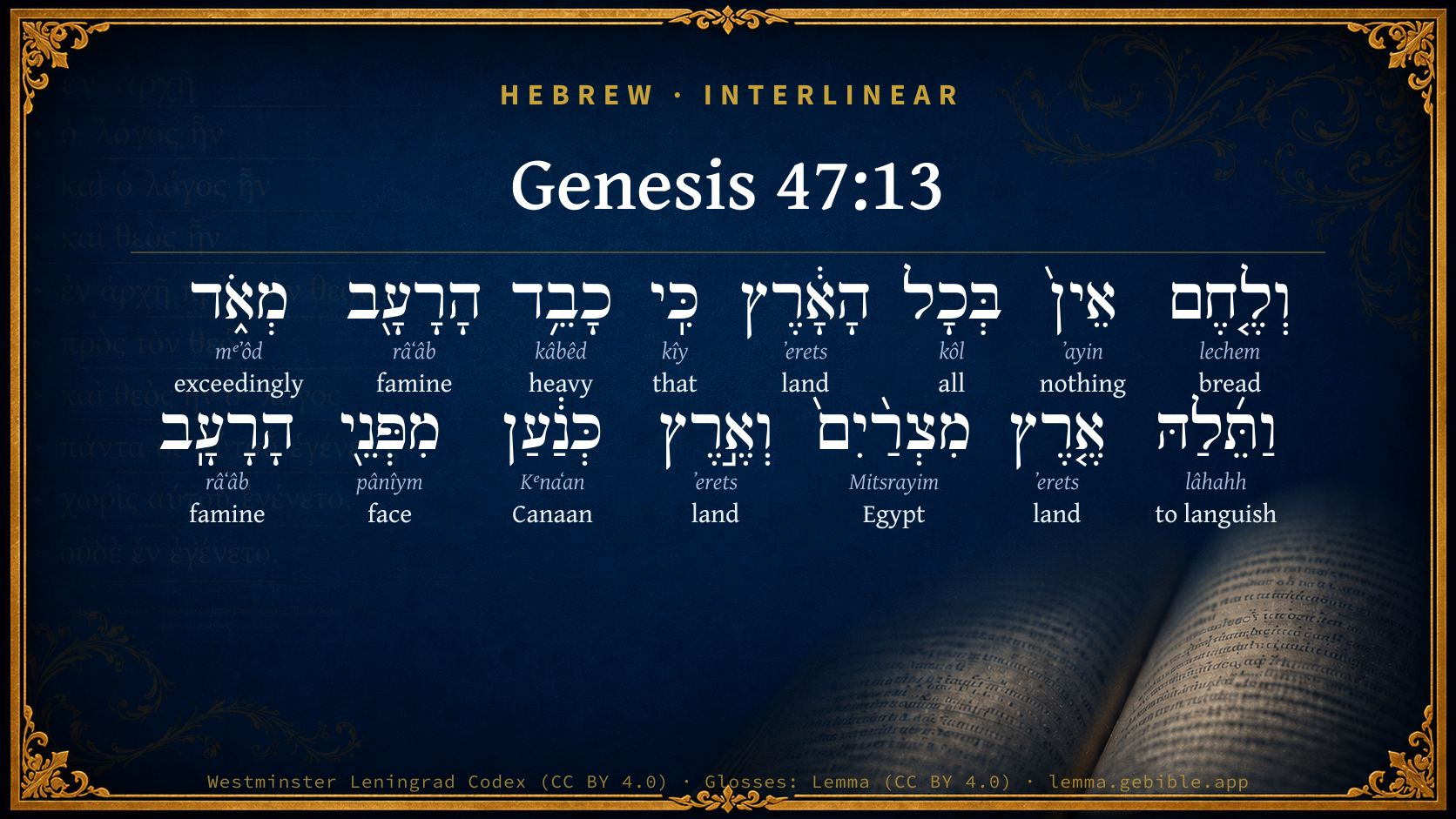
  1. וְלֶ֤חֶם lechem H3899 “and · bread” Conjunction + Noun, Common, Both, Singular, Absolute
  2. אֵין֙ ʼayin H369 “nothing” Particle, Negative
  3. בְּכָל kôl H3605 “in/at · all of” Preposition + Noun, Common, Masculine, Singular, Construct
  4. הָאָ֔רֶץ ʼerets H776 “the · land” Particle, Definite Article + Noun, Common, Both, Singular, Absolute
  5. כִּֽי kîy H3588 “that” Conjunction
  6. כָבֵ֥ד kâbêd H3515 “heavy” Adjective, Adjective, Masculine, Singular, Absolute
  7. הָרָעָ֖ב râʻâb H7458 “the · famine” Particle, Definite Article + Noun, Common, Masculine, Singular, Absolute
  8. מְאֹ֑ד mᵉʼôd H3966 “exceedingly” Adverb
  9. אֶ֤רֶץ ʼerets H776 “land of” Noun, Common, Both, Singular, Construct
  10. מִצְרַ֨יִם֙ Mitsrayim H4714 “Egypt” Noun, Proper
  11. וְאֶ֣רֶץ ʼerets H776 “and · land of” Conjunction + Noun, Common, Both, Singular, Construct
  12. כְּנַ֔עַן Kᵉnaʻan H3667 “Canaan” Noun, Proper
  13. מִפְּנֵ֖י pânîym H6440 “from · face(s) of” Preposition + Noun, Common, Both, Plural, Construct
  14. הָרָעָֽב râʻâb H7458 “the · famine” Particle, Definite Article + Noun, Common, Masculine, Singular, Absolute

About this verse

These counts appear in no published source. They are computed here, from the morphology-tagged text and Lemma’s own curated glosses. What Lemma adds →

15
words
12
distinct lemmas
Pentateuch
section

Notable vocabulary

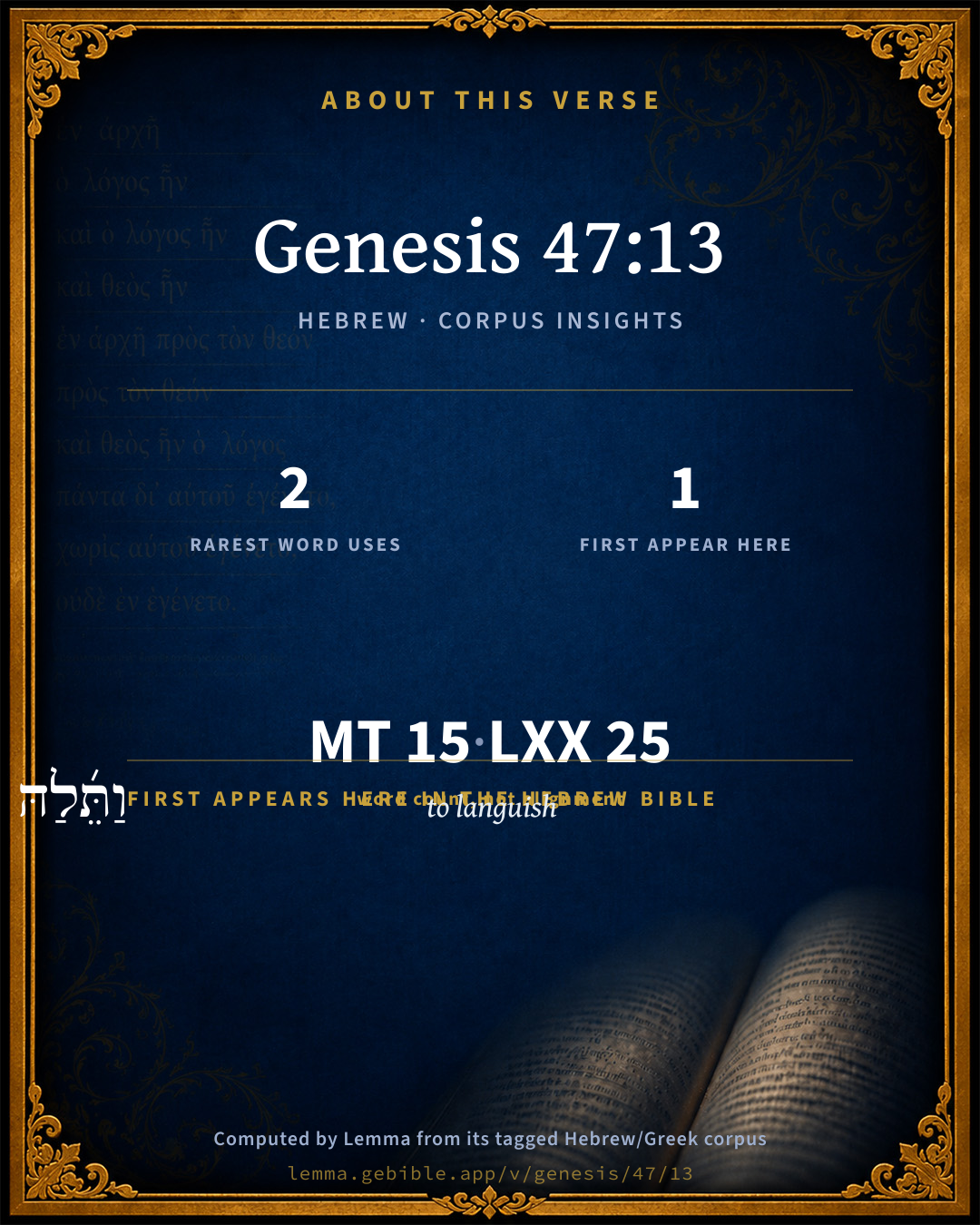
The rarest word here is וַתֵּ֜לַהּ to languish H3856 — appearing just 2 times in the whole Hebrew Bible.

First appearance in Scripture

This word makes its first canonical appearance in the Hebrew Bible here:

  • וַתֵּ֜לַהּ to languish H3856

Shared distinctive vocabulary

וַתֵּ֜לַהּ to languish H3856 occurs in 2 verses of the Hebrew Bible. Also found in:

Grammatical profile

  • 1 verb
  • 10 nouns
  • 1 adjective
  • 1 conjunction
  • 1 adverb
  • 1 particle

Verb forms

  • וַתֵּ֜לַהּ Qal · Sequential Imperfect

Repetition

Words recur within this verse — often emphatic in Hebrew:

  • הָאָ֔רֶץ land H776 ×3
  • הָרָעָ֖ב famine H7458 ×2

Hebrew & Septuagint length

In English translation the verse runs 31 words from the Hebrew and 28 from the Septuagint (LXX English) — closely comparable.

A rough comparison of the two English renderings, which tokenize alike — not a word-level alignment.

Word counts can differ between the Hebrew and the Greek without any difference in meaning — e.g. the Hebrew direct-object marker אֵת has no separate Greek word, and Greek often adds the article ὁ.

In the original languages it is 15 Hebrew tokens and 25 Greek tokens — but the two are counted differently (Hebrew bundles its prefixes and suffixes into one token; the Greek is in lemma form), so that isn’t a like-for-like length.

Cross-references

8

Topical passages linked to Genesis 47:13 in the Treasury of Scripture Knowledge — connected by theme and wording, ordered by reader-vote popularity; previews shown in the World English Bible.

  • Acts 7:11 Now a famine came over all the land of Egypt and Canaan, and great affliction. Our fathers found no food.
  • Genesis 41:30–31 There will arise after them seven years of famine, and all the plenty will be forgotten in the land of Egypt. The famine will consume the land,
  • 1 Kings 18:5 Ahab said to Obadiah, Go through the land, to all the springs of water, and to all the brooks: peradventure we may find grass and save the horses and mules alive, that we not lose all the animals.
  • Jeremiah 9:12 Who is the wise man, that may understand this? and [who is] he to whom the mouth of Yahweh has spoken, that he may declare it? why is the land perished and burned up like a wilderness, so that none passes through?
  • Jeremiah 14:1–6 The word of Yahweh that came to Jeremiah concerning the drought.
  • Lamentations 2:19–20 Arise, cry out in the night, at the beginning of the watches; Pour out your heart like water before the face of the Lord: Lift up your hands toward him for the life of your young children, that faint for hunger at the head of every street.
  • Lamentations 4:9 Those who are killed with the sword are better than those who are killed with hunger; For these pine away, stricken through, for want of the fruits of the field.
  • Joel 1:10–12 The field is laid waste. The land mourns, for the grain is destroyed, The new wine has dried up, And the oil languishes.

Cross-references courtesy of OpenBible.info (CC BY 4.0).

Hebrew and Greek witnesses Masoretic Hebrew ↔ Greek Septuagint

The same verse in the two great witnesses to the Old Testament, shown verse-for-verse.

These are two independent witnesses, not word-aligned to each other, and the Septuagint is shown in lemma (dictionary) form.

Hebrew Genesis 47:13 Masoretic · Westminster Leningrad Codex

וְלֶ֤חֶם אֵין֙ בְּכָל הָאָ֔רֶץ כִּֽי כָבֵ֥ד הָרָעָ֖ב מְאֹ֑ד וַתֵּ֜לַהּ אֶ֤רֶץ מִצְרַ֨יִם֙ וְאֶ֣רֶץ כְּנַ֔עַן מִפְּנֵ֖י הָרָעָֽב

There was no bread in all the land; for the famine was very severe, so that the land of Egypt and the land of Canaan fainted by reason of the famine.

World English Bible · Public Domain

Greek LXX Genesis 47:13 Septuagint · lemma form

σῖτος δέ οὐ εἰμί ἐν πᾶς ὁ γῆ ἐνἰσχύω γάρ ὁ λιμός σφόδρα ἐκλείπω δέ ὁ γῆ αἴγυπτος καί ὁ γῆ χανααν ἀπό ὁ λιμός

And there was no corn in all the land, for the famine prevailed greatly; and the land of Egypt, and the land of Chanaan, fainted for the famine.

LXX2012 (modern English Septuagint) · Public Domain

On this verse, The Cambridge Bible for Schools and Colleges discusses the Septuagint’s reading. Read the note in Commentary ↓

Hebrew: Westminster Leningrad Codex (CC BY 4.0). Greek: Septuagint (public domain); English from LXX2012 (modern English Septuagint) (Public Domain). How the Septuagint differs from the Hebrew →

Targum (Aramaic paraphrase)

2

The Targum is the ancient Jewish Aramaic paraphrase of the Hebrew Scriptures — an interpretive translation, not the Hebrew text itself. Onkelos (literal) and Pseudo-Jonathan (expansive) render the Torah, and Jonathan the Prophets. Coverage is partial: where no permissively-licensed English translation exists for a verse, only the Aramaic is shown. This is verse-level text, not a word-by-word alignment to the Hebrew.

  1. Targum Onkelos Torah (Genesis–Deuteronomy)
    וְלַחֲמָא לֵית בְּכָל אַרְעָא אֲרֵי תַקִּיף כַּפְנָא לַחֲדָא וְאִשְׁתַּלְהֵי עַמָּא דְאַרְעָא דְמִצְרַיִם וְעַמָּא דְאַרְעָא דִּכְנַעַן מִן קֳדָם כַּפְנָא

    (no public-domain English translation for this verse)

    Targum Onkelos — Aramaic: “Onkelos Genesis” (public domain); “Onkelos Exodus” (public domain); “Onkelos Leviticus” (public domain); “Onkelos Numbers” (public domain); “Onkelos Deuteronomy” (public domain). English: “Sefaria Community Translation” (CC0 1.0 (public-domain dedication)); “J.W. Etheridge. The Targums of Onkelos and Jonathan Ben Uzziel on the Pentateuch. London: Longmans, Green, 1862” (public domain). Text via Sefaria.

  2. Targum Pseudo-Jonathan Torah (Genesis–Deuteronomy)
    וְלַחְמָא לֵית בְּכָל אַרְעָא אַרוּם תַּקִיף כַּפְנָא לַחֲדָא וְאִשְׁתַּלְהוֹן דַיְירֵי אַרְעָא דְמִצְרַיִם וְדַיְירֵי אַרְעָא דִכְנָעַן מִן קֳדָם כַּפְנָא

    But there was no bread (grown) in all the land, because the famine prevailed greatly, and the inhabitants of the land of Mizraim failed, and the dwellers in the land of Kenaan, in presence of the famine.

    Targum Pseudo-Jonathan — Aramaic: “Targum Jonathan on Genesis” (public domain); “Targum Jonathan on Exodus” (public domain); “Targum Jonathan on Leviticus” (public domain); “Targum Jonathan on Numbers” (public domain); “Targum Jonathan on Deuteronomy” (public domain). English: “The Targum of Jonathan ben Uzziel, trans. J. W. Etheridge, London, 1862” (public domain). Text via Sefaria.

Commentary

Notes on Genesis 47:13 from classic Christian and Jewish commentators (each source and its license shown beneath its notes). The classic Christian expositions comment on the surrounding passage and are grouped to its opening verse, so a note may address several verses; the Jewish commentaries on the Tanakh (Rashi and others) are per-verse, so they appear only where the commentator wrote on this verse.

Lemma curates 59 commentaries, every one of them public domain or Creative Commons licensed, each selected and text-cleaned for this edition rather than reprinted as found. About our sources →

Matthew Henry's Commentary

Care being taken of Jacob and his family, the preservation of which was especially designed by Providence in Joseph's advancement, an account is now given of the saving of the kingdom of Egypt too from ruin; for God is King of nations as well as King of saints, and provideth food for all flesh. Joseph now returns to the management of that great trust which Pharaoh had lodged in his hand. It would have been pleasing enough to him to have gone and lived with his father and brethren in Goshen; but his employment would not permit it. When he had seen his father, and seen him well settled, he applied himself as closely as ever to the execution of his office. Note, Even natural affection must give way to necessary business. Parents and children must be content to be absent one from another, when it is necessary, on either side, for the service of God or their generation. In Joseph's transactions with the Egyptians observe,

I. The great extremity that Egypt, and the parts adjacent, were reduced to by the famine. There was no bread, and they fainted (Gen 47:13), they were ready to die, Gen 47:15, Gen 47:19. 1. See here what a dependence we have upon God's providence. If its usual favours are suspended but for a while, we die, we perish, we all perish. All our wealth would not keep us from starving if the rain of heaven were but withheld for two or three years. See how much we lie at God's mercy, and let us keep ourselves always in his love. 2. See how much we smart by our own improvidence. If all the Egyptians had done for themselves in the seven years of plenty as Joseph did for Pharaoh, they had not been now in these straits; but they regarded not the warning they had of the years of famine, concluding that tomorrow shall be as this day, next year as this, and much more abundant. Note, Because man knows not his time (his time of gathering when he has it) therefore his misery is great upon him when the spending time comes, Ecc 8:6, Ecc 8:7. 3. See how early God put a difference between the Egyptians and the Israelites, as afterwards in the plagues, Exo 8:22; Exo 9:4, Exo 9:26; Exo 10:23. Jacob and his family, though strangers, were plentifully fed on free cost, while the Egyptians were dying for want. See Isa 65:13, My servants shall eat, but you shall be hungry. Happy art thou, O Israel. Whoever wants, God's children shall not, Psa 34:10.

II. The price they had come up to, for their supply, in this exigency. 1. They parted with all their money which they had hoarded up, Gen 47:14. Silver and gold would not feed them, they must have corn. All the money of the kingdom was by this means brought into the exchequer. 2. When the money failed, they parted with all their cattle, those for labour, as the horses and asses, and those for food, as the flocks and the herds, Gen 47:17. By this it should seem that we may better live upon bread without flesh than upon flesh without bread. We may suppose they parted the more easily with their cattle because they had little or no grass for them; and now Pharaoh saw in reality what he had before seen in vision, nothing but lean kine. 3. When they had sold their stocks off their land, it was easy to persuade themselves (rather than starve) to sell their land too; for what good would that do them, when they had neither corn to sow it nor cattle to eat of it? They therefore sold that next, for a further supply of corn. 4. When their land was sold, so that they had nothing to live on, they must of course sell themselves, that they might live purely upon their labour, and hold their lands by the base tenure of villenage, at the courtesy of the crown. Note, Skin for skin, and all that a man hath, even liberty and property (those darling twins), will he give for his life; for life is sweet. There are few (though perhaps there are some) who would even dare to die rather than live in slavery, and dependence on an arbitrary power. And perhaps there are those who, in that case, could die by the sword, in a heat, who yet could not deliberately die by famine, which is much worse, Lam 4:9. Now it was a great mercy to the Egyptians that, in this distress, they could have corn at any rate; if they had all died for hunger, their lands perhaps would have escheated to the crown of course, for want of heirs; they therefore resolved to make the best of bad.

III. The method which Joseph took to accommodate the matter between prince and people, so that the prince might have his just advantage, and yet the people not be quite ruined. 1. For their lands, he needed not come to any bargain with them while the years of famine lasted; but when these were over (for God will not contend for ever, nor will he be always wroth) he came to an agreement, which it seems both sides were pleased with, that the people should occupy and enjoy the lands, as he thought fit to assign them, and should have seed to sow them with out of the king's stores, for their own proper use and behoof, yielding and paying only a fifth part of the yearly profits as a chief rent to the crown. This became a standing law, Gen 47:26. And it was a very good bargain to have food for their lands, when otherwise they and theirs must have starved, and then to have their lands again upon such easy terms. Note, Those ministers of state are worthy of double honour, both for wisdom and integrity, that keep the balance even between prince and people, so that liberty and property may not intrench upon prerogative, nor the prerogative bear hard upon liberty and property: in the multitude of such counsellors there is safety. If afterwards the Egyptians thought it hard to pay so great a duty to the king out of their lands, they must remember, not only how just, but how kind, the first imposing of it was. They might thankfully pay a fifth where all was due. It is observable how faithful Joseph was to him that appointed him. He did not put the money into his own pocket, nor entail the lands upon his own family; but converted both entirely to Pharaoh's use; and therefore we do not find that his posterity went out of Egypt any richer than the rest of their poor brethren. Those in public trusts, if they raise great estates, must take heed that it be not at the expense of a good conscience, which is much more valuable. 2. For their persons, he removed them to cities, Gen 47:21. He transplanted them, to show Pharaoh's sovereign power over them, and that they might, in time, forget their titles to their lands, and be the more easily reconciled to their new condition of servitude. The Jewish writers say, "He removed them thus from their former habitations because they reproached his brethren as strangers, to silence which reproach they were all made, in effect, strangers." See what changes a little time may make with a people, and how soon God can empty those from vessel to vessel who had settled upon their lees. How hard soever this seems to have been upon them, they themselves were at this time sensible of it as a very great kindness, and were thankful they were not worse used: Thou hast saved our lives, Gen 47:25. Note, There is good reason that the Saviour of our lives should be the Master of our lives. "Thou hast saved us; do what thou wilt with us."

IV. The reservation he made in favour of the priests. They were maintained on free cost, so that they needed not to sell their lands, Gen 47:22. All people will thus walk in the name of their God; they will be kind to those that attend the public service of their God, and that minister to them in holy things; and we should, in like manner, honour our God, by esteeming his ministers highly in love for their work's sake.

Matthew Henry's Commentary on the Whole Bible (1708–1710) — public domain (CC PDM 1.0). Text via the HelloAO Bible API.

The Cambridge Bible for Schools and Colleges

gen. ed. J. J. S. Perowne

13–27a (J (?)). The Famine in Egypt, and Joseph’s Policy

13. in all the land] or “in all the earth.” LXX πάσῃ τῇ γῇ; Lat. in toto orbe. Cf. Gen_41:54; Gen_41:57; Act_11:28, “a great famine over all the world.” “Very sore”: cf. Gen_12:10, Gen_41:31; Gen_41:56, Gen_43:1.

fainted] A striking metaphor (the Heb. word not occurring again in O.T.) to express the complete collapse of the inhabitants of Egypt and Canaan: LXX ἐξέλιτε. Notice the association of Canaan with Egypt in these three Gen_47:13-15. Afterwards only Egypt is spoken of.

The Cambridge Bible for Schools and Colleges (gen. ed. J. J. S. Perowne; Cambridge University Press, 1878–1918) — public domain. Text from a community e-Sword module.

Trapp's Complete Commentary

John Trapp

Gen 47:13 And [there was] no bread in all the land; for the famine [was] very sore, so that the land of Egypt and [all] the land of Canaan fainted by reason of the famine.

Ver. 13. The famine was very sore.] Of this famine mention is made by Justin, lib. i., and Orosius, lib. i., cap. 8.

So that the land of Egypt fainted.] Furebat, saith Junius. The Egyptians in the fifth year of the famine began to rage, if they could have told at what; and were well-nigh mad. Our Saviour’s friends "went out to lay hold of him: for they said, He is beside himself." {a} {Mar 3:21} Or, as some render it, he will faint: for, Mar 3:20, "The multitude came so together, that they could not so much as eat bread." These Egyptians, whether they fainted or fretted, it was for want of bread. Joseph had foretold them of this seven years’ famine; but saturity and security had so besotted them, that they feared nothing, till they felt it. Fulness bred forgetfulness; and now they are ready to let fly at others, because pinched with that penury that they might have prevented. "The wickedness of a man perverts his way, and his heart frets against the Lord." {Pro 19:3} See it in that furious king, 2Ki 6:33.

{a} οτι εξεστη. So Gen 45:26. εξεστη τη διανοια. - Sept.

John Trapp, A Commentary or Exposition upon All the Books of the Old and New Testament (1647–1656) — public domain. Text from a community e-Sword module.

The Biblical Illustrator

Joseph S. Exell

Gen_47:13-26

Joseph gathered up all the money that was found in the land of Egypt, and in the Land of Canaan, for the corn which they bought: and Joseph brought the money into Pharaohs house

The morality of Josephs administration

The significance of the transaction is obvious; it brought men back to first principles; made them feel, in a very practical way, their absolute dependence on God, and on that one man through whom God was pleased to deal with them.

But what are we to think about its morality? Was Joseph right in buying men? The following considerations, are, to my own mind, satisfactory.

1. Joseph was acting under Divine guidance in an extraordinary emergency. It was not his own wisdom that foresaw the plenty and the famine, and which devised the plan he was raised up to carry out. It was God who gave him the message to Pharaoh, and it was God more than Pharaoh who exalted him to absolute power.

2. It is unreasonable to impute mean motives or cruelty to a man whose character, before this time and after it, was so singularly noble and good.

3. The people themselves proposed this arrangement, and they accepted it with gratitude. And they said, Thou hast saved our lives: let us find grace in the sight of my lord, and we will be Pharaohs servants.

4. Left to themselves, where would they have been? Even supposing that every farmer from the cataracts to the seaboard had been as fully persuaded that famine was coming as men generally are that they must soon die, yet greed and the craving for present indulgence would have got the better of their prudence during the years of plenty; and long before the fourth year of continuous famine, Egypt would have become one grave. As it was, Joseph saved their lives, and saved them also from the utter moral ruin into which years of indolent pauperism would have sunk them. As for the people, he removed them to cities from one end of the borders of Egypt, even to the other end. I understand this to mean, not that Joseph transported the population of the Delta to the vicinity of the Cataracts, and vice versa, but that he brought them in from the fields, where they could do nothing, and provided them some form of work in the towns. The fact is recorded to the honour of Joseph. When our own government has had to deal with famine, it has exhausted its ingenuity in making work for the relieved. So far, then, is Josephs plan of selling instead of giving the corn to the people, from being a matter of reprehension, that we ought to be astonished at a course of proceeding which anticipated the discoveries of the nineteenth century after Christ, and at the strength of mind which enabled the minister of the Egyptian crown to forego the vulgar popularity which profuse but unreasonable bounty can always secure.

5. The arrangement, as described by the sacred narrative, was a highly beneficent one. The record is very brief and subordinate, but its meaning becomes sufficiently clear on candid examination. (A. M.Symington, D. D.)

Josephs policy vindicated

1. The believer in the divine inspiration of the Scriptures is not bound to vindicate the policy of Joseph in every particular.

2. It would be manifestly unfair to judge Josephs policy by the principles of modern political economy or by those of New Testament enforcement and obligation. We must put him in the environment of his age, and we have no right to expect from him conformity to a standard which was not at that time in existence.

3. The policy itself was approved by those who had the best means of judging of its character, and who, as being directly and immediately concerned, would have felt its hardships if there had been any in the case. But, so far from regarding him as an oppressor, the people hailed him as a benefactor.

4. It must not be forgotten that Egypt is an exceptional country, and that, from the constant dependence of the people on the irrigation of their fields, and the continual changes made in the surface of the country by the annual inundation of the river, in the way of obliterating landmarks, and removing part of the soil from the one side of the Nile to the other, the holding of all the lands by the crown would have special public advantages which could not well be either enjoyed or appreciated by the inhabitants of other territories. In conversation upon this subject the other day with the venerable author of The Land and the Book, I discovered that he was inclined to find the explanation of Josephs settlement with the people for their lands in the unusual character of the country itself; and from what he then said I gathered that he would fully agree with Bishop Browne, when, in the Speakers Commentary, he alleges, The peculiar nature of the land, its dependence on the overflow of the Nile, and the unthrifty habits of the cultivators, made it desirable to establish a system of centralization, perhaps to introduce some general principle of irrigation, in modern phraseology, to promote the prosperity of the country by great government works, in preference to leaving all to the uncertainty of individual enterprise. If this were so, then the saying Thou hast saved our lives was no language of Eastern adulation, but the verdict of a grateful people.

5. For the rest, this policy of Josephs did not create a scarcity for the advantage either of himself or of the monarch, but it provided the means of meeting a scarcity; it did not withhold corn, and so earn the curse of the people, but it frankly brought it out as it was required, and sold it at a price that was mutually agreed upon; it did not insist on everything in the bond, no matter what hardship might be thereby occasioned, for, so far as appears, Joseph not only gave the people seed for their fields, but also gave them back their cattle, which he had meanwhile preserved to them; above all, it neither bought what was not in existence, nor sold what was not in actual possession, and so it had in it nothing which makes it in any respect a parallel case to those speculative combinations among ourselves with which some have sought to classify it. True, it left the government owners of the land, but, as we have seen, that was the most convenient settlement both for the carrying out of systematic works for the prevention of similar national calamities in the future, and for the stoppage of all litigation over matters of boundary; and one-fifth part of the produce, considering the fertility of the soil, was not an exorbitant rental, especially if it included all government imposts of every sort. (W. M. Taylor, D. D.)

Josephs conduct

This part of Josephs conduct has been thought by some very exceptionable, as tending to reduce a nation to poverty and slavery. I am not sure that it was entirely right, though the parties concerned appear to have cast no reflection upon him. If it were not, it only proves that Joseph, though a good and great man, yet was not perfect. The following remarks, if they do not wholly exculpate him from blame, may at least serve greatly to extenuate the evil of his conduct:

(1) He does not appear to have been employed by the country, but by the king only, and that for himself. He did not buy up corn during the plentiful years, at the public expense, but at that of the king, paying the people the full price for their commodities, and as it would seem out of the kings private purse.

(2) In supplying their wants, it was absolutely necessary to distribute the provisions, not by gift, but by sale; and that, according to what we should call the market price; otherwise the whole would have been consumed in half(the time, and the country have perished.

(3) The slavery to which they were reduced was merely that of being tenants to the king, and who accepted of one-fifth of the produce for his rent. Indeed it was scarcely possible for a whole nation to be greatly oppressed, without being driven to redress themselves; and, probably, what they paid in aftertimes as a rent, was much the same thing as we pay in taxes, enabling the king to maintain his state, and support his government, without any other burdens. There is no mention, I believe, in history of this event producing any ill effects upon the country. Finally: Whatever he did, it was not for himself, or his kindred, but for the king, by whom he was employed. The utmost therefore that can be made of it to his disadvantage, does not affect the disinterestedness of his character. (A. Fuller.)

The Biblical Illustrator, edited by Joseph S. Exell (c. 1880s–1900s) — public domain. Text from a community e-Sword module.

Joseph Benson's Commentary

Gen 47:13. The land fainted — So the Chaldee renders the word תלה. That is, the spirits of the people were depressed and sunk within them, and their flesh also wasted for want of food. But many critics prefer translating the words, The land raged, or became furious. This is commonly the case with the lower class of people in a time of scarcity and famine. Instead of being humbled under the chastening hand of God, they are filled with rage both against him and their governors, and become furious.

Gen 47:19-25. Wherefore shall we die, we and our land? — Land may be said to die when it is desolate and barren; or when the fruits of it die, or, which is the same in effect, do not live and flourish. Buy us and our land for bread — The severity of the famine brought them to this. To obtain bread they not only readily parted with their money, their cattle, their lands, but even at last sold themselves nay, and thought themselves under great obligations to Joseph that they could, even on these apparently hard terms, obtain food! How thankful we ought to be in this country, that we seldom know, by experience, what either famine or scarcity means!

Joseph Benson's Commentary on the Old and New Testaments (1811–1818) — public domain. Text from a community e-Sword module.

Whedon's Commentary on the Bible

Daniel D. Whedon

JOSEPH’S ADMINISTRATION DURING THE YEARS OF FAMINE, Gen_47:13-26.

13. Egypt and… Canaan fainted — Like an exhausted person, dying of thirst.

Daniel D. Whedon (gen. ed.), Commentary on the Old and New Testaments (1874–1909) — public domain. Text from a community e-Sword module.

The Preacher's Complete Homiletical Commentary

Joseph S. Exell (gen. ed.)

CRITICAL NOTES.—

Gen_47:21. He removed them to cities.] Heb.—According to the cities. “Thus he distributed the population of the land in and around the cities according to the cities in which the grain was stored, so as to produce the easiest distribution of the supplies among them.” (Jacobus.)—

Gen_47:22. Only the land of the priests bought he not.] “The Egyptian priesthood was already placed by Pharaoh upon an independent and separate basis. Wilkinson shows from the monuments that only the kings and priests and the military (who held lands of the king) are represented as landowners. Heeren finds in his researches that a greater, perhaps the greatest and best, part of the land was in the possession of the priests.” (Jacobus.)—A portion assigned them of Pharaoh.] They had daily rations from the king. Thus they had no occasion to sell their land, though it was rendered useless by the famine.—

Gen_47:24. The fifth part unto Pharaoh.] “The royalty here proposed for the occupiers of the land to pay does not, says Knobel, appear exorbitant. The tenth of the produce of the soil, and also of the flocks, seems to have been a common royal tribute (1Sa_8:15; 1Sa_8:17; Lev_27:30). The kings of Syria received from the conquered Jews (1Ma_10:3) a third part of the seed, (i.e. cereal crops), and half the fruit of the trees.” (Alford.)—

Gen_47:26. Except the land of the priests only which became not Pharaoh’s.] “Knobel remarks, that this account is confirmed by history. Diodorus Siculus relates that the only possessors of land in Egypt were the king, the priestly and the warrior-caste: from these the occupiers rented the land” (Alford.)

Gen_47:31. And Israel bowed himself upon the bed’s head.] “On receiving the solemn promise of Joseph, he turns towards the head of the bed, and assumes the posture of adoration, rendering, no doubt, thanks to God for all the mercies of his past life, and for this closing token of filial duty and affection. The LXX has the rendering, ‘on the top of his staff,’ which is given in Heb_11:21. This is obtained by a mere change in the vowel pointing of the last word.” (Murphy.)

MAIN HOMILETICS OF THE PARAGRAPH.—Gen_47:13-26

JOSEPH’S ADMINISTRATION IN EGYPT

I. He introduced a great political and social revolution. The famine was sore in the land. The private supplies of the people being exhausted, they were obliged to purchase. Joseph’s foresight had filled the granaries with corn, and therefore to him the people applied. The inhabitants, with the nations around, first parted with their money, for the necessaries of life must be had. This enriched the king’s treasury; and without injustice, for the corn which was stored up was bought with his own private money. When the people’s money failed they brought their cattle. (Gen_47:17.) And when they had parted with these, they brought their land; and, lastly, their persons. (Gen_47:20-23.) The effect of all this was, that everything became the property of the state. “The land became Pharaoh’s.” On behalf of Pharaoh Joseph could say, “I have bought you.” But thereby they did not become bondsmen. The term signifies rather, “I have acquired you.” Nothing is said concerning servitude. There is simply to be a fixed income tax. They are not to be subject to arbitrary enactions, but to pay a fixed rent.

II. His conduct therein admits of justification. Joseph has been charged with being the tool of an ambitious and despotic ruler, using his foresight and skill in order to reduce a free people to poverty and slavery. But the following considerations may be urged in justification of the course he pursued.

1. He bought the corn by the king’s command and not as ordered of the people. He paid full price for the corn during the plentiful years. The purchase-money came out of the king’s private purse.

2. If the people had believed the word of God as the king did, they might have laid by grain for themselves. The straits to which they were put partook of the nature of a punishment. They had the same opportunity as the king, and they might have laid by for the years of famine. But they paid no regard to Joseph’s prophetic dreams. Even the years of plenty did not convince them. They mostly used it for purposes of luxury.

3. It was expedient that the people’s wants should be supplied, not by gifts, but by sale. Otherwise idleness would be encouraged, and the public peace endangered. Joseph’s policy promoted industry and loyalty.

4. This measure actually preserved the people from starvation, and provided them with securities for their future prosperity. They were hereby saved from famine. They had a regular tax to pay, and so were preserved from any arbitrary rule. They were, in every sense, a free people; for taxes do not make people slaves. Land, property, and labour must be protected by public authority and laws. For these necessary and beneficial purposes the people pay taxes. By means of Joseph’s measure the people were placed under the protection of a statute law. They knew the utmost extent of their liability.

5. The people were satisfied with Joseph’s administration. “Thou hast saved our lives.” (Gen_47:25.) Such was the people’s verdict in favour of Joseph’s policy. They, who could best understand all the circumstances of the case, pronounce this favourable opinion. They were willing to render the required service to the king.

SUGGESTIVE COMMENTS ON THE VERSES

Gen_47:13-26. From this time every man held his property and his life in fiefship to the king. This suggests to us two parallel cases, the constitution of ancient Israel and of modern England. In ancient Israel we find something parallel. When the destroying angel passed over the houses of the Egyptians, the firstborn of the Israelites were spared. It was then held that every Israelite was bought with blood, and the firstborn of every family offered sacrifice for himself. Afterwards, one tribe was substituted for the firstborn of Israel, consecrated to be priests. If we remember that the tribe of Levi represented the whole nation of Israel, we shall then understand the tenure upon which each man was in covenant with God. He was touched with blood, and thus every power was consecrated to Jehovah’s service. We also find this principle in the constitution of England. The king is the supreme lord of all property; against the king every crime that is committed is considered to be done. This principle, in three different nations, rests on a separate historical fact. In the case of Egypt, it rested on the preserving the people from famine; in that of Israel, in passing over the first born, and in that of England, on the conquest of the country by one of its ancient kings. That which Joseph meant to teach was the right of monarchy and the duty of the people to their king. In the case of Israel, that which was to be taught was that God was their sovereign, representing to them the majesty of the law. And our loyalty we give to the sovereigns, not because they are the representatives of the majority of the people, but because they are the chosen symbols of that which assuredly came from no people’s will, the eternal law of God, the law of right and wrong.—(Robertson.)

The Preacher's Complete Homiletical Commentary (gen. ed. Joseph S. Exell; Funk & Wagnalls, c. 1892) — public domain (pre-1929). A full-Bible homiletical/sermon-outline anthology covering 65 of 66 books (2 John is absent from the source module). Text from a community e-Sword module.

Keil & Delitzsch

C. F. Keil & F. Delitzsch

To make the extent of the benefit conferred by Joseph upon his family, in providing them with the necessary supplies during the years of famine, all the more apparent, a description is given of the distress into which the inhabitants of Egypt and Canaan were plunged by the continuance of the famine.

Gen 47:13

The land of Egypt and the land of Canaan were exhausted with hunger. - ותּלהּ: from להה = לאה, to languish, to be exhausted, only occurring again in Pro 26:18, Hithp. in a secondary sense.

Gen 47:14

All the money in both countries was paid in to Joseph for the purchase of corn, and deposited by him in Pharaoh's house, i.e., the royal treasury.

Gen 47:15-17

When the money was exhausted, the Egyptians all came to Joseph with the petition: "Give us bread, why should we die before thee" (i.e., so that thou shouldst see us die, when in reality thou canst support us)? Joseph then offered to accept their cattle in payment; and they brought him near their herds, in return for which he provided them that year with bread. נהל: Piel to lead, with the secondary meaning, to care for (Psa 23:2; Isa 40:11, etc.); hence the signification here, "to maintain."

Gen 47:18-19

When that year had passed (תּתּם, as in Psa 102:28, to denote the termination of the year), they came again "the second year" (i.e., after the money was gone, not the second of the seven years of famine) and said: "We cannot hide it from my lord (אדוני, a title similar to your majesty), but the money is all gone, and the cattle have come to my lord; we have nothing left to offer to my lord but our bodies and our land." אם כּי is an intensified כּי following a negation ("but," as in Gen 32:29, etc.), and is to be understood elliptically; lit., "for if," sc., we would speak openly; not "that because," for the causal signification of אם is not established. תּם with אל is constructio praegnans: "completed to my lord," i.e., completely handed over to my lord. לפני נשׁאר is the same: "left before my lord," i.e., for us to lay before, or offer to my lord. "Why should we die before thine eyes, we and our land! Buy us and our land for bread, that we may be, we and our land, servants (subject) to Pharaoh; and give seed, that we may live and not die, and the land become not desolate." In the first clause נמוּת is transferred per zeugma to the land; in the last, the word תּשׁם is used to describe the destruction of the land. The form תּשׁם is the same as תּקל in Gen 16:4.

Gen 47:20-21

Thus Joseph secured the possession of the whole land to Pharaoh by purchase, and "the people he removed to cities, from one end of the land of Egypt to the other." לערים, not from one city to another, but "according to (= κατά) the cities;" so that he distributed the population of the whole land according to the cities in which the corn was housed, placing them partly in the cities themselves, and partly in the immediate neighbourhood.

Gen 47:22

The lands of the priests Joseph did not buy, "for the priests had an allowance from Pharaoh, and ate their allowance, which Pharaoh gave them; therefore they sold not their lands." חק a fixed allowance of food, as in Pro 30:8; Eze 16:27. This allowance was granted by Pharaoh probably only during the years of famine; in any case it was an arrangement which ceased when the possessions of the priests sufficed for their need, since, according to Diod. Sic. i. 73, the priests provided the sacrifices and the support of both themselves and their servants from the revenue of their lands; and with this Herodotus also agrees (2, 37).

Gen 47:23-27

Then Joseph said to the people: "Behold I have bought you this day and your land for Pharaoh; there have ye (הא only found in Eze 16:43 and Dan 2:43) seed, and sow the land; and of the produce ye shall give the fifth for Pharaoh, and four parts (ידת, as in Gen 43:34) shall belong to you for seed, and for the support of yourselves, your families and children." The people agreed to this; and the writer adds (Gen 47:26), it became a law, in existence to this day (his own time), "with regard to the land of Egypt for Pharaoh with reference to the fifth," i.e., that the fifth of the produce of the land should be paid to Pharaoh.

Profane writers have given at least an indirect support to the reality of this political reform of Joseph's. Herodotus, for example (2, 109), states that king Sesostris divided the land among the Egyptians, giving every one a square piece of the same size as his hereditary possession (κλῆρον), and derived his own revenue from a yearly tax upon them. Diod. Sic. (1, 73), again, says that all the land in Egypt belonged either to the priests, to the king, or to the warriors; and Strabo (xvii. p. 787), that the farmers and traders held rateable land, so that the peasants were not landowners. On the monuments, too, the kings, priests, and warriors only are represented as having landed property (cf. Wilkinson, Manners and Customs, i. 263). The biblical account says nothing about the exemption of the warriors from taxation and their possession of land, for that was a later arrangement. According to Herod. 2, 168, every warrior had received from former kings, as an honourable payment, twelve choice fields (ἄρουραι) free from taxation, but they were taken away by the Hephaesto-priest Sethos, a contemporary of Hezekiah, when he ascended the throne (Herod. 2, 141). But when Herodotus and Diodorus Sic. attribute to Sesostris the division of the land into 36 νομοί, and the letting of these for a yearly payment; these comparatively recent accounts simply transfer the arrangement, which was actually made by Joseph, to a half-mythical king, to whom the later legends ascribed all the greater deeds and more important measures of the early Pharaohs. And so far as Joseph's arrangement itself was concerned, not only had he the good of the people and the interests of the king in view, but the people themselves accepted it as a favour, inasmuch as in a land where the produce was regularly thirty-fold, the cession of a fifth could not be an oppressive burden. And it is probable that Joseph not only turned the temporary distress to account by raising the king into the position of sole possessor of the land, with the exception of that of the priests, and bringing the people into a condition of feudal dependence upon him, but had also a still more comprehensive object in view; viz., to secure the population against the danger of starvation in case the crops should fail at any future time, not only by dividing the arable land in equal proportions among the people generally, but, as has been conjectured, by laying the foundation for a system of cultivation regulated by laws and watched over by the state, and possibly also by commencing a system of artificial irrigation by means of canals, for the purpose of conveying the fertilizing water of the Nile as uniformly as possible to all parts of the land. (An explanation of this system is given by Hengstenberg in his Dissertations, from the Correspondance d'Orient par Michaud, etc.) To mention either these or any other plans of a similar kind, did not come within the scope of the book of Genesis, which restricts itself, in accordance with its purely religious intention, to a description of the way in which, during the years of famine, Joseph proved himself to both the king and people of Egypt to be the true support of the land, so that in him Israel already became a saviour of the Gentiles. The measures taken by Joseph are thus circumstantially described, partly because the relation into which the Egyptians were brought to their visible king bore a typical resemblance to the relation in which the Israelites were placed by the Mosaic constitution to Jehovah, their God-King, since they also had to give a double tenth, i.e., the fifth of the produce of their lands, and were in reality only farmers of the soil which Jehovah had given them in Canaan for a possession, so that they could not part with their hereditary possessions in perpetuity (Lev 25:23); and partly also because Joseph's conduct exhibited in type how God entrusts His servants with the good things of this earth, in order that they may use them not only for the preservation of the lives of individuals and nations, but also for the promotion of the purposes of His kingdom. For, as is stated in conclusion in Gen 47:27, not only did Joseph preserve the lives of the Egyptians, for which they expressed their acknowledgements (Gen 47:25), but under his administration the house of Israel was able, without suffering any privations, or being brought into a relation of dependence towards Pharaoh, to dwell in the land of Goshen, to establish itself there (נאחז as in Gen 34:10), and to become fruitful and multiply.

Keil & Delitzsch — Biblical Commentary on the Old Testament (1861–1891) — public domain (CC PDM 1.0). Text via the HelloAO Bible API. (Old Testament only.)

Tyndale Open Study Notes

Tyndale Open Resources

47:13-26 The Lord blessed Pharaoh because Pharaoh was blessing Abraham’s descendants (12:3). Through Joseph’s wise administration in Egypt, the Lord saved the people from starvation and prospered Pharaoh. In selling food to the Egyptians during the years of famine, Joseph accepted money, livestock, and finally land as payment, until almost all of Egypt belonged to Pharaoh. Meanwhile, God provided Israel with some of the best land in Egypt where they could live, work, and multiply.

Tyndale Open Study Notes — © Tyndale Open Resources, licensed CC BY-SA 4.0. Text via the HelloAO Bible API.

Geneva Bible (1599)

Geneva Bible translators

Hebrew, brought to an extremity, or at their wit’s end.

Geneva Bible (1599) marginal notes — public domain. Text via Bolls.life.

Jamieson, Fausset & Brown

Robert Jamieson, A. R. Fausset & David Brown

there was no bread in all the land--This probably refers to the second year of the famine (Gen 45:6) when any little stores of individuals or families were exhausted and when the people had become universally dependent on the government. At first they obtained supplies for payment. Before long money failed.

Jamieson, Fausset & Brown — Commentary Critical and Explanatory on the Whole Bible (1871) — public domain (CC PDM 1.0). Text via the HelloAO Bible API.

John Calvin's Commentaries

13. And all the land of Canaan fainted. It was a memorable judgment of God, that the most fertile regions, which were accustomed to supply provisions for distant and transmarine nations, were reduced to such poverty that they were almost consumed. The word להה (lahah,) which Moses uses, is explained in two ways. Some say that they were driven to madness on account of the famine; others, that they were so destitute of food that they fainted; but whichever method of interpretation be approved, we see that they who had been accustomed to supply others with food, were themselves famishing. Therefore it is not for those who cultivate fertile lands to trust in their abundance; rather let them acknowledge that a large supply of provision does not so much spring from the bowels of the earth, as it distills, or rather flows down from heaven, by the secret blessing of God. For there is no luxuriance so great, that it is not soon exchanged for barrenness, when God sprinkles it with salt instead of rain. Meanwhile, it is right to turn our eyes to that special kindness of God by which he nourishes his own people in the midst of famine, as it is said in Psalm 37:19. If, however, God is pleased to try us with famine, we must pray that he would prepare us to endure hunger with a meek and equal mind, lest we should rage, like fierce, and even ravenous wild beasts. And although it is possible that grievous commotions were raised during the protracted scarcity, (as it is said in the old proverb that the belly has no ears,) yet the more simple sense of the passage seems to me to be, that the Egyptians and Canaanites had sunk under the famine, and were lying prostrate, as if at the point of death. Moreover, Moses pursues the history of the famine, with the intention of showing that the prediction of Joseph was verified by the event; and that, by his skill and industry, the greatest dangers were so well and dexterously provided against, that Egypt ought justly to acknowledge him as the author of its deliverance.

John Calvin's Commentaries (1540-1563) — public domain. Text from the Calvin Translation Society English edition (1840s-50s) via the Christian Classics Ethereal Library (ccel.org). Calvin's coverage is partial (roughly two-thirds of the Bible); uncommented books and verses are honest gaps, never fabricated. The 19th-century editor's footnotes and remarks are omitted so the notes are faithfully Calvin's own voice.

John Gill's Exposition

And Joseph gathered up all the money,.... Not that he went about to collect it, or employed men to do it, but he gathered it, being brought to him for corn as follows: even all

that was found in the land of Egypt, and in the land of Canaan, for the corn which they bought: by which means those countries became as bare of money as of provisions:

and Joseph brought the money into Pharaoh's house: into his repository, as the Targum of Jonathan, into his treasury, not into his own house or coffers, in which he acted the faithful part to Pharaoh; for it was with his money he bought the corn, built storehouses, kept men to look after them to sell the corn; wherefore the money arising from thence belonged to him; nor did he do any injury to the people: they sold their corn in the time of plenty freely; he gave them a price for it, it then bore, and he sold it out again to them, at a price according to the season; nor was it ever complained of, that it was an exorbitant one; it was highly just and necessary it should be at a greater price than when it was bought in, considering the great expense in the collection, preservation, and distribution of it: it must be a vast sum of money he amassed together, and Dr. Hammond (e) thinks it probable that this Pharaoh, who, by Joseph's advice, got all this wealth, is the same with Remphis, of whom Diodorus Siculus (f) says, that he spent his time in minding the taxes and heaping up riches from all quarters, and left more behind him than any of the kings that reigned before, even in silver and gold four million talents, the same that Herodotus (g) calls Rhampsinitus, who, he says, had the greatest quantity of money of any of the kings of Egypt.

(e) Annotat. on Acts vii. 43. (f) Bibliothec. l. 1. p. 56. (g) Euterpe, sive, l. 2. c. 121.

John Gill's Exposition of the Whole Bible (1746–1763) — public domain (CC PDM 1.0). Text via the HelloAO Bible API.

Haydock's Catholic Bible Commentary

Chanaan. The whole world that was inhabited, and known to the Hebrews, felt perhaps the effect of this raging famine; but the countries here mentioned were the most afflicted. (Haydock)

George Leo Haydock (1774–1849), Haydock's Catholic Family Bible and Commentary, 1859 edition — public domain. Excludes Psalms (Douay-Rheims chapter numbering differs from Protestant) and Deuterocanonical books (Catholic canon only).

Matthew Poole's English Annotations

Quest. Whence came it that the people in this extremity did not take the corn by force out of the several store-houses?

Answ. Besides that singular providence of God which watcheth over kings and rulers, and stilleth the tumults of the people, Joseph had no doubt foreseen this difficulty, and took due care to prevent it, partly, by disposing the stores in strong and well-guarded places; partly, by adding wealth and strength to the king, whereby he might more easily suppress any seditious risings; and principally, by not permitting the people to despair, or come to the utmost extremity, but giving them relief in all their exigences.

Matthew Poole's English Annotations on the Holy Bible (1683–1685) — public domain. Text from a community e-Sword/MySword module.

The Pulpit Commentary

And there was no bread in all the land; for the famine was very sore (literally, heavy), so that the land of Egypt and all the land of Canaan fainted (literally, was exhausted, had become languid and spiritless) by reason of the famine. The introduction of the present section, which first depicts the miseries of a starving population, and then circumstantially describes a great political revolution forced upon them by the stern necessity of hunger, may have been due to a desire

(1) to exhibit the extreme urgency which existed for Joseph"s care of his father and brethren (Bush),

(2) to show the greatness of the benefit conferred on Joseph"s house (Baumgarten, Keil, Lange), and perhaps also

(3) to foreshadow the political constitution afterwards bestowed upon the Israelites (Gerlach).

Vers. 13-26. The policy of Joseph is faithfully employed for his monarch. The advantage taken of the people"s necessities to increase the power of the throne is quite Eastern in its character not commended to general imitation, but permitted to be carded out through Joseph, because it gave him greater hold upon the government, and perhaps wrought beneficially on the whole in that early period of civilization. The honor of the priesthood is a testimony to the sacredness which the Egyptians attached to religious persons and things. The earliest nations were the most religious, and there is no doubt that the universality of religion can be traced among the tribes of the earth. An atheistic nation never has existed, and never can exist, except as in France, at a revolutionary period, and for a short time. R.

The Pulpit Commentary (1880–1919), ed. H.D.M. Spence-Jones & Joseph S. Exell — public domain. Text from a community e-Sword module.

unfoldingWord translationNotes

Door43 World Missions Community

Now

This word is used here to mark a break in the main story line. Here the author starts to tell a new part of the story.

The land of Egypt and the land of Canaan

This refers to the people living in these lands. AT: "The people of Egypt and the people of Canaan" (See: Metonymy)

wasted away

"became thin and weak"

Joseph gathered all the money that was in the land of Egypt and in the land of Canaan, by selling grain to the inhabitants

"The people of Egypt and Canaan spent all of their money buying grain from Joseph"

Joseph gathered ... Joseph brought

Most likely Joseph ordered his servants to gather and bring the money. (See: Metonymy)

translationWords

famine

Canaan

grain

unfoldingWord translationNotes — © Distant Shores Media and the Door43 World Missions Community, licensed CC BY-SA 4.0. Source: git.door43.org/Door43/en_tn.

Rashi

Rabbi Shlomo Yitzchaki (Rashi)

ולחם אין בכל הארץ AND THERE WAS NO BREAD IN ALL THE LAND — Scripture reverts now to the original subject, viz, to the account of the beginning of the years of famine.

ותלה AND FAINTED — This is the same as ותלאה, it means to be wearied, as the Targum renders it. Another example of the root is (Proverbs 26:18) “Like one fatigued who casteth fire-brands”.

Rashi on the Tanakh — English translations: “The Judaica Press complete Tanach with Rashi, translated by A. J. Rosenberg” (CC BY 4.0); “Pentateuch with Rashi's commentary by M. Rosenbaum and A.M. Silbermann, 1929-1934” (public domain); “The Metsudah Tanach series, Lakewood, N.J” (CC BY 4.0); and “The Book of Joshua, Metsudah Publications, 1997” (CC BY 4.0). Text via Sefaria.

Radak

Rabbi David Kimhi (Radak)

ותלה, a word describing mental disturbance, Famine has that impact on people. The dagesh in the first root letter also indicates that meaning, compare Proverbs 26,18 כמתלהלה היורה זקים, “like a madman who throws firebrands.”

Radak on the Tanakh — English translations: “Sefaria Community Translation” (CC0 1.0 (public-domain dedication)); “Eliyahu Munk, HaChut Hameshulash” (CC BY 4.0); “Rabbi Mike Feuer, Jerusalem Anthology” (CC BY 4.0); and “R. David Kimhi on the first book of Psalms, Translated by R.G. Finch, London, 1919” (public domain). Text via Sefaria.

Lesson kit

Teaching starters — assembled from the data on this page, not authored interpretation. Every prompt links to the verse data it draws on. Edit before teaching.

Genesis, in the Pentateuch, opens this verse with 15 words (12 distinct Hebrew lemmas). Its most distinctive word is lâhahh (“to languish”). A historical commentator’s framing appears above. Read the whole chapter for the surrounding context.

Discussion questions

  1. The word lâhahh carries the sense “to languish.” How does it shape the verse?
  2. This is the first place “to languish” appears in Scripture (first appears here). What does its debut here establish?
  3. How does Proverbs 26:18, which shares the word «to languish», read alongside this verse?
  4. What does the repetition of “land” (3× in this one verse) do in this verse?
  5. The translations on this page render this verse differently — a whole-verse word diff, not a word-by-word alignment. What might account for the different wordings?
  6. «וַתֵּ֜לַהּ» is a Qal Sequential Imperfect verb. How does that grammatical form shape the action described?
  7. Compare how Matthew Henry's Commentary and The Cambridge Bible for Schools and Colleges read this verse. Where do they agree or differ?

Things to notice

Reading settings

Reading text

Shown beneath each verse's original-language words.

Old Testament
Old Testament edition

Read the OT as the Masoretic Hebrew (MT) or the Greek Septuagint (LXX).

English shown for the Greek Septuagint (in the Hebrew ↔ Greek comparison).

Comparing translations? Open the Compare panel on any verse page to stack up to four side by side.