
1 Samuel 20:2

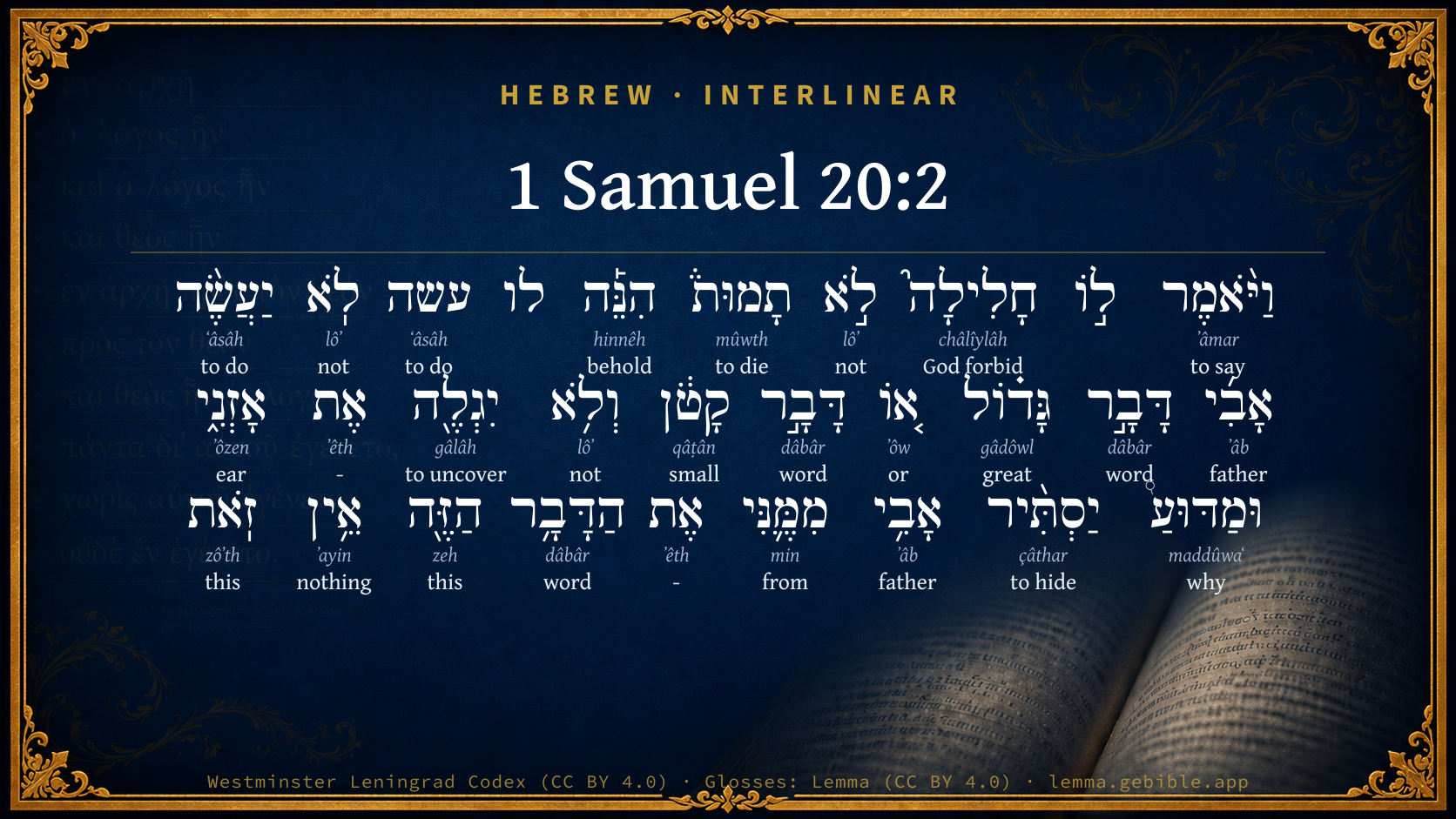
Hebrew (Westminster Leningrad Codex) 1 Samuel 20:2 appears in the Hebrew Old Testament. The text above is from the Westminster Leningrad Codex. Each word links to its Strong’s number, a concise gloss, and parsing drawn from the Open Scriptures Hebrew Bible morphology. Click any word for its full Brown-Driver-Briggs (BDB) entry.
Download image
Cite this verse

1 Samuel 20:2 (World English Bible). Public Domain. Lemma interlinear Bible study tool, https://lemma.gebible.app/v/1-samuel/20/2.

Show BibTeX & RIS
BibTeX
RIS
English Translation
He said to him, "Far from it; you shall not die: behold, my father does nothing either great or small, but that he discloses it to me; and why should my father hide this thing from me? It is not so."
World English Bible · Public Domain
Download a study sheet

One document with this verse’s original text, its word-by-word gloss line, the meaning frame, cross-references with their text, attributed commentary, and full source and license credits — printable, and it pastes into notes with its structure intact.

This verse Autodidact and up

Study sheet (.html) Plain text (.txt)

A passage Seminary Student

Up to 50 verses in one chapter. A passage sheet keeps up to 6 commentary sources and 12 cross-references per verse, in the order this page ranks them, and says so on the sheet whenever that leaves anything out. Ask for a single verse and you get the Autodidact verse sheet above.

Everything on this page stays free to read, with no account — the sheet is a download of what is already on screen, not access to it.

Want to remove ads? Support Godless Engineer
Compare translations 3

The same verse in 3 English versions, stacked beneath the original-language interlinear above. Click any original word for its lexicon entry.

Each is an independent rendering of the whole verse — the interlinear is not word-aligned to these translations.

Highlighted words mark where these versions differ — a whole-verse word diff, not a word-by-word alignment.

  • World English Bible Public Domain
    He said to him, "Far from it; you shall not die: behold, my father does nothing either great or small, but that he discloses it to me; and why should my father hide this thing from me? It is not so."
  • King James Version Public Domain
    And he said unto him, God forbid; thou shalt not die: behold, my father will do nothing either great or small, but that he will show it me: and why should my father hide this thing from me? it is not so.
  • unfoldingWord Literal Text CC BY-SA 4.0
    And he said to him, “Profane! You will not die. Behold, my father does not do a great thing or a small thing and not uncover my ear. So why would my father hide this thing from me? not this!”

unfoldingWord Literal Text — © unfoldingWord, licensed CC BY-SA 4.0. Word-aligned USFM3 via Door43 (git.door43.org/unfoldingWord/en_ult).

Versions to compare (up to 4)

3 of 4 selected

Show all 18 translations

Every available English version of this verse, each an independent rendering of the whole verse.

  • World English Bible Public Domain
    He said to him, "Far from it; you shall not die: behold, my father does nothing either great or small, but that he discloses it to me; and why should my father hide this thing from me? It is not so."
  • Berean Standard Bible Public Domain
    “Far from it!” Jonathan replied. “You will not die. Indeed, my father does nothing, great or small, without telling me. So why would he hide this matter from me? This cannot be true!”
  • Majority Standard Bible Public Domain
    “Far from it!” Jonathan replied. “You will not die. Indeed, my father does nothing, great or small, without telling me. So why would he hide this matter from me? This cannot be true!”
  • King James Version Public Domain
    And he said unto him, God forbid; thou shalt not die: behold, my father will do nothing either great or small, but that he will show it me: and why should my father hide this thing from me? it is not so.
  • American Standard Version (1901) Public Domain
    And he said unto him, Far from it; thou shalt not die: behold, my father doeth nothing either great or small, but that he discloseth it unto me; and why should my father hide this thing from me? it is not so.
  • Revised Version (1885) Public Domain
    And he said unto him, God forbid; thou shalt not die: behold, my father doeth nothing either great or small, but that he discloseth it unto me: and why should my father hide this thing from me? it is not so.
  • Geneva Bible (1599) Public Domain
    And he sayde vnto him, God forbid, thou shalt not die: beholde, my father will do nothing great nor small, but he will shewe it me: and why should my father hide this thing from me? he will not doe it.
  • Douay-Rheims (1899) Public Domain
    And he said to him: God forbid, thou shalt not die: for my father will do nothing great or little, without first telling me: hath then my father hid this word only from me? no, this shall not be.
  • Young's Literal Translation Public Domain
    And he saith to him, `Far be it! thou dost not die; lo, my father doth not do anything great or small and doth not uncover mine ear; and wherefore doth my father hide from me this thing? this `thing' is not.'
  • Literal Standard Version CC BY-SA 4.0
    And he says to him, “Far be it! You do not die; behold, my father does not do anything great or small and does not uncover my ear; and why does my father hide this thing from me? This [thing] is not.”
  • Unlocked Literal Bible CC BY-SA 4.0
    Jonathan said to David, “Far from it; you will not die. My father does nothing either great or small without telling it to me. Why should my father hide this thing from me? It is not so.”
  • unfoldingWord Literal Text CC BY-SA 4.0
    And he said to him, “Profane! You will not die. Behold, my father does not do a great thing or a small thing and not uncover my ear. So why would my father hide this thing from me? not this!”
  • Darby Bible Public Domain
    And he said to him, God forbid; thou shalt not die: behold, my father will do nothing either great or small, and not apprise me; and why should my father hide this thing from me? it is not so.
  • World Messianic Bible Public Domain
    He said to him, “Far from it; you will not die. Behold, my father does nothing either great or small, but that he discloses it to me. Why would my father hide this thing from me? It is not so.”
  • Webster's Bible Public Domain
    And he said to him, Far be it from thee; thou shalt not die: behold, my father will do nothing, either great or small, but that he will show it to me: and why should my father hide this thing from me? it is not so.
  • Free Bible Version CC BY-SA 4.0
    “Nothing!” Jonathan replied. “You're not going to die! Listen! My father tells me everything he's planning, whatever it is. Why would my father keep something like this from me? It's not true!”
  • Bible in Basic English Public Domain
    And he said to him, Far be the thought: you will not be put to death: see, my father does nothing, great or small, without giving me word of it: would he keep this secret from me? It is not so.
  • JPS Tanakh (1917) Public Domain
    And he said unto him: 'Far from it; thou shalt not die; behold, my father doeth nothing either great or small, but that he discloseth it unto me; and why should my father hide this thing from me? it is not so.'

Literal Standard Version (2020), Covenant Press — licensed CC BY-SA 4.0. Text via the HelloAO Bible API (eBible.org). Unlocked Literal Bible (unfoldingWord) — licensed CC BY-SA 4.0. Text via the HelloAO Bible API (eBible.org). unfoldingWord Literal Text — © unfoldingWord, licensed CC BY-SA 4.0. Word-aligned USFM3 via Door43 (git.door43.org/unfoldingWord/en_ult). Free Bible Version, Dr. Jonathan Gallagher — licensed CC BY-SA 4.0. Text via the HelloAO Bible API (eBible.org).

Word by word

More ways to search: Search by grammar → Find every occurrence → Compare this word →

Practice this passage: Drill this verse → Learn its vocabulary →

חָלִילָה֮
châlîylâh
H2486
“God forbid”
Particle, Interjection + Suffix, h
Part of Speech
Particle
Type
Interjection
Full BDB Definition

Origin: a directive from H2490

TWOT: 661c

far be it (from me), God forbid that, let it not be
  1. וַיֹּ֨אמֶר ʼâmar H559 “and · to say” Conjunction + Verb, Qal, Sequential Imperfect, 3rd Person, Masculine, Singular
  2. לֹ֣א lôʼ H3808 “not” Particle, Negative
  3. תָמוּת֒ mûwth H4191 “to die” Verb, Qal, Imperfect, 2nd Person, Masculine, Singular
  4. הִנֵּ֡ה hinnêh H2009 “behold” Particle, Demonstrative
  5. עשה ʻâsâh H6213 “to do” Verb, Qal, Perfect, 3rd Person, Masculine, Singular
  6. לֹֽא lôʼ H3808 “not” Particle, Negative
  7. יַעֲשֶׂ֨ה ʻâsâh H6213 “to do” Verb, Qal, Imperfect, 3rd Person, Masculine, Singular
  8. אָבִ֜י ʼâb H1 “father · my” Noun, Common, Masculine, Singular, Construct + Suffix, Personal, 1st Person, Common, Singular
  9. דָּבָ֣ר dâbâr H1697 “word” Noun, Common, Masculine, Singular, Absolute
  10. גָּד֗וֹל gâdôwl H1419 “great” Adjective, Adjective, Masculine, Singular, Absolute
  11. א֚וֹ ʼôw H176 “or” Conjunction
  12. דָּבָ֣ר dâbâr H1697 “word” Noun, Common, Masculine, Singular, Absolute
  13. קָטֹ֔ן qâṭân H6996 “small” Adjective, Adjective, Masculine, Singular, Absolute
  14. וְלֹ֥א lôʼ H3808 “and · not” Conjunction + Particle, Negative
  15. יִגְלֶ֖ה gâlâh H1540 “to uncover” Verb, Qal, Imperfect, 3rd Person, Masculine, Singular
  16. אֶת ʼêth H853 “-” Particle, Direct Object
  17. אָזְנִ֑י ʼôzen H241 “ear · my” Noun, Common, Feminine, Singular, Construct + Suffix, Personal, 1st Person, Common, Singular
  18. וּמַדּוּעַ֩ maddûwaʻ H4069 “and · why” Conjunction + Particle, Interrogative
  19. יַסְתִּ֨יר çâthar H5641 “to hide” Verb, Hiphil, Imperfect, 3rd Person, Masculine, Singular
  20. אָבִ֥י ʼâb H1 “father · my” Noun, Common, Masculine, Singular, Construct + Suffix, Personal, 1st Person, Common, Singular
  21. מִמֶּ֛נִּי min H4480 “from · me” Preposition + Suffix, Personal, 1st Person, Common, Singular
  22. אֶת ʼêth H853 “-” Particle, Direct Object
  23. הַדָּבָ֥ר dâbâr H1697 “the · word” Particle, Definite Article + Noun, Common, Masculine, Singular, Absolute
  24. הַזֶּ֖ה zeh H2088 “the · this” Particle, Definite Article + Pronoun, Demonstrative, Masculine, Singular
  25. אֵ֥ין ʼayin H369 “nothing” Particle, Negative
  26. זֹֽאת zôʼth H2063 “this” Pronoun, Demonstrative, Feminine, Singular

About this verse

These counts appear in no published source. They are computed here, from the morphology-tagged text and Lemma’s own curated glosses. What Lemma adds →

29
words
20
distinct lemmas
Historical
section

Notable vocabulary

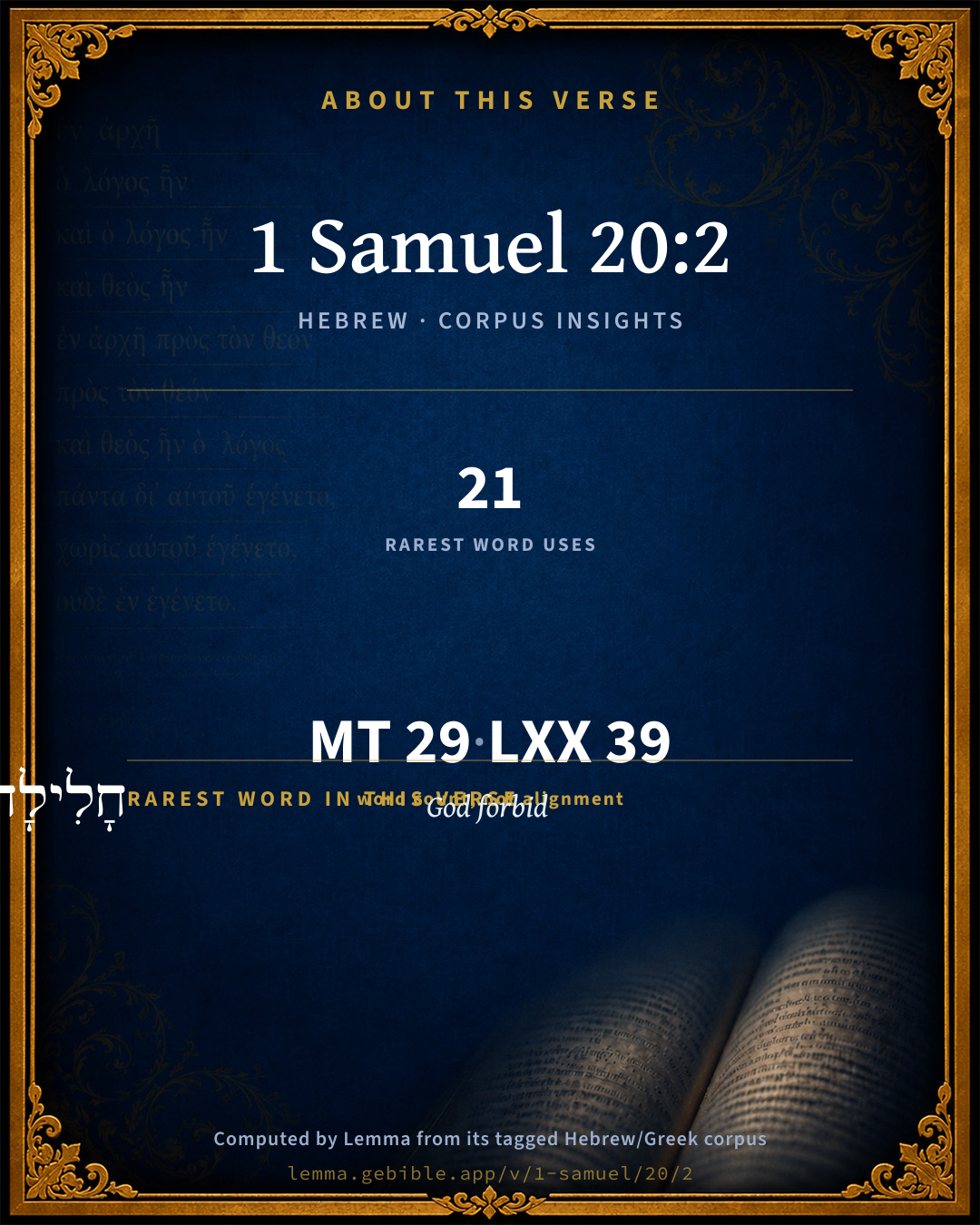
The rarest word here is חָלִילָה֮ God forbid H2486 — appearing just 21 times in the whole Hebrew Bible.

Shared distinctive vocabulary

חָלִילָה֮ God forbid H2486 occurs in 19 verses of the Hebrew Bible. Also found in:

Grammatical profile

  • 6 verbs
  • 6 nouns
  • 2 adjectives
  • 2 pronouns
  • 3 prepositions
  • 1 conjunction
  • 9 particles

Verb forms

  • וַיֹּ֨אמֶר Qal · Sequential Imperfect
  • תָמוּת֒ Qal · Imperfect
  • עשה Qal · Perfect
  • יַעֲשֶׂ֨ה Qal · Imperfect
  • יִגְלֶ֖ה Qal · Imperfect
  • יַסְתִּ֨יר Hiphil · Imperfect

Repetition

Words recur within this verse — often emphatic in Hebrew:

  • דָּבָ֣ר word H1697 ×3
  • עשה to do H6213 ×2
  • אָבִ֜י father H1 ×2
  • לֹ֣א not H3808 ×3

Hebrew & Septuagint length

In English translation the verse runs 41 words from the Hebrew and 45 from the Septuagint (LXX English) — closely comparable.

A rough comparison of the two English renderings, which tokenize alike — not a word-level alignment.

Word counts can differ between the Hebrew and the Greek without any difference in meaning — e.g. the Hebrew direct-object marker אֵת has no separate Greek word, and Greek often adds the article ὁ.

In the original languages it is 29 Hebrew tokens and 39 Greek tokens — but the two are counted differently (Hebrew bundles its prefixes and suffixes into one token; the Greek is in lemma form), so that isn’t a like-for-like length.

Cross-references

11

Topical passages linked to 1 Samuel 20:2 in the Treasury of Scripture Knowledge — connected by theme and wording, ordered by reader-vote popularity; previews shown in the World English Bible.

  • 1 Samuel 9:15 Now Yahweh had revealed to Samuel a day before Saul came, saying,
  • John 17:8 for the words which you have given me I have given to them, and they received them, and knew for sure that I came forth from you, and they have believed that you sent me.
  • Genesis 44:7 They said to him, "Why does my lord speak such words as these? Far be it from your servants that they should do such a thing!
  • Joshua 22:29 Far be it from us that we should rebel against Yahweh, and turn away this day from following Yahweh, to build an altar for burnt-offering, for meal-offering, or for sacrifice, besides the altar of Yahweh our God that is before his tent.
  • 1 Samuel 14:45 The people said to Saul, Shall Jonathan die, who has worked this great salvation in Israel? Far from it: as Yahweh lives, there shall not one hair of his head fall to the ground; for he has worked with God this day. So the people rescued Jonathan, that he didn't die.
  • 1 Samuel 20:12 Jonathan said to David, Yahweh, the God of Israel, [be witness]: when I have sounded my father about this time tomorrow, [or] the third day, behold, if there be good toward David, shall I not then send to you, and disclose it to you?
  • John 15:15 No longer do I call you servants, for the servant doesn't know what his lord does. But I have called you friends, for everything that I heard from my Father, I have made known to you.
  • Joshua 24:16 The people answered, Far be it from us that we should forsake Yahweh, to serve other gods;
  • Psalms 40:6 Sacrifice and offering you didn't desire. You have opened my ears: Burnt offering and sin offering you have not required.
  • Isaiah 50:5 The Lord Yahweh has opened my ear, and I was not rebellious, neither turned away backward.
  • Luke 20:16 He will come and destroy these farmers, and will give the vineyard to others." When they heard it, they said, "May it never be!"

Cross-references courtesy of OpenBible.info (CC BY 4.0).

Hebrew and Greek witnesses Masoretic Hebrew ↔ Greek Septuagint

The same verse in the two great witnesses to the Old Testament, shown verse-for-verse.

These are two independent witnesses, not word-aligned to each other, and the Septuagint is shown in lemma (dictionary) form.

Hebrew 1 Samuel 20:2 Masoretic · Westminster Leningrad Codex

וַיֹּ֨אמֶר ל֣וֹ חָלִילָה֮ לֹ֣א תָמוּת֒ הִנֵּ֡ה לו עשה לֹֽא יַעֲשֶׂ֨ה אָבִ֜י דָּבָ֣ר גָּד֗וֹל א֚וֹ דָּבָ֣ר קָטֹ֔ן וְלֹ֥א יִגְלֶ֖ה אֶת אָזְנִ֑י וּמַדּוּעַ֩ יַסְתִּ֨יר אָבִ֥י מִמֶּ֛נִּי אֶת הַדָּבָ֥ר הַזֶּ֖ה אֵ֥ין זֹֽאת

He said to him, "Far from it; you shall not die: behold, my father does nothing either great or small, but that he discloses it to me; and why should my father hide this thing from me? It is not so."

World English Bible · Public Domain

Greek LXX 1 Samuel 20:2 Septuagint · lemma form

καί εἶπον αὐτός ιωναθαν μηδαμῶς σύ οὐ μή ἀποθνήσκω ἰδού οὐ μή ποιέω ὁ πατήρ ἐγώ ῥῆμα μέγας ἤ μικρός καί οὐ ἀποκαλύπτω ὁ ὠτίον ἐγώ καί τίς ὅτι κρύπτω ὁ πατήρ ἐγώ ὁ ῥῆμα οὗτος οὐ εἰμί οὗτος

And Jonathan said to him, Far be it from you: you shall not die: behold, my father will not do any thing great or small without discovering it to me; and why should my father hide this matter from me? This thing is not so.

LXX2012 (modern English Septuagint) · Public Domain

On this verse, Ellicott's Commentary for English Readers discusses the Septuagint’s reading. Read the note in Commentary ↓

Hebrew: Westminster Leningrad Codex (CC BY 4.0). Greek: Septuagint (public domain); English from LXX2012 (modern English Septuagint) (Public Domain). How the Septuagint differs from the Hebrew →

Targum (Aramaic paraphrase)

1

The Targum is the ancient Jewish Aramaic paraphrase of the Hebrew Scriptures — an interpretive translation, not the Hebrew text itself. Onkelos (literal) and Pseudo-Jonathan (expansive) render the Torah, and Jonathan the Prophets. Coverage is partial: where no permissively-licensed English translation exists for a verse, only the Aramaic is shown. This is verse-level text, not a word-by-word alignment to the Hebrew.

  1. Targum Jonathan Prophets (Joshua–Malachi)
    וַאֲמַר לֵיהּ חַס לָא תְמוּת הָא לָא יַעְבֵּיד אַבָּא פִּתְגַם רַב אוֹ פִּתְגַם זְעֵיר וְלָא יְחַוֵי לִי וּמָא דֵין כַסֵי אַבָּא מִנִי יַת פִּתְגָמָא הָדֵין לֵית דָא קַיָמָא:

    (no public-domain English translation for this verse)

    Targum Jonathan — Aramaic: “Mikraot Gedolot” (public domain). English: “Sefaria Community Translation” (CC0 1.0 (public-domain dedication)); “London "Chaldee Paraphrase," 1871” (public domain). Text via Sefaria.

Commentary

Notes on 1 Samuel 20:2 from classic Christian and Jewish commentators (each source and its license shown beneath its notes). The classic Christian expositions comment on the surrounding passage and are grouped to its opening verse, so a note may address several verses; the Jewish commentaries on the Tanakh (Rashi and others) are per-verse, so they appear only where the commentator wrote on this verse.

Lemma curates 59 commentaries, every one of them public domain or Creative Commons licensed, each selected and text-cleaned for this edition rather than reprinted as found. About our sources →

Trapp's Complete Commentary

John Trapp

1Sa 20:2 And he said unto him, God forbid; thou shalt not die: behold, my father will do nothing either great or small, but that he will shew it me: and why should my father hide this thing from me? it [is] not [so].

Ver. 2. God forbid; thou shalt not die.] Jonathan could not think his father so perfidious and bloody minded; having so lately sworn to the contrary. "Love thinketh not evil, but believeth all things, hopeth all things." {1Co 13:5} He knew not that Machiavellian maxim, Mercatorum est, non regum, stare iuramentis: It is for tradesmen, and not for kings to keep their oaths.

Behold, my father will do nothing.] Either Jonathan knew not of Saul’s recent attempts against David, or else he looked upon them as fruits of his frenzy, which would be soon over.

John Trapp, A Commentary or Exposition upon All the Books of the Old and New Testament (1647–1656) — public domain. Text from a community e-Sword module.

Joseph Benson's Commentary

1Sa 20:2. He said, God forbid: thou shalt not die — It appears by this that Jonathan knew nothing of his father’s design, and that the messengers before named had been sent to seize David without his privity. Hence, from a principle of filial respect to his father, he was very loath to believe that he would do so ill a thing. Behold, my father will do nothing, but he will show it me — In this he was greatly mistaken. Communicative as Saul was to his son Jonathan in other things, he was ashamed to disclose to him the wicked design he had formed against the life of his friend. Why should my father hide this thing from me? — Why? For an obvious reason; because it was too base and shameful to be discovered to any one that had any fear of God before his eyes, or any sense of moral obligation. He was afraid too that if he should disclose his design to Jonathan, he should find means to prevent its execution. It is not so — Jonathan gave credit to his father’s oath, mentioned 1Sa 19:6.

Joseph Benson's Commentary on the Old and New Testaments (1811–1818) — public domain. Text from a community e-Sword module.

Tyndale Open Study Notes

Tyndale Open Resources

20:2-3 Jonathan was naive about his father’s intentions. David’s willingness to swear . . . by the Lord showed how convinced he was about Saul’s intentions.

Tyndale Open Study Notes — © Tyndale Open Resources, licensed CC BY-SA 4.0. Text via the HelloAO Bible API.

Geneva Bible (1599)

Geneva Bible translators

Hebrew, reveal it in mine ear.

Geneva Bible (1599) marginal notes — public domain. Text via Bolls.life.

Adam Clarke's Commentary

Verse 2. My father will do nothing] Jonathan thought that his father could have no evil design against David, because of the oath which he had sworn to himself 1Sa 19:6; and at any rate, that he would do nothing against David without informing him.

Adam Clarke's Commentary on the Bible (1810–1826) — public domain. Text from a community e-Sword/MySword module.

Ellicott's Commentary for English Readers

(2) God forbid; thou shalt not die.—Jonathan even now refuses to believe that his loved father, when he was himself, really wished ill to David; all that had hitherto happened the princely Jonathan put down to his father’s unhappy malady. He urges upon his friend that if the king in good earnest had designs upon David’s life, he would in his calm, lucid days have consulted with him, Jonathan, to whom he ever confided all his State secrets.

Will do nothing.—Here the commentators and the versions—LXX., Vulg., and Cbaldee—all agree to read in the Hebrew text, lo “not,” for lo “to him,” that is, for a vau an aleph must be substituted.

A Bible Commentary for English Readers, edited by Charles John Ellicott (1878–1897) — public domain. Text from a community e-Sword module.

The Cambridge Bible for Schools and Colleges

gen. ed. J. J. S. Perowne

2. nothing either great or small] i.e. absolutely nothing. Cp. 1Sa_22:15, 1Sa_25:36.

shew it me] Lit. “uncover mine ear,” and so in 1Sa_20:12. See on 1Sa_9:15.

it is not so] Bearing in mind Saul’s oath (1Sa_19:6), and attributing his recent violence to temporary madness, Jonathan refuses to believe that his father has any deliberate design against David’s life.

The Cambridge Bible for Schools and Colleges (gen. ed. J. J. S. Perowne; Cambridge University Press, 1878–1918) — public domain. Text from a community e-Sword module.

John Gill's Exposition

And he said unto him, God forbid, thou shalt not die,.... He could not believe his father had any such intention; and that if he discovered anything of that kind, it was only when he was in a frenzy, and a melancholy disorder had seized him; and that David had nothing to fear on that head, and that he would secure him from all danger in that respect; the thing was too gross and detestable to be credited:

behold, my father will do nothing, either great or small, but that he will show it me; such an interest had he in him, and in his favour, being his son and heir to his crown, and having done many warlike exploits, which had the more endeared him to him, that he made him privy to all his secret designs, and took his opinion in all matters of moment and importance:

and why should my father hide this thing from me? his design of taking away the life of David, if he had really formed one:

it is not so; Jonathan concluded, from his ignorance of it, there was nothing in it, and that it was only a surmise of David's; and yet it is strange that Jonathan should know nothing of the messengers being sent to David's house to take him, and of others sent to Naioth after him, and of Saul's going there himself with such a design; and if he did know anything of the matter, he made the best of it to David, partly to allay his fears, and partly that his father might not appear so black and vile as he really was.

John Gill's Exposition of the Whole Bible (1746–1763) — public domain (CC PDM 1.0). Text via the HelloAO Bible API.

Albert Barnes' Notes on the Bible

It is not so - Jonathan’s unwillingness to believe evil of his father is one of the many admirable traits in his character.

Albert Barnes' Notes on the Bible (1834–1885) — public domain. Text from a community e-Sword/MySword module.

Haydock's Catholic Bible Commentary

Be. The recent machinations and orders of Saul had been concealed from his son, with whom he used to consult on all important matters. (Calmet) --- Perceiving, however, that Jonathan was unwilling to come into his measures, Saul, in his phrenzy, tried to destroy David. (Haydock) --- But Jonathan, forming his judgment of others by his own upright heart, relied on the oath of his father, (Calmet) and on the information he had lately communicated to him, when he desired David to be slain. (Menochius) --- Abulensis believes that the particulars of a preceding reconciliation have been lost, which Salien supplies, the year of the world 2973.

George Leo Haydock (1774–1849), Haydock's Catholic Family Bible and Commentary, 1859 edition — public domain. Excludes Psalms (Douay-Rheims chapter numbering differs from Protestant) and Deuterocanonical books (Catholic canon only).

Matthew Poole's English Annotations

Thou shalt not die; I will secure thee by my interest with my father; nor doth he design to destroy thee; for what he doth in his frantic fits is not to be imputed to him; and when he comes to himself, I doubt not to reconcile thee to him. For Jonathan gave credit to his father’s oath, 1Sa 19:6; and the worthiest minds are least suspicious and most charitable in their opinions of others.

Matthew Poole's English Annotations on the Holy Bible (1683–1685) — public domain. Text from a community e-Sword/MySword module.

The Pulpit Commentary

God forbid. An exclamation of horror; literally, "Far be it". (see 1Sa_9:4-5) In spite of the many proofs of Saul"s bitter hatred, Jonathan cannot believe that after all that had taken place at Ramah his father would still persist in his murderous purpose. He further assures David that Saul would do nothing without telling him; literally, without uncovering his ear, without telling it him privately (see on 1Sa_9:15). The phrase is used again in ver. 12. For will do nothing the written text reads "has done for himself," which the Kri properly corrects. The rashness of Saul"s temper, and his frank talk about killing David recorded in 1Sa_19:1, confirm Jonathan"s statement about the openness of his father"s ways, and he therefore assures David that he may take his place in safety.

The Pulpit Commentary (1880–1919), ed. H.D.M. Spence-Jones & Joseph S. Exell — public domain. Text from a community e-Sword module.

John Wesley's Explanatory Notes

Is it not so - For Jonathan gave credit to his father's oath, chap. xix, 6.

John Wesley, Explanatory Notes Upon the Whole Bible (1754–1765) — public domain. Text via the GEBible commentary corpus.

Lesson kit

Teaching starters — assembled from the data on this page, not authored interpretation. Every prompt links to the verse data it draws on. Edit before teaching.

1 Samuel, in the Historical, opens this verse with 29 words (20 distinct Hebrew lemmas). Its most distinctive word is châlîylâh (“God forbid”). A historical commentator’s framing appears above. Read the whole chapter for the surrounding context.

Discussion questions

  1. The word châlîylâh carries the sense “God forbid.” How does it shape the verse?
  2. Genesis 18:25 shares the word «God forbid» with this verse. How do the two illuminate each other?
  3. “word” occurs 3× in this one verse. What is the effect of the repetition?
  4. These translations render this verse differently; the difference is in the English rendering, not the original. What questions does that raise?
  5. The verb «וַיֹּ֨אמֶר» is Qal Sequential Imperfect. How does its form color the action?
  6. Reading how Trapp's Complete Commentary and Joseph Benson's Commentary read this verse, where do the two commentators agree and where do they part?

Things to notice

Reading settings

Reading text

Shown beneath each verse's original-language words.

Old Testament
Old Testament edition

Read the OT as the Masoretic Hebrew (MT) or the Greek Septuagint (LXX).

English shown for the Greek Septuagint (in the Hebrew ↔ Greek comparison).

Comparing translations? Open the Compare panel on any verse page to stack up to four side by side.