
Judges 19:15

Hebrew (Westminster Leningrad Codex) Judges 19:15 appears in the Hebrew Old Testament. The text above is from the Westminster Leningrad Codex. Each word links to its Strong’s number, a concise gloss, and parsing drawn from the Open Scriptures Hebrew Bible morphology. Click any word for its full Brown-Driver-Briggs (BDB) entry.
Download image
Cite this verse

Judges 19:15 (World English Bible). Public Domain. Lemma interlinear Bible study tool, https://lemma.gebible.app/v/judges/19/15.

Show BibTeX & RIS
BibTeX
RIS
English Translation
They turned aside there, to go in to lodge in Gibeah: and he went in, and sat him down in the street of the city; for there was no man who took them into his house to lodge.
World English Bible · Public Domain
Download a study sheet

One document with this verse’s original text, its word-by-word gloss line, the meaning frame, cross-references with their text, attributed commentary, and full source and license credits — printable, and it pastes into notes with its structure intact.

This verse Autodidact and up

Study sheet (.html) Plain text (.txt)

A passage Seminary Student

Up to 50 verses in one chapter. A passage sheet keeps up to 6 commentary sources and 12 cross-references per verse, in the order this page ranks them, and says so on the sheet whenever that leaves anything out. Ask for a single verse and you get the Autodidact verse sheet above.

Everything on this page stays free to read, with no account — the sheet is a download of what is already on screen, not access to it.

Want to remove ads? Support Godless Engineer
Compare translations 3

The same verse in 3 English versions, stacked beneath the original-language interlinear above. Click any original word for its lexicon entry.

Each is an independent rendering of the whole verse — the interlinear is not word-aligned to these translations.

Highlighted words mark where these versions differ — a whole-verse word diff, not a word-by-word alignment.

  • World English Bible Public Domain
    They turned aside there, to go in to lodge in Gibeah: and he went in, and sat him down in the street of the city; for there was no man who took them into his house to lodge.
  • King James Version Public Domain
    And they turned aside thither, to go in and to lodge in Gibeah: and when he went in, he sat him down in a street of the city: for there was no man that took them into his house to lodging.
  • unfoldingWord Literal Text CC BY-SA 4.0
    So they turned aside there to enter to lodge in Gibeah. And they entered and they sat down in the open area of the city, but no one was receiving them into the house to lodge.

unfoldingWord Literal Text — © unfoldingWord, licensed CC BY-SA 4.0. Word-aligned USFM3 via Door43 (git.door43.org/unfoldingWord/en_ult).

Versions to compare (up to 4)

3 of 4 selected

Show all 18 translations

Every available English version of this verse, each an independent rendering of the whole verse.

  • World English Bible Public Domain
    They turned aside there, to go in to lodge in Gibeah: and he went in, and sat him down in the street of the city; for there was no man who took them into his house to lodge.
  • Berean Standard Bible Public Domain
    They stopped to go in and lodge in Gibeah. The Levite went in and sat down in the city square, but no one would take them into his home for the night.
  • Majority Standard Bible Public Domain
    They stopped to go in and lodge in Gibeah. The Levite went in and sat down in the city square, but no one would take them into his home for the night.
  • King James Version Public Domain
    And they turned aside thither, to go in and to lodge in Gibeah: and when he went in, he sat him down in a street of the city: for there was no man that took them into his house to lodging.
  • American Standard Version (1901) Public Domain
    And they turned aside thither, to go in to lodge in Gibeah: and he went in, and sat him down in the street of the city; for there was no man that took them into his house to lodge.
  • Revised Version (1885) Public Domain
    And they turned aside thither, to go in to lodge in Gibeah: and he went in, and sat him down in the street of the city: for there was no man that took them into his house to lodge.
  • Geneva Bible (1599) Public Domain
    Then they turned thither to goe in and lodge in Gibeah: and when he came, he sate him downe in a streete of the citie: for there was no man that tooke them into his house to lodging.
  • Douay-Rheims (1899) Public Domain
    And they turned into it, to lodge there. And when they were come in, they sat in the street of the city, for no man would receive them to lodge.
  • Young's Literal Translation Public Domain
    and they turn aside there to go in to lodge in Gibeah, and he goeth in and sitteth in a broad place of the city, and there is no man gathering them into the house to lodge.
  • Literal Standard Version CC BY-SA 4.0
    and they turn aside there to go in to lodge in Gibeah, and he goes in and sits in a broad place of the city, and there is no man gathering them into the house to lodge.
  • Unlocked Literal Bible CC BY-SA 4.0
    They turned aside there to spend the night in Gibeah. They went and sat down in the city square, but no one took them into his house for the night.
  • unfoldingWord Literal Text CC BY-SA 4.0
    So they turned aside there to enter to lodge in Gibeah. And they entered and they sat down in the open area of the city, but no one was receiving them into the house to lodge.
  • Darby Bible Public Domain
    and they turned aside there, to go in and spend the night at Gib'e-ah. And he went in and sat down in the open square of the city; for no man took them into his house to spend the night.
  • World Messianic Bible Public Domain
    They went over there, to go in to stay in Gibeah. He went in, and sat down in the street of the city; for there was no one who took them into his house to stay.
  • Webster's Bible Public Domain
    And they turned aside thither, to go in and to lodge in Gibeah: and when he went in, he sat down in a street of the city: for there was no man that took them into his house to lodge.
  • Free Bible Version CC BY-SA 4.0
    They stopped in Gibeah to spend the night, and sat down in the town's main square, but no one invited them to come and stay.
  • Bible in Basic English Public Domain
    And they went off the road there with the purpose of stopping for the night in Gibeah: and he went in, seating himself in the street of the town, for no one took them into his house for the night.
  • JPS Tanakh (1917) Public Domain
    And they turned aside thither, to go in to lodge in Gibeah; and he went in, and sat him down in the broad place of the city; for there was no man that took them into his house to lodge.

Literal Standard Version (2020), Covenant Press — licensed CC BY-SA 4.0. Text via the HelloAO Bible API (eBible.org). Unlocked Literal Bible (unfoldingWord) — licensed CC BY-SA 4.0. Text via the HelloAO Bible API (eBible.org). unfoldingWord Literal Text — © unfoldingWord, licensed CC BY-SA 4.0. Word-aligned USFM3 via Door43 (git.door43.org/unfoldingWord/en_ult). Free Bible Version, Dr. Jonathan Gallagher — licensed CC BY-SA 4.0. Text via the HelloAO Bible API (eBible.org).

Word by word

More ways to search: Search by grammar → Find every occurrence → Compare this word →

Practice this passage: Drill this verse → Learn its vocabulary →

בַּגִּבְעָ֑ה
Gibʻâh
H1390
“in/at the · Gibeah”
Preposition, Determined + Noun, Proper
Part of Speech
Preposition + Noun
Type
Proper
Full BDB Definition

Origin: the same as H1389

TWOT: None

Gibeah = "hill" - a city in the mountain district of Judah - a city of Benjamin, birthplace of king Saul - a city in Kirjath-jearim of Ephraim
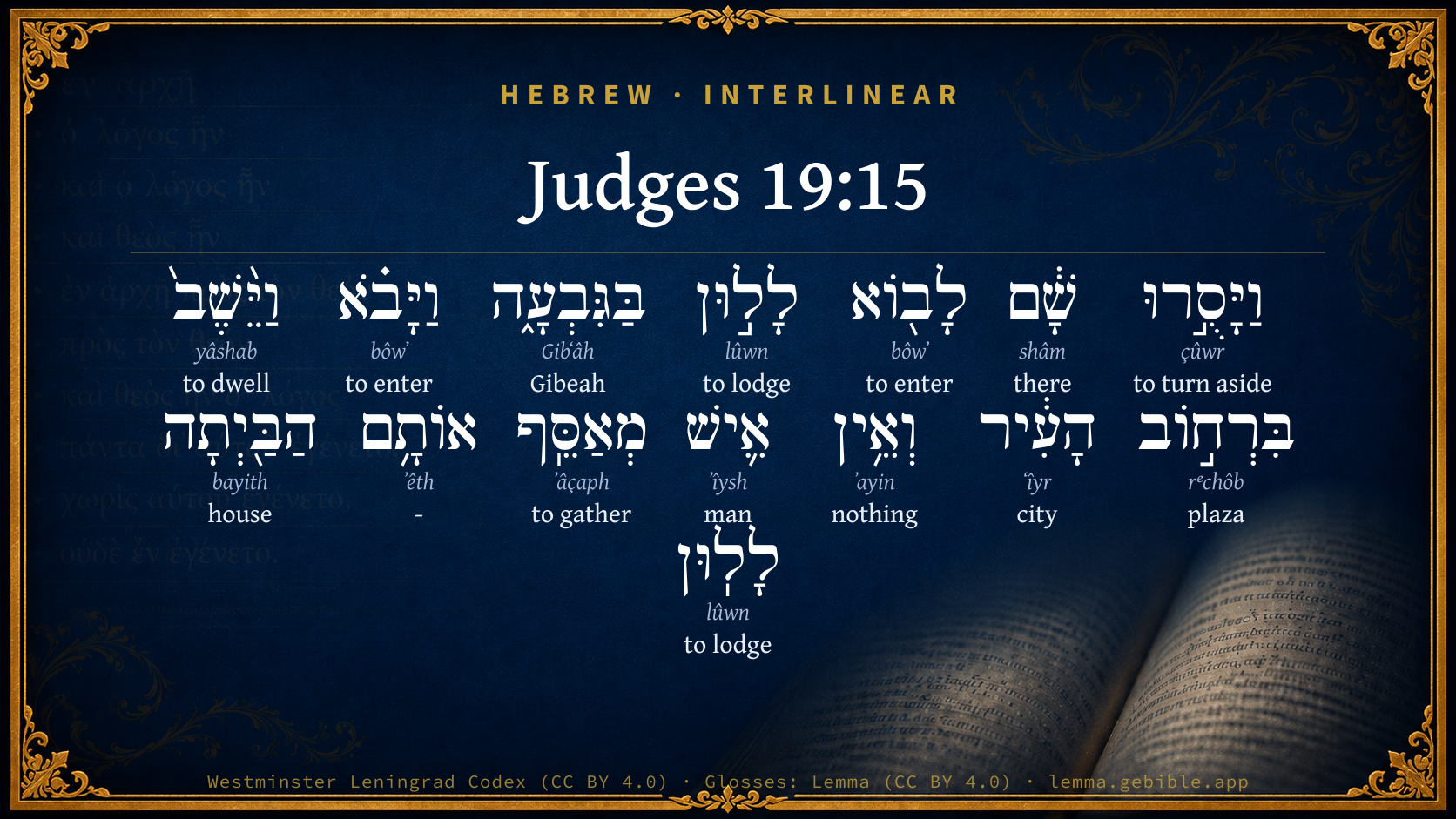
  1. וַיָּסֻ֣רוּ çûwr H5493 “and · to turn aside” Conjunction + Verb, Qal, Sequential Imperfect, 3rd Person, Masculine, Plural
  2. שָׁ֔ם shâm H8033 “there” Adverb
  3. לָב֖וֹא bôwʼ H935 “to enter” Preposition + Verb, Qal, Infinitive Construct
  4. לָל֣וּן lûwn H3885 “to lodge” Preposition + Verb, Qal, Infinitive Construct
  5. וַיָּבֹ֗א bôwʼ H935 “and · to enter” Conjunction + Verb, Qal, Sequential Imperfect, 3rd Person, Masculine, Singular
  6. וַיֵּ֨שֶׁב֙ yâshab H3427 “and · to dwell” Conjunction + Verb, Qal, Sequential Imperfect, 3rd Person, Masculine, Singular
  7. בִּרְח֣וֹב rᵉchôb H7339 “in/at · plaza of” Preposition + Noun, Common, Feminine, Singular, Construct
  8. הָעִ֔יר ʻîyr H5892 “the · city” Particle, Definite Article + Noun, Common, Feminine, Singular, Absolute
  9. וְאֵ֥ין ʼayin H369 “and · nothing” Conjunction + Particle, Negative
  10. אִ֛ישׁ ʼîysh H376 “man” Noun, Common, Masculine, Singular, Absolute
  11. מְאַסֵּֽף ʼâçaph H622 “gathering” Verb, Piel, Participle Active, Masculine, Singular, Absolute
  12. אוֹתָ֥ם ʼêth H853 “- · them” Particle, Direct Object + Suffix, Personal, 3rd Person, Masculine, Plural
  13. הַבַּ֖יְתָה bayith H1004 “the · house · toward” Particle, Definite Article + Noun, Common, Masculine, Singular, Absolute + Suffix, Demonstrative
  14. לָלֽוּן lûwn H3885 “to lodge” Preposition + Verb, Qal, Infinitive Construct

About this verse

These counts appear in no published source. They are computed here, from the morphology-tagged text and Lemma’s own curated glosses. What Lemma adds →

15
words
13
distinct lemmas
Historical
section

Shared distinctive vocabulary

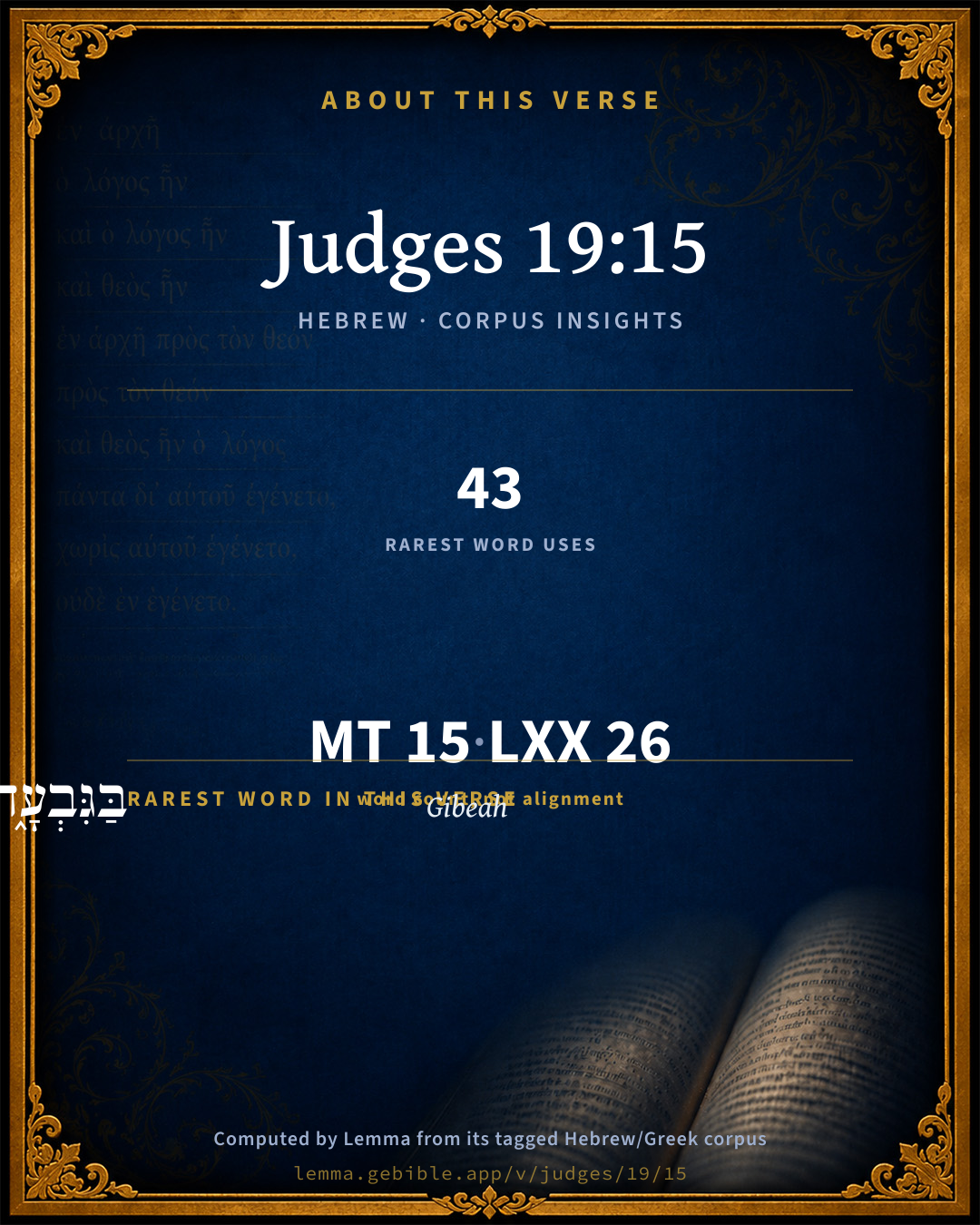
בַּגִּבְעָ֑ה Gibeah H1390 occurs in 42 verses of the Hebrew Bible. Also found in:

Grammatical profile

  • 7 verbs
  • 5 nouns
  • 1 adverb
  • 2 particles

Verb forms

  • וַיָּסֻ֣רוּ Qal · Sequential Imperfect
  • לָב֖וֹא Qal · Infinitive Construct
  • לָל֣וּן Qal · Infinitive Construct
  • וַיָּבֹ֗א Qal · Sequential Imperfect
  • וַיֵּ֨שֶׁב֙ Qal · Sequential Imperfect
  • מְאַסֵּֽף Piel · Participle Active
  • לָלֽוּן Qal · Infinitive Construct

Repetition

Words recur within this verse — often emphatic in Hebrew:

  • לָב֖וֹא to enter H935 ×2
  • לָל֣וּן to lodge H3885 ×2

Hebrew & Septuagint length

In English translation the verse runs 38 words from the Hebrew and 38 from the Septuagint (LXX English) — the same length.

A rough comparison of the two English renderings, which tokenize alike — not a word-level alignment.

Word counts can differ between the Hebrew and the Greek without any difference in meaning — e.g. the Hebrew direct-object marker אֵת has no separate Greek word, and Greek often adds the article ὁ.

In the original languages it is 15 Hebrew tokens and 26 Greek tokens — but the two are counted differently (Hebrew bundles its prefixes and suffixes into one token; the Greek is in lemma form), so that isn’t a like-for-like length.

Cross-references

6

Topical passages linked to Judges 19:15 in the Treasury of Scripture Knowledge — connected by theme and wording, ordered by reader-vote popularity; previews shown in the World English Bible.

  • Judges 19:18 He said to him, We are passing from Bethlehem Judah to the farther side of the hill-country of Ephraim; from there am I, and I went to Bethlehem Judah: and I am [now] going to the house of Yahweh; and there is no man who takes me into his house.
  • Matthew 25:43 I was a stranger, and you didn't take me in; naked, and you didn't clothe me; sick, and in prison, and you didn't visit me.'
  • Hebrews 13:2 Don't forget to show hospitality to strangers, for in doing so, some have entertained angels without knowing it.
  • Genesis 18:2–8 He lifted up his eyes and looked, and saw that three men stood opposite him. When he saw them, he ran to meet them from the tent door, and bowed himself to the earth,
  • Genesis 19:2–3 and he said, "See now, my lords, please turn aside into your servant's house, stay all night, wash your feet, and you will rise up early, and go on your way." They said, "No, but we will stay in the street all night."
  • Matthew 25:35 for I was hungry, and you gave me food to eat; I was thirsty, and you gave me drink; I was a stranger, and you took me in;

Cross-references courtesy of OpenBible.info (CC BY 4.0).

Hebrew and Greek witnesses Masoretic Hebrew ↔ Greek Septuagint

The same verse in the two great witnesses to the Old Testament, shown verse-for-verse.

These are two independent witnesses, not word-aligned to each other, and the Septuagint is shown in lemma (dictionary) form.

Hebrew Judges 19:15 Masoretic · Westminster Leningrad Codex

וַיָּסֻ֣רוּ שָׁ֔ם לָב֖וֹא לָל֣וּן בַּגִּבְעָ֑ה וַיָּבֹ֗א וַיֵּ֨שֶׁב֙ בִּרְח֣וֹב הָעִ֔יר וְאֵ֥ין אִ֛ישׁ מְאַסֵּֽף אוֹתָ֥ם הַבַּ֖יְתָה לָלֽוּן

They turned aside there, to go in to lodge in Gibeah: and he went in, and sat him down in the street of the city; for there was no man who took them into his house to lodge.

World English Bible · Public Domain

Greek LXX Judges 19:15 Septuagint · lemma form

καί ἐκκλίνω ἐκεῖ ὁ εἰςἔρχομαι αὐλίζω ἐν γαβαα καί εἰςἔρχομαι καί καταἵζω ἐν ὁ πλατύς ὁ πόλις καί οὐ εἰμί ἀνήρ συνἄγω αὐτός εἰς οἰκία αὐλίζω

And they turned aside thence to go in to lodge in Gabaa; and they went in, and sat down in the street of the city, and there was no one who conducted them into a house to lodge.

LXX2012 (modern English Septuagint) · Public Domain

Hebrew: Westminster Leningrad Codex (CC BY 4.0). Greek: Septuagint (public domain); English from LXX2012 (modern English Septuagint) (Public Domain). How the Septuagint differs from the Hebrew →

Targum (Aramaic paraphrase)

1

The Targum is the ancient Jewish Aramaic paraphrase of the Hebrew Scriptures — an interpretive translation, not the Hebrew text itself. Onkelos (literal) and Pseudo-Jonathan (expansive) render the Torah, and Jonathan the Prophets. Coverage is partial: where no permissively-licensed English translation exists for a verse, only the Aramaic is shown. This is verse-level text, not a word-by-word alignment to the Hebrew.

  1. Targum Jonathan Prophets (Joshua–Malachi)
    וְזָרוּ לְתַמָן לְמֵיעַל לְמֵבַת בְּגִבְעָתָא וַאֲתָא וִיתֵיב בִּרְחוֹבָא דְקַרְתָּא וְלֵית אֱנָשׁ דִכְנֵישׁ יַתְהוֹן לְבֵיתָא לִמְבָת:

    (no public-domain English translation for this verse)

    Targum Jonathan — Aramaic: “Mikraot Gedolot” (public domain). English: “Sefaria Community Translation” (CC0 1.0 (public-domain dedication)); “London "Chaldee Paraphrase," 1871” (public domain). Text via Sefaria.

Commentary

Notes on Judges 19:15 from classic Christian and Jewish commentators (each source and its license shown beneath its notes). The classic Christian expositions comment on the surrounding passage and are grouped to its opening verse, so a note may address several verses; the Jewish commentaries on the Tanakh (Rashi and others) are per-verse, so they appear only where the commentator wrote on this verse.

Lemma curates 59 commentaries, every one of them public domain or Creative Commons licensed, each selected and text-cleaned for this edition rather than reprinted as found. About our sources →

Trapp's Complete Commentary

John Trapp

Jdg 19:15 And they turned aside thither, to go in [and] to lodge in Gibeah: and when he went in, he sat him down in a street of the city: for [there was] no man that took them into his house to lodging.

Ver. 15. He sat him down in a street of the city.] There were not inns and houses of receipt for strangers in those days, as are now: but if no man took them in, they lay in the streets. {Gen 19:2}

For there was no man that took them into his house.] This their inhospitality and inhumanity was a forerunner of their destruction. The Jews at this day are very hospitable to their own. So were the ancient Protestants the Waldenses. And surely if God had been in any of these Benjamites’ houses, his servant had not been excluded.

John Trapp, A Commentary or Exposition upon All the Books of the Old and New Testament (1647–1656) — public domain. Text from a community e-Sword module.

Joseph Benson's Commentary

Jdg 19:15. He sat down in the street of the city — There being no public inns in that country in those days, this was the general custom. Travellers sat down in the streets till some person invited them into his house. And this was generally readily done by one or other, except in places where there was a great degeneracy of manners. Here, although they were soft and effeminate in other respects, yet they were hard-hearted to strangers, for there was no man that took them into his house to lodging, till a poor labouring man performed that office of hospitality toward them.

Joseph Benson's Commentary on the Old and New Testaments (1811–1818) — public domain. Text from a community e-Sword module.

Geneva Bible (1599)

Geneva Bible translators

Or gathered them.

Geneva Bible (1599) marginal notes — public domain. Text via Bolls.life.

Jamieson, Fausset & Brown

Robert Jamieson, A. R. Fausset & David Brown

when he went in, he sat him down in a street of the city--The towns of Palestine at this remote period could not, it seems, furnish any establishment in the shape of an inn or public lodging-house. Hence we conclude that the custom, which is still frequently witnessed in the cities of the East, was then not uncommon, for travellers who were late in arriving and who had no introduction to a private family, to spread their bedding in the streets, or wrapping themselves up in their cloaks, pass the night in the open air. In the Arab towns and villages, however, the sheik, or some other person, usually comes out and urgently invites the strangers to his house. This was done also in ancient Palestine (Gen 18:4; Gen 19:2). That the same hospitality was not shown in Gibeah seems to have been owing to the bad character of the people.

Jamieson, Fausset & Brown — Commentary Critical and Explanatory on the Whole Bible (1871) — public domain (CC PDM 1.0). Text via the HelloAO Bible API.

Adam Clarke's Commentary

Verse 15. No man - took them into his house to lodging.] There was probably no inn or house of public entertainment in this place, and therefore they could not have a lodging unless furnished by mere hospitality. To say that there were no inns in those primitive times, is not true; there were such places, though not very frequent. Joseph's brethren found their money in their sacks when they loosed them at an inn, Ge 42:27. The house of Rahab was an inn, Jos 2:1. And the woman whose house Samson frequented at Gaza was a hostess, or one who kept a place of public entertainment.

Adam Clarke's Commentary on the Bible (1810–1826) — public domain. Text from a community e-Sword/MySword module.

Ellicott's Commentary for English Readers

(15) In a street.—Rather, in the open place (Rechob)—i.e., the square or market-place of the city, often a space outside the walls (Deu_13:16). (Comp. Gen_19:1-2; “The stranger did not lodge in the street”—Job_31:32.)

No man that took them into his house.—The same neglect would have been experienced by the angels at Sodom but for the care of Lot. This neglect of the very first duty of the East was sufficient at once to prove the base condition into which Gibeah had fallen (Deu_10:19; Mat_25:35).

A Bible Commentary for English Readers, edited by Charles John Ellicott (1878–1897) — public domain. Text from a community e-Sword module.

The Cambridge Bible for Schools and Colleges

gen. ed. J. J. S. Perowne

15. and he went in, and sat him down] The verbs should probably be read as plurals.

the street] Rather broad place (Jdg_19:17; Jdg_19:20), Gen_19:2 b, usually near the gate, 2Ch_32:6, Neh_8:1; Neh_8:3; Neh_8:16 etc. At this point we begin to notice parallels with Genesis 19.

The Cambridge Bible for Schools and Colleges (gen. ed. J. J. S. Perowne; Cambridge University Press, 1878–1918) — public domain. Text from a community e-Sword module.

John Gill's Exposition

And they turned aside thither to go in and lodge in Gibeah,.... Instead of going right forward, and passing by Gibeah, over against which they were, they turned out of their road, and went into the city to seek a lodging in it:

and when he went in, he sat him down in a street of the city; to see whether any person would invite him into any of their houses, as was usual in those hospitable times and countries, and where there were few inns for the entertainment of travellers and strangers, or none at all, and especially in cities; if any where, they were upon the public road:

for there was no man that took them into his house to lodging; the spirit of hospitality being greatly declined, and even gone from among them; or as some think, those that had such a spirit, and were willing to receive strangers, were afraid, because of their wicked neighbours, who would beset their houses to abuse strangers, as the sequel of this history shows.

John Gill's Exposition of the Whole Bible (1746–1763) — public domain (CC PDM 1.0). Text via the HelloAO Bible API.

Albert Barnes' Notes on the Bible

A street - Probably the square or place within the gates, where courts were held, bargains made, and where the chief men and strangers congregated.

Albert Barnes' Notes on the Bible (1834–1885) — public domain. Text from a community e-Sword/MySword module.

Haydock's Catholic Bible Commentary

Lodge. No one invited them in. How much had these people degenerated from the manners of Abraham and of Lot, to imitate those of the men of Sodom! (Haydock) --- There was no inn it seems at Gabaa, though we read of some at Jericho, Gaza, &c., chap. xvi. 1., Josue ii. 1., and Genesis xlii. 27. (Calmet)

George Leo Haydock (1774–1849), Haydock's Catholic Family Bible and Commentary, 1859 edition — public domain. Excludes Psalms (Douay-Rheims chapter numbering differs from Protestant) and Deuterocanonical books (Catholic canon only).

Matthew Poole's English Annotations

Though they were soft and effeminate in other respects, yet they were hard-hearted towards strangers or indigent persons. Either there were no public houses to receive and entertain travellers, as may be gathered from Ge 28; Ge 42; Ge 45; Jos 9 &c.; or, if there were such a one here, they might perceive it to be a very wicked house, as being in so lewd a place, and therefore might decline it, and expect that some private person would exercise hospitality to them, as persons of any worth used to do, as Gen 18:1-4; 19:1,2; Heb 13:2.

Matthew Poole's English Annotations on the Holy Bible (1683–1685) — public domain. Text from a community e-Sword/MySword module.

Whedon's Commentary on the Bible

Daniel D. Whedon

15. He sat him down in a street of the city — This, we are told by Orientalists, is a way of making known one’s want of entertainment, and is a custom still existing in the East. Usually one is allowed to wait but a little while in such a place.

For there was no man that took them — Rather, And no man took them. This implies that the inhabitants of that town were wilfully inhospitable. It was a reproach to them that they allowed a wayfaring man to wait so long in a street of their city before entertainment was offered him, and Jdg_19:18 implies that the Levite himself felt misused.

Daniel D. Whedon (gen. ed.), Commentary on the Old and New Testaments (1874–1909) — public domain. Text from a community e-Sword module.

The Pulpit Commentary

A street of the city. Rather, the broad space or place near the gate, such as is usual in an Oriental city. (cf. Rth_4:1) There was no man that took them into his house. This absence of the common rites of hospitality toward strangers was a sign of the degraded character of the men of Gibeah. (see Gen_18:3-8 Gen_19:2, 3 Rom_12:13 Heb_13:2 1Pe_4:9)

The Pulpit Commentary (1880–1919), ed. H.D.M. Spence-Jones & Joseph S. Exell — public domain. Text from a community e-Sword module.

John Wesley's Explanatory Notes

To lodge - Though they were soft and effeminate in other respects, yet they were hard-hearted to strangers, and at that time there were no public-houses in that country.

John Wesley, Explanatory Notes Upon the Whole Bible (1754–1765) — public domain. Text via the GEBible commentary corpus.

Keil & Delitzsch

C. F. Keil & F. Delitzsch

And they turned aside thither to pass the night in Gibeah; and he (the Levite) remained in the market-place of the town, as no one received them into his house to pass the night.

Jdg 19:16-19

Behold, there came an old man from the field, who was of the mountains of Ephraim, and dwelt as a stranger in Gibeah, the inhabitants of which were Benjaminites (as is observed here, as a preliminary introduction to the account which follows). When he saw the traveller in the market-place of the town, he asked him whither he was going and whence he came; and when he had heard the particulars concerning his descent and his journey, he received him into his house. ואת־בּית י הלך אני (Jdg 19:18), "and I walk at the house of Jehovah, and no one receives me into his house" (Seb. Schm., etc.); not "I am going to the house of Jehovah" (Ros., Berth., etc.), for את הלך does not signify to go to a place, for which the simple accusative is used either with or without ה local. It either means "to go through a place" (Deu 1:19, etc.), or "to go with a person," or, when applied to things, "to go about with anything" (see Job 31:5, and Ges. Thes. p. 378). Moreover, in this instance the Levite was not going to the house of Jehovah (i.e., the tabernacle), but, as he expressly told the old man, from Bethlehem to the outermost sides of the mountains of Ephraim. The words in question explain the reason why he was staying in the market-place. Because he served at the house of Jehovah, no one in Gibeah would receive him into his house,

(Note: As Seb. Schmidt correctly observes, "the argument is taken from the indignity shown him: the Lord thinks me worthy to minister to Him, as a Levite, in His house, and there is not one of the people of the Lord who thinks me worthy to receive his hospitality.")

although, as he adds in Jdg 19:19, he had everything with him that was requisite for his wants. "We have both straw and fodder for our asses, and bread and wine for me and thy maid, and for the young man with thy servants. No want of anything at all," so as to cause him to be burdensome to his host. By the words "thy maid" and "thy servants" he means himself and his concubine, describing himself and his wife, according to the obsequious style of the East in olden times, as servants of the man from whom he was expecting a welcome.

Jdg 19:20

The old man replied, "Peace to thee," assuring him of a welcome by this style of greeting; "only all thy wants upon me," i.e., let me provide for them. Thus the friendly host declined the offer made by his guest to provide for himself. "Only do not pass the night in the market-place."

Jdg 19:21

He then took him into his house, mixed fodder for his asses (יבול from בּלל, a denom. verb from בּליל, to make a mixture, to give fodder to the beasts), and waited upon his guest with washing of feet, food, and drink (see Gen 18:4., Jdg 19:2).

Jdg 19:22

Whilst they were enjoying themselves, some worthless men of the city surrounded the house, knocking continuously at the door (התדּפּק, a form indicative of gradual increase), and demanding of the master of the house that he would bring out the man who had entered his house, that they might know him,-the very same demand that the Sodomites had made of Lot (Gen 19:6.). The construct state בני־בליּעל אנשׁי is used instead of בּני־בל אנשׁים (Deu 13:14, etc.), because בליעל בני is regarded as one idea: people of worthless fellows. Other cases of the same kind are given by Ewald, Lehrb. 289, c.

Jdg 19:23-24

The old man sought, as Lot had done, to defend his guests from such a shameful crime by appealing to the sacred rights of hospitality, and by giving up his own virgin daughter and the concubine of his guest (see the remarks on Gen 19:7-8). נבלה, folly, used to denote shameful licentiousness and whoredom, as in Gen 34:7 and Deu 22:21. אותם ענּוּ, "humble them." The masculine is used in אותם and להם as the more general gender, instead of the more definite feminine, as in Gen 39:9; Exo 1:21, etc.

Jdg 19:25

But as the people would not listen to this proposal, the man (no doubt the master of the house, according to Jdg 19:24) took his (the guest's) concubine (of course with the consent of his guest) and led her out to them, and they abused her the whole night. It is not stated how it was that they were satisfied with this; probably because they felt too weak to enforce their demand. בּ התעלּל, to exercise his power or wantonness upon a person (see Exo 10:2).

Jdg 19:26

When the morning drew on (i.e., at the first dawn of day), the woman fell down before the door of the house in which אדוניה, "her lord," i.e., her husband, was, and lay there till it was light, i.e., till sunrise.

Jdg 19:27-28

There her husband found her, when he opened the house-door to go his way (having given up all thought of receiving her back again from the barbarous crowd), "lying before the house-door, and her hands upon the threshold" (i.e., with outstretched arms), and giving no answer to his word, having died, that is to say, in consequence of the ill-treatment of the night. He then took the corpse upon his ass to carry it to his place, i.e., to his home.

Jdg 19:29-30

As soon as he arrived there, he cut up the body, according to its bones (as they cut slaughtered animals in pieces: see at Lev 1:6), into twelve pieces, and sent them (the corpse in its pieces) into the whole of the territory of Israel, i.e., to all the twelve tribes, in the hope that every one who saw it would say: No such thing has happened or been seen since the coming up of Israel out of Egypt until this day. Give ye heed to it (שׁימוּ for לב שׂימוּ); make up your minds and say on, i.e., decide how this unparalleled wickedness is to be punished. Sending the dissected pieces of the corpse to the tribes was a symbolical act, by which the crime committed upon the murdered woman was placed before the eyes of the whole nation, to summon it to punish the crime, and was naturally associated with a verbal explanation of the matter by the bearer of the pieces. See the analogous proceeding on the part of Saul (Sa1 11:7), and the Scythian custom related by Lucian in Toxaris, c. 48, that whoever was unable to procure satisfaction for an injury that he had received, cut an ox in pieces and sent it round, whereupon all who were willing to help him to obtain redress took a piece, and swore that they would stand by him to the utmost of their strength. The perfects ואמר - והיה (Jdg 19:30) are not used for the imperfects c. vav consec. ויּאמר - ויהי, as Hitzig supposes, but as simple perfects (perfecta conseq.), expressing the result which the Levite expected from his conduct; and we have simply to supply לאמר before והיה, which is often omitted in lively narrative or animated conversation (compare, for example, Exo 8:5 with Jdg 7:2). The perfects are used by the historian instead of imperfects with a simple vav, which are commonly employed in clauses indicating intention, "because what he foresaw would certainly take place, floated before his mind as a thing already done" (Rosenmller). The moral indignation, which the Levite expected on the part of all the tribes at such a crime as this, and their resolution to avenge it, are thereby exhibited not merely as an uncertain conjecture, but a fact that was sure to occur, and concerning which, as Judg 20 clearly shows, he had not deceived himself.

Keil & Delitzsch — Biblical Commentary on the Old Testament (1861–1891) — public domain (CC PDM 1.0). Text via the HelloAO Bible API. (Old Testament only.)

Lesson kit

Teaching starters — assembled from the data on this page, not authored interpretation. Every prompt links to the verse data it draws on. Edit before teaching.

Judges, in the Historical, opens this verse with 15 words (13 distinct Hebrew lemmas). Its most distinctive word is Gibʻâh (“Gibeah”). A historical commentator’s framing appears above. Read the whole chapter for the surrounding context.

Discussion questions

  1. What does “Gibeah” (Gibʻâh) contribute to the verse as a whole?
  2. Joshua 15:57 shares the word «Gibeah» with this verse. How do the two illuminate each other?
  3. “to enter” occurs 2× in this one verse. What is the effect of the repetition?
  4. These translations render this verse differently. What is at stake in choosing one wording over another?
  5. The verb «וַיָּסֻ֣רוּ» is Qal Sequential Imperfect. How does its form color the action?
  6. Reading how Trapp's Complete Commentary and Joseph Benson's Commentary read this verse, where do the two commentators agree and where do they part?

Things to notice

Reading settings

Reading text

Shown beneath each verse's original-language words.

Old Testament
Old Testament edition

Read the OT as the Masoretic Hebrew (MT) or the Greek Septuagint (LXX).

English shown for the Greek Septuagint (in the Hebrew ↔ Greek comparison).

Comparing translations? Open the Compare panel on any verse page to stack up to four side by side.