
1 Kings 10:21

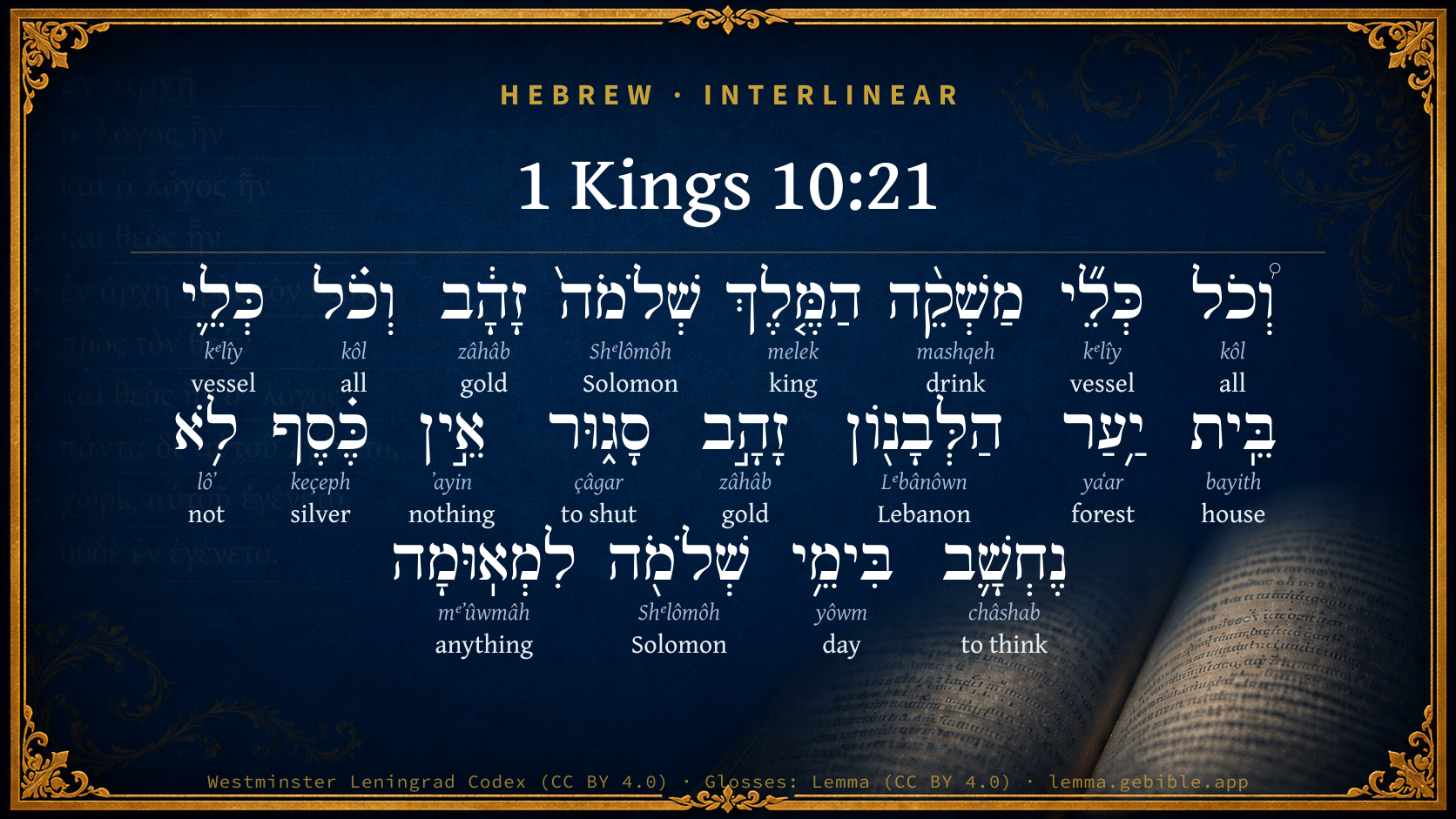
Hebrew (Westminster Leningrad Codex) 1 Kings 10:21 appears in the Hebrew Old Testament. The text above is from the Westminster Leningrad Codex. Each word links to its Strong’s number, a concise gloss, and parsing drawn from the Open Scriptures Hebrew Bible morphology. Click any word for its full Brown-Driver-Briggs (BDB) entry.
Download image
Cite this verse

1 Kings 10:21 (World English Bible). Public Domain. Lemma interlinear Bible study tool, https://lemma.gebible.app/v/1-kings/10/21.

Show BibTeX & RIS
BibTeX
RIS
English Translation
All king Solomon's drinking vessels were of gold, and all the vessels of the house of the forest of Lebanon were of pure gold: none were of silver; it was nothing accounted of in the days of Solomon.
World English Bible · Public Domain
Download a study sheet

One document with this verse’s original text, its word-by-word gloss line, the meaning frame, cross-references with their text, attributed commentary, and full source and license credits — printable, and it pastes into notes with its structure intact.

This verse Autodidact and up

Study sheet (.html) Plain text (.txt)

A passage Seminary Student

Up to 50 verses in one chapter. A passage sheet keeps up to 6 commentary sources and 12 cross-references per verse, in the order this page ranks them, and says so on the sheet whenever that leaves anything out. Ask for a single verse and you get the Autodidact verse sheet above.

Everything on this page stays free to read, with no account — the sheet is a download of what is already on screen, not access to it.

Want to remove ads? Support Godless Engineer
Compare translations 3

The same verse in 3 English versions, stacked beneath the original-language interlinear above. Click any original word for its lexicon entry.

Each is an independent rendering of the whole verse — the interlinear is not word-aligned to these translations.

Highlighted words mark where these versions differ — a whole-verse word diff, not a word-by-word alignment.

  • World English Bible Public Domain
    All king Solomon's drinking vessels were of gold, and all the vessels of the house of the forest of Lebanon were of pure gold: none were of silver; it was nothing accounted of in the days of Solomon.
  • King James Version Public Domain
    And all king Solomon's drinking vessels were of gold, and all the vessels of the house of the forest of Lebanon were of pure gold; none were of silver: it was nothing accounted of in the days of Solomon.
  • unfoldingWord Literal Text CC BY-SA 4.0
    And all of the vessels of the drink of King Solomon were gold, and all of the vessels of the House of the Forest of Lebanon were beaten gold. no silver. It was not reckoned as anything in the days of Solomon.

unfoldingWord Literal Text — © unfoldingWord, licensed CC BY-SA 4.0. Word-aligned USFM3 via Door43 (git.door43.org/unfoldingWord/en_ult).

Versions to compare (up to 4)

3 of 4 selected

Show all 18 translations

Every available English version of this verse, each an independent rendering of the whole verse.

  • World English Bible Public Domain
    All king Solomon's drinking vessels were of gold, and all the vessels of the house of the forest of Lebanon were of pure gold: none were of silver; it was nothing accounted of in the days of Solomon.
  • Berean Standard Bible Public Domain
    All King Solomon’s drinking cups were gold, and all the utensils of the House of the Forest of Lebanon were pure gold. There was no silver, because it was accounted as nothing in the days of Solomon.
  • Majority Standard Bible Public Domain
    All King Solomon’s drinking cups were gold, and all the utensils of the House of the Forest of Lebanon were pure gold. There was no silver, because it was accounted as nothing in the days of Solomon.
  • King James Version Public Domain
    And all king Solomon's drinking vessels were of gold, and all the vessels of the house of the forest of Lebanon were of pure gold; none were of silver: it was nothing accounted of in the days of Solomon.
  • American Standard Version (1901) Public Domain
    And all king Solomon's drinking vessels were of gold, and all the vessels of the house of the forest of Lebanon were of pure gold: none were of silver; it was nothing accounted of in the days of Solomon.
  • Revised Version (1885) Public Domain
    And all king Solomon’s drinking vessels were of gold, and all the vessels of the house of the forest of Lebanon were of pure gold: none were of silver; it was nothing accounted of in the days of Solomon.
  • Geneva Bible (1599) Public Domain
    And all King Salomons drinking vessels were of golde, and all the vessels of the house of the woode of Lebanon were of pure golde, none were of siluer: for it was nothing esteemed in the dayes of Salomon.
  • Douay-Rheims (1899) Public Domain
    Moreover all the vessels, out of which king Solomon drank, were of gold: and all the furniture of the house of the forest of Libanus was of most pure gold: there was no silver, nor was any account made of it in the days of Solomon:
  • Young's Literal Translation Public Domain
    And all the drinking vessels of king Solomon `are' of gold, and all the vessels of the house of the forest of Lebanon `are' of refined gold -- there are none of silver; it was not reckoned in the days of Solomon for anything,
  • Literal Standard Version CC BY-SA 4.0
    And all the drinking vessels of King Solomon [are] of gold, and all the vessels of the House of the Forest of Lebanon [are] of refined gold—there are none of silver; it was not reckoned in the days of Solomon for anything,
  • Unlocked Literal Bible CC BY-SA 4.0
    All King Solomon's drinking cups were gold, and all the drinking cups in the Palace of the Forest of Lebanon were of pure gold. None were silver, because silver was not considered valuable in Solomon's days.
  • unfoldingWord Literal Text CC BY-SA 4.0
    And all of the vessels of the drink of King Solomon were gold, and all of the vessels of the House of the Forest of Lebanon were beaten gold. no silver. It was not reckoned as anything in the days of Solomon.
  • Darby Bible Public Domain
    And all king Solomon's drinking vessels were of gold, and all the vessels of the house of the forest of Lebanon were of precious gold: none were of silver, [which] was not of the least account in the days of Solomon.
  • World Messianic Bible Public Domain
    All King Solomon’s drinking vessels were of gold, and all the vessels of the House of the Forest of Lebanon were of pure gold. None were of silver, because it was considered of little value in the days of Solomon.
  • Webster's Bible Public Domain
    And all king Solomon's drinking vessels were of gold, and all the vessels of the house of the forest of Lebanon were of pure gold; none were of silver: it was nothing accounted of in the days of Solomon.
  • Free Bible Version CC BY-SA 4.0
    All of King Solomon's drinking cups were gold, and all the utensils of the Palace of the Forest of Lebanon were pure gold. No silver was used, because it was not valued in the days of Solomon.
  • Bible in Basic English Public Domain
    And all King Solomon's drinking-vessels were of gold, and all the vessels of the house of the Woods of Lebanon were of the best gold; not one was of silver, for no one gave a thought to silver in the days of King Solomon.
  • JPS Tanakh (1917) Public Domain
    And all king Solomon's drinking-vessels were of gold, and all the vessels of the house of the forest of Lebanon were of pure gold; none were of silver; it was nothing accounted of in the days of Solomon.

Literal Standard Version (2020), Covenant Press — licensed CC BY-SA 4.0. Text via the HelloAO Bible API (eBible.org). Unlocked Literal Bible (unfoldingWord) — licensed CC BY-SA 4.0. Text via the HelloAO Bible API (eBible.org). unfoldingWord Literal Text — © unfoldingWord, licensed CC BY-SA 4.0. Word-aligned USFM3 via Door43 (git.door43.org/unfoldingWord/en_ult). Free Bible Version, Dr. Jonathan Gallagher — licensed CC BY-SA 4.0. Text via the HelloAO Bible API (eBible.org).

Word by word

More ways to search: Search by grammar → Find every occurrence → Compare this word →

Practice this passage: Drill this verse → Learn its vocabulary →

מַשְׁקֵ֨ה
mashqeh
H4945
“drink of”
Noun, Common, Masculine, Singular, Construct
Part of Speech
Noun
Type
Common
Gender
Masculine
Number
Singular
State
Construct
Full BDB Definition

Origin: from H8248

TWOT: 2452c

irrigation, drink - irrigation - drink, drinking vessels - butlership (office of butler) - butler, cup-bearer
  1. וְ֠כֹל kôl H3605 “and · all of” Conjunction + Noun, Common, Masculine, Singular, Construct
  2. כְּלֵ֞י kᵉlîy H3627 “vessels of” Noun, Common, Masculine, Plural, Construct
  3. הַמֶּ֤לֶךְ melek H4428 “the · king” Particle, Definite Article + Noun, Common, Masculine, Singular, Absolute
  4. שְׁלֹמֹה֙ Shᵉlômôh H8010 “Solomon” Noun, Proper
  5. זָהָ֔ב zâhâb H2091 “gold” Noun, Common, Masculine, Singular, Absolute
  6. וְכֹ֗ל kôl H3605 “and · all of” Conjunction + Noun, Common, Masculine, Singular, Construct
  7. כְּלֵ֛י kᵉlîy H3627 “vessels of” Noun, Common, Masculine, Plural, Construct
  8. בֵּֽית bayith H1004 “house of” Noun, Common, Masculine, Singular, Construct
  9. יַ֥עַר yaʻar H3293 “forest of” Noun, Common, Masculine, Singular, Construct
  10. הַלְּבָנ֖וֹן Lᵉbânôwn H3844 “the · Lebanon” Particle, Definite Article + Noun, Proper
  11. זָהָ֣ב zâhâb H2091 “gold” Noun, Common, Masculine, Singular, Absolute
  12. סָג֑וּר çâgar H5462 “pure” Noun, Common, Masculine, Singular, Absolute
  13. אֵ֣ין ʼayin H369 “nothing” Particle, Negative
  14. כֶּ֗סֶף keçeph H3701 “silver” Noun, Common, Masculine, Singular, Absolute
  15. לֹ֥א lôʼ H3808 “not” Particle, Negative
  16. נֶחְשָׁ֛ב châshab H2803 “thinking” Verb, Niphal, Participle Active, Masculine, Singular, Absolute
  17. בִּימֵ֥י yôwm H3117 “in/at · days of” Preposition + Noun, Common, Masculine, Plural, Construct
  18. שְׁלֹמֹ֖ה Shᵉlômôh H8010 “Solomon” Noun, Proper
  19. לִמְאֽוּמָה mᵉʼûwmâh H3972 “to/for · anything” Preposition + Noun, Common, Feminine, Singular, Absolute

About this verse

These counts appear in no published source. They are computed here, from the morphology-tagged text and Lemma’s own curated glosses. What Lemma adds →

20
words
16
distinct lemmas
Historical
section

Notable vocabulary

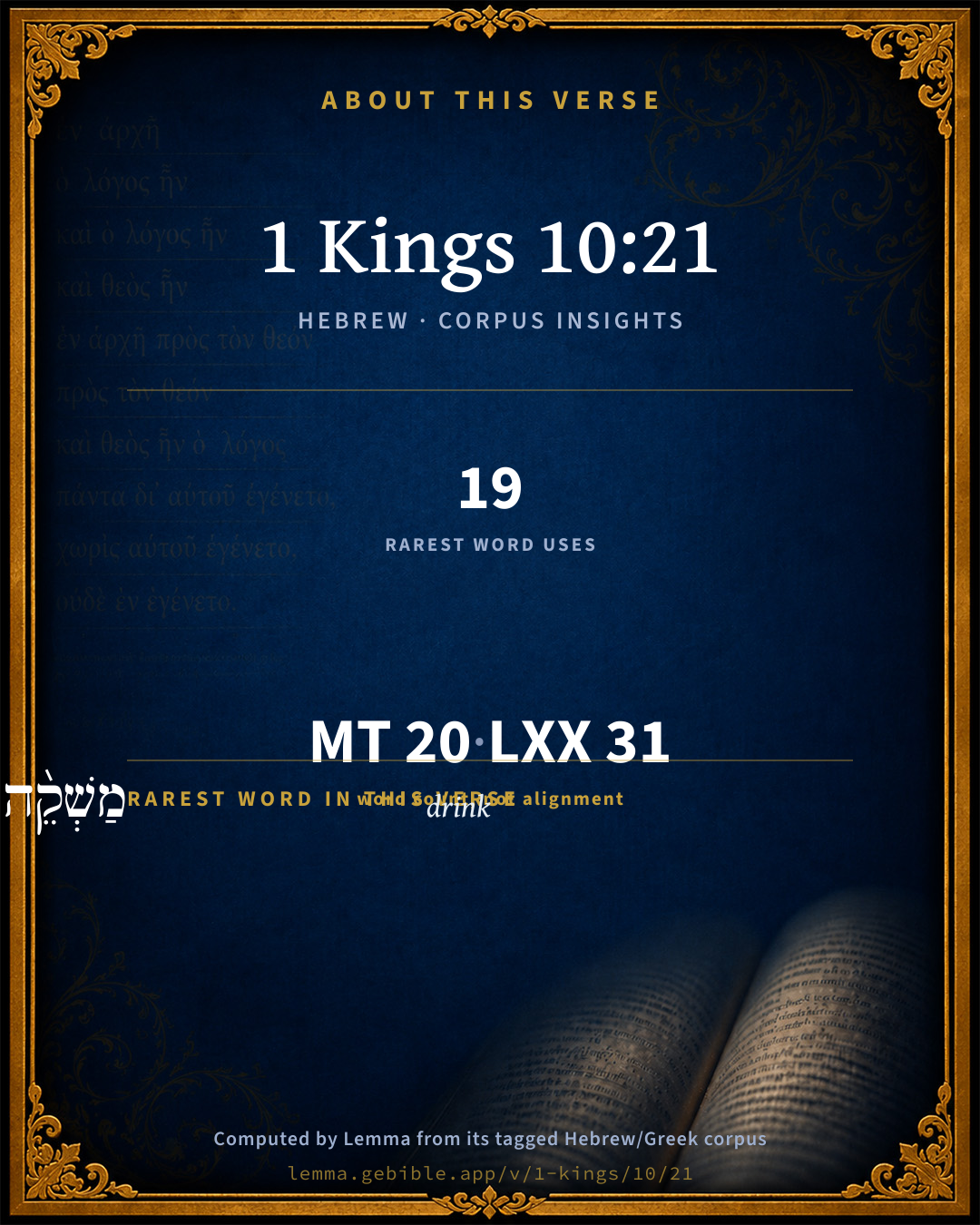
The rarest word here is מַשְׁקֵ֨ה drink H4945 — appearing just 19 times in the whole Hebrew Bible.

Shared distinctive vocabulary

מַשְׁקֵ֨ה drink H4945 occurs in 18 verses of the Hebrew Bible. Also found in:

Grammatical profile

  • 1 verb
  • 17 nouns
  • 2 particles

Verb forms

  • נֶחְשָׁ֛ב Niphal · Participle Active

Repetition

Words recur within this verse — often emphatic in Hebrew:

  • וְ֠כֹל all H3605 ×2
  • כְּלֵ֞י vessel H3627 ×2
  • שְׁלֹמֹה֙ Solomon H8010 ×2
  • זָהָ֔ב gold H2091 ×2

Hebrew & Septuagint length

In English translation the verse runs 38 words from the Hebrew and 46 from the Septuagint (LXX English) — closely comparable.

A rough comparison of the two English renderings, which tokenize alike — not a word-level alignment.

Word counts can differ between the Hebrew and the Greek without any difference in meaning — e.g. the Hebrew direct-object marker אֵת has no separate Greek word, and Greek often adds the article ὁ.

In the original languages it is 20 Hebrew tokens and 31 Greek tokens — but the two are counted differently (Hebrew bundles its prefixes and suffixes into one token; the Greek is in lemma form), so that isn’t a like-for-like length.

Cross-references

3

Topical passages linked to 1 Kings 10:21 in the Treasury of Scripture Knowledge — connected by theme and wording, ordered by reader-vote popularity; previews shown in the World English Bible.

  • 1 Kings 10:17 [he made] three hundred shields of beaten gold; three minas of gold went to one shield: and the king put them in the house of the forest of Lebanon.
  • 1 Kings 7:2 For he built the house of the forest of Lebanon; the length of it was one hundred cubits, and the breadth of it fifty cubits, and the height of it thirty cubits, on four rows of cedar pillars, with cedar beams on the pillars.
  • 2 Chronicles 9:20–22 All king Solomon's drinking vessels were of gold, and all the vessels of the house of the forest of Lebanon were of pure gold: silver was nothing accounted of in the days of Solomon.

Cross-references courtesy of OpenBible.info (CC BY 4.0).

Hebrew and Greek witnesses Masoretic Hebrew ↔ Greek Septuagint

The same verse in the two great witnesses to the Old Testament, shown verse-for-verse.

These are two independent witnesses, not word-aligned to each other, and the Septuagint is shown in lemma (dictionary) form.

Hebrew 1 Kings 10:21 Masoretic · Westminster Leningrad Codex

וְ֠כֹל כְּלֵ֞י מַשְׁקֵ֨ה הַמֶּ֤לֶךְ שְׁלֹמֹה֙ זָהָ֔ב וְכֹ֗ל כְּלֵ֛י בֵּֽית יַ֥עַר הַלְּבָנ֖וֹן זָהָ֣ב סָג֑וּר אֵ֣ין כֶּ֗סֶף לֹ֥א נֶחְשָׁ֛ב בִּימֵ֥י שְׁלֹמֹ֖ה לִמְאֽוּמָה

All king Solomon's drinking vessels were of gold, and all the vessels of the house of the forest of Lebanon were of pure gold: none were of silver; it was nothing accounted of in the days of Solomon.

World English Bible · Public Domain

Greek LXX 1 Kings 10:21 Septuagint · lemma form

καί πᾶς ὁ σκεῦος ὁ πότος σαλωμών χρυσοῦς καί λουτήρ χρυσοῦς πᾶς ὁ σκεῦος οἶκος δρυμός ὁ λίβανος χρυσίον συνκλείω οὐ εἰμί ἀργύριον ὅτι οὐ εἰμί λογίζομαι ἐν ὁ ἡμέρα σαλωμών

And all the vessels made by Solomon were of gold, and the lavers were golden, and all the vessels of the house of the forest of Lebanon were of pure gold; there was no silver, for it was not accounted of in the days of Solomon.

LXX2012 (modern English Septuagint) · Public Domain

On this verse, The Cambridge Bible for Schools and Colleges discusses the Septuagint’s reading. Read the note in Commentary ↓

Hebrew: Westminster Leningrad Codex (CC BY 4.0). Greek: Septuagint (public domain); English from LXX2012 (modern English Septuagint) (Public Domain). How the Septuagint differs from the Hebrew →

Targum (Aramaic paraphrase)

1

The Targum is the ancient Jewish Aramaic paraphrase of the Hebrew Scriptures — an interpretive translation, not the Hebrew text itself. Onkelos (literal) and Pseudo-Jonathan (expansive) render the Torah, and Jonathan the Prophets. Coverage is partial: where no permissively-licensed English translation exists for a verse, only the Aramaic is shown. This is verse-level text, not a word-by-word alignment to the Hebrew.

  1. Targum Jonathan Prophets (Joshua–Malachi)
    וְכָל מָנֵי מִשְׁתַּיָא דְמַלְכָּא שְׁלֹמֹה דַהֲבָא וְכָל מָנֵי בֵּית מְקֵרַת מַלְכָּא דַהֲבָא טָבָא לֵית כַּסְפָּא לָא אִתְחֲשִׁיב בְּיוֹמֵי שְׁלֹמֹה לְמִדָעַם:

    (no public-domain English translation for this verse)

    Targum Jonathan — Aramaic: “Mikraot Gedolot” (public domain). English: “Sefaria Community Translation” (CC0 1.0 (public-domain dedication)); “London "Chaldee Paraphrase," 1871” (public domain). Text via Sefaria.

Commentary

Notes on 1 Kings 10:21 from classic Christian and Jewish commentators (each source and its license shown beneath its notes). The classic Christian expositions comment on the surrounding passage and are grouped to its opening verse, so a note may address several verses; the Jewish commentaries on the Tanakh (Rashi and others) are per-verse, so they appear only where the commentator wrote on this verse.

Lemma curates 59 commentaries, every one of them public domain or Creative Commons licensed, each selected and text-cleaned for this edition rather than reprinted as found. About our sources →

Trapp's Complete Commentary

John Trapp

1Ki 10:21 And all king Solomon’s drinking vessels [were of] gold, and all the vessels of the house of the forest of Lebanon [were of] pure gold; none [were of] silver: it was nothing accounted of in the days of Solomon.

Ver. 21. And all king Solomon’s drinking vessels were of gold.] This was both for state and wholesomeness, if that be true which is reported, viz., that if poison be put into a cup of pure gold it hisseth, and so discovereth itself to be poison. Of Prester John, the lord of Africa, it is reported, that as for his scutcheon of arms (guard) he hath a lion standing, and holding in his paw a cross lifted up: so in his greatest solemnities, he causeth to be carried before him a golden cup filled within with dirt, and without also bedaubed therewith, yet so as that the gold appeareth; near unto this cup is carried a rich crucifix: and all to set forth the condition of man, who did once and should still shine as gold, but it is both within and without polluted with sin, till restored by Christ crucified, &c. {a} It is fore-prophesied by Zechariah, that in the days of the gospel every pot and bowl in Jerusalem shall be "holiness to the Lord." {Zec 14:20-21} This is "better than gold, yea, than fine gold."

It was nothing accounted of.] It was well accounted of, {1Ki 10:22; 1Ki 10:25} but nothing so much as in other lands, and as now-a-days amongst us: where money beareth the mastery, and few such Medes are to be found as regard not silver, and as for gold they delight not in it. {Isa 13:17}

{a} Selneccer., Paedagog. Christian., pars ii. p. 118.

John Trapp, A Commentary or Exposition upon All the Books of the Old and New Testament (1647–1656) — public domain. Text from a community e-Sword module.

Joseph Benson's Commentary

1Ki 10:21. It was nothing accounted of in the days of Solomon — Comparatively, and about his palace; for it is not to be supposed that all his subjects had so much gold as to make no account of silver. But if gold in abundance would make silver seem so despicable, shall not wisdom and grace, and the foretastes of heaven, make gold seem much more so?

Joseph Benson's Commentary on the Old and New Testaments (1811–1818) — public domain. Text from a community e-Sword module.

Ellicott's Commentary for English Readers

(21) None were of silver . . .—See 2Ch_9:27, “The king made silver in Jerusalem as stones.” The importation of silver (see 1Ki_10:22) was by the navy of Tarshish; and the mention of the plentifulness of silver seems the reason for noticing the existence of this navy.

A Bible Commentary for English Readers, edited by Charles John Ellicott (1878–1897) — public domain. Text from a community e-Sword module.

The Cambridge Bible for Schools and Colleges

gen. ed. J. J. S. Perowne

21. all king Solomon’s drinking vessels] The LXX. here leaves out the defining word, merely putting σκεύη = vessels, but adds afterwards, what has nothing to represent it in our Hebrew, καὶ λουτῆρες χρυσοῖ, ‘and golden la vers.’

The Cambridge Bible for Schools and Colleges (gen. ed. J. J. S. Perowne; Cambridge University Press, 1878–1918) — public domain. Text from a community e-Sword module.

John Gill's Exposition

And all King Solomon's drinking vessels were of gold,.... Such quantities of it were brought to him from Ophir, and paid to him in tribute, and given him as presents:

and all the vessels of the forest of Lebanon were of pure gold; not only what were used in his palace at Jerusalem, but in his country house at some little distance:

none were of silver; it was nothing accounted of in the days of Solomon; to make plate of; or silver plate was but little esteemed, and scarce any use of it made in Solomon's palace, if at all: though doubtless it was elsewhere, and especially silver as money.

John Gill's Exposition of the Whole Bible (1746–1763) — public domain (CC PDM 1.0). Text via the HelloAO Bible API.

Haydock's Catholic Bible Commentary

No silver vessels, (Calmet) though there was a great abundance of that metal, ver. 27. It was not deemed worthy to be admitted at the king’s table. (Haydock)

George Leo Haydock (1774–1849), Haydock's Catholic Family Bible and Commentary, 1859 edition — public domain. Excludes Psalms (Douay-Rheims chapter numbering differs from Protestant) and Deuterocanonical books (Catholic canon only).

Matthew Poole's English Annotations

Comparatively; such hyperbolical expressions being frequent, both in Scripture and other authors.

Matthew Poole's English Annotations on the Holy Bible (1683–1685) — public domain. Text from a community e-Sword/MySword module.

The Pulpit Commentary

And king Solomon"s drinking vessels were of gold as were those of Assyria and Babylon. This lavish display of wealth was characteristic of Oriental courts. Rawlinson quotes Chardin"s description of the splendour of the court of Persia, Tout est d"or massif," etc., and adds, "Both Symes and Yule note a similar use of gold utensils by the king of Ava (Symes, p. 372; Yule, p. 84)", and all the vessels of the house of the forest of Lebanon were of pure gold rWgs, see on 1Ki_6:20.

LXX crusiw sugkekleismena. This immense quantity of gold is quite paralleled in the accounts of profane writers. "Sardanapalus, when Nineveh was besieged, had 150 golden bedsteads, 150 golden tables, a million talents of gold, ten times as much silver, etc. (Ctesias, ap. Athenaeus, 12. p. 29). No less than 7170 talents of gold were used for the vessels andstatues of the temple of Bel in Babylon.. Alexander"s pillage of Ectabana was estimated at 120, 000 talents of gold," etc. (Bahr, in loc.); none were of silver Heb. none silver. The Marg., "there was no silver in them," i.e., they were unalloyed, is a misapprehension of the true meaning: it was nothing accounted of in the days of Solomon.

The Pulpit Commentary (1880–1919), ed. H.D.M. Spence-Jones & Joseph S. Exell — public domain. Text from a community e-Sword module.

John Wesley's Explanatory Notes

Nothing - Comparatively. Such hyperbolical expressions are frequent both in scripture and other authors. But if gold in abundance, would make silver seem so despicable, shall not wisdom and grace, and the foretastes of heaven, make gold seem much more so?

John Wesley, Explanatory Notes Upon the Whole Bible (1754–1765) — public domain. Text via the GEBible commentary corpus.

Keil & Delitzsch

C. F. Keil & F. Delitzsch

The drinking vessels of Solomon also were all of gold, and all the vessels of the house of the forest of Lebanon of costly gold (סגוּר: see at Kg1 6:20). Silver was counted as nothing, because the Tarshish fleet arrived once in three years, bringing gold, silver, etc. (see at Kg1 9:28).

Keil & Delitzsch — Biblical Commentary on the Old Testament (1861–1891) — public domain (CC PDM 1.0). Text via the HelloAO Bible API. (Old Testament only.)

unfoldingWord translationNotes

Door43 World Missions Community

the Palace of the Forest of Lebanon

"the house called the House of the Lebanon Forest." See how you translated this in 1 Kings 7:2.

ivory

Ivory is the hard, white substance from the tusks or teeth of large animals. See how you translated this in 1 Kings 10:18. (See: Translate Unknowns)

apes and baboons

These animals live wild in Africa. At the ends of their four limbs are what look like human hands and feet, and they have long tails. Some people consider baboons a type of ape. (See: Translate Unknowns)

translationWords

king

Solomon

gold

silver

unfoldingWord translationNotes — © Distant Shores Media and the Door43 World Missions Community, licensed CC BY-SA 4.0. Source: git.door43.org/Door43/en_tn.

Rashi

Rabbi Shlomo Yitzchaki (Rashi)

None of them were made of silver, as [silver] was not considered of value. There was no silver in any of them because it was not valuable.

Rashi on the Tanakh — English translations: “The Judaica Press complete Tanach with Rashi, translated by A. J. Rosenberg” (CC BY 4.0); “Pentateuch with Rashi's commentary by M. Rosenbaum and A.M. Silbermann, 1929-1934” (public domain); “The Metsudah Tanach series, Lakewood, N.J” (CC BY 4.0); and “The Book of Joshua, Metsudah Publications, 1997” (CC BY 4.0). Text via Sefaria.

Lesson kit

Teaching starters — assembled from the data on this page, not authored interpretation. Every prompt links to the verse data it draws on. Edit before teaching.

1 Kings, in the Historical, opens this verse with 20 words (16 distinct Hebrew lemmas). Its most distinctive word is mashqeh (“drink”). A historical commentator’s framing appears above. Read the whole chapter for the surrounding context.

Discussion questions

  1. How does “drink” (mashqeh) shape what this verse is saying?
  2. How does Genesis 13:10, which shares the word «drink», read alongside this verse?
  3. What does the repetition of “all” (2× in this one verse) do in this verse?
  4. The translations on this page render this verse differently — a whole-verse word diff, not a word-by-word alignment. What might account for the different wordings?
  5. «נֶחְשָׁ֛ב» is a Niphal Participle Active verb. How does that grammatical form shape the action described?
  6. Compare how Trapp's Complete Commentary and Joseph Benson's Commentary read this verse. Where do they agree or differ?

Things to notice

Reading settings

Reading text

Shown beneath each verse's original-language words.

Old Testament
Old Testament edition

Read the OT as the Masoretic Hebrew (MT) or the Greek Septuagint (LXX).

English shown for the Greek Septuagint (in the Hebrew ↔ Greek comparison).

Comparing translations? Open the Compare panel on any verse page to stack up to four side by side.