
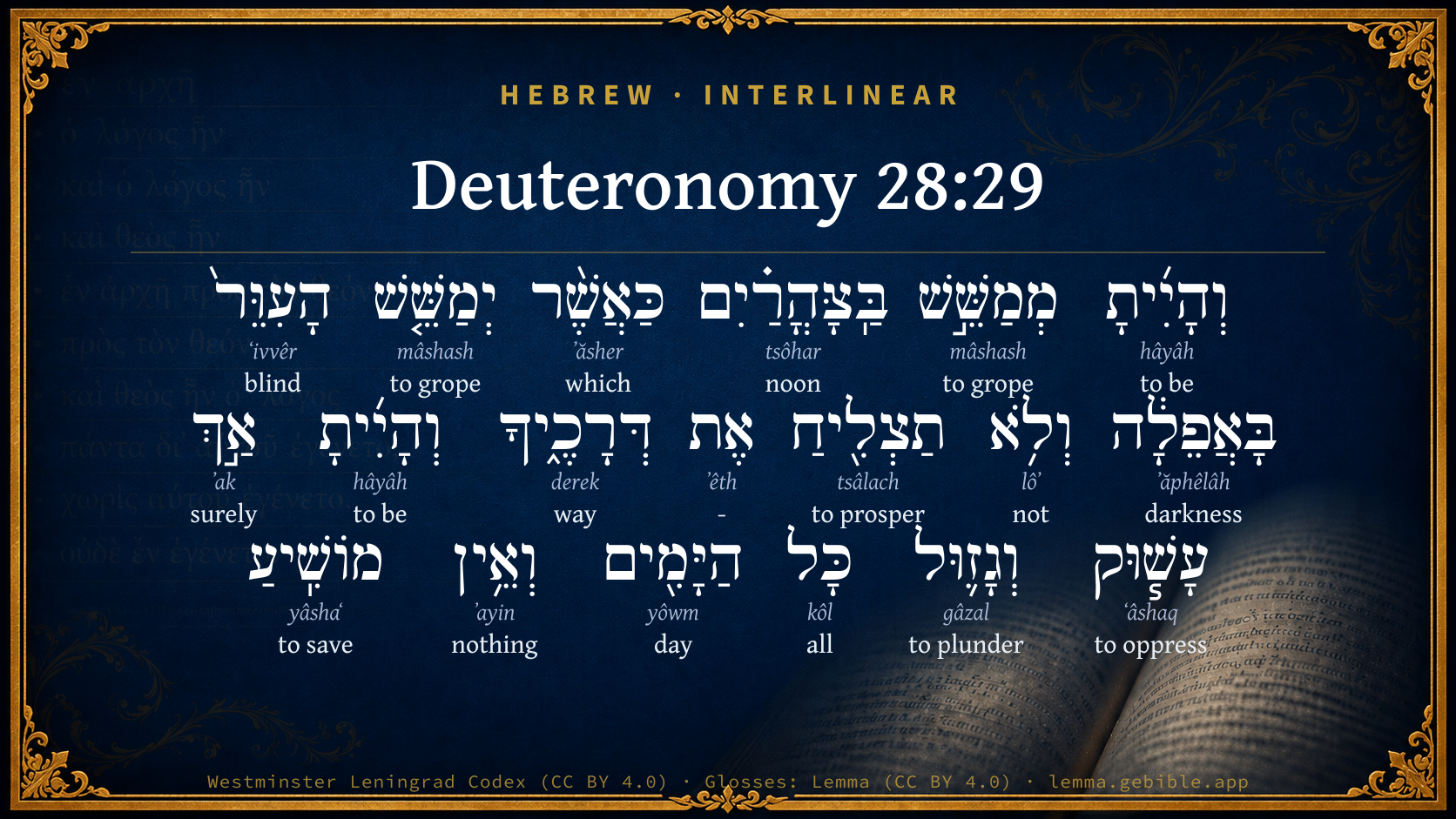
Deuteronomy 28:29

Hebrew (Westminster Leningrad Codex) Deuteronomy 28:29 appears in the Hebrew Old Testament. The text above is from the Westminster Leningrad Codex. Each word links to its Strong’s number, a concise gloss, and parsing drawn from the Open Scriptures Hebrew Bible morphology. Click any word for its full Brown-Driver-Briggs (BDB) entry.
Download image
Cite this verse

Deuteronomy 28:29 (World English Bible). Public Domain. Lemma interlinear Bible study tool, https://lemma.gebible.app/v/deuteronomy/28/29.

Show BibTeX & RIS
BibTeX
RIS
English Translation
and you shall grope at noonday, as the blind gropes in darkness, and you shall not prosper in your ways: and you shall be only oppressed and robbed always, and there shall be none to save you.
World English Bible · Public Domain
Download a study sheet

One document with this verse’s original text, its word-by-word gloss line, the meaning frame, cross-references with their text, attributed commentary, and full source and license credits — printable, and it pastes into notes with its structure intact.

This verse Autodidact and up

Study sheet (.html) Plain text (.txt)

A passage Seminary Student

Up to 50 verses in one chapter. A passage sheet keeps up to 6 commentary sources and 12 cross-references per verse, in the order this page ranks them, and says so on the sheet whenever that leaves anything out. Ask for a single verse and you get the Autodidact verse sheet above.

Everything on this page stays free to read, with no account — the sheet is a download of what is already on screen, not access to it.

Want to remove ads? Support Godless Engineer
Compare translations 3

The same verse in 3 English versions, stacked beneath the original-language interlinear above. Click any original word for its lexicon entry.

Each is an independent rendering of the whole verse — the interlinear is not word-aligned to these translations.

Highlighted words mark where these versions differ — a whole-verse word diff, not a word-by-word alignment.

  • World English Bible Public Domain
    and you shall grope at noonday, as the blind gropes in darkness, and you shall not prosper in your ways: and you shall be only oppressed and robbed always, and there shall be none to save you.
  • King James Version Public Domain
    And thou shalt grope at noonday, as the blind gropeth in darkness, and thou shalt not prosper in thy ways: and thou shalt be only oppressed and spoiled evermore, and no man shall save thee.
  • unfoldingWord Literal Text CC BY-SA 4.0
    And you will be groping about at noon like the blind grope in the darkness, and you will not succeed in your ways. And you shall again be oppressed and robbed all of the days, and there will be no deliverer.

unfoldingWord Literal Text — © unfoldingWord, licensed CC BY-SA 4.0. Word-aligned USFM3 via Door43 (git.door43.org/unfoldingWord/en_ult).

Versions to compare (up to 4)

3 of 4 selected

Show all 18 translations

Every available English version of this verse, each an independent rendering of the whole verse.

  • World English Bible Public Domain
    and you shall grope at noonday, as the blind gropes in darkness, and you shall not prosper in your ways: and you shall be only oppressed and robbed always, and there shall be none to save you.
  • Berean Standard Bible Public Domain
    and at noon you will grope about like a blind man in the darkness. You will not prosper in your ways. Day after day you will be oppressed and plundered, with no one to save you.
  • Majority Standard Bible Public Domain
    and at noon you will grope about like a blind man in the darkness. You will not prosper in your ways. Day after day you will be oppressed and plundered, with no one to save you.
  • King James Version Public Domain
    And thou shalt grope at noonday, as the blind gropeth in darkness, and thou shalt not prosper in thy ways: and thou shalt be only oppressed and spoiled evermore, and no man shall save thee.
  • American Standard Version (1901) Public Domain
    and thou shalt grope at noonday, as the blind gropeth in darkness, and thou shalt not prosper in thy ways: and thou shalt be only oppressed and robbed alway, and there shall be none to save thee.
  • Revised Version (1885) Public Domain
    and thou shalt grope at noonday, as the blind gropeth in darkness, and thou shalt not prosper in thy ways: and thou shalt be only oppressed and spoiled alway, and there shall be none to save thee.
  • Geneva Bible (1599) Public Domain
    Thou shalt also grope at noone daies, as the blinde gropeth in darknes, and shalt not prosper in thy wayes: thou shalt neuer but bee oppressed with wrong and be powled euermore, and no man shall succour thee.
  • Douay-Rheims (1899) Public Domain
    And mayst thou grope at midday as the blind is wont to grope in the dark, and not make straight thy ways. And mayst thou at all times suffer wrong, and be oppressed with violence, and mayst thou have no one to deliver thee.
  • Young's Literal Translation Public Domain
    and thou hast been gropling at noon, as the blind gropeth in darkness; and thou dost not cause thy ways to prosper; and thou hast been only oppressed and plundered all the days, and there is no saviour.
  • Literal Standard Version CC BY-SA 4.0
    and you have been groping at noon, as the blind gropes in darkness; and you do not cause your ways to prosper; and you have been only oppressed and plundered [for] all the days, and there is no savior.
  • Unlocked Literal Bible CC BY-SA 4.0
    You will grope about at noonday like the blind grope in the darkness, and you will not prosper in your ways; you will be always oppressed and robbed, and there will be no one to save you.
  • unfoldingWord Literal Text CC BY-SA 4.0
    And you will be groping about at noon like the blind grope in the darkness, and you will not succeed in your ways. And you shall again be oppressed and robbed all of the days, and there will be no deliverer.
  • Darby Bible Public Domain
    and thou shalt grope at noonday, as the blind gropeth in darkness, and thou shalt not prosper in thy ways; and thou shalt be only oppressed and spoiled continually, and there shall be none to save.
  • World Messianic Bible Public Domain
    You will grope at noonday, as the blind gropes in darkness, and you shall not prosper in your ways. You will only be oppressed and robbed always, and there will be no one to save you.
  • Webster's Bible Public Domain
    And thou shalt grope at noon-day, as the blind gropeth in darkness, and thou shalt not prosper in thy ways: and thou shalt be only oppressed and spoiled evermore, and no man shall save thee.
  • Free Bible Version CC BY-SA 4.0
    so that even at noon you will be groping around like a blind man in the dark. You won't be successful in what you do. You'll be persecuted and robbed the whole time, and no one will come and save you.
  • Bible in Basic English Public Domain
    You will go feeling your way when the sun is high, like a blind man for whom all is dark, and nothing will go well for you: you will be crushed and made poor for ever, and you will have no saviour.
  • JPS Tanakh (1917) Public Domain
    And thou shalt grope at noonday, as the blind gropeth in darkness, and thou shalt not make thy ways prosperous; and thou shalt be only oppressed and robbed alway, and there shall be none to save thee.

Literal Standard Version (2020), Covenant Press — licensed CC BY-SA 4.0. Text via the HelloAO Bible API (eBible.org). Unlocked Literal Bible (unfoldingWord) — licensed CC BY-SA 4.0. Text via the HelloAO Bible API (eBible.org). unfoldingWord Literal Text — © unfoldingWord, licensed CC BY-SA 4.0. Word-aligned USFM3 via Door43 (git.door43.org/unfoldingWord/en_ult). Free Bible Version, Dr. Jonathan Gallagher — licensed CC BY-SA 4.0. Text via the HelloAO Bible API (eBible.org).

Word by word

More ways to search: Search by grammar → Find every occurrence → Compare this word →

Practice this passage: Drill this verse → Learn its vocabulary →

מְמַשֵּׁ֣שׁ
mâshash
H4959
“groping”
Verb, Piel, Participle Active, Masculine, Singular, Absolute
Part of Speech
Verb
Stem
Piel
Form
Participle Active
Gender
Masculine
Number
Singular
State
Absolute
Full BDB Definition

Origin: a primitive root

TWOT: 1262

to feel, grope - (Qal) to feel, grope - (Piel) to feel over or through, grope - to feel through - to grope - (Hiphil) to feel
  1. וְהָיִ֜יתָ hâyâh H1961 “and · to be” Conjunction + Verb, Qal, Sequential Perfect, 2nd Person, Masculine, Singular
  2. בַּֽצָּהֳרַ֗יִם tsôhar H6672 “in/at the · noon” Preposition, Determined + Noun, Common, Masculine, Plural, Absolute
  3. כַּאֲשֶׁ֨ר ʼăsher H834 “like/as · which” Preposition + Particle, Relative
  4. יְמַשֵּׁ֤שׁ mâshash H4959 “to grope” Verb, Piel, Imperfect, 3rd Person, Masculine, Singular
  5. הָעִוֵּר֙ ʻivvêr H5787 “the · blind” Particle, Definite Article + Adjective, Adjective, Masculine, Singular, Absolute
  6. בָּאֲפֵלָ֔ה ʼăphêlâh H653 “in/at the · darkness” Preposition, Determined + Noun, Common, Feminine, Singular, Absolute
  7. וְלֹ֥א lôʼ H3808 “and · not” Conjunction + Particle, Negative
  8. תַצְלִ֖יחַ tsâlach H6743 “to prosper” Verb, Hiphil, Imperfect, 2nd Person, Masculine, Singular
  9. אֶת ʼêth H853 “-” Particle, Direct Object
  10. דְּרָכֶ֑יךָ derek H1870 “ways · your” Noun, Common, Both, Plural, Construct + Suffix, Personal, 2nd Person, Masculine, Singular
  11. וְהָיִ֜יתָ hâyâh H1961 “and · to be” Conjunction + Verb, Qal, Sequential Perfect, 2nd Person, Masculine, Singular
  12. אַ֣ךְ ʼak H389 “surely” Particle, Accusative
  13. עָשׁ֧וּק ʻâshaq H6231 “oppressed” Verb, Qal, Participle Passive, Masculine, Singular, Absolute
  14. וְגָז֛וּל gâzal H1497 “and · plundered” Conjunction + Verb, Qal, Participle Passive, Masculine, Singular, Absolute
  15. כָּל kôl H3605 “all of” Noun, Common, Masculine, Singular, Construct
  16. הַיָּמִ֖ים yôwm H3117 “the · days” Particle, Definite Article + Noun, Common, Masculine, Plural, Absolute
  17. וְאֵ֥ין ʼayin H369 “and · nothing” Conjunction + Particle, Negative
  18. מוֹשִֽׁיעַ yâshaʻ H3467 “saving” Verb, Hiphil, Participle Active, Masculine, Singular, Absolute

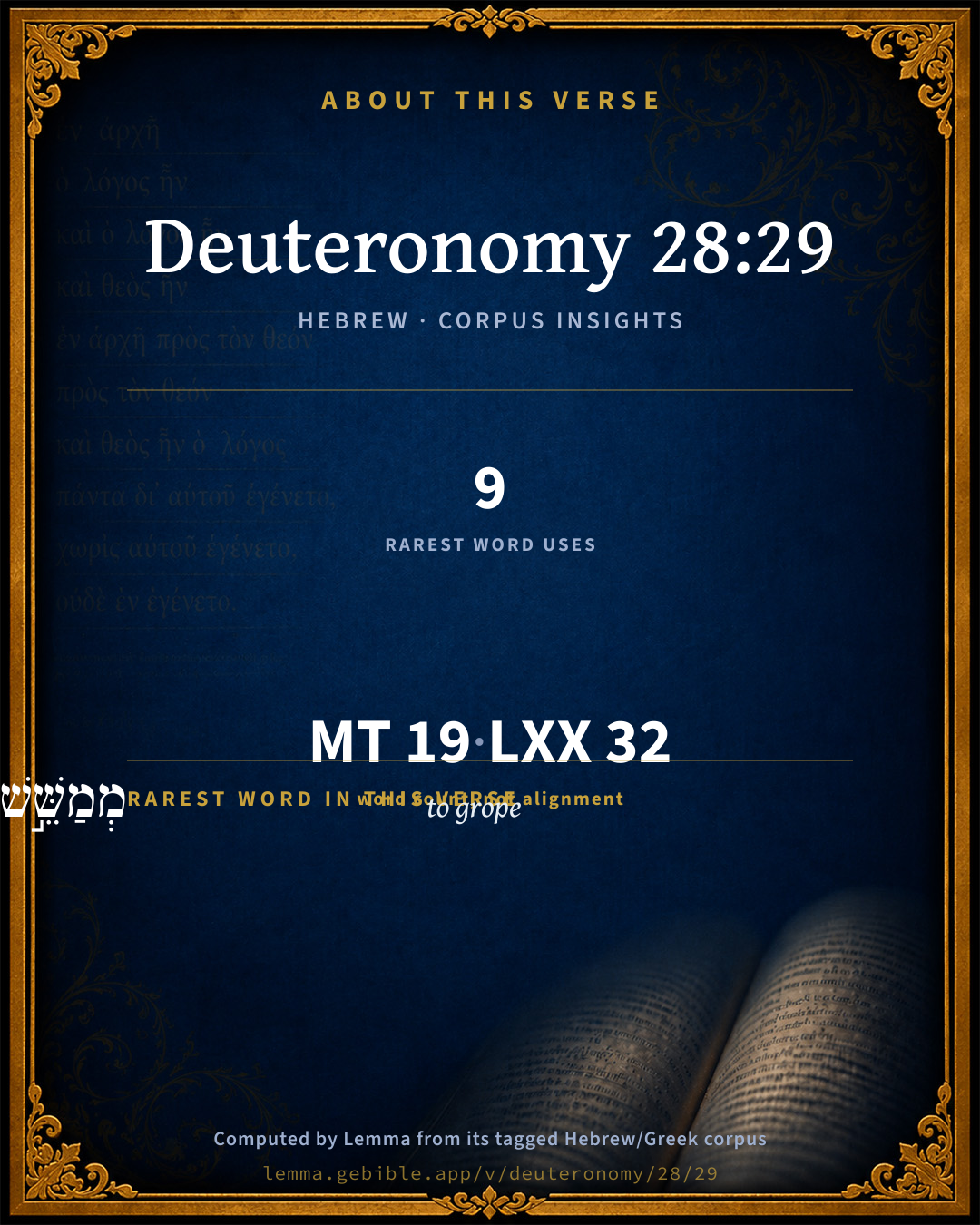
About this verse

These counts appear in no published source. They are computed here, from the morphology-tagged text and Lemma’s own curated glosses. What Lemma adds →

19
words
17
distinct lemmas
Pentateuch
section

Notable vocabulary

The rarest word here is מְמַשֵּׁ֣שׁ to grope H4959 — appearing just 9 times in the whole Hebrew Bible.

Shared distinctive vocabulary

מְמַשֵּׁ֣שׁ to grope H4959 occurs in 8 verses of the Hebrew Bible. Also found in:

Grammatical profile

  • 8 verbs
  • 5 nouns
  • 1 adjective
  • 5 particles

Verb forms

  • וְהָיִ֜יתָ Qal · Sequential Perfect
  • מְמַשֵּׁ֣שׁ Piel · Participle Active
  • יְמַשֵּׁ֤שׁ Piel · Imperfect
  • תַצְלִ֖יחַ Hiphil · Imperfect
  • וְהָיִ֜יתָ Qal · Sequential Perfect
  • עָשׁ֧וּק Qal · Participle Passive
  • וְגָז֛וּל Qal · Participle Passive
  • מוֹשִֽׁיעַ Hiphil · Participle Active

Repetition

Words recur within this verse — often emphatic in Hebrew:

  • וְהָיִ֜יתָ to be H1961 ×2
  • מְמַשֵּׁ֣שׁ to grope H4959 ×2

Hebrew & Septuagint length

In English translation the verse runs 37 words from the Hebrew and 39 from the Septuagint (LXX English) — closely comparable.

A rough comparison of the two English renderings, which tokenize alike — not a word-level alignment.

Word counts can differ between the Hebrew and the Greek without any difference in meaning — e.g. the Hebrew direct-object marker אֵת has no separate Greek word, and Greek often adds the article ὁ.

In the original languages it is 19 Hebrew tokens and 32 Greek tokens — but the two are counted differently (Hebrew bundles its prefixes and suffixes into one token; the Greek is in lemma form), so that isn’t a like-for-like length.

Cross-references

21

Topical passages linked to Deuteronomy 28:29 in the Treasury of Scripture Knowledge — connected by theme and wording, ordered by reader-vote popularity; previews shown in the World English Bible.

  • Isaiah 59:10 We grope for the wall like the blind; yes, we grope as those who have no eyes: we stumble at noonday as in the twilight; among those who are lusty we are as dead men.
  • Job 5:14 They meet with darkness in the day-time, And grope at noonday as in the night.
  • Judges 3:14 The children of Israel served Eglon the king of Moab eighteen years.
  • Judges 4:2–3 Yahweh sold them into the hand of Jabin king of Canaan, who reigned in Hazor; the captain of whose host was Sisera, who lived in Harosheth of the Gentiles.
  • Judges 6:1–6 The children of Israel did that which was evil in the sight of Yahweh: and Yahweh delivered them into the hand of Midian seven years.
  • Judges 10:8 They vexed and oppressed the children of Israel that year: eighteen years [oppressed they] all the children of Israel that were beyond the Jordan in the land of the Amorites, which is in Gilead.
  • Judges 13:1 The children of Israel again did that which was evil in the sight of Yahweh; and Yahweh delivered them into the hand of the Philistines forty years.
  • Psalms 106:40–42 Therefore Yahweh burned with anger against his people. He abhorred his inheritance.
  • 1 Samuel 13:5–7 The Philistines assembled themselves together to fight with Israel, thirty thousand chariots, and six thousand horsemen, and people as the sand which is on the sea-shore in multitude: and they came up, and encamped in Michmash, eastward of Beth Aven.
  • 1 Samuel 13:19–22 Now there was no smith found throughout all the land of Israel; for the Philistines said, Lest the Hebrews make them swords or spears:
  • Nehemiah 9:26–29 Nevertheless they were disobedient, and rebelled against you, and cast your law behind their back, and killed your prophets that testified against them to turn them again to you, and they committed awful blasphemies.
  • Nehemiah 9:37 It yields much increase to the kings whom you have set over us because of our sins: also they have power over our bodies, and over our cattle, at their pleasure, and we are in great distress.
  • Job 12:25 They grope in the dark without light. He makes them stagger like a drunken man.
  • Psalms 69:23–24 Let their eyes be darkened, so that they can't see. Let their backs be continually bent.
  • Lamentations 5:8 Servants rule over us: There is none to deliver us out of their hand.
  • Lamentations 5:17 For this our heart is faint; For these things our eyes are dim;
  • Zephaniah 1:17 I will bring distress on men, that they will walk like blind men, because they have sinned against Yahweh, and their blood will be poured out like dust, and their flesh like dung.
  • Acts 21:24 Take them, and purify yourself with them, and pay their expenses for them, that they may shave their heads. Then all will know that there is no truth in the things that they have been informed about you, but that you yourself also walk keeping the law.
  • Romans 11:7–10 What then? That which Israel seeks for, that he didn't obtain, but the chosen ones obtained it, and the rest were hardened.
  • Romans 11:25 For I don't desire, brothers, to have you ignorant of this mystery, so that you won't be wise in your own conceits, that a partial hardening has happened to Israel, until the fullness of the Gentiles has come in,
  • 2 Corinthians 4:3–4 Even if our Gospel is veiled, it is veiled in those who perish;

Cross-references courtesy of OpenBible.info (CC BY 4.0).

Hebrew and Greek witnesses Masoretic Hebrew ↔ Greek Septuagint

The same verse in the two great witnesses to the Old Testament, shown verse-for-verse.

These are two independent witnesses, not word-aligned to each other, and the Septuagint is shown in lemma (dictionary) form.

Hebrew Deuteronomy 28:29 Masoretic · Westminster Leningrad Codex

וְהָיִ֜יתָ מְמַשֵּׁ֣שׁ בַּֽצָּהֳרַ֗יִם כַּאֲשֶׁ֨ר יְמַשֵּׁ֤שׁ הָעִוֵּר֙ בָּאֲפֵלָ֔ה וְלֹ֥א תַצְלִ֖יחַ אֶת דְּרָכֶ֑יךָ וְהָיִ֜יתָ אַ֣ךְ עָשׁ֧וּק וְגָז֛וּל כָּל הַיָּמִ֖ים וְאֵ֥ין מוֹשִֽׁיעַ

and you shall grope at noonday, as the blind gropes in darkness, and you shall not prosper in your ways: and you shall be only oppressed and robbed always, and there shall be none to save you.

World English Bible · Public Domain

Greek LXX Deuteronomy 28:29 Septuagint · lemma form

καί εἰμί ψηλαφάω μεσημβρία ὡσεί ψηλαφάω ὁ τυφλός ἐν ὁ σκότος καί οὐ εὐοδόω ὁ ὁδός σύ καί εἰμί τότε ἀδικέω καί διαἁρπάζω πᾶς ὁ ἡμέρα καί οὐ εἰμί σύ ὁ βοηθέω

And you shall grope at mid-day, as a blind man would grope in the darkness, and you shall not prosper in your ways; and then you shall be unjustly treated, and plundered continually, and there shall be no helper.

LXX2012 (modern English Septuagint) · Public Domain

Hebrew: Westminster Leningrad Codex (CC BY 4.0). Greek: Septuagint (public domain); English from LXX2012 (modern English Septuagint) (Public Domain). How the Septuagint differs from the Hebrew →

Targum (Aramaic paraphrase)

2

The Targum is the ancient Jewish Aramaic paraphrase of the Hebrew Scriptures — an interpretive translation, not the Hebrew text itself. Onkelos (literal) and Pseudo-Jonathan (expansive) render the Torah, and Jonathan the Prophets. Coverage is partial: where no permissively-licensed English translation exists for a verse, only the Aramaic is shown. This is verse-level text, not a word-by-word alignment to the Hebrew.

  1. Targum Onkelos Torah (Genesis–Deuteronomy)
    וּתְהֵי מְמַשֵׁשׁ בְּטִּהֲרָא כְּמָא דִי מַשֵׁשׁ עַוִירָא בְּקַבְלָא וְלָא תַצְלַח יָת אָרְחָתָיךְ וּתְהֵי בְּרַם עָשִׁיק וְאָנִיס כָּל יוֹמַיָא וְלֵית דְפָרִיק

    (no public-domain English translation for this verse)

    Targum Onkelos — Aramaic: “Onkelos Genesis” (public domain); “Onkelos Exodus” (public domain); “Onkelos Leviticus” (public domain); “Onkelos Numbers” (public domain); “Onkelos Deuteronomy” (public domain). English: “Sefaria Community Translation” (CC0 1.0 (public-domain dedication)); “J.W. Etheridge. The Targums of Onkelos and Jonathan Ben Uzziel on the Pentateuch. London: Longmans, Green, 1862” (public domain). Text via Sefaria.

  2. Targum Pseudo-Jonathan Torah (Genesis–Deuteronomy)
    וְתֶהֱווֹן תְּבִיעִין מִילְכָּא טָבָא לִרְוָחֵי עֲקַתְכוֹן וְלָא יֶהֱוֵי בְּכוֹן מְחַוֵי קוּשְׁטָא הֵיכְמָא דִמְמַשֵׁשׁ סַמְיָא בְּקִיבְלָא דְלֵית לַעֲדֵי אוֹרְחָא לְמֶחֱמֵי לִמְכַוָונוּתְהוֹן בְּאָרְחָא וְלָא תַצְלְחוּן יַת אָרְחַתְכוֹן וְתֶהֱווֹן בְּרַם עַצְיַין וַאֲנִיסִין כָּל יוֹמַיָא וְלֵית דְפָרִיק

    And you will seek good counsel for enlargement from your adversities, but there will be none among you to show the truth, so that you will grope in darkness like the blind who have none passing by the road to see how to direct them in the way; nor shall you prosper in your ways, but be oppressed and afflicted all the days, without any to deliver.

    Targum Pseudo-Jonathan — Aramaic: “Targum Jonathan on Genesis” (public domain); “Targum Jonathan on Exodus” (public domain); “Targum Jonathan on Leviticus” (public domain); “Targum Jonathan on Numbers” (public domain); “Targum Jonathan on Deuteronomy” (public domain). English: “The Targum of Jonathan ben Uzziel, trans. J. W. Etheridge, London, 1862” (public domain). Text via Sefaria.

Commentary

Notes on Deuteronomy 28:29 from classic Christian and Jewish commentators (each source and its license shown beneath its notes). The classic Christian expositions comment on the surrounding passage and are grouped to its opening verse, so a note may address several verses; the Jewish commentaries on the Tanakh (Rashi and others) are per-verse, so they appear only where the commentator wrote on this verse.

Lemma curates 59 commentaries, every one of them public domain or Creative Commons licensed, each selected and text-cleaned for this edition rather than reprinted as found. About our sources →

Trapp's Complete Commentary

John Trapp

Deu 28:29 And thou shalt grope at noonday, as the blind gropeth in darkness, and thou shalt not prosper in thy ways: and thou shalt be only oppressed and spoiled evermore, and no man shall save [thee].

Ver. 29. And thou shalt be only oppressed.] As the Thebans, ever till then victorious, were, after the death of Epaminondas, famous only for their overthrows: as Rome, since Antichristian, was never besieged by an enemy, but it was taken and plundered: as the Jews since Christ’s death never attempted anything but miscarried. An evil, an only evil, &c. {Eze 7:5}

John Trapp, A Commentary or Exposition upon All the Books of the Old and New Testament (1647–1656) — public domain. Text from a community e-Sword module.

Geneva Bible (1599)

Geneva Bible translators

In things most evident and clear thou shalt lack discretion and judgment.

Geneva Bible (1599) marginal notes — public domain. Text via Bolls.life.

Jamieson, Fausset & Brown

Robert Jamieson, A. R. Fausset & David Brown

thou shalt grope at noonday--a general description of the painful uncertainty in which they would live. During the Middle Ages the Jews were driven from society into hiding-places which they were afraid to leave, not knowing from what quarter they might be assailed and their children dragged into captivity, from which no friend could rescue, and no money ransom them.

Jamieson, Fausset & Brown — Commentary Critical and Explanatory on the Whole Bible (1871) — public domain (CC PDM 1.0). Text via the HelloAO Bible API.

Adam Clarke's Commentary

Verse 29. Thou shalt be only oppressed, &c.] Perhaps no people under the sun have been more oppressed and spoiled than the rebellious Jews. Indeed, this has been their portion, with but little intermission, for nearly 1,800 years. And still they grope at noon day, as the blind gropeth in darkness-they do not yet discover, notwithstanding the effulgence of the light by which they are encompassed, that the rejection of their own Messiah is the cause of all their calamities.

Adam Clarke's Commentary on the Bible (1810–1826) — public domain. Text from a community e-Sword/MySword module.

Ellicott's Commentary for English Readers

(29) Thou shalt not prosper in thy ways.—The exact opposite is promised to Joshua (Deu_1:8) if he follows the Book of the Law. (Comp. Isa_29:10-14.) When men find it no longer possible to follow the word of God, it is written that “the wisdom of their wise men shall perish, and the understanding of their prudent men shall be hid.”

Oppressed.—The children of Israel and of Judah were “oppressed “together (Jer_50:33). But it is added, “Their Redeemer is strong” (Deu_28:34).

Spoiled.—The word occurs again in Deu_28:31 : “Violently taken away.”

A Bible Commentary for English Readers, edited by Charles John Ellicott (1878–1897) — public domain. Text from a community e-Sword module.

The Cambridge Bible for Schools and Colleges

gen. ed. J. J. S. Perowne

29. The mental weakness and even infatuation which possess nations and individuals physically debilitated lead to their oppression by stronger peoples; the details of which are illustrated in the next Deu_28:30-34.

The Cambridge Bible for Schools and Colleges (gen. ed. J. J. S. Perowne; Cambridge University Press, 1878–1918) — public domain. Text from a community e-Sword module.

John Gill's Exposition

Thy sons and thy daughters shall be given unto another people,.... This also was not true in the Babylonish captivity; for then their sons and daughters went with them, and continued with them, and returned again; but has been oftentimes verified since their captivity by the Romans; frequently their sons and daughters have been taken from them by force, to be brought up in another religion, by the edicts of kings and popes, and by the canons of councils, and particularly of the fourth council of Toledo:

and thine eyes shall look and fail; with longing:

for them all the day long; expecting every day their children would be returned to them, at least wishing and hoping they would; their hearts yearning after them, but all in vain:

and there shall be no might in thy hand; to recover them out of the hands of those who had the possession of them, or fetch them back from distant countries, whither they were carried. By an edict of the Portuguese, the children of the Jews were ordered to be carried to the uninhabited islands; and when, by the king's command, they were had to the ships in which they were to be transported, it is incredible, the Jewish historian says (l), what howlings and lamentations were made by the women; and there wore none pitied them and comforted them, or could help them.

(l) Shebet Judah, sive Hist. Jud. sect. 59. p. 332.

John Gill's Exposition of the Whole Bible (1746–1763) — public domain (CC PDM 1.0). Text via the HelloAO Bible API.

Haydock's Catholic Bible Commentary

Ways. Is not this visibly the present condition of the Jews, amid the blaze of the gospel light, the miracles and divine conduct of the Son of God! They shut their eyes, and will not acknowledge him for the Messias. (Calmet)

George Leo Haydock (1774–1849), Haydock's Catholic Family Bible and Commentary, 1859 edition — public domain. Excludes Psalms (Douay-Rheims chapter numbering differs from Protestant) and Deuterocanonical books (Catholic canon only).

Matthew Poole's English Annotations

At noon-day, i.e. in the most clear and evident matters thou shalt grossly mistake and miss thy way.

Thou shalt not prosper in thy ways; thy counsels and enterprises shall be frustrated, and turn to thy destruction.

Matthew Poole's English Annotations on the Holy Bible (1683–1685) — public domain. Text from a community e-Sword/MySword module.

Whedon's Commentary on the Bible

Daniel D. Whedon

29. Grope at noonday — In the clear light of God’s requirements they will be blind. Comp. Joh_12:35.

Daniel D. Whedon (gen. ed.), Commentary on the Old and New Testaments (1874–1909) — public domain. Text from a community e-Sword module.

John Wesley's Explanatory Notes

Grope at noon day - In the most clear and evident matters thou shalt grossly mistake. Thy ways - Thy counsels and enterprizes shall be frustrated and turn to thy destruction.

John Wesley, Explanatory Notes Upon the Whole Bible (1754–1765) — public domain. Text via the GEBible commentary corpus.

Rashi

Rabbi Shlomo Yitzchaki (Rashi)

עשוק [THOU SHALT BE] WRONGED — i.e. against every action of yours there will be dispute.

Rashi on the Tanakh — English translations: “The Judaica Press complete Tanach with Rashi, translated by A. J. Rosenberg” (CC BY 4.0); “Pentateuch with Rashi's commentary by M. Rosenbaum and A.M. Silbermann, 1929-1934” (public domain); “The Metsudah Tanach series, Lakewood, N.J” (CC BY 4.0); and “The Book of Joshua, Metsudah Publications, 1997” (CC BY 4.0). Text via Sefaria.

Lesson kit

Teaching starters — assembled from the data on this page, not authored interpretation. Every prompt links to the verse data it draws on. Edit before teaching.

Deuteronomy, in the Pentateuch, opens this verse with 19 words (17 distinct Hebrew lemmas). Its most distinctive word is mâshash (“to grope”). A historical commentator’s framing appears above. Read the whole chapter for the surrounding context.

Discussion questions

  1. How does “to grope” (mâshash) shape what this verse is saying?
  2. Genesis 27:12 shares the word «to grope» with this verse. How do the two illuminate each other?
  3. “to be” occurs 2× in this one verse. What is the effect of the repetition?
  4. These translations render this verse differently; the difference is in the English rendering, not the original. What questions does that raise?
  5. The verb «וְהָיִ֜יתָ» is Qal Sequential Perfect. How does its form color the action?
  6. Reading how Trapp's Complete Commentary and Geneva Bible (1599) read this verse, where do the two commentators agree and where do they part?

Things to notice

Reading settings

Reading text

Shown beneath each verse's original-language words.

Old Testament
Old Testament edition

Read the OT as the Masoretic Hebrew (MT) or the Greek Septuagint (LXX).

English shown for the Greek Septuagint (in the Hebrew ↔ Greek comparison).

Comparing translations? Open the Compare panel on any verse page to stack up to four side by side.