
1 Kings 3:18

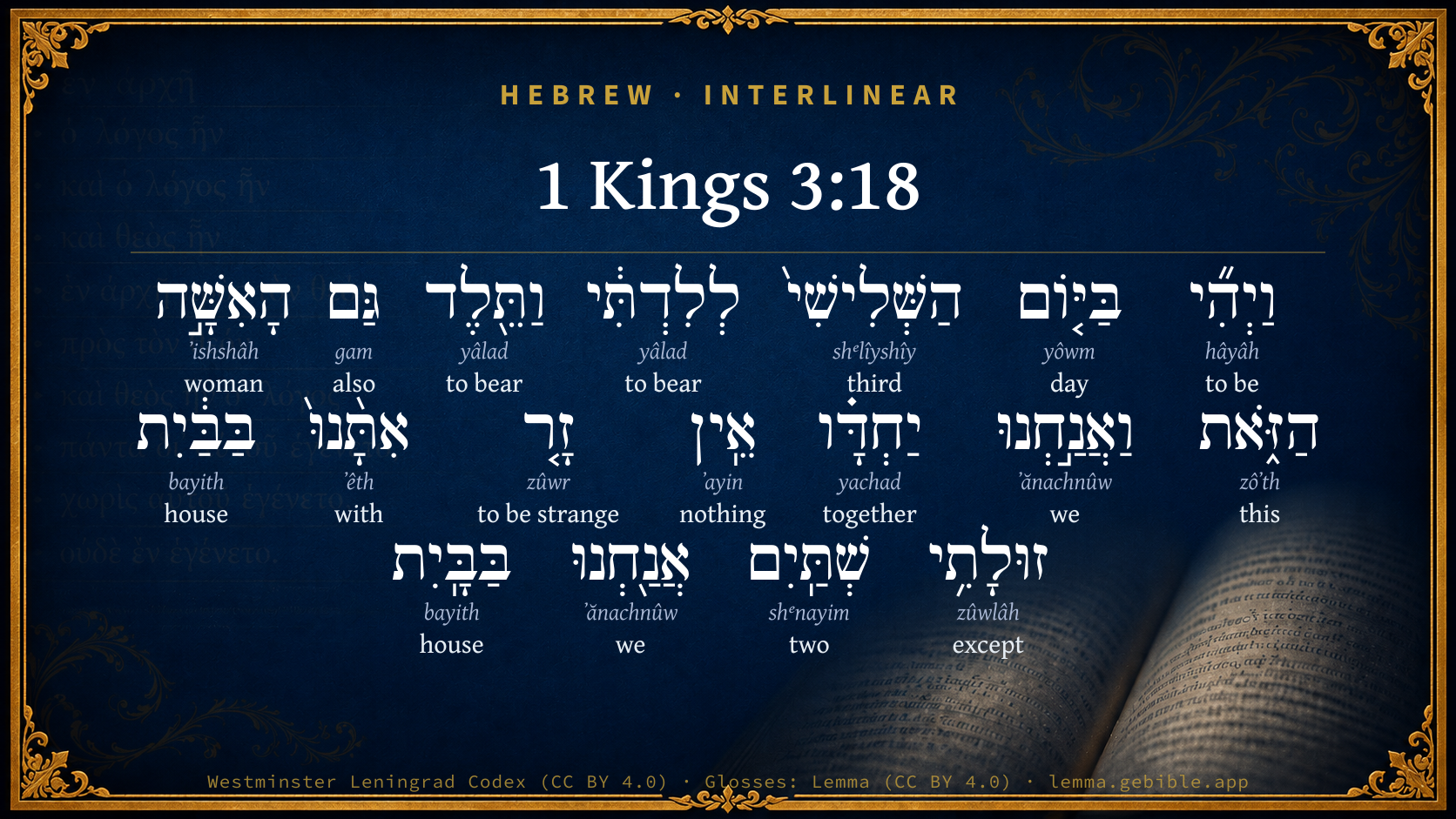
Hebrew (Westminster Leningrad Codex) 1 Kings 3:18 appears in the Hebrew Old Testament. The text above is from the Westminster Leningrad Codex. Each word links to its Strong’s number, a concise gloss, and parsing drawn from the Open Scriptures Hebrew Bible morphology. Click any word for its full Brown-Driver-Briggs (BDB) entry.
Download image
Cite this verse

1 Kings 3:18 (World English Bible). Public Domain. Lemma interlinear Bible study tool, https://lemma.gebible.app/v/1-kings/3/18.

Show BibTeX & RIS
BibTeX
RIS
English Translation
It happened the third day after I was delivered, that this woman was delivered also; and we were together; there was no stranger with us in the house, save we two in the house.
World English Bible · Public Domain
Download a study sheet

One document with this verse’s original text, its word-by-word gloss line, the meaning frame, cross-references with their text, attributed commentary, and full source and license credits — printable, and it pastes into notes with its structure intact.

This verse Autodidact and up

Study sheet (.html) Plain text (.txt)

A passage Seminary Student

Up to 50 verses in one chapter. A passage sheet keeps up to 6 commentary sources and 12 cross-references per verse, in the order this page ranks them, and says so on the sheet whenever that leaves anything out. Ask for a single verse and you get the Autodidact verse sheet above.

Everything on this page stays free to read, with no account — the sheet is a download of what is already on screen, not access to it.

Want to remove ads? Support Godless Engineer
Compare translations 3

The same verse in 3 English versions, stacked beneath the original-language interlinear above. Click any original word for its lexicon entry.

Each is an independent rendering of the whole verse — the interlinear is not word-aligned to these translations.

Highlighted words mark where these versions differ — a whole-verse word diff, not a word-by-word alignment.

  • World English Bible Public Domain
    It happened the third day after I was delivered, that this woman was delivered also; and we were together; there was no stranger with us in the house, save we two in the house.
  • King James Version Public Domain
    And it came to pass the third day after that I was delivered, that this woman was delivered also: and we were together; there was no stranger with us in the house, save we two in the house.
  • unfoldingWord Literal Text CC BY-SA 4.0
    And it happened on the third day of my giving birth that this woman also gave birth. And we together, no stranger with us in the house, only we two in the house.

unfoldingWord Literal Text — © unfoldingWord, licensed CC BY-SA 4.0. Word-aligned USFM3 via Door43 (git.door43.org/unfoldingWord/en_ult).

Versions to compare (up to 4)

3 of 4 selected

Show all 18 translations

Every available English version of this verse, each an independent rendering of the whole verse.

  • World English Bible Public Domain
    It happened the third day after I was delivered, that this woman was delivered also; and we were together; there was no stranger with us in the house, save we two in the house.
  • Berean Standard Bible Public Domain
    On the third day after I gave birth, this woman also had a baby. We were alone, with no one in the house but the two of us.
  • Majority Standard Bible Public Domain
    On the third day after I gave birth, this woman also had a baby. We were alone, with no one in the house but the two of us.
  • King James Version Public Domain
    And it came to pass the third day after that I was delivered, that this woman was delivered also: and we were together; there was no stranger with us in the house, save we two in the house.
  • American Standard Version (1901) Public Domain
    And it came to pass the third day after I was delivered, that this woman was delivered also; and we were together; there was no stranger with us in the house, save we two in the house.
  • Revised Version (1885) Public Domain
    And it came to pass the third day after I was delivered, that this woman was delivered also; and we were together; there was no stranger with us in the house, save we two in the house.
  • Geneva Bible (1599) Public Domain
    And the third day after that I was deliuered, this woman was deliuered also: and we were in the house together: no stranger was with vs in the house, saue we twaine.
  • Douay-Rheims (1899) Public Domain
    And the third day, after that I was delivered, she also was delivered, and we were together, and no other person with us in the house, only we two.
  • Young's Literal Translation Public Domain
    and it cometh to pass on the third day of my bringing forth, that this woman also bringeth forth, and we `are' together, there is no stranger with us in the house, save we two, in the house.
  • Literal Standard Version CC BY-SA 4.0
    and it comes to pass on the third day of my bringing forth, that this woman also brings forth, and we [are] together, there is no stranger with us in the house, except the two of us, in the house.
  • Unlocked Literal Bible CC BY-SA 4.0
    It happened on the third day after I gave birth that this woman also gave birth. We were together. There was no one else with us in the house, but only the two of us in the house.
  • unfoldingWord Literal Text CC BY-SA 4.0
    And it happened on the third day of my giving birth that this woman also gave birth. And we together, no stranger with us in the house, only we two in the house.
  • Darby Bible Public Domain
    And it came to pass the third day after I was delivered, that this woman was delivered also; and we were together; no stranger was with us in the house, only we two were in the house.
  • World Messianic Bible Public Domain
    The third day after I delivered, this woman delivered also. We were together. There was no stranger with us in the house, just us two in the house.
  • Webster's Bible Public Domain
    And it came to pass the third day after I was delivered, that this woman was delivered also: and we were together; there was no stranger with us in the house, save us two in the house.
  • Free Bible Version CC BY-SA 4.0
    Three days after the birth of my baby, this woman also had a baby. We were together; there was no one else in the house, just the two of us.
  • Bible in Basic English Public Domain
    And three days after the birth of my child, this woman had a child: we were together, no other-person was with us in the house but we two only.
  • JPS Tanakh (1917) Public Domain
    And it came to pass the third day after I was delivered, that this woman was delivered also; and we were together; there was no stranger with us in the house, save we two in the house.

Literal Standard Version (2020), Covenant Press — licensed CC BY-SA 4.0. Text via the HelloAO Bible API (eBible.org). Unlocked Literal Bible (unfoldingWord) — licensed CC BY-SA 4.0. Text via the HelloAO Bible API (eBible.org). unfoldingWord Literal Text — © unfoldingWord, licensed CC BY-SA 4.0. Word-aligned USFM3 via Door43 (git.door43.org/unfoldingWord/en_ult). Free Bible Version, Dr. Jonathan Gallagher — licensed CC BY-SA 4.0. Text via the HelloAO Bible API (eBible.org).

Word by word

More ways to search: Search by grammar → Find every occurrence → Compare this word →

Practice this passage: Drill this verse → Learn its vocabulary →

זוּלָתִ֥י
zûwlâh
H2108
“except”
Preposition
Part of Speech
Preposition
Full BDB Definition

Origin: from H2107

TWOT: 537a

a removal, a putting away (noun feminine) - except, besides, with the exception of, with removal of (preposition) - except that (conjunction)
  1. וַיְהִ֞י hâyâh H1961 “and · to be” Conjunction + Verb, Qal, Sequential Imperfect, 3rd Person, Masculine, Singular
  2. בַּיּ֤וֹם yôwm H3117 “in/at the · day” Preposition, Determined + Noun, Common, Masculine, Singular, Absolute
  3. הַשְּׁלִישִׁי֙ shᵉlîyshîy H7992 “the · third” Particle, Definite Article + Adjective, Ordinal number, Masculine, Singular, Absolute
  4. לְלִדְתִּ֔י yâlad H3205 “to bear · me” Preposition + Verb, Qal, Infinitive Construct + Suffix, Personal, 1st Person, Common, Singular
  5. וַתֵּ֖לֶד yâlad H3205 “and · to bear” Conjunction + Verb, Qal, Sequential Imperfect, 3rd Person, Feminine, Singular
  6. גַּם gam H1571 “also” Particle, Accusative
  7. הָאִשָּׁ֣ה ʼishshâh H802 “the · woman” Particle, Definite Article + Noun, Common, Feminine, Singular, Absolute
  8. הַזֹּ֑את zôʼth H2063 “the · this” Particle, Definite Article + Pronoun, Demonstrative, Feminine, Singular
  9. וַאֲנַ֣חְנוּ ʼănachnûw H587 “and · we” Conjunction + Pronoun, Personal, 1st Person, Common, Plural
  10. יַחְדָּ֗ו yachad H3162 “together” Adverb
  11. אֵֽין ʼayin H369 “nothing” Particle, Negative
  12. זָ֤ר zûwr H2114 “strange” Adjective, Adjective, Masculine, Singular, Absolute
  13. אִתָּ֨נוּ֙ ʼêth H854 “with · us” Preposition + Suffix, Personal, 1st Person, Common, Plural
  14. בַּבַּ֔יִת bayith H1004 “in/at the · house” Preposition, Determined + Noun, Common, Masculine, Singular, Absolute
  15. שְׁתַּֽיִם shᵉnayim H8147 “two” Adjective, Cardinal number, Feminine, Dual, Absolute
  16. אֲנַ֖חְנוּ ʼănachnûw H587 “we” Pronoun, Personal, 1st Person, Common, Plural
  17. בַּבָּֽיִת bayith H1004 “in/at the · house” Preposition, Determined + Noun, Common, Masculine, Singular, Absolute

About this verse

These counts appear in no published source. They are computed here, from the morphology-tagged text and Lemma’s own curated glosses. What Lemma adds →

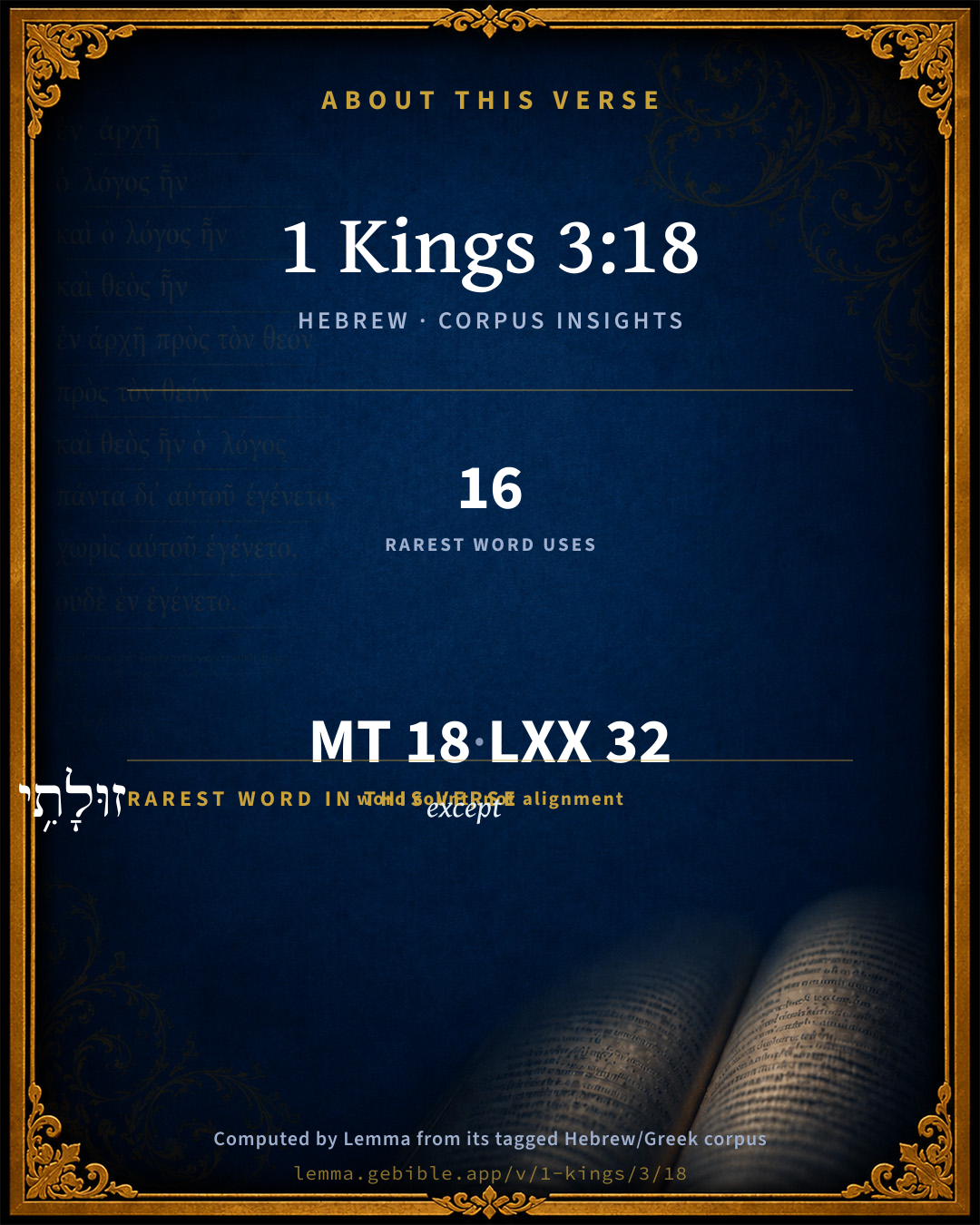
18
words
15
distinct lemmas
Historical
section

Notable vocabulary

The rarest word here is זוּלָתִ֥י except H2108 — appearing just 16 times in the whole Hebrew Bible.

Shared distinctive vocabulary

זוּלָתִ֥י except H2108 occurs in 16 verses of the Hebrew Bible. Also found in:

Grammatical profile

  • 3 verbs
  • 4 nouns
  • 3 adjectives
  • 3 pronouns
  • 2 prepositions
  • 1 adverb
  • 2 particles

Verb forms

  • וַיְהִ֞י Qal · Sequential Imperfect
  • לְלִדְתִּ֔י Qal · Infinitive Construct
  • וַתֵּ֖לֶד Qal · Sequential Imperfect

Repetition

Words recur within this verse — often emphatic in Hebrew:

  • לְלִדְתִּ֔י to bear H3205 ×2
  • בַּבַּ֔יִת house H1004 ×2
  • וַאֲנַ֣חְנוּ we H587 ×2

Hebrew & Septuagint length

In English translation the verse runs 34 words from the Hebrew and 36 from the Septuagint (LXX English) — closely comparable.

A rough comparison of the two English renderings, which tokenize alike — not a word-level alignment.

Word counts can differ between the Hebrew and the Greek without any difference in meaning — e.g. the Hebrew direct-object marker אֵת has no separate Greek word, and Greek often adds the article ὁ.

In the original languages it is 18 Hebrew tokens and 32 Greek tokens — but the two are counted differently (Hebrew bundles its prefixes and suffixes into one token; the Greek is in lemma form), so that isn’t a like-for-like length.

Hebrew and Greek witnesses Masoretic Hebrew ↔ Greek Septuagint

The same verse in the two great witnesses to the Old Testament, shown verse-for-verse.

These are two independent witnesses, not word-aligned to each other, and the Septuagint is shown in lemma (dictionary) form.

Hebrew 1 Kings 3:18 Masoretic · Westminster Leningrad Codex

וַיְהִ֞י בַּיּ֤וֹם הַשְּׁלִישִׁי֙ לְלִדְתִּ֔י וַתֵּ֖לֶד גַּם הָאִשָּׁ֣ה הַזֹּ֑את וַאֲנַ֣חְנוּ יַחְדָּ֗ו אֵֽין זָ֤ר אִתָּ֨נוּ֙ בַּבַּ֔יִת זוּלָתִ֥י שְׁתַּֽיִם אֲנַ֖חְנוּ בַּבָּֽיִת

It happened the third day after I was delivered, that this woman was delivered also; and we were together; there was no stranger with us in the house, save we two in the house.

World English Bible · Public Domain

Greek LXX 1 Kings 3:18 Septuagint · lemma form

καί γίγνομαι ἐν ὁ ἡμέρα ὁ τρίτος τίκτω ἐγώ καί τίκτω καί ὁ γυνή οὗτος καί ἐγώ κατά ὁ αὐτός καί οὐ εἰμί οὐδείς μετά ἐγώ πάρεξ ἀμφότεροι ἐγώ ἐν ὁ οἶκος

And it came to pass on the third day after I was delivered, this woman also was delivered: and we were together; and there was no one with us besides our two selves in the house.

LXX2012 (modern English Septuagint) · Public Domain

Hebrew: Westminster Leningrad Codex (CC BY 4.0). Greek: Septuagint (public domain); English from LXX2012 (modern English Septuagint) (Public Domain). How the Septuagint differs from the Hebrew →

Targum (Aramaic paraphrase)

1

The Targum is the ancient Jewish Aramaic paraphrase of the Hebrew Scriptures — an interpretive translation, not the Hebrew text itself. Onkelos (literal) and Pseudo-Jonathan (expansive) render the Torah, and Jonathan the Prophets. Coverage is partial: where no permissively-licensed English translation exists for a verse, only the Aramaic is shown. This is verse-level text, not a word-by-word alignment to the Hebrew.

  1. Targum Jonathan Prophets (Joshua–Malachi)
    וַהֲוָה בְּיוֹמָא תְלִיתָאָה לְמֵילְדִי וִילִידַת אַף אִתְּתָא הָדָא וַאֲנַחְנָא כַּחֲדָא זַכָּאִין לֵית נוּכְרָא עִמָנָא בְּבֵיתָא אֱלָהֵין תַּרְתֵּין אֲנַחְנָא בְּבֵיתָא:

    (no public-domain English translation for this verse)

    Targum Jonathan — Aramaic: “Mikraot Gedolot” (public domain). English: “Sefaria Community Translation” (CC0 1.0 (public-domain dedication)); “London "Chaldee Paraphrase," 1871” (public domain). Text via Sefaria.

Commentary

Notes on 1 Kings 3:18 from classic Christian and Jewish commentators (each source and its license shown beneath its notes). The classic Christian expositions comment on the surrounding passage and are grouped to its opening verse, so a note may address several verses; the Jewish commentaries on the Tanakh (Rashi and others) are per-verse, so they appear only where the commentator wrote on this verse.

Lemma curates 59 commentaries, every one of them public domain or Creative Commons licensed, each selected and text-cleaned for this edition rather than reprinted as found. About our sources →

Trapp's Complete Commentary

John Trapp

1Ki 3:18 And it came to pass the third day after that I was delivered, that this woman was delivered also: and we [were] together; [there was] no stranger with us in the house, save we two in the house.

Ver. 18. That this woman was delivered also.] Hence some argue that they were not harlots, because they use not to bring forth children; or if they do, they usually make them away as soon as they are born.

There was no stranger with us in the house.] This made the case so difficult, because there was not witness to be had, nor any other way of discovery left to see to, nisi hariolari in re dubia, but to give a guess at the business. {a}

{a} Tortura fortassis nondum in usu fuit. - Phlac.

John Trapp, A Commentary or Exposition upon All the Books of the Old and New Testament (1647–1656) — public domain. Text from a community e-Sword module.

Joseph Benson's Commentary

1Ki 3:18-22. On the third day — this woman was delivered also — So that the children could not be distinguished by their age. No stranger was with us in the house — Therefore there was no witness on either side; and although there might be some difference distinguishable by an exact observer between the features of the two children, yet it is not probable that was much attended to by the neighbours who might be present to assist either or both of them in their labour; as they were persons, it seems, of suspected fame. And the testimonies of the women were of equal credit, that is, of no credit at all. Because she overlaid it — And so smothered it: which she justly conjectures, because there were evidences of that kind of death, but no appearance of any other cause thereof. Thus they spake before the king — Both peremptorily and vehemently affirmed the same thing; oft repeating the same words.

Joseph Benson's Commentary on the Old and New Testaments (1811–1818) — public domain. Text from a community e-Sword module.

The Cambridge Bible for Schools and Colleges

gen. ed. J. J. S. Perowne

18. there was no stranger with us] Thus the mother of the dead child was able to persist in her false story. The word of one was as good as that of the other.

The Cambridge Bible for Schools and Colleges (gen. ed. J. J. S. Perowne; Cambridge University Press, 1878–1918) — public domain. Text from a community e-Sword module.

John Gill's Exposition

And this woman's child died in the night,.... Whether the same night following the day it was born is not certain;

because she overlaid it; or laid upon it, being heavy through sleep, and not knowing what she did, turned herself upon it, and smothered it; because it had no previous illness, or any marks of any disease it could be thought to die of, and perhaps there might be some of its being overlaid.

John Gill's Exposition of the Whole Bible (1746–1763) — public domain (CC PDM 1.0). Text via the HelloAO Bible API.

Matthew Poole's English Annotations

The third day; so they could not be distinguished by their age.

There was no stranger with us in the house; therefore no witness on either side; and although there might be some sensible difference to an exact observer between the features of the two children, yet it is not probable that was much minded by the neighbours; for though civil women might assist them both in their child-births, yet it is not likely they would afterwards converse much with them, as being persons of suspected fame, and the features of the children, especially for so few days, might easily be so like, that it was difficult to discern the one from the other. And the testimonies of the women were of equal credit, i.e. of none at all.

Matthew Poole's English Annotations on the Holy Bible (1683–1685) — public domain. Text from a community e-Sword/MySword module.

The Pulpit Commentary

And it came to pass the third day after that I was delivered, that this woman was delivered also: and we were together; there was no stranger with us in the house, save we two in the house. Emphasis is laid on this fact, as showing the possibility of the fraud and the impossibility of producing proof. Hebrew women have always required but little assistance in childbearing. That which is written in Exo_1:19 is true to this day.

The Pulpit Commentary (1880–1919), ed. H.D.M. Spence-Jones & Joseph S. Exell — public domain. Text from a community e-Sword module.

unfoldingWord translationNotes

Door43 World Missions Community

General Information:

The two prostitutes tell Solomon their story.

lay on him

It may be helpful to state that this caused the baby to die. AT: "accidentally rolled on top of her baby and smothered him" (See: Assumed Knowledge and Implicit Information)

your servant

The woman speaks as if she were speaking of someone else to show that she respects Solomon. AT: "I" (See: Pronouns)

translationWords

son

die

unfoldingWord translationNotes — © Distant Shores Media and the Door43 World Missions Community, licensed CC BY-SA 4.0. Source: git.door43.org/Door43/en_tn.

Lesson kit

Teaching starters — assembled from the data on this page, not authored interpretation. Every prompt links to the verse data it draws on. Edit before teaching.

1 Kings, in the Historical, opens this verse with 18 words (15 distinct Hebrew lemmas). Its most distinctive word is zûwlâh (“except”). A historical commentator’s framing appears above. Read the whole chapter for the surrounding context.

Discussion questions

  1. How does “except” (zûwlâh) shape what this verse is saying?
  2. How does Deuteronomy 1:36, which shares the word «except», read alongside this verse?
  3. What does the repetition of “to bear” (2× in this one verse) do in this verse?
  4. These translations render this verse differently; the difference is in the English rendering, not the original. What questions does that raise?
  5. «וַיְהִ֞י» is a Qal Sequential Imperfect verb. How does that grammatical form shape the action described?
  6. Compare how Trapp's Complete Commentary and Joseph Benson's Commentary read this verse. Where do they agree or differ?

Things to notice

Reading settings

Reading text

Shown beneath each verse's original-language words.

Old Testament
Old Testament edition

Read the OT as the Masoretic Hebrew (MT) or the Greek Septuagint (LXX).

English shown for the Greek Septuagint (in the Hebrew ↔ Greek comparison).

Comparing translations? Open the Compare panel on any verse page to stack up to four side by side.