

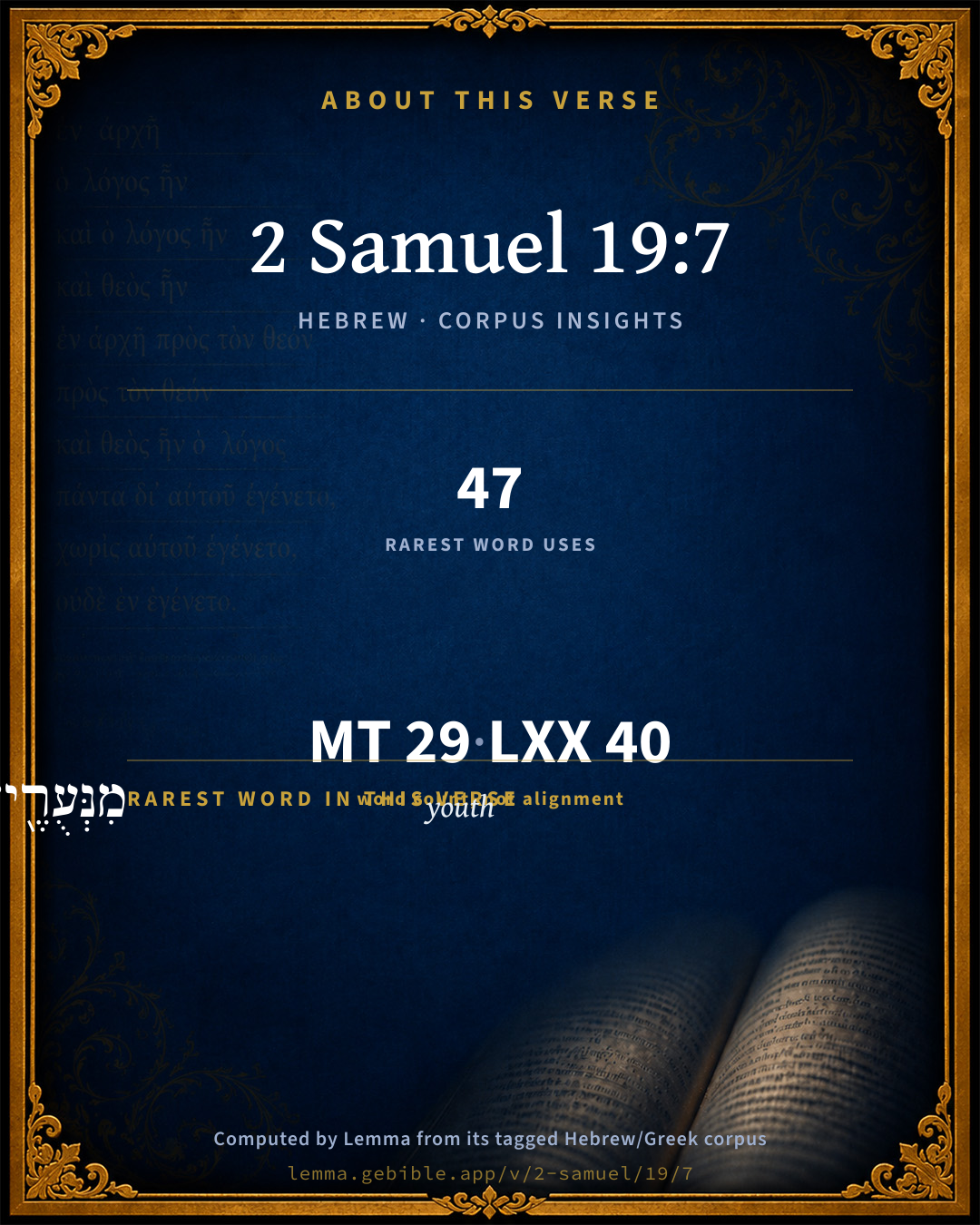
2 Samuel 19:7

Hebrew (Westminster Leningrad Codex) 2 Samuel 19:7 appears in the Hebrew Old Testament. The text above is from the Westminster Leningrad Codex. Each word links to its Strong’s number, a concise gloss, and parsing drawn from the Open Scriptures Hebrew Bible morphology. Click any word for its full Brown-Driver-Briggs (BDB) entry.
Download image
Cite this verse

2 Samuel 19:7 (World English Bible). Public Domain. Lemma interlinear Bible study tool, https://lemma.gebible.app/v/2-samuel/19/7.

Show BibTeX & RIS
BibTeX
RIS
English Translation
Now therefore arise, go forth, and speak comfortably to your servants; for I swear by Yahweh, if you don't go forth, there will not stay a man with you this night: and that will be worse to you than all the evil that has happened to you from your youth until now.
World English Bible · Public Domain
Download a study sheet

One document with this verse’s original text, its word-by-word gloss line, the meaning frame, cross-references with their text, attributed commentary, and full source and license credits — printable, and it pastes into notes with its structure intact.

This verse Autodidact and up

Study sheet (.html) Plain text (.txt)

A passage Seminary Student

Up to 50 verses in one chapter. A passage sheet keeps up to 6 commentary sources and 12 cross-references per verse, in the order this page ranks them, and says so on the sheet whenever that leaves anything out. Ask for a single verse and you get the Autodidact verse sheet above.

Everything on this page stays free to read, with no account — the sheet is a download of what is already on screen, not access to it.

Want to remove ads? Support Godless Engineer
Compare translations 3

The same verse in 3 English versions, stacked beneath the original-language interlinear above. Click any original word for its lexicon entry.

Each is an independent rendering of the whole verse — the interlinear is not word-aligned to these translations.

Highlighted words mark where these versions differ — a whole-verse word diff, not a word-by-word alignment.

  • World English Bible Public Domain
    Now therefore arise, go forth, and speak comfortably to your servants; for I swear by Yahweh, if you don't go forth, there will not stay a man with you this night: and that will be worse to you than all the evil that has happened to you from your youth until now.
  • King James Version Public Domain
    Now therefore arise, go forth, and speak comfortably unto thy servants: for I swear by the LORD, if thou go not forth, there will not tarry one with thee this night: and that will be worse unto thee than all the evil that befell thee from thy youth until now.
  • unfoldingWord Literal Text CC BY-SA 4.0
    But now, arise, go out and speak to the heart of your servants, for I swear by Yahweh, if you are not going out, if a man will lodge with you tonight, and this more trouble for you than all of the trouble that has come on you from your youth until now.”

unfoldingWord Literal Text — © unfoldingWord, licensed CC BY-SA 4.0. Word-aligned USFM3 via Door43 (git.door43.org/unfoldingWord/en_ult).

Versions to compare (up to 4)

3 of 4 selected

Show all 18 translations

Every available English version of this verse, each an independent rendering of the whole verse.

  • World English Bible Public Domain
    Now therefore arise, go forth, and speak comfortably to your servants; for I swear by Yahweh, if you don't go forth, there will not stay a man with you this night: and that will be worse to you than all the evil that has happened to you from your youth until now.
  • Berean Standard Bible Public Domain
    Now therefore get up! Go out and speak comfort to your servants, for I swear by the LORD that if you do not go out, not a man will remain with you tonight. This will be worse for you than all the adversity that has befallen you from your youth until now!”
  • Majority Standard Bible Public Domain
    Now therefore get up! Go out and speak comfort to your servants, for I swear by the LORD that if you do not go out, not a man will remain with you tonight. This will be worse for you than all the adversity that has befallen you from your youth until now!”
  • King James Version Public Domain
    Now therefore arise, go forth, and speak comfortably unto thy servants: for I swear by the LORD, if thou go not forth, there will not tarry one with thee this night: and that will be worse unto thee than all the evil that befell thee from thy youth until now.
  • American Standard Version (1901) Public Domain
    Now therefore arise, go forth, and speak comfortably unto thy servants; for I swear by Jehovah, if thou go not forth, there will not tarry a man with thee this night: and that will be worse unto thee than all the evil that hath befallen thee from thy youth until now.
  • Revised Version (1885) Public Domain
    Now therefore arise, go forth and speak comfortably unto thy servants: for I swear by the LORD, if thou go not forth, there will not tarry a man with thee this night: and that will be worse unto thee than all the evil that hath befallen thee from thy youth until now.
  • Geneva Bible (1599) Public Domain
    Nowe therefore vp, come out, and speake comfortably vnto thy seruants: for I sweare by the Lord, except thou come out, there will not tarie one man with thee this night: and that wil be worse vnto thee, then all the euill that fell on thee from thy youth hitherto.
  • Douay-Rheims (1899) Public Domain
    Now therefore arise, and go out, and speak to the satisfaction of thy servants: for I swear to thee by the Lord, that if thou wilt not go forth, there will not tarry with thee so much as one this night: and that will be worse to thee, than all the evils that have befallen thee from thy youth until now.
  • Young's Literal Translation Public Domain
    `And now, rise, go out and speak unto the heart of thy servants, for by Jehovah I have sworn, that -- thou art not going out -- there doth not lodge a man with thee to-night; and this `is' worse for thee than all the evil that hath come upon thee from thy youth till now.'
  • Literal Standard Version CC BY-SA 4.0
    And now, rise, go out and speak to the heart of your servants, for I have sworn by YHWH, that [if] you are not going out—there does not lodge a man with you tonight; and this [is] worse for you than all the evil that has come on you from your youth until now.”
  • Unlocked Literal Bible CC BY-SA 4.0
    Now therefore get up and go out and speak kindly to your soldiers, for I swear by Yahweh, if you do not go, not one man will remain with you tonight. That would be worse for you than all the disasters that have ever happened to you from your youth until now.”
  • unfoldingWord Literal Text CC BY-SA 4.0
    But now, arise, go out and speak to the heart of your servants, for I swear by Yahweh, if you are not going out, if a man will lodge with you tonight, and this more trouble for you than all of the trouble that has come on you from your youth until now.”
  • Darby Bible Public Domain
    But now arise, go forth, and speak consolingly to thy servants; for I swear by Jehovah, if thou go not forth, there will not tarry one with thee this night; and that would be worse to thee than all the evil that has befallen thee from thy youth until now.
  • World Messianic Bible Public Domain
    Now therefore arise, go out and speak to comfort your servants; for I swear by the LORD, if you don’t go out, not a man will stay with you this night. That would be worse to you than all the evil that has happened to you from your youth until now.”
  • Webster's Bible Public Domain
    Now therefore arise, go forth, and speak comfortably to thy servants: for I swear by the LORD, if thou shalt not go forth, there will not tarry one with thee this night: and that will be worse to thee than all the evil that hath befallen thee from thy youth until now.
  • Free Bible Version CC BY-SA 4.0
    So get up, go out, and thank your men. I swear by the Lord that if you don't, you won't have a man left by tonight. That will be far worse for you than all the disasters you've had from your youth until now.”
  • Bible in Basic English Public Domain
    So get up now, and go out and say some kind words to your servants; for, by the Lord, I give you my oath, that if you do not go out, not one of them will keep with you tonight; and that will be worse for you than all the evil which has overtaken you from your earliest years.
  • JPS Tanakh (1917) Public Domain
    (19-8) Now therefore arise, go forth, and speak to the heart of thy servants; for I swear by the LORD, if thou go not forth, there will not tarry a man with thee this night; and that will be worse unto thee than all the evil that hath befallen thee from thy youth until now.'

Literal Standard Version (2020), Covenant Press — licensed CC BY-SA 4.0. Text via the HelloAO Bible API (eBible.org). Unlocked Literal Bible (unfoldingWord) — licensed CC BY-SA 4.0. Text via the HelloAO Bible API (eBible.org). unfoldingWord Literal Text — © unfoldingWord, licensed CC BY-SA 4.0. Word-aligned USFM3 via Door43 (git.door43.org/unfoldingWord/en_ult). Free Bible Version, Dr. Jonathan Gallagher — licensed CC BY-SA 4.0. Text via the HelloAO Bible API (eBible.org).

Word by word

More ways to search: Search by grammar → Find every occurrence → Compare this word →

Practice this passage: Drill this verse → Learn its vocabulary →

מִנְּעֻרֶ֖יךָ
nâʻûwr
H5271
“from · youth · your”
Preposition + Noun, Common, Both, Plural, Construct + Suffix, Personal, 2nd Person, Masculine, Singular
Part of Speech
Preposition + Noun
Type
Common
Gender
Both
Number
Plural
State
Construct
Full BDB Definition

Origin: properly, pass. participle from H5288 as denominative

TWOT: 1389d , 1389e

youth, early life
  1. וְעַתָּה֙ ʻattâh H6258 “and · now” Conjunction + Adverb
  2. ק֣וּם qûwm H6965 “rise” Verb, Qal, Imperative, 2nd Person, Masculine, Singular
  3. צֵ֔א yâtsâʼ H3318 “go out” Verb, Qal, Imperative, 2nd Person, Masculine, Singular
  4. וְדַבֵּ֖ר dâbar H1696 “and · speak” Conjunction + Verb, Piel, Imperative, 2nd Person, Masculine, Singular
  5. עַל ʻal H5921 “upon” Preposition
  6. לֵ֣ב lêb H3820 “heart of” Noun, Common, Masculine, Singular, Construct
  7. עֲבָדֶ֑יךָ ʻebed H5650 “servants · your” Noun, Common, Masculine, Plural, Construct + Suffix, Personal, 2nd Person, Masculine, Singular
  8. כִּי֩ kîy H3588 “that” Conjunction
  9. בַיהוָ֨ה Yᵉhôvâh H3068 “in/at · LORD” Preposition + Noun, Proper
  10. נִשְׁבַּ֜עְתִּי shâbaʻ H7650 “to swear” Verb, Niphal, Perfect, 1st Person, Common, Singular
  11. כִּי kîy H3588 “that” Conjunction
  12. אֵינְךָ֣ ʼayin H369 “nothing · you” Particle, Negative + Suffix, Personal, 2nd Person, Masculine, Singular
  13. יוֹצֵ֗א yâtsâʼ H3318 “going out” Verb, Qal, Participle Active, Masculine, Singular, Absolute
  14. אִם ʼim H518 “if” Conjunction
  15. יָלִ֨ין lûwn H3885 “to lodge” Verb, Qal, Imperfect, 3rd Person, Masculine, Singular
  16. אִ֤ישׁ ʼîysh H376 “man” Noun, Common, Masculine, Singular, Absolute
  17. אִתְּךָ֙ ʼêth H854 “with · you” Preposition + Suffix, Personal, 2nd Person, Masculine, Singular
  18. הַלַּ֔יְלָה layil H3915 “the · night” Particle, Definite Article + Noun, Common, Masculine, Singular, Absolute
  19. וְרָעָ֧ה râʻaʻ H7489 “and · to do evil” Conjunction + Verb, Qal, Sequential Perfect, 3rd Person, Feminine, Singular
  20. זֹ֗את zôʼth H2063 “this” Pronoun, Demonstrative, Feminine, Singular
  21. מִכָּל kôl H3605 “from · all of” Preposition + Noun, Common, Masculine, Singular, Construct
  22. הָרָעָה֙ raʻ H7451 “the · evil” Particle, Definite Article + Noun, Common, Feminine, Singular, Absolute
  23. אֲשֶׁר ʼăsher H834 “which” Particle, Relative
  24. בָּ֣אָה bôwʼ H935 “to enter” Verb, Qal, Perfect, 3rd Person, Feminine, Singular
  25. עָלֶ֔יךָ ʻal H5921 “upon · you” Preposition + Suffix, Personal, 2nd Person, Masculine, Singular
  26. עַד ʻad H5704 “until” Preposition
  27. עָֽתָּה ʻattâh H6258 “now” Adverb

About this verse

These counts appear in no published source. They are computed here, from the morphology-tagged text and Lemma’s own curated glosses. What Lemma adds →

29
words
24
distinct lemmas
Historical
section

Shared distinctive vocabulary

מִנְּעֻרֶ֖יךָ youth H5271 occurs in 46 verses of the Hebrew Bible. Also found in:

Grammatical profile

  • 8 verbs
  • 8 nouns
  • 1 pronoun
  • 5 prepositions
  • 3 conjunctions
  • 2 adverbs
  • 2 particles

Verb forms

  • ק֣וּם Qal · Imperative
  • צֵ֔א Qal · Imperative
  • וְדַבֵּ֖ר Piel · Imperative
  • נִשְׁבַּ֜עְתִּי Niphal · Perfect
  • יוֹצֵ֗א Qal · Participle Active
  • יָלִ֨ין Qal · Imperfect
  • וְרָעָ֧ה Qal · Sequential Perfect
  • בָּ֣אָה Qal · Perfect

Repetition

Words recur within this verse — often emphatic in Hebrew:

  • וְעַתָּה֙ now H6258 ×2
  • צֵ֔א to go out H3318 ×2
  • עַל upon H5921 ×2
  • כִּי֩ that H3588 ×2

Hebrew & Septuagint length

In English translation the verse runs 52 words from the Hebrew and 62 from the Septuagint (LXX English) — closely comparable.

A rough comparison of the two English renderings, which tokenize alike — not a word-level alignment.

Word counts can differ between the Hebrew and the Greek without any difference in meaning — e.g. the Hebrew direct-object marker אֵת has no separate Greek word, and Greek often adds the article ὁ.

In the original languages it is 29 Hebrew tokens and 40 Greek tokens — but the two are counted differently (Hebrew bundles its prefixes and suffixes into one token; the Greek is in lemma form), so that isn’t a like-for-like length.

Cross-references

9

Topical passages linked to 2 Samuel 19:7 in the Treasury of Scripture Knowledge — connected by theme and wording, ordered by reader-vote popularity; previews shown in the World English Bible.

  • Proverbs 14:28 In the multitude of people is the king's glory, But in the lack of people is the destruction of the prince.
  • Genesis 34:3 His soul joined to Dinah, the daughter of Jacob, and he loved the young lady, and spoke kindly to the young lady.
  • Psalms 71:4–6 Rescue me, my God, from the hand of the wicked, From the hand of the unrighteous and cruel man.
  • Psalms 71:9–11 Don't reject me in my old age. Don't forsake me when my strength fails.
  • Psalms 71:18–20 Yes, even when I am old and gray-haired, God, don't forsake me, Until I have declared your strength to the next generation, Your might to everyone who is to come.
  • Psalms 129:1–2 Many times they have afflicted me from my youth up. Let Israel now say,
  • Proverbs 19:15 Slothfulness casts into a deep sleep. The idle soul shall suffer hunger.
  • Isaiah 40:1 Comfort you, comfort you my people, says your God.
  • Hosea 2:14 "Therefore, behold, I will allure her, And bring her into the wilderness, And speak tenderly to her.

Cross-references courtesy of OpenBible.info (CC BY 4.0).

Hebrew and Greek witnesses Masoretic Hebrew ↔ Greek Septuagint

The same verse in the two great witnesses to the Old Testament, shown verse-for-verse.

These are two independent witnesses, not word-aligned to each other, and the Septuagint is shown in lemma (dictionary) form.

Hebrew 2 Samuel 19:7 Masoretic · Westminster Leningrad Codex

וְעַתָּה֙ ק֣וּם צֵ֔א וְדַבֵּ֖ר עַל לֵ֣ב עֲבָדֶ֑יךָ כִּי֩ בַיהוָ֨ה נִשְׁבַּ֜עְתִּי כִּי אֵינְךָ֣ יוֹצֵ֗א אִם יָלִ֨ין אִ֤ישׁ אִתְּךָ֙ הַלַּ֔יְלָה וְרָעָ֧ה לְךָ֣ זֹ֗את מִכָּל הָרָעָה֙ אֲשֶׁר בָּ֣אָה עָלֶ֔יךָ מִנְּעֻרֶ֖יךָ עַד עָֽתָּה

Now therefore arise, go forth, and speak comfortably to your servants; for I swear by Yahweh, if you don't go forth, there will not stay a man with you this night: and that will be worse to you than all the evil that has happened to you from your youth until now.

World English Bible · Public Domain

Greek LXX 2 Samuel 19:7 Septuagint · lemma form

ὁ ἀγαπάω ὁ μισέω σύ καί μισέω ὁ ἀγαπάω σύ καί ἀναἀγγέλλω σήμερον ὅτι οὐ εἰμί ὁ ἄρχων σύ οὐδέ παῖς ὅτι γιγνώσκω σήμερον ὅτι εἰ αβεσσαλωμ ζάω πᾶς ἐγώ σήμερον νεκρός ὅτι τότε ὁ εὐθής εἰμί ἐν ὀφθαλμός σύ

And now arise, and go forth, and speak comfortably to your servants; for I have sworn by the Lord, that unless you will go forth today, there shall not a man remain with you this night: and know for yourself, this thing will indeed be evil to you beyond all the evil that has come upon you from your youth until now.

LXX2012 (modern English Septuagint) · Public Domain

Hebrew: Westminster Leningrad Codex (CC BY 4.0). Greek: Septuagint (public domain); English from LXX2012 (modern English Septuagint) (Public Domain). How the Septuagint differs from the Hebrew →

Targum (Aramaic paraphrase)

1

The Targum is the ancient Jewish Aramaic paraphrase of the Hebrew Scriptures — an interpretive translation, not the Hebrew text itself. Onkelos (literal) and Pseudo-Jonathan (expansive) render the Torah, and Jonathan the Prophets. Coverage is partial: where no permissively-licensed English translation exists for a verse, only the Aramaic is shown. This is verse-level text, not a word-by-word alignment to the Hebrew.

  1. Targum Jonathan Prophets (Joshua–Malachi)
    לְמִרְחַם יַת סַנְאָיִךְ וּלְמִסְנֵי יַת רַחֲמָיִךְ אֲרֵי חַוֵיתָא יוֹמָא דֵין אֲרֵי לֵית לָךְ רַבְרְבִין וְעַבְדִין אֲרֵי אֲנָא יְדַעְנָא יוֹמָא דֵין אֲרֵי אִלוּ אַבְשָׁלוֹם קַיָם וְכוּלָנָא יוֹמָא דֵין מִתְקַטְלִין אֲרֵי בְכֵן כָּשַׁר בְּעֵינָךְ:

    (no public-domain English translation for this verse)

    Targum Jonathan — Aramaic: “Mikraot Gedolot” (public domain). English: “Sefaria Community Translation” (CC0 1.0 (public-domain dedication)); “London "Chaldee Paraphrase," 1871” (public domain). Text via Sefaria.

Commentary

Notes on 2 Samuel 19:7 from classic Christian and Jewish commentators (each source and its license shown beneath its notes). The classic Christian expositions comment on the surrounding passage and are grouped to its opening verse, so a note may address several verses; the Jewish commentaries on the Tanakh (Rashi and others) are per-verse, so they appear only where the commentator wrote on this verse.

Lemma curates 59 commentaries, every one of them public domain or Creative Commons licensed, each selected and text-cleaned for this edition rather than reprinted as found. About our sources →

Trapp's Complete Commentary

John Trapp

2Sa 19:7 Now therefore arise, go forth, and speak comfortably unto thy servants: for I swear by the LORD, if thou go not forth, there will not tarry one with thee this night: and that will be worse unto thee than all the evil that befell thee from thy youth until now.

Ver. 7. Now therefore arise, go forth.] Good counsel, but ill administered: like a good potion ill prepared, or not well sweetened. How much better Melancthon, who when he found on a time Luther overcome by his passions, overcame both him and them by saying,

“ Vince animos, iramque tuam, qui caetera vincis. ”

There will not tarry one with thee.] {a} They will choose them a ruler that can better rule his passions, and use his great place and power with more sobriety and moderation: they will depose thee, and expose thee to the greatest miseries. And all this Joab bindeth with an oath (but not well), to startle and scare David.

{a} Non pernoctaturum, sc., ex meo iussu. - Piscat.

John Trapp, A Commentary or Exposition upon All the Books of the Old and New Testament (1647–1656) — public domain. Text from a community e-Sword module.

Joseph Benson's Commentary

2Sa 19:7. Now, therefore, arise, go forth, and speak comfortably unto thy servants — Show thyself to thy people, acknowledge their good services, and congratulate their success. For I swear by the Lord — He confirms his threat with the most solemn oath. If thou go not forth, &c. — If thou do not instantly quit thy apartment, appear in public, and treat thy people as they deserve; there will not tarry one with thee this night, &c. — Thy subjects will desert thee as one man. This, he signifies, would be far worse than all the calamities that had hitherto befallen him. David appears to have answered nothing to these harsh words of Joab; but, however offended he might be by such rough treatment, he thought fit to dissemble his resentment for the present. He, therefore, immediately left his chamber, and went to the gate, the seat of public justice, where he gave audience to the people, who immediately resorted thither in crowds to him, and were received and treated by him as kindly as his present distress would allow.

Joseph Benson's Commentary on the Old and New Testaments (1811–1818) — public domain. Text from a community e-Sword module.

Geneva Bible (1599)

Geneva Bible translators

Hebrew, to the heart of thy servant.

Geneva Bible (1599) marginal notes — public domain. Text via Bolls.life.

Jamieson, Fausset & Brown

Robert Jamieson, A. R. Fausset & David Brown

Now . . . arise, go forth, and speak comfortably unto thy servants--The king felt the truth of Joab's reprimand; but the threat by which it was enforced, grounded as it was on the general's unbounded popularity with the army, showed him to be a dangerous person; and that circumstance, together with the violation of an express order to deal gently for his sake with Absalom, produced in David's mind a settled hatred, which was strongly manifested in his last directions to Solomon.

Jamieson, Fausset & Brown — Commentary Critical and Explanatory on the Whole Bible (1871) — public domain (CC PDM 1.0). Text via the HelloAO Bible API.

Ellicott's Commentary for English Readers

(7) I swear by the Lord.—The statement which Joab emphasises with this solemn oath is not that ne will lead the people into revolt—he does not seem to have conceived, far less to have expressed any such design—but it is simply an assurance of the extreme danger of the course David was pursuing, put in such a strong and startling way as to rouse him from the selfishness of his sorrow.

A Bible Commentary for English Readers, edited by Charles John Ellicott (1878–1897) — public domain. Text from a community e-Sword module.

The Cambridge Bible for Schools and Colleges

gen. ed. J. J. S. Perowne

7. speak comfortably] Speak to them in a friendly way, encourage them, and appease their discontent.

I swear, &c.] This is not a threat that he will persuade the army to desert David; but an asseveration in the strongest possible terms that they will not continue faithful to a king who allows a private grief to outweigh his gratitude for their services.

The Cambridge Bible for Schools and Colleges (gen. ed. J. J. S. Perowne; Cambridge University Press, 1878–1918) — public domain. Text from a community e-Sword module.

John Gill's Exposition

Now therefore arise, go forth,.... Arise from his couch, he was watering with his tears, and go forth from his house, where he had shut himself up retired from all company, to the gate of the city, where the people passed and repassed, and there was a concourse of them: this he said not by way of command, but by way of advice; though all along he seems to take too much upon him, and to speak unbecoming a subject, and not with that decency as was necessary in, speaking to a king; but it may be observed, that a general of an army had great power over princes in those times; and presumed very much on their interest in the army, which led them sometimes not to behave with that decorum as became them:

and speak comfortably unto thy servants; commend them for their courage and faithfulness, thank them for their services, and reward them suitably; at least give them assurance of it:

for I swear by the Lord; by the Word of the Lord, as the Targum; this he said to arouse him, and make him bestir himself, and think what was proper for him to do:

if thou go not forth, there will not tarry one with thee this night; signifying that he would use his interest in the army to go off with it, and set up another king; and did not doubt of success, as well knowing what temper and humour the people were in through the king's conduct:

and that will be worse unto thee than all the evil that befell thee from thy youth until now; for when he was persecuted by Saul he had a number of friends that adhered close to him; and when Ishbosheth was set up against him by Abner as king of Israel, the tribe of Judah cleaved to him, anointed him their king, and abode by him; wherefore, should he now be abandoned by his army, his case would be worse than ever it had been.

John Gill's Exposition of the Whole Bible (1746–1763) — public domain (CC PDM 1.0). Text via the HelloAO Bible API.

Haydock's Catholic Bible Commentary

To. (satisfac). Hebrew, "speak to the heart," &c., with a cheerful countenance, to testify that their services will be rewarded. (Calmet)

George Leo Haydock (1774–1849), Haydock's Catholic Family Bible and Commentary, 1859 edition — public domain. Excludes Psalms (Douay-Rheims chapter numbering differs from Protestant) and Deuterocanonical books (Catholic canon only).

Matthew Poole's English Annotations

I swear by the Lord: this oath was either assertory of what he believed might in reason be expected, as likely in great measure to come to pass; or else promissory; or rather, minatory of what he by his influence could and would effect; and if so, it was much more than became him to say to his sovereign, and could only be excused by the circumstances, which at. this time might make it seem necessary: for David was indeed to blame in taking no more notice of their good service (however Joab might be faulty also in disobeying the king’s express command as to Absalom’s person); and great reason there was that David, as Joab did-now advise, should show himself less displeased to the people, who had exposed their lives to preserve him and his.

If thou go not forth to the gate, to show thyself to thy people, and kindly and thankfully to acknowledge the good service that they have now done thee.

There will not tarry one with thee this night; the hearts of all thy people will forthwith be irrecoverably alienated from thee, and they will look out for some other person on whom they may set the crown.

Matthew Poole's English Annotations on the Holy Bible (1683–1685) — public domain. Text from a community e-Sword/MySword module.

Whedon's Commentary on the Bible

Daniel D. Whedon

7. I swear — None but the dauntless Joab dared speak to the king in this way. “In his manner,” says Clarke, “Joab far exceeded the bounds of that reverence which a servant owes to his master, or a subject to his prince. Joab was a good soldier, but a bad man and dangerous subject.”

Daniel D. Whedon (gen. ed.), Commentary on the Old and New Testaments (1874–1909) — public domain. Text from a community e-Sword module.

unfoldingWord translationNotes

Door43 World Missions Community

I swear by Yahweh

Joab is making a very strong oath. AT: "I swear, as surely as Yahweh is alive" (See: Assumed Knowledge and Implicit Information)

if you do not go, not one man will remain with you

This means that only if David went would his soldiers remain with him. AT: "only if you go will any of your men remain with you" (See: Double Negatives)

not one man will remain with you

This refers to them remaining loyal to him. AT: "not one man will remain loyal to you" (See: Idiom)

all the people were told

This is a generalization. It means most of the men. It can be stated in active form. AT: "many of the men who were there heard others saying" (See: Hyperbole and Generalization and Active or Passive)

Look, the king is sitting

The word "Look" is used here to draw someone's attention to what is said next. AT: "Listen, the king is sitting"

all the people

Here "the people" refer to the people who followed David. Here "all" is an generalization. It means a large number came and gathered around him. AT: "many of the people" (See: Hyperbole and Generalization)

So Israel fled, every man to his home

Here "Israel" refers to the Israelite soldiers who followed Absalom. AT: "And every Israelite soldier fled to his own home" or "And all of the Israelite soldiers fled to their homes" (See: Synecdoche)

translationWords

oath

Yahweh

king

gate

people group

unfoldingWord translationNotes — © Distant Shores Media and the Door43 World Missions Community, licensed CC BY-SA 4.0. Source: git.door43.org/Door43/en_tn.

Lesson kit

Teaching starters — assembled from the data on this page, not authored interpretation. Every prompt links to the verse data it draws on. Edit before teaching.

2 Samuel, in the Historical, opens this verse with 29 words (24 distinct Hebrew lemmas). Its most distinctive word is nâʻûwr (“youth”). A historical commentator’s framing appears above. Read the whole chapter for the surrounding context.

Discussion questions

  1. What does “youth” (nâʻûwr) contribute to the verse as a whole?
  2. Genesis 8:21 shares the word «youth» with this verse. How do the two illuminate each other?
  3. “now” occurs 2× in this one verse. What is the effect of the repetition?
  4. The translations on this page render this verse differently — a whole-verse word diff, not a word-by-word alignment. What might account for the different wordings?
  5. The verb «ק֣וּם» is Qal Imperative. How does its form color the action?
  6. Reading how Trapp's Complete Commentary and Joseph Benson's Commentary read this verse, where do the two commentators agree and where do they part?

Things to notice

Reading settings

Reading text

Shown beneath each verse's original-language words.

Old Testament
Old Testament edition

Read the OT as the Masoretic Hebrew (MT) or the Greek Septuagint (LXX).

English shown for the Greek Septuagint (in the Hebrew ↔ Greek comparison).

Comparing translations? Open the Compare panel on any verse page to stack up to four side by side.