
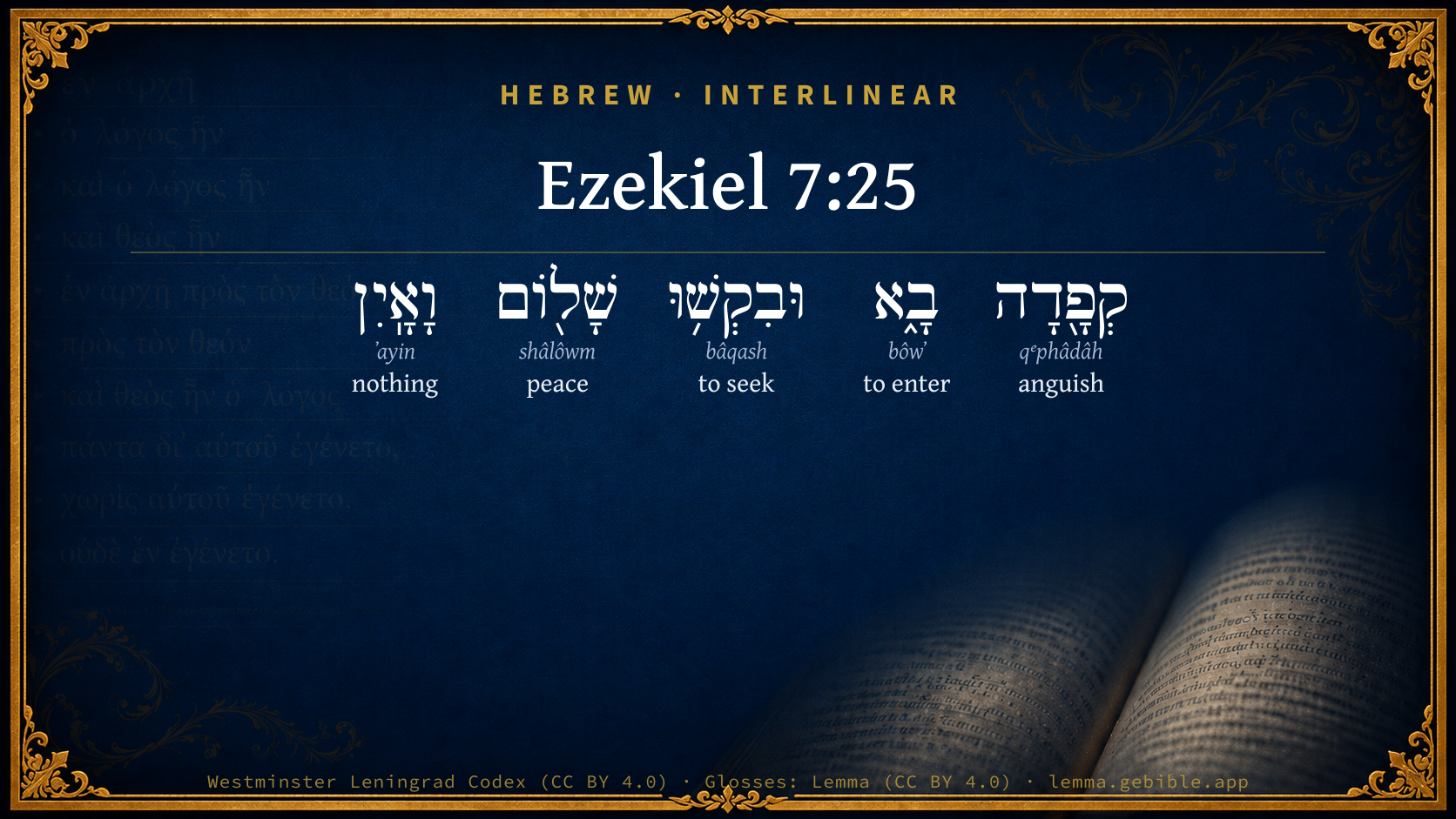
Ezekiel 7:25

Hebrew (Westminster Leningrad Codex) Ezekiel 7:25 appears in the Hebrew Old Testament. The text above is from the Westminster Leningrad Codex. Each word links to its Strong’s number, a concise gloss, and parsing drawn from the Open Scriptures Hebrew Bible morphology. Click any word for its full Brown-Driver-Briggs (BDB) entry.
Download image
Cite this verse

Ezekiel 7:25 (World English Bible). Public Domain. Lemma interlinear Bible study tool, https://lemma.gebible.app/v/ezekiel/7/25.

Show BibTeX & RIS
BibTeX
RIS
English Translation
Destruction comes; and they shall seek peace, and there shall be none.
World English Bible · Public Domain
Highlights
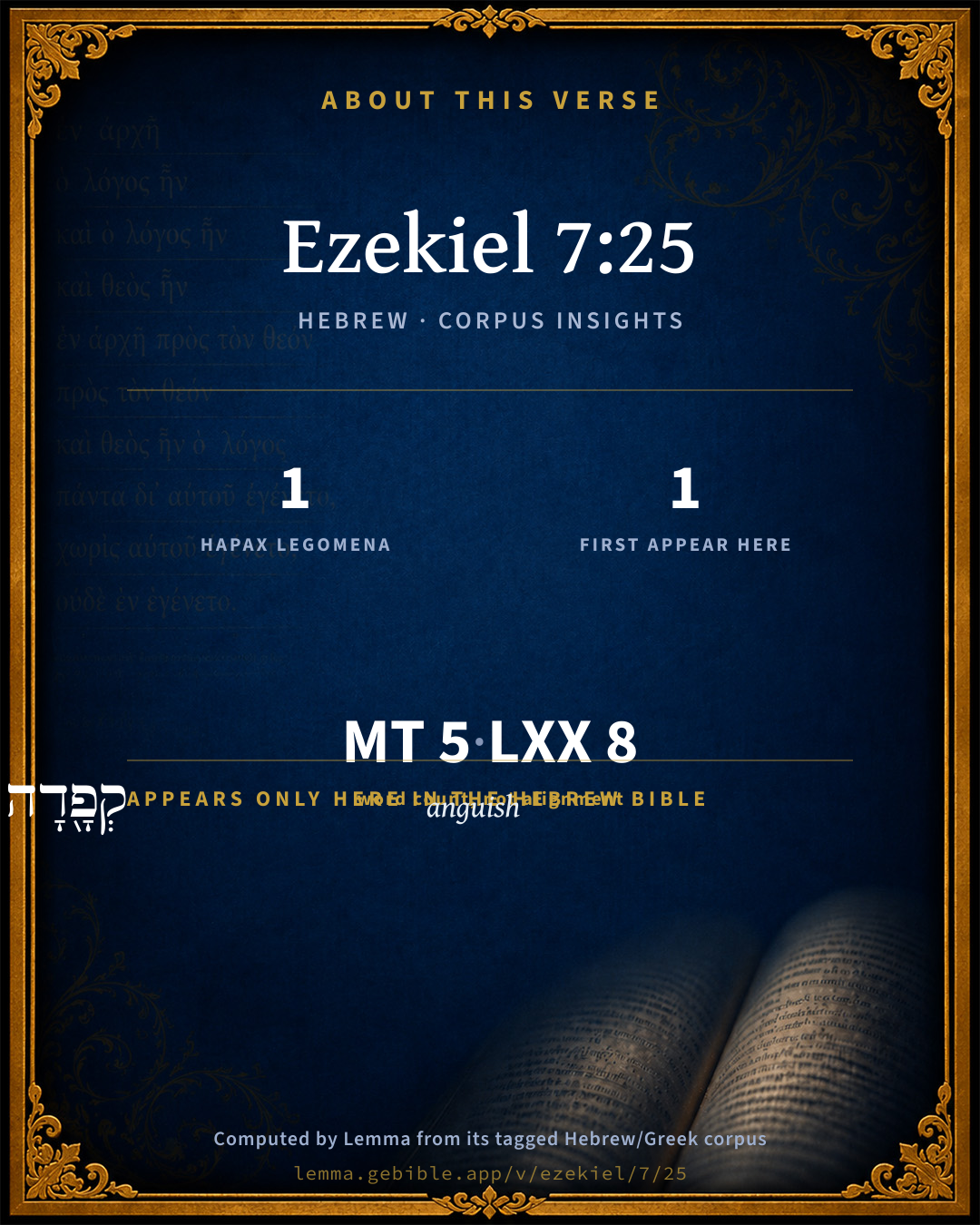
  • 1 hapax legomenon — only here in the Hebrew Bible
  • 1 first appearance in the Hebrew Bible
Full analysis ↓
Download a study sheet

One document with this verse’s original text, its word-by-word gloss line, the meaning frame, cross-references with their text, attributed commentary, and full source and license credits — printable, and it pastes into notes with its structure intact.

This verse Autodidact and up

Study sheet (.html) Plain text (.txt)

A passage Seminary Student

Up to 50 verses in one chapter. A passage sheet keeps up to 6 commentary sources and 12 cross-references per verse, in the order this page ranks them, and says so on the sheet whenever that leaves anything out. Ask for a single verse and you get the Autodidact verse sheet above.

Everything on this page stays free to read, with no account — the sheet is a download of what is already on screen, not access to it.

Want to remove ads? Support Godless Engineer
Compare translations 3

The same verse in 3 English versions, stacked beneath the original-language interlinear above. Click any original word for its lexicon entry.

Each is an independent rendering of the whole verse — the interlinear is not word-aligned to these translations.

Highlighted words mark where these versions differ — a whole-verse word diff, not a word-by-word alignment.

  • World English Bible Public Domain
    Destruction comes; and they shall seek peace, and there shall be none.
  • King James Version Public Domain
    Destruction cometh; and they shall seek peace, and there shall be none.
  • unfoldingWord Literal Text CC BY-SA 4.0
    Fear will come! They will seek peace, but there will be none.

unfoldingWord Literal Text — © unfoldingWord, licensed CC BY-SA 4.0. Word-aligned USFM3 via Door43 (git.door43.org/unfoldingWord/en_ult).

Versions to compare (up to 4)

3 of 4 selected

Show all 18 translations

Every available English version of this verse, each an independent rendering of the whole verse.

  • World English Bible Public Domain
    Destruction comes; and they shall seek peace, and there shall be none.
  • Berean Standard Bible Public Domain
    Anguish is coming! They will seek peace, but find none.
  • Majority Standard Bible Public Domain
    Anguish is coming! They will seek peace, but find none.
  • King James Version Public Domain
    Destruction cometh; and they shall seek peace, and there shall be none.
  • American Standard Version (1901) Public Domain
    Destruction cometh; and they shall seek peace, and there shall be none.
  • Revised Version (1885) Public Domain
    Destruction cometh; and they shall seek peace, and there shall be none.
  • Geneva Bible (1599) Public Domain
    When destruction commeth, they shall seeke peace, and shall not haue it.
  • Douay-Rheims (1899) Public Domain
    When distress cometh upon them, they will seek for peace and there shall be none.
  • Young's Literal Translation Public Domain
    Destruction hath come, And they have sought peace, and there is none.
  • Literal Standard Version CC BY-SA 4.0
    Destruction has come, || And they have sought peace, and there is none.
  • Unlocked Literal Bible CC BY-SA 4.0
    Fear will come! They will seek peace, but there will be none.
  • unfoldingWord Literal Text CC BY-SA 4.0
    Fear will come! They will seek peace, but there will be none.
  • Darby Bible Public Domain
    Destruction cometh; and they shall seek peace, but there shall be none.
  • World Messianic Bible Public Domain
    Destruction comes! They will seek peace, and there will be none.
  • Webster's Bible Public Domain
    Destruction cometh; and they shall seek peace, and there shall be none.
  • Free Bible Version CC BY-SA 4.0
    Absolutely terrified, the people will look for peace, but won't find it.
  • Bible in Basic English Public Domain
    Shaking fear is coming; and they will be looking for peace, and there will be no peace.
  • JPS Tanakh (1917) Public Domain
    Horror cometh; and they shall seek peace, and there shall be none.

Literal Standard Version (2020), Covenant Press — licensed CC BY-SA 4.0. Text via the HelloAO Bible API (eBible.org). Unlocked Literal Bible (unfoldingWord) — licensed CC BY-SA 4.0. Text via the HelloAO Bible API (eBible.org). unfoldingWord Literal Text — © unfoldingWord, licensed CC BY-SA 4.0. Word-aligned USFM3 via Door43 (git.door43.org/unfoldingWord/en_ult). Free Bible Version, Dr. Jonathan Gallagher — licensed CC BY-SA 4.0. Text via the HelloAO Bible API (eBible.org).

Word by word

More ways to search: Search by grammar → Find every occurrence → Compare this word →

Practice this passage: Drill this verse → Learn its vocabulary →

About this verse

These counts appear in no published source. They are computed here, from the morphology-tagged text and Lemma’s own curated glosses. What Lemma adds →

5
words
5
distinct lemmas
Prophets
section

Notable vocabulary

1 hapax legomenon — a word that appears only here in the entire Hebrew Bible:

  • קְפָ֖דָה anguish H7089

First appearance in Scripture

This word makes its first canonical appearance in the Hebrew Bible here:

  • קְפָ֖דָה anguish H7089

Grammatical profile

  • 2 verbs
  • 2 nouns
  • 1 particle

Verb forms

  • בָ֑א Qal · Perfect
  • וּבִקְשׁ֥וּ Piel · Sequential Perfect

Hebrew & Septuagint length

In English translation the verse runs 12 words from the Hebrew and 15 from the Septuagint (LXX English) — closely comparable.

A rough comparison of the two English renderings, which tokenize alike — not a word-level alignment.

Word counts can differ between the Hebrew and the Greek without any difference in meaning — e.g. the Hebrew direct-object marker אֵת has no separate Greek word, and Greek often adds the article ὁ.

In the original languages it is 5 Hebrew tokens and 8 Greek tokens — but the two are counted differently (Hebrew bundles its prefixes and suffixes into one token; the Greek is in lemma form), so that isn’t a like-for-like length.

Cross-references

7

Topical passages linked to Ezekiel 7:25 in the Treasury of Scripture Knowledge — connected by theme and wording, ordered by reader-vote popularity; previews shown in the World English Bible.

  • Isaiah 57:21 There is no peace, says my God, to the wicked.
  • Isaiah 59:8–12 The way of peace they don't know; and there is no justice in their goings: they have made them crooked paths; whoever goes therein does not know peace.
  • Jeremiah 8:15–16 We looked for peace, but no good came; [and] for a time of healing, and, behold, dismay!
  • Lamentations 4:17–18 Our eyes do yet fail [in looking] for our vain help: In our watching we have watched for a nation that could not save.
  • Ezekiel 13:10 Because, even because they have seduced my people, saying, Peace; and there is no peace; and when one builds up a wall, behold, they daub it with whitewash:
  • Ezekiel 13:16 [to wit], the prophets of Israel who prophesy concerning Jerusalem, and who see visions of peace for her, and there is no peace, says the Lord Yahweh.
  • Micah 1:12 For the inhabitant of Maroth waits anxiously for good, Because evil has come down from Yahweh to the gate of Jerusalem.

Cross-references courtesy of OpenBible.info (CC BY 4.0).

Hebrew and Greek witnesses Masoretic Hebrew ↔ Greek Septuagint

The same verse in the two great witnesses to the Old Testament, shown verse-for-verse.

These are two independent witnesses, not word-aligned to each other, and the Septuagint is shown in lemma (dictionary) form.

Hebrew Ezekiel 7:25 Masoretic · Westminster Leningrad Codex

קְפָ֖דָה בָ֑א וּבִקְשׁ֥וּ שָׁל֖וֹם וָאָֽיִן

Destruction comes; and they shall seek peace, and there shall be none.

World English Bible · Public Domain

Greek LXX Ezekiel 7:25 Septuagint · lemma form

ἐξιλασμός ἥκω καί ζητέω εἰρήνη καί οὐ εἰμί

And though propitiation shall come, and one shall seek peace, yet there shall be none.

LXX2012 (modern English Septuagint) · Public Domain

On this verse, Trapp's Complete Commentary discusses the Septuagint’s reading. Read the note in Commentary ↓

Hebrew: Westminster Leningrad Codex (CC BY 4.0). Greek: Septuagint (public domain); English from LXX2012 (modern English Septuagint) (Public Domain). How the Septuagint differs from the Hebrew →

Targum (Aramaic paraphrase)

1

The Targum is the ancient Jewish Aramaic paraphrase of the Hebrew Scriptures — an interpretive translation, not the Hebrew text itself. Onkelos (literal) and Pseudo-Jonathan (expansive) render the Torah, and Jonathan the Prophets. Coverage is partial: where no permissively-licensed English translation exists for a verse, only the Aramaic is shown. This is verse-level text, not a word-by-word alignment to the Hebrew.

  1. Targum Jonathan Prophets (Joshua–Malachi)
    אִתְקְפָדַת מְטַת וְיִבְעוֹן שְׁלָמָא וְלֵית:

    (no public-domain English translation for this verse)

    Targum Jonathan — Aramaic: “Mikraot Gedolot” (public domain). English: “Sefaria Community Translation” (CC0 1.0 (public-domain dedication)); “London "Chaldee Paraphrase," 1871” (public domain). Text via Sefaria.

Commentary

Notes on Ezekiel 7:25 from classic Christian and Jewish commentators (each source and its license shown beneath its notes). The classic Christian expositions comment on the surrounding passage and are grouped to its opening verse, so a note may address several verses; the Jewish commentaries on the Tanakh (Rashi and others) are per-verse, so they appear only where the commentator wrote on this verse.

Lemma curates 59 commentaries, every one of them public domain or Creative Commons licensed, each selected and text-cleaned for this edition rather than reprinted as found. About our sources →

Trapp's Complete Commentary

John Trapp

Eze 7:25 Destruction cometh; and they shall seek peace, and [there shall be] none.

Ver. 25. Destruction cometh.] Not εξιλασμος ηκει, Mercy shall come, as the Septuagint ill render it, but utter excision, as when a weaver cutteth the web he hath finished out of the loom. {Isa 38:12}

They shall seek peace.] Of God, but all too late; of the Chaldees, but all in vain; for they were cockatrices, and would not be charmed. {Jer 8:17; Jer 8:15; Jer 12:12; Jer 16:5} Note here how Jeremiah and Ezekiel say the same thing, as being acted by the same spirit.

John Trapp, A Commentary or Exposition upon All the Books of the Old and New Testament (1647–1656) — public domain. Text from a community e-Sword module.

The Biblical Illustrator

Joseph S. Exell

Eze_7:25

Destruction cometh; and they shall seek peace, and there shall be none.

Destruction instead of peace

I remember hearing Dr. James Spurgeon, in the course of a sermon preached at the Metropolitan Tabernacle, say that on one occasion when he was returning from New York, and the vessel had not been long out at sea, he noticed a number of small birds in the rigging of the vessel. Ah, poor things, said the captain, they will be dead by tomorrow; they think they are going landward, while they are going out into the sea. And the captain was right, for on the morrow their little stiffened bodies were scattered about the deck. And just so is it with impenitent men who, in their false security, pursue what they fondly dream to be a safe way, but it is the way of certain ruin. Destruction cometh, and they shall seek peace, and there shall he none. (Charles Deal.)

The Biblical Illustrator, edited by Joseph S. Exell (c. 1880s–1900s) — public domain. Text from a community e-Sword module.

Joseph Benson's Commentary

Eze 7:25-27. Destruction cometh — Such as a provoked power makes when it cuts off all, root and branch. And they shall seek peace — By inquiring of the prophets; or rather, by suing to Nebuchadnezzar, whom, after so many affronts, they will attempt to pacify. And there shall be none — No such thing can be obtained. Mischief shall come upon mischief — One calamity shall follow upon the neck of another. And rumour upon rumour — One piece of mournful intelligence after another, namely, of the enemies’ preparations, marches, successes, and cruelties, causing the hearts of the stoutest to sink within them. Then shall they seek a vision of the prophet — In this multiplied perplexity they will inquire of the prophets, true or false, concerning the event of things; or will seek to them for some word of direction or comfort from God, as Zedekiah did, Jer 34:18, &c. But the law shall perish from the priest, &c. — He shall have no words, either of advice or comfort, to speak to them. And counsel from the ancients — Nor shall their senators know what to advise. So great will be the confusion, trouble, and terror, that neither the pious nor the wise, whom they were wont to consult, and who used to give them counsel in all difficult cases, shall be able to advise any thing to the purpose in this great perplexity and distress. The king shall mourn — Zedekiah shall droop and despair. And the prince shall be clothed with desolation — Every magistrate shall be seized with trouble and astonishment. And the hands of the people shall be troubled — Hang down and melt away. There shall be a general consternation of all ranks and degrees of men. They that are in authority shall want presence of mind to give counsel and directions, and the inferiors shall have no heart to put any advice in execution. What can men contrive, or do for themselves, when God is departed from them? All must needs be in tears, all in trouble, when God comes to judge them according to their deserts, and so make them know, to their cost, that he is the Lord to whom vengeance belongeth.

Joseph Benson's Commentary on the Old and New Testaments (1811–1818) — public domain. Text from a community e-Sword module.

Jamieson, Fausset & Brown

Robert Jamieson, A. R. Fausset & David Brown

peace, and . . . none-- (Th1 5:3).

Jamieson, Fausset & Brown — Commentary Critical and Explanatory on the Whole Bible (1871) — public domain (CC PDM 1.0). Text via the HelloAO Bible API.

Adam Clarke's Commentary

Verse 25. They shall seek peace] They see now that their ceasing to pay the tribute to the king of Babylon has brought the Chaldeans against them; and now they sue for peace in vain. He will not hear: he is resolved on their destruction.

Adam Clarke's Commentary on the Bible (1810–1826) — public domain. Text from a community e-Sword/MySword module.

John Calvin's Commentaries

He confirms the same doctrine. He says therefore, destruction is come He now adds, there shall be no peace This confirmation was not in vain. For men always hope they shall obtain some advantage by turning their backs; hence they seize on hiding-places whence God draws them into light. Then they form for themselves many hopes of safety when God holds them bound down. Since, therefore, men are so slippery, and, by catching at refuges, think to elude God and his judgments, the Prophet says, though they seek peace they shall find none, that they may not doubt about that destruction and cutting off which he mentions. It follows —

John Calvin's Commentaries (1540-1563) — public domain. Text from the Calvin Translation Society English edition (1840s-50s) via the Christian Classics Ethereal Library (ccel.org). Calvin's coverage is partial (roughly two-thirds of the Bible); uncommented books and verses are honest gaps, never fabricated. The 19th-century editor's footnotes and remarks are omitted so the notes are faithfully Calvin's own voice.

Ellicott's Commentary for English Readers

(25) Destruction cometh.—This is another of the peculiar words occurring only in this chapter. It is generally explained of the dismay and horror accompanying great judgments, and vividly described by our Lord as “men’s hearts failing them for fear” (Luk_21:26).

A Bible Commentary for English Readers, edited by Charles John Ellicott (1878–1897) — public domain. Text from a community e-Sword module.

The Cambridge Bible for Schools and Colleges

gen. ed. J. J. S. Perowne

25. Destruction cometh] Or, anguish.

The Cambridge Bible for Schools and Colleges (gen. ed. J. J. S. Perowne; Cambridge University Press, 1878–1918) — public domain. Text from a community e-Sword module.

John Gill's Exposition

Mischief shall come upon mischief,.... One misfortune or calamity after another; first one unhappy event, and then another, as was Job's case. The Targum is,

"breach upon breach shall come (o):''

and rumour shall be upon rumour; that the Chaldean army is in such a place; and then that it is in another place still nearer; and then that it is but a few miles off, and, will be here immediately: rumours of wars, as well as wars, themselves, are very distressing; see Mat 24:6;

then shall they seek a vision of the prophet; apply to him for a prophecy, to know the event of things, whether and when they might expect a deliverance:

but the law shall perish from the priest; whose lips should keep knowledge, and from whose mouth the law, the doctrine and interpretation of it, might be expected; but now either there would be no priests at all; or such as were would be ignorant and unlearned, and incapable of instructing the people:

and counsel from the ancients; with whom it usually is; and which is of great service in a time of distress: this therefore adds greatly to the calamity, that there would be no prophet to tell them what should come to pass; no priest to instruct them; nor senator or wise man to give them counsel.

(o) So R. Sol. Urhin. Ohel Moed, fol. 96. 1.

John Gill's Exposition of the Whole Bible (1746–1763) — public domain (CC PDM 1.0). Text via the HelloAO Bible API.

Haydock's Catholic Bible Commentary

Distress. When the enemy is before the city, they will see their error; but it will be too late. They shall not obtain peace, Jeremias xxxviii. 1.

George Leo Haydock (1774–1849), Haydock's Catholic Family Bible and Commentary, 1859 edition — public domain. Excludes Psalms (Douay-Rheims chapter numbering differs from Protestant) and Deuterocanonical books (Catholic canon only).

Matthew Poole's English Annotations

Destruction; such as an angry, provoked power makes when it cuts off all root and branch.

They shall seek peace; either by inquiring of prophets; or rather, suing to Nebuchadnezzar, whom, after so many affronts, they will attempt to pacify.

There shall be none; no such thing can be had: they should seek it elsewhere, and appease their God, who could give them peace; as for the Chaldean, he will not, because God doth not.

Matthew Poole's English Annotations on the Holy Bible (1683–1685) — public domain. Text from a community e-Sword/MySword module.

The Pulpit Commentary

They shall seek peace, etc. The noun is probably to be taken in its wider sense as including safety and prosperity, but may also include specific overtures for peace made to the Chaldean generals.

Peace sought in vain.

No feature of distress and horror is omitted in this prophetic description of the effects of God"s displeasure manifested towards the Jewish people. The burden of predicting such judgments must have been too heavy to bear: what can be said of the state of those upon whom the judgments came? They might well ask, "Who can abide the day of his coming?" What more appalling than the account given in these few words of the state of the people in the time of their disasters: "They shall seek peace, and there shall be none"?

I THE GREAT BLESSING OF PEACE. This may be misunderstood. Warfare with ignorance, error, and iniquity, is characteristic of the condition of the good man here upon earth. Our Lord Jesus saw this, and declared, "I am not come to send peace, but a sword." The presence of evil requires that the attitude of the righteous should be one of antagonism. But this is for a season and for a purpose. A state of controversy and hostility is not a state in itself perfectly desirable and good. Peace of conscience, peace with God, peace with Christian brethren, as far as possible peace with all men, these are blessings devoutly to be desired and sought.

II THE INCOMPATIBILITY OF SIN WITH PEACE. If peace results from the harmony of the several parts of a man"s nature among themselves, and from harmony between man as a moral being and his God, it is not to be expected that, when the passions are arrayed against the reason, interest against conscience, the subject against the rightful and Divine Ruler, there can be peace. It is mercifully ordered that peace should flee when iniquity prevails. "There is no peace, saith my God, to the wicked.

III THE PUNISHMENT APPROPRIATE TO SIN OFTEN LEADS TO A DESIRE FOR THE BLESSINGS OF PEACE. Men seek peace, and there is none. Thus they are led to reflect upon the unreasonableness of their expectation that the moral laws of the universe should be changed for their pleasure. Tossed to and fro upon the stormy waters, they long for the haven of repose.

IV PEACE IS ONLY TO BE OBTAINED UPON GOD"S OWN TERMS OF COMPLETE SURRENDER AND SUBMISSION. It is not to be found either by endeavoring to stifle the voice of conscience within, or by withdrawing from a world of outward strife to some seclusion and isolation. Both these methods have often been tried, but in vain. The conciliation must take place within. The heart must find rest and satisfaction in the gospel of Jesus Christ, "our Peace." The whole nature must, by the power of the Spirit, be brought into subjection to God. The fountain of peace must thus be divinely opened, and "peace will flow as a river. T.

The Pulpit Commentary (1880–1919), ed. H.D.M. Spence-Jones & Joseph S. Exell — public domain. Text from a community e-Sword module.

Rashi

Rabbi Shlomo Yitzchaki (Rashi)

A cutting off comes Heb. קְפָדָה like (Isa. 38:12): “I severed (קִפַּדְתִּי) like a weaver, my life”; a term denoting cutting off.

Rashi on the Tanakh — English translations: “The Judaica Press complete Tanach with Rashi, translated by A. J. Rosenberg” (CC BY 4.0); “Pentateuch with Rashi's commentary by M. Rosenbaum and A.M. Silbermann, 1929-1934” (public domain); “The Metsudah Tanach series, Lakewood, N.J” (CC BY 4.0); and “The Book of Joshua, Metsudah Publications, 1997” (CC BY 4.0). Text via Sefaria.

Lesson kit

Teaching starters — assembled from the data on this page, not authored interpretation. Every prompt links to the verse data it draws on. Edit before teaching.

Ezekiel, in the Prophets, opens this verse with 5 words (5 distinct Hebrew lemmas). Its most distinctive word is qᵉphâdâh (“anguish”). A historical commentator’s framing appears above. Read the whole chapter for the surrounding context.

Discussion questions

  1. What does “anguish” (qᵉphâdâh) contribute to the verse as a whole?
  2. 1 word here appears nowhere else in the Hebrew Bible. Why might the author reach for such rare wording?
  3. This is the first place “anguish” appears in Scripture (first appears here). What does its debut here establish?
  4. How does Isaiah 57:21, which shares this passage’s theme, read alongside this verse?
  5. These translations render this verse differently; the difference is in the English rendering, not the original. What questions does that raise?
  6. «בָ֑א» is a Qal Perfect verb. How does that grammatical form shape the action described?
  7. Compare how Trapp's Complete Commentary and The Biblical Illustrator read this verse. Where do they agree or differ?

Things to notice

Reading settings

Reading text

Shown beneath each verse's original-language words.

Old Testament
Old Testament edition

Read the OT as the Masoretic Hebrew (MT) or the Greek Septuagint (LXX).

English shown for the Greek Septuagint (in the Hebrew ↔ Greek comparison).

Comparing translations? Open the Compare panel on any verse page to stack up to four side by side.