
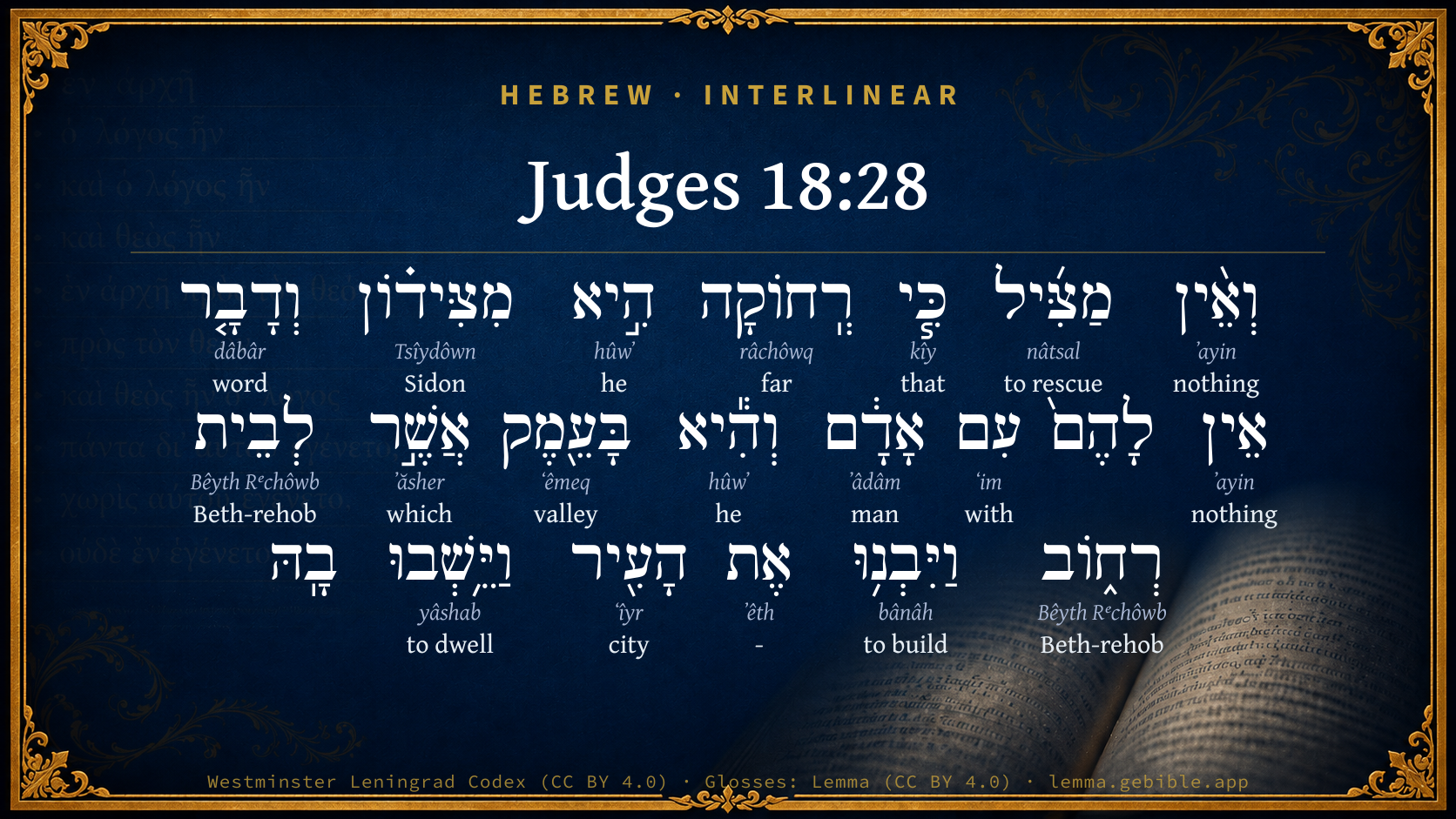
Judges 18:28

Hebrew (Westminster Leningrad Codex) Judges 18:28 appears in the Hebrew Old Testament. The text above is from the Westminster Leningrad Codex. Each word links to its Strong’s number, a concise gloss, and parsing drawn from the Open Scriptures Hebrew Bible morphology. Click any word for its full Brown-Driver-Briggs (BDB) entry.
Download image
Cite this verse

Judges 18:28 (World English Bible). Public Domain. Lemma interlinear Bible study tool, https://lemma.gebible.app/v/judges/18/28.

Show BibTeX & RIS
BibTeX
RIS
English Translation
There was no deliverer, because it was far from Sidon, and they had no dealings with any man; and it was in the valley that lies by Beth Rehob. They built the city, and lived therein.
World English Bible · Public Domain
Highlights
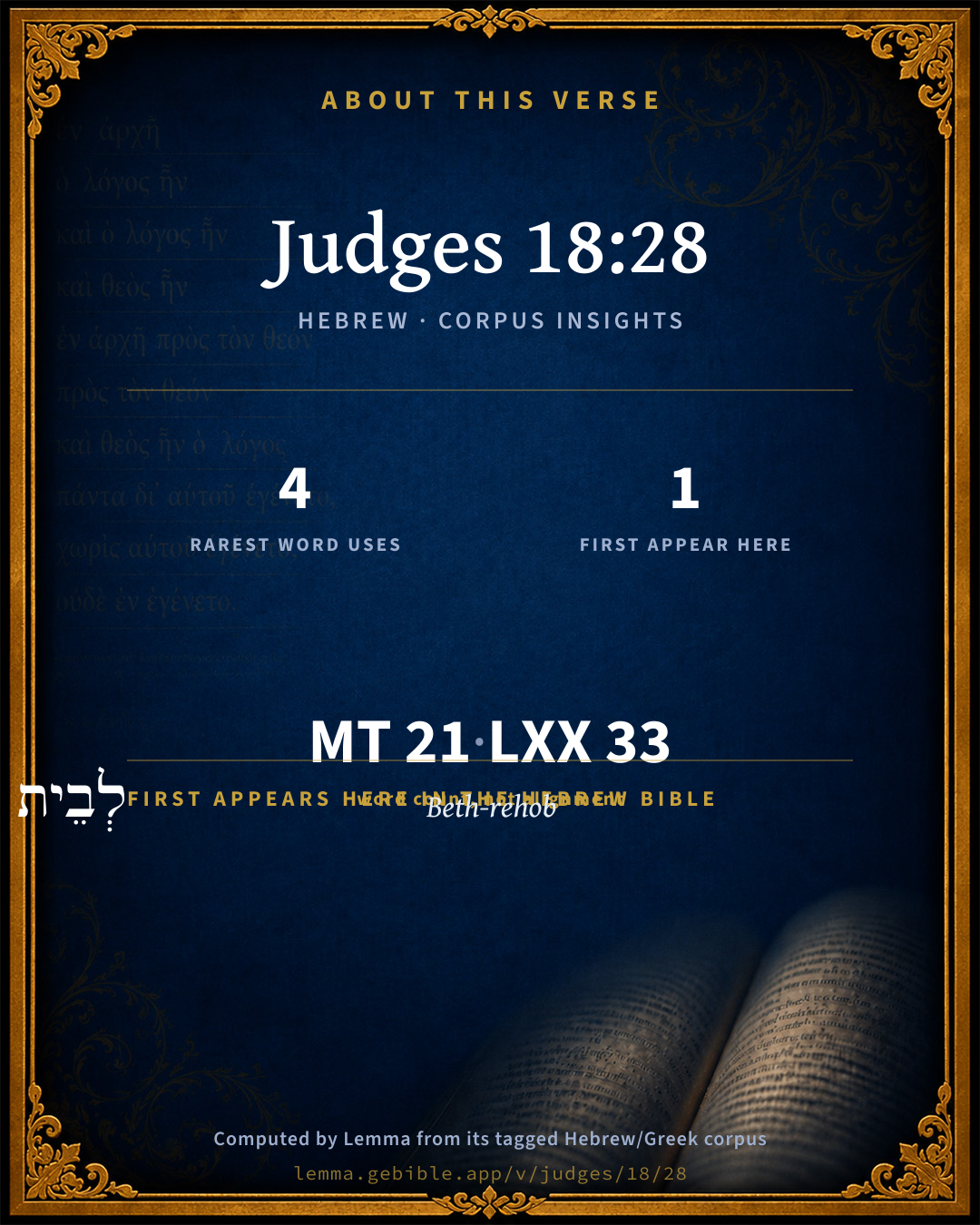
  • 1 first appearance in the Hebrew Bible
Full analysis ↓
Download a study sheet

One document with this verse’s original text, its word-by-word gloss line, the meaning frame, cross-references with their text, attributed commentary, and full source and license credits — printable, and it pastes into notes with its structure intact.

This verse Autodidact and up

Study sheet (.html) Plain text (.txt)

A passage Seminary Student

Up to 50 verses in one chapter. A passage sheet keeps up to 6 commentary sources and 12 cross-references per verse, in the order this page ranks them, and says so on the sheet whenever that leaves anything out. Ask for a single verse and you get the Autodidact verse sheet above.

Everything on this page stays free to read, with no account — the sheet is a download of what is already on screen, not access to it.

Want to remove ads? Support Godless Engineer
Compare translations 3

The same verse in 3 English versions, stacked beneath the original-language interlinear above. Click any original word for its lexicon entry.

Each is an independent rendering of the whole verse — the interlinear is not word-aligned to these translations.

Highlighted words mark where these versions differ — a whole-verse word diff, not a word-by-word alignment.

  • World English Bible Public Domain
    There was no deliverer, because it was far from Sidon, and they had no dealings with any man; and it was in the valley that lies by Beth Rehob. They built the city, and lived therein.
  • King James Version Public Domain
    And there was no deliverer, because it was far from Zidon, and they had no business with any man; and it was in the valley that lieth by Bethrehob. And they built a city, and dwelt therein.
  • unfoldingWord Literal Text CC BY-SA 4.0
    And there was not a deliverer, for it was far from Sidon and no thing to them with man. Now it in the valley that to Beth Rehob. And they built the city, and they dwelled in it.

unfoldingWord Literal Text — © unfoldingWord, licensed CC BY-SA 4.0. Word-aligned USFM3 via Door43 (git.door43.org/unfoldingWord/en_ult).

Versions to compare (up to 4)

3 of 4 selected

Show all 18 translations

Every available English version of this verse, each an independent rendering of the whole verse.

  • World English Bible Public Domain
    There was no deliverer, because it was far from Sidon, and they had no dealings with any man; and it was in the valley that lies by Beth Rehob. They built the city, and lived therein.
  • Berean Standard Bible Public Domain
    There was no one to deliver them, because the city was far from Sidon and had no alliance with anyone; it was in a valley near Beth-rehob. And the Danites rebuilt the city and lived there.
  • Majority Standard Bible Public Domain
    There was no one to deliver them, because the city was far from Sidon and had no alliance with anyone; it was in a valley near Beth-rehob. And the Danites rebuilt the city and lived there.
  • King James Version Public Domain
    And there was no deliverer, because it was far from Zidon, and they had no business with any man; and it was in the valley that lieth by Bethrehob. And they built a city, and dwelt therein.
  • American Standard Version (1901) Public Domain
    And there was no deliverer, because it was far from Sidon, and they had no dealings with any man; and it was in the valley that lieth by Beth-rehob. And they built the city, and dwelt therein.
  • Revised Version (1885) Public Domain
    And there was no deliverer, because it was far from Zidon, and they had no dealings with any man; and it was in the valley that lieth by Beth-rehob. And they built the city, and dwelt therein.
  • Geneva Bible (1599) Public Domain
    And there was none to helpe, because Laish was farre from Zidon, and they had no businesse with other men: also it was in the valley that lyeth by Beth-rehob. After, they built the citie, and dwelt therein,
  • Douay-Rheims (1899) Public Domain
    There being no man at all who brought them any succour, because they dwelt far from Sidon, and had no society or business with any man. And the city was in the land of Rohob: and they rebuilt it and dwelt therein.
  • Young's Literal Translation Public Domain
    and there is no deliverer, for it `is' far off from Zidon, and they have no word with `any' man, and it `is' in the valley which `is' by Beth-Rehob; and they build the city, and dwell in it,
  • Literal Standard Version CC BY-SA 4.0
    and there is no deliverer, for it [is] far off from Sidon, and they have no word with [any] man, and it [is] in the valley which [is] by Beth-Rehob; and they build the city, and dwell in it,
  • Unlocked Literal Bible CC BY-SA 4.0
    There was no one to rescue them because it was a long way from Sidon, and they had no dealings with anyone. It was in the valley that is near Beth Rehob. The Danites rebuilt the city and lived there.
  • unfoldingWord Literal Text CC BY-SA 4.0
    And there was not a deliverer, for it was far from Sidon and no thing to them with man. Now it in the valley that to Beth Rehob. And they built the city, and they dwelled in it.
  • Darby Bible Public Domain
    And there was no deliverer because it was far from Sidon, and they had no dealings with any one. It was in the valley which belongs to Beth-rehob. And they rebuilt the city, and dwelt in it.
  • World Messianic Bible Public Domain
    There was no deliverer, because it was far from Sidon, and they had no dealings with anyone else; and it was in the valley that lies by Beth Rehob. They built the city and lived in it.
  • Webster's Bible Public Domain
    And there was no deliverer, because it was far from Zidon, and they had no business with any man; and it was in the valley that lieth by Beth-rehob. And they built a city and dwelt in it.
  • Free Bible Version CC BY-SA 4.0
    No one could save them because they were a long way from Sidon and had no other allies to help them. The town was in the valley belonging to Beth-rehob. The Danites rebuilt the city and lived there.
  • Bible in Basic English Public Domain
    And they had no saviour, because it was far from Zidon, and they had no business with Aram; and it was in the valley which is the property of Beth-rehob. And building up the town again they took it for their living-place.
  • JPS Tanakh (1917) Public Domain
    And there was no deliverer, because it was far from Zidon, and they had no dealings with any man; and it was in the valley that lieth by Beth-rehob. And they built the city, and dwelt therein.

Literal Standard Version (2020), Covenant Press — licensed CC BY-SA 4.0. Text via the HelloAO Bible API (eBible.org). Unlocked Literal Bible (unfoldingWord) — licensed CC BY-SA 4.0. Text via the HelloAO Bible API (eBible.org). unfoldingWord Literal Text — © unfoldingWord, licensed CC BY-SA 4.0. Word-aligned USFM3 via Door43 (git.door43.org/unfoldingWord/en_ult). Free Bible Version, Dr. Jonathan Gallagher — licensed CC BY-SA 4.0. Text via the HelloAO Bible API (eBible.org).

Word by word

More ways to search: Search by grammar → Find every occurrence → Compare this word →

Practice this passage: Drill this verse → Learn its vocabulary →

לְבֵית
Bêyth Rᵉchôwb
H1050
“to/for · Beth-rehob”
Preposition + Noun, Proper
Part of Speech
Preposition + Noun
Type
Proper
Full BDB Definition

Origin: from H1004 and H7339

TWOT: None

Beth-rehob = "house of the street" - a place in Dan on road to Hamath
  1. וְאֵ֨ין ʼayin H369 “and · nothing” Conjunction + Particle, Negative
  2. מַצִּ֜יל nâtsal H5337 “rescuing” Verb, Hiphil, Participle Active, Masculine, Singular, Absolute
  3. כִּ֧י kîy H3588 “that” Conjunction
  4. רְֽחוֹקָה râchôwq H7350 “far” Adjective, Adjective, Feminine, Singular, Absolute
  5. הִ֣יא hûwʼ H1931 “he” Pronoun, Personal, 3rd Person, Feminine, Singular
  6. מִצִּיד֗וֹן Tsîydôwn H6721 “from · Sidon” Preposition + Noun, Proper
  7. וְדָבָ֤ר dâbâr H1697 “and · word” Conjunction + Noun, Common, Masculine, Singular, Absolute
  8. אֵין ʼayin H369 “nothing” Particle, Negative
  9. עִם ʻim H5973 “with” Preposition
  10. אָדָ֔ם ʼâdâm H120 “man” Noun, Common, Masculine, Singular, Absolute
  11. וְהִ֕יא hûwʼ H1931 “and · he” Conjunction + Pronoun, Personal, 3rd Person, Feminine, Singular
  12. בָּעֵ֖מֶק ʻêmeq H6010 “in/at the · valley” Preposition, Determined + Noun, Common, Masculine, Singular, Absolute
  13. אֲשֶׁ֣ר ʼăsher H834 “which” Particle, Relative
  14. רְח֑וֹב Bêyth Rᵉchôwb H1050 “Beth-rehob” Noun, Proper
  15. וַיִּבְנ֥וּ bânâh H1129 “and · to build” Conjunction + Verb, Qal, Sequential Imperfect, 3rd Person, Masculine, Plural
  16. אֶת ʼêth H853 “-” Particle, Direct Object
  17. הָעִ֖יר ʻîyr H5892 “the · city” Particle, Definite Article + Noun, Common, Feminine, Singular, Absolute
  18. וַיֵּ֥שְׁבוּ yâshab H3427 “and · to dwell” Conjunction + Verb, Qal, Sequential Imperfect, 3rd Person, Masculine, Plural

About this verse

These counts appear in no published source. They are computed here, from the morphology-tagged text and Lemma’s own curated glosses. What Lemma adds →

21
words
16
distinct lemmas
Historical
section

Notable vocabulary

The rarest word here is לְבֵית Beth-rehob H1050 — appearing just 4 times in the whole Hebrew Bible.

First appearance in Scripture

This word makes its first canonical appearance in the Hebrew Bible here:

  • לְבֵית Beth-rehob H1050

Shared distinctive vocabulary

לְבֵית Beth-rehob H1050 occurs in 2 verses of the Hebrew Bible. Also found in:

Grammatical profile

  • 3 verbs
  • 7 nouns
  • 1 adjective
  • 2 pronouns
  • 3 prepositions
  • 1 conjunction
  • 4 particles

Verb forms

  • מַצִּ֜יל Hiphil · Participle Active
  • וַיִּבְנ֥וּ Qal · Sequential Imperfect
  • וַיֵּ֥שְׁבוּ Qal · Sequential Imperfect

Repetition

Words recur within this verse — often emphatic in Hebrew:

  • וְאֵ֨ין nothing H369 ×2
  • לְבֵית Beth-rehob H1050 ×2
  • הִ֣יא he H1931 ×2

Hebrew & Septuagint length

In English translation the verse runs 36 words from the Hebrew and 40 from the Septuagint (LXX English) — closely comparable.

A rough comparison of the two English renderings, which tokenize alike — not a word-level alignment.

Word counts can differ between the Hebrew and the Greek without any difference in meaning — e.g. the Hebrew direct-object marker אֵת has no separate Greek word, and Greek often adds the article ὁ.

In the original languages it is 21 Hebrew tokens and 33 Greek tokens — but the two are counted differently (Hebrew bundles its prefixes and suffixes into one token; the Greek is in lemma form), so that isn’t a like-for-like length.

Cross-references

11

Topical passages linked to Judges 18:28 in the Treasury of Scripture Knowledge — connected by theme and wording, ordered by reader-vote popularity; previews shown in the World English Bible.

  • 2 Samuel 10:6 When the children of Ammon saw that they were become odious to David, the children of Ammon sent and hired the Syrians of Beth Rehob, and the Syrians of Zobah, twenty thousand footmen, and the king of Maacah with one thousand men, and the men of Tob twelve thousand men.
  • Numbers 13:21 So they went up, and spied out the land from the wilderness of Zin to Rehob, to the entrance of Hamath.
  • Judges 18:7 Then the five men departed, and came to Laish, and saw the people who were therein, how they lived in security, after the manner of the Sidonians, quiet and secure; for there was none in the land, possessing authority, that might put [them] to shame in anything, and they were far from the Sidonians, and had no dealings with any man.
  • Psalms 7:2 Lest they tear apart my soul like a lion, Ripping it in pieces, while there is none to deliver.
  • Joshua 11:8 Yahweh delivered them into the hand of Israel, and they struck them, and chased them to great Sidon, and to Misrephoth Maim, and to the valley of Mizpeh eastward; and they struck them, until they left them none remaining.
  • Judges 18:1 In those days there was no king in Israel: and in those days the tribe of the Danites sought them an inheritance to dwell in; for to that day [their] inheritance had not fallen to them among the tribes of Israel.
  • 2 Samuel 14:6 Your handmaid had two sons, and they two strove together in the field, and there was none to part them, but the one struck the other, and killed him.
  • Psalms 50:22 "Now consider this, you who forget God, Lest I tear you into pieces, and there be none to deliver.
  • Isaiah 23:4 Be ashamed, Sidon; for the sea has spoken, the stronghold of the sea, saying, I have not travailed, nor brought forth, neither have I nourished young men, nor brought up virgins.
  • Isaiah 23:12 He said, You shall no more rejoice, you oppressed virgin daughter of Sidon: arise, pass over to Kittim; even there shall you have no rest.
  • Daniel 3:15–17 Now if you are ready whenever you hear the sound of the horn, flute, zither, lyre, harp, pipe, and all kinds of music to you fall down and worship the image which I have made, [well]: but if you don't worship, you shall be cast the same hour into the midst of a burning fiery furnace; and who is that god that shall deliver you out of my hands?

Cross-references courtesy of OpenBible.info (CC BY 4.0).

Hebrew and Greek witnesses Masoretic Hebrew ↔ Greek Septuagint

The same verse in the two great witnesses to the Old Testament, shown verse-for-verse.

These are two independent witnesses, not word-aligned to each other, and the Septuagint is shown in lemma (dictionary) form.

Hebrew Judges 18:28 Masoretic · Westminster Leningrad Codex

וְאֵ֨ין מַצִּ֜יל כִּ֧י רְֽחוֹקָה הִ֣יא מִצִּיד֗וֹן וְדָבָ֤ר אֵין לָהֶם֙ עִם אָדָ֔ם וְהִ֕יא בָּעֵ֖מֶק אֲשֶׁ֣ר לְבֵית רְח֑וֹב וַיִּבְנ֥וּ אֶת הָעִ֖יר וַיֵּ֥שְׁבוּ בָֽהּ

There was no deliverer, because it was far from Sidon, and they had no dealings with any man; and it was in the valley that lies by Beth Rehob. They built the city, and lived therein.

World English Bible · Public Domain

Greek LXX Judges 18:28 Septuagint · lemma form

καί οὐ εἰμί ὁ ῥύομαι ὅτι μακράν εἰμί ἀπό σιδώνιος καί λόγος οὐ εἰμί αὐτός μετά ἄνθρωπος καί αὐτός ἐν ὁ κοιλάς ὁ οἶκος ρααβ καί οἰκοδομέω ὁ πόλις καί κατασκηνόω ἐν αὐτός

And there was no deliverer, because the city is far from the Sidonians, and they have no intercourse with men, and it is in the valley of the house of Raab; and they built the city, and lived in it.

LXX2012 (modern English Septuagint) · Public Domain

Hebrew: Westminster Leningrad Codex (CC BY 4.0). Greek: Septuagint (public domain); English from LXX2012 (modern English Septuagint) (Public Domain). How the Septuagint differs from the Hebrew →

Targum (Aramaic paraphrase)

1

The Targum is the ancient Jewish Aramaic paraphrase of the Hebrew Scriptures — an interpretive translation, not the Hebrew text itself. Onkelos (literal) and Pseudo-Jonathan (expansive) render the Torah, and Jonathan the Prophets. Coverage is partial: where no permissively-licensed English translation exists for a verse, only the Aramaic is shown. This is verse-level text, not a word-by-word alignment to the Hebrew.

  1. Targum Jonathan Prophets (Joshua–Malachi)
    וְלֵית דִמְשֵׁיזִיב אֲרֵי רְחִיקָא הִיא מִצִידוֹן וּפִתְגַם לֵית לְהוֹן עִם אֱנַשׁ וְאִינוּן בְּמֵשַׁר דִלְבֵית רְחוֹב וּבְנוֹ יַת קַרְתָּא וִיתִיבוּ בָהּ:

    (no public-domain English translation for this verse)

    Targum Jonathan — Aramaic: “Mikraot Gedolot” (public domain). English: “Sefaria Community Translation” (CC0 1.0 (public-domain dedication)); “London "Chaldee Paraphrase," 1871” (public domain). Text via Sefaria.

Commentary

Notes on Judges 18:28 from classic Christian and Jewish commentators (each source and its license shown beneath its notes). The classic Christian expositions comment on the surrounding passage and are grouped to its opening verse, so a note may address several verses; the Jewish commentaries on the Tanakh (Rashi and others) are per-verse, so they appear only where the commentator wrote on this verse.

Lemma curates 59 commentaries, every one of them public domain or Creative Commons licensed, each selected and text-cleaned for this edition rather than reprinted as found. About our sources →

Trapp's Complete Commentary

John Trapp

Jdg 18:28 And [there was] no deliverer, because it [was] far from Zidon, and they had no business with [any] man; and it was in the valley that [lieth] by Bethrehob. And they built a city, and dwelt therein.

Ver. 28. Because it was far from Zidon.] See on Jdg 18:7.

John Trapp, A Commentary or Exposition upon All the Books of the Old and New Testament (1647–1656) — public domain. Text from a community e-Sword module.

Geneva Bible (1599)

Geneva Bible translators

Which after was called Cesarea Philippi.

Or, deliver them.

Geneva Bible (1599) marginal notes — public domain. Text via Bolls.life.

Jamieson, Fausset & Brown

Robert Jamieson, A. R. Fausset & David Brown

they built a city, and . . . call the name of that city Dan--It was in the northern extremity of the land, and hence the origin of the phrase, "from Dan to Beer-sheba."

Jamieson, Fausset & Brown — Commentary Critical and Explanatory on the Whole Bible (1871) — public domain (CC PDM 1.0). Text via the HelloAO Bible API.

Adam Clarke's Commentary

Verse 28. There was no deliverer] They had no succour, because the Sidonians, from whom they might have expected it, were at too great a distance.

Adam Clarke's Commentary on the Bible (1810–1826) — public domain. Text from a community e-Sword/MySword module.

Ellicott's Commentary for English Readers

(28) In the valley that lieth by Beth-rehob.—At the foot of the lowest range of Lebanon, and at the sources of the Jordan (Num_13:21), north of Lake Huleh. It is probably the Rehob of Jdg_1:31, Jos_19:30; and later it belonged to Syria (2Sa_10:6) The name means “house of spaciousness.” Robinson (Bibl. Res. Iii. 371) identifies it with Hunîn, a fortress which commands the plain of Huleh.

A Bible Commentary for English Readers, edited by Charles John Ellicott (1878–1897) — public domain. Text from a community e-Sword module.

The Cambridge Bible for Schools and Colleges

gen. ed. J. J. S. Perowne

28. See on Jdg_18:7. The city was too far off from the suzerain power to obtain any help; and as no alliances had been made with the Syrians (again reading Aram for adam = ‘any man’), there were no friendly neighbours to come to the rescue.

the valley that lieth by Beth-rehob] or that belongeth to B. The depression through which the Jordan flows begins to open out at the S.W. foot of Hermon; this seems to be the valley alluded to. If, as is probable, Laish-Dan occupied the site of Tell el-Ḳâḍi, Beth-rehob may be identified with Bânias. According to 2Sa_10:6; 2Sa_10:8 Beth-rehob was a Syrian state.

The Cambridge Bible for Schools and Colleges (gen. ed. J. J. S. Perowne; Cambridge University Press, 1878–1918) — public domain. Text from a community e-Sword module.

John Gill's Exposition

And there was no deliverer, because it was far from Zidon,.... Under whose government and protection they seem to have been; and that city being at a distance from them, and the Danites coming upon them suddenly, there was no time to send to them for help, or any to come in to their assistance, and save them from their enemies, see Jdg 18:7.

and they had no business with any man; that could have given them notice of the design of the children of Dan against them, nor to the Zidonians to come soon enough for their protection and defence; none there were in alliance with them except them:

and it was in the valley that lieth by Bethrehob; which lay in the northern border of the land of Canaan, as you go to Hamath of Syria; see Gill on Num 13:21.

and they built a city to dwell there; not a new one altogether, but they rebuilt and enlarged Laish, and made it convenient for them to dwell in.

John Gill's Exposition of the Whole Bible (1746–1763) — public domain (CC PDM 1.0). Text via the HelloAO Bible API.

Albert Barnes' Notes on the Bible

Rehob (as Dan afterward) is mentioned as the northernmost point of the land of Canaan Num 13:21, and its position is defined with reference to the entering in of Hamath.

A city - Rather, “the” city. They rebuilt Laish, which they had burned down Jdg 18:29.

Albert Barnes' Notes on the Bible (1834–1885) — public domain. Text from a community e-Sword/MySword module.

Haydock's Catholic Bible Commentary

Rohob, which stood at the foot of Libanus. The vale belonging to this city, extended for about twenty miles.

George Leo Haydock (1774–1849), Haydock's Catholic Family Bible and Commentary, 1859 edition — public domain. Excludes Psalms (Douay-Rheims chapter numbering differs from Protestant) and Deuterocanonical books (Catholic canon only).

Matthew Poole's English Annotations

Beth-rehob; a place near Libanus and Hamath; of which see Num 13:21; Jos 19:28; 21:31; Jdg 1:31.

Matthew Poole's English Annotations on the Holy Bible (1683–1685) — public domain. Text from a community e-Sword/MySword module.

Whedon's Commentary on the Bible

Daniel D. Whedon

28. Because it was far from Zidon — The Zidonians were the only people likely to give them assistance at such a time of disaster, for they originally belonged to Zidon. See note on Jdg_18:7.

No business with any man — No alliance with nearer governments. from whom, in such case, they might have received help.

Beth-rehob — Dr. Robinson is inclined to identify this place with Hunin, an ancient fortress several miles southwest of Dan, and commanding a fine prospect of the plain of the Huleh. With him agrees J.L. Porter, who says: “The site is most commanding — a terrace on the steep mountain side, a thousand feet above the plain of Dan. Facing it, on the opposite range of Hermon, I saw the ruins of Caesarea Philippi. The sacred writer, in telling the story of the capture of Laish by the Danites, says it was situated in the valley that lieth by Beth-rehob. There was the valley before me, and yonder little rounded hill in the midst of it is the site of Laish.” It was an important stronghold, and was occupied, in the time of David, by the Syrians. 2Sa_10:6. It is not to be confounded with the Rehob in the tribe of Asher, further west. Jdg_1:31; Jos_19:28.

Daniel D. Whedon (gen. ed.), Commentary on the Old and New Testaments (1874–1909) — public domain. Text from a community e-Sword module.

The Pulpit Commentary

Because it was far, etc. He reverts again to the description given in ver 7. That lieth by Beth-Rehob. It is literally, which belongeth to Beth-Rehob, i.e. the valley here spoken of was part of the territory of the Syrians of Beth-Rehob in the time of David (and very likely earlier), as we read in 2Sa_10:6. It seems to have taken its name, House of Rehob, from Rehob the father of Hadadezer, king of Zobah, (2Sa_8:12) and to have been called Beth-Rehob very much as Micah"s settlement was called Beth-Micah. It was also called for shortness Rehob, Num_13:21 Jud 1:31 2Sa_10:8. It was situated, as we learn from Jud 1:31, in the bounds of the tribe of Asher, in the extreme north of the Holy Land, near the entering in of Hamath, the site of which, however, is unknown. (see Num_13:21) The valley is that through which the Leddan fountain flows (ver. 7, note), and is the upper part of the plain called el-Hulleh, which is the northern continuation of the Jordan valley. They built a city. Rather, they rebuilt the city.

The Pulpit Commentary (1880–1919), ed. H.D.M. Spence-Jones & Joseph S. Exell — public domain. Text from a community e-Sword module.

John Wesley's Explanatory Notes

And they built a city - That is, rebuilt it.

John Wesley, Explanatory Notes Upon the Whole Bible (1754–1765) — public domain. Text via the GEBible commentary corpus.

Lesson kit

Teaching starters — assembled from the data on this page, not authored interpretation. Every prompt links to the verse data it draws on. Edit before teaching.

Judges, in the Historical, opens this verse with 21 words (16 distinct Hebrew lemmas). Its most distinctive word is Bêyth Rᵉchôwb (“Beth-rehob”). A historical commentator’s framing appears above. Read the whole chapter for the surrounding context.

Discussion questions

  1. What does “Beth-rehob” (Bêyth Rᵉchôwb) contribute to the verse as a whole?
  2. This is the first place “Beth-rehob” appears in Scripture (first appears here). What does its debut here establish?
  3. How does 2 Samuel 10:6, which shares the word «Beth-rehob», read alongside this verse?
  4. What does the repetition of “nothing” (2× in this one verse) do in this verse?
  5. The translations on this page render this verse differently — a whole-verse word diff, not a word-by-word alignment. What might account for the different wordings?
  6. «מַצִּ֜יל» is a Hiphil Participle Active verb. How does that grammatical form shape the action described?
  7. Compare how Trapp's Complete Commentary and Geneva Bible (1599) read this verse. Where do they agree or differ?

Things to notice

Reading settings

Reading text

Shown beneath each verse's original-language words.

Old Testament
Old Testament edition

Read the OT as the Masoretic Hebrew (MT) or the Greek Septuagint (LXX).

English shown for the Greek Septuagint (in the Hebrew ↔ Greek comparison).

Comparing translations? Open the Compare panel on any verse page to stack up to four side by side.