
Ezekiel 33:28

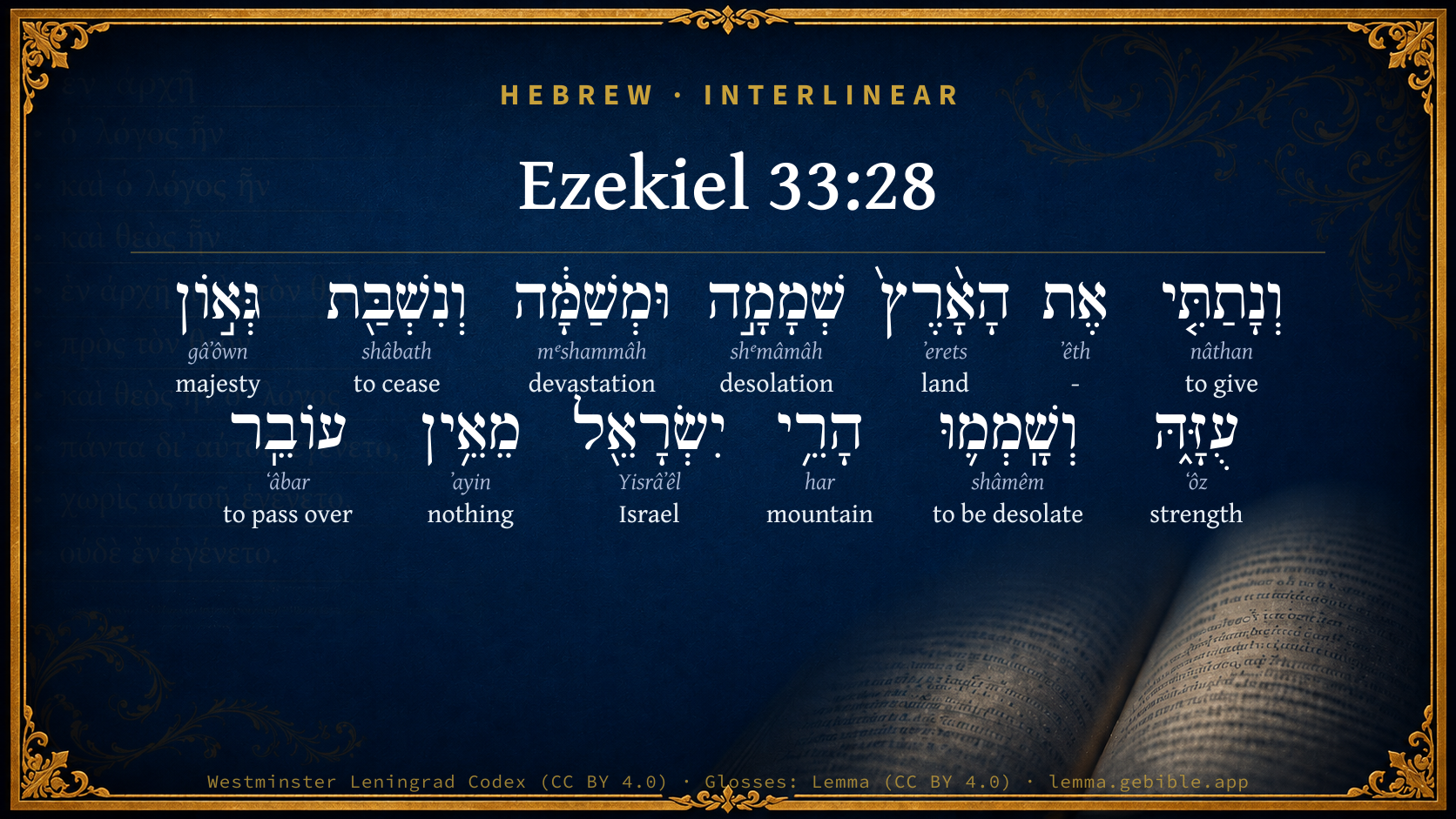
Hebrew (Westminster Leningrad Codex) Ezekiel 33:28 appears in the Hebrew Old Testament. The text above is from the Westminster Leningrad Codex. Each word links to its Strong’s number, a concise gloss, and parsing drawn from the Open Scriptures Hebrew Bible morphology. Click any word for its full Brown-Driver-Briggs (BDB) entry.
Download image
Cite this verse

Ezekiel 33:28 (World English Bible). Public Domain. Lemma interlinear Bible study tool, https://lemma.gebible.app/v/ezekiel/33/28.

Show BibTeX & RIS
BibTeX
RIS
English Translation
I will make the land a desolation and an astonishment; and the pride of her power shall cease; and the mountains of Israel shall be desolate, so that none shall pass through.
World English Bible · Public Domain
Download a study sheet

One document with this verse’s original text, its word-by-word gloss line, the meaning frame, cross-references with their text, attributed commentary, and full source and license credits — printable, and it pastes into notes with its structure intact.

This verse Autodidact and up

Study sheet (.html) Plain text (.txt)

A passage Seminary Student

Up to 50 verses in one chapter. A passage sheet keeps up to 6 commentary sources and 12 cross-references per verse, in the order this page ranks them, and says so on the sheet whenever that leaves anything out. Ask for a single verse and you get the Autodidact verse sheet above.

Everything on this page stays free to read, with no account — the sheet is a download of what is already on screen, not access to it.

Want to remove ads? Support Godless Engineer
Compare translations 3

The same verse in 3 English versions, stacked beneath the original-language interlinear above. Click any original word for its lexicon entry.

Each is an independent rendering of the whole verse — the interlinear is not word-aligned to these translations.

Highlighted words mark where these versions differ — a whole-verse word diff, not a word-by-word alignment.

  • World English Bible Public Domain
    I will make the land a desolation and an astonishment; and the pride of her power shall cease; and the mountains of Israel shall be desolate, so that none shall pass through.
  • King James Version Public Domain
    For I will lay the land most desolate, and the pomp of her strength shall cease; and the mountains of Israel shall be desolate, that none shall pass through.
  • unfoldingWord Literal Text CC BY-SA 4.0
    Then I will turn the land into a desolation and a horror, and the pride of its might will end, for the mountains of Israel will be deserted, and there will be no one to pass through them.’

unfoldingWord Literal Text — © unfoldingWord, licensed CC BY-SA 4.0. Word-aligned USFM3 via Door43 (git.door43.org/unfoldingWord/en_ult).

Versions to compare (up to 4)

3 of 4 selected

Show all 18 translations

Every available English version of this verse, each an independent rendering of the whole verse.

  • World English Bible Public Domain
    I will make the land a desolation and an astonishment; and the pride of her power shall cease; and the mountains of Israel shall be desolate, so that none shall pass through.
  • Berean Standard Bible Public Domain
    I will make the land a desolate waste, and the pride of her strength will come to an end. The mountains of Israel will become desolate, so that no one will pass through.
  • Majority Standard Bible Public Domain
    I will make the land a desolate waste, and the pride of her strength will come to an end. The mountains of Israel will become desolate, so that no one will pass through.
  • King James Version Public Domain
    For I will lay the land most desolate, and the pomp of her strength shall cease; and the mountains of Israel shall be desolate, that none shall pass through.
  • American Standard Version (1901) Public Domain
    And I will make the land a desolation and an astonishment; and the pride of her power shall cease; and the mountains of Israel shall be desolate, so that none shall pass through.
  • Revised Version (1885) Public Domain
    And I will make the land a desolation and an astonishment, and the pride of her power shall cease; and the mountains of Israel shall be desolate, that none shall pass through.
  • Geneva Bible (1599) Public Domain
    For I will lay the land desolate and waste, and the pompe of her strength shall cease: and the moutaines of Israel shalbe desolate, and none shall passe through.
  • Douay-Rheims (1899) Public Domain
    And I will make the land a wilderness, and a desert, and the proud strength thereof shall fail, and the mountains of Israel shall be desolate, because there is none to pass by them.
  • Young's Literal Translation Public Domain
    And I have made the land a desolation and an astonishment, And ceased hath the excellency of its strength, And desolated have been mountains of Israel, Without any one passing through.
  • Literal Standard Version CC BY-SA 4.0
    And I have made the land a desolation and an astonishment, || And the excellence of its strength has ceased, || And mountains of Israel have been desolated, || Without anyone passing through.
  • Unlocked Literal Bible CC BY-SA 4.0
    Then I will turn the land into a desolation and a horror, and the pride of its might will end, for the mountains of Israel will be deserted, and there will be no one to pass through them.'
  • unfoldingWord Literal Text CC BY-SA 4.0
    Then I will turn the land into a desolation and a horror, and the pride of its might will end, for the mountains of Israel will be deserted, and there will be no one to pass through them.’
  • Darby Bible Public Domain
    And I will make the land a desolation and an astonishment, and the pride of her strength shall cease; and the mountains of Israel shall be desolated, so that none shall pass through.
  • World Messianic Bible Public Domain
    I will make the land a desolation and an astonishment. The pride of her power will cease. The mountains of Israel will be desolate, so that no one will pass through.
  • Webster's Bible Public Domain
    For I will lay the land most desolate, and the pomp of her strength shall cease; and the mountains of Israel shall be desolate, that none shall pass through.
  • Free Bible Version CC BY-SA 4.0
    I will turn the country into a wasteland, and power you are so proud of will be ended. The mountains of Israel will become wild places that no one will want to travel through.
  • Bible in Basic English Public Domain
    And I will make the land a waste and a cause of wonder, and the pride of her strength will come to an end; and the mountains of Israel will be made waste so that no one will go through.
  • JPS Tanakh (1917) Public Domain
    And I will make the land most desolate, and the pride of her power shall cease; and the mountains of Israel shall be desolate, so that none shall pass through.

Literal Standard Version (2020), Covenant Press — licensed CC BY-SA 4.0. Text via the HelloAO Bible API (eBible.org). Unlocked Literal Bible (unfoldingWord) — licensed CC BY-SA 4.0. Text via the HelloAO Bible API (eBible.org). unfoldingWord Literal Text — © unfoldingWord, licensed CC BY-SA 4.0. Word-aligned USFM3 via Door43 (git.door43.org/unfoldingWord/en_ult). Free Bible Version, Dr. Jonathan Gallagher — licensed CC BY-SA 4.0. Text via the HelloAO Bible API (eBible.org).

Word by word

More ways to search: Search by grammar → Find every occurrence → Compare this word →

Practice this passage: Drill this verse → Learn its vocabulary →

וּמְשַׁמָּ֔ה
mᵉshammâh
H4923
“and · devastation”
Conjunction + Noun, Common, Feminine, Singular, Absolute
Part of Speech
Conjunction + Noun
Type
Common
Gender
Feminine
Number
Singular
State
Absolute
Full BDB Definition

Origin: from H8074

TWOT: 2409f

devastation, horror - devastation, waste - horror
  1. וְנָתַתִּ֤י nâthan H5414 “and · to give” Conjunction + Verb, Qal, Sequential Perfect, 1st Person, Common, Singular
  2. אֶת ʼêth H853 “-” Particle, Direct Object
  3. הָאָ֨רֶץ֙ ʼerets H776 “the · land” Particle, Definite Article + Noun, Common, Both, Singular, Absolute
  4. שְׁמָמָ֣ה shᵉmâmâh H8077 “desolation” Noun, Common, Feminine, Singular, Absolute
  5. וְנִשְׁבַּ֖ת shâbath H7673 “and · to cease” Conjunction + Verb, Niphal, Sequential Perfect, 3rd Person, Masculine, Singular
  6. גְּא֣וֹן gâʼôwn H1347 “majesty of” Noun, Common, Masculine, Singular, Construct
  7. עֻזָּ֑הּ ʻôz H5797 “strength · her” Noun, Common, Masculine, Singular, Construct + Suffix, Personal, 3rd Person, Feminine, Singular
  8. וְשָֽׁמְמ֛וּ shâmêm H8074 “and · to be desolate” Conjunction + Verb, Qal, Sequential Perfect, 3rd Person, Common, Plural
  9. הָרֵ֥י har H2022 “mountains of” Noun, Common, Masculine, Plural, Construct
  10. יִשְׂרָאֵ֖ל Yisrâʼêl H3478 “Israel” Noun, Proper
  11. מֵאֵ֥ין ʼayin H369 “from · nothing” Preposition + Particle, Negative
  12. עוֹבֵֽר ʻâbar H5674 “passing over” Verb, Qal, Participle Active, Masculine, Singular, Absolute

About this verse

These counts appear in no published source. They are computed here, from the morphology-tagged text and Lemma’s own curated glosses. What Lemma adds →

13
words
13
distinct lemmas
Prophets
section

Notable vocabulary

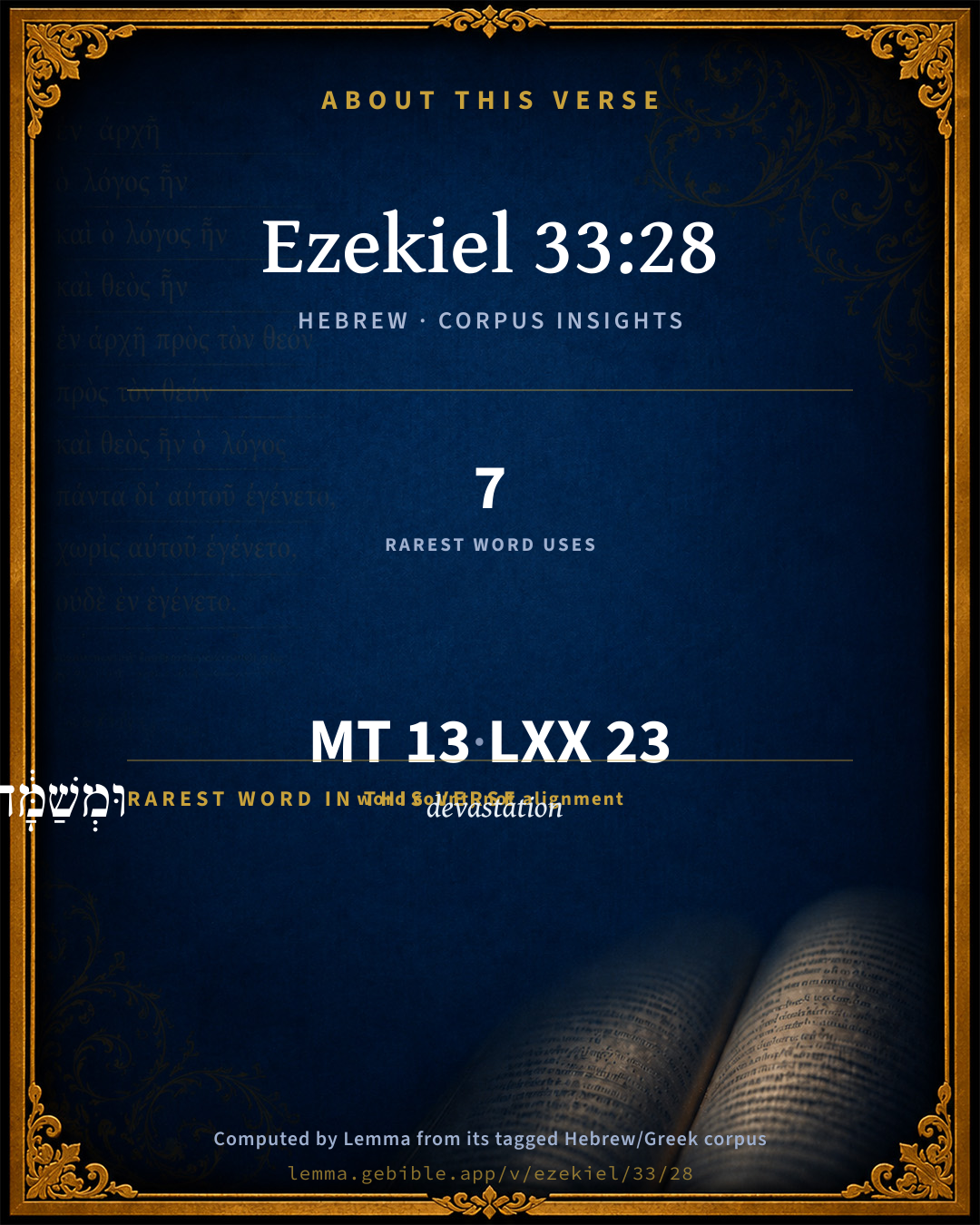
The rarest word here is וּמְשַׁמָּ֔ה devastation H4923 — appearing just 7 times in the whole Hebrew Bible.

Shared distinctive vocabulary

וּמְשַׁמָּ֔ה devastation H4923 occurs in 7 verses of the Hebrew Bible. Also found in:

Grammatical profile

  • 4 verbs
  • 7 nouns
  • 2 particles

Verb forms

  • וְנָתַתִּ֤י Qal · Sequential Perfect
  • וְנִשְׁבַּ֖ת Niphal · Sequential Perfect
  • וְשָֽׁמְמ֛וּ Qal · Sequential Perfect
  • עוֹבֵֽר Qal · Participle Active

Hebrew & Septuagint length

In English translation the verse runs 32 words from the Hebrew and 31 from the Septuagint (LXX English) — closely comparable.

A rough comparison of the two English renderings, which tokenize alike — not a word-level alignment.

Word counts can differ between the Hebrew and the Greek without any difference in meaning — e.g. the Hebrew direct-object marker אֵת has no separate Greek word, and Greek often adds the article ὁ.

In the original languages it is 13 Hebrew tokens and 23 Greek tokens — but the two are counted differently (Hebrew bundles its prefixes and suffixes into one token; the Greek is in lemma form), so that isn’t a like-for-like length.

Cross-references

19

Topical passages linked to Ezekiel 33:28 in the Treasury of Scripture Knowledge — connected by theme and wording, ordered by reader-vote popularity; previews shown in the World English Bible.

  • Ezekiel 7:24 Therefore I will bring the worst of the nations, and they shall possess their houses: I will also make the pride of the strong to cease; and their holy places shall be profaned.
  • Jeremiah 44:2 Thus says Yahweh of Hosts, the God of Israel: You have seen all the evil that I have brought on Jerusalem, and on all the cities of Judah; and, behold, this day they are a desolation, and no man dwells therein,
  • Jeremiah 44:6 Therefore my wrath and my anger was poured forth, and was kindled in the cities of Judah and in the streets of Jerusalem; and they are wasted and desolate, as it is this day.
  • Jeremiah 44:22 so that Yahweh could no longer bear, because of the evil of your doings, and because of the abominations which you have committed; therefore is your land become a desolation, and an astonishment, and a curse, without inhabitant, as it is this day.
  • Ezekiel 6:14 I will stretch out my hand on them, and make the land desolate and waste, from the wilderness toward Diblah, throughout all their habitations: and they shall know that I am Yahweh.
  • Ezekiel 24:21 Speak to the house of Israel, Thus says the Lord Yahweh: Behold, I will profane my sanctuary, the pride of your power, the desire of your eyes, and that which your soul pities; and your sons and your daughters whom you have left behind shall fall by the sword.
  • Micah 7:13 Yet the land will be desolate because of those who dwell therein, For the fruit of their doings.
  • 2 Chronicles 36:21 to fulfill the word of Yahweh by the mouth of Jeremiah, until the land had enjoyed its Sabbaths: [for] as long as it lay desolate it kept Sabbath, to fulfill seventy years.
  • Isaiah 6:11 Then I said, "Lord, how long?" He answered, "Until cities are waste without inhabitant, And houses without man, And the land becomes utterly waste,
  • Jeremiah 9:11 I will make Jerusalem heaps, a dwelling-place of jackals; and I will make the cities of Judah a desolation, without inhabitant.
  • Jeremiah 16:16 Behold, I will send for many fishermen, says Yahweh, and they shall fish them up; and afterward I will send for many hunters, and they shall hunt them from every mountain, and from every hill, and out of the clefts of the rocks.
  • Jeremiah 25:11 This whole land shall be a desolation, and an astonishment; and these nations shall serve the king of Babylon seventy years.
  • Ezekiel 6:2–6 Son of man, set your face toward the mountains of Israel, and prophesy to them,
  • Ezekiel 12:20 The cities that are inhabited shall be laid waste, and the land shall be a desolation; and you shall know that I am Yahweh.
  • Ezekiel 15:8 I will make the land desolate, because they have committed a trespass, says the Lord Yahweh.
  • Ezekiel 30:6–7 Thus says Yahweh: They also who uphold Egypt shall fall; and the pride of her power shall come down: from the tower of Seveneh shall they fall in it by the sword, says the Lord Yahweh.
  • Ezekiel 36:4 therefore, you mountains of Israel, hear the word of the Lord Yahweh: Thus says the Lord Yahweh to the mountains and to the hills, to the watercourses and to the valleys, to the desolate wastes and to the cities that are forsaken, which are become a prey and derision to the residue of the nations that are round about;
  • Ezekiel 36:34–35 The land that was desolate shall be tilled, whereas it was a desolation in the sight of all who passed by.
  • Zechariah 7:13–14 It has come to pass that, as he called, and they refused to listen, so they will call, and I will not listen," said Yahweh of Hosts;

Cross-references courtesy of OpenBible.info (CC BY 4.0).

Hebrew and Greek witnesses Masoretic Hebrew ↔ Greek Septuagint

The same verse in the two great witnesses to the Old Testament, shown verse-for-verse.

These are two independent witnesses, not word-aligned to each other, and the Septuagint is shown in lemma (dictionary) form.

Hebrew Ezekiel 33:28 Masoretic · Westminster Leningrad Codex

וְנָתַתִּ֤י אֶת הָאָ֨רֶץ֙ שְׁמָמָ֣ה וּמְשַׁמָּ֔ה וְנִשְׁבַּ֖ת גְּא֣וֹן עֻזָּ֑הּ וְשָֽׁמְמ֛וּ הָרֵ֥י יִשְׂרָאֵ֖ל מֵאֵ֥ין עוֹבֵֽר

I will make the land a desolation and an astonishment; and the pride of her power shall cease; and the mountains of Israel shall be desolate, so that none shall pass through.

World English Bible · Public Domain

Greek LXX Ezekiel 33:28 Septuagint · lemma form

καί δίδωμι ὁ γῆ ἔρημος καί ἀποὀλλύω ὁ ὕβρις ὁ ἰσχύς αὐτός καί ἐρημόω ὁ ὄρος ὁ ἰσραήλ διά ὁ μή εἰμί διαπορεύομαι

And I will make the land desert, and the pride of her strength shall perish; and the mountains of Israel shall be made desolate by reason of no man passing through.

LXX2012 (modern English Septuagint) · Public Domain

Hebrew: Westminster Leningrad Codex (CC BY 4.0). Greek: Septuagint (public domain); English from LXX2012 (modern English Septuagint) (Public Domain). How the Septuagint differs from the Hebrew →

Targum (Aramaic paraphrase)

1

The Targum is the ancient Jewish Aramaic paraphrase of the Hebrew Scriptures — an interpretive translation, not the Hebrew text itself. Onkelos (literal) and Pseudo-Jonathan (expansive) render the Torah, and Jonathan the Prophets. Coverage is partial: where no permissively-licensed English translation exists for a verse, only the Aramaic is shown. This is verse-level text, not a word-by-word alignment to the Hebrew.

  1. Targum Jonathan Prophets (Joshua–Malachi)
    וְאֶתֵּן יַת אַרְעָא לְצָדוּ וְאִשְׁתְּמָמוּ וְיִבְטַל יְקַר תּוּקְפָהּ וְיִצְדוּן טוּרֵי יִשְׂרָאֵל מִבְּלֵי עָדֵי:

    (no public-domain English translation for this verse)

    Targum Jonathan — Aramaic: “Mikraot Gedolot” (public domain). English: “Sefaria Community Translation” (CC0 1.0 (public-domain dedication)); “London "Chaldee Paraphrase," 1871” (public domain). Text via Sefaria.

Commentary

Notes on Ezekiel 33:28 from classic Christian and Jewish commentators (each source and its license shown beneath its notes). The classic Christian expositions comment on the surrounding passage and are grouped to its opening verse, so a note may address several verses; the Jewish commentaries on the Tanakh (Rashi and others) are per-verse, so they appear only where the commentator wrote on this verse.

Lemma curates 59 commentaries, every one of them public domain or Creative Commons licensed, each selected and text-cleaned for this edition rather than reprinted as found. About our sources →

Trapp's Complete Commentary

John Trapp

Eze 33:28 For I will lay the land most desolate, and the pomp of her strength shall cease; and the mountains of Israel shall be desolate, that none shall pass through.

Ver. 28. For I will lay the land most desolate.] Heb., Desolation and desolation. God made clean work there; there was not a Jew left in the country. See Zec 7:14.

John Trapp, A Commentary or Exposition upon All the Books of the Old and New Testament (1647–1656) — public domain. Text from a community e-Sword module.

Joseph Benson's Commentary

Eze 33:28-29. For I will lay the land most desolate — I will make the land destitute of inhabitants, by the destruction which shall be made of them by the sword, by wild beasts, and the pestilence, and by their being carried into captivity. And the pomp of her strength shall cease — All that wealth and magnificence wherein they pleased themselves, as that which gave them strength and reputation in the eyes of the world, are taken away: see Eze 7:24. Or the phrase may denote the beauty and glory of the temple, which they looked upon as their chief strength and protection; none shall pass through — None shall choose even so much as to pass through the country, on account of its being infested with wild beasts through its desolateness, and because the air of it shall be rendered unwholesome, by means of the effluvia arising from dead and dying bodies, and the pestilential diseases which rage in the country, and sweep away its inhabitants. Then shall they know that I am the Lord — That I am their Lord, their righteous governor, and just judge. When I have laid the land most desolate, &c. — When I have brought these destructive calamities upon it, because of the sins and abominations of its inhabitants. Observe, reader, those are untractable and unteachable indeed, that are not made to know their dependence upon God when all their creature comforts fail them, and they are made desolate.

Joseph Benson's Commentary on the Old and New Testaments (1811–1818) — public domain. Text from a community e-Sword module.

Jamieson, Fausset & Brown

Robert Jamieson, A. R. Fausset & David Brown

most desolate-- (Jer 4:27; Jer 12:11).

none . . . pass through--from fear of wild beasts and pestilence [GROTIUS].

Jamieson, Fausset & Brown — Commentary Critical and Explanatory on the Whole Bible (1871) — public domain (CC PDM 1.0). Text via the HelloAO Bible API.

Ellicott's Commentary for English Readers

(28) Most desolate.—When the people of the northern kingdom had been carried into captivity, the land had been re-populated by colonies brought from various quarters by the king of Assyria, for the ten tribes were not to return; but now the land of Judah was to be left utterly desolate and uninhabited, that it might yet be re-occupied by the returning exiles. The complete dispersion of the people, not to be effected even by war and conquest, was finally accomplished by the flight of the remnant into Egypt (Jer_43:5-7), in consequence of their fears.

A Bible Commentary for English Readers, edited by Charles John Ellicott (1878–1897) — public domain. Text from a community e-Sword module.

The Cambridge Bible for Schools and Colleges

gen. ed. J. J. S. Perowne

28. Cf. Eze_7:24, Eze_24:21, Eze_30:6-7. The “mountains of Israel” are the mountain land of Israel.

The Cambridge Bible for Schools and Colleges (gen. ed. J. J. S. Perowne; Cambridge University Press, 1878–1918) — public domain. Text from a community e-Sword module.

John Gill's Exposition

Also, thou son of man,.... I have something to say to thee, and inform thee of, not only concerning the Jews in Judea, what they say, and what will befall them; but concerning those that are with thee, and what they say of thee, and what will be the issue of it:

the children of thy people still are talking against thee; not the Lord's people, but his own people, which was the more cutting to him to hear of, and the more ungrateful in them; though indeed they were but children, who acted a weak part, and the less to be regarded; these spake against the prophet: they could not say he was no prophet, he had his credentials and commission from the Lord, which were well known, and many of his prophecies had been fulfilled; they could not speak against his doctrine, which was of God; nor against his conversation, which was agreeable to his character and office; but they said some things in a ludicrous and jocose manner, in a slighting and contemptuous way, as showed they had little reverence and respect for him, and were careless and indifferent about hearing him; at least had little regard to this matter, or the subject of his ministry, which they had no great value for: and this they did still; they had been long at it; it was their common talk and constant business, though the prophet knew nothing of it, and thought they had the greatest respect for him, speaking fair to his face, and behaving with decency towards him; but the Lord knew it, and resented it, and informs him of it: and this they did continually, from time to time,

by the walls, and in the doors of the houses; privately and secretly; "by the walls", where they used to get together and sun themselves, and pass away their time, by talking against the prophet; and, when they did, would place themselves against the walls, that nobody might overhear them; and they would sometimes stand in the porches of their houses, and, as their neighbours and acquaintance passed by, would call them in, and hold a chat about the prophet; and jeer and laugh at him, and what he had said: and speak one to another,

every man to his brother, saying, come, l pray you, and hear what is the word that cometh forth from the Lord; let us go and amuse ourselves for an hour or two with what the prophet says; perhaps we shall hear some new thing, which may be pleasing and diverting: for, not their spiritual profit did they seek, but to have their ears tickled, and their fancies pleased.

John Gill's Exposition of the Whole Bible (1746–1763) — public domain (CC PDM 1.0). Text via the HelloAO Bible API.

Matthew Poole's English Annotations

I will lay the land; I do purpose to destroy utterly all in this land; and what can escape, when savage beasts, cruel men, and a pestilential air all concur to ruin the land? The pomp of her strength; the stately and pompous shows of her strength, and her former riches and power.

The mountains of Israel, on which were vineyards and oliveyards, where the joyful sounds of the vintage and harvests did glad the heart, there shall be utter desolation.

None shall pass through; no man daring to venture for fear of wild beasts, or pestilential air, or famine in those wasted mountains.

Matthew Poole's English Annotations on the Holy Bible (1683–1685) — public domain. Text from a community e-Sword/MySword module.

Lesson kit

Teaching starters — assembled from the data on this page, not authored interpretation. Every prompt links to the verse data it draws on. Edit before teaching.

Ezekiel, in the Prophets, opens this verse with 13 words (13 distinct Hebrew lemmas). Its most distinctive word is mᵉshammâh (“devastation”). A historical commentator’s framing appears above. Read the whole chapter for the surrounding context.

Discussion questions

  1. What does “devastation” (mᵉshammâh) contribute to the verse as a whole?
  2. How does Isaiah 15:6, which shares the word «devastation», read alongside this verse?
  3. These translations render this verse differently. What is at stake in choosing one wording over another?
  4. «וְנָתַתִּ֤י» is a Qal Sequential Perfect verb. How does that grammatical form shape the action described?
  5. Compare how Trapp's Complete Commentary and Joseph Benson's Commentary read this verse. Where do they agree or differ?

Things to notice

Reading settings

Reading text

Shown beneath each verse's original-language words.

Old Testament
Old Testament edition

Read the OT as the Masoretic Hebrew (MT) or the Greek Septuagint (LXX).

English shown for the Greek Septuagint (in the Hebrew ↔ Greek comparison).

Comparing translations? Open the Compare panel on any verse page to stack up to four side by side.