
Exodus 21:11

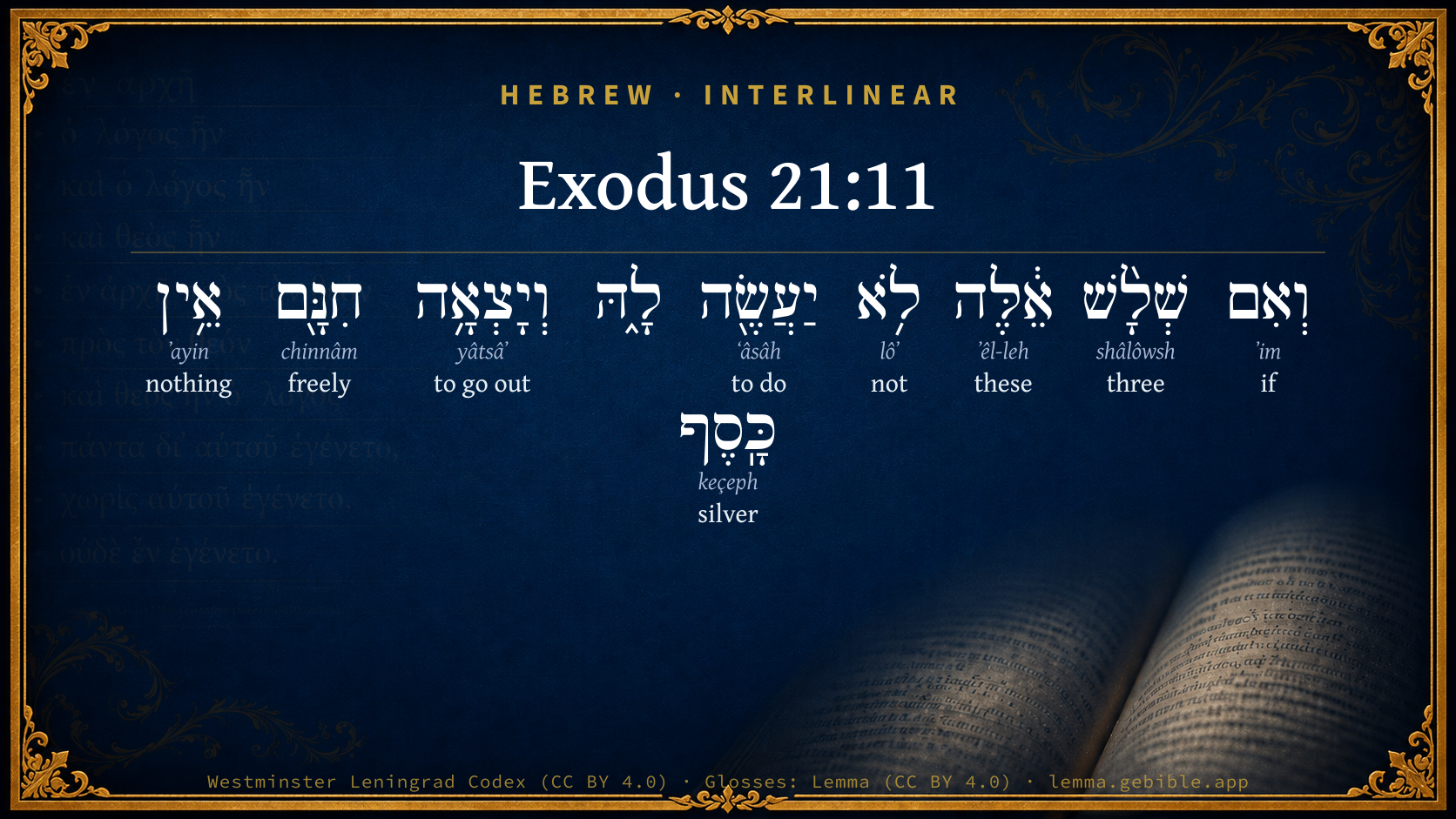
Hebrew (Westminster Leningrad Codex) Exodus 21:11 appears in the Hebrew Old Testament. The text above is from the Westminster Leningrad Codex. Each word links to its Strong’s number, a concise gloss, and parsing drawn from the Open Scriptures Hebrew Bible morphology. Click any word for its full Brown-Driver-Briggs (BDB) entry.
Download image
Cite this verse

Exodus 21:11 (World English Bible). Public Domain. Lemma interlinear Bible study tool, https://lemma.gebible.app/v/exodus/21/11.

Show BibTeX & RIS
BibTeX
RIS
English Translation
If he doesn't do these three things for her, she may go free without paying any money.
World English Bible · Public Domain
Download a study sheet

One document with this verse’s original text, its word-by-word gloss line, the meaning frame, cross-references with their text, attributed commentary, and full source and license credits — printable, and it pastes into notes with its structure intact.

This verse Autodidact and up

Study sheet (.html) Plain text (.txt)

A passage Seminary Student

Up to 50 verses in one chapter. A passage sheet keeps up to 6 commentary sources and 12 cross-references per verse, in the order this page ranks them, and says so on the sheet whenever that leaves anything out. Ask for a single verse and you get the Autodidact verse sheet above.

Everything on this page stays free to read, with no account — the sheet is a download of what is already on screen, not access to it.

Want to remove ads? Support Godless Engineer
Compare translations 3

The same verse in 3 English versions, stacked beneath the original-language interlinear above. Click any original word for its lexicon entry.

Each is an independent rendering of the whole verse — the interlinear is not word-aligned to these translations.

Highlighted words mark where these versions differ — a whole-verse word diff, not a word-by-word alignment.

  • World English Bible Public Domain
    If he doesn't do these three things for her, she may go free without paying any money.
  • King James Version Public Domain
    And if he do not these three unto her, then shall she go out free without money.
  • unfoldingWord Literal Text CC BY-SA 4.0
    But if he does not provide these three things to her, then she can go free without silver.

unfoldingWord Literal Text — © unfoldingWord, licensed CC BY-SA 4.0. Word-aligned USFM3 via Door43 (git.door43.org/unfoldingWord/en_ult).

Versions to compare (up to 4)

3 of 4 selected

Show all 18 translations

Every available English version of this verse, each an independent rendering of the whole verse.

  • World English Bible Public Domain
    If he doesn't do these three things for her, she may go free without paying any money.
  • Berean Standard Bible Public Domain
    If, however, he does not provide her with these three things, she is free to go without monetary payment.
  • Majority Standard Bible Public Domain
    If, however, he does not provide her with these three things, she is free to go without monetary payment.
  • King James Version Public Domain
    And if he do not these three unto her, then shall she go out free without money.
  • American Standard Version (1901) Public Domain
    And if he do not these three things unto her, then shall she go out for nothing, without money.
  • Revised Version (1885) Public Domain
    And if he do not these three unto her, then shall she go out for nothing, without money.
  • Geneva Bible (1599) Public Domain
    And if he do not these three vnto her, the shall she go out free, paying no money.
  • Douay-Rheims (1899) Public Domain
    If he do not these three things, she shall go out free without money.
  • Young's Literal Translation Public Domain
    and if these three he do not to her, then she hath gone out for nought, without money.
  • Literal Standard Version CC BY-SA 4.0
    and if he does not do these three for her, then she has gone out for nothing, without money.
  • Unlocked Literal Bible CC BY-SA 4.0
    But if he does not provide these three things for her, then she can go free without paying any money.
  • unfoldingWord Literal Text CC BY-SA 4.0
    But if he does not provide these three things to her, then she can go free without silver.
  • Darby Bible Public Domain
    And if he do not these three things unto her, then shall she go out free without money.
  • World Messianic Bible Public Domain
    If he doesn’t do these three things for her, she may go free without paying any money.
  • Webster's Bible Public Domain
    And if he shall not perform these three to her, then shall she depart free without money.
  • Free Bible Version CC BY-SA 4.0
    If he doesn't give her these three things, she is free to leave without paying anything.
  • Bible in Basic English Public Domain
    And if he does not do these three things for her, she has the right to go free without payment.
  • JPS Tanakh (1917) Public Domain
    And if he do not these three unto her, then shall she go out for nothing, without money.

Literal Standard Version (2020), Covenant Press — licensed CC BY-SA 4.0. Text via the HelloAO Bible API (eBible.org). Unlocked Literal Bible (unfoldingWord) — licensed CC BY-SA 4.0. Text via the HelloAO Bible API (eBible.org). unfoldingWord Literal Text — © unfoldingWord, licensed CC BY-SA 4.0. Word-aligned USFM3 via Door43 (git.door43.org/unfoldingWord/en_ult). Free Bible Version, Dr. Jonathan Gallagher — licensed CC BY-SA 4.0. Text via the HelloAO Bible API (eBible.org).

Word by word

More ways to search: Search by grammar → Find every occurrence → Compare this word →

Practice this passage: Drill this verse → Learn its vocabulary →

About this verse

These counts appear in no published source. They are computed here, from the morphology-tagged text and Lemma’s own curated glosses. What Lemma adds →

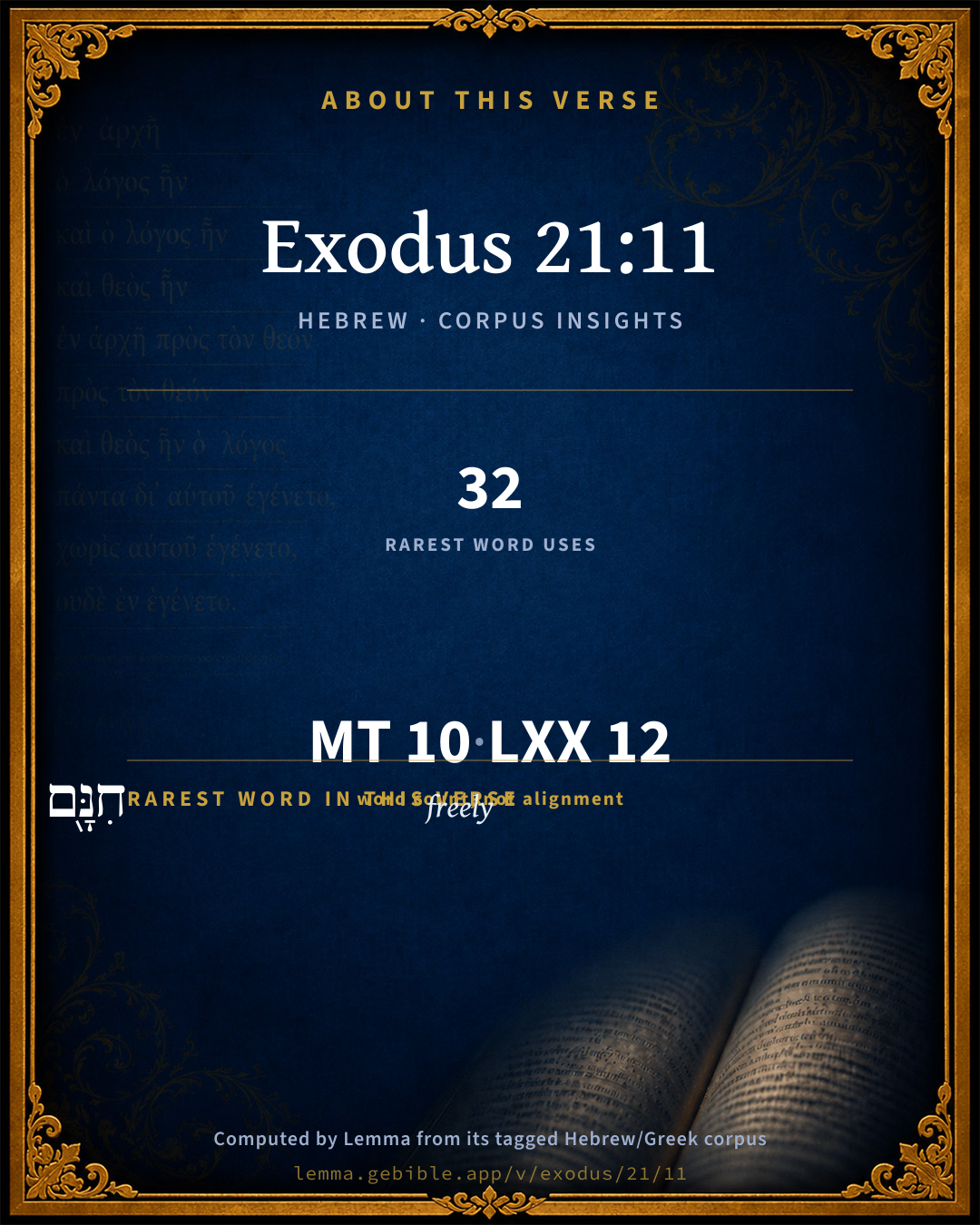
10
words
9
distinct lemmas
Pentateuch
section

Shared distinctive vocabulary

חִנָּ֖ם freely H2600 occurs in 31 verses of the Hebrew Bible. Also found in:

Grammatical profile

  • 2 verbs
  • 1 noun
  • 1 adjective
  • 1 pronoun
  • 1 preposition
  • 1 conjunction
  • 1 adverb
  • 2 particles

Verb forms

  • יַעֲשֶׂ֖ה Qal · Imperfect
  • וְיָצְאָ֥ה Qal · Sequential Perfect

Hebrew & Septuagint length

In English translation the verse runs 17 words from the Hebrew and 18 from the Septuagint (LXX English) — closely comparable.

A rough comparison of the two English renderings, which tokenize alike — not a word-level alignment.

Word counts can differ between the Hebrew and the Greek without any difference in meaning — e.g. the Hebrew direct-object marker אֵת has no separate Greek word, and Greek often adds the article ὁ.

In the original languages it is 10 Hebrew tokens and 12 Greek tokens — but the two are counted differently (Hebrew bundles its prefixes and suffixes into one token; the Greek is in lemma form), so that isn’t a like-for-like length.

Hebrew and Greek witnesses Masoretic Hebrew ↔ Greek Septuagint

The same verse in the two great witnesses to the Old Testament, shown verse-for-verse.

These are two independent witnesses, not word-aligned to each other, and the Septuagint is shown in lemma (dictionary) form.

Hebrew Exodus 21:11 Masoretic · Westminster Leningrad Codex

וְאִם שְׁלָ֨שׁ אֵ֔לֶּה לֹ֥א יַעֲשֶׂ֖ה לָ֑הּ וְיָצְאָ֥ה חִנָּ֖ם אֵ֥ין כָּֽסֶף

If he doesn't do these three things for her, she may go free without paying any money.

World English Bible · Public Domain

Greek LXX Exodus 21:11 Septuagint · lemma form

ἐάν δέ ὁ τρεῖς οὗτος μή ποιέω αὐτός ἐκἔρχομαι δωρεά ἄνευ ἀργύριον

And if he will not do these three things to her, she shall go out free without money.

LXX2012 (modern English Septuagint) · Public Domain

Hebrew: Westminster Leningrad Codex (CC BY 4.0). Greek: Septuagint (public domain); English from LXX2012 (modern English Septuagint) (Public Domain). How the Septuagint differs from the Hebrew →

Targum (Aramaic paraphrase)

2

The Targum is the ancient Jewish Aramaic paraphrase of the Hebrew Scriptures — an interpretive translation, not the Hebrew text itself. Onkelos (literal) and Pseudo-Jonathan (expansive) render the Torah, and Jonathan the Prophets. Coverage is partial: where no permissively-licensed English translation exists for a verse, only the Aramaic is shown. This is verse-level text, not a word-by-word alignment to the Hebrew.

  1. Targum Onkelos Torah (Genesis–Deuteronomy)
    וְאִם תְּלָת אִלֵין לָא יַעְבֵּד לַהּ וְתִפּוֹק מַגָן בְּלָא כְסַף:

    (no public-domain English translation for this verse)

    Targum Onkelos — Aramaic: “Onkelos Genesis” (public domain); “Onkelos Exodus” (public domain); “Onkelos Leviticus” (public domain); “Onkelos Numbers” (public domain); “Onkelos Deuteronomy” (public domain). English: “Sefaria Community Translation” (CC0 1.0 (public-domain dedication)); “J.W. Etheridge. The Targums of Onkelos and Jonathan Ben Uzziel on the Pentateuch. London: Longmans, Green, 1862” (public domain). Text via Sefaria.

  2. Targum Pseudo-Jonathan Torah (Genesis–Deuteronomy)
    אִין תְּלַת מִילַיָיא הָאִלֵּין לָא יַעֲבֵיד לָהּ לִמְזַמְנָא יָתָהּ לֵיהּ אוֹ לִבְרֵיהּ אוֹ לְמִפְרְקָא לְבַר אָבוּהָא וְתִיפּוֹק מַגָּן בְּלָא כְסַף בְּרַם גֵּט פְּטוּרִין יָהִיב לָהּ

    And if these three things he doth not for her, to covenant her to himself, or to his son, or to release her into the hand of her father, she shall go free without payment, and a writing of release he shall give her.

    Targum Pseudo-Jonathan — Aramaic: “Targum Jonathan on Genesis” (public domain); “Targum Jonathan on Exodus” (public domain); “Targum Jonathan on Leviticus” (public domain); “Targum Jonathan on Numbers” (public domain); “Targum Jonathan on Deuteronomy” (public domain). English: “The Targum of Jonathan ben Uzziel, trans. J. W. Etheridge, London, 1862” (public domain). Text via Sefaria.

Commentary

Notes on Exodus 21:11 from classic Christian and Jewish commentators (each source and its license shown beneath its notes). The classic Christian expositions comment on the surrounding passage and are grouped to its opening verse, so a note may address several verses; the Jewish commentaries on the Tanakh (Rashi and others) are per-verse, so they appear only where the commentator wrote on this verse.

Lemma curates 59 commentaries, every one of them public domain or Creative Commons licensed, each selected and text-cleaned for this edition rather than reprinted as found. About our sources →

Trapp's Complete Commentary

John Trapp

Exo 21:11 And if he do not these three unto her, then shall she go out free without money.

Ver. 11. And if he do not these three unto her.] Picus est imago ingrati mariti, quia sub autumnum eiecit coniugem, ne cogatur per hyemem nutrire: postea sub vernum tempus eam ad se blande revocat, ac in consortium recipit. {a}

{a} Melancthon.

John Trapp, A Commentary or Exposition upon All the Books of the Old and New Testament (1647–1656) — public domain. Text from a community e-Sword module.

Geneva Bible (1599)

Geneva Bible translators

Neither marry her himself, nor give another money to buy her, nor bestow her upon his son.

Geneva Bible (1599) marginal notes — public domain. Text via Bolls.life.

Adam Clarke's Commentary

Verse 11. These three]

1. Her food, שארה sheerah, her flesh, for she must not, like a common slave, be fed merely on vegetables.

2. Her raiment - her private wardrobe, with all occasional necessary additions. And,

3. The marriage debt - a due proportion of the husband's time and company.

Adam Clarke's Commentary on the Bible (1810–1826) — public domain. Text from a community e-Sword/MySword module.

Ellicott's Commentary for English Readers

(11) These three—i.e., one of these three things: (1) Espouse her himself; (2) marry her to his son; or (3) transfer her, on the terms on which he received her, to another Hebrew.

A Bible Commentary for English Readers, edited by Charles John Ellicott (1878–1897) — public domain. Text from a community e-Sword module.

The Cambridge Bible for Schools and Colleges

gen. ed. J. J. S. Perowne

11. these three] The three rights mentioned in v. 10.

The view expressed above is the one ordinarily taken of vv. 7–11, vv. 8–10 stating three special cases, falling under the general case of v. 7, If a man sell his daughter, &c. Budde, however (ZATW. 1891, p. 102 f.), argues forcibly, and Bä. agrees, that the three special cases fall, not under the general case of v. 7, but under the general case of v. 8a, If she please not her master,—the first two, as upon the ordinary view, relating to the time before the woman is taken actually as a concubine: the three cases being (1) he may let her be redeemed, v. 8b; (2) how he is to deal with her, if he passes her on to his son, v. 9; (3) how he is to deal with her, if, after having made her his concubine, he takes another concubine as well. If the girl bought in this way was as a matter of course bought to be her master’s concubine, the words in v. 8, ‘who hath designated her for himself,’ are otiose; on the other hand, the condition that the two alternatives mentioned in vv. 8, 9 are to be adopted only if she is still a virgin, ought, Budde thinks, to be clearly expressed: accordingly, taking ‘not’ from the margin, and transposing two letters in the following word, he reads for the words quoted, who (or in case he) hath not known her (Gen_4:1): he further argues that this view does better justice to the wording of v. 8 (which is not, as it should be on the ordinary view, If he hath designated her for himself, and she please him not), and to the tense of ‘designate’ in v. 9 (which is the impf., as in vv. 10, 11, not the perf., as in v. 8a), and also that it explains better v. 9b (why, if he originally intended her as a concubine for his son, should he treat her as a daughter, and so place her in a better position than if he intended he for himself? On the other hand, this is intelligible, if he did not fulfil his original engagement to her, and passed her on to his son). For another solution of the difficulties of the passage, resting upon a further emendation, see W. R. Smith, ZATW. 1892, p. 162 f., or Ryssel in Di.2 p. 253.

The Cambridge Bible for Schools and Colleges (gen. ed. J. J. S. Perowne; Cambridge University Press, 1878–1918) — public domain. Text from a community e-Sword module.

John Gill's Exposition

And if he do not these three unto her,.... Not the three things last mentioned; though this sense, Aben Ezra says, many of their interpreters give, which is rejected by him, so do some Christian expositors; but these three things are, espousing her to himself, or to his son, or redeeming her by the hand of her father; that is, letting her be redeemed by him, as the Targum of Jonathan; and so Jarchi, Aben Ezra, and Ben Melech: the meaning is, if one or other of these things are not done:

then shall she go out free without money; be dismissed from her servitude, and not obliged to pay anything for her freedom; the Targum of Jonathan adds, he shall give her a bill of divorce; that is, the son to whom she had been betrothed, and another wife taken by him, and she denied the above things; which favours the first sense.

John Gill's Exposition of the Whole Bible (1746–1763) — public domain (CC PDM 1.0). Text via the HelloAO Bible API.

Albert Barnes' Notes on the Bible

If he do not these three unto her - The words express a choice of one of three things. The man was to give the woman, whom he had purchased from her father, her freedom, unless

(i) he caused her to be redeemed by a Hebrew master Exo 21:8; or,

(ii) gave her to his son, and treated her as a daughter Exo 21:9; or,

(iii) in the event of his taking another wife Exo 21:10, unless he allowed her to retain her place and privileges.

These rules Exo 21:7-11 are to be regarded as mitigations of the then existing usages of concubinage.

Albert Barnes' Notes on the Bible (1834–1885) — public domain. Text from a community e-Sword/MySword module.

Matthew Poole's English Annotations

And with gifts also by virtue of the law, Deu 15:14. The sum is this, The master was either,

1. Willing to part with her; and then he was to let her be redeemed by herself, or any of her friends, but not by a heathen, Exo 21:8. Or,

2. Willing to keep her; and then, as he had betrothed her, he was to perform all the duties of a husband to her, although he had another wife besides her, Exo 21:10.

3. If he would keep her, and yet deny those duties to her, then as his fault was aggravated, so was his punishment; for now he cannot sell her, but must let her go freely, as in this verse.

Matthew Poole's English Annotations on the Holy Bible (1683–1685) — public domain. Text from a community e-Sword/MySword module.

Whedon's Commentary on the Bible

Daniel D. Whedon

11. These three — Most simply, the three things mentioned in the previous verse; namely, food, raiment, and cohabitation. Others understand the three things to be, (1) letting her be redeemed, (2) betrothing her to his son, (3) allowing her the rights of marriage named in Exo_21:10.

Daniel D. Whedon (gen. ed.), Commentary on the Old and New Testaments (1874–1909) — public domain. Text from a community e-Sword module.

The Pulpit Commentary

If he do not these three unto her. Not the "three" points of the latter part of ver. 10; but one of the three courses laid down in vers. 8, 9, and 10. She shall go out freei.e. , she shall not be retained as a drudge, a mere maidservant, but shall return to her father at once, a free woman, capable of contracting another marriage; and without moneyi.e. , without the father being called upon to refund any portion of the stun for which he had sold her.

The Pulpit Commentary (1880–1919), ed. H.D.M. Spence-Jones & Joseph S. Exell — public domain. Text from a community e-Sword module.

Rashi

Rabbi Shlomo Yitzchaki (Rashi)

ואם שלש אלה לא יעשה לה means IF HE DO NOT one of THESE THREE UNTO HER. What are these three? He should designate her to himself as his wife, or to his son, or allow her a deduction from the ransom so that she may go free (Mekhilta). This man, however, has neither betrothed her to himself, nor to his son, and she herself does not possess the entire sum paid for her originally that she might buy herself out, therefore shall she go out free without money.

ויצאה חנם THEN SHALL SHE GO OUT FOR NOTHING (i. e. without making any payment) — Scripture adds in her case one more way of acquiring freedom than it provides for menservants. What is this additional way of acquiring freedom? This verse teaches you that she goes free also on account of having shown signs of incipient puberty: but she must stay with him until she reaches this stage of incipient puberty. For that she goes free if the termination of the six years happened to come before the signs of incipient puberty we have already learned, since it is said, (Deuteronomy 15:12),‘[and if thy brother], an Hebrew man, or an Hebrew woman [be sold unto thee], and serve thee six years [then in the seventh year thou shalt let him go free from thee]” (cf. Rashi v. 7). What then must be the meaning of what is stated here, “she shall go out for nothing”? That when the signs of incipient puberty appear before the six years are at end she shall go out on account of them. Or perhaps Scripture states here that she shall go free only when she has reached the intermediate stage of womenhood (בגרות, fuller development after twelve years and a half), if this stage happened to be reached before the termination of the six years! To teach this Scripture states “without money” — which would be superfluous since it has already said “she shall go out חנם” — in order to add as another date of her acquiring freedom the time of her reaching this stage of womanhood. And though it necessarily follows that she goes free an reaching the state of בגרות since her freedom is brought about even by the earlier stage of נערות yet if Scripture had not used both terms (both חנם and אין כסף), I might have said that ויצאה חנם refers to the stage of womanhood; therefore both expressions are used in order to give a disputant no opportunity to offer a different explanation (i. e. Scripture wishes to be quite clear on the point in order to preclude all possibility of misunderstanding) (Mekhilta; Kiddushin 4a).

Rashi on the Tanakh — English translations: “The Judaica Press complete Tanach with Rashi, translated by A. J. Rosenberg” (CC BY 4.0); “Pentateuch with Rashi's commentary by M. Rosenbaum and A.M. Silbermann, 1929-1934” (public domain); “The Metsudah Tanach series, Lakewood, N.J” (CC BY 4.0); and “The Book of Joshua, Metsudah Publications, 1997” (CC BY 4.0). Text via Sefaria.

Ramban (Nachmanides)

Rabbi Moshe ben Nachman (Ramban / Nachmanides)

AND IF THESE THREE — designating her to himself as his wife, or to his son, or allowing her to be redeemed — HE DO NOT UNTO HER, then SHALL SHE GO OUT FOR NOTHING, WITHOUT MONEY, as do the menservants mentioned.. But if the master do not these three things to her [as explained], then she shall go out as the menservants do. See Ramban above at the end of Verse 8 [“The plain meaning of Scripture in this section etc.”]. To this he now adds that if the master fails to do any of the three ways to ameliorate her condition, then she shall go out free for nothing, as menservants do.

Ramban (Nachmanides) on the Tanakh — English translation: “Commentary on the Torah by Ramban (Nachmanides). Translated and annotated by Charles B. Chavel. New York, Shilo Pub. House, 1971-1976” (CC BY 4.0). Text via Sefaria.

Lesson kit

Teaching starters — assembled from the data on this page, not authored interpretation. Every prompt links to the verse data it draws on. Edit before teaching.

Exodus, in the Pentateuch, opens this verse with 10 words (9 distinct Hebrew lemmas). Its most distinctive word is chinnâm (“freely”). A historical commentator’s framing appears above. Read the whole chapter for the surrounding context.

Discussion questions

  1. What does “freely” (chinnâm) contribute to the verse as a whole?
  2. How does Genesis 29:15, which shares the word «freely», read alongside this verse?
  3. The translations on this page render this verse differently — a whole-verse word diff, not a word-by-word alignment. What might account for the different wordings?
  4. «יַעֲשֶׂ֖ה» is a Qal Imperfect verb. How does that grammatical form shape the action described?
  5. Compare how Trapp's Complete Commentary and Geneva Bible (1599) read this verse. Where do they agree or differ?

Things to notice

Reading settings

Reading text

Shown beneath each verse's original-language words.

Old Testament
Old Testament edition

Read the OT as the Masoretic Hebrew (MT) or the Greek Septuagint (LXX).

English shown for the Greek Septuagint (in the Hebrew ↔ Greek comparison).

Comparing translations? Open the Compare panel on any verse page to stack up to four side by side.