
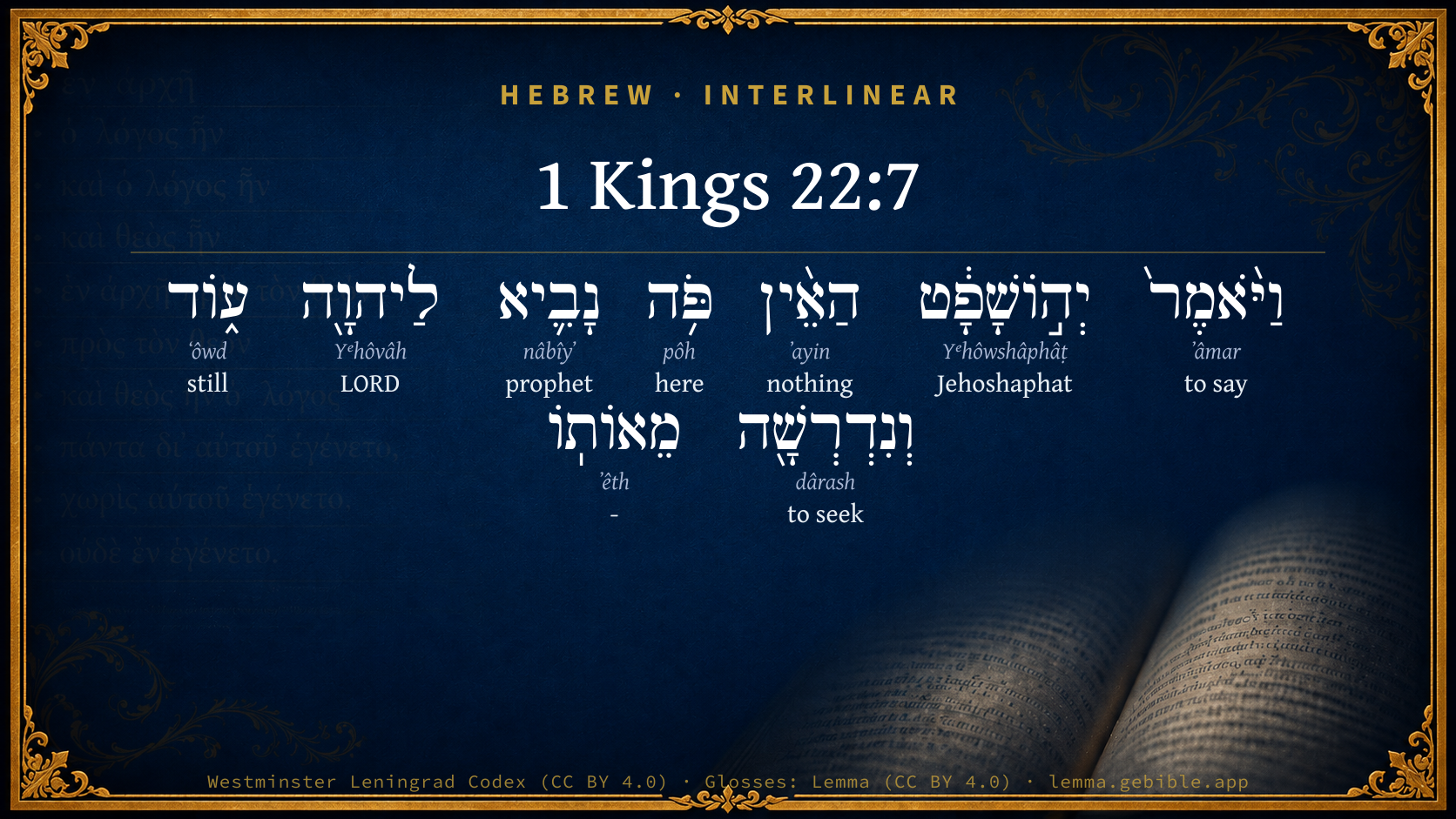
1 Kings 22:7

Hebrew (Westminster Leningrad Codex) 1 Kings 22:7 appears in the Hebrew Old Testament. The text above is from the Westminster Leningrad Codex. Each word links to its Strong’s number, a concise gloss, and parsing drawn from the Open Scriptures Hebrew Bible morphology. Click any word for its full Brown-Driver-Briggs (BDB) entry.
Download image
Cite this verse

1 Kings 22:7 (World English Bible). Public Domain. Lemma interlinear Bible study tool, https://lemma.gebible.app/v/1-kings/22/7.

Show BibTeX & RIS
BibTeX
RIS
English Translation
But Jehoshaphat said, Isn't there here a prophet of Yahweh besides, that we may inquire of him?
World English Bible · Public Domain
Download a study sheet

One document with this verse’s original text, its word-by-word gloss line, the meaning frame, cross-references with their text, attributed commentary, and full source and license credits — printable, and it pastes into notes with its structure intact.

This verse Autodidact and up

Study sheet (.html) Plain text (.txt)

A passage Seminary Student

Up to 50 verses in one chapter. A passage sheet keeps up to 6 commentary sources and 12 cross-references per verse, in the order this page ranks them, and says so on the sheet whenever that leaves anything out. Ask for a single verse and you get the Autodidact verse sheet above.

Everything on this page stays free to read, with no account — the sheet is a download of what is already on screen, not access to it.

Want to remove ads? Support Godless Engineer
Compare translations 3

The same verse in 3 English versions, stacked beneath the original-language interlinear above. Click any original word for its lexicon entry.

Each is an independent rendering of the whole verse — the interlinear is not word-aligned to these translations.

Highlighted words mark where these versions differ — a whole-verse word diff, not a word-by-word alignment.

  • World English Bible Public Domain
    But Jehoshaphat said, Isn't there here a prophet of Yahweh besides, that we may inquire of him?
  • King James Version Public Domain
    And Jehoshaphat said, Is there not here a prophet of the LORD besides, that we might enquire of him?
  • unfoldingWord Literal Text CC BY-SA 4.0
    And Jehoshaphat said, “ no prophet of Yahweh still here, that we may seek from him?”

unfoldingWord Literal Text — © unfoldingWord, licensed CC BY-SA 4.0. Word-aligned USFM3 via Door43 (git.door43.org/unfoldingWord/en_ult).

Versions to compare (up to 4)

3 of 4 selected

Show all 18 translations

Every available English version of this verse, each an independent rendering of the whole verse.

  • World English Bible Public Domain
    But Jehoshaphat said, Isn't there here a prophet of Yahweh besides, that we may inquire of him?
  • Berean Standard Bible Public Domain
    But Jehoshaphat asked, “Is there not still a prophet of the LORD here of whom we can inquire?”
  • Majority Standard Bible Public Domain
    But Jehoshaphat asked, “Is there not still a prophet of the LORD here of whom we can inquire?”
  • King James Version Public Domain
    And Jehoshaphat said, Is there not here a prophet of the LORD besides, that we might enquire of him?
  • American Standard Version (1901) Public Domain
    But Jehoshaphat said, Is there not here a prophet of Jehovah besides, that we may inquire of him?
  • Revised Version (1885) Public Domain
    But Jehoshaphat said, Is there not here besides a prophet of the LORD, that we might inquire of him?
  • Geneva Bible (1599) Public Domain
    And Iehoshaphat said, Is there here neuer a Prophet of the Lord more, that we might inquire of him?
  • Douay-Rheims (1899) Public Domain
    And Josaphat said: Is there not here some prophet of the Lord, that we may inquire by him?
  • Young's Literal Translation Public Domain
    And Jehoshaphat saith, `Is there not here a prophet of Jehovah besides, and we seek by him?'
  • Literal Standard Version CC BY-SA 4.0
    And Jehoshaphat says, “[Is there] not a prophet of YHWH still here that we may seek from him?”
  • Unlocked Literal Bible CC BY-SA 4.0
    But Jehoshaphat said, “Is there not here yet another prophet of Yahweh from whom we might seek advice?”
  • unfoldingWord Literal Text CC BY-SA 4.0
    And Jehoshaphat said, “ no prophet of Yahweh still here, that we may seek from him?”
  • Darby Bible Public Domain
    But Jehoshaphat said, Is there not here a prophet of Jehovah besides, that we might inquire of him?
  • World Messianic Bible Public Domain
    But Jehoshaphat said, “Isn’t there here a prophet of the LORD, that we may inquire of him?”
  • Webster's Bible Public Domain
    And Jehoshaphat said, Is there not here a prophet of the LORD besides, that we may inquire of him?
  • Free Bible Version CC BY-SA 4.0
    But Jehoshaphat asked, “Isn't there another prophet of the Lord here that we can ask?”
  • Bible in Basic English Public Domain
    But Jehoshaphat said, Is there no other prophet of the Lord here from whom we may get directions?
  • JPS Tanakh (1917) Public Domain
    But Jehoshaphat said: 'Is there not here besides a prophet of the LORD, that we might inquire of him?'

Literal Standard Version (2020), Covenant Press — licensed CC BY-SA 4.0. Text via the HelloAO Bible API (eBible.org). Unlocked Literal Bible (unfoldingWord) — licensed CC BY-SA 4.0. Text via the HelloAO Bible API (eBible.org). unfoldingWord Literal Text — © unfoldingWord, licensed CC BY-SA 4.0. Word-aligned USFM3 via Door43 (git.door43.org/unfoldingWord/en_ult). Free Bible Version, Dr. Jonathan Gallagher — licensed CC BY-SA 4.0. Text via the HelloAO Bible API (eBible.org).

Word by word

More ways to search: Search by grammar → Find every occurrence → Compare this word →

Practice this passage: Drill this verse → Learn its vocabulary →

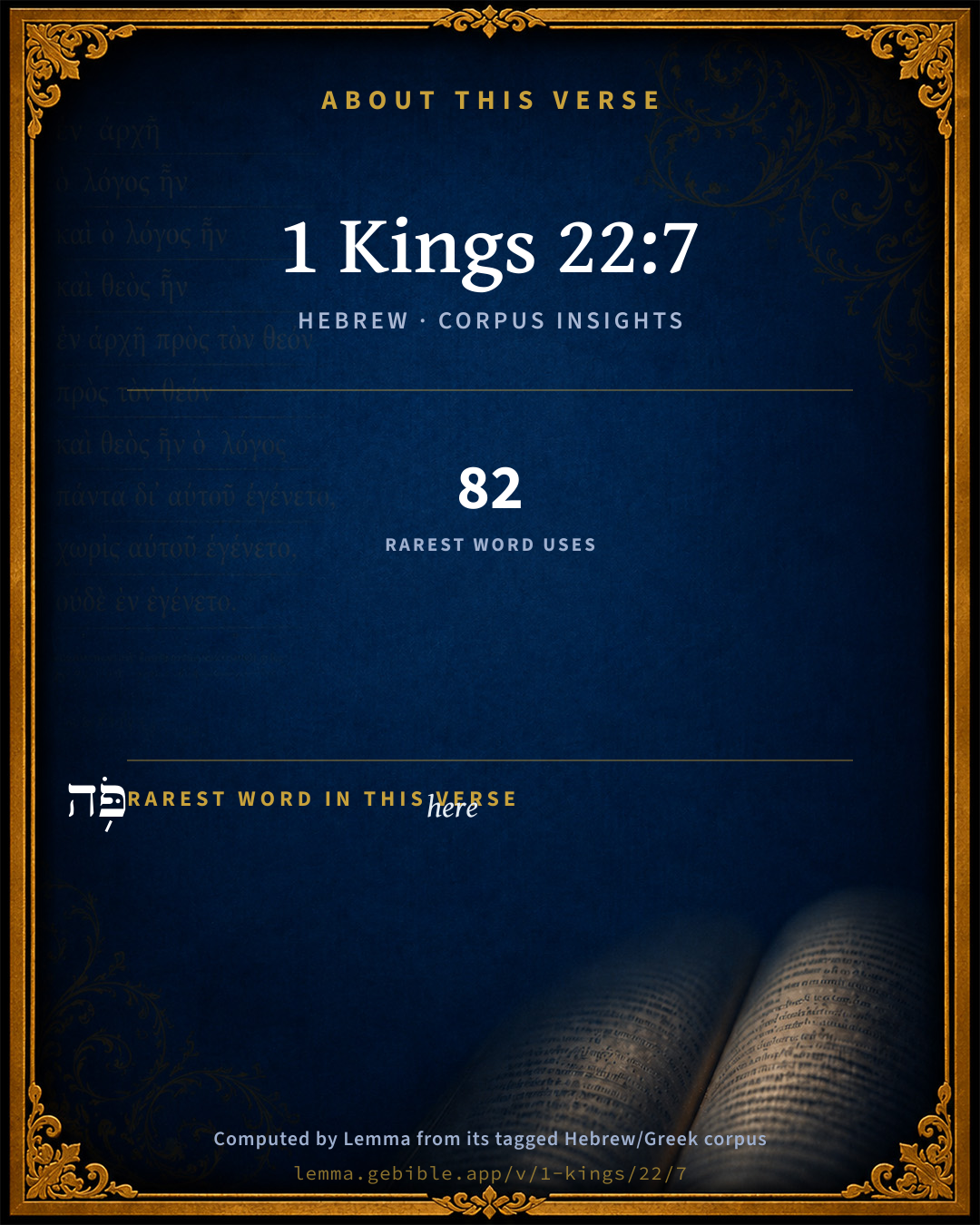
About this verse

These counts appear in no published source. They are computed here, from the morphology-tagged text and Lemma’s own curated glosses. What Lemma adds →

9
words
9
distinct lemmas
Historical
section

Grammatical profile

  • 2 verbs
  • 3 nouns
  • 2 adverbs
  • 2 particles

Verb forms

  • וַיֹּ֨אמֶר֙ Qal · Sequential Imperfect
  • וְנִדְרְשָׁ֖ה Qal · Imperfect

Hebrew & Septuagint length

In English translation the verse runs 17 words from the Hebrew and 26 from the Septuagint (LXX English) — the Septuagint runs noticeably longer here. See the side-by-side →

A rough comparison of the two English renderings, which tokenize alike — not a word-level alignment.

Word counts can differ between the Hebrew and the Greek without any difference in meaning — e.g. the Hebrew direct-object marker אֵת has no separate Greek word, and Greek often adds the article ὁ.

Cross-references

2

Topical passages linked to 1 Kings 22:7 in the Treasury of Scripture Knowledge — connected by theme and wording, ordered by reader-vote popularity; previews shown in the World English Bible.

  • 2 Kings 3:11–13 But Jehoshaphat said, Isn't there here a prophet of Yahweh, that we may inquire of Yahweh by him? One of the king of Israel's servants answered, Elisha the son of Shaphat is here, who poured water on the hands of Elijah.
  • 2 Chronicles 18:6–7 But Jehoshaphat said, Isn't there here a prophet of Yahweh besides, that we may inquire of him?

Cross-references courtesy of OpenBible.info (CC BY 4.0).

Hebrew and Greek witnesses Masoretic Hebrew ↔ Greek Septuagint

The same verse in the two great witnesses to the Old Testament, shown verse-for-verse.

Here the Septuagint runs noticeably longer than the Hebrew — LXX2012 (modern English Septuagint) 26 words vs World English Bible 17. A rough length comparison of the two English translations, not a word-level alignment — read both below.

These are two independent witnesses, not word-aligned to each other, and the Septuagint is shown in lemma (dictionary) form.

Hebrew 1 Kings 22:7 Masoretic · Westminster Leningrad Codex

וַיֹּ֨אמֶר֙ יְה֣וֹשָׁפָ֔ט הַאֵ֨ין פֹּ֥ה נָבִ֛יא לַיהוָ֖ה ע֑וֹד וְנִדְרְשָׁ֖ה מֵאוֹתֽוֹ

But Jehoshaphat said, Isn't there here a prophet of Yahweh besides, that we may inquire of him?

World English Bible · Public Domain

Greek LXX 1 Kings 22:7 Septuagint · lemma form

καί εἶπον ιωσαφατ πρός βασιλεύς ἰσραήλ οὐ εἰμί ὧδε προφήτης ὁ κύριος καί ἐπιἐρωτάω ὁ κύριος διά αὐτός

And Josaphat said to the king of Israel, Is there not here a prophet of the Lord, that we may enquire of the Lord by him?

LXX2012 (modern English Septuagint) · Public Domain

Hebrew: Westminster Leningrad Codex (CC BY 4.0). Greek: Septuagint (public domain); English from LXX2012 (modern English Septuagint) (Public Domain). How the Septuagint differs from the Hebrew →

Targum (Aramaic paraphrase)

1

The Targum is the ancient Jewish Aramaic paraphrase of the Hebrew Scriptures — an interpretive translation, not the Hebrew text itself. Onkelos (literal) and Pseudo-Jonathan (expansive) render the Torah, and Jonathan the Prophets. Coverage is partial: where no permissively-licensed English translation exists for a verse, only the Aramaic is shown. This is verse-level text, not a word-by-word alignment to the Hebrew.

  1. Targum Jonathan Prophets (Joshua–Malachi)
    וַאֲמַר יְהוֹשָׁפָט הֲלֵית כָּא נְבִיָא קֳדָם יְיָ עוֹד וְנִתְבַּע מִנֵיהּ:

    (no public-domain English translation for this verse)

    Targum Jonathan — Aramaic: “Mikraot Gedolot” (public domain). English: “Sefaria Community Translation” (CC0 1.0 (public-domain dedication)); “London "Chaldee Paraphrase," 1871” (public domain). Text via Sefaria.

Commentary

Notes on 1 Kings 22:7 from classic Christian and Jewish commentators (each source and its license shown beneath its notes). The classic Christian expositions comment on the surrounding passage and are grouped to its opening verse, so a note may address several verses; the Jewish commentaries on the Tanakh (Rashi and others) are per-verse, so they appear only where the commentator wrote on this verse.

Lemma curates 59 commentaries, every one of them public domain or Creative Commons licensed, each selected and text-cleaned for this edition rather than reprinted as found. About our sources →

Trapp's Complete Commentary

John Trapp

1Ki 22:7 And Jehoshaphat said, [Is there] not here a prophet of the LORD besides, that we might enquire of him?

Ver. 7. Is there not here a prophet of the Lord besides?] Good Jehoshaphat suspecting these four hundred of base flattery, maketh further inquiry for a prophet of the Lord that was melioris monetae of a better stamp. But should such a king as Jehoshaphat be without some true prophet or priest in his retinue?

That we might inquire of him.] But did he inquire pro forma tantum, as resolved to go on howsoever? This can hardly be excused.

John Trapp, A Commentary or Exposition upon All the Books of the Old and New Testament (1647–1656) — public domain. Text from a community e-Sword module.

Joseph Benson's Commentary

1Ki 22:7-8. Is there not here a prophet of the Lord besides? — Besides these who may seem to be such in your opinion, and by their own profession? He did not entirely reject these as no prophets of the Lord, though he had some doubt of their being divinely inspired with the certain knowledge of future events; and therefore he desired to know if there was any other from whom he might receive further satisfaction. There is yet one man, &c. — Namely, in this place, for whom I can speedily send; for there were also other prophets elsewhere in the kingdom, but these were not at hand. Micaiah the son of Imlah — Not the person whom we call Micah, one of the twelve minor prophets, for he lived a hundred and fifty years after this time, but another of that name. He doth not prophesy good concerning me, but evil — He is always a messenger to me of evil tidings. This probably was true, but not a sufficient reason why he should hate him, because Micaiah only delivered the messages which God sent by him; and whatsoever evil he denounced, Ahab himself was the cause and procurer of it. Jehoshaphat said, Let not the king say so — Let us neither hate his person, nor despise his message; but first hear it, and then do as we see cause.

Joseph Benson's Commentary on the Old and New Testaments (1811–1818) — public domain. Text from a community e-Sword module.

MacLaren's Expositions of Holy Scripture

Alexander MacLaren

1 Kings

AHAB AND MICAIAH

1Ki 22:7 - 1Ki 22:8.

An ill-omened alliance had been struck up between Ahab of Israel and Jehoshaphat of Judah. The latter, who would have been much better in Jerusalem, had come down to Samaria to join in an assault on the kingdom of Damascus; but, like a great many other people, Jehoshaphat first made up his mind without asking God, and then thought that it might be well to get some kind of varnish of a religious sanction for his decision. So he proposes to Ahab to inquire of the Lord about this matter. One would have thought that that should have been done before, and not after, the determination was made. Ahab does not at all see the necessity for such a thing, but, to please his scrupulous ally, he sends for his priests. They came, four hundred of them, and of course they all played the tune that Ahab called for. It is not difficult to get prophets to pat a king on the back, and tell him, ‘Do what you like.’

But Jehoshaphat was not satisfied yet. Perhaps he thought that Ahab’s clergy were not exactly God’s prophets, but at all events he wanted an independent opinion; and so he asks if there is not in all Samaria a man that can be trusted to speak out. He gets for answer the name of this ‘Micaiah the son of Imlah.’ Ahab had had experience of him, and knew his man; and the very name leads him to an explosion of passion, which, like other explosions, lays bare some very ugly depths. ‘I hate him; for he doth not prophesy good concerning me, but evil.’

That is a curious mood, is it not? that a man should know another to be a messenger of God, and therefore know that his words are true, and that if he asked his counsel he would be forbidden to do the thing that he is dead set on doing, and would be warned that to do it was destruction; and that still he should not ask the counsel, nor ever dream of dropping the purpose, but should burst out in a passion of puerile rage against the counsellor, and will have none of his reproofs. Very curious! But there are a great many of us that have something of the same mood in us, though we do not speak it out as plainly as Ahab did. It lurks more or less in us all, and it largely determines the attitude that some of us take to Christianity and to Christ. So I wish to say a word or two about it.

I. My text suggests the inevitable opposition between a message from God, and man’s evil.

No doubt, God is love; and just because He is, it is absolutely necessary that what comes from Him, and is the reflex and cast, so to speak, of His character, should be in stern and continual antagonism to that evil which is the worst foe of men, and is sure to lead to their death. It is because God is love, that ‘to the froward He shows Himself froward.’ and opposes that which, unopposed and yielded to, will ruin the man that does it. So this is one of the characteristic marks of all true messages from God, that men who will not part with their evil call them ‘stern,’ ‘rigid,’ ‘gloomy,’ ‘narrow’ Yes, of course; because God must look upon godless lives with disapprobation, and must desire by all means to draw men away from that which is drawing them away from Him and to their death.

Now, I suppose I need not spend time in enumerating or describing the points in the attitude of Christianity towards the solemn fact of human sin, which correspond to Ahab’s complaint that the prophet spake always ‘not good concerning him, but evil.’ The ‘gospel’ of Jesus Christ proves its name to be true, and that it is ‘good news,’ not only by its graciousness, its promises, its offers, and the rich blessings of eternal life with which its hands are full, but by its severity, as men call it. One characteristic of the gospel is the altogether unique place which the fact of sin fills in it. There is no other religion on the face of the earth that has so grasped and made prominent this thought: ‘All have sinned and come short of the glory of God.’ There is none that has painted human nature as it is in such dark colours, because there is none that knows itself to be able to change human nature into such radiance of glory and purity. The gospel has, if I might so say, on its palette a far greater range of pigments than any other system. Its blacks are blacker; its whites are whiter; its golds are more lustrous than those of other painters of human nature as it is and as it may become. It is a mark of its divine origin that it unfalteringly looks facts in the face, and will not say smooth things about men as they are.

Side by side with that characteristic of the dark picture which it draws of us, as we are in ourselves, is its unhesitating restraint or condemnation of deep-seated desires and tendencies. It does not come to men with the smooth words on its lips, ‘Do as thou wilt.’ It does not seek for favour by relaxing bonds, but it rigidly builds up a wall on either side of a narrow path, and says, ‘Walk within these limits and thou art safe. Go beyond them a hair’s-breadth, and thou perishest.’ It may suit Ahab’s prophets to fling the reins on the neck of human nature; God’s prophet says, ‘Thou shalt not,’ That is another of the tests of divine origin, that there shall be no base compliance with inclinations, but rigid condemnation of many of our deep desires.

Side by side with these two, there is a third characteristic that the Word, which is the outcome and expression of the divine love, is distinguished by its plain and stern declarations of the bitter consequences of evil-doing. I need not dwell upon these, brethren. They seem to me to be far too solemn to be spoken of by a man to men in other words than Scripture’s. But I beseech you to remember that this, too, is the characteristic of Christ’s message. So a man should feel, when he thinks of the dark and solemn things that the Old Testament partially, and the New Testament more clearly, utter as to the death which is the outcome of sin, that these are indeed the very voice of infinite love pleading with us all. Brother I do not so misapprehend facts as to think that the restraints and threatenings and dark pictures which Christ and His servants have drawn are anything but the utterance of the purest affection.

II. Now, secondly, let me ask you to look for a moment at the strange dislike which this attitude of Christianity kindles.

I have said that Ahab’s mental condition was a very odd one. Strange as it is, it is, as I have already remarked, in some degree a very frequent one. There are in us all, as we see in many regions of life, the beginnings of the same kind of feeling. Here, for example, is a course that I am quite sure, if I pursue it, will land me in evil. Does the drunkard take a glass the less, because he knows that if he goes on he will have a drunkard’s liver and die a miserable death? Does the gambler ever take away his hand from the pack of cards or the dice-box, because he knows that play means, in the long run, poverty and disgrace? When a man sets his will upon a certain course, he is like a bull that has started in its rage. Down goes the head, and, with eyes shut, he will charge a stone wall or an iron door, though he knows it will smash his skull. Men are very foolish animals; and there is no greater mark of their folly than the conspicuous and oft-repeated fact that the clearest vision of the consequences of a course of conduct is powerless to turn a man from it, when once his passions, or his will, or, worse still, his weakness, or, worst of all, his habits, have bound him to it.

Take another illustration. Do we not all know that honest friends have sometimes fallen out of favour, perhaps with ourselves, because they have persistently kept telling us what our consciences and common-sense knew to be true, that if we go on by that road we shall be suffocated in a bog? A man makes up his mind to a course of conduct. He has a shrewd suspicion that an honest friend will condemn him, and that the condemnation will be right. What does he do, therefore? He never consults his friend, but if by chance that friend should say what was expected of him, he gets angry with his adviser and doggedly goes his own road. I suppose we all know what it is to treat our consciences in the style in which Ahab treated Micaiah. We do not listen to them because we know what they will say before they have said it; and we call ourselves sensible people! Martin Luther once said, ‘It is neither safe nor wise to do anything against conscience.’ But Ahab put Micaiah in prison; and we shut up our consciences in a dungeon, and put a gag in their mouths, and a muffler over the gag, that we may hear them say no word, because we know that what we are doing, and we are doggedly determined to do, is wrong.

But the saddest illustration of this infatuation is to be found in the attitude that many men take in regard to Christianity. There is a great craving to-day, more perhaps than there has been in some other periods of the world’s history, for a religion which shall adorn, but shall not restrain; for a religion which shall be toothless, and have no bite in it; for a religion that shall sanction anything that it pleases our sovereign mightiness to want to do. We should all like to have God’s sanction for our actions. But there are a great many of us who will not take the only way to secure that-viz. to do the actions which He commands, and to abstain from those which He forbids. Popular Christianity is a very easy-fitting garment; it is like an old shoe that you can slip off and on without any difficulty. But a religion which does not put up a strong barrier between you and many of your inclinations in not worth anything. The mark of a message from God is that it restrains and coerces and forbids and commands. And some of you do not like it because it does.

There is a great tendency in this day to cut out of the Old and New Testaments all the pages that say things like this, ‘The soul that sinneth it shall die’; or things like this, ‘This is the condemnation, that light is come into the world, and men love darkness rather than light’; or things like this, ‘Then shall the wicked go away into outer darkness.’ Brethren, men being what they are, and God being what He is, there can be no divine message without a side of what the world calls threatening, or what Ahab called’ prophesying evil.’ I beseech you, do not be carried away by the modern talk about Christianity being gloomy and dark, or fancy that we put a blot and an excrescence upon the pure religion of the Man of Nazareth, when we speak of the death that follows sin, and of the darkness into which unbelief carries a man.

III. Once more, let me say a word about the intense folly of such an attitude.

Ahab hated Micaiah. Why? Because Micaiah told him what would come to him as the fruit of his own actions. That was foolish. It is no less foolish for people to take up a position of dislike, and to turn away from the gospel of Jesus Christ because it speaks in like manner. I said that men are very foolish animals; there is surely nothing in all the annals of human stupidity more stupid than to be angry with the word that tells you the truth about what you are bringing down upon your heads. It is absurd, because Micaiah did not make the evil, but Ahab made it; and Micaiah’s business was only to tell him what he was doing. It is absurd, because the only question to be asked is. Are the warnings true? are the threatenings representations of what really will come? are the prohibitions reasonable? And it is absurd, because, if these things are so-if it is true that the soul that sinneth dies, and will die; if it is true that you, who have heard of the name and the salvation of Jesus Christ over and over again, and have turned away from it, will, if you continue in that negligence and unbelief, reap bitter fruits here and hereafter therefrom-if these things are true, surely the man that tells you so, and the gospel that tells you so, deserve better treatment than Ahab’s petulant hatred or your stolid indifference and neglect.

Would you think it wise for a sea-captain to try to take the clapper out of the bell that floats and tolls above a shoal on which his ship will be wrecked if it strikes? Would it be wise to put out the lighthouse lamps, and then think that you had abolished the reef? Does the signalman with his red flag make the danger of which he warns, and is it not like a baby to hate and to neglect the message that comes to you and says, ‘Turn ye, turn ye, why will ye die’?

IV. So, lastly, I notice the end of this foolish attitude.

Ahab was told in plain words by Micaiah, before the interview closed, that he would never come back again in peace. He ordered the bold prophet into prison, and rode away gaily, no doubt, to his campaign. Weak men are very often obstinate, because they are not strong enough to rise to the height of changing a purpose when reason condemns it. This weak man was always obstinate in the wrong place, as so many of us are. So away he went, down from Samaria, across the plain, down to the fords of the Jordan. But when he had crossed to the other side, and was coming near his objective point, the memories of Micaiah in prison at Samaria began to sit heavy on his soul.

So he tried to deceive divine judgment, and got up an ingenious scheme by which his ally was to go into the field in royal pomp, and he to slip into it disguised. A great many of us try to hoodwink God, and it does not answer. The man who ‘drew the bow at a venture’ had his hand guided by a higher Hand. Ahab was plated all over with iron and brass, but there is always a crevice through which God’s arrow can find its way; and, where God’s arrow finds its way, it kills. When the night fell, he was lying dead on his chariot floor, and the host was scattered, and Micaiah, the prisoner, was avenged; and his word had taken hold on the despiser of it.

So it always will be. So it will be with us, dear brethren, if we do not give heed to our ways and listen to the word which may be bitter in the mouth, but, eaten, turns sweet as honey. Nailing the index of the barometer to ‘set fair’ will not keep off the thunderstorm, and no negligence or dislike of divine threatenings will arrest the slow, solemn march, inevitable as destiny, of the consequences of our doings. Things will be as they will be. Believed or unbelieved, the avalanche will come.

Dear brethren, there is one way to get Micaiah on your side. Listen to him, and then he will speak good to you, and not what you foolishly call evil. Let God’s word convince you of sin. Let it bring you to the Cross for pardon. Jesus Christ addresses each of us in the Apostle’s words: ‘Am I therefore become your enemy because I tell you the truth?’ The sternest threatenings in the Bible come from the lips of that infinite Love. If you will listen to Him, if you will yield yourselves to Him, if you will take Him for your Saviour and your Lord, if you will cast your confidence and anchor your love upon Him, if you will let Him restrain you, if you will consult Him about what He would have you do, if you will accept His prohibitions as well as His permissions, then His word and His act to you, here and hereafter, will be only good and not evil, all the days of your life.

Remember Ahab lying dead on the floor of his chariot in a pool of his own blood, and bethink yourselves of what despising the threatenings, and turning away from the rebukes and prohibitions of the divine word, come to. These threatenings are spoken that they may never need to be put in effect. If you give heed to them they will never be put in effect in regard to you, if you neglect them and ‘will none of’ God’s ‘reproof,’ they will come down on you like a mighty rock loosed from the mountain, and will grind you to powder.

Alexander MacLaren, Expositions of Holy Scripture (1904–1910) — public domain. Text from a community e-Sword module.

Geneva Bible (1599)

Geneva Bible translators

Jehoshaphat did not acknowledge the false prophets to be God’s ministers, but did contemn them.

Geneva Bible (1599) marginal notes — public domain. Text via Bolls.life.

Ellicott's Commentary for English Readers

(7) Is there not here a prophet of the Lord.—The rendering of the great name “Jehovah” by “the Lord” obscures the sense of the passage. In the previous utterance of the prophets the word (Adonai) is merely “Lord” in the etymological sense, which might mean the Supreme God of any religion. Jehoshaphat, struck with their shrinking from the distinctive name Jehovah, asks, “Is there not a prophet of Jehovah?”—one who is not ashamed or afraid to speak in His awful name?

A Bible Commentary for English Readers, edited by Charles John Ellicott (1878–1897) — public domain. Text from a community e-Sword module.

The Cambridge Bible for Schools and Colleges

gen. ed. J. J. S. Perowne

7. Is there not here a prophet of the Lord besides] The R.V. transposes besides, putting it after here. This brings out more clearly the reason for Jehoshaphat’s inquiry. Besides what he has heard, he would gladly be told what to do by a true prophet of Jehovah. These men and their answer did not quite satisfy him. Josephus says Jehoshaphat understood from their language that they were false prophets.

The Cambridge Bible for Schools and Colleges (gen. ed. J. J. S. Perowne; Cambridge University Press, 1878–1918) — public domain. Text from a community e-Sword module.

John Gill's Exposition

And the king of Israel, and Jehoshaphat the king of Judah, sat each on his throne,.... In great state and majesty:

having put on their robes; their royal robes, which they wore when they appeared in pomp and grandeur:

in a void place in the entrance of the gate of Samaria; where courts of judicature were held, and there was an open void space for the people to assemble in to hear; the word has the signification of a corn floor, and the Jews suppose they and their attendants sat in a semicircle like the half of a corn floor, after the same manner in which they say the sanhedrim at Jerusalem sat (o):

and all the prophets prophesied before them; concerning this affair of going to Ramothgilead.

(o) T. Bab. Cholin, fol. 5. 1. Vid. Kimchium in loc.

John Gill's Exposition of the Whole Bible (1746–1763) — public domain (CC PDM 1.0). Text via the HelloAO Bible API.

Albert Barnes' Notes on the Bible

Jehoshaphat was dissatisfied. These men - creatures of Ahab, tainted with the worship of calves if not with Baal-worship - had promised victory, but not in the name of Yahweh. Jehoshaphat, therefore, asked, “Is there not here a true prophet of Yahweh besides these 400 professed prophets?”

Albert Barnes' Notes on the Bible (1834–1885) — public domain. Text from a community e-Sword/MySword module.

Haydock's Catholic Bible Commentary

Lord. Josaphat knew that these four hundred were addicted to idol worship, (Haydock) and suspected that they only flattered their king. (Josephus)

George Leo Haydock (1774–1849), Haydock's Catholic Family Bible and Commentary, 1859 edition — public domain. Excludes Psalms (Douay-Rheims chapter numbering differs from Protestant) and Deuterocanonical books (Catholic canon only).

Matthew Poole's English Annotations

Besides these, who may seem to be such by your opinion, and their own profession; but I desire further satisfaction from some other prophet.

Matthew Poole's English Annotations on the Holy Bible (1683–1685) — public domain. Text from a community e-Sword/MySword module.

Whedon's Commentary on the Bible

Daniel D. Whedon

7. A prophet of the Lord besides — Jehoshaphat was not satisfied with the four hundred. He would hear Jehovah’s word from another class of prophets; for, while not denying that these were prophets of the Lord, he looked upon them as doubtful characters.

Daniel D. Whedon (gen. ed.), Commentary on the Old and New Testaments (1874–1909) — public domain. Text from a community e-Sword module.

The Pulpit Commentary

And Jehoshaphat said, Is there not here a prophet of the Lord Heb. Jehovah besides i.e. , in addition to these soi-disant prophets. He hardly likes to say bluntly that he cannot regard them as inspired, but at the same time hints clearly that he cannot be satisfied as to their mission and authority, that we might inquire of him?

The Pulpit Commentary (1880–1919), ed. H.D.M. Spence-Jones & Joseph S. Exell — public domain. Text from a community e-Sword module.

unfoldingWord translationNotes

Door43 World Missions Community

May the king not say that

Jehoshaphat refers to Ahab in the third person to show respect for him. AT: "You should not say that" (See: First, Second, or Third Person)

translationWords

Jehoshaphat

Yahweh

advice

king

kingdom of Israel

good

command

unfoldingWord translationNotes — © Distant Shores Media and the Door43 World Missions Community, licensed CC BY-SA 4.0. Source: git.door43.org/Door43/en_tn.

Rashi

Rabbi Shlomo Yitzchaki (Rashi)

Is there no other prophet of Adonoy? I have a tradition that no two prophets prophesy with the same expression, and these are all saying the same expression.

Rashi on the Tanakh — English translations: “The Judaica Press complete Tanach with Rashi, translated by A. J. Rosenberg” (CC BY 4.0); “Pentateuch with Rashi's commentary by M. Rosenbaum and A.M. Silbermann, 1929-1934” (public domain); “The Metsudah Tanach series, Lakewood, N.J” (CC BY 4.0); and “The Book of Joshua, Metsudah Publications, 1997” (CC BY 4.0). Text via Sefaria.

Lesson kit

Teaching starters — assembled from the data on this page, not authored interpretation. Every prompt links to the verse data it draws on. Edit before teaching.

1 Kings, in the Historical, opens this verse with 9 words (9 distinct Hebrew lemmas). Its most distinctive word is pôh (“here”). The Greek Septuagint runs longer here. A historical commentator’s framing appears above. Read the whole chapter for the surrounding context.

Discussion questions

  1. What does “here” (pôh) contribute to the verse as a whole?
  2. 2 Kings 3:11–13 shares this passage’s theme. How do the two illuminate each other?
  3. Compared with the Hebrew, the Septuagint runs longer here. What questions does that raise?
  4. These translations render this verse differently. What is at stake in choosing one wording over another?
  5. The verb «וַיֹּ֨אמֶר֙» is Qal Sequential Imperfect. How does its form color the action?
  6. Reading how Trapp's Complete Commentary and Joseph Benson's Commentary read this verse, where do the two commentators agree and where do they part?

Things to notice

Reading settings

Reading text

Shown beneath each verse's original-language words.

Old Testament
Old Testament edition

Read the OT as the Masoretic Hebrew (MT) or the Greek Septuagint (LXX).

English shown for the Greek Septuagint (in the Hebrew ↔ Greek comparison).

Comparing translations? Open the Compare panel on any verse page to stack up to four side by side.