
Ezekiel 38:11

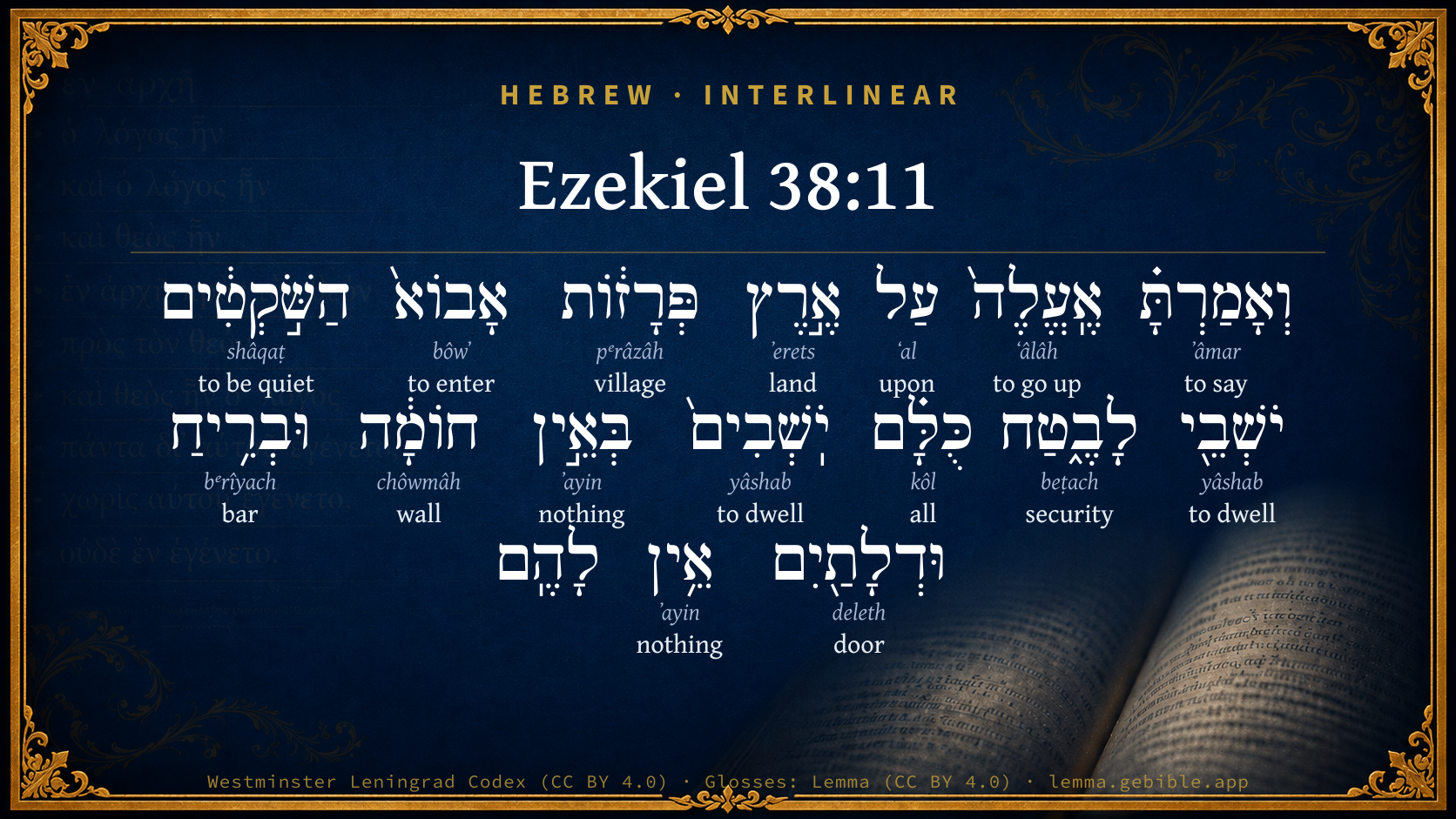
Hebrew (Westminster Leningrad Codex) Ezekiel 38:11 appears in the Hebrew Old Testament. The text above is from the Westminster Leningrad Codex. Each word links to its Strong’s number, a concise gloss, and parsing drawn from the Open Scriptures Hebrew Bible morphology. Click any word for its full Brown-Driver-Briggs (BDB) entry.
Download image
Cite this verse

Ezekiel 38:11 (World English Bible). Public Domain. Lemma interlinear Bible study tool, https://lemma.gebible.app/v/ezekiel/38/11.

Show BibTeX & RIS
BibTeX
RIS
English Translation
and you shall say, I will go up to the land of unwalled villages; I will go to those who are at rest, who dwell securely, all of them dwelling without walls, and having neither bars nor gates;
World English Bible · Public Domain
Download a study sheet

One document with this verse’s original text, its word-by-word gloss line, the meaning frame, cross-references with their text, attributed commentary, and full source and license credits — printable, and it pastes into notes with its structure intact.

This verse Autodidact and up

Study sheet (.html) Plain text (.txt)

A passage Seminary Student

Up to 50 verses in one chapter. A passage sheet keeps up to 6 commentary sources and 12 cross-references per verse, in the order this page ranks them, and says so on the sheet whenever that leaves anything out. Ask for a single verse and you get the Autodidact verse sheet above.

Everything on this page stays free to read, with no account — the sheet is a download of what is already on screen, not access to it.

Want to remove ads? Support Godless Engineer
Compare translations 3

The same verse in 3 English versions, stacked beneath the original-language interlinear above. Click any original word for its lexicon entry.

Each is an independent rendering of the whole verse — the interlinear is not word-aligned to these translations.

Highlighted words mark where these versions differ — a whole-verse word diff, not a word-by-word alignment.

  • World English Bible Public Domain
    and you shall say, I will go up to the land of unwalled villages; I will go to those who are at rest, who dwell securely, all of them dwelling without walls, and having neither bars nor gates;
  • King James Version Public Domain
    And thou shalt say, I will go up to the land of unwalled villages; I will go to them that are at rest, that dwell safely, all of them dwelling without walls, and having neither bars nor gates,
  • unfoldingWord Literal Text CC BY-SA 4.0
    Then you will say, ‘I will go up to the open land; I will go to the quiet people living in safety, all of them living where there are no walls or bars, and where there are no city gates.

unfoldingWord Literal Text — © unfoldingWord, licensed CC BY-SA 4.0. Word-aligned USFM3 via Door43 (git.door43.org/unfoldingWord/en_ult).

Versions to compare (up to 4)

3 of 4 selected

Show all 18 translations

Every available English version of this verse, each an independent rendering of the whole verse.

  • World English Bible Public Domain
    and you shall say, I will go up to the land of unwalled villages; I will go to those who are at rest, who dwell securely, all of them dwelling without walls, and having neither bars nor gates;
  • Berean Standard Bible Public Domain
    You will say, ‘I will go up against a land of unwalled villages; I will come against a tranquil people who dwell securely, all of them living without walls or bars or gates—
  • Majority Standard Bible Public Domain
    You will say, ‘I will go up against a land of unwalled villages; I will come against a quiet people who dwell securely, all of them living without walls or bars or gates—
  • King James Version Public Domain
    And thou shalt say, I will go up to the land of unwalled villages; I will go to them that are at rest, that dwell safely, all of them dwelling without walls, and having neither bars nor gates,
  • American Standard Version (1901) Public Domain
    and thou shalt say, I will go up to the land of unwalled villages; I will go to them that are at rest, that dwell securely, all of them dwelling without walls, and having neither bars nor gates;
  • Revised Version (1885) Public Domain
    and thou shalt say, I will go up to the land of unwalled villages; I will go to them that are at quiet, that dwell securely, all of them dwelling without walls, and having neither bars nor gates:
  • Geneva Bible (1599) Public Domain
    And thou shalt say, I wil go vp to the land that hath no walled towres: I will goe to them that are at rest, and dwell in safetie, which dwell all without walles, and haue neither barres nor gates,
  • Douay-Rheims (1899) Public Domain
    And thou shalt say: I will go up to the land which is without a wall, I will come to them that are at rest, and dwell securely: all these dwell without a wall, they have no bars nor gates:
  • Young's Literal Translation Public Domain
    And thou hast said: I go up against a land of unwalled villages, I go in to those at rest, dwelling confidently, All of them are dwelling without walls, And bar and doors they have not.
  • Literal Standard Version CC BY-SA 4.0
    And you have said: I go up over a land of open places, || I go to those at rest, dwelling confidently, || All of them are dwelling without walls, || And they have no bar and doors—
  • Unlocked Literal Bible CC BY-SA 4.0
    Then you will say, 'I will go up to the open land; I will go to the quiet people living in safety, all of them living where there are no walls or bars, and where there are no city gates.
  • unfoldingWord Literal Text CC BY-SA 4.0
    Then you will say, ‘I will go up to the open land; I will go to the quiet people living in safety, all of them living where there are no walls or bars, and where there are no city gates.
  • Darby Bible Public Domain
    and thou shalt say, I will go up to the land of unwalled villages; I will come to them that are in quiet, that dwell in safety, all of them dwelling without walls, and having neither bars nor gates,
  • World Messianic Bible Public Domain
    You will say, ‘I will go up to the land of unwalled villages. I will go to those who are at rest, who dwell securely, all of them dwelling without walls, and having neither bars nor gates,
  • Webster's Bible Public Domain
    And thou shalt say, I will go up to the land of unwalled villages; I will go to them that are at rest, that dwell safely, all of them dwelling without walls, and having neither bars nor gates,
  • Free Bible Version CC BY-SA 4.0
    You tell yourself, ‘I'm going to attack a country of undefended villages, a peaceful people who don't suspect an attack. They all live in towns without defensive walls or barred gates.
  • Bible in Basic English Public Domain
    And you will say, I will go up to the land of small unwalled towns; I will go to those who are quiet, living, all of them, without fear of danger, without walls or locks or doors:
  • JPS Tanakh (1917) Public Domain
    and thou shalt say: I will go up against the land of unwalled villages; I will come upon them that are at quiet, that dwell safely, all of them dwelling without walls, and having neither bars nor gates;

Literal Standard Version (2020), Covenant Press — licensed CC BY-SA 4.0. Text via the HelloAO Bible API (eBible.org). Unlocked Literal Bible (unfoldingWord) — licensed CC BY-SA 4.0. Text via the HelloAO Bible API (eBible.org). unfoldingWord Literal Text — © unfoldingWord, licensed CC BY-SA 4.0. Word-aligned USFM3 via Door43 (git.door43.org/unfoldingWord/en_ult). Free Bible Version, Dr. Jonathan Gallagher — licensed CC BY-SA 4.0. Text via the HelloAO Bible API (eBible.org).

Word by word

More ways to search: Search by grammar → Find every occurrence → Compare this word →

Practice this passage: Drill this verse → Learn its vocabulary →

פְּרָז֔וֹת
pᵉrâzâh
H6519
“villages”
Noun, Common, Feminine, Plural, Absolute
Part of Speech
Noun
Type
Common
Gender
Feminine
Number
Plural
State
Absolute
Full BDB Definition

Origin: from the same as H6518

TWOT: 1812a

open region, hamlet, unwalled village, open country
  1. וְאָמַרְתָּ֗ ʼâmar H559 “and · to say” Conjunction + Verb, Qal, Sequential Perfect, 2nd Person, Masculine, Singular
  2. אֶֽעֱלֶה֙ ʻâlâh H5927 “to go up” Verb, Qal, Imperfect, 1st Person, Common, Singular
  3. עַל ʻal H5921 “upon” Preposition
  4. אֶ֣רֶץ ʼerets H776 “land of” Noun, Common, Both, Singular, Construct
  5. אָבוֹא֙ bôwʼ H935 “to enter” Verb, Qal, Imperfect, 1st Person, Common, Singular
  6. הַשֹּׁ֣קְטִ֔ים shâqaṭ H8252 “the · being quiet” Particle, Definite Article + Verb, Qal, Participle Active, Masculine, Plural, Absolute
  7. יֹשְׁבֵ֖י yâshab H3427 “dwelling” Verb, Qal, Participle Active, Masculine, Plural, Construct
  8. לָבֶ֑טַח beṭach H983 “to/for · security” Preposition + Noun, Common, Masculine, Singular, Absolute
  9. כֻּלָּ֗ם kôl H3605 “all · their” Noun, Common, Masculine, Singular, Construct + Suffix, Personal, 3rd Person, Masculine, Plural
  10. יֹֽשְׁבִים֙ yâshab H3427 “dwelling” Verb, Qal, Participle Active, Masculine, Plural, Absolute
  11. בְּאֵ֣ין ʼayin H369 “in/at · nothing” Preposition + Particle, Negative
  12. חוֹמָ֔ה chôwmâh H2346 “wall” Noun, Common, Feminine, Singular, Absolute
  13. וּבְרִ֥יחַ bᵉrîyach H1280 “and · bar” Conjunction + Noun, Common, Masculine, Singular, Absolute
  14. וּדְלָתַ֖יִם deleth H1817 “and · doors” Conjunction + Noun, Common, Feminine, Dual, Absolute
  15. אֵ֥ין ʼayin H369 “nothing” Particle, Negative

About this verse

These counts appear in no published source. They are computed here, from the morphology-tagged text and Lemma’s own curated glosses. What Lemma adds →

17
words
14
distinct lemmas
Prophets
section

Notable vocabulary

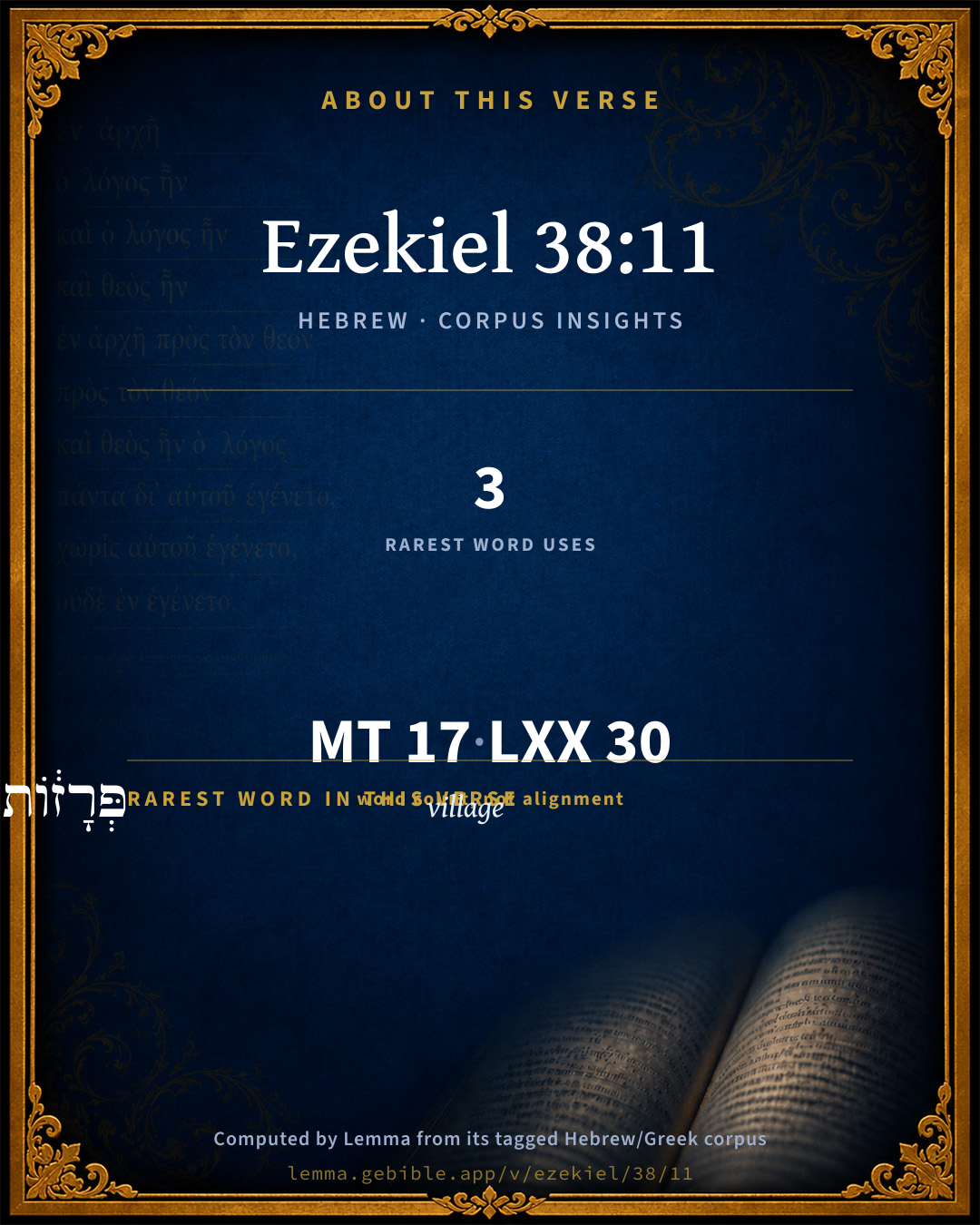
The rarest word here is פְּרָז֔וֹת village H6519 — appearing just 3 times in the whole Hebrew Bible.

Shared distinctive vocabulary

פְּרָז֔וֹת village H6519 occurs in 3 verses of the Hebrew Bible. Also found in:

Grammatical profile

  • 6 verbs
  • 7 nouns
  • 2 prepositions
  • 2 particles

Verb forms

  • וְאָמַרְתָּ֗ Qal · Sequential Perfect
  • אֶֽעֱלֶה֙ Qal · Imperfect
  • אָבוֹא֙ Qal · Imperfect
  • הַשֹּׁ֣קְטִ֔ים Qal · Participle Active
  • יֹשְׁבֵ֖י Qal · Participle Active
  • יֹֽשְׁבִים֙ Qal · Participle Active

Repetition

Words recur within this verse — often emphatic in Hebrew:

  • יֹשְׁבֵ֖י to dwell H3427 ×2
  • בְּאֵ֣ין nothing H369 ×2

Hebrew & Septuagint length

In English translation the verse runs 38 words from the Hebrew and 43 from the Septuagint (LXX English) — closely comparable.

A rough comparison of the two English renderings, which tokenize alike — not a word-level alignment.

Word counts can differ between the Hebrew and the Greek without any difference in meaning — e.g. the Hebrew direct-object marker אֵת has no separate Greek word, and Greek often adds the article ὁ.

In the original languages it is 17 Hebrew tokens and 30 Greek tokens — but the two are counted differently (Hebrew bundles its prefixes and suffixes into one token; the Greek is in lemma form), so that isn’t a like-for-like length.

Cross-references

11

Topical passages linked to Ezekiel 38:11 in the Treasury of Scripture Knowledge — connected by theme and wording, ordered by reader-vote popularity; previews shown in the World English Bible.

  • Zechariah 2:4–5 and said to him, "Run, speak to this young man, saying, 'Jerusalem will be inhabited as villages without walls, because of the multitude of men and cattle in it.
  • Exodus 15:9 The enemy said, 'I will pursue, I will overtake, I will divide the spoil. My desire shall be satisfied on them. I will draw my sword, my hand shall destroy them.'
  • Judges 18:7 Then the five men departed, and came to Laish, and saw the people who were therein, how they lived in security, after the manner of the Sidonians, quiet and secure; for there was none in the land, possessing authority, that might put [them] to shame in anything, and they were far from the Sidonians, and had no dealings with any man.
  • Judges 18:27 They took that which Micah had made, and the priest whom he had, and came to Laish, to a people quiet and secure, and struck them with the edge of the sword; and they burnt the city with fire.
  • Psalms 10:9 He lurks in secret as a lion in his ambush. He lies in wait to catch the helpless. He catches the helpless, when he draws him in his net.
  • Proverbs 1:11–16 If they say, "Come with us, Let's lay in wait for blood; Let's lurk secretly for the innocent without cause;
  • Proverbs 3:29–30 Don't devise evil against your neighbor, Seeing he dwells securely by you.
  • Isaiah 37:24–25 By your servants have you defied the Lord, and have said, With the multitude of my chariots am I come up to the height of the mountains, to the innermost parts of Lebanon; and I will cut down the tall cedars of it, and the choice fir trees of it; and I will enter into its farthest height, the forest of its fruitful field;
  • Jeremiah 49:31–32 Arise, go up to a nation that is at ease, that dwells without care, says Yahweh; that have neither gates nor bars, that dwell alone.
  • Ezekiel 38:8 After many days you shall be visited: in the latter years you shall come into the land that is brought back from the sword, that is gathered out of many peoples, on the mountains of Israel, which have been a continual waste; but it is brought forth out of the peoples, and they shall dwell securely, all of them.
  • Romans 3:15 "Their feet are swift to shed blood.

Cross-references courtesy of OpenBible.info (CC BY 4.0).

Hebrew and Greek witnesses Masoretic Hebrew ↔ Greek Septuagint

The same verse in the two great witnesses to the Old Testament, shown verse-for-verse.

These are two independent witnesses, not word-aligned to each other, and the Septuagint is shown in lemma (dictionary) form.

Hebrew Ezekiel 38:11 Masoretic · Westminster Leningrad Codex

וְאָמַרְתָּ֗ אֶֽעֱלֶה֙ עַל אֶ֣רֶץ פְּרָז֔וֹת אָבוֹא֙ הַשֹּׁ֣קְטִ֔ים יֹשְׁבֵ֖י לָבֶ֑טַח כֻּלָּ֗ם יֹֽשְׁבִים֙ בְּאֵ֣ין חוֹמָ֔ה וּבְרִ֥יחַ וּדְלָתַ֖יִם אֵ֥ין לָהֶֽם

and you shall say, I will go up to the land of unwalled villages; I will go to those who are at rest, who dwell securely, all of them dwelling without walls, and having neither bars nor gates;

World English Bible · Public Domain

Greek LXX Ezekiel 38:11 Septuagint · lemma form

καί εἶπον ἀναβαίνω ἐπί γῆ ἀποῥίπτω ἥκω ἐπί ἡσυχάζω ἐν ἡσυχία καί οἰκέω ἐπί εἰρήνη πᾶς καταοἰκέω γῆ ἐν ὅς οὐ ὑποἄρχω τεῖχος οὐδέ μοχλός καί θύρα οὐ εἰμί αὐτός

And you shall say, I will go up to the rejected land; I will come upon them that are at ease in tranquility, and dwelling in peace, all inhabiting a land in which there is no wall, nor bars, nor have they doors;

LXX2012 (modern English Septuagint) · Public Domain

On this verse, The Pulpit Commentary discusses the Septuagint’s reading. Read the note in Commentary ↓

Hebrew: Westminster Leningrad Codex (CC BY 4.0). Greek: Septuagint (public domain); English from LXX2012 (modern English Septuagint) (Public Domain). How the Septuagint differs from the Hebrew →

Targum (Aramaic paraphrase)

1

The Targum is the ancient Jewish Aramaic paraphrase of the Hebrew Scriptures — an interpretive translation, not the Hebrew text itself. Onkelos (literal) and Pseudo-Jonathan (expansive) render the Torah, and Jonathan the Prophets. Coverage is partial: where no permissively-licensed English translation exists for a verse, only the Aramaic is shown. This is verse-level text, not a word-by-word alignment to the Hebrew.

  1. Targum Jonathan Prophets (Joshua–Malachi)
    וְתֵימַר אֶסַק עַל אַרְעָא דְיָתְבָא שְׁלֵיוָא בְּקִרְוֵי פִצְחַיָא אֱהַךְ עַל עַמָא דְשָׁקְטִין וְשָׁרָן לְרוֹחֲצָן כּוּלְהוֹן יָתְבִין בְּלָא שׁוּרָא וְעָבְרִין וְדָשִׁין לֵית לְהוֹן:

    (no public-domain English translation for this verse)

    Targum Jonathan — Aramaic: “Mikraot Gedolot” (public domain). English: “Sefaria Community Translation” (CC0 1.0 (public-domain dedication)); “London "Chaldee Paraphrase," 1871” (public domain). Text via Sefaria.

Commentary

Notes on Ezekiel 38:11 from classic Christian and Jewish commentators (each source and its license shown beneath its notes). The classic Christian expositions comment on the surrounding passage and are grouped to its opening verse, so a note may address several verses; the Jewish commentaries on the Tanakh (Rashi and others) are per-verse, so they appear only where the commentator wrote on this verse.

Lemma curates 59 commentaries, every one of them public domain or Creative Commons licensed, each selected and text-cleaned for this edition rather than reprinted as found. About our sources →

Trapp's Complete Commentary

John Trapp

Eze 38:11 And thou shalt say, I will go up to the land of unwalled villages; I will go to them that are at rest, that dwell safely, all of them dwelling without walls, and having neither bars nor gates,

Ver. 11. I will go up to the land of unwalled villages.] That care not to fortify their towns, but commit themselves to God, and think to escape us, but we shall soon show them their folly therein. The Hebrews have one and the same word for folly ( כסל) and confidence. (Psa 49:14 Ecc 7:25 Psa 78:7 Job 31:24) See on Job 4:6 But "in the fear of the Lord is strong confidence; and his children," though their towns be unwalled, "have a place of refuge." {Pro 14:26}

John Trapp, A Commentary or Exposition upon All the Books of the Old and New Testament (1647–1656) — public domain. Text from a community e-Sword module.

Geneva Bible (1599)

Geneva Bible translators

Meaning, Israel, which had now been destroyed, and was not yet built again: declaring hereby the simplicity of the godly, who seek not so much to fortify themselves by outward force, as to depend on the providence and goodness of God.

Geneva Bible (1599) marginal notes — public domain. Text via Bolls.life.

Jamieson, Fausset & Brown

Robert Jamieson, A. R. Fausset & David Brown

dwell safely--that is, securely, without fear of danger (compare Est 9:19). Antiochus, the type of Antichrist, took Jerusalem without a blow.

Jamieson, Fausset & Brown — Commentary Critical and Explanatory on the Whole Bible (1871) — public domain (CC PDM 1.0). Text via the HelloAO Bible API.

Ellicott's Commentary for English Readers

(11) The land of unwalled villages.—Again, omit the definite article before land, as in Eze_38:8. The description of a people living in prosperity and security looks quite beyond anything hitherto realised in the history of the Jews, and points to such a state of things as is described in Zec_2:4-5. The description of the attack of Gog and Magog in Rev_20:9 corresponds to this.

A Bible Commentary for English Readers, edited by Charles John Ellicott (1878–1897) — public domain. Text from a community e-Sword module.

The Cambridge Bible for Schools and Colleges

gen. ed. J. J. S. Perowne

11. Cf. Deu_3:5; 1Sa_6:18; Jdg_18:27. “Safely,” i.e. in confidence, Eze_38:8.

The Cambridge Bible for Schools and Colleges (gen. ed. J. J. S. Perowne; Cambridge University Press, 1878–1918) — public domain. Text from a community e-Sword module.

John Gill's Exposition

To take a spoil, and to take a prey,.... These are the words of Gog continued; suggesting that he should have no occasion to fight; should have nothing else to do but to seize upon the goods and plunder the substance of these people:

to turn thine hand upon the desolate places that are now inhabited: such as were before desolate, and had lain long so, but now peopled and cultivated; these he would attack and demolish, and make a spoil and prey of:

and upon the people that are gathered out of the nations; a description of the Jews, as before; Eze 38:8.

which have gotten cattle and goods; so that it should seem that Gog or the Turks will not immediately attack the Jews upon their possession of the land of Judea; but some time after, when they have settled in it, and have acquired much wealth and riches in cattle and goods, and then think to have a fine booty of them:

that dwell in the midst of the land; or, "the navel of the land" (p); which may design Jerusalem, situated in the midst of the land of Israel, and so called the navel of it, as that is in the midst of the body; as Enna is said by Cicero to be the navel of Sicily: or, as Kimchi thinks, the land of Israel itself is meant; which is in the midst of the world, and so the navel of it; though the former seems best.

(p) , Sept.; "in vel super umbilico terrae", Pagninus, Montanus, Cocceius, Starckius.

John Gill's Exposition of the Whole Bible (1746–1763) — public domain (CC PDM 1.0). Text via the HelloAO Bible API.

Albert Barnes' Notes on the Bible

Unwalled villages - Compare Zec 2:4-5.

Albert Barnes' Notes on the Bible (1834–1885) — public domain. Text from a community e-Sword/MySword module.

Matthew Poole's English Annotations

Thou shalt say; thou wilt resolve in thyself, and declare it to thy council.

Go up; invade with all thy puissance.

Of unwalled villages; weak, and without any considerable defences: a scattered people, that dwell in villages, can make little if any resistance.

That are at rest; who would willingly be quiet.

That dwell safely; suspecting as little evil from others, as they intend little against others, and trusting in the protection of their God, who hath promised they shall dwell safely.

Without walls that may resist and be too strong for my forces and engines; though they have walls, bars, and gates, yet Gog accounts as none against his mighty armies.

Matthew Poole's English Annotations on the Holy Bible (1683–1685) — public domain. Text from a community e-Sword/MySword module.

The Pulpit Commentary

Vers. 11, 12 give voice to the things that should come into Gog"s mind and incite him to his enterprise against Israel. The spectacle of Israel dwelling safely, i.e. securely and confidently, in a land of un-walled villages literally, a land of open places, as opposed to fortified citiesi.e. of towns without walls, and having neither bars nor gates (comp Zec_2:4, Zec_2:5; Deu_3:5; 1Sa_6:18) because of being no more apprehensive of invasion, should excite within his bosom the thought that Israel would fall an easy prey to his assault; and this thought again should kindle in his bosom the lust of conquest which should finally impel him to the sinful project described, viz. to take a spoil and to take a prey; literally, to spoil the spoil (comp. Eze_29:19; and (Isa_10:6) to prey the prey. (Isa_33:23) In execution of this he would fall upon the once desolate but then inhabited places, upon the once scattered but then collected population, upon the previously poor but then wealthy inhabitants, who should then have gotten cattle and goods (cattle and chattel best renders the Hebrew parouomasia, mikneh vekinyan), as the patriarchs of their nation had once done, (Gen_34:23 Gen_36:6) and who should then be dwelling in the midst of the land; literally, in the height, or, navel (LXX, Vulgate), of the earth, (comp. Jud_1:9:37) the Hebrews generally regarding Palestine as the Greeks did Delphi, both as the middle (Eze_5:5) and perhaps therefore if not as the highest (Gesenius), at least as the fairest and most fertile portion of the earth.

Spiritual security.

We may treat this subject in two ways, We may have regard to

I NATIONAL SECURITY. Unfortunately, it is only too typical of our race that a great power should say, "I will go up to the land of unwalled villages," etc. Taking men and nations as they are, we have to reckon upon:

1. N ational unscrupulousness. It has been enough that one country has been strong and another weak, one covetous and another wealthy, one well armed and another defenseless, for the military enterprise to be undertaken, the attack to be delivered, and the disaster to be sustained. Then there has to be:

2. Some means and method of national defense. And we may find a country:

(1) Pitiably helpless. Such is the case with Israel (in the text); it has not yet recovered from its past defeats and despoilments; it has not had the opportunity of strengthening itself against attack.

(2) Culpably negligent. It may be so intent on enrichment or enjoyment that it has not given the needful time and strength to make itself secure against assault from without.

(3) Secured by international covenant; as Switzerland.

(4) Wisely regardful of its chief source of safety. This is found, not in regiments and in ships, not in fortresses and in magazines though these may not be disregarded but in the manliness and temperance of its citizens, and in the favor of Almighty God.

II INDIVIDUAL SECURITY. Every man has to guard the sanctity of his own heart and character, the honor of his own name; his most sacred and bounden duty is to see that it is not invaded and defiled. That it may be preserved in its purity and integrity it becomes him:

1. To recognize the strength of the enemy. To remember and to realize that the adversaries of his soul are many, subtle, and strong; they are such as these covetousness, passion, pride, intemperance, worldliness, unbelief.

2. To raise the strongest defenses he can secure. And these are

(1) good principles, the love of that which is true and pure and sound, the hatred of that which is base and shameful and degrading;

(2) good habits, the habits, well cultivated and constantly sustained, of self-command, of temperance, of purity, of through investigation before acceptance and utterance, of devotion. There are "the walls, the bars, and the gates" of the soul, which the adversary must take before he succeeds in his attack, within which the soul should be safely entrenched.

3. To secure the guardianship of God. By simplicity and uprightness of heart, by prayerfulness of attitude and engagement, to secure that gracious and mighty power against which all the devices and all the assaults of evil will not be able to succeed. C.

The Pulpit Commentary (1880–1919), ed. H.D.M. Spence-Jones & Joseph S. Exell — public domain. Text from a community e-Sword module.

John Wesley's Explanatory Notes

Unwalled - Weak, and without any considerable defenses.

John Wesley, Explanatory Notes Upon the Whole Bible (1754–1765) — public domain. Text via the GEBible commentary corpus.

Rashi

Rabbi Shlomo Yitzchaki (Rashi)

upon a land of open cities [Heb. פְּרָזוֹת,] dwellers in villages without a wall, who trust in their might and are not [so] afraid as to gather into fortified cities.

פְּרָזוֹת is like (Deut. 3:5): “in addition to the very many open cities (עָרֵי הַפְרָזִי),” without a wall.

I shall come to the tranquil ones and see what they trust in.

Rashi on the Tanakh — English translations: “The Judaica Press complete Tanach with Rashi, translated by A. J. Rosenberg” (CC BY 4.0); “Pentateuch with Rashi's commentary by M. Rosenbaum and A.M. Silbermann, 1929-1934” (public domain); “The Metsudah Tanach series, Lakewood, N.J” (CC BY 4.0); and “The Book of Joshua, Metsudah Publications, 1997” (CC BY 4.0). Text via Sefaria.

Lesson kit

Teaching starters — assembled from the data on this page, not authored interpretation. Every prompt links to the verse data it draws on. Edit before teaching.

Ezekiel, in the Prophets, opens this verse with 17 words (14 distinct Hebrew lemmas). Its most distinctive word is pᵉrâzâh (“village”). A historical commentator’s framing appears above. Read the whole chapter for the surrounding context.

Discussion questions

  1. The word pᵉrâzâh carries the sense “village.” How does it shape the verse?
  2. Esther 9:19 shares the word «village» with this verse. How do the two illuminate each other?
  3. “to dwell” occurs 2× in this one verse. What is the effect of the repetition?
  4. These translations render this verse differently; the difference is in the English rendering, not the original. What questions does that raise?
  5. The verb «וְאָמַרְתָּ֗» is Qal Sequential Perfect. How does its form color the action?
  6. Reading how Trapp's Complete Commentary and Geneva Bible (1599) read this verse, where do the two commentators agree and where do they part?

Things to notice

Reading settings

Reading text

Shown beneath each verse's original-language words.

Old Testament
Old Testament edition

Read the OT as the Masoretic Hebrew (MT) or the Greek Septuagint (LXX).

English shown for the Greek Septuagint (in the Hebrew ↔ Greek comparison).

Comparing translations? Open the Compare panel on any verse page to stack up to four side by side.