
Ezra 9:14

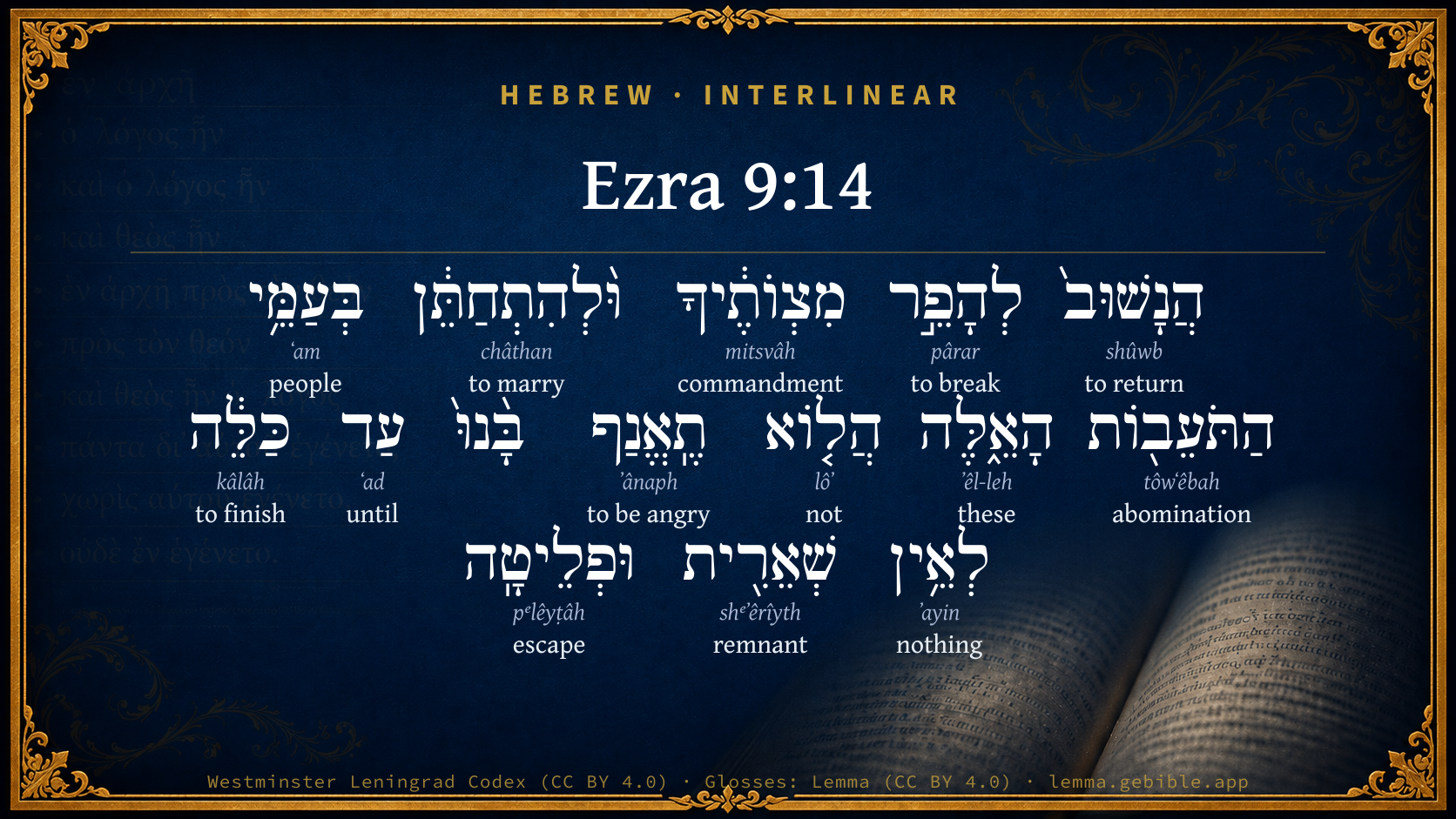
Hebrew (Westminster Leningrad Codex) Ezra 9:14 appears in the Hebrew Old Testament. The text above is from the Westminster Leningrad Codex. Each word links to its Strong’s number, a concise gloss, and parsing drawn from the Open Scriptures Hebrew Bible morphology. Click any word for its full Brown-Driver-Briggs (BDB) entry.
Download image
Cite this verse

Ezra 9:14 (World English Bible). Public Domain. Lemma interlinear Bible study tool, https://lemma.gebible.app/v/ezra/9/14.

Show BibTeX & RIS
BibTeX
RIS
English Translation
shall we again break your commandments, and join in affinity with the peoples that do these abominations? would not you be angry with us until you had consumed us, so that there should be no remnant, nor any to escape?
World English Bible · Public Domain
Download a study sheet

One document with this verse’s original text, its word-by-word gloss line, the meaning frame, cross-references with their text, attributed commentary, and full source and license credits — printable, and it pastes into notes with its structure intact.

This verse Autodidact and up

Study sheet (.html) Plain text (.txt)

A passage Seminary Student

Up to 50 verses in one chapter. A passage sheet keeps up to 6 commentary sources and 12 cross-references per verse, in the order this page ranks them, and says so on the sheet whenever that leaves anything out. Ask for a single verse and you get the Autodidact verse sheet above.

Everything on this page stays free to read, with no account — the sheet is a download of what is already on screen, not access to it.

Want to remove ads? Support Godless Engineer
Compare translations 3

The same verse in 3 English versions, stacked beneath the original-language interlinear above. Click any original word for its lexicon entry.

Each is an independent rendering of the whole verse — the interlinear is not word-aligned to these translations.

Highlighted words mark where these versions differ — a whole-verse word diff, not a word-by-word alignment.

  • World English Bible Public Domain
    shall we again break your commandments, and join in affinity with the peoples that do these abominations? would not you be angry with us until you had consumed us, so that there should be no remnant, nor any to escape?
  • King James Version Public Domain
    Should we again break thy commandments, and join in affinity with the people of these abominations? wouldest not thou be angry with us till thou hadst consumed us, so that there should be no remnant nor escaping?
  • unfoldingWord Literal Text CC BY-SA 4.0
    should we return to breaking your commandments and to intermarrying with the peoples of these abominations? Would you not be angry with us as far as completion, so that there is neither remnant nor survivors?

unfoldingWord Literal Text — © unfoldingWord, licensed CC BY-SA 4.0. Word-aligned USFM3 via Door43 (git.door43.org/unfoldingWord/en_ult).

Versions to compare (up to 4)

3 of 4 selected

Show all 18 translations

Every available English version of this verse, each an independent rendering of the whole verse.

  • World English Bible Public Domain
    shall we again break your commandments, and join in affinity with the peoples that do these abominations? would not you be angry with us until you had consumed us, so that there should be no remnant, nor any to escape?
  • Berean Standard Bible Public Domain
    shall we again break Your commandments and intermarry with the peoples who commit these abominations? Would You not become so angry with us as to wipe us out, leaving no remnant or survivor?
  • Majority Standard Bible Public Domain
    shall we again break Your commandments and intermarry with the peoples who commit these abominations? Would You not become so angry with us as to wipe us out, leaving no remnant or survivor?
  • King James Version Public Domain
    Should we again break thy commandments, and join in affinity with the people of these abominations? wouldest not thou be angry with us till thou hadst consumed us, so that there should be no remnant nor escaping?
  • American Standard Version (1901) Public Domain
    shall we again break thy commandments, and join in affinity with the peoples that do these abominations? wouldest not thou be angry with us till thou hadst consumed us, so that there should be no remnant, nor any to escape?
  • Revised Version (1885) Public Domain
    shall we again break thy commandments, and join in affinity with the peoples that do these abominations? wouldest not thou be angry with us till thou hadst consumed us, so that there should be no remnant, nor any to escape?
  • Geneva Bible (1599) Public Domain
    Should we returne to breake thy commadements, and ioyne in affinitie with the people of such abominations? wouldest not thou be angrie towarde vs till thou haddest consumed vs, so that there should be no remnant nor any escaping?
  • Douay-Rheims (1899) Public Domain
    That we should not turn away, nor break thy commandments, nor join in marriage with the people of these abominations. Art thou angry with us unto utter destruction, not to leave us a remnant to be saved?
  • Young's Literal Translation Public Domain
    do we turn back to break Thy commands, and to join ourselves in marriage with the people of these abominations? art not Thou angry against us -- even to consumption -- till there is no remnant and escaped part?
  • Literal Standard Version CC BY-SA 4.0
    do we turn back to break Your commands, and to join ourselves in marriage with the people of these abominations? Are You not angry against us—even to consumption—until there is no remnant and escaped part?
  • Unlocked Literal Bible CC BY-SA 4.0
    should we again break your commandments and make mixed marriages with these abominable people? Will you not be angry and annihilate us so there will be no one left, no one to escape?
  • unfoldingWord Literal Text CC BY-SA 4.0
    should we return to breaking your commandments and to intermarrying with the peoples of these abominations? Would you not be angry with us as far as completion, so that there is neither remnant nor survivors?
  • Darby Bible Public Domain
    should we again break thy commandments, and join in affinity with the peoples of these abominations? wouldest thou not be angry with us till thou hadst consumed us, so that there should be no remnant nor any to escape?
  • World Messianic Bible Public Domain
    shall we again break your commandments, and join ourselves with the peoples that do these abominations? Wouldn’t you be angry with us until you had consumed us, so that there would be no remnant, nor any to escape?
  • Webster's Bible Public Domain
    Should we again break thy commandments, and join in affinity with the people of these abominations? wouldst thou not be angry with us till thou hadst consumed us, so that there should be no remnant nor escaping?
  • Free Bible Version CC BY-SA 4.0
    shall we break your commandments once again and intermarry with the peoples who commit these disgusting religious practices? Wouldn't you become so angry with us that you would destroy us? No remnant would be left, not a single survivor.
  • Bible in Basic English Public Domain
    Are we again to go against your orders, taking wives from among the people who do these disgusting things? would you not be angry with us till our destruction was complete, till there was not one who got away safe?
  • JPS Tanakh (1917) Public Domain
    shall we again break Thy commandments, and make marriages with the peoples that do these abominations? wouldest not Thou be angry with us till Thou hadst consumed us, so that there should be no remnant, nor any to escape?

Literal Standard Version (2020), Covenant Press — licensed CC BY-SA 4.0. Text via the HelloAO Bible API (eBible.org). Unlocked Literal Bible (unfoldingWord) — licensed CC BY-SA 4.0. Text via the HelloAO Bible API (eBible.org). unfoldingWord Literal Text — © unfoldingWord, licensed CC BY-SA 4.0. Word-aligned USFM3 via Door43 (git.door43.org/unfoldingWord/en_ult). Free Bible Version, Dr. Jonathan Gallagher — licensed CC BY-SA 4.0. Text via the HelloAO Bible API (eBible.org).

Word by word

More ways to search: Search by grammar → Find every occurrence → Compare this word →

Practice this passage: Drill this verse → Learn its vocabulary →

תֶֽאֱנַף
ʼânaph
H599
“to be angry”
Verb, Qal, Imperfect, 2nd Person, Masculine, Singular
Part of Speech
Verb
Stem
Qal
Form
Imperfect
Person
2nd Person
Gender
Masculine
Number
Singular
Full BDB Definition

Origin: a primitive root

TWOT: 133

to be angry, to be displeased, to breathe hard - (Qal) to be angry (of God) - (Hithpael) to be angry (always of God)
  1. הֲנָשׁוּב֙ shûwb H7725 “to return” Particle, Interrogative + Verb, Qal, Imperfect, 1st Person, Common, Plural
  2. לְהָפֵ֣ר pârar H6565 “to break” Preposition + Verb, Hiphil, Infinitive Construct
  3. מִצְוֺתֶ֔יךָ mitsvâh H4687 “commandments · your” Noun, Common, Feminine, Plural, Construct + Suffix, Personal, 2nd Person, Masculine, Singular
  4. וּ֨לְהִתְחַתֵּ֔ן châthan H2859 “and · to marry” Conjunction + Preposition + Verb, Hithpael, Infinitive Construct
  5. בְּעַמֵּ֥י ʻam H5971 “in/at · peoples of” Preposition + Noun, Common, Masculine, Plural, Construct
  6. הַתֹּעֵב֖וֹת tôwʻêbah H8441 “the · abominations” Particle, Definite Article + Noun, Common, Feminine, Plural, Absolute
  7. הָאֵ֑לֶּה ʼêl-leh H428 “the · these” Particle, Definite Article + Pronoun, Demonstrative, Common, Plural
  8. הֲל֤וֹא lôʼ H3808 “not” Particle, Interrogative + Particle, Negative
  9. עַד ʻad H5704 “until” Preposition
  10. כַּלֵּ֔ה kâlâh H3615 “to finish” Verb, Piel, Infinitive Construct
  11. לְאֵ֥ין ʼayin H369 “to/for · nothing” Preposition + Particle, Negative
  12. שְׁאֵרִ֖ית shᵉʼêrîyth H7611 “remnant” Noun, Common, Feminine, Singular, Absolute
  13. וּפְלֵיטָֽה pᵉlêyṭâh H6413 “and · escape” Conjunction + Noun, Common, Feminine, Singular, Absolute

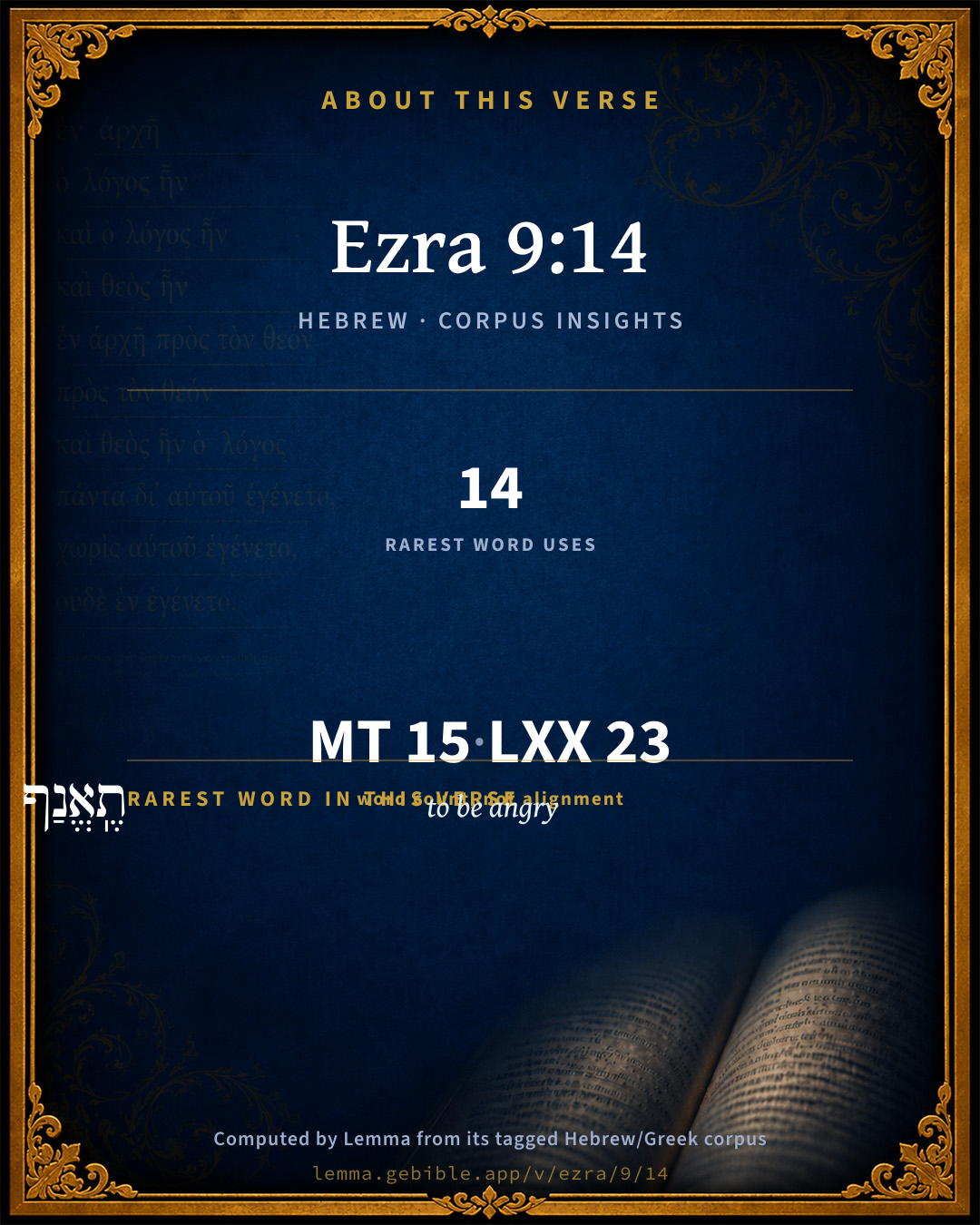
About this verse

These counts appear in no published source. They are computed here, from the morphology-tagged text and Lemma’s own curated glosses. What Lemma adds →

15
words
14
distinct lemmas
Historical
section

Notable vocabulary

The rarest word here is תֶֽאֱנַף to be angry H599 — appearing just 14 times in the whole Hebrew Bible.

Shared distinctive vocabulary

תֶֽאֱנַף to be angry H599 occurs in 14 verses of the Hebrew Bible. Also found in:

Grammatical profile

  • 5 verbs
  • 5 nouns
  • 1 pronoun
  • 2 prepositions
  • 2 particles

Verb forms

  • הֲנָשׁוּב֙ Qal · Imperfect
  • לְהָפֵ֣ר Hiphil · Infinitive Construct
  • וּ֨לְהִתְחַתֵּ֔ן Hithpael · Infinitive Construct
  • תֶֽאֱנַף Qal · Imperfect
  • כַּלֵּ֔ה Piel · Infinitive Construct

Hebrew & Septuagint length

In English translation the verse runs 40 words from the Hebrew and 35 from the Septuagint (LXX English) — closely comparable.

A rough comparison of the two English renderings, which tokenize alike — not a word-level alignment.

Word counts can differ between the Hebrew and the Greek without any difference in meaning — e.g. the Hebrew direct-object marker אֵת has no separate Greek word, and Greek often adds the article ὁ.

In the original languages it is 15 Hebrew tokens and 23 Greek tokens — but the two are counted differently (Hebrew bundles its prefixes and suffixes into one token; the Greek is in lemma form), so that isn’t a like-for-like length.

Cross-references

17

Topical passages linked to Ezra 9:14 in the Treasury of Scripture Knowledge — connected by theme and wording, ordered by reader-vote popularity; previews shown in the World English Bible.

  • Deuteronomy 9:8 Also in Horeb you provoked Yahweh to wrath, and Yahweh was angry with you to destroy you.
  • Deuteronomy 9:14 let me alone, that I may destroy them, and blot out their name from under the sky; and I will make of you a nation mightier and greater than they.
  • Ezra 9:2 For they have taken of their daughters for themselves and for their sons, so that the holy seed have mixed themselves with the peoples of the lands: yes, the hand of the princes and rulers has been chief in this trespass.
  • Exodus 32:10 Now therefore leave me alone, that my wrath may burn hot against them, and that I may consume them; and I will make of you a great nation."
  • Numbers 16:21 Separate yourselves from among this congregation, that I may consume them in a moment.
  • Numbers 16:45 Get away from among this congregation, that I may consume them in a moment. They fell on their faces.
  • Judges 2:2 and you shall make no covenant with the inhabitants of this land; you shall break down their altars. But you have not listened to my voice: why have you done this?
  • John 5:14 Afterward Jesus found him in the temple, and said to him, "Behold, you are made well. Sin no more, so that nothing worse happens to you."
  • Romans 6:1 What shall we say then? Shall we continue in sin, that grace may abound?
  • 2 Peter 2:20–21 For if, after they have escaped the defilement of the world through the knowledge of the Lord and Savior Jesus Christ, they are again entangled therein and overcome, the last state has become worse with them than the first.
  • Exodus 23:32 You shall make no covenant with them, nor with their gods.
  • Deuteronomy 32:26–27 I said, I would scatter them afar, I would make the memory of them to cease from among men;
  • Ezra 9:8 Now for a little moment grace has been shown from Yahweh our God, to leave us a remnant to escape, and to give us a nail in his holy place, that our God may lighten our eyes, and give us a little reviving in our bondage.
  • Nehemiah 13:23–27 In those days also saw I the Jews who had married women of Ashdod, of Ammon, [and] of Moab:
  • Isaiah 1:9 Unless Yahweh of hosts had left to us a very small remnant, We would have been as Sodom; We would have been like Gomorrah.
  • Jeremiah 46:28 Don't be afraid you, O Jacob my servant, says Yahweh; for I am with you: for I will make a full end of all the nations where I have driven you; but I will not make a full end of you, but I will correct you in measure, and will in no way leave you unpunished.
  • Ezekiel 6:8 Yet will I leave a remnant, in that you shall have some that escape the sword among the nations, when you shall be scattered through the countries.

Cross-references courtesy of OpenBible.info (CC BY 4.0).

Hebrew and Greek witnesses Masoretic Hebrew ↔ Greek Septuagint

The same verse in the two great witnesses to the Old Testament, shown verse-for-verse.

These are two independent witnesses, not word-aligned to each other, and the Septuagint is shown in lemma (dictionary) form.

Hebrew Ezra 9:14 Masoretic · Westminster Leningrad Codex

הֲנָשׁוּב֙ לְהָפֵ֣ר מִצְוֺתֶ֔יךָ וּ֨לְהִתְחַתֵּ֔ן בְּעַמֵּ֥י הַתֹּעֵב֖וֹת הָאֵ֑לֶּה הֲל֤וֹא תֶֽאֱנַף בָּ֨נוּ֙ עַד כַּלֵּ֔ה לְאֵ֥ין שְׁאֵרִ֖ית וּפְלֵיטָֽה

shall we again break your commandments, and join in affinity with the peoples that do these abominations? would not you be angry with us until you had consumed us, so that there should be no remnant, nor any to escape?

World English Bible · Public Domain

Greek LXX Ezra 9:14 Septuagint · lemma form

ὅτι ἐπιστρέφω διασκεδάζω ἐντολή σύ καί ἐπιγαμβρεύω ὁ λαός ὁ γαῖα μή παραὀξύνω ἐν ἐγώ ἕως συντέλεια ὁ μή εἰμί ἐγκατάλειμμα καί διασώζω

whereas we have repeatedly broken your commandments, and intermarried with the people of the lands: be not very angry with us to our utter destruction, so that there should be no remnant or escaping one.

LXX2012 (modern English Septuagint) · Public Domain

In the Septuagint this is one book — Esdras B (2 Esdras): Ezra is chapters 1–10, Nehemiah 11–23.

On this verse, The Cambridge Bible for Schools and Colleges discusses the Septuagint’s reading. Read the note in Commentary ↓

Hebrew: Westminster Leningrad Codex (CC BY 4.0). Greek: Septuagint (public domain); English from LXX2012 (modern English Septuagint) (Public Domain). How the Septuagint differs from the Hebrew →

Commentary

Notes on Ezra 9:14 from classic Christian and Jewish commentators (each source and its license shown beneath its notes). The classic Christian expositions comment on the surrounding passage and are grouped to its opening verse, so a note may address several verses; the Jewish commentaries on the Tanakh (Rashi and others) are per-verse, so they appear only where the commentator wrote on this verse.

Lemma curates 59 commentaries, every one of them public domain or Creative Commons licensed, each selected and text-cleaned for this edition rather than reprinted as found. About our sources →

Trapp's Complete Commentary

John Trapp

Ezr 9:14 Should we again break thy commandments, and join in affinity with the people of these abominations? wouldest not thou be angry with us till thou hadst consumed [us], so that [there should be] no remnant nor escaping?

Ver. 14. Should we again break thy commandments] There is so much unthankfulness and disingenuity in such an entertainment of mercy, that holy Ezra here thinks that heaven and earth would be ashamed of it.

And join in affinity with the people of these abominations?] Especially when we may hear God himself screeching out as it were those words of his, Oh, do not this abominable thing! Save yourselves from this untoward generation, &c.

Wouldest thou not be angry with us?] i.e. Chide us, smite us, and so set it on, as no creature should be able to take it off? Sin may move God, when we ask bread and fish to feed us, to answer us with a stone to bruise us or a serpent to bite us. Shun it therefore as a serpent in your way, or as poison in your meats. "Kiss the Son, lest he be angry, and ye perish from the way," Psa 2:12.

So that there should be no remnant] So that our late preservation should prove but a reservation to further mischief; as was Sodom’s, Sennacberib’s, Pharaoh’s.

John Trapp, A Commentary or Exposition upon All the Books of the Old and New Testament (1647–1656) — public domain. Text from a community e-Sword module.

Tyndale Open Study Notes

Tyndale Open Resources

9:14 Won’t your anger be enough to destroy us? The sin of intermarriage with non-believers was so serious that they had no hope of survival if they did not repent.

Tyndale Open Study Notes — © Tyndale Open Resources, licensed CC BY-SA 4.0. Text via the HelloAO Bible API.

The Cambridge Bible for Schools and Colleges

gen. ed. J. J. S. Perowne

14. should we again, &c.] R.V. shall we again.

break thy commandments] The work rendered ‘break’ is found with ‘commandment’ in Num_15:31, and is especially frequently found with ‘covenant’, e.g. Gen_17:14; Deu_31:16; Jdg_2:1; Isa_24:5; Jer_31:32; Eze_17:16 in the sense of ‘annul’, ‘violate’. Compare its use in Ezr_4:5 ‘frustrate their purpose’.

join in affinity] This word occurs once only in the Pentateuch, Deu_7:3.

with the people of these abominations] R.V. with the peoples that do these abominations. See note on Ezr_9:11.

wouldest thou not be angry, &c.] The question expects the answer ‘yes’. Ezra recalls the declarations of God’s displeasure in such passages as Deu_7:4 ‘For he will turn away thy son from following me, that they may serve other gods; so will the anger of the Lord be kindled against you, and he will destroy you utterly’, Deu_11:17; Jos_23:16. The tense is missed in the LXX. μὴ παροξυνθῇς and the Vulg. ‘numquid iratus es’.

till thou hadst consumed us] The precise form of this phrase only occurs elsewhere in 2Ki_13:17; 2Ki_13:19 ‘till thou have (hadst) consumed them’; but a very similar form of it appears in 2Ch_24:10 ‘until they had made an end’, 2Ch_31:1 ‘until they had destroyed them all’. It means ‘up to the point of extinction’. Cf. LXX. ἕως συντελείας. Vulg. ‘usque ad consummationem’.

no remnant nor escaping] R.V. no remnant nor any to escape. It is hard to render the two words in English. ‘Any to escape’ is the same word as ‘remnant’ in Ezr_9:8; Ezr_9:13. The two words occur together in 1Ch_4:43 ‘they smote the remnant of the Amalekites that escaped’. The former word denotes simply the ‘remainder’; the latter has the idea of ‘survival from flight’ (cf. Ezr_9:15). The LXX. distinguishes by ἐγκατάλειμμα καὶ διασωζόμενον. The Vulgate renders ‘reliquias ad salutem’.

The Cambridge Bible for Schools and Colleges (gen. ed. J. J. S. Perowne; Cambridge University Press, 1878–1918) — public domain. Text from a community e-Sword module.

John Gill's Exposition

Should we again break thy commandments, and join in affinity with the people of these abominations?.... That are guilty of abominable idolatries, and of all uncleanness:

wouldest thou not be angry with us till thou hadst consumed us; it might be justly expected:

so that there should be no remnant nor escaping? any left or suffered to escape the wrath of but all consumed by it.

John Gill's Exposition of the Whole Bible (1746–1763) — public domain (CC PDM 1.0). Text via the HelloAO Bible API.

Haydock's Catholic Bible Commentary

That. Hebrew, "should we again break, &c....Wouldst thou not be angry?" &c.

George Leo Haydock (1774–1849), Haydock's Catholic Family Bible and Commentary, 1859 edition — public domain. Excludes Psalms (Douay-Rheims chapter numbering differs from Protestant) and Deuterocanonical books (Catholic canon only).

Matthew Poole's English Annotations

Should we again break thy commandments? was this a fit and just requital of all thy kindnesses? or was this thy end and design in these actions? or wilt thou take this well from our hands?

There should be no remnant nor escaping: can we reasonably expect any thing from thee less than utter ruin?

Matthew Poole's English Annotations on the Holy Bible (1683–1685) — public domain. Text from a community e-Sword/MySword module.

Whedon's Commentary on the Bible

Daniel D. Whedon

14. Wouldest not thou be angry — The question is the strongest possible confession that they merited the Divine anger.

Daniel D. Whedon (gen. ed.), Commentary on the Old and New Testaments (1874–1909) — public domain. Text from a community e-Sword module.

Rashi

Rabbi Shlomo Yitzchaki (Rashi)

If we revert Heb. הֲנָשּׁוּב, if we return.

will You not be wroth with us a wonder with an affirmative answer.

Rashi on the Tanakh — English translations: “The Judaica Press complete Tanach with Rashi, translated by A. J. Rosenberg” (CC BY 4.0); “Pentateuch with Rashi's commentary by M. Rosenbaum and A.M. Silbermann, 1929-1934” (public domain); “The Metsudah Tanach series, Lakewood, N.J” (CC BY 4.0); and “The Book of Joshua, Metsudah Publications, 1997” (CC BY 4.0). Text via Sefaria.

Lesson kit

Teaching starters — assembled from the data on this page, not authored interpretation. Every prompt links to the verse data it draws on. Edit before teaching.

Ezra, in the Historical, opens this verse with 15 words (14 distinct Hebrew lemmas). Its most distinctive word is ʼânaph (“to be angry”). A historical commentator’s framing appears above. Read the whole chapter for the surrounding context.

Discussion questions

  1. What does “to be angry” (ʼânaph) contribute to the verse as a whole?
  2. Deuteronomy 1:37 shares the word «to be angry» with this verse. How do the two illuminate each other?
  3. These translations render this verse differently. What is at stake in choosing one wording over another?
  4. The verb «הֲנָשׁוּב֙» is Qal Imperfect. How does its form color the action?
  5. Reading how Trapp's Complete Commentary and Tyndale Open Study Notes read this verse, where do the two commentators agree and where do they part?

Things to notice

Reading settings

Reading text

Shown beneath each verse's original-language words.

Old Testament
Old Testament edition

Read the OT as the Masoretic Hebrew (MT) or the Greek Septuagint (LXX).

English shown for the Greek Septuagint (in the Hebrew ↔ Greek comparison).

Comparing translations? Open the Compare panel on any verse page to stack up to four side by side.