
Judges 14:6

Hebrew (Westminster Leningrad Codex) Judges 14:6 appears in the Hebrew Old Testament. The text above is from the Westminster Leningrad Codex. Each word links to its Strong’s number, a concise gloss, and parsing drawn from the Open Scriptures Hebrew Bible morphology. Click any word for its full Brown-Driver-Briggs (BDB) entry.
Download image
Cite this verse

Judges 14:6 (World English Bible). Public Domain. Lemma interlinear Bible study tool, https://lemma.gebible.app/v/judges/14/6.

Show BibTeX & RIS
BibTeX
RIS
English Translation
The Spirit of Yahweh came mightily on him, and he tore him as he would have torn a kid; and he had nothing in his hand: but he didn't tell his father or his mother what he had done.
World English Bible · Public Domain
Download a study sheet

One document with this verse’s original text, its word-by-word gloss line, the meaning frame, cross-references with their text, attributed commentary, and full source and license credits — printable, and it pastes into notes with its structure intact.

This verse Autodidact and up

Study sheet (.html) Plain text (.txt)

A passage Seminary Student

Up to 50 verses in one chapter. A passage sheet keeps up to 6 commentary sources and 12 cross-references per verse, in the order this page ranks them, and says so on the sheet whenever that leaves anything out. Ask for a single verse and you get the Autodidact verse sheet above.

Everything on this page stays free to read, with no account — the sheet is a download of what is already on screen, not access to it.

Want to remove ads? Support Godless Engineer
Compare translations 3

The same verse in 3 English versions, stacked beneath the original-language interlinear above. Click any original word for its lexicon entry.

Each is an independent rendering of the whole verse — the interlinear is not word-aligned to these translations.

Highlighted words mark where these versions differ — a whole-verse word diff, not a word-by-word alignment.

  • World English Bible Public Domain
    The Spirit of Yahweh came mightily on him, and he tore him as he would have torn a kid; and he had nothing in his hand: but he didn't tell his father or his mother what he had done.
  • King James Version Public Domain
    And the Spirit of the LORD came mightily upon him, and he rent him as he would have rent a kid, and he had nothing in his hand: but he told not his father or his mother what he had done.
  • unfoldingWord Literal Text CC BY-SA 4.0
    Then the Spirit of Yahweh rushed on him, and he tore it as the tearing of a kid, and not anything in his hand. And he did not declare to his father or to his mother what he had done.

unfoldingWord Literal Text — © unfoldingWord, licensed CC BY-SA 4.0. Word-aligned USFM3 via Door43 (git.door43.org/unfoldingWord/en_ult).

Versions to compare (up to 4)

3 of 4 selected

Show all 18 translations

Every available English version of this verse, each an independent rendering of the whole verse.

  • World English Bible Public Domain
    The Spirit of Yahweh came mightily on him, and he tore him as he would have torn a kid; and he had nothing in his hand: but he didn't tell his father or his mother what he had done.
  • Berean Standard Bible Public Domain
    and the Spirit of the LORD came powerfully upon him, and he tore the lion apart with his bare hands as one would tear a young goat. But he did not tell his father or mother what he had done.
  • Majority Standard Bible Public Domain
    and the Spirit of the LORD came powerfully upon him, and he tore the lion apart with his bare hands as one would tear a young goat. But he did not tell his father or mother what he had done.
  • King James Version Public Domain
    And the Spirit of the LORD came mightily upon him, and he rent him as he would have rent a kid, and he had nothing in his hand: but he told not his father or his mother what he had done.
  • American Standard Version (1901) Public Domain
    And the Spirit of Jehovah came mightily upon him, and he rent him as he would have rent a kid; and he had nothing in his hand: but he told not his father or his mother what he had done.
  • Revised Version (1885) Public Domain
    And the spirit of the LORD came mightily upon him, and he rent him as he would have rent a kid, and he had nothing in his hand: but he told not his father or his mother what he had done.
  • Geneva Bible (1599) Public Domain
    And the Spirit of the Lord came vpon him, and he tare him, as one should haue rent a kid, and had nothing in his hand, neither told he his father nor his mother what he had done.
  • Douay-Rheims (1899) Public Domain
    And the spirit of the Lord came upon Samson, and he tore the lion as he would have torn a kid in pieces, having nothing at all in his hand: and he would not tell this to his father and mother.
  • Young's Literal Translation Public Domain
    and the Spirit of Jehovah prospereth over him, and he rendeth it as the rending of a kid, and there is nothing in his hand, and he hath not declared to his father and to his mother that which he hath done.
  • Literal Standard Version CC BY-SA 4.0
    and the Spirit of YHWH prospers over him, and he tears it as the tearing of a kid, and there is nothing in his hand, and he has not declared to his father and to his mother that which he has done.
  • Unlocked Literal Bible CC BY-SA 4.0
    Yahweh's Spirit suddenly came on him, and he tore the lion apart as easily as he would have torn apart a small goat, and he had nothing in his hand. But he did not tell his father or his mother what he had done.
  • unfoldingWord Literal Text CC BY-SA 4.0
    Then the Spirit of Yahweh rushed on him, and he tore it as the tearing of a kid, and not anything in his hand. And he did not declare to his father or to his mother what he had done.
  • Darby Bible Public Domain
    and the Spirit of the LORD came mightily upon him, and he tore the lion asunder as one tears a kid; and he had nothing in his hand. But he did not tell his father or his mother what he had done.
  • World Messianic Bible Public Domain
    The LORD’s Spirit came mightily on him, and he tore him as he would have torn a young goat with his bare hands, but he didn’t tell his father or his mother what he had done.
  • Webster's Bible Public Domain
    And the Spirit of the LORD came mightily upon him, and he rent him as he would have rent a kid, and he had nothing in his hand: but he told not his father or his mother what he had done.
  • Free Bible Version CC BY-SA 4.0
    The Spirit of the Lord swept over him, and he ripped the lion apart with his bare hands as easily as ripping apart a young goat. But he didn't tell his father or mother what he'd done. Then he went on his way.
  • Bible in Basic English Public Domain
    And the spirit of the Lord came on him with power, and, unarmed as he was, pulling the lion in two as one might do to a young goat, he put him to death; (but he said nothing to his father and mother of what he had done.)
  • JPS Tanakh (1917) Public Domain
    And the spirit of the LORD came mightily upon him, and he rent him as one would have rent a kid, and he had nothing in his hand; but he told not his father or his mother what he had done.

Literal Standard Version (2020), Covenant Press — licensed CC BY-SA 4.0. Text via the HelloAO Bible API (eBible.org). Unlocked Literal Bible (unfoldingWord) — licensed CC BY-SA 4.0. Text via the HelloAO Bible API (eBible.org). unfoldingWord Literal Text — © unfoldingWord, licensed CC BY-SA 4.0. Word-aligned USFM3 via Door43 (git.door43.org/unfoldingWord/en_ult). Free Bible Version, Dr. Jonathan Gallagher — licensed CC BY-SA 4.0. Text via the HelloAO Bible API (eBible.org).

Word by word

More ways to search: Search by grammar → Find every occurrence → Compare this word →

Practice this passage: Drill this verse → Learn its vocabulary →

וַֽיְשַׁסְּעֵ֨הוּ֙
shâçaʻ
H8156
“and · to split · him”
Conjunction + Verb, Piel, Sequential Imperfect, 3rd Person, Masculine, Singular + Suffix, Personal, 3rd Person, Masculine, Singular
Part of Speech
Conjunction + Verb
Stem
Piel
Form
Sequential Imperfect
Person
3rd Person
Gender
Masculine
Number
Singular
Full BDB Definition

Origin: a primitive root

TWOT: 2427

to divide, cleave, part, split - (Qal) cleaving, cleft (participle) - (Piel) to tear in two, cleave in two
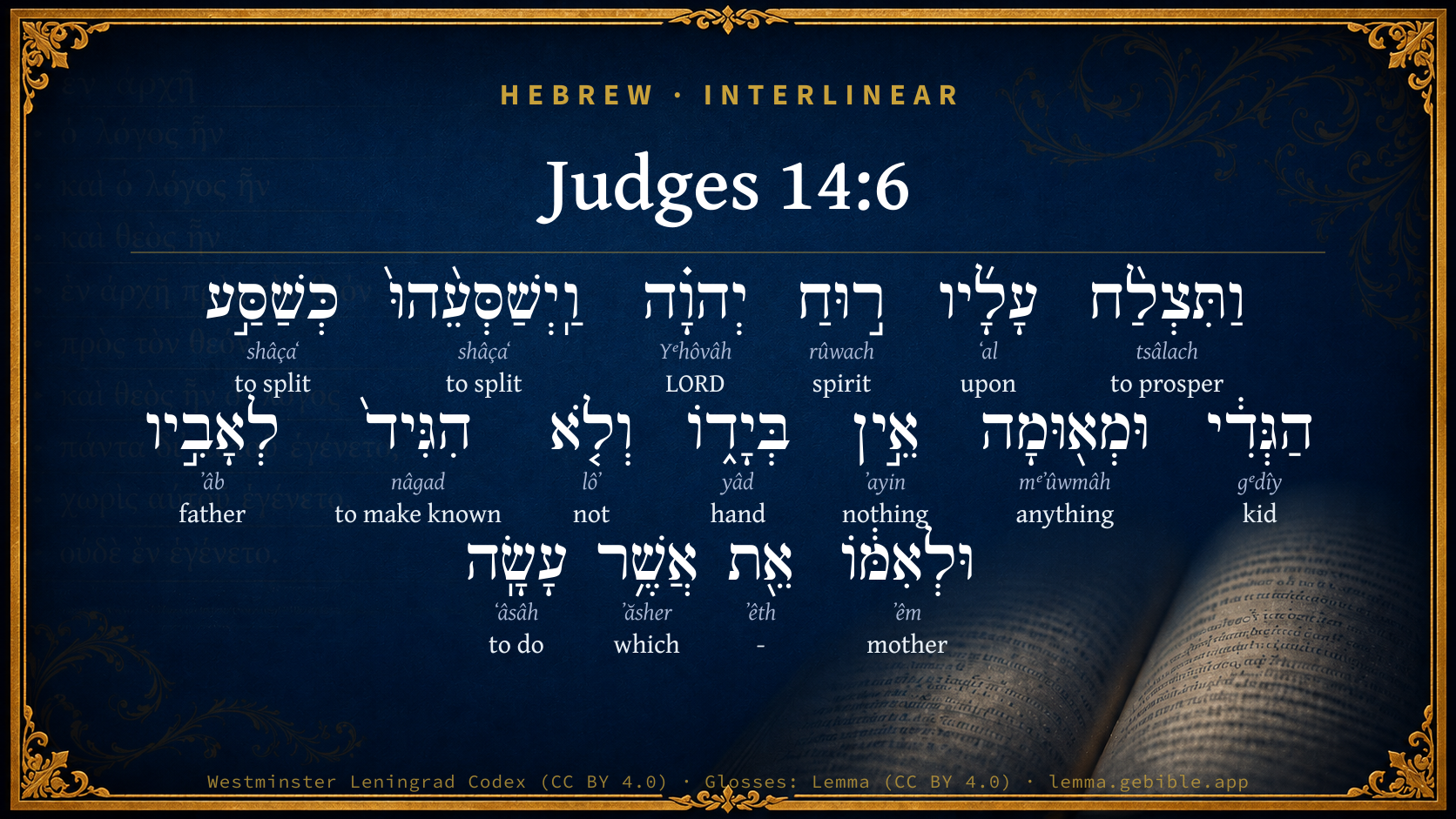
  1. וַתִּצְלַ֨ח tsâlach H6743 “and · to prosper” Conjunction + Verb, Qal, Sequential Imperfect, 3rd Person, Feminine, Singular
  2. עָלָ֜יו ʻal H5921 “upon · him” Preposition + Suffix, Personal, 3rd Person, Masculine, Singular
  3. ר֣וּחַ rûwach H7307 “spirit of” Noun, Common, Both, Singular, Construct
  4. יְהוָ֗ה Yᵉhôvâh H3068 “LORD” Noun, Proper
  5. כְּשַׁסַּ֣ע shâçaʻ H8156 “like/as · to split” Preposition + Verb, Piel, Infinitive Construct
  6. הַגְּדִ֔י gᵉdîy H1423 “the · kid” Particle, Definite Article + Noun, Common, Masculine, Singular, Absolute
  7. וּמְא֖וּמָה mᵉʼûwmâh H3972 “and · anything” Conjunction + Noun, Common, Feminine, Singular, Absolute
  8. אֵ֣ין ʼayin H369 “nothing” Particle, Negative
  9. בְּיָד֑וֹ yâd H3027 “in/at · hand · his” Preposition + Noun, Common, Both, Singular, Construct + Suffix, Personal, 3rd Person, Masculine, Singular
  10. וְלֹ֤א lôʼ H3808 “and · not” Conjunction + Particle, Negative
  11. הִגִּיד֙ nâgad H5046 “to make known” Verb, Hiphil, Perfect, 3rd Person, Masculine, Singular
  12. לְאָבִ֣יו ʼâb H1 “to/for · father · his” Preposition + Noun, Common, Masculine, Singular, Construct + Suffix, Personal, 3rd Person, Masculine, Singular
  13. וּלְאִמּ֔וֹ ʼêm H517 “and · to/for · mother · his” Conjunction + Preposition + Noun, Common, Feminine, Singular, Construct + Suffix, Personal, 3rd Person, Masculine, Singular
  14. אֵ֖ת ʼêth H853 “-” Particle, Direct Object
  15. אֲשֶׁ֥ר ʼăsher H834 “which” Particle, Relative
  16. עָשָֽׂה ʻâsâh H6213 “to do” Verb, Qal, Perfect, 3rd Person, Masculine, Singular

About this verse

These counts appear in no published source. They are computed here, from the morphology-tagged text and Lemma’s own curated glosses. What Lemma adds →

17
words
16
distinct lemmas
Historical
section

Notable vocabulary

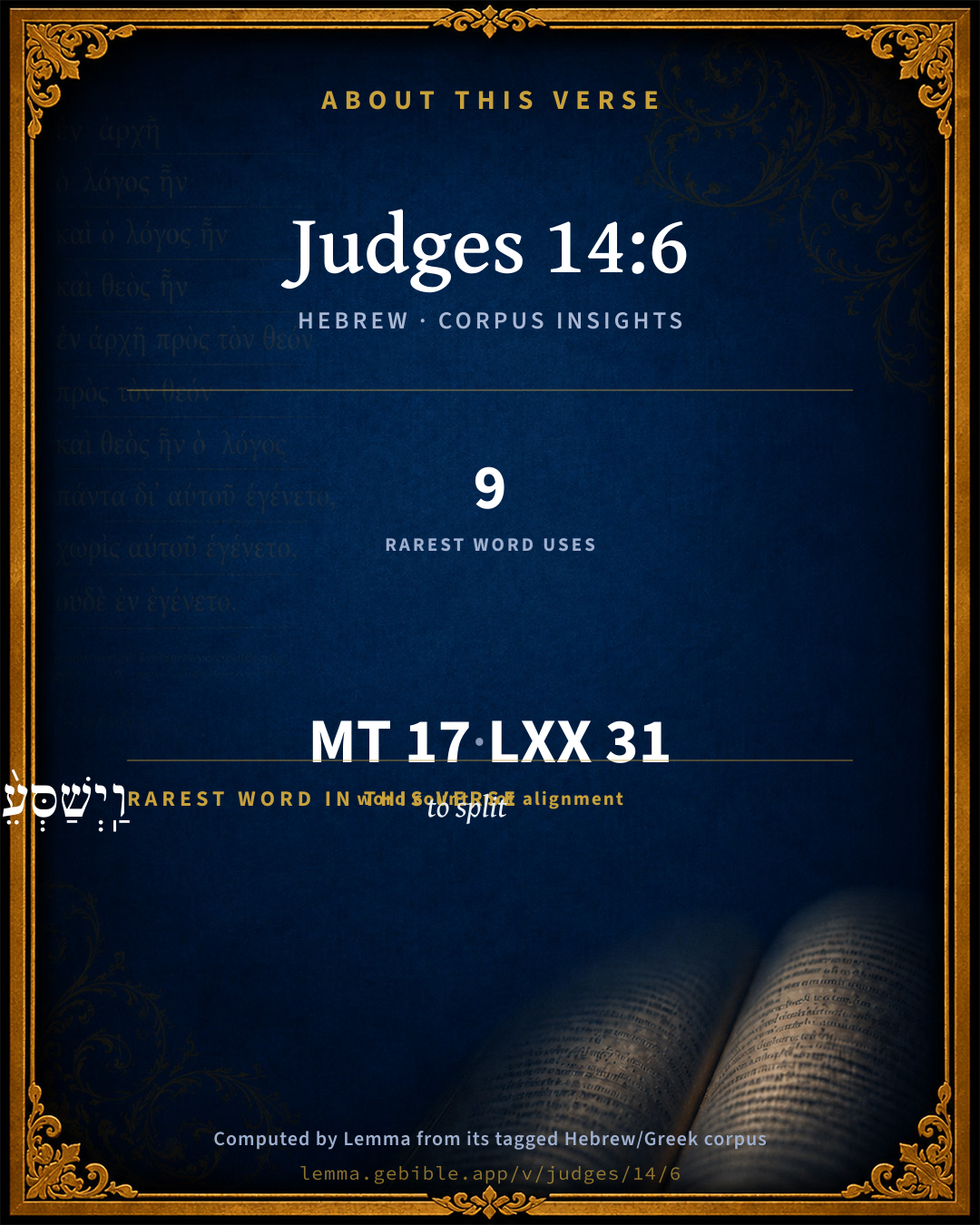
The rarest word here is וַֽיְשַׁסְּעֵ֨הוּ֙ to split H8156 — appearing just 9 times in the whole Hebrew Bible.

Shared distinctive vocabulary

וַֽיְשַׁסְּעֵ֨הוּ֙ to split H8156 occurs in 8 verses of the Hebrew Bible. Also found in:

Grammatical profile

  • 5 verbs
  • 7 nouns
  • 1 preposition
  • 4 particles

Verb forms

  • וַתִּצְלַ֨ח Qal · Sequential Imperfect
  • וַֽיְשַׁסְּעֵ֨הוּ֙ Piel · Sequential Imperfect
  • כְּשַׁסַּ֣ע Piel · Infinitive Construct
  • הִגִּיד֙ Hiphil · Perfect
  • עָשָֽׂה Qal · Perfect

Repetition

A word recurs within this verse — often emphatic in Hebrew:

  • וַֽיְשַׁסְּעֵ֨הוּ֙ to split H8156 ×2

Hebrew & Septuagint length

In English translation the verse runs 39 words from the Hebrew and 44 from the Septuagint (LXX English) — closely comparable.

A rough comparison of the two English renderings, which tokenize alike — not a word-level alignment.

Word counts can differ between the Hebrew and the Greek without any difference in meaning — e.g. the Hebrew direct-object marker אֵת has no separate Greek word, and Greek often adds the article ὁ.

In the original languages it is 17 Hebrew tokens and 31 Greek tokens — but the two are counted differently (Hebrew bundles its prefixes and suffixes into one token; the Greek is in lemma form), so that isn’t a like-for-like length.

Cross-references

13

Topical passages linked to Judges 14:6 in the Treasury of Scripture Knowledge — connected by theme and wording, ordered by reader-vote popularity; previews shown in the World English Bible.

  • Judges 3:10 The Spirit of Yahweh came on him, and he judged Israel; and he went out to war, and Yahweh delivered Cushan Rishathaim king of Mesopotamia into his hand: and his hand prevailed against Cushan Rishathaim.
  • Zechariah 4:6 Then he answered and spoke to me, saying, "This is the word of Yahweh to Zerubbabel, saying, 'Not by might, nor by power, but by my Spirit,' says Yahweh of Hosts.
  • Judges 13:25 The Spirit of Yahweh began to move him in Mahaneh-dan, between Zorah and Eshtaol.
  • 1 Samuel 11:6 The Spirit of God came mightily on Saul when he heard those words, and his anger was kindled greatly.
  • 1 Samuel 17:34–37 David said to Saul, Your servant was keeping his father's sheep; and when there came a lion, or a bear, and took a lamb out of the flock,
  • 1 Samuel 17:46 This day will Yahweh deliver you into my hand; and I will strike you, and take your head from off you; and I will give the dead bodies of the host of the Philistines this day to the birds of the sky, and to the wild animals of the earth; that all the earth may know that there is a God in Israel,
  • Isaiah 42:2 He will not cry, nor lift up his voice, nor cause it to be heard in the street.
  • 1 John 3:8 He who sins is of the devil, for the devil has been sinning from the beginning. To this end the Son of God was revealed, that he might destroy the works of the devil.
  • Judges 15:8 He struck them hip and thigh with a great slaughter: and he went down and lived in the cleft of the rock of Etam.
  • Judges 15:15 He found a fresh jawbone of a donkey, and put forth his hand, and took it, and struck a thousand men therewith.
  • Judges 16:30 Samson said, Let me die with the Philistines. He bowed himself with all his might; and the house fell on the lords, and on all the people who were therein. So the dead that he killed at his death were more than those who he killed in his life.
  • Matthew 11:29 Take my yoke upon you, and learn from me, for I am gentle and lowly in heart; and you will find rest for your souls.
  • Judges 11:29 Then the Spirit of Yahweh came on Jephthah, and he passed over Gilead and Manasseh, and passed over Mizpeh of Gilead, and from Mizpeh of Gilead he passed over to the children of Ammon.

Cross-references courtesy of OpenBible.info (CC BY 4.0).

Hebrew and Greek witnesses Masoretic Hebrew ↔ Greek Septuagint

The same verse in the two great witnesses to the Old Testament, shown verse-for-verse.

These are two independent witnesses, not word-aligned to each other, and the Septuagint is shown in lemma (dictionary) form.

Hebrew Judges 14:6 Masoretic · Westminster Leningrad Codex

וַתִּצְלַ֨ח עָלָ֜יו ר֣וּחַ יְהוָ֗ה וַֽיְשַׁסְּעֵ֨הוּ֙ כְּשַׁסַּ֣ע הַגְּדִ֔י וּמְא֖וּמָה אֵ֣ין בְּיָד֑וֹ וְלֹ֤א הִגִּיד֙ לְאָבִ֣יו וּלְאִמּ֔וֹ אֵ֖ת אֲשֶׁ֥ר עָשָֽׂה

The Spirit of Yahweh came mightily on him, and he tore him as he would have torn a kid; and he had nothing in his hand: but he didn't tell his father or his mother what he had done.

World English Bible · Public Domain

Greek LXX Judges 14:6 Septuagint · lemma form

καί ἅλλομαι ἐπί αὐτός πνεῦμα κύριος καί συντρίβω αὐτός ὡσεί συντρίβω ἔριφος καί οὐδείς εἰμί ἐν ὁ χείρ αὐτός καί οὐ ἀποἀγγέλλω ὁ πατήρ αὐτός καί ὁ μήτηρ αὐτός ὅς ποιέω

And the spirit of the Lord came powerfully upon him, and he crushed him as he would have crushed a kid of the goats, and there was nothing in his hands: and he told not his father and his mother what he had done.

LXX2012 (modern English Septuagint) · Public Domain

On this verse, Ellicott's Commentary for English Readers discusses the Septuagint’s reading. Read the note in Commentary ↓

Hebrew: Westminster Leningrad Codex (CC BY 4.0). Greek: Septuagint (public domain); English from LXX2012 (modern English Septuagint) (Public Domain). How the Septuagint differs from the Hebrew →

Targum (Aramaic paraphrase)

1

The Targum is the ancient Jewish Aramaic paraphrase of the Hebrew Scriptures — an interpretive translation, not the Hebrew text itself. Onkelos (literal) and Pseudo-Jonathan (expansive) render the Torah, and Jonathan the Prophets. Coverage is partial: where no permissively-licensed English translation exists for a verse, only the Aramaic is shown. This is verse-level text, not a word-by-word alignment to the Hebrew.

  1. Targum Jonathan Prophets (Joshua–Malachi)
    וּשְׁרַת עֲלוֹהִי רוּחַ גְבוּרָא מִן קֳדָם יְיָ וְהַדְמֵיהּ כְּמָא דִמְהַדְמִין גַדְיָא וּמִדַעַם לֵית בִּידֵיהּ וְלָא חַוִי לַאֲבוּהִי וּלְאִמֵיהּ יַת דַעֲבָד:

    (no public-domain English translation for this verse)

    Targum Jonathan — Aramaic: “Mikraot Gedolot” (public domain). English: “Sefaria Community Translation” (CC0 1.0 (public-domain dedication)); “London "Chaldee Paraphrase," 1871” (public domain). Text via Sefaria.

Commentary

Notes on Judges 14:6 from classic Christian and Jewish commentators (each source and its license shown beneath its notes). The classic Christian expositions comment on the surrounding passage and are grouped to its opening verse, so a note may address several verses; the Jewish commentaries on the Tanakh (Rashi and others) are per-verse, so they appear only where the commentator wrote on this verse.

Lemma curates 59 commentaries, every one of them public domain or Creative Commons licensed, each selected and text-cleaned for this edition rather than reprinted as found. About our sources →

Trapp's Complete Commentary

John Trapp

Jdg 14:6 And the Spirit of the LORD came mightily upon him, and he rent him as he would have rent a kid, and [he had] nothing in his hand: but he told not his father or his mother what he had done.

Ver. 6. And he rent him as he would have rent a kid.] So did the Lord Christ subdue the devil in the desert, {Mat 4:4; Mat 4:7; Mat 4:10-11} whereof David also was a type, when he slew the lion and the bear. {1Sa 17:36}

And he had nothing in his hand.] But so had Hercules, when he killed a lion and a bear, as the poets sing of him, and Lysimachus, one of Alexander’s worthies. Polydamus, Milo Crotonitates, and others are famous for their strength, but none comparable to Samson, the Church’s champion.

But he told not his father.] As some braggart would have done: this was his modesty. And it may be he feared to be chidden by his parents, for his rashness in this exploit.

John Trapp, A Commentary or Exposition upon All the Books of the Old and New Testament (1647–1656) — public domain. Text from a community e-Sword module.

Geneva Bible (1599)

Geneva Bible translators

Whereby he had strength and boldness.

Geneva Bible (1599) marginal notes — public domain. Text via Bolls.life.

Adam Clarke's Commentary

Verse 6. He rent him as he would have rent a kid] Now it is not intimated that he did this by his own natural strength, but by the Spirit of the Lord coming mightily upon him: so that his strength does not appear to be his own, nor to be at his command; his might was, by the will of God, attached to his hair and to his Nazarate.

Adam Clarke's Commentary on the Bible (1810–1826) — public domain. Text from a community e-Sword/MySword module.

Ellicott's Commentary for English Readers

(6) The Spirit of the Lord.—Implying here an access of courage and strength. The verb rendered “came mightily” literally means pervaded, as in Jdg_14:19, Jdg_15:14; 1Sa_10:10. (Comp. 1Sa_18:10—of the evil spirit rushing upon Saul; LXX., “leapt upon him;” Vulg., irruit.)

Rent him.—Josephus (with the intention of making his Greek readers think of Hercules and the Nemean lion) says “he throttled him.” Of course this was a most heroic exploit, but it is not unparalleled. Pausanias, in his Eliaca (ap. Suid. Lex. s.v Polydamas), related a feat of the athlete Polydamas, who in his youth slew, while unarmed, a great and strong lion in Olympus, B.C. 400. Cases are recorded in which Arabs have done the same. Similar acts of prowess are attributed to David (1Sa_17:54) and to Benaiah (2Sa_23:28).

He told not his father or his mother.—This reticence shows how free he was from all boastfulness.

A Bible Commentary for English Readers, edited by Charles John Ellicott (1878–1897) — public domain. Text from a community e-Sword module.

The Cambridge Bible for Schools and Colleges

gen. ed. J. J. S. Perowne

6. came mightily upon him] Cf. Jdg_14:19, Jdg_15:14, 1Sa_10:6; 1Sa_10:10; 1Sa_11:6; the expression denotes a sudden rush of superhuman power.

and he rent him … a kid] rent him as a man rends a kid; the verb only here and in Lev_1:17, where it is used of the ritual learing asunder of a fowl in burnt offering. The comparison as one rends a kid may refer to some ceremonial act, as Moore suggests, but we have no evidence of such a practice. Milton’s version, ‘Who tore the lion, as the lion tears the kid,’ Samson Agonistes, l. 128, gets over the difficulty by substituting ‘the lion’ for the indefinite subject (as one rends). The hero’s fight with a lion is a favourite theme in ancient mythology and folk-lore; e.g. the scene represented on early Bab. seals, above, p. 130; the reliefs from the palace of Ashurbanipal (A. Jeremias, l.c. 479); Herakles and the Nemean lion figured on Greek coins1[55]; the stories of David and of Benaiah (1Sa_17:34-36, 2Sa_23:20).

[55] Hill, Catal. of Gk. Coins in the Brit. Mus., Cyprus, Pl. xxv. 6–8; Lycaonia, etc., Pl. xvii. 5, xl. 12. Instances of this motif from ancient sources are collected by Stahn, Die Simson-Sage, 1908, pp. 32 ff.

but he told not etc.] The clause introduces some confusion, and may be an interpolation from Jdg_14:9.

The Cambridge Bible for Schools and Colleges (gen. ed. J. J. S. Perowne; Cambridge University Press, 1878–1918) — public domain. Text from a community e-Sword module.

John Gill's Exposition

And the Spirit of the Lord came mightily upon him,.... The Spirit of might from the Lord, as the Targum, inspiring him with courage and intrepidity of mind, and increasing his bodily strength:

and he rent him as he would rend a kid; as he came up to him to seize him, he laid hold on him and strangled him, as Josephus (b) says, caught him by the throat, and tore it out; for it does not seem that the carcass was torn to pieces, or limb from limb, by what follows; and this he did with as much ease as if he had had only a kid to deal with:

and he had nothing in his hand; not a staff to keep it off, nor a spear, sword, or knife to stab it with: in this Samson was a type of Christ, who has destroyed our adversary the devil, compared to a roaring lion, Pe1 5:8 to a lion for his strength, cruelty, and voraciousness; to a roaring lion, making a hideous noise and stir when the Gospel was carried unto the Gentiles, and they were about to be called and espoused to Christ; from among whom he was cast out, and by no other weapon than the ministration of the Gospel, accompanied with the power of Christ, and his Spirit:

but he told not his father or his mother what he had done; when he overtook them, as he quickly did, he said not a word to them of his meeting with a lion and slaying it; which, as it showed his modesty in not blazing abroad his wonderful and heroic actions, in which also he was a type of Christ, but his great prudence in concealing this, lest his great strength should be known too soon, and the Philistines be upon their guard against him, or seek to dispatch him privately; though no doubt he had pondered this in his own mind, and considered it as an omen and presage of the advantage he should have over the Philistines his enemies, whom he should as easily overcome as he had that lion, and that without any instrument of war.

(b) Antiqu l. 5. c. 8. sect. 5.

John Gill's Exposition of the Whole Bible (1746–1763) — public domain (CC PDM 1.0). Text via the HelloAO Bible API.

Haydock's Catholic Bible Commentary

Spirit, increasing his courage and strength. (Menochius) --- This shews that the strength of Samson was miraculous, attached to the keeping of his hair, and the observance of the duties of the Nazarites. (Calmet) (Chap. xvi. 19.) --- Mother. The modesty which he displays is more wonderful than the feat of valour. (Haydock) --- Brave men are never boasters. (Menochius) --- He kept what he had done secret, designing to propose a riddle. (Salien)

George Leo Haydock (1774–1849), Haydock's Catholic Family Bible and Commentary, 1859 edition — public domain. Excludes Psalms (Douay-Rheims chapter numbering differs from Protestant) and Deuterocanonical books (Catholic canon only).

Matthew Poole's English Annotations

Came mightily upon him; stirred up and increased his courage and bodily strength.

As he would have rent a kid; as soon and as safely.

He told not his father or his mother, lest by their means it should be publicly known; for he wisely considered that it was not yet a fit time to awaken the jealousies and fears of the Philistines concerning him, as this would have done.

Matthew Poole's English Annotations on the Holy Bible (1683–1685) — public domain. Text from a community e-Sword/MySword module.

Whedon's Commentary on the Bible

Daniel D. Whedon

6. Spirit of the Lord came mightily upon him — A remarkable supernatural quickening and strengthening of his physical powers, which enabled him to perform a feat beyond the measure of his ordinary strength. Observe that here the expression does not imply any great sanctity or moral purity in Samson, and is therefore not to be confounded with the New Testament gift of the Holy Ghost.

Daniel D. Whedon (gen. ed.), Commentary on the Old and New Testaments (1874–1909) — public domain. Text from a community e-Sword module.

The Pulpit Commentary

The Spirit of the Lord, etc. as a spirit of dauntless courage and irresistible strength of body. Came mightily. Hebrew, fell upon him, or passed over upon him, as in ver. 19; Jud_1:15:14 1Sa_10:6, 10 18:10, etc. He rent him, etc. He "had nothing in his hand," no weapon or knife, nor even a stick; but he rent him with as much ease as the kid is rent. The Hebrew has the kid, with the definite article, which is not prefixed unless some particular kid is meant, as in Gen_38:23. Perhaps the kid means the one about to be served, which the cook rends open either before or after it is cooked. Unless some such operation is alluded to, it is not easy to understand what the rending of the kid means. He told not his father, etc. This is mentioned to. explain ver. 16; but it shows that Samson had wandered some distance from his parents among the vineyards (see note to ver. 5).

The mystery of spiritual might.

"And he had nothing in his hand." This is typical of the Christian. Christ"s injunctions to the seventy. In Samson"s case it was probably due to the regulation imposed by the Philistines upon a conquered people. Christians are commanded not to put their trust in earthly equipment or the arm of flesh.

I THAT OUR CONFLICTS WITH SATAN MAY BE TRUE SPIRITUAL EXERCISES AND NOT MERELY OUTWARD TRIUMPHS.

II THE INFLUX AND WITHDRAWAL OF THE HOLY SPIRIT LIMIT THE AUTHORITY AND SECURE THE HUMILITY OF THE AGENT. HOW helpless even a Samson but for the Spirit! Temptations of our own seeking may be left to our own resources. No enterprise ought to be undertaken without the aid of the Holy Spirit, and the Divine blessing. What God brings upon us he will help us to overcome.

III THE FAITH OF THE CHRISTIAN SOLDIER AND WORKER MUST BE WHOLLY IN GOD. M.

The Pulpit Commentary (1880–1919), ed. H.D.M. Spence-Jones & Joseph S. Exell — public domain. Text from a community e-Sword module.

John Wesley's Explanatory Notes

Came mightily - Increased his courage and bodily strength. A kid - As soon and as safely. Told not, &c. - Lest by their means it should be publickly known; for he wisely considered, that it was not yet a fit time to awaken the jealousies and fears of the Philistines concerning him, as this would have done.

John Wesley, Explanatory Notes Upon the Whole Bible (1754–1765) — public domain. Text via the GEBible commentary corpus.

Lesson kit

Teaching starters — assembled from the data on this page, not authored interpretation. Every prompt links to the verse data it draws on. Edit before teaching.

Judges, in the Historical, opens this verse with 17 words (16 distinct Hebrew lemmas). Its most distinctive word is shâçaʻ (“to split”). A historical commentator’s framing appears above. Read the whole chapter for the surrounding context.

Discussion questions

  1. How does “to split” (shâçaʻ) shape what this verse is saying?
  2. How does Leviticus 1:17, which shares the word «to split», read alongside this verse?
  3. What does the repetition of “to split” (2× in this one verse) do in this verse?
  4. The translations on this page render this verse differently — a whole-verse word diff, not a word-by-word alignment. What might account for the different wordings?
  5. «וַתִּצְלַ֨ח» is a Qal Sequential Imperfect verb. How does that grammatical form shape the action described?
  6. Compare how Trapp's Complete Commentary and Geneva Bible (1599) read this verse. Where do they agree or differ?

Things to notice

Reading settings

Reading text

Shown beneath each verse's original-language words.

Old Testament
Old Testament edition

Read the OT as the Masoretic Hebrew (MT) or the Greek Septuagint (LXX).

English shown for the Greek Septuagint (in the Hebrew ↔ Greek comparison).

Comparing translations? Open the Compare panel on any verse page to stack up to four side by side.