
Numbers 5:13

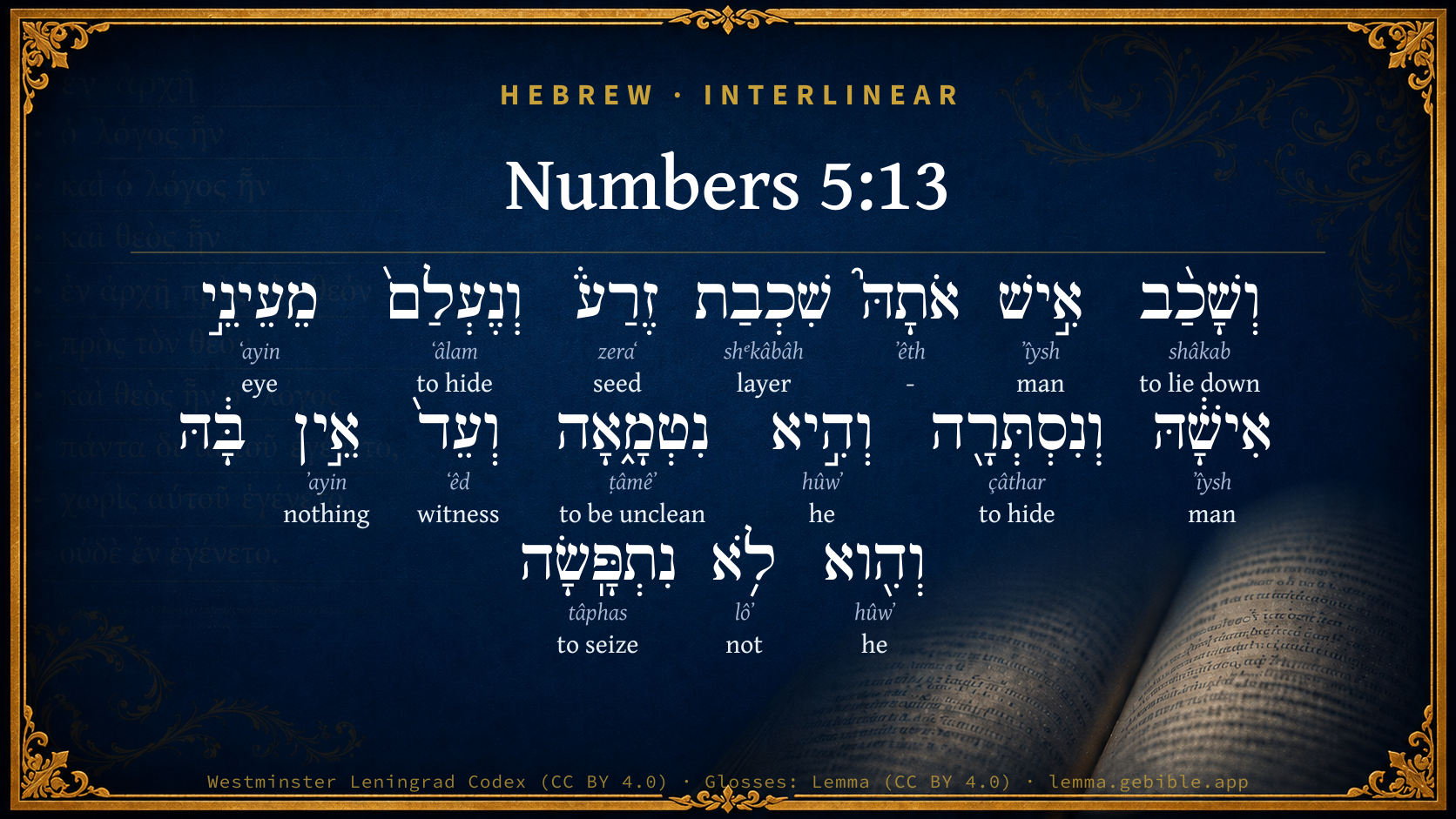
Hebrew (Westminster Leningrad Codex) Numbers 5:13 appears in the Hebrew Old Testament. The text above is from the Westminster Leningrad Codex. Each word links to its Strong’s number, a concise gloss, and parsing drawn from the Open Scriptures Hebrew Bible morphology. Click any word for its full Brown-Driver-Briggs (BDB) entry.
Download image
Cite this verse

Numbers 5:13 (World English Bible). Public Domain. Lemma interlinear Bible study tool, https://lemma.gebible.app/v/numbers/5/13.

Show BibTeX & RIS
BibTeX
RIS
English Translation
and a man lies with her carnally, and it is hidden from the eyes of her husband, and is kept close, and she is defiled, and there is no witness against her, and she isn't taken in the act;
World English Bible · Public Domain
Download a study sheet

One document with this verse’s original text, its word-by-word gloss line, the meaning frame, cross-references with their text, attributed commentary, and full source and license credits — printable, and it pastes into notes with its structure intact.

This verse Autodidact and up

Study sheet (.html) Plain text (.txt)

A passage Seminary Student

Up to 50 verses in one chapter. A passage sheet keeps up to 6 commentary sources and 12 cross-references per verse, in the order this page ranks them, and says so on the sheet whenever that leaves anything out. Ask for a single verse and you get the Autodidact verse sheet above.

Everything on this page stays free to read, with no account — the sheet is a download of what is already on screen, not access to it.

Want to remove ads? Support Godless Engineer
Compare translations 3

The same verse in 3 English versions, stacked beneath the original-language interlinear above. Click any original word for its lexicon entry.

Each is an independent rendering of the whole verse — the interlinear is not word-aligned to these translations.

Highlighted words mark where these versions differ — a whole-verse word diff, not a word-by-word alignment.

  • World English Bible Public Domain
    and a man lies with her carnally, and it is hidden from the eyes of her husband, and is kept close, and she is defiled, and there is no witness against her, and she isn't taken in the act;
  • King James Version Public Domain
    And a man lie with her carnally, and it be hid from the eyes of her husband, and be kept close, and she be defiled, and there be no witness against her, neither she be taken with the manner;
  • unfoldingWord Literal Text CC BY-SA 4.0
    and a man lies with her the lying of seed, and it is concealed from the eyes of her husband, and it is hidden, and she, she is made unclean, but there is no witness against her, and she, she has not been caught,

unfoldingWord Literal Text — © unfoldingWord, licensed CC BY-SA 4.0. Word-aligned USFM3 via Door43 (git.door43.org/unfoldingWord/en_ult).

Versions to compare (up to 4)

3 of 4 selected

Show all 18 translations

Every available English version of this verse, each an independent rendering of the whole verse.

  • World English Bible Public Domain
    and a man lies with her carnally, and it is hidden from the eyes of her husband, and is kept close, and she is defiled, and there is no witness against her, and she isn't taken in the act;
  • Berean Standard Bible Public Domain
    by sleeping with another man, and it is concealed from her husband and her impurity is undetected (since there is no witness against her and she was not caught in the act),
  • Majority Standard Bible Public Domain
    by sleeping with another man, and it is concealed from her husband and her impurity is undetected (since there is no witness against her and she was not caught in the act),
  • King James Version Public Domain
    And a man lie with her carnally, and it be hid from the eyes of her husband, and be kept close, and she be defiled, and there be no witness against her, neither she be taken with the manner;
  • American Standard Version (1901) Public Domain
    and a man lie with her carnally, and it be hid from the eyes of her husband, and be kept close, and she be defiled, and there be no witness against her, and she be not taken in the act;
  • Revised Version (1885) Public Domain
    and a man lie with her carnally, and it be hid from the eyes of her husband, and be kept close, and she be defiled, and there be no witness against her, neither she be taken in the act;
  • Geneva Bible (1599) Public Domain
    So that an other man lie with her fleshly, and it bee hid from the eyes of her husband, and kept close, and yet she be defiled, and there be no witnesse against her, neither she taken with the maner,
  • Douay-Rheims (1899) Public Domain
    Shall have slept with another man, and her husband cannot discover it, but the adultery is secret, and cannot be proved by witnesses, because she was not found in the adultery:
  • Young's Literal Translation Public Domain
    and a man hath lain with her `with' the seed of copulation, and it hath been hid from the eyes of her husband, and concealed, and she hath been defiled, and there is no witness against her, and she hath not been caught,
  • Literal Standard Version CC BY-SA 4.0
    and a man has lain with her [with] the seed [from] intercourse, and it has been hid from the eyes of her husband, and concealed, and she has been defiled, and there is no witness against her, and she has not been caught,
  • Unlocked Literal Bible CC BY-SA 4.0
    Then suppose that another man sleeps with her. In that case, she is defiled. Even if her husband does not see it or know about it, and even if no one catches her in the act and there is no one to testify against her,
  • unfoldingWord Literal Text CC BY-SA 4.0
    and a man lies with her the lying of seed, and it is concealed from the eyes of her husband, and it is hidden, and she, she is made unclean, but there is no witness against her, and she, she has not been caught,
  • Darby Bible Public Domain
    and a man lie with her carnally, and it be hid from the eyes of her husband, and she be defiled in secret, and there be no witness against her, and she have not been caught;
  • World Messianic Bible Public Domain
    and a man lies with her carnally, and it is hidden from the eyes of her husband and this is kept concealed, and she is defiled, there is no witness against her, and she isn’t taken in the act;
  • Webster's Bible Public Domain
    And a man shall lie with her carnally, and it shall be hid from the eyes of her husband, and be kept close, and she be defiled, and there be no witness against her, neither she be taken with the manner;
  • Free Bible Version CC BY-SA 4.0
    by sleeping with someone else. It may be that her husband doesn't find out and her unclean act wasn't witnessed—she wasn't caught out.
  • Bible in Basic English Public Domain
    By taking as her lover another man, and keeps it secret so that her husband has no knowledge of it, and there is no witness against her, and she is not taken in the act;
  • JPS Tanakh (1917) Public Domain
    and a man lie with her carnally, and it be hid from the eyes of her husband, she being defiled secretly, and there be no witness against her, neither she be taken in the act;

Literal Standard Version (2020), Covenant Press — licensed CC BY-SA 4.0. Text via the HelloAO Bible API (eBible.org). Unlocked Literal Bible (unfoldingWord) — licensed CC BY-SA 4.0. Text via the HelloAO Bible API (eBible.org). unfoldingWord Literal Text — © unfoldingWord, licensed CC BY-SA 4.0. Word-aligned USFM3 via Door43 (git.door43.org/unfoldingWord/en_ult). Free Bible Version, Dr. Jonathan Gallagher — licensed CC BY-SA 4.0. Text via the HelloAO Bible API (eBible.org).

Word by word

More ways to search: Search by grammar → Find every occurrence → Compare this word →

Practice this passage: Drill this verse → Learn its vocabulary →

שִׁכְבַת
shᵉkâbâh
H7902
“layer of”
Noun, Common, Feminine, Singular, Construct
Part of Speech
Noun
Type
Common
Gender
Feminine
Number
Singular
State
Construct
Full BDB Definition

Origin: from H7901

TWOT: 2381a

act of lying, layer, coating - act of lying (of sexual relations) - layer
  1. וְשָׁכַ֨ב shâkab H7901 “and · to lie down” Conjunction + Verb, Qal, Sequential Perfect, 3rd Person, Masculine, Singular
  2. אִ֣ישׁ ʼîysh H376 “man” Noun, Common, Masculine, Singular, Absolute
  3. אֹתָהּ֮ ʼêth H853 “- · her” Particle, Direct Object + Suffix, Personal, 3rd Person, Feminine, Singular
  4. זֶרַע֒ zeraʻ H2233 “seed” Noun, Common, Masculine, Singular, Absolute
  5. וְנֶעְלַם֙ ʻâlam H5956 “and · to hide” Conjunction + Verb, Niphal, Sequential Perfect, 3rd Person, Masculine, Singular
  6. מֵעֵינֵ֣י ʻayin H5869 “from · eyes of” Preposition + Noun, Common, Both, Dual, Construct
  7. אִישָׁ֔הּ ʼîysh H376 “man · her” Noun, Common, Masculine, Singular, Construct + Suffix, Personal, 3rd Person, Feminine, Singular
  8. וְנִסְתְּרָ֖ה çâthar H5641 “and · to hide” Conjunction + Verb, Niphal, Sequential Perfect, 3rd Person, Feminine, Singular
  9. וְהִ֣יא hûwʼ H1931 “and · he” Conjunction + Pronoun, Personal, 3rd Person, Feminine, Singular
  10. נִטְמָ֑אָה ṭâmêʼ H2930 “to be unclean” Verb, Niphal, Perfect, 3rd Person, Feminine, Singular
  11. וְעֵד֙ ʻêd H5707 “and · witness” Conjunction + Noun, Common, Masculine, Singular, Absolute
  12. אֵ֣ין ʼayin H369 “nothing” Particle, Negative
  13. וְהִ֖וא hûwʼ H1931 “and · he” Conjunction + Pronoun, Personal, 3rd Person, Feminine, Singular
  14. לֹ֥א lôʼ H3808 “not” Particle, Negative
  15. נִתְפָּֽשָׂה tâphas H8610 “to seize” Verb, Niphal, Perfect, 3rd Person, Feminine, Singular

About this verse

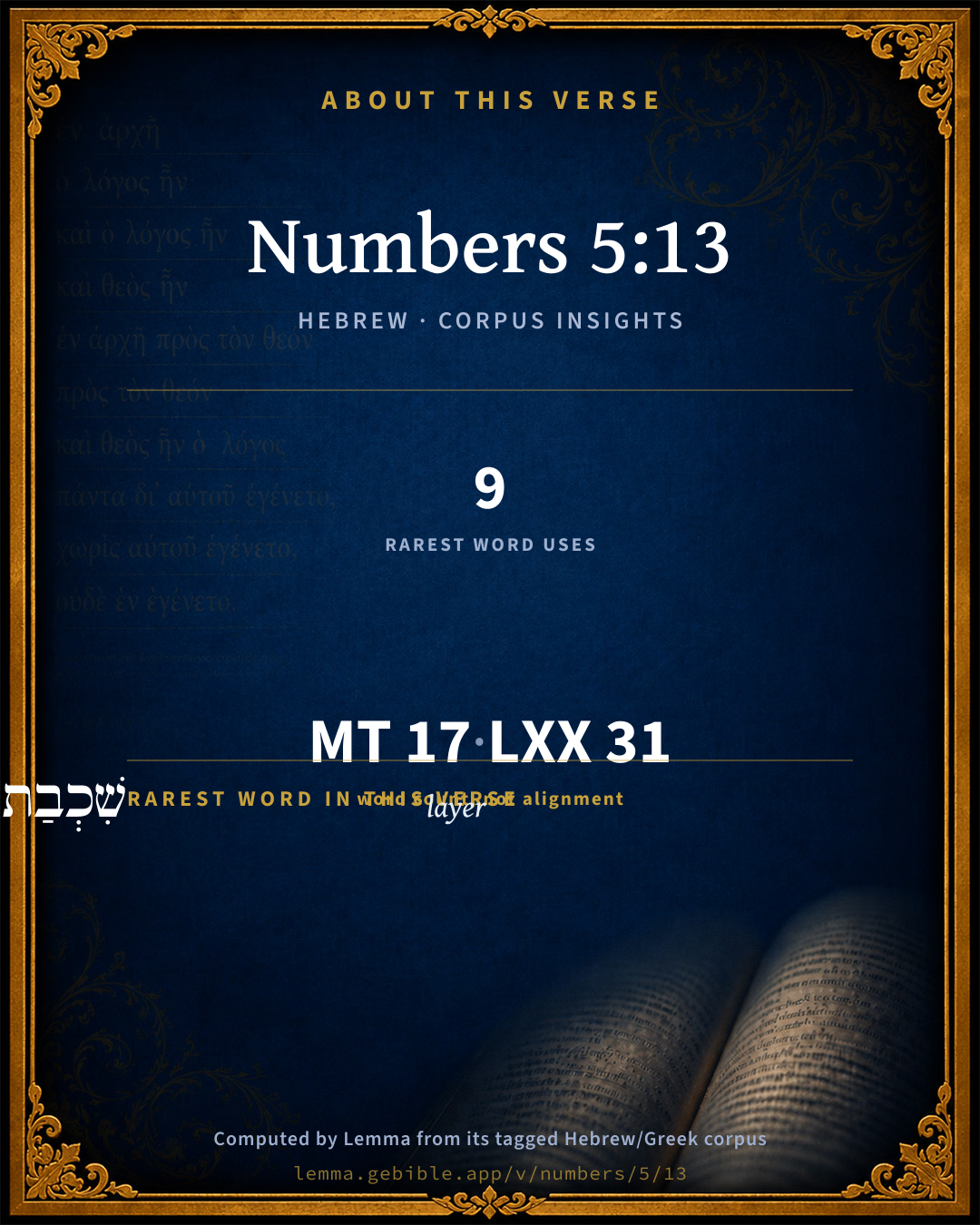
These counts appear in no published source. They are computed here, from the morphology-tagged text and Lemma’s own curated glosses. What Lemma adds →

17
words
14
distinct lemmas
Pentateuch
section

Notable vocabulary

The rarest word here is שִׁכְבַת layer H7902 — appearing just 9 times in the whole Hebrew Bible.

Shared distinctive vocabulary

שִׁכְבַת layer H7902 occurs in 9 verses of the Hebrew Bible. Also found in:

Grammatical profile

  • 5 verbs
  • 6 nouns
  • 2 pronouns
  • 1 preposition
  • 3 particles

Verb forms

  • וְשָׁכַ֨ב Qal · Sequential Perfect
  • וְנֶעְלַם֙ Niphal · Sequential Perfect
  • וְנִסְתְּרָ֖ה Niphal · Sequential Perfect
  • נִטְמָ֑אָה Niphal · Perfect
  • נִתְפָּֽשָׂה Niphal · Perfect

Repetition

Words recur within this verse — often emphatic in Hebrew:

  • אִ֣ישׁ man H376 ×2
  • וְהִ֣יא he H1931 ×2

Hebrew & Septuagint length

In English translation the verse runs 39 words from the Hebrew and 43 from the Septuagint (LXX English) — closely comparable.

A rough comparison of the two English renderings, which tokenize alike — not a word-level alignment.

Word counts can differ between the Hebrew and the Greek without any difference in meaning — e.g. the Hebrew direct-object marker אֵת has no separate Greek word, and Greek often adds the article ὁ.

In the original languages it is 17 Hebrew tokens and 31 Greek tokens — but the two are counted differently (Hebrew bundles its prefixes and suffixes into one token; the Greek is in lemma form), so that isn’t a like-for-like length.

Cross-references

4

Topical passages linked to Numbers 5:13 in the Treasury of Scripture Knowledge — connected by theme and wording, ordered by reader-vote popularity; previews shown in the World English Bible.

  • Leviticus 18:20 "'You shall not lie carnally with your neighbor's wife, and defile yourself with her.
  • Leviticus 20:10 "'The man who commits adultery with another man's wife, even he who commits adultery with his neighbor's wife, the adulterer and the adulteress shall surely be put to death.
  • Proverbs 7:18–19 Come, let's take our fill of loving until the morning. Let's solace ourselves with loving.
  • Proverbs 30:20 So is the way of an adulterous woman: She eats and wipes her mouth, And says, 'I have done nothing wrong.'

Cross-references courtesy of OpenBible.info (CC BY 4.0).

Hebrew and Greek witnesses Masoretic Hebrew ↔ Greek Septuagint

The same verse in the two great witnesses to the Old Testament, shown verse-for-verse.

These are two independent witnesses, not word-aligned to each other, and the Septuagint is shown in lemma (dictionary) form.

Hebrew Numbers 5:13 Masoretic · Westminster Leningrad Codex

וְשָׁכַ֨ב אִ֣ישׁ אֹתָהּ֮ שִׁכְבַת זֶרַע֒ וְנֶעְלַם֙ מֵעֵינֵ֣י אִישָׁ֔הּ וְנִסְתְּרָ֖ה וְהִ֣יא נִטְמָ֑אָה וְעֵד֙ אֵ֣ין בָּ֔הּ וְהִ֖וא לֹ֥א נִתְפָּֽשָׂה

and a man lies with her carnally, and it is hidden from the eyes of her husband, and is kept close, and she is defiled, and there is no witness against her, and she isn't taken in the act;

World English Bible · Public Domain

Greek LXX Numbers 5:13 Septuagint · lemma form

καί κοιμάω τις μετά αὐτός κοίτη σπέρμα καί λανθάνω ἐκ ὀφθαλμός ὁ ἀνήρ αὐτός καί κρύπτω αὐτός δέ εἰμί μιαίνω καί μάρτυς μή εἰμί μετά αὐτός καί αὐτός μή εἰμί συνλαμβάνω

and supposing any one shall lie with her carnally, and the thing shall be hid from the eyes of her husband, and she should conceal it and be herself defiled, and there be no witness with her, and she should not be taken;

LXX2012 (modern English Septuagint) · Public Domain

On this verse, The Pulpit Commentary discusses the Septuagint’s reading. Read the note in Commentary ↓

Hebrew: Westminster Leningrad Codex (CC BY 4.0). Greek: Septuagint (public domain); English from LXX2012 (modern English Septuagint) (Public Domain). How the Septuagint differs from the Hebrew →

Targum (Aramaic paraphrase)

2

The Targum is the ancient Jewish Aramaic paraphrase of the Hebrew Scriptures — an interpretive translation, not the Hebrew text itself. Onkelos (literal) and Pseudo-Jonathan (expansive) render the Torah, and Jonathan the Prophets. Coverage is partial: where no permissively-licensed English translation exists for a verse, only the Aramaic is shown. This is verse-level text, not a word-by-word alignment to the Hebrew.

  1. Targum Onkelos Torah (Genesis–Deuteronomy)
    וְיִשְׁכֻּב גְבַר יָתַהּ שָׁכְבַת זַרְעָא וִיהֵי מְכַסָא מֵעֵינֵי בַעְלַהּ וּמִטַמְרָא וְהִיא מְסָאֲבָא וְסָהִיד לֵית בַּהּ וְהִיא לָא אִתַּחָדַת

    (no public-domain English translation for this verse)

    Targum Onkelos — Aramaic: “Onkelos Genesis” (public domain); “Onkelos Exodus” (public domain); “Onkelos Leviticus” (public domain); “Onkelos Numbers” (public domain); “Onkelos Deuteronomy” (public domain). English: “Sefaria Community Translation” (CC0 1.0 (public-domain dedication)); “J.W. Etheridge. The Targums of Onkelos and Jonathan Ben Uzziel on the Pentateuch. London: Longmans, Green, 1862” (public domain). Text via Sefaria.

  2. Targum Pseudo-Jonathan Torah (Genesis–Deuteronomy)
    וִישַׁמֵשׁ גְבַר חוֹרָן עִמָהּ תַּשְׁמִישׁ דְעָרִיס וִיהֵי מְכַסֵי מֵעֵינֵי בַּעֲלָהּ וּמִטַמְרָא וְהִיא מְסָאֲבָא וְסַהֲדוּ בְּרִיר לֵית דְמַסְהִיד בָּהּ וְהִיא לָא אִתְחָדָת

    and another man lie with her, and it be hidden from her husband's eyes, and be concealed, and she be contaminated: or, if the testimony be not clear which is witnessed against her, and she be not convicted;

    Targum Pseudo-Jonathan — Aramaic: “Targum Jonathan on Genesis” (public domain); “Targum Jonathan on Exodus” (public domain); “Targum Jonathan on Leviticus” (public domain); “Targum Jonathan on Numbers” (public domain); “Targum Jonathan on Deuteronomy” (public domain). English: “The Targum of Jonathan ben Uzziel, trans. J. W. Etheridge, London, 1862” (public domain). Text via Sefaria.

Commentary

Notes on Numbers 5:13 from classic Christian and Jewish commentators (each source and its license shown beneath its notes). The classic Christian expositions comment on the surrounding passage and are grouped to its opening verse, so a note may address several verses; the Jewish commentaries on the Tanakh (Rashi and others) are per-verse, so they appear only where the commentator wrote on this verse.

Lemma curates 59 commentaries, every one of them public domain or Creative Commons licensed, each selected and text-cleaned for this edition rather than reprinted as found. About our sources →

Trapp's Complete Commentary

John Trapp

Num 5:13 And a man lie with her carnally, and it be hid from the eyes of her husband, and be kept close, and she be defiled, and [there be] no witness against her, neither she be taken [with the manner];

Ver. 13. And it be hid from the eyes] As Pro 30:20. Such a privy whore was Livia, the wife of Augustus Caesar, who, though otherwise very observant of her husband, yet lived in adultery with Eudemus her physician: qui specie artis frequens secretis, saith Taeitus; who, under a show of curing her, corrupted her. So do the Jesuits many dames at this day; being, as one saith of them, Connubi sanctifugae, clam meretricitegae. The friars are said to send men whose wives are barren, in pilgrimage to St. Joyce the patroness of fruitfulness, and meanwhile to lie with their wives.

John Trapp, A Commentary or Exposition upon All the Books of the Old and New Testament (1647–1656) — public domain. Text from a community e-Sword module.

The Cambridge Bible for Schools and Colleges

gen. ed. J. J. S. Perowne

13. and be kept close &c.] and she be undetected, though she has defiled herself.

since she was not taken in the act] On the evidence of two witnesses at least (Deu_17:6; Deu_19:15) the woman and the man would be put to death (Lev_20:10 (P ), Deu_22:22); cf. Joh_8:4 f.

14b. The merest suspicion on the husband’s part might render her liable to the ordeal.

The Cambridge Bible for Schools and Colleges (gen. ed. J. J. S. Perowne; Cambridge University Press, 1878–1918) — public domain. Text from a community e-Sword module.

John Gill's Exposition

And a man lie with her carnally,.... That is, is suspected that he has so done, not that it is a clear case, for it follows:

and it be hid from the eyes of her husband, and be kept close; so that it is not known by her husband, nor by any other; "she hath hid herself", so Ainsworth, being in a private place with another man, though warned to the contrary by her husband:

and she be defiled, and there be no witness against her; of her being defiled, though there may be of her being in private with such a man:

neither she be taken with the manner; or in the act of uncleanness.

John Gill's Exposition of the Whole Bible (1746–1763) — public domain (CC PDM 1.0). Text via the HelloAO Bible API.

Matthew Poole's English Annotations

She utterly denying it, Pro 30:20, and none being able and willing to discover it; for if it was witnessed, she was to die for it, Lev 20:10; Deu 22:22.

Matthew Poole's English Annotations on the Holy Bible (1683–1685) — public domain. Text from a community e-Sword/MySword module.

The Pulpit Commentary

If it be laid. Or, "if he be hid." This verse is explanatory of the former. Taken with the manner. The latter words are not in the Hebrew. It means no doubt "taken in the act". (cf. Joh_8:4) Auth mh h suneilhmmenh , Septuagint.

The Pulpit Commentary (1880–1919), ed. H.D.M. Spence-Jones & Joseph S. Exell — public domain. Text from a community e-Sword module.

unfoldingWord translationNotes

Door43 World Missions Community

Then suppose that another man sleeps with her

"and another man sleeps with her." This sentence can be written as part of the previous sentence. This explains how she sinned against her husband. This is something that could possibly happen. Yahweh is telling Moses what to do if it does happen. (See: Hypothetical Situations)

she is defiled ... his wife is defiled ... his wife is not defiled

These phrases can be stated in active form. AT: "she has defiled herself ... his wife has defiled herself ... his wife has not defiled herself" (See: Active or Passive)

in the act

This refers to the act of adultery. The full meaning of this statement can be made explicit. AT: "in the act of adultery" or "sleeping with him" (See: Assumed Knowledge and Implicit Information)

a spirit of jealousy might still inform the husband

Here the word "spirit" refers to a person's attitude and emotions. His "jealously" is spoken of as if it were a person who spoke to him. AT: "the husband might feel jealous and become suspicious" (See: Metonymy and Personification)

a spirit of jealousy might falsely come on a man

Here the word "spirit" refers to a person's attitude and emotions. The idea of the spirit "coming on him" means that he began to have these jealous feelings. AT: "a man might feel jealous for no reason" (See: Metonymy and Idiom)

translationWords

had relations with

defile

know

testimony

spirit

jealous

unfoldingWord translationNotes — © Distant Shores Media and the Door43 World Missions Community, licensed CC BY-SA 4.0. Source: git.door43.org/Door43/en_tn.

Rashi

Rabbi Shlomo Yitzchaki (Rashi)

ושכב איש AND A MAN LIETH [WITH HER] — a man, thus excluding a minor and a being that does not come under the term איש (i. e., an animal) (Sifrei Bamidbar 7:2; Sotah 24a).

אתה שכבת זרע [AND A MAN LIETH] WITH HER CARNALLY — This implies: that only her sexual intercourse with another man makes her unfit for continuing in marital relation with her husband, but the fact that her sister had sexual intercourse with him does not make her unfit for such (Yevamot 95a) [as was once the case with two sisters who greatly resembled each other (Tanchuma 5:2:6)]

תעלם מעיני אשה AND IT BE HID FROM THE EYES OF HER HUSBAND — Since it speaks of the eyes of the husband, it excludes the case of a blind man (i.e., a blind man cannot subject his wife to the ordeal). On the other hand, it states: “if it be concealed from his eyes”; it follows therefore that if he sees her improper conduct and wilfully closes his eyes to it the waters cannot try her (i.e., she cannot be subjected to the ordeal) (Sifrei Bamidbar 7:3; Sotah 27a).

ונסתרה AND SHE WAS ASIDE SECRETLY with him such a period of time wherein there was a possibility for her to become defiled by intercourse (Sotah 4a).

ועד אין בה AND THERE BE NO WITNESS AGAINST HER — But if there was even only one witness against her who stated that she was defiled she did not drink the מים המאררים, but was henceforth forbidden to her husband (Sotah 2b).

ועד אין בה AND THERE WAS NO WITNESS AGAINST HER, as regards defilement, but there were witnesses regarding her meeting with the man privily.

ונתפשה [AND SHE WAS NOT] SEIZED — i.e. subjected to force (Sifrei Bamidbar 7:3). Similar is, (Deuteronomy 22:28) “And seizes her (ותפשה) and lieth with her”.

Rashi on the Tanakh — English translations: “The Judaica Press complete Tanach with Rashi, translated by A. J. Rosenberg” (CC BY 4.0); “Pentateuch with Rashi's commentary by M. Rosenbaum and A.M. Silbermann, 1929-1934” (public domain); “The Metsudah Tanach series, Lakewood, N.J” (CC BY 4.0); and “The Book of Joshua, Metsudah Publications, 1997” (CC BY 4.0). Text via Sefaria.

Lesson kit

Teaching starters — assembled from the data on this page, not authored interpretation. Every prompt links to the verse data it draws on. Edit before teaching.

Numbers, in the Pentateuch, opens this verse with 17 words (14 distinct Hebrew lemmas). Its most distinctive word is shᵉkâbâh (“layer”). A historical commentator’s framing appears above. Read the whole chapter for the surrounding context.

Discussion questions

  1. How does “layer” (shᵉkâbâh) shape what this verse is saying?
  2. How does Exodus 16:13, which shares the word «layer», read alongside this verse?
  3. What does the repetition of “man” (2× in this one verse) do in this verse?
  4. These translations render this verse differently; the difference is in the English rendering, not the original. What questions does that raise?
  5. «וְשָׁכַ֨ב» is a Qal Sequential Perfect verb. How does that grammatical form shape the action described?
  6. Compare how Trapp's Complete Commentary and The Cambridge Bible for Schools and Colleges read this verse. Where do they agree or differ?

Things to notice

Reading settings

Reading text

Shown beneath each verse's original-language words.

Old Testament
Old Testament edition

Read the OT as the Masoretic Hebrew (MT) or the Greek Septuagint (LXX).

English shown for the Greek Septuagint (in the Hebrew ↔ Greek comparison).

Comparing translations? Open the Compare panel on any verse page to stack up to four side by side.