Job 3:9

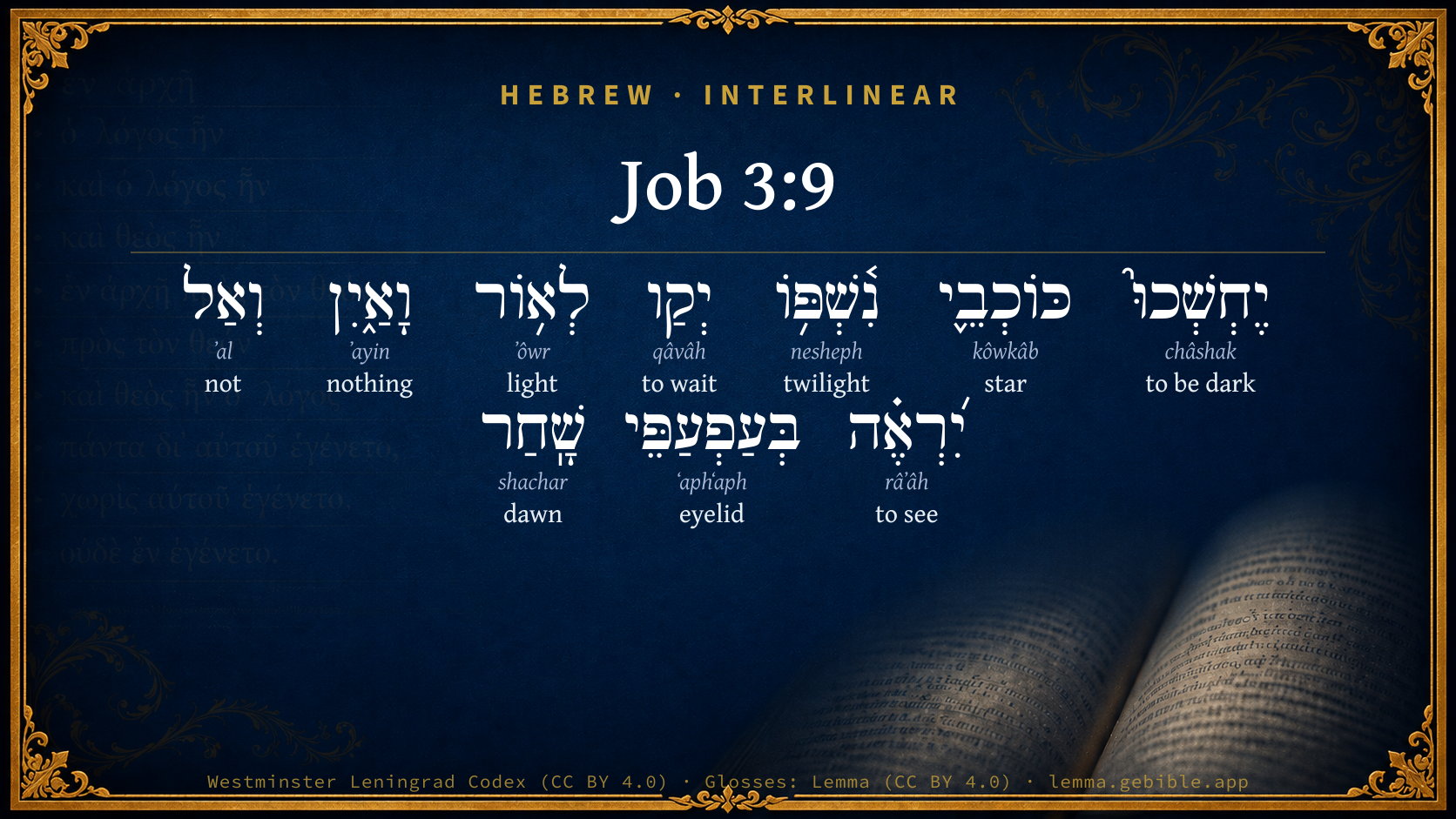
Hebrew (Westminster Leningrad Codex) Job 3:9 appears in the Hebrew Old Testament. The text above is from the Westminster Leningrad Codex. Each word links to its Strong’s number, a concise gloss, and parsing drawn from the Open Scriptures Hebrew Bible morphology. Click any word for its full Brown-Driver-Briggs (BDB) entry.
Download image
Cite this verse

Job 3:9 (World English Bible). Public Domain. Lemma interlinear Bible study tool, https://lemma.gebible.app/v/job/3/9.

Show BibTeX & RIS
BibTeX
RIS
English Translation
Let the stars of the twilight of it be dark. Let it look for light, but have none, Neither let it see the eyelids of the morning,
World English Bible · Public Domain
Highlights
  • 1 first appearance in the Hebrew Bible
Full analysis ↓
Download a study sheet

One document with this verse’s original text, its word-by-word gloss line, the meaning frame, cross-references with their text, attributed commentary, and full source and license credits — printable, and it pastes into notes with its structure intact.

This verse Autodidact and up

Study sheet (.html) Plain text (.txt)

A passage Seminary Student

Up to 50 verses in one chapter. A passage sheet keeps up to 6 commentary sources and 12 cross-references per verse, in the order this page ranks them, and says so on the sheet whenever that leaves anything out. Ask for a single verse and you get the Autodidact verse sheet above.

Everything on this page stays free to read, with no account — the sheet is a download of what is already on screen, not access to it.

Want to remove ads? Support Godless Engineer
Compare translations 3

The same verse in 3 English versions, stacked beneath the original-language interlinear above. Click any original word for its lexicon entry.

Each is an independent rendering of the whole verse — the interlinear is not word-aligned to these translations.

Highlighted words mark where these versions differ — a whole-verse word diff, not a word-by-word alignment.

  • World English Bible Public Domain
    Let the stars of the twilight of it be dark. Let it look for light, but have none, Neither let it see the eyelids of the morning,
  • King James Version Public Domain
    Let the stars of the twilight thereof be dark; let it look for light, but have none; neither let it see the dawning of the day:
  • unfoldingWord Literal Text CC BY-SA 4.0
    May the stars of its twilight be dark; may it wait for light but none, and may it not see the eyelids of the dawn,

unfoldingWord Literal Text — © unfoldingWord, licensed CC BY-SA 4.0. Word-aligned USFM3 via Door43 (git.door43.org/unfoldingWord/en_ult).

Versions to compare (up to 4)

3 of 4 selected

Show all 18 translations

Every available English version of this verse, each an independent rendering of the whole verse.

  • World English Bible Public Domain
    Let the stars of the twilight of it be dark. Let it look for light, but have none, Neither let it see the eyelids of the morning,
  • Berean Standard Bible Public Domain
    May its morning stars grow dark; may it wait in vain for daylight; may it not see the breaking of dawn.
  • Majority Standard Bible Public Domain
    May its morning stars grow dark; may it wait in vain for daylight; may it not see the breaking of dawn.
  • King James Version Public Domain
    Let the stars of the twilight thereof be dark; let it look for light, but have none; neither let it see the dawning of the day:
  • American Standard Version (1901) Public Domain
    Let the stars of the twilight thereof be dark: Let it look for light, but have none; Neither let it behold the eyelids of the morning:
  • Revised Version (1885) Public Domain
    Let the stars of the twilight thereof be dark: let it look for light, but have none; neither let it behold the eyelids of the morning:
  • Geneva Bible (1599) Public Domain
    Let the starres of that twilight be dimme through darkenesse of it: let it looke for light, but haue none: neither let it see the dawning of the day,
  • Douay-Rheims (1899) Public Domain
    Let the stars be darkened with the mist thereof: let it expect light and not see it, nor the rising of the dawning of the day:
  • Young's Literal Translation Public Domain
    Let the stars of its twilight be dark, Let it wait for light, and there is none, And let it not look on the eyelids of the dawn.
  • Literal Standard Version CC BY-SA 4.0
    Let the stars of its twilight be dark, || Let it wait for light, and there is none, || And let it not look on the eyelids of the dawn.
  • Unlocked Literal Bible CC BY-SA 4.0
    May the stars of that day's dawn be dark. May that day look for light, but find none; neither may it see the eyelids of the dawn,
  • unfoldingWord Literal Text CC BY-SA 4.0
    May the stars of its twilight be dark; may it wait for light but none, and may it not see the eyelids of the dawn,
  • Darby Bible Public Domain
    Let the stars of its twilight be dark; let it wait for light, and have none, neither let it see the eyelids of the dawn:
  • World Messianic Bible Public Domain
    Let the stars of its twilight be dark. Let it look for light, but have none, neither let it see the eyelids of the morning,
  • Webster's Bible Public Domain
    Let the stars of its twilight be dark; let it look for light, but have none; neither let it see the dawning of the day:
  • Free Bible Version CC BY-SA 4.0
    Its early morning stars should stay dark. Looking for light, may none come, may it not see the glimmer of dawn
  • Bible in Basic English Public Domain
    Let its morning stars be dark; let it be looking for light, but may it not have any; let it not see the eyes of the dawn.
  • JPS Tanakh (1917) Public Domain
    Let the stars of the twilight thereof be dark; let it look for light, but have none; neither let it behold the eyelids of the morning;

Literal Standard Version (2020), Covenant Press — licensed CC BY-SA 4.0. Text via the HelloAO Bible API (eBible.org). Unlocked Literal Bible (unfoldingWord) — licensed CC BY-SA 4.0. Text via the HelloAO Bible API (eBible.org). unfoldingWord Literal Text — © unfoldingWord, licensed CC BY-SA 4.0. Word-aligned USFM3 via Door43 (git.door43.org/unfoldingWord/en_ult). Free Bible Version, Dr. Jonathan Gallagher — licensed CC BY-SA 4.0. Text via the HelloAO Bible API (eBible.org).

Word by word

More ways to search: Search by grammar → Find every occurrence → Compare this word →

Practice this passage: Drill this verse → Learn its vocabulary →

בְּעַפְעַפֵּי
ʻaphʻaph
H6079
“in/at · eyelids of”
Preposition + Noun, Common, Masculine, Plural, Construct
Part of Speech
Preposition + Noun
Type
Common
Gender
Masculine
Number
Plural
State
Construct
Full BDB Definition

Origin: from H5774

TWOT: 1582b

eyelid - eyelid - of dawn, rays of sun (figuratively)
  1. יֶחְשְׁכוּ֮ châshak H2821 “to be dark” Verb, Qal, Imperfect, 3rd Person, Masculine, Plural
  2. כּוֹכְבֵ֪י kôwkâb H3556 “stars of” Noun, Common, Masculine, Plural, Construct
  3. נִ֫שְׁפּ֥וֹ nesheph H5399 “twilight · his” Noun, Common, Masculine, Singular, Construct + Suffix, Personal, 3rd Person, Masculine, Singular
  4. יְקַו qâvâh H6960 “to wait” Verb, Piel, Imperfect, 3rd Person, Masculine, Singular
  5. לְא֥וֹר ʼôwr H216 “to/for · light” Preposition + Noun, Common, Both, Singular, Absolute
  6. וָאַ֑יִן ʼayin H369 “and · nothing” Conjunction + Particle, Negative
  7. וְאַל ʼal H408 “and · not” Conjunction + Particle, Negative
  8. יִ֝רְאֶ֗ה râʼâh H7200 “to see” Verb, Qal, Jussive, 3rd Person, Masculine, Singular
  9. שָֽׁחַר shachar H7837 “dawn” Noun, Common, Masculine, Singular, Absolute

About this verse

These counts appear in no published source. They are computed here, from the morphology-tagged text and Lemma’s own curated glosses. What Lemma adds →

10
words
10
distinct lemmas
Wisdom
section

Notable vocabulary

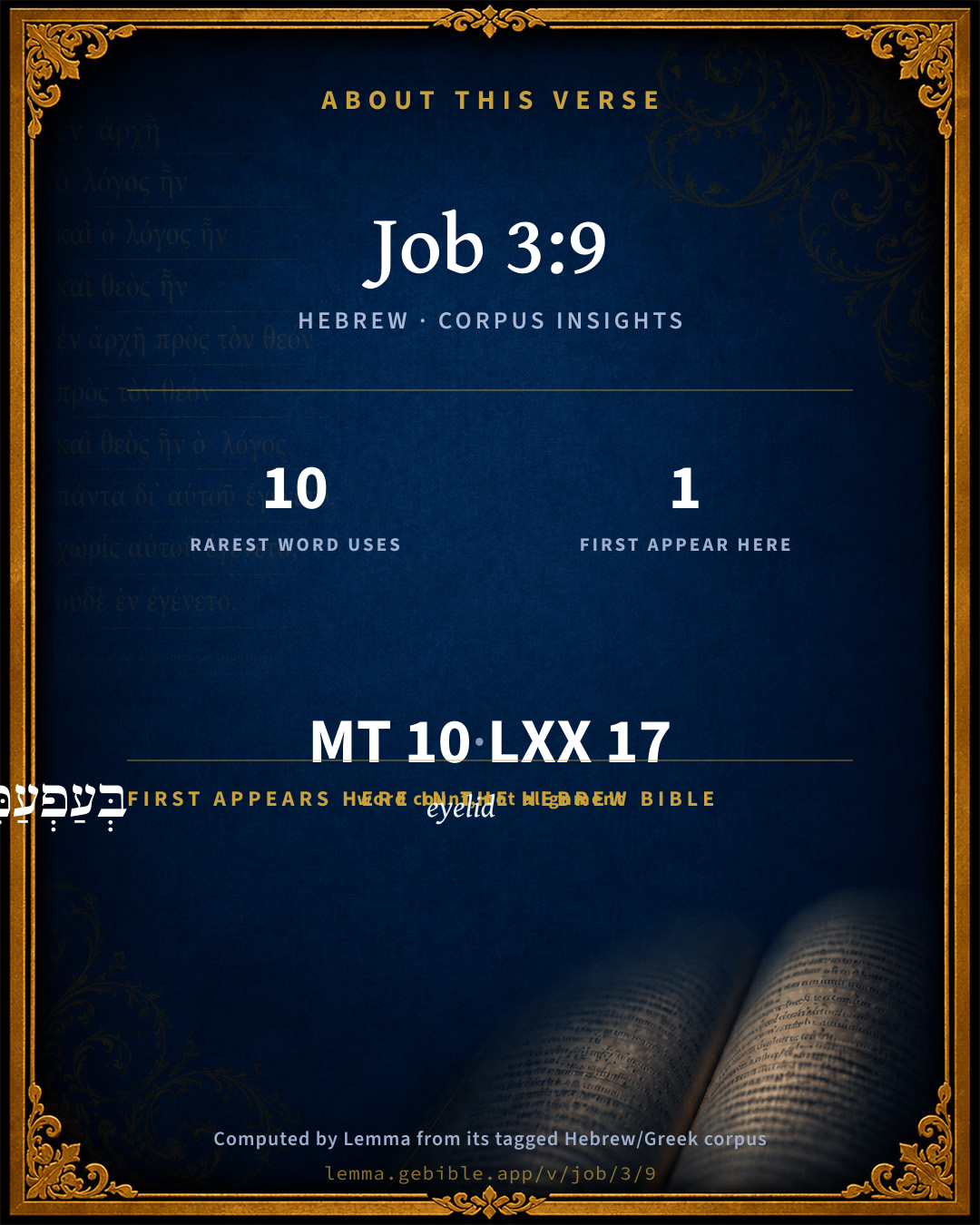
The rarest word here is בְּעַפְעַפֵּי eyelid H6079 — appearing just 10 times in the whole Hebrew Bible.

First appearance in Scripture

This word makes its first canonical appearance in the Hebrew Bible here:

  • בְּעַפְעַפֵּי eyelid H6079

Shared distinctive vocabulary

בְּעַפְעַפֵּי eyelid H6079 occurs in 10 verses of the Hebrew Bible. Also found in:

Grammatical profile

  • 3 verbs
  • 5 nouns
  • 2 particles

Verb forms

  • יֶחְשְׁכוּ֮ Qal · Imperfect
  • יְקַו Piel · Imperfect
  • יִ֝רְאֶ֗ה Qal · Jussive

Hebrew & Septuagint length

In English translation the verse runs 27 words from the Hebrew and 26 from the Septuagint (LXX English) — closely comparable.

A rough comparison of the two English renderings, which tokenize alike — not a word-level alignment.

Word counts can differ between the Hebrew and the Greek without any difference in meaning — e.g. the Hebrew direct-object marker אֵת has no separate Greek word, and Greek often adds the article ὁ.

In the original languages it is 10 Hebrew tokens and 17 Greek tokens — but the two are counted differently (Hebrew bundles its prefixes and suffixes into one token; the Greek is in lemma form), so that isn’t a like-for-like length.

Cross-references

4

Topical passages linked to Job 3:9 in the Treasury of Scripture Knowledge — connected by theme and wording, ordered by reader-vote popularity; previews shown in the World English Bible.

  • Job 41:18 His sneezing flashes forth light, His eyes are like the eyelids of the morning.
  • Job 30:26 When I looked for good, then evil came; When I waited for light, there came darkness.
  • Jeremiah 8:15 We looked for peace, but no good came; [and] for a time of healing, and, behold, dismay!
  • Jeremiah 13:16 Give glory to Yahweh your God, before he cause darkness, and before your feet stumble on the dark mountains, and, while you look for light, he turn it into the shadow of death, and make it gross darkness.

Cross-references courtesy of OpenBible.info (CC BY 4.0).

Hebrew and Greek witnesses Masoretic Hebrew ↔ Greek Septuagint

The same verse in the two great witnesses to the Old Testament, shown verse-for-verse.

These are two independent witnesses, not word-aligned to each other, and the Septuagint is shown in lemma (dictionary) form.

Hebrew Job 3:9 Masoretic · Westminster Leningrad Codex

יֶחְשְׁכוּ֮ כּוֹכְבֵ֪י נִ֫שְׁפּ֥וֹ יְקַו לְא֥וֹר וָאַ֑יִן וְאַל יִ֝רְאֶ֗ה בְּעַפְעַפֵּי שָֽׁחַר

Let the stars of the twilight of it be dark. Let it look for light, but have none, Neither let it see the eyelids of the morning,

World English Bible · Public Domain

Greek LXX Job 3:9 Septuagint · lemma form

σκοτόω ὁ ἄστρον ὁ νύξ ἐκεῖνος ὑπομένω καί εἰς φωτισμός μή ἔρχομαι καί μή ὁράω ἑωσφόρος ἀνατέλλω

Let the stars of that night be darkened; let it remain dark, and not come into light; and let it not see the morning star arise:

LXX2012 (modern English Septuagint) · Public Domain

On this verse, Albert Barnes' Notes on the Bible discusses the Septuagint’s reading. Read the note in Commentary ↓

Hebrew: Westminster Leningrad Codex (CC BY 4.0). Greek: Septuagint (public domain); English from LXX2012 (modern English Septuagint) (Public Domain). How the Septuagint differs from the Hebrew →

Commentary

Notes on Job 3:9 from classic Christian and Jewish commentators (each source and its license shown beneath its notes). The classic Christian expositions comment on the surrounding passage and are grouped to its opening verse, so a note may address several verses; the Jewish commentaries on the Tanakh (Rashi and others) are per-verse, so they appear only where the commentator wrote on this verse.

Lemma curates 59 commentaries, every one of them public domain or Creative Commons licensed, each selected and text-cleaned for this edition rather than reprinted as found. About our sources →

Trapp's Complete Commentary

John Trapp

Job 3:9 Let the stars of the twilight thereof be dark; let it look for light, but [have] none; neither let it see the dawning of the day:

Ver. 9. Let the stars of the twilight thereof be dark] If the stars of its twilight be dark, how great is that darkness! Job would not have this night to have light of stars, or hope of day’s dawn, hope of better, or place of worse. And this part of the curse he reserveth to the last place, as worse than any of the former. Semblably, that judgment of pining away in their iniquity is the last that God denounceth, Lev 26:39, after those other dismal ones there to befall the disobedient. And that, Rev 22:11, Let him that is filthy be filthy still, is the last, but not the least (of those that befall in this life), threatened in all the New Testament.

Let it look for light, but have none] Heb. But none. Loss of expectation is a great loss. Esau found it so, and the mother of Sisera, Jdg 5:28, and those shall once, that come knocking and bouncing at heaven’s gates, with "Lord, Lord, open unto us," and shall hear, "Depart ye." The hopes of the wicked fail them when at highest; whereas the saints find that comfort in extremity which they durst not expect: their light shall rise in obscurity, Isa 58:10, it shall shine more and more unto the perfect day, Pro 4:18.

Let it not see the dawning of the day] Heb. The eyelids of the morning; that is, the first breakings of light, the morning rays or beams peeping abroad. These this night must never see. Heaven is a nightless day (ανεσπερος ημερα), hell a dayless night. Fire there is, but without light; it burneth, but shineth not to those reprobates who are in tenebras ex tenebris infeliciter exclusi, infelicius excludendi; thrust into outer darkness, a darkness beyond a darkness, as the dungeon is beyond the prison, Mat 8:12.

John Trapp, A Commentary or Exposition upon All the Books of the Old and New Testament (1647–1656) — public domain. Text from a community e-Sword module.

Joseph Benson's Commentary

Job 3:9. Let the stars of the twilight thereof, &c. — That adorn the heavens with so much beauty and lustre, never be seen that night. Let it look for light, but have none — Let it wait with the greatest impatience for some pleasing refreshment from thick, heavy clouds hanging over it; but let not the smallest degree of light appear; neither let it see the dawning of the day — Neither let it perceive the least glimpse of those bright rays, which, with so much swiftness, issue from the rising sun.

Joseph Benson's Commentary on the Old and New Testaments (1811–1818) — public domain. Text from a community e-Sword module.

Tyndale Open Study Notes

Tyndale Open Resources

3:9 Venus and Mercury, the morning stars, herald the dawn (38:7).

Tyndale Open Study Notes — © Tyndale Open Resources, licensed CC BY-SA 4.0. Text via the HelloAO Bible API.

Geneva Bible (1599)

Geneva Bible translators

Hebrew, The eyelids of the morning.

Let it be always night, and never see day.

Geneva Bible (1599) marginal notes — public domain. Text via Bolls.life.

Jamieson, Fausset & Brown

Robert Jamieson, A. R. Fausset & David Brown

dawning of the day--literally, "eyelashes of morning." The Arab poets call the sun the eye of day. His early rays, therefore, breaking forth before sunrise, are the opening eyelids or eyelashes of morning.

Jamieson, Fausset & Brown — Commentary Critical and Explanatory on the Whole Bible (1871) — public domain (CC PDM 1.0). Text via the HelloAO Bible API.

Adam Clarke's Commentary

Verse 9. Let the stars of the twilight thereof] The stars of the twilight may here refer to the planets Venus, Jupiter, Mars, and Mercury, as well as to the brighter fixed stars.

Let it look for light] Here the prosopopoeia or personification is still carried on. The darkness is represented as waiting for the lustre of the evening star, but is disappointed; and these for the aurora or dawn, but equally in vain. He had prayed that its light, the sun, should not shine upon it, Job 3:4; and here he prays that its evening star may be totally obscured, and that it might never see the dawning of the day. Thus his execration comprehends every thing that might irradiate or enliven it.

Adam Clarke's Commentary on the Bible (1810–1826) — public domain. Text from a community e-Sword/MySword module.

Ellicott's Commentary for English Readers

(9) The dawning . . .—Literally, the eyelids of the dawn.

A Bible Commentary for English Readers, edited by Charles John Ellicott (1878–1897) — public domain. Text from a community e-Sword module.

The Cambridge Bible for Schools and Colleges

gen. ed. J. J. S. Perowne

9. the twilight thereof] that is, the morning twilight of that night. Let its morning stars, that should herald its day, go out—as the next clause explains: let it look for the light of a day that never breaks.

see the dawning of the day] lit. behold the eyelids of the morning. This beautiful figure looks like an idea from Western poetry, just as the chamber of the Sun, Psa_19:5. All commentators quote the parallel from Sophocles, χρυσέας ἁμέρας βλέφαρον, Antigone, 103.

The Cambridge Bible for Schools and Colleges (gen. ed. J. J. S. Perowne; Cambridge University Press, 1878–1918) — public domain. Text from a community e-Sword module.

John Gill's Exposition

Let the stars of the twilight thereof be dark,.... Either of the morning or evening twilight; both may be meant, rather the latter, because of the following clause; the sense is, let not these appear to adorn the heavens, and to relieve the darkness of the night, and make it more pleasant and delightful, as well as to be useful to travellers and sailors:

let it look for light, but have none; that is, either for the light of the moon and stars, to shine in the night till daybreak, or for the light of the sun at the time when it arises; but let it have neither; let the whole time, from sun setting to sunrising, from one twilight to another, be one continued gross and horrible darkness; here, by a strong and beautiful figure, looking is ascribed to the night:

neither let it see the dawning of the day; or, "let it not see the eyelids of the morning" (l), or what we call "peep of day"; here, in very elegant language, the dawn of morning light is expressed, which is like the opening of an eye and its lids, quick and vibrating, when light is let in and perceived; or this may be interpreted of the sun, the eye of the morning and of light, and of its rays, which, when first darted, are like the opening of the eyelids.

(l) "palpebras aurorae", Montanus, Mercerus, &c.

John Gill's Exposition of the Whole Bible (1746–1763) — public domain (CC PDM 1.0). Text via the HelloAO Bible API.

Albert Barnes' Notes on the Bible

Let the stars of the twilight thereof be dark - That is, be extinguished, so that it shall be total darkness - darkness not even relieved by a single star. The word here rendered “twilight” נשׁף nesheph means properly a breathing; and hence, the evening, when cooling breezes “blow,” or gently breathe. It is used however, to denote both the morning and the evening twilight, though here probably it means the latter. He wishes that the evening of that night, instead of being in any way illuminated, should “set in” with total darkness and continue so. The Septuagint renders it, “night.

Let it look for light, but have none - Personifying the night, and representing it as looking out anxiously for some ray of light. This is a beautiful poetic image - the image of “Night,” dark and gloomy and sad, anxiously looking out for a single beam or a star to break in upon its darkness and diminish its gloom.

Neither let it see the dawning of the day - Margin, more literally and more beautifully, “eyelids of the morning.” The word rendered “dawning” עפעפים ‛aph‛aphı̂ym means properly “the eyelashes” (from עוּף ‛ûph “to fly”), and it is given to them from their flying or fluttering. The word rendered “day” שׁחר shachar means the aurora, the morning. The sun when he is above the horizon is called by the poets the eye of day; and hence, his earliest beams, before he is risen, are called the eyelids or eyelashes of the morning opening upon the world. This figure is common in the ancient Classics, and occurs frequently in the Arabic poets; see Schultens “in loc.” Thus, in Soph. Antiq. 104, the phrase occurs, Ἁμέρας βλέφυρον Hameras blefaron. So in Milton’s Lycidas,

“ - Ere the high lawns appeared

Under the opening eyelids of the dawn,

We drive afield.”

Job’s wish was, that there might be no star in the evening twilight, and that no ray might illuminate that of the morning; that it might be enveloped in perpetual, unbroken darkness.

Albert Barnes' Notes on the Bible (1834–1885) — public domain. Text from a community e-Sword/MySword module.

Matthew Poole's English Annotations

Let the stars, which are the glory and beauty of the night, to render it amiable and delightful to men,

be covered with thick darkness, nd that both in the evening twilight, as is here expressed, when the stars begin to arise and shine forth; and also in the further progress of the night, even till the morning begins to dawn, as the following words imply.

Let it look for light, but have none; let its darkness be aggravated with the disappointment of its hopes and expectations of light. He ascribes sense or reasoning to the night, by a poetical fiction usual in all writers.

The dawning of the day, Heb. the eyelids of the day, i.e. the morningstar, which ushers in the day, and the beginning, and consequently the progress, of the morning light, and the day following. Let this whole natural day, consisting of night and day, be blotted out of the catalogue of days, as he wished before.

Matthew Poole's English Annotations on the Holy Bible (1683–1685) — public domain. Text from a community e-Sword/MySword module.

Whedon's Commentary on the Bible

Daniel D. Whedon

9. The dawning of the day — Literally, Let it not see the eyelashes of the dawn; that is, the first rays of the sun. Sophocles speaks of the eyelid of the golden day. (Antig., 103.) The Arab poets call the sun the eye of the day. In his early struggling rays their imagination traces eyebrows for the approaching sun. “Like the sun, before whose face the mantle of clouds is spread, while through the rifts his eyebrows appear.” But this and other citations, made by Schultens from the Arab muse, pale before the striking and tender beauty of our text. Milton has evidently borrowed from it —

“Ere the high lawns appeared

Under the opening eyelids of the dawn

We drove afield.” — Lycidas, 50. 26.

Daniel D. Whedon (gen. ed.), Commentary on the Old and New Testaments (1874–1909) — public domain. Text from a community e-Sword module.

The Pulpit Commentary

Let the stars of the twilight thereof be dark; i.e. "let not even the light of a star illuminate the morning or evening twilight of that night; let it be dark from beginning to end, uncheered even by the ray of a star." Let it look for light, but have none. Again a personification. The night is regarded as consciously waiting in hope of the appearance of morning, but continually disappointed by the long lingering of the darkness. And let it not see the dawning of the day; rather, as in the margin and in the Revised Version, let it not behold the eyelids of the morning (compare Milton"s "Lycidas," "Under the opening eyelids of the morn," and Soph., "Antigone," crussehv amerav blefaron ).

The Pulpit Commentary (1880–1919), ed. H.D.M. Spence-Jones & Joseph S. Exell — public domain. Text from a community e-Sword module.

John Wesley's Explanatory Notes

The stars - Let the stars, which are the glory and beauty of the night, be covered with thick darkness, and that both in the evening twilight, when the stars begin to shine; and also in the farther progress of the night, even 'till the morning dawns. Look - Let its darkness be aggravated with the disappointment of its expectations of light. He ascribes sense or reasoning to the night, by a poetical fiction, usual in all writers. Dawning - Hebrew. the eye-lids of the day, the morning-star which ushers in the day, and the beginning, and progress of the morning light, let this whole natural day, consisting of night and day, be blotted out of the catalogue of days.

John Wesley, Explanatory Notes Upon the Whole Bible (1754–1765) — public domain. Text via the GEBible commentary corpus.

Scofield Reference Notes

C. I. Scofield

dawning

Heb. "the eyelids of the morning." Job 41:18.

The Scofield Reference Bible (1917 edition), notes by C. I. Scofield — public domain. Text from a community e-Sword module.

Rashi

Rabbi Shlomo Yitzchaki (Rashi)

its evening Heb. נשפו, the darkness of its night.

the rays of Heb. עפעפי, rays of, like (Jer. 9:17), “and our eyelids (or pupils) (ועפעפינו) gush water.”

Rashi on the Tanakh — English translations: “The Judaica Press complete Tanach with Rashi, translated by A. J. Rosenberg” (CC BY 4.0); “Pentateuch with Rashi's commentary by M. Rosenbaum and A.M. Silbermann, 1929-1934” (public domain); “The Metsudah Tanach series, Lakewood, N.J” (CC BY 4.0); and “The Book of Joshua, Metsudah Publications, 1997” (CC BY 4.0). Text via Sefaria.

Lesson kit

Teaching starters — assembled from the data on this page, not authored interpretation. Every prompt links to the verse data it draws on. Edit before teaching.

Job, in the Wisdom, opens this verse with 10 words (10 distinct Hebrew lemmas). Its most distinctive word is ʻaphʻaph (“eyelid”). A historical commentator’s framing appears above. Read the whole chapter for the surrounding context.

Discussion questions

  1. The word ʻaphʻaph carries the sense “eyelid.” How does it shape the verse?
  2. This is the first place “eyelid” appears in Scripture (first appears here). What does its debut here establish?
  3. How does Job 16:16, which shares the word «eyelid», read alongside this verse?
  4. The translations on this page render this verse differently — a whole-verse word diff, not a word-by-word alignment. What might account for the different wordings?
  5. «יֶחְשְׁכוּ֮» is a Qal Imperfect verb. How does that grammatical form shape the action described?
  6. Compare how Trapp's Complete Commentary and Joseph Benson's Commentary read this verse. Where do they agree or differ?

Things to notice

Reading settings

Reading text

Shown beneath each verse's original-language words.

Old Testament
Old Testament edition

Read the OT as the Masoretic Hebrew (MT) or the Greek Septuagint (LXX).

English shown for the Greek Septuagint (in the Hebrew ↔ Greek comparison).

Comparing translations? Open the Compare panel on any verse page to stack up to four side by side.