
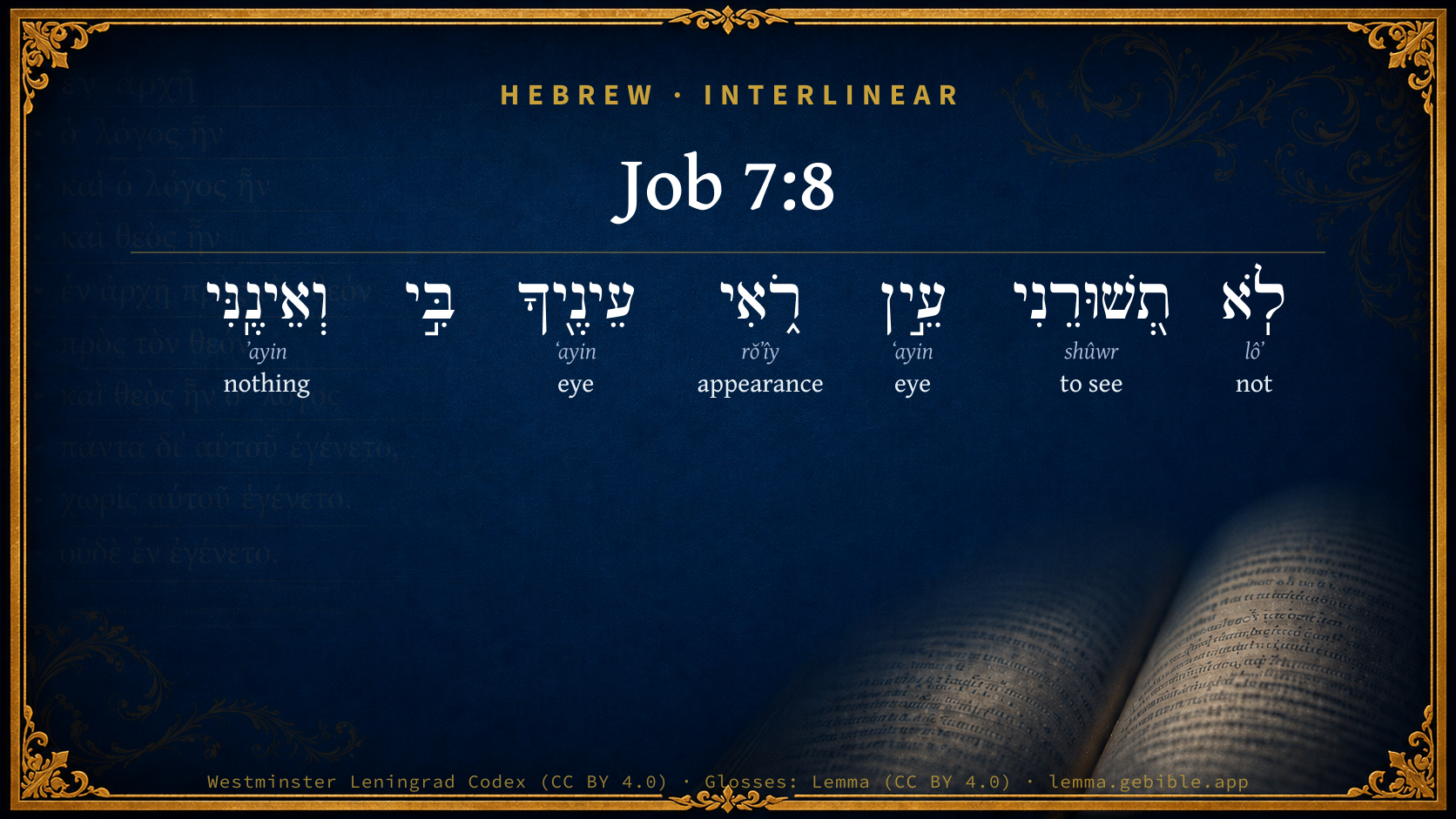
Job 7:8

Hebrew (Westminster Leningrad Codex) Job 7:8 appears in the Hebrew Old Testament. The text above is from the Westminster Leningrad Codex. Each word links to its Strong’s number, a concise gloss, and parsing drawn from the Open Scriptures Hebrew Bible morphology. Click any word for its full Brown-Driver-Briggs (BDB) entry.
Download image
Cite this verse

Job 7:8 (World English Bible). Public Domain. Lemma interlinear Bible study tool, https://lemma.gebible.app/v/job/7/8.

Show BibTeX & RIS
BibTeX
RIS
English Translation
The eye of him who sees me shall see me no more. Your eyes shall be on me, but I shall not be.
World English Bible · Public Domain
Download a study sheet

One document with this verse’s original text, its word-by-word gloss line, the meaning frame, cross-references with their text, attributed commentary, and full source and license credits — printable, and it pastes into notes with its structure intact.

This verse Autodidact and up

Study sheet (.html) Plain text (.txt)

A passage Seminary Student

Up to 50 verses in one chapter. A passage sheet keeps up to 6 commentary sources and 12 cross-references per verse, in the order this page ranks them, and says so on the sheet whenever that leaves anything out. Ask for a single verse and you get the Autodidact verse sheet above.

Everything on this page stays free to read, with no account — the sheet is a download of what is already on screen, not access to it.

Want to remove ads? Support Godless Engineer
Compare translations 3

The same verse in 3 English versions, stacked beneath the original-language interlinear above. Click any original word for its lexicon entry.

Each is an independent rendering of the whole verse — the interlinear is not word-aligned to these translations.

Highlighted words mark where these versions differ — a whole-verse word diff, not a word-by-word alignment.

  • World English Bible Public Domain
    The eye of him who sees me shall see me no more. Your eyes shall be on me, but I shall not be.
  • King James Version Public Domain
    The eye of him that hath seen me shall see me no more: thine eyes are upon me, and I am not.
  • unfoldingWord Literal Text CC BY-SA 4.0
    The eye of the one seeing me will not regard me; your eyes on me, but I will not exist.

unfoldingWord Literal Text — © unfoldingWord, licensed CC BY-SA 4.0. Word-aligned USFM3 via Door43 (git.door43.org/unfoldingWord/en_ult).

Versions to compare (up to 4)

3 of 4 selected

Show all 18 translations

Every available English version of this verse, each an independent rendering of the whole verse.

  • World English Bible Public Domain
    The eye of him who sees me shall see me no more. Your eyes shall be on me, but I shall not be.
  • Berean Standard Bible Public Domain
    The eye that beholds me will no longer see me. You will look for me, but I will be no more.
  • Majority Standard Bible Public Domain
    The eye that beholds me will no longer see me. You will look for me, but I will be no more.
  • King James Version Public Domain
    The eye of him that hath seen me shall see me no more: thine eyes are upon me, and I am not.
  • American Standard Version (1901) Public Domain
    The eye of him that seeth me shall behold me no more; Thine eyes shall be upon me, but I shall not be.
  • Revised Version (1885) Public Domain
    The eye of him that seeth me shall behold me no more: thine eyes shall be upon me, but I shall not be.
  • Geneva Bible (1599) Public Domain
    The eye that hath seene me, shall see me no more: thine eyes are vpon me, and I shall be no longer.
  • Douay-Rheims (1899) Public Domain
    Nor shall the sight of man behold me: thy eyes are upon me, and I shall be no more.
  • Young's Literal Translation Public Domain
    The eye of my beholder beholdeth me not. Thine eyes `are' upon me -- and I am not.
  • Literal Standard Version CC BY-SA 4.0
    The eye of my beholder does not behold me. Your eyes [are] on me—and I am not.
  • Unlocked Literal Bible CC BY-SA 4.0
    The eye of God, who sees me, will see me no more; God's eyes will be on me, but I will not exist.
  • unfoldingWord Literal Text CC BY-SA 4.0
    The eye of the one seeing me will not regard me; your eyes on me, but I will not exist.
  • Darby Bible Public Domain
    The eye of him that hath seen me shall behold me no [more]: thine eyes are upon me, and I am not.
  • World Messianic Bible Public Domain
    The eye of him who sees me will see me no more. Your eyes will be on me, but I will not be.
  • Webster's Bible Public Domain
    The eye of him that hath seen me shall see me no more: thy eyes are upon me, and I am not.
  • Free Bible Version CC BY-SA 4.0
    Those watching me won't see me anymore; your eyes will be looking for me, but I will be gone.
  • Bible in Basic English Public Domain
    The eye of him who sees me will see me no longer: your eyes will be looking for me, but I will be gone.
  • JPS Tanakh (1917) Public Domain
    The eye of him that seeth me shall behold me no more; while Thine eyes are upon me, I am gone.

Literal Standard Version (2020), Covenant Press — licensed CC BY-SA 4.0. Text via the HelloAO Bible API (eBible.org). Unlocked Literal Bible (unfoldingWord) — licensed CC BY-SA 4.0. Text via the HelloAO Bible API (eBible.org). unfoldingWord Literal Text — © unfoldingWord, licensed CC BY-SA 4.0. Word-aligned USFM3 via Door43 (git.door43.org/unfoldingWord/en_ult). Free Bible Version, Dr. Jonathan Gallagher — licensed CC BY-SA 4.0. Text via the HelloAO Bible API (eBible.org).

Word by word

More ways to search: Search by grammar → Find every occurrence → Compare this word →

Practice this passage: Drill this verse → Learn its vocabulary →

About this verse

These counts appear in no published source. They are computed here, from the morphology-tagged text and Lemma’s own curated glosses. What Lemma adds →

7
words
5
distinct lemmas
Wisdom
section

Notable vocabulary

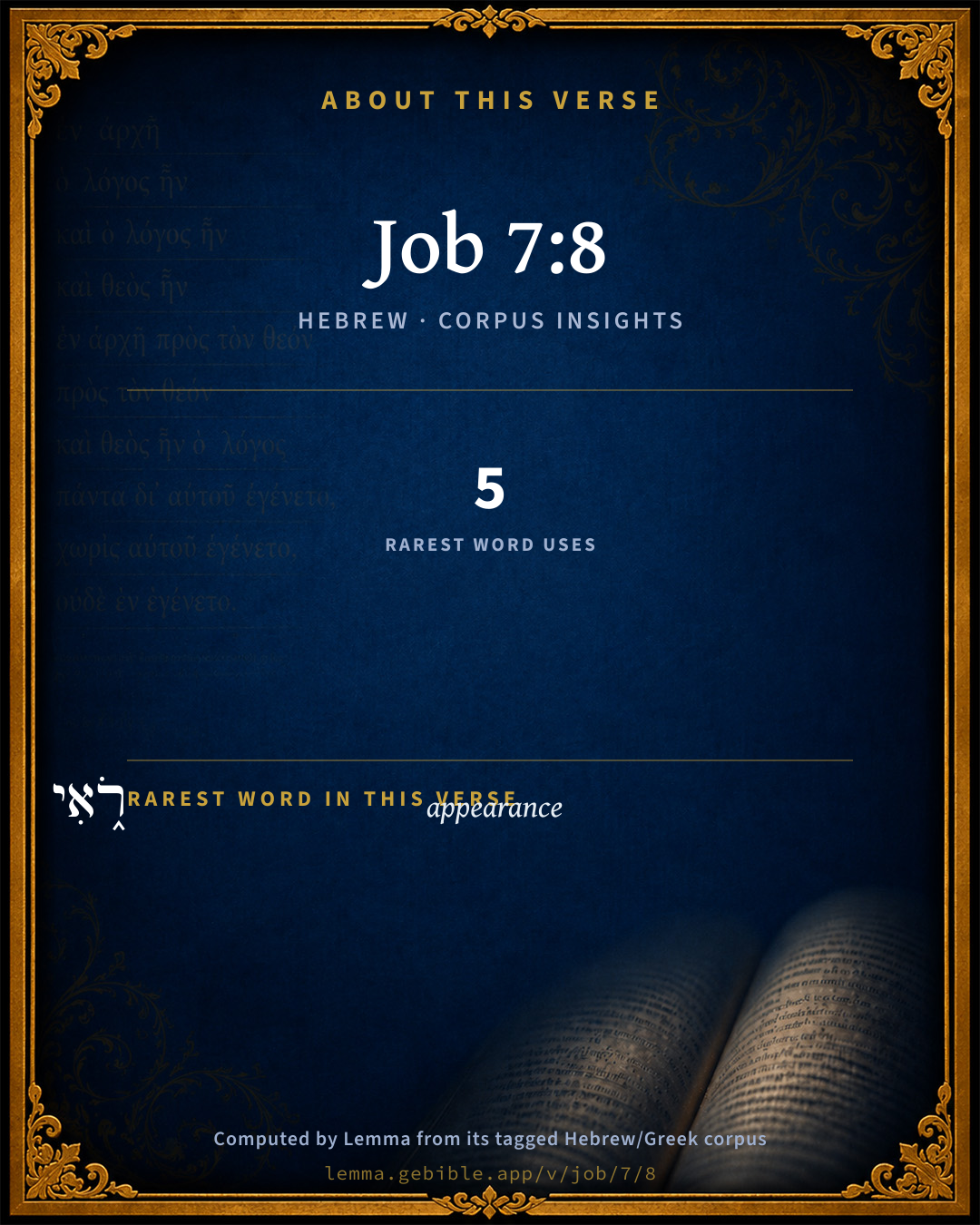
The rarest word here is רֹ֑אִי appearance H7210 — appearing just 5 times in the whole Hebrew Bible.

Shared distinctive vocabulary

רֹ֑אִי appearance H7210 occurs in 5 verses of the Hebrew Bible. Also found in:

Grammatical profile

  • 2 verbs
  • 2 nouns
  • 1 preposition
  • 2 particles

Verb forms

  • תְ֭שׁוּרֵנִי Qal · Imperfect
  • רֹ֑אִי Qal · Participle Active

Repetition

A word recurs within this verse — often emphatic in Hebrew:

  • עֵ֣ין eye H5869 ×2

Hebrew & Septuagint length

In English translation the verse runs 23 words from the Hebrew and 22 from the Septuagint (LXX English) — closely comparable.

A rough comparison of the two English renderings, which tokenize alike — not a word-level alignment.

Word counts can differ between the Hebrew and the Greek without any difference in meaning — e.g. the Hebrew direct-object marker אֵת has no separate Greek word, and Greek often adds the article ὁ.

Cross-references

7

Topical passages linked to Job 7:8 in the Treasury of Scripture Knowledge — connected by theme and wording, ordered by reader-vote popularity; previews shown in the World English Bible.

  • Job 20:9 The eye which saw him shall see him no more, Neither shall his place any more see him.
  • Psalms 37:36 But he passed away, and, behold, he was not. Yes, I sought him, but he could not be found.
  • Job 8:18 If he is destroyed from his place, Then it shall deny him, saying, 'I have not seen you.'
  • Job 13:27 You also put my feet in the stocks, And mark all my paths. You set a bound to the soles of my feet:
  • Job 14:3 Do you open your eyes on such a one, And bring me into judgment with you?
  • Psalms 39:11 When you rebuke and correct man for iniquity, You consume his wealth like a moth. Surely every man is but a breath." Selah.
  • Psalms 90:8–9 You have set our iniquities before you, Our secret sins in the light of your presence.

Cross-references courtesy of OpenBible.info (CC BY 4.0).

Hebrew and Greek witnesses Masoretic Hebrew ↔ Greek Septuagint

The same verse in the two great witnesses to the Old Testament, shown verse-for-verse.

These are two independent witnesses, not word-aligned to each other, and the Septuagint is shown in lemma (dictionary) form.

Hebrew Job 7:8 Masoretic · Westminster Leningrad Codex

לֹֽא תְ֭שׁוּרֵנִי עֵ֣ין רֹ֑אִי עֵינֶ֖יךָ בִּ֣י וְאֵינֶֽנִּי

The eye of him who sees me shall see me no more. Your eyes shall be on me, but I shall not be.

World English Bible · Public Domain

Greek LXX Job 7:8 Septuagint · lemma form

οὐ περιβλέπω ἐγώ ὀφθαλμός ὁράω ἐγώ ὁ ὀφθαλμός σύ ἐν ἐγώ καί οὐκέτι εἰμί

The eye of him that sees me shall not see me again: your eyes are upon me, and I am no more.

LXX2012 (modern English Septuagint) · Public Domain

On this verse, Ellicott's Commentary for English Readers discusses the Septuagint’s reading. Read the note in Commentary ↓

Hebrew: Westminster Leningrad Codex (CC BY 4.0). Greek: Septuagint (public domain); English from LXX2012 (modern English Septuagint) (Public Domain). How the Septuagint differs from the Hebrew →

Commentary

Notes on Job 7:8 from classic Christian and Jewish commentators (each source and its license shown beneath its notes). The classic Christian expositions comment on the surrounding passage and are grouped to its opening verse, so a note may address several verses; the Jewish commentaries on the Tanakh (Rashi and others) are per-verse, so they appear only where the commentator wrote on this verse.

Lemma curates 59 commentaries, every one of them public domain or Creative Commons licensed, each selected and text-cleaned for this edition rather than reprinted as found. About our sources →

Trapp's Complete Commentary

John Trapp

Job 7:8 The eye of him that hath seen me shall see me no [more]: thine eyes [are] upon me, and I [am] not.

Ver. 8. The eye of him that hath seen me shall see me no more] In death we shall neither see nor be seen, but be soon both out of sight and out of mind too. It is told of Richard III, that he caused the dead corpse of his two smothered nephews to be closed in lead, and so put in a coffin full of holes, and hooked at the ends with two hooks of iron, and so to be cast into a place called the black deeps, at the Thames’ mouth, whereby they should never rise up, nor be any more seen (Speed. 935). Such a place is the grave till the last day: for then the sea shall give up the dead which are in it, and death and the grave shall render up the dead which are in them, Rev 20:13, then shall Adam see all his nephews at once, &c.

Thine eyes are upon me, and I am not] Thou even lookest me to death; like as elsewhere God is said to frown men to destruction, Psa 80:16 Psa 104:29; they are not able to endure his flaming eyes, sparkling out wrath against them. What mad men therefore are they that speak and act against him who can so easily do them to death! If God but set his eyes upon them for evil (as he oft threateneth to do, Amo 9:4 Job 16:9), they are undone.

John Trapp, A Commentary or Exposition upon All the Books of the Old and New Testament (1647–1656) — public domain. Text from a community e-Sword module.

Tyndale Open Study Notes

Tyndale Open Resources

7:8 You see me now, but not for long: The Greek Old Testament omitted this verse to avoid the implication that God would be unable to see Job in Sheol (see study note on 7:9).

Tyndale Open Study Notes — © Tyndale Open Resources, licensed CC BY-SA 4.0. Text via the HelloAO Bible API.

Jamieson, Fausset & Brown

Robert Jamieson, A. R. Fausset & David Brown

The eye of him who beholds me (present, not past), that is, in the very act of beholding me, seeth me no more.

Thine eyes are upon me, and I am not--He disappears, even while God is looking upon him. Job cannot survive the gaze of Jehovah (Psa 104:32; Rev 20:11). Not, "Thine eyes seek me and I am not to be found"; for God's eye penetrates even to the unseen world (Psa 139:8). UMBREIT unnaturally takes "thine" to refer to one of the three friends.

Jamieson, Fausset & Brown — Commentary Critical and Explanatory on the Whole Bible (1871) — public domain (CC PDM 1.0). Text via the HelloAO Bible API.

Adam Clarke's Commentary

Verse 8. Shall see me no more] If I die in my present state, with all this load of undeserved odium which is cast upon me by my friends, I shall never have an opportunity of vindicating my character, and regaining the good opinion of mankind.

Thine eyes are upon one, and I am not.] Thou canst look me into nothing. Or, Let thine eye be upon me as judged to death, and I shall immediately cease to live among men.

Adam Clarke's Commentary on the Bible (1810–1826) — public domain. Text from a community e-Sword/MySword module.

Ellicott's Commentary for English Readers

(8) Shall see me no more.—That is, thine own eyes shall look for me, but I shall be no more. So LXX. and Vulg.

A Bible Commentary for English Readers, edited by Charles John Ellicott (1878–1897) — public domain. Text from a community e-Sword module.

The Cambridge Bible for Schools and Colleges

gen. ed. J. J. S. Perowne

8. are upon me, and I am not] Perhaps rather, shall be upon me and I shall not be; God will look for him, enquiring, it may be, after the work of His hands, but he shall be gone; cf. Job_7:21.

The Cambridge Bible for Schools and Colleges (gen. ed. J. J. S. Perowne; Cambridge University Press, 1878–1918) — public domain. Text from a community e-Sword module.

John Gill's Exposition

The eye of him that hath seen me shall see me no more,.... Or "the eye of sight" (e); the seeing eye, the most acute and quick sighted eye; so Mr. Broughton renders it, "the quick eye" (f): this is to be understood as "after" (g) death, that then the sharpest eye should not see him, he would be out of the reach of it; which must be taken with a limitation; for men after death are seen by the eyes of the omniscient God, their souls, be they in heaven or in hell, and their bodies in the grave; and as for good men, such as Job, they are at once with him in his immediate presence, beholding and beheld by him; and they are seen by angels, whose care and charge their souls become immediately upon death, and are carried by them into heaven, where they are fellow worshippers with them; and they are seen by glorified saints, to whose company they are joined; for if the rich man in hell could see Abraham, and Lazarus in his bosom, Luk 16:23, then much more do the saints see one another: but the meaning is, that when a man is dead, he is seen no more by men on earth, by his relations, friends, and acquaintance; the consideration of which is a cutting stroke at parting, see Act 20:25; the state of the dead is an invisible state, and therefore called in the Greek tongue "Hades", "unseen"; so the dead will remain, with respect to the inhabitants of this world, till the resurrection, and then they shall see and be seen again in the same bodies they now have; for this is no denial of the resurrection of the dead, as some Jewish writers charge Job with, and infer from this and some following passages:

thine eyes are upon me, and I am not; am a dead man, a phrase expressive of death, and of being in the state of the dead, or however of being no more in this world, see Gen 5:24; not that the dead are nonentities, or are reduced to nothing; this is not true of them, either with respect to soul or body; their souls are immaterial and immoral, and exist in a separate state after death, and their bodies, though reduced to dust, are not annihilated; they return to earth and dust, from whence they came; but still they are something, they are earth and dust, unless these can be thought to be nothing; and this dust is taken care of and preserved, and will be gathered together, and moulded, and framed, and fashioned into bodies again, which will endure for ever: nor is the meaning, that they are nowhere; the spirits of just men made perfect are in heaven, in paradise, in a state of life, immortality, and bliss; and the souls of the wicked are in their own place, in the prison of hell, reserved with devils, to the judgment of the great day; and the bodies of both are in the graves till the day of the resurrection; but they are not, and no more, in the land of the living, in their houses and families, in their shops and business, and places of trade and merchandise, or in the house of God serving him there, according to their different stations. And this Job ascribes to God, "thine eyes are upon me": meaning not his eyes of love, favour, and kindness, which had respect unto him; and yet, notwithstanding this, as it did not secure him from afflictions, so neither would it from death itself; for "though his eyes were upon him" in such sense, yet he "would not be" (a), or should die; but rather his angry eyes, the frowns of his countenance, which were now upon him, and might be discerned in the dispensations of his providence towards him, by reason of which he "was not" as he was before; not fit for anything, as Sephorno understands it; or should he frown upon him, one angry look would sink him into the state of the dead, and he should be no more, who "looks on the earth, and it trembles", Psa 104:32. Mr. Broughton renders it as a petition, "let thine eyes be upon me, that I be no more"; that is, let me die, the same request he made in Job 6:8; but it seems best to interpret it or the eyes of God's omnipresence and providence, which are on men in every state and place; and the sense be, either as granting, that though the eyes of men should not see him after death, yet the eyes of God would be upon him when he was not, or in the state of the fiend; or else, that should he long defer doing him good, it would be too late, he should soon die, and then, though he should look after him, and seek for him, he should not be in the land of the living, according to Job 7:21; or this may denote the suddenness of death, which comes to a man in a moment, as Bar Tzemach observes, in the twinkling of an eye; nay, as soon as the eye of God is upon a man, that is, as soon almost as a man appears in the world, and the eye of Divine Providence is upon him, he is out of it again, and is no more; see Ecc 3:2.

(e) Heb. "oculus visus", Drusius, Piscator; "aspectus", Mercerus; so Simeon Bar Tzemach. (f) "Ocuium perspicacissimum", Junius & Tremellius, Piscator. (g) Posthac, Tigurine version. (a) "Etiam oculis tuis ad me respicientibus, me non fore amplius", Junius & Tremellius, Piscator.

John Gill's Exposition of the Whole Bible (1746–1763) — public domain (CC PDM 1.0). Text via the HelloAO Bible API.

Albert Barnes' Notes on the Bible

The eye of him that hath seen me shall see me no more - I shall be cut off from all my friends - one of the things which most distresses people when they come to die.

Thine eyes are upon me, and I am not - see Job 7:21. Dr. Good renders this, “let thine eye be upon me, and I am nothing.” Herder, “thine eye will seek me, but I am no more.” According to this the sense is, that he was soon to be removed from the place where he had dwelt, and that should he be sought there he could not be found. He would seem to represent God as looking for him, and not finding him; see Job 7:21. The margin has,” I can live no longer.” It may be possible that this is the meaning, that God had fixed an intense gaze upon him, and that he could not survive it. If this is the sense, then it accords with the descriptions given of the majesty of God everywhere in the Scriptures - that nothing could endure His presence, that even the earth trembles, and the mountains melt away, at his touch. Thus, in Psa 104:32 :

He looketh on the earth, and it trembleth;

He toucheth the hills, and they smoke.

Compare the representation of the power of the eye in Job 16:9 :

He teareth me in his wrath who hateth me;

He gnasheth upon me with his teeth

Mine enemy sharpeneth his eyes upon me.

On the whole, I think it probable that this is the sense here. There is an energy in the original which is greatly enfeebled in the common translation. God had fixed his eyes upon Job, and he at once disappeared; compare Rev 20:11 : “And I saw a great white throne, and him that sat upon it, from whose face the earth and the heaven fled away, and there was found no place for them.”

Albert Barnes' Notes on the Bible (1834–1885) — public domain. Text from a community e-Sword/MySword module.

Haydock's Catholic Bible Commentary

Eyes, in anger, (Calmet) or thy mercy will come too late when I shall be no more.

George Leo Haydock (1774–1849), Haydock's Catholic Family Bible and Commentary, 1859 edition — public domain. Excludes Psalms (Douay-Rheims chapter numbering differs from Protestant) and Deuterocanonical books (Catholic canon only).

Matthew Poole's English Annotations

Shall see me no more in this mortal state; I shall never return to this life again.

Thine eyes are upon me, and I am not: either,

1. If thou dost but east one angry look upon me, I am not, i.e. I am a dead man. So that phrase is used Gen 5:24; 42:13; 44:20; Psa 103:16; Jer 31:15. Or,

2. When thine eyes shall be upon me (i.e. when thou shalt look for me to do me good, thou wilt find that) I am not, that I am dead and gone, and uncapable of that bounty and goodness which thou givest to men in this world. Compare Job 7:21; Psa 10:15; Jer 50:20.

Matthew Poole's English Annotations on the Holy Bible (1683–1685) — public domain. Text from a community e-Sword/MySword module.

Whedon's Commentary on the Bible

Daniel D. Whedon

8. And I am not — Compare Rev_20:11. When God maketh requisition for man, he at once ceases to be. God looks upon him and he is not.

A drop that trembles on the lotus leaf;

Such is this life, so soon dispelled, so brief.

— Buddhistic Hymn, by Sankara.

Daniel D. Whedon (gen. ed.), Commentary on the Old and New Testaments (1874–1909) — public domain. Text from a community e-Sword module.

The Pulpit Commentary

The eye of him that hath seen me shall see me no more; that is, I shall go down to the grave, and be no more seen upon earth. Neither friend nor enemy shall behold me after that. Thine eyes. God"s eyes. God still sees him and watches him; this is a certain consolation; but will it last? Are upon me, and I am not. I am on the point of disappearing. Even now I scarcely exist.

The Pulpit Commentary (1880–1919), ed. H.D.M. Spence-Jones & Joseph S. Exell — public domain. Text from a community e-Sword module.

John Wesley's Explanatory Notes

No more - In this mortal state: I shall never return to this life again. Am not - If thou cast one angry look upon me, I am not; thou canst look me into eternity.

John Wesley, Explanatory Notes Upon the Whole Bible (1754–1765) — public domain. Text via the GEBible commentary corpus.

unfoldingWord translationNotes

Door43 World Missions Community

General Information:

The writer continues to use parallelism in each of these verses, conveying a single idea using two different statements to emphasize Job's thought that, after death, neither God nor the people he knew will see him again. (See: Parallelism)

The eye of God, who sees me, will see me no more

Many versions of the Bible translate this as "The eye which sees me will see me no more." The words "of God" were added to this phrase because they are implied by the context. (See: Assumed Knowledge and Implicit Information)

The eye of God, who sees me ... God's eyes will be on me

Here God is represented by his "eye" to emphasize what he looks at. AT: "God who watches me ... God will look for me" (See: Synecdoche)

As a cloud is consumed and vanishes away, so he who goes down to Sheol will come up no more

Job is describing death as being like the clouds that disappear. (See: Simile)

As a cloud is consumed

This can be expressed in active form. AT: "As a cloud fades" (See: Active or Passive)

he who goes down to Sheol will come up no more

"he who dies will not return"

his place

The words "his place" represent those who live in his place. AT: "the people who live in his place" or "his family" (See: Metonymy)

translationWords

God

consume

Hades

unfoldingWord translationNotes — © Distant Shores Media and the Door43 World Missions Community, licensed CC BY-SA 4.0. Source: git.door43.org/Door43/en_tn.

Rashi

Rabbi Shlomo Yitzchaki (Rashi)

shall see me no more The eye that wishes to see me shall see me no more after I die.

set Your eyes upon me and I will be here no longer He is addressing the Holy One, blessed be He: “Why did You have to finish me off and crush me with pains? With one look that you set Your eyes on me, I am no longer in the world.”

Rashi on the Tanakh — English translations: “The Judaica Press complete Tanach with Rashi, translated by A. J. Rosenberg” (CC BY 4.0); “Pentateuch with Rashi's commentary by M. Rosenbaum and A.M. Silbermann, 1929-1934” (public domain); “The Metsudah Tanach series, Lakewood, N.J” (CC BY 4.0); and “The Book of Joshua, Metsudah Publications, 1997” (CC BY 4.0). Text via Sefaria.

Lesson kit

Teaching starters — assembled from the data on this page, not authored interpretation. Every prompt links to the verse data it draws on. Edit before teaching.

Job, in the Wisdom, opens this verse with 7 words (5 distinct Hebrew lemmas). Its most distinctive word is rŏʼîy (“appearance”). A historical commentator’s framing appears above. Read the whole chapter for the surrounding context.

Discussion questions

  1. How does “appearance” (rŏʼîy) shape what this verse is saying?
  2. Genesis 16:13 shares the word «appearance» with this verse. How do the two illuminate each other?
  3. “eye” occurs 2× in this one verse. What is the effect of the repetition?
  4. The translations on this page render this verse differently — a whole-verse word diff, not a word-by-word alignment. What might account for the different wordings?
  5. The verb «תְ֭שׁוּרֵנִי» is Qal Imperfect. How does its form color the action?
  6. Reading how Trapp's Complete Commentary and Tyndale Open Study Notes read this verse, where do the two commentators agree and where do they part?

Things to notice

Reading settings

Reading text

Shown beneath each verse's original-language words.

Old Testament
Old Testament edition

Read the OT as the Masoretic Hebrew (MT) or the Greek Septuagint (LXX).

English shown for the Greek Septuagint (in the Hebrew ↔ Greek comparison).

Comparing translations? Open the Compare panel on any verse page to stack up to four side by side.