
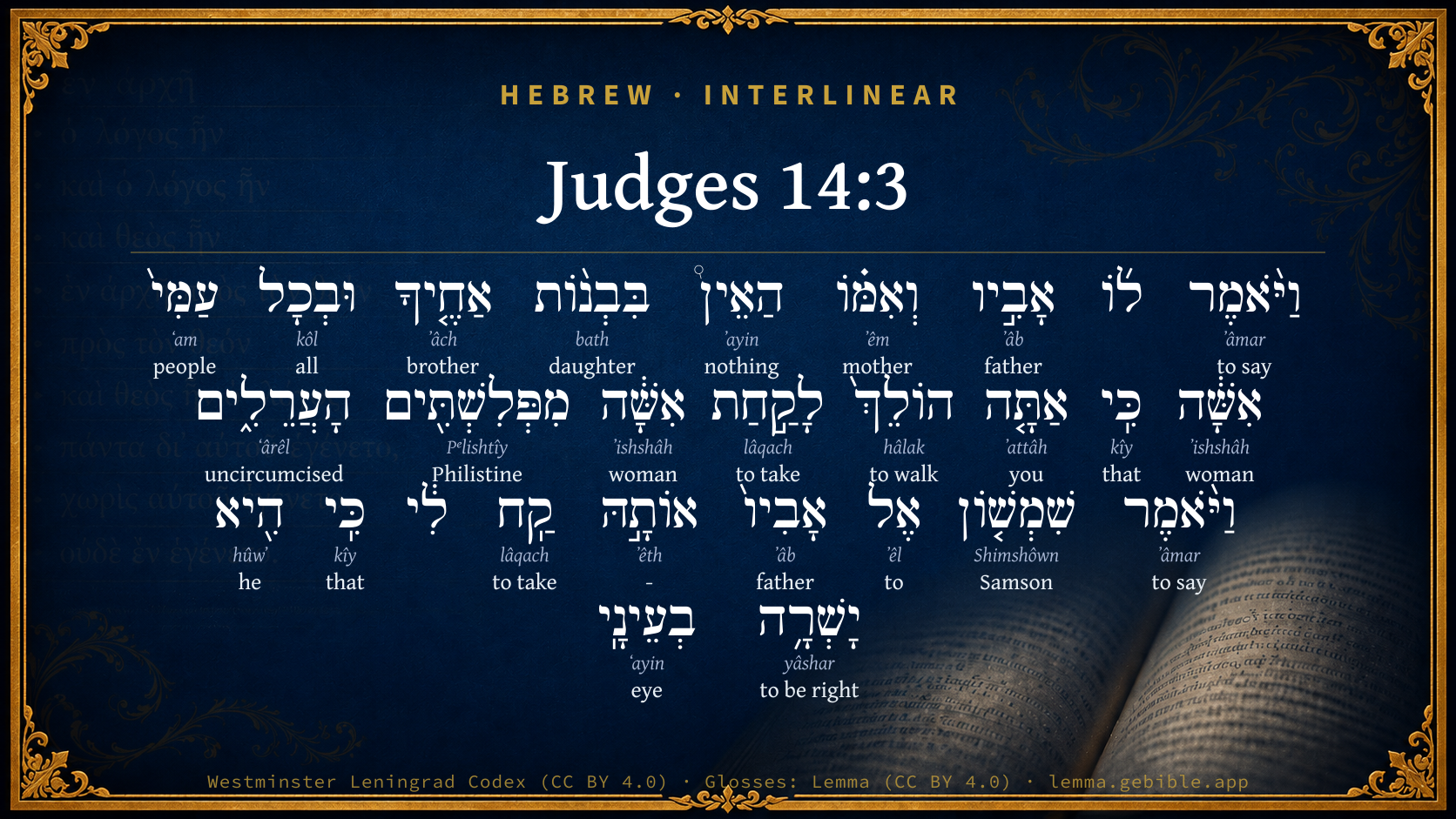
Judges 14:3

Hebrew (Westminster Leningrad Codex) Judges 14:3 appears in the Hebrew Old Testament. The text above is from the Westminster Leningrad Codex. Each word links to its Strong’s number, a concise gloss, and parsing drawn from the Open Scriptures Hebrew Bible morphology. Click any word for its full Brown-Driver-Briggs (BDB) entry.
Download image
Cite this verse

Judges 14:3 (World English Bible). Public Domain. Lemma interlinear Bible study tool, https://lemma.gebible.app/v/judges/14/3.

Show BibTeX & RIS
BibTeX
RIS
English Translation
Then his father and his mother said to him, Is there never a woman among the daughters of your brothers, or among all my people, that you go to take a wife of the uncircumcised Philistines? Samson said to his father, Get her for me; for she pleases me well.
World English Bible · Public Domain
Download a study sheet

One document with this verse’s original text, its word-by-word gloss line, the meaning frame, cross-references with their text, attributed commentary, and full source and license credits — printable, and it pastes into notes with its structure intact.

This verse Autodidact and up

Study sheet (.html) Plain text (.txt)

A passage Seminary Student

Up to 50 verses in one chapter. A passage sheet keeps up to 6 commentary sources and 12 cross-references per verse, in the order this page ranks them, and says so on the sheet whenever that leaves anything out. Ask for a single verse and you get the Autodidact verse sheet above.

Everything on this page stays free to read, with no account — the sheet is a download of what is already on screen, not access to it.

Want to remove ads? Support Godless Engineer
Compare translations 3

The same verse in 3 English versions, stacked beneath the original-language interlinear above. Click any original word for its lexicon entry.

Each is an independent rendering of the whole verse — the interlinear is not word-aligned to these translations.

Highlighted words mark where these versions differ — a whole-verse word diff, not a word-by-word alignment.

  • World English Bible Public Domain
    Then his father and his mother said to him, Is there never a woman among the daughters of your brothers, or among all my people, that you go to take a wife of the uncircumcised Philistines? Samson said to his father, Get her for me; for she pleases me well.
  • King James Version Public Domain
    Then his father and his mother said unto him, Is there never a woman among the daughters of thy brethren, or among all my people, that thou goest to take a wife of the uncircumcised Philistines? And Samson said unto his father, Get her for me; for she pleaseth me well.
  • unfoldingWord Literal Text CC BY-SA 4.0
    And his father and his mother said to him, “ not among the daughters of your brothers and among all of my people a woman, that you going to take a wife from the uncircumcised Philistines?” And Samson said to his father, “Get her for me, for she right in my eyes.”

unfoldingWord Literal Text — © unfoldingWord, licensed CC BY-SA 4.0. Word-aligned USFM3 via Door43 (git.door43.org/unfoldingWord/en_ult).

Versions to compare (up to 4)

3 of 4 selected

Show all 18 translations

Every available English version of this verse, each an independent rendering of the whole verse.

  • World English Bible Public Domain
    Then his father and his mother said to him, Is there never a woman among the daughters of your brothers, or among all my people, that you go to take a wife of the uncircumcised Philistines? Samson said to his father, Get her for me; for she pleases me well.
  • Berean Standard Bible Public Domain
    But his father and mother replied, “Can’t you find a young woman among your relatives or among any of our people? Must you go to the uncircumcised Philistines to get a wife?” But Samson told his father, “Get her for me, for she is pleasing to my eyes.”
  • Majority Standard Bible Public Domain
    But his father and mother replied, “Can’t you find a young woman among your relatives or among any of our people? Must you go to the uncircumcised Philistines to get a wife?” But Samson told his father, “Get her for me, for she is pleasing to my eyes.”
  • King James Version Public Domain
    Then his father and his mother said unto him, Is there never a woman among the daughters of thy brethren, or among all my people, that thou goest to take a wife of the uncircumcised Philistines? And Samson said unto his father, Get her for me; for she pleaseth me well.
  • American Standard Version (1901) Public Domain
    Then his father and his mother said unto him, Is there never a woman among the daughters of thy brethren, or among all my people, that thou goest to take a wife of the uncircumcised Philistines? And Samson said unto his father, Get her for me; for she pleaseth me well.
  • Revised Version (1885) Public Domain
    Then his father and his mother said unto him, Is there never a woman among the daughters of thy brethren, or among all my people, that thou goest to take a wife of the uncircumcised Philistines? And Samson said unto his father, Get her for me; for she pleaseth me well.
  • Geneva Bible (1599) Public Domain
    Then his father and his mother sayde vnto him, Is there neuer a wife among the daughters of thy brethren, and among all my people, that thou must go to take a wife of the vncircumcised Philistims? And Samson sayd vnto his father, Giue mee her, for she pleaseth me well.
  • Douay-Rheims (1899) Public Domain
    And his father and mother said to him: Is there no woman among the daughters of thy brethren, or among all my people, that thou wilt take a wife of the Philistines, who are uncircumcised? And Samson said to his father: Take this woman for me, for she hath pleased my eyes.
  • Young's Literal Translation Public Domain
    And his father saith to him -- also his mother, `Is there not among the daughters of thy brethren, and among all my people, a woman, that thou art going to take a woman from the uncircumcised Philistines?' and Samson saith unto his father, `Take her for me, for she is right in mine eyes.'
  • Literal Standard Version CC BY-SA 4.0
    And his father says to him—also his mother, “Is there no woman among the daughters of your brothers, and among all my people, that you are going to take a woman from the uncircumcised Philistines?” And Samson says to his father, “Take her for me, for she is right in my eyes.”
  • Unlocked Literal Bible CC BY-SA 4.0
    His father and mother said to him, “Is there not a woman among the daughters of your relatives, or among all our people? Are you going to take a wife from the uncircumcised Philistines?” Samson said to his father, “Get her for me, for when I look at her, she pleases me.”
  • unfoldingWord Literal Text CC BY-SA 4.0
    And his father and his mother said to him, “ not among the daughters of your brothers and among all of my people a woman, that you going to take a wife from the uncircumcised Philistines?” And Samson said to his father, “Get her for me, for she right in my eyes.”
  • Darby Bible Public Domain
    But his father and mother said to him, "Is there not a woman among the daughters of your kinsmen, or among all our people, that you must go to take a wife from the uncircumcised Philistines?" But Samson said to his father, "Get her for me; for she pleases me well."
  • World Messianic Bible Public Domain
    Then his father and his mother said to him, “Isn’t there a woman among your brothers’ daughters, or among all my people, that you go to take a wife of the uncircumcised Philistines?” Samson said to his father, “Get her for me, for she pleases me well.”
  • Webster's Bible Public Domain
    Then his father and his mother said to him, Is there not a woman among the daughters of thy brethren, or among all my people, that thou goest to take a wife of the uncircumcised Philistines? And Samson said to his father, Get her for me; for she pleaseth me well.
  • Free Bible Version CC BY-SA 4.0
    But his father and mother replied, “Can't you find a young woman from our tribe or from our own people? Do you have to go to the heathen Philistines to get a wife?” But Samson told his father, “Just get her for me, because she's the one I find attractive.”
  • Bible in Basic English Public Domain
    Then his father and mother said to him, Is there no woman among the daughters of your relations or among all my people, that you have to go for your wife to the Philistines, who are without circumcision? But Samson said to his father, Get her for me, for she is pleasing to me.
  • JPS Tanakh (1917) Public Domain
    Then his father and his mother said unto him: 'Is there never a woman among the daughters of thy brethren, or among all my people, that thou goest to take a wife of the uncircumcised Philistines?' And Samson said unto his father: 'Get her for me; for she pleaseth me well.'

Literal Standard Version (2020), Covenant Press — licensed CC BY-SA 4.0. Text via the HelloAO Bible API (eBible.org). Unlocked Literal Bible (unfoldingWord) — licensed CC BY-SA 4.0. Text via the HelloAO Bible API (eBible.org). unfoldingWord Literal Text — © unfoldingWord, licensed CC BY-SA 4.0. Word-aligned USFM3 via Door43 (git.door43.org/unfoldingWord/en_ult). Free Bible Version, Dr. Jonathan Gallagher — licensed CC BY-SA 4.0. Text via the HelloAO Bible API (eBible.org).

Word by word

More ways to search: Search by grammar → Find every occurrence → Compare this word →

Practice this passage: Drill this verse → Learn its vocabulary →

יָשְׁרָ֥ה
yâshar
H3474
“to be right”
Verb, Qal, Perfect, 3rd Person, Feminine, Singular
Part of Speech
Verb
Stem
Qal
Form
Perfect
Person
3rd Person
Gender
Feminine
Number
Singular
Full BDB Definition

Origin: a primitive root

TWOT: 930

to be right, be straight, be level, be upright, be just, be lawful, be smooth - (Qal) - to go straight - to be pleasing, be agreeable, be right (figuratively) - to be straightforward, be upright - (Piel) - to make right, make smooth, make straight - to lead, direct, lead straight along - to esteem right, approve - (Pual) to be made level, be laid smoothly out - (Hiphil) to make straight, look straight
  1. וַיֹּ֨אמֶר ʼâmar H559 “and · to say” Conjunction + Verb, Qal, Sequential Imperfect, 3rd Person, Masculine, Singular
  2. אָבִ֣יו ʼâb H1 “father · his” Noun, Common, Masculine, Singular, Construct + Suffix, Personal, 3rd Person, Masculine, Singular
  3. וְאִמּ֗וֹ ʼêm H517 “and · mother · his” Conjunction + Noun, Common, Feminine, Singular, Construct + Suffix, Personal, 3rd Person, Masculine, Singular
  4. הַאֵין֩ ʼayin H369 “nothing” Particle, Interrogative + Particle, Negative
  5. בִּבְנ֨וֹת bath H1323 “in/at · daughters of” Preposition + Noun, Common, Feminine, Plural, Construct
  6. אַחֶ֤יךָ ʼâch H251 “brothers · your” Noun, Common, Masculine, Plural, Construct + Suffix, Personal, 2nd Person, Masculine, Singular
  7. וּבְכָל kôl H3605 “and · in/at · all of” Conjunction + Preposition + Noun, Common, Masculine, Singular, Construct
  8. עַמִּי֙ ʻam H5971 “people · my” Noun, Common, Masculine, Singular, Construct + Suffix, Personal, 1st Person, Common, Singular
  9. אִשָּׁ֔ה ʼishshâh H802 “woman” Noun, Common, Feminine, Singular, Absolute
  10. כִּֽי kîy H3588 “that” Conjunction
  11. אַתָּ֤ה ʼattâh H859 “you” Pronoun, Personal, 2nd Person, Masculine, Singular
  12. הוֹלֵךְ֙ hâlak H1980 “walking” Verb, Qal, Participle Active, Masculine, Singular, Absolute
  13. לָקַ֣חַת lâqach H3947 “to take” Preposition + Verb, Qal, Infinitive Construct
  14. אִשָּׁ֔ה ʼishshâh H802 “woman” Noun, Common, Feminine, Singular, Absolute
  15. מִפְּלִשְׁתִּ֖ים Pᵉlishtîy H6430 “from · Philistines” Preposition + Noun, Gentilic, Masculine, Plural, Absolute
  16. הָעֲרֵלִ֑ים ʻârêl H6189 “the · uncircumcised” Particle, Definite Article + Adjective, Adjective, Masculine, Plural, Absolute
  17. וַיֹּ֨אמֶר ʼâmar H559 “and · to say” Conjunction + Verb, Qal, Sequential Imperfect, 3rd Person, Masculine, Singular
  18. שִׁמְשׁ֤וֹן Shimshôwn H8123 “Samson” Noun, Proper
  19. אֶל ʼêl H413 “to” Preposition
  20. אָבִיו֙ ʼâb H1 “father · his” Noun, Common, Masculine, Singular, Construct + Suffix, Personal, 3rd Person, Masculine, Singular
  21. אוֹתָ֣הּ ʼêth H853 “- · her” Particle, Direct Object + Suffix, Personal, 3rd Person, Feminine, Singular
  22. קַֽח lâqach H3947 “take” Verb, Qal, Imperative, 2nd Person, Masculine, Singular
  23. כִּֽי kîy H3588 “that” Conjunction
  24. הִ֖יא hûwʼ H1931 “he” Pronoun, Personal, 3rd Person, Feminine, Singular
  25. בְעֵינָֽי ʻayin H5869 “in/at · eyes · my” Preposition + Noun, Common, Both, Dual, Construct + Suffix, Personal, 1st Person, Common, Singular

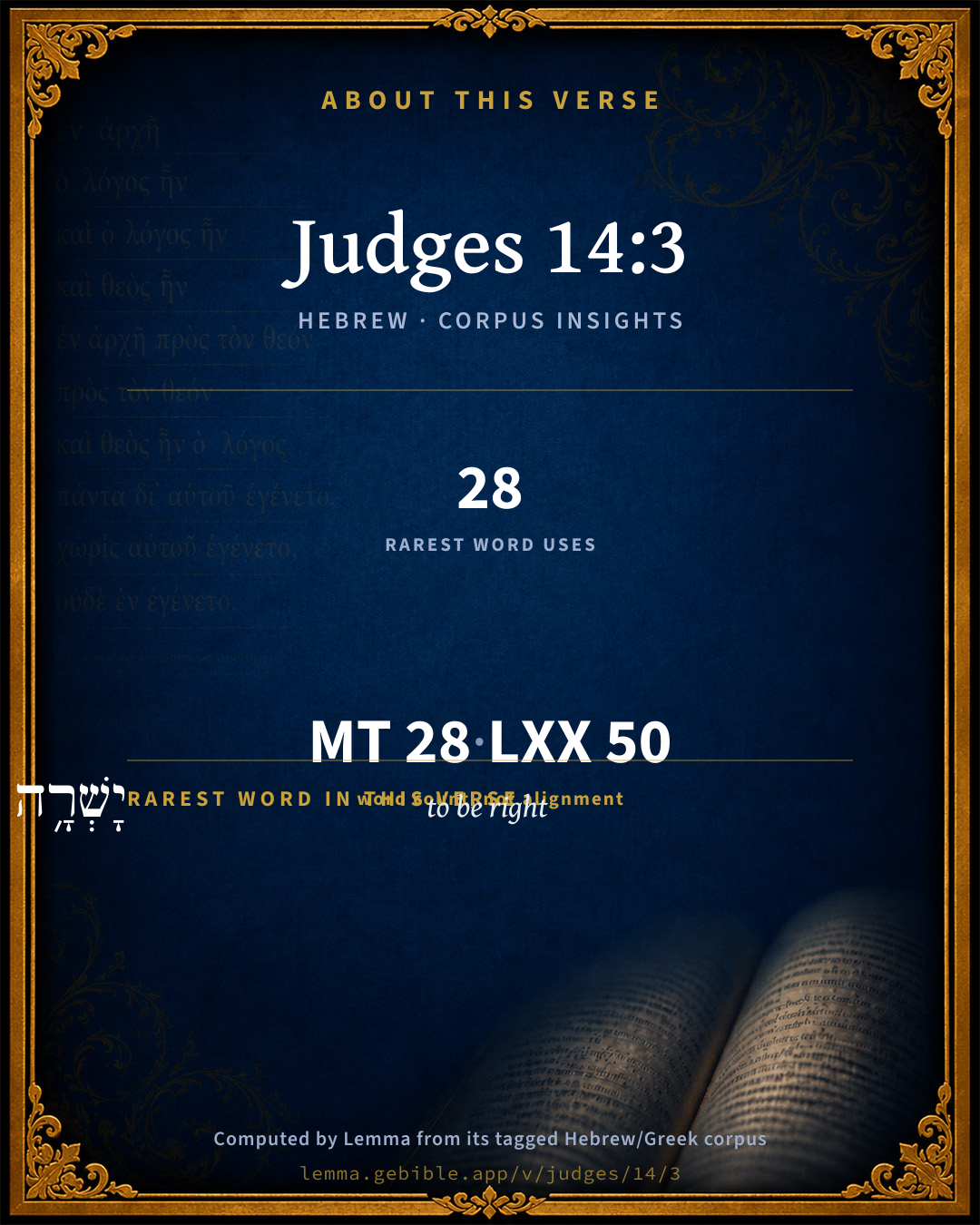
About this verse

These counts appear in no published source. They are computed here, from the morphology-tagged text and Lemma’s own curated glosses. What Lemma adds →

28
words
21
distinct lemmas
Historical
section

Shared distinctive vocabulary

יָשְׁרָ֥ה to be right H3474 occurs in 26 verses of the Hebrew Bible. Also found in:

Grammatical profile

  • 6 verbs
  • 12 nouns
  • 1 adjective
  • 2 pronouns
  • 3 prepositions
  • 2 conjunctions
  • 2 particles

Verb forms

  • וַיֹּ֨אמֶר Qal · Sequential Imperfect
  • הוֹלֵךְ֙ Qal · Participle Active
  • לָקַ֣חַת Qal · Infinitive Construct
  • וַיֹּ֨אמֶר Qal · Sequential Imperfect
  • קַֽח Qal · Imperative
  • יָשְׁרָ֥ה Qal · Perfect

Repetition

Words recur within this verse — often emphatic in Hebrew:

  • וַיֹּ֨אמֶר to say H559 ×2
  • אָבִ֣יו father H1 ×2
  • אִשָּׁ֔ה woman H802 ×2
  • לָקַ֣חַת to take H3947 ×2
  • כִּֽי that H3588 ×2

Hebrew & Septuagint length

In English translation the verse runs 50 words from the Hebrew and 54 from the Septuagint (LXX English) — closely comparable.

A rough comparison of the two English renderings, which tokenize alike — not a word-level alignment.

Word counts can differ between the Hebrew and the Greek without any difference in meaning — e.g. the Hebrew direct-object marker אֵת has no separate Greek word, and Greek often adds the article ὁ.

In the original languages it is 28 Hebrew tokens and 50 Greek tokens — but the two are counted differently (Hebrew bundles its prefixes and suffixes into one token; the Greek is in lemma form), so that isn’t a like-for-like length.

Cross-references

13

Topical passages linked to Judges 14:3 in the Treasury of Scripture Knowledge — connected by theme and wording, ordered by reader-vote popularity; previews shown in the World English Bible.

  • Deuteronomy 7:2–3 and when Yahweh your God shall deliver them up before you, and you shall strike them; then you shall utterly destroy them: you shall make no covenant with them, nor show mercy to them;
  • Judges 15:18 He was very thirsty, and called on Yahweh, and said, You have given this great deliverance by the hand of your servant; and now shall I die for thirst, and fall into the hand of the uncircumcised.
  • 1 Samuel 17:36 Your servant struck both the lion and the bear: and this uncircumcised Philistine shall be as one of them, seeing he has defied the armies of the living God.
  • Exodus 34:12–16 Be careful, lest you make a covenant with the inhabitants of the land where you are going, lest it be for a snare in the midst of you:
  • 1 Samuel 14:6 Jonathan said to the young man who bore his armor, Come, and let us go over to the garrison of these uncircumcised: it may be that Yahweh will work for us; for there is no restraint to Yahweh to save by many or by few.
  • 1 Samuel 17:26 David spoke to the men who stood by him, saying, What shall be done to the man who kills this Philistine, and takes away the reproach from Israel? for who is this uncircumcised Philistine, that he should defy the armies of the living God?
  • 1 Samuel 31:4 Then said Saul to his armor bearer, Draw your sword, and thrust me through therewith, lest these uncircumcised come and thrust me through, and abuse me. But his armor bearer would not; for he was sore afraid. Therefore Saul took his sword, and fell on it.
  • 2 Samuel 1:20 Don't tell it in Gath, Don't publish it in the streets of Ashkelon; Lest the daughters of the Philistines rejoice, Lest the daughters of the uncircumcised triumph.
  • Genesis 13:8 Abram said to Lot, "Please, let there be no strife between me and you, and between my herdsmen and your herdsmen; for we are relatives.
  • Genesis 21:3–4 Abraham called his son who was born to him, whom Sarah bare to him, Isaac.
  • Genesis 24:3–4 I will make you swear by Yahweh, the God of heaven and the God of the earth, that you shall not take a wife for my son of the daughters of the Canaanites, among whom I live.
  • Genesis 34:14 and said to them, "We can't do this thing, to give our sister to one who is uncircumcised; for that is a reproach to us.
  • Genesis 21:27 Abraham took sheep and oxen, and gave them to Abimelech. Those two made a covenant.

Cross-references courtesy of OpenBible.info (CC BY 4.0).

Hebrew and Greek witnesses Masoretic Hebrew ↔ Greek Septuagint

The same verse in the two great witnesses to the Old Testament, shown verse-for-verse.

These are two independent witnesses, not word-aligned to each other, and the Septuagint is shown in lemma (dictionary) form.

Hebrew Judges 14:3 Masoretic · Westminster Leningrad Codex

וַיֹּ֨אמֶר ל֜וֹ אָבִ֣יו וְאִמּ֗וֹ הַאֵין֩ בִּבְנ֨וֹת אַחֶ֤יךָ וּבְכָל עַמִּי֙ אִשָּׁ֔ה כִּֽי אַתָּ֤ה הוֹלֵךְ֙ לָקַ֣חַת אִשָּׁ֔ה מִפְּלִשְׁתִּ֖ים הָעֲרֵלִ֑ים וַיֹּ֨אמֶר שִׁמְשׁ֤וֹן אֶל אָבִיו֙ אוֹתָ֣הּ קַֽח לִ֔י כִּֽי הִ֖יא יָשְׁרָ֥ה בְעֵינָֽי

Then his father and his mother said to him, Is there never a woman among the daughters of your brothers, or among all my people, that you go to take a wife of the uncircumcised Philistines? Samson said to his father, Get her for me; for she pleases me well.

World English Bible · Public Domain

Greek LXX Judges 14:3 Septuagint · lemma form

καί εἶπον αὐτός ὁ πατήρ αὐτός καί ὁ μήτηρ αὐτός μή οὐ εἰμί θυγάτηρ ὁ ἀδελφός σύ καί ἐκ πᾶς ὁ λαός ἐγώ γυνή ὅτι σύ πορεύομαι λαμβάνω γυνή ἀπό ὁ ἀλλόφυλος ὁ ἀπερίτμητος καί εἶπον σαμψων πρός ὁ πατήρ αὐτός οὗτος λαμβάνω ἐγώ ὅτι οὗτος εὐθύς ἐν ὀφθαλμός ἐγώ

And his father and his mother said to him, Are there no daughters of your brethren, and is there not a woman of all my people, that you go to take a wife of the uncircumcised Philistines? And Sampson said to his father, Take her for me, for she is right in my eyes.

LXX2012 (modern English Septuagint) · Public Domain

Hebrew: Westminster Leningrad Codex (CC BY 4.0). Greek: Septuagint (public domain); English from LXX2012 (modern English Septuagint) (Public Domain). How the Septuagint differs from the Hebrew →

Targum (Aramaic paraphrase)

1

The Targum is the ancient Jewish Aramaic paraphrase of the Hebrew Scriptures — an interpretive translation, not the Hebrew text itself. Onkelos (literal) and Pseudo-Jonathan (expansive) render the Torah, and Jonathan the Prophets. Coverage is partial: where no permissively-licensed English translation exists for a verse, only the Aramaic is shown. This is verse-level text, not a word-by-word alignment to the Hebrew.

  1. Targum Jonathan Prophets (Joshua–Malachi)
    וַאֲמַרוּ לֵיהּ אֲבוּהִי וְאִמֵיהּ הָא לֵית בִּבְנַת אַחָךְ וּבְכָל עַמִי אִתְּתָא דְאַתְּ אָזֵיל לְמִיסַב אִתְּתָא מִפְּלִשְׁתָּאֵי עֲרֵלַיָא וַאֲמַר שִׁמְשׁוֹן לַאֲבוּהִי יָתָהּ סַב לִי אֲרֵי הִיא כַּשְׁרַת בְּעֵינָי:

    (no public-domain English translation for this verse)

    Targum Jonathan — Aramaic: “Mikraot Gedolot” (public domain). English: “Sefaria Community Translation” (CC0 1.0 (public-domain dedication)); “London "Chaldee Paraphrase," 1871” (public domain). Text via Sefaria.

Commentary

Notes on Judges 14:3 from classic Christian and Jewish commentators (each source and its license shown beneath its notes). The classic Christian expositions comment on the surrounding passage and are grouped to its opening verse, so a note may address several verses; the Jewish commentaries on the Tanakh (Rashi and others) are per-verse, so they appear only where the commentator wrote on this verse.

Lemma curates 59 commentaries, every one of them public domain or Creative Commons licensed, each selected and text-cleaned for this edition rather than reprinted as found. About our sources →

Trapp's Complete Commentary

John Trapp

Jdg 14:3 Then his father and his mother said unto him, [Is there] never a woman among the daughters of thy brethren, or among all my people, that thou goest to take a wife of the uncircumcised Philistines? And Samson said unto his father, Get her for me; for she pleaseth me well.

Ver. 3. Then his father and his mother said unto him.] I wish, saith a grave divine, Manoah and his wife could speak so loud that all our Israelites might hear him.

Is there never a woman? &c.] If religion be any other than a cipher, how dare we not regard it in our most important choice? Marriage is like a stratagem of war, saith another, where one can err but once. Therefore the heathens were wont to set Mercury, their god of wisdom, by Venus, their goddess of marriage, to note that there was need of judgment there; and that it is not evil to marry, but good to be wary.

For she pleaseth me well.] The eye indeed is to be pleased in the choice of a wife; but that is not the chief thing to be minded; there is a better beauty; and many a man hath died of the wound in the eye.

John Trapp, A Commentary or Exposition upon All the Books of the Old and New Testament (1647–1656) — public domain. Text from a community e-Sword module.

Joseph Benson's Commentary

Jdg 14:3. To take a wife of the uncircumcised Philistines — With whom the Israelites were forbidden to marry. For although the Philistines were not Canaanites in their original, yet they were so in their concurrence with them in wickedness, and therefore were liable to the same judgments with them. Get her for me — This action of Samson’s, though against common rules, seems to be warranted by the direction of God, (mentioned in the following words,) which was known to Samson, but not to his parents. Pleaseth me — Not so much for her beauty, as for the design mentioned in the next verse.

Joseph Benson's Commentary on the Old and New Testaments (1811–1818) — public domain. Text from a community e-Sword module.

Geneva Bible (1599)

Geneva Bible translators

Though his parents did justly reprove him, yet it appeareth that this was the secret work of the Lord, verse 4.

Geneva Bible (1599) marginal notes — public domain. Text via Bolls.life.

Jamieson, Fausset & Brown

Robert Jamieson, A. R. Fausset & David Brown

Is there never a woman among the daughters of thy brethren--that is, "of thine own tribe"--a Danite woman.

Samson said . . . Get her for me; for she pleaseth me well--literally, "she is right in mine eyes"; not by her beautiful countenance or handsome figure, but right or fit for his purpose. And this throws light on the historian's remark in reference to the resistance of his parents: they "knew not that it was of the Lord, that he sought an occasion against the Philistines"--rather, "from the Philistines"--originating on their side. The Lord, by a course of retributive proceedings, was about to destroy the Philistine power, and the means which He meant to employ was not the forces of a numerous army, as in the case of the preceding judges, but the miraculous prowess of the single-handed champion of Israel. In these circumstances, the provocation to hostilities could only spring out of a private quarrel, and this marriage scheme was doubtless suggested by the secret influence of the Spirit as the best way of accomplishing the intended result.

Jamieson, Fausset & Brown — Commentary Critical and Explanatory on the Whole Bible (1871) — public domain (CC PDM 1.0). Text via the HelloAO Bible API.

Adam Clarke's Commentary

Verse 3. Is there never a woman] To marry with any that did not belong to the Israelitish stock, was contrary to the law, Ex 34:16; De 7:3. But this marriage of Samson was said to be of the Lord, Jdg 14:4; that is, God permitted it, (for in no other sense can we understand the phrase,) that it might be a means of bringing about the deliverance of Israel.

For she pleaseth me well.] כי היאישרה בעיני ki hi yisherah beeynai, for she is right in my eyes. This is what is supposed to be a sufficient reason to justify either man or woman in their random choice of wife or husband; the maxim is the same with that of the poet: -

"Thou hast no fault, or I no fault can spy;

Thou art all beauty or all blindness I."

When the will has sufficient power, its determinations are its own rule of right. That will should be pure and well directed that says, It shall be so, because I WILL it should be so. A reason of this kind is similar to that which I have seen in a motto on the brass ordnance of Lewis XIV., ULTIMA RATIO REGUM, the sum of regal logic; i.e., "My will, backed by these instruments of destruction, shall be the rule of right and wrong." The rules and principles of this logic are now suspected; and it is not likely to be generally received again without violent demonstration.

Adam Clarke's Commentary on the Bible (1810–1826) — public domain. Text from a community e-Sword/MySword module.

Ellicott's Commentary for English Readers

(3) Of the uncircumcised Philistines.—This on the lips of Israelites was a term of peculiar hatred (1Sa_17:36). How repugnant such a marriage would be in the eyes of Manoah and his wife we may see from the story of Simeon, Levi, and the Shechemites (Gen. xxxiv).

She pleaseth me well.—Literally, she is right in my eyes (Jdg_14:7; 1Ki_9:12).

A Bible Commentary for English Readers, edited by Charles John Ellicott (1878–1897) — public domain. Text from a community e-Sword module.

The Cambridge Bible for Schools and Colleges

gen. ed. J. J. S. Perowne

3. It was the father’s business to arrange a marriage and the amount of the dowry, e.g. Gen_24:2 ff; Gen_34:4; Gen_38:6. Hence the father alone is named in clause b; in cl. a the words and his mother look like an insertion to harmonize with Jdg_14:2 : note my people; said is singular.

the uncircumcised] A standing term of contempt in Judg. and Sam., pointing to the alien origin of the Philistines, the only uncircumcised people known to the early Israelites; see on Jdg_13:1 and cf. 1Sa_18:25. A marriage outside the tribe was looked upon with disfavour, Gen_29:19; both tribal feeling and religious motives would combine against an alliance with a Philistine; cf. Gen_24:3, Exo_34:16 (JE), Deu_7:3.

The Cambridge Bible for Schools and Colleges (gen. ed. J. J. S. Perowne; Cambridge University Press, 1878–1918) — public domain. Text from a community e-Sword module.

John Gill's Exposition

Then his father and his mother said unto him,.... What he might expect, and doubtless did expect:

is there never a woman among the daughters of thy brethren, or among all my people, that thou goest to take a wife of the uncircumcised Philistines? none in their own family, nor in the tribe of Dan, nor among the whole nation of Israel, but must go among the uncircumcised Philistines; for though they were not of the seven nations of the Canaanites, with whom marriage was forbidden, yet they not only dwelt where they did, and where the Israelites should, but were idolaters and impure persons, and therefore affinity should not be contracted with them, as being of a dangerous consequence, which might entice to idolatry. Ben Gersom observes, that their Rabbins say he made her a proselyte first, though he did not acquaint his parents with it, and so Abarbinel; but this seems not likely, for, had this been the case, he would have had an easy and ready reply to this objection of theirs:

and Samson said unto his father, get her for me, for she pleaseth me well; or "is right in mine eyes" (x); not only his eyes were taken with her beauty or external form, but it was right in his sight, in his judgment, to marry her; he having an impulse upon his mind from the Spirit of God unto it, though he did not let his parents know of it, but left them to conclude it sprung from a strong affection to her person. Abarbinel observes, that he only addressed his father, and not his mother, she being most vehemently against the match, and expressing more uneasiness at it than his father did; but it is most likely that he addressed his father particularly, because he was the proper person to negotiate this affair for him.

(x) "recta in oculis meis", Montanus, Junius et Tremellius.

John Gill's Exposition of the Whole Bible (1746–1763) — public domain (CC PDM 1.0). Text via the HelloAO Bible API.

Albert Barnes' Notes on the Bible

The uncircumcised Philistines - Compare 1Sa 14:6; 1Sa 17:26; 1Sa 31:4, for a similar use of the term as one of reproach. Also Act 11:3.

Albert Barnes' Notes on the Bible (1834–1885) — public domain. Text from a community e-Sword/MySword module.

Haydock's Catholic Bible Commentary

Eyes. He probably informed his parents (Haydock) that he was inspired by the Lord, ver. 4. (Worthington) --- The Jews say that he had first converted this woman; and interpreters generally excuse his conduct. But St. Ambrose thinks that he forfeited God’s grace; (ep. 19) and Theodoret also supposes that he transgressed the law, (Exodus xxxiv. 12.) and God only permitted him to fall in love with women, without approving his conduct, q. 21. The Scripture often says, that he does and wills what he only permits, Exodus iv. 21., and Josue xi. 20. (Calmet) --- If the conversion of this woman were well attested, there would be no difficulty about his marrying her, as Salmon did Rahab, St. Matthew i. 5. We have only conjecture that the women whom these and other holy personages espoused, embraced the true faith. But these may suffice in a matter of this nature. We cannot condemn Samson on this occasion, without involving his parents in the same censure, as they were charged to keep him from any contamination. St. Ambrose justly observes that a woman was the occasion of his fall, but he might allude to Dalilia, chap. xvi. 4. It seems hard to pass sentence on this judge of Israel, on his first appearance, without the most cogent reasons. See Lyranus, Cornelius a Lapide, &c. (Haydock) --- Hebrew, "She is right in my eyes." His parents were at length convinced that he was directed by God. (Tirinus)

George Leo Haydock (1774–1849), Haydock's Catholic Family Bible and Commentary, 1859 edition — public domain. Excludes Psalms (Douay-Rheims chapter numbering differs from Protestant) and Deuterocanonical books (Catholic canon only).

Matthew Poole's English Annotations

The uncircumcised Philistines, with whom the Israelites were forbidden to marry, Exo 34:12, &c. And although the Philistines were not Canaanites in their original, Gen 10:14; Deu 2:23; yet they were so in their habitation, and concurrence with them in wickedness, and therefore were liable to the same censures and judgments with them.

Get her for me: this action of Samson’s, though against common rules, seems to be warranted, partly by the greatness and goodness of his design in it, and principally by the instinct and direction of God, which is mentioned in the following words, which was known to Samson, but not to his parents.

She pleaseth me well; not so much for her beauty, as for the design mentioned in the next verse.

Matthew Poole's English Annotations on the Holy Bible (1683–1685) — public domain. Text from a community e-Sword/MySword module.

Whedon's Commentary on the Bible

Daniel D. Whedon

3. Daughters of thy brethren — That is, women of the tribe of the Danites.

All my people — All Israel, in distinction from the tribe of Dan.

A wife of the uncircumcised — The law forbade marriages with Canaanitish women, (Exo_34:16; Deu_7:3,) and therefore the opposition of Samson’s parents to his marriage was well founded. The Philistines are not usually classified with the Canaanitish tribes, but in respect to Israel and the law they were aliens and idolaters. Compare Jos_13:3.

She pleaseth me well — Literally, She is righteous in my eyes. Samson saw in her no evil, no wrong.

Daniel D. Whedon (gen. ed.), Commentary on the Old and New Testaments (1874–1909) — public domain. Text from a community e-Sword module.

The Pulpit Commentary

Uncircumcised. Cf. Gen_34:14. A term of reproach here added to deter Samson from the marriage. It is particularly applied to the Philistines. (see Jud_1:15:18 1Sa_17:26, 36 18:29 31:4 2Sa_1:20, etc.)

The Pulpit Commentary (1880–1919), ed. H.D.M. Spence-Jones & Joseph S. Exell — public domain. Text from a community e-Sword module.

John Wesley's Explanatory Notes

Philistines - With whom the Israelites were forbidden to marry. For although the Philistines were not Canaanites in their original, yet they were so in their concurrence with them in wickedness, and therefore were liable to the same judgments with them. Get her - This action of Samson's, though against common rules, seems to be warranted, by the direction of God, (mentioned in the following words) which was known to Samson, but not to his parents. Pleaseth me - Not so much for her beauty, as for the design mentioned in the next verse.

John Wesley, Explanatory Notes Upon the Whole Bible (1754–1765) — public domain. Text via the GEBible commentary corpus.

Keil & Delitzsch

C. F. Keil & F. Delitzsch

His parents expressed their astonishment at the choice, and asked him whether there was not a woman among the daughters of his brethren (i.e., the members of his own tribe), or among all his people, that he should want to fetch one from the Philistines, the uncircumcised. But Samson repeated his request, because the daughter of the Philistines pleased him. The aversion of his parents to the marriage was well founded, as such a marriage was not in accordance with the law. It is true that the only marriages expressly prohibited in Exo 34:16 and Deu 7:3-4, are marriages with Canaanitish women; but the reason assigned for this prohibition was equally applicable to marriages with daughters of the Philistines. In fact, the Philistines are reckoned among the Canaanites in Jos 13:3 upon the very same ground. But Samson was acting under a higher impulse, whereas his parents did not know that it was from Jehovah, i.e., that Jehovah had so planned it; "for Samson was seeking an opportunity on account of the Philistines," i.e., an occasion to quarrel with them, because, as is afterwards added in the form of an explanatory circumstantial clause, the Philistines had dominion over Israel at that time. תּאנה, ἁπ. λεγ., an opportunity (cf. התאנּה, Kg2 5:7).

Keil & Delitzsch — Biblical Commentary on the Old Testament (1861–1891) — public domain (CC PDM 1.0). Text via the HelloAO Bible API. (Old Testament only.)

unfoldingWord translationNotes

Door43 World Missions Community

Is there not a woman among the daughters of your relatives, or among all our people?

They ask this question to suggest that they could find Samson a wife among their own people. This question can be written as a statement. AT: "Surely there are women among your people whom you could marry." (See: Rhetorical Question)

the daughters of your relatives

The word "daughter" is a polite way to refer to a young, unmarried woman. AT: "one of the unmarried women among your relatives" (See: Euphemism)

Are you going to take a wife from the uncircumcised Philistines?

This question is asked to rebuke Samson. This question can be written as a statement. You can make explicit the reason his parents do not want him to marry a Philistine. AT: "You really should not marry a Philistine woman because the Philistine people do not worship Yahweh." (See: Rhetorical Question and Assumed Knowledge and Implicit Information)

Get her for me

This is an idiom. Samson was demanding his parents to speak to the Philistine woman's parents about marriage. AT: "Now arrange for her to be my wife" (See: Idiom)

she pleases me

This means that Samson thinks she is beautiful. "I am pleased by how beautiful she is" or "she is beautiful" (See: Assumed Knowledge and Implicit Information)

this matter

This refers to Samson's request to marry the Philistine woman.

for he desired to create a conflict

The word "he" refers to Yahweh.

translationWords

circumcise

Philistines

Samson

Yahweh

rule

Israel

unfoldingWord translationNotes — © Distant Shores Media and the Door43 World Missions Community, licensed CC BY-SA 4.0. Source: git.door43.org/Door43/en_tn.

Lesson kit

Teaching starters — assembled from the data on this page, not authored interpretation. Every prompt links to the verse data it draws on. Edit before teaching.

Judges, in the Historical, opens this verse with 28 words (21 distinct Hebrew lemmas). Its most distinctive word is yâshar (“to be right”). A historical commentator’s framing appears above. Read the whole chapter for the surrounding context.

Discussion questions

  1. What does “to be right” (yâshar) contribute to the verse as a whole?
  2. Numbers 23:27 shares the word «to be right» with this verse. How do the two illuminate each other?
  3. “to say” occurs 2× in this one verse. What is the effect of the repetition?
  4. These translations render this verse differently; the difference is in the English rendering, not the original. What questions does that raise?
  5. The verb «וַיֹּ֨אמֶר» is Qal Sequential Imperfect. How does its form color the action?
  6. Reading how Trapp's Complete Commentary and Joseph Benson's Commentary read this verse, where do the two commentators agree and where do they part?

Things to notice

Reading settings

Reading text

Shown beneath each verse's original-language words.

Old Testament
Old Testament edition

Read the OT as the Masoretic Hebrew (MT) or the Greek Septuagint (LXX).

English shown for the Greek Septuagint (in the Hebrew ↔ Greek comparison).

Comparing translations? Open the Compare panel on any verse page to stack up to four side by side.