Isaiah 1:15

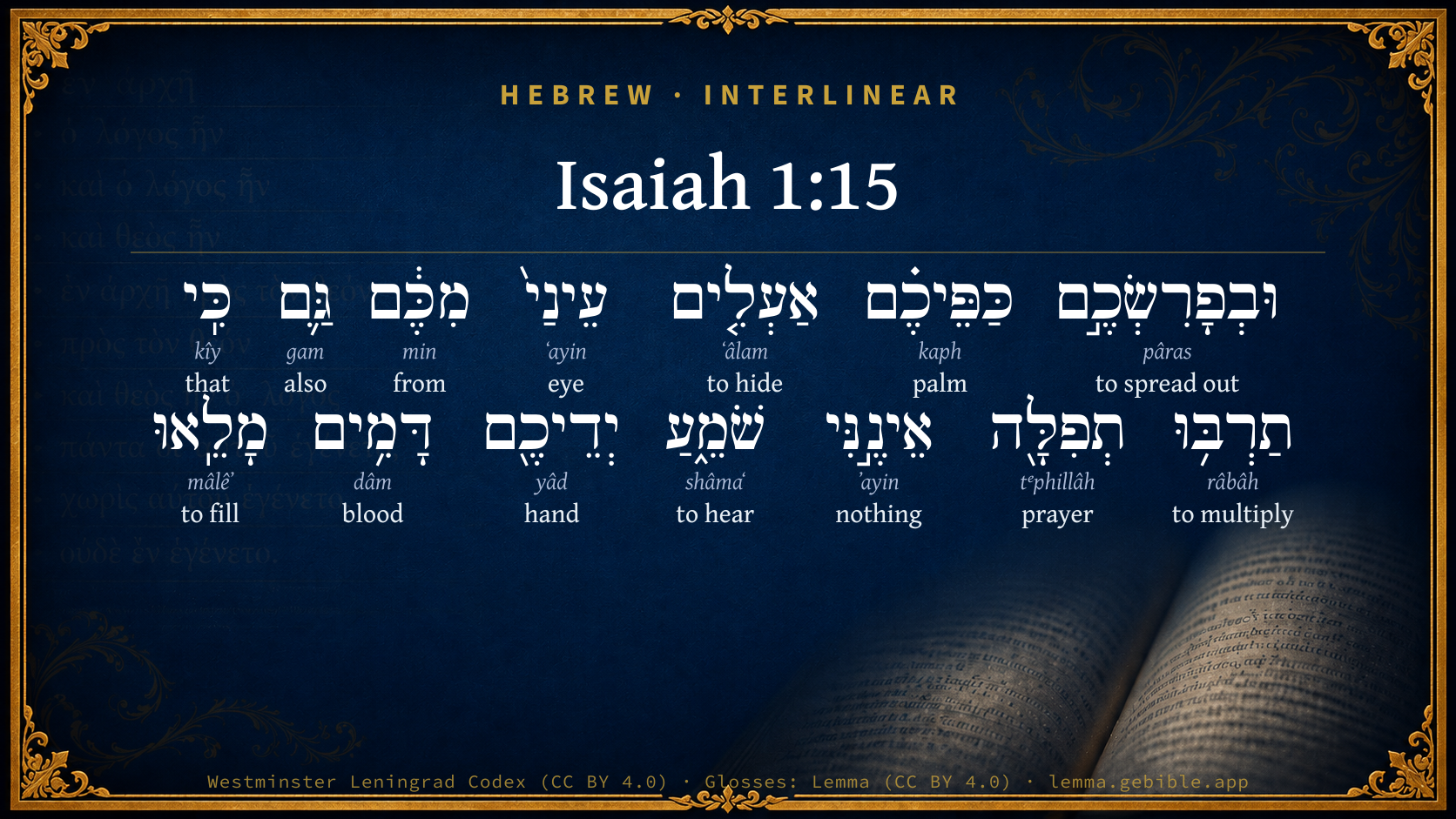
Hebrew (Westminster Leningrad Codex) Isaiah 1:15 appears in the Hebrew Old Testament. The text above is from the Westminster Leningrad Codex. Each word links to its Strong’s number, a concise gloss, and parsing drawn from the Open Scriptures Hebrew Bible morphology. Click any word for its full Brown-Driver-Briggs (BDB) entry.
Download image
Cite this verse

Isaiah 1:15 (World English Bible). Public Domain. Lemma interlinear Bible study tool, https://lemma.gebible.app/v/isaiah/1/15.

Show BibTeX & RIS
BibTeX
RIS
English Translation
When you spread forth your hands, I will hide my eyes from you; Yes, when you make many prayers, I will not hear. Your hands are full of blood.
World English Bible · Public Domain
Download a study sheet

One document with this verse’s original text, its word-by-word gloss line, the meaning frame, cross-references with their text, attributed commentary, and full source and license credits — printable, and it pastes into notes with its structure intact.

This verse Autodidact and up

Study sheet (.html) Plain text (.txt)

A passage Seminary Student

Up to 50 verses in one chapter. A passage sheet keeps up to 6 commentary sources and 12 cross-references per verse, in the order this page ranks them, and says so on the sheet whenever that leaves anything out. Ask for a single verse and you get the Autodidact verse sheet above.

Everything on this page stays free to read, with no account — the sheet is a download of what is already on screen, not access to it.

Want to remove ads? Support Godless Engineer
Compare translations 3

The same verse in 3 English versions, stacked beneath the original-language interlinear above. Click any original word for its lexicon entry.

Each is an independent rendering of the whole verse — the interlinear is not word-aligned to these translations.

Highlighted words mark where these versions differ — a whole-verse word diff, not a word-by-word alignment.

  • World English Bible Public Domain
    When you spread forth your hands, I will hide my eyes from you; Yes, when you make many prayers, I will not hear. Your hands are full of blood.
  • King James Version Public Domain
    And when ye spread forth your hands, I will hide mine eyes from you: yea, when ye make many prayers, I will not hear: your hands are full of blood.
  • unfoldingWord Literal Text CC BY-SA 4.0
    And when you spread out your palms, I hide my eyes from you. Even when you multiply prayer, I am not listening. Your hands are full blood.

unfoldingWord Literal Text — © unfoldingWord, licensed CC BY-SA 4.0. Word-aligned USFM3 via Door43 (git.door43.org/unfoldingWord/en_ult).

Versions to compare (up to 4)

3 of 4 selected

Show all 18 translations

Every available English version of this verse, each an independent rendering of the whole verse.

  • World English Bible Public Domain
    When you spread forth your hands, I will hide my eyes from you; Yes, when you make many prayers, I will not hear. Your hands are full of blood.
  • Berean Standard Bible Public Domain
    When you spread out your hands in prayer, I will hide My eyes from you; even though you multiply your prayers, I will not listen. Your hands are covered with blood.
  • Majority Standard Bible Public Domain
    When you spread out your hands in prayer, I will hide My eyes from you; even though you multiply your prayers, I will not listen. Your hands are covered with blood.
  • King James Version Public Domain
    And when ye spread forth your hands, I will hide mine eyes from you: yea, when ye make many prayers, I will not hear: your hands are full of blood.
  • American Standard Version (1901) Public Domain
    And when ye spread forth your hands, I will hide mine eyes from you; yea, when ye make many prayers, I will not hear: your hands are full of blood.
  • Revised Version (1885) Public Domain
    And when ye spread forth your hands, I will hide mine eyes from you: yea, when ye make many prayers, I will not hear: your hands are full of blood.
  • Geneva Bible (1599) Public Domain
    And when you shall stretch out your hands, I wil hide mine eyes from you: and though ye make many prayers, I wil not heare: for your hands are full of blood.
  • Douay-Rheims (1899) Public Domain
    And when you stretch forth your hands, I will turn away my eyes from you: and when you multiply prayer, I will not hear: for your hands are full of blood.
  • Young's Literal Translation Public Domain
    And in your spreading forth your hands, I hide mine eyes from you, Also when ye increase prayer, I do not hear, Your hands of blood have been full.
  • Literal Standard Version CC BY-SA 4.0
    And in your spreading forth your hands, I hide My eyes from you, || Also when you increase prayer, I do not hear, || Your hands have been full of blood.
  • Unlocked Literal Bible CC BY-SA 4.0
    So when you spread out your hands in prayer, I hide my eyes from you; even though you offer many prayers, I will not listen; your hands are full of blood.
  • unfoldingWord Literal Text CC BY-SA 4.0
    And when you spread out your palms, I hide my eyes from you. Even when you multiply prayer, I am not listening. Your hands are full blood.
  • Darby Bible Public Domain
    And when ye spread forth your hands, I will hide mine eyes from you; yea, when ye make many prayers, I will not hear: your hands are full of blood.
  • World Messianic Bible Public Domain
    When you spread out your hands, I will hide my eyes from you. Yes, when you make many prayers, I will not hear. Your hands are full of blood.
  • Webster's Bible Public Domain
    And when ye spread forth your hands, I will hide my eyes from you: yes, when ye make many prayers, I will not hear: your hands are full of blood.
  • Free Bible Version CC BY-SA 4.0
    When you hold up your hands to me in prayer, I'll look away. Even though you pray many prayers, I won't pay attention to them, because your hands are full of blood.
  • Bible in Basic English Public Domain
    And when your hands are stretched out to me, my eyes will be turned away from you: even though you go on making prayers, I will not give ear: your hands are full of blood.
  • JPS Tanakh (1917) Public Domain
    And when ye spread forth your hands, I will hide Mine eyes from you; yea, when ye make many prayers, I will not hear; your hands are full of blood.

Literal Standard Version (2020), Covenant Press — licensed CC BY-SA 4.0. Text via the HelloAO Bible API (eBible.org). Unlocked Literal Bible (unfoldingWord) — licensed CC BY-SA 4.0. Text via the HelloAO Bible API (eBible.org). unfoldingWord Literal Text — © unfoldingWord, licensed CC BY-SA 4.0. Word-aligned USFM3 via Door43 (git.door43.org/unfoldingWord/en_ult). Free Bible Version, Dr. Jonathan Gallagher — licensed CC BY-SA 4.0. Text via the HelloAO Bible API (eBible.org).

Word by word

More ways to search: Search by grammar → Find every occurrence → Compare this word →

Practice this passage: Drill this verse → Learn its vocabulary →

אַעְלִ֤ים
ʻâlam
H5956
“to hide”
Verb, Hiphil, Imperfect, 1st Person, Common, Singular
Part of Speech
Verb
Stem
Hiphil
Form
Imperfect
Person
1st Person
Gender
Common
Number
Singular
Full BDB Definition

Origin: a primitive root

TWOT: 1629

to conceal, hide, be hidden, be concealed, be secret - (Qal) secret (participle) - (Niphal) - to be concealed - concealed, dissembler (participle) - (Hiphil) to conceal, hide - (Hithpael) to hide oneself
  1. וּבְפָרִשְׂכֶ֣ם pâras H6566 “and · in/at · to spread out · you” Conjunction + Preposition + Verb, Piel, Infinitive Construct + Suffix, Personal, 2nd Person, Masculine, Plural
  2. כַּפֵּיכֶ֗ם kaph H3709 “palms · your” Noun, Common, Feminine, Dual, Construct + Suffix, Personal, 2nd Person, Masculine, Plural
  3. עֵינַי֙ ʻayin H5869 “eyes · my” Noun, Common, Both, Dual, Construct + Suffix, Personal, 1st Person, Common, Singular
  4. מִכֶּ֔ם min H4480 “from · you” Preposition + Suffix, Personal, 2nd Person, Masculine, Plural
  5. גַּ֛ם gam H1571 “also” Particle, Accusative
  6. כִּֽי kîy H3588 “that” Conjunction
  7. תַרְבּ֥וּ râbâh H7235 “to multiply” Verb, Hiphil, Imperfect, 2nd Person, Masculine, Plural
  8. תְפִלָּ֖ה tᵉphillâh H8605 “prayer” Noun, Common, Feminine, Singular, Absolute
  9. אֵינֶ֣נִּי ʼayin H369 “nothing · me” Particle, Negative + Suffix, Personal, 1st Person, Common, Singular
  10. שֹׁמֵ֑עַ shâmaʻ H8085 “hearing” Verb, Qal, Participle Active, Masculine, Singular, Absolute
  11. יְדֵיכֶ֖ם yâd H3027 “hands · your” Noun, Common, Both, Dual, Construct + Suffix, Personal, 2nd Person, Masculine, Plural
  12. דָּמִ֥ים dâm H1818 “blood” Noun, Common, Masculine, Plural, Absolute
  13. מָלֵֽאוּ mâlêʼ H4390 “to fill” Verb, Qal, Perfect, 3rd Person, Common, Plural

About this verse

These counts appear in no published source. They are computed here, from the morphology-tagged text and Lemma’s own curated glosses. What Lemma adds →

14
words
14
distinct lemmas
Prophets
section

Shared distinctive vocabulary

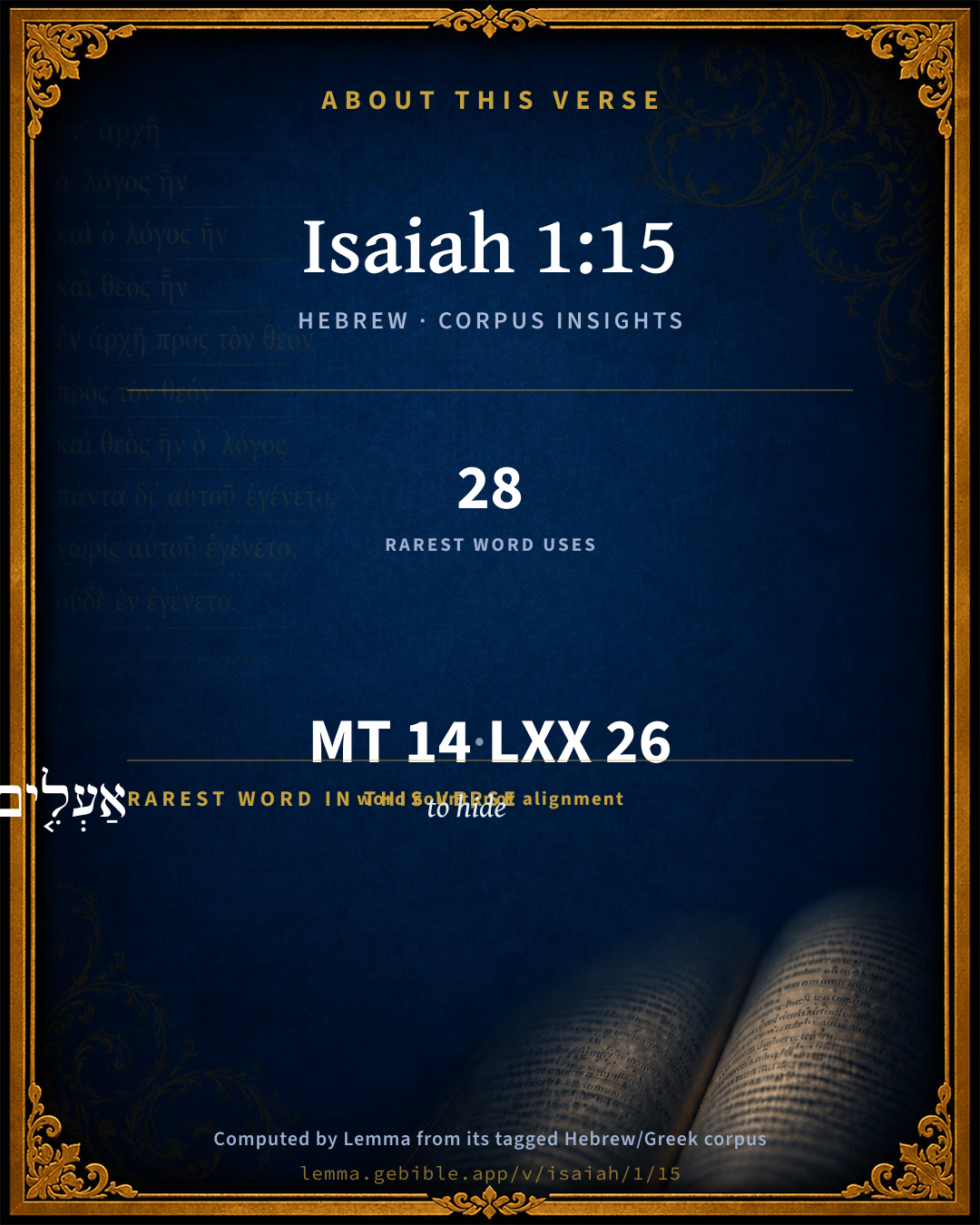
אַעְלִ֤ים to hide H5956 occurs in 27 verses of the Hebrew Bible. Also found in:

Grammatical profile

  • 5 verbs
  • 5 nouns
  • 1 preposition
  • 1 conjunction
  • 2 particles

Verb forms

  • וּבְפָרִשְׂכֶ֣ם Piel · Infinitive Construct
  • אַעְלִ֤ים Hiphil · Imperfect
  • תַרְבּ֥וּ Hiphil · Imperfect
  • שֹׁמֵ֑עַ Qal · Participle Active
  • מָלֵֽאוּ Qal · Perfect

Hebrew & Septuagint length

In English translation the verse runs 29 words from the Hebrew and 33 from the Septuagint (LXX English) — closely comparable.

A rough comparison of the two English renderings, which tokenize alike — not a word-level alignment.

Word counts can differ between the Hebrew and the Greek without any difference in meaning — e.g. the Hebrew direct-object marker אֵת has no separate Greek word, and Greek often adds the article ὁ.

In the original languages it is 14 Hebrew tokens and 26 Greek tokens — but the two are counted differently (Hebrew bundles its prefixes and suffixes into one token; the Greek is in lemma form), so that isn’t a like-for-like length.

Cross-references

22

Topical passages linked to Isaiah 1:15 in the Treasury of Scripture Knowledge — connected by theme and wording, ordered by reader-vote popularity; previews shown in the World English Bible.

  • Micah 3:4 Then they will cry to Yahweh, But he will not answer them. Yes, he will hide his face from them at that time, Because they made their deeds evil."
  • Proverbs 1:28 Then will they call on me, but I will not answer. They will seek me diligently, but they will not find me;
  • Isaiah 59:2–3 but your iniquities have separated between you and your God, and your sins have hidden his face from you, so that he will not hear.
  • Zechariah 7:13 It has come to pass that, as he called, and they refused to listen, so they will call, and I will not listen," said Yahweh of Hosts;
  • Jeremiah 7:8–10 Behold, you trust in lying words, that can't profit.
  • Psalms 66:18 If I cherished sin in my heart, The Lord wouldn't have listened.
  • Jeremiah 14:12 When they fast, I will not hear their cry; and when they offer burnt offering and meal-offering, I will not accept them; but I will consume them by the sword, and by the famine, and by the pestilence.
  • Luke 13:25–28 When once the master of the house has risen up, and has shut the door, and you begin to stand outside, and to knock at the door, saying, 'Lord, Lord, open to us!' then he will answer and tell you, 'I don't know you or where you come from.'
  • 1 Kings 8:22 Solomon stood before the altar of Yahweh in the presence of all the assembly of Israel, and spread forth his hands toward heaven;
  • Psalms 55:1 Listen to my prayer, God. Don't hide yourself from my supplication.
  • Isaiah 58:7 Isn't it to deal your bread to the hungry, and that you bring the poor who are cast out to your house? when you see the naked, that you cover him; and that you not hide yourself from your own flesh?
  • 1 Kings 8:54 It was so, that when Solomon had made an end of praying all this prayer and supplication to Yahweh, he arose from before the altar of Yahweh, from kneeling on his knees with his hands spread forth toward heaven.
  • Job 27:20 Terrors overtake him like waters; A tempest steals him away in the night.
  • Micah 3:9–11 Please listen to this, you heads of the house of Jacob, And rulers of the house of Israel, Who abhor justice, And pervert all equity.
  • Matthew 6:7 In praying, don't use vain repetitions, as the Gentiles do; for they think that they will be heard for their much speaking.
  • Matthew 23:13 "Woe to you, scribes and Pharisees, hypocrites! For you devour widows' houses, and as a pretense you make long prayers. Therefore you will receive greater condemnation.
  • Job 27:8–9 For what is the hope of the godless, when he is cut off, When God takes away his life?
  • Psalms 134:2 Lift up your hands in the sanctuary. Praise Yahweh!
  • Isaiah 8:17 I will wait for Yahweh, who hides his face from the house of Jacob, and I will look for him.
  • Ezekiel 8:17–18 Then he said to me, Have you seen [this], son of man? Is it a light thing to the house of Judah that they commit the abominations which they commit here? for they have filled the land with violence, and have turned again to provoke me to anger: and, behold, they put the branch to their nose.
  • 1 Timothy 2:8 I desire therefore that the men in every place pray, lifting up holy hands without wrath and doubting.
  • Ezra 9:5 At the evening offering I arose up from my humiliation, even with my garment and my robe torn; and I fell on my knees, and spread out my hands to Yahweh my God;

Cross-references courtesy of OpenBible.info (CC BY 4.0).

Hebrew and Greek witnesses Masoretic Hebrew ↔ Greek Septuagint

The same verse in the two great witnesses to the Old Testament, shown verse-for-verse.

These are two independent witnesses, not word-aligned to each other, and the Septuagint is shown in lemma (dictionary) form.

Hebrew Isaiah 1:15 Masoretic · Westminster Leningrad Codex

וּבְפָרִשְׂכֶ֣ם כַּפֵּיכֶ֗ם אַעְלִ֤ים עֵינַי֙ מִכֶּ֔ם גַּ֛ם כִּֽי תַרְבּ֥וּ תְפִלָּ֖ה אֵינֶ֣נִּי שֹׁמֵ֑עַ יְדֵיכֶ֖ם דָּמִ֥ים מָלֵֽאוּ

When you spread forth your hands, I will hide my eyes from you; Yes, when you make many prayers, I will not hear. Your hands are full of blood.

World English Bible · Public Domain

Greek LXX Isaiah 1:15 Septuagint · lemma form

ὅταν ὁ χείρ ἐκτείνω πρός ἐγώ ἀποστρέφω ὁ ὀφθαλμός ἐγώ ἀπό σύ καί ἐάν πληθύνω ὁ δέησις οὐ εἰςἀκούω σύ ὁ γάρ χείρ σύ αἷμα πλήρης

When you⌃ stretch forth your hands, I will turn away my eyes from you: and though you⌃ make many supplications, I will not listen to you; for your hands are full of blood.

LXX2012 (modern English Septuagint) · Public Domain

On this verse, Adam Clarke's Commentary discusses the Septuagint’s reading. Read the note in Commentary ↓

Hebrew: Westminster Leningrad Codex (CC BY 4.0). Greek: Septuagint (public domain); English from LXX2012 (modern English Septuagint) (Public Domain). How the Septuagint differs from the Hebrew →

Targum (Aramaic paraphrase)

1

The Targum is the ancient Jewish Aramaic paraphrase of the Hebrew Scriptures — an interpretive translation, not the Hebrew text itself. Onkelos (literal) and Pseudo-Jonathan (expansive) render the Torah, and Jonathan the Prophets. Coverage is partial: where no permissively-licensed English translation exists for a verse, only the Aramaic is shown. This is verse-level text, not a word-by-word alignment to the Hebrew.

  1. Targum Jonathan Prophets (Joshua–Malachi)
    וְכַד כַּהֲנַיָא פָּרְסִין יְדֵהוֹן לְצַלָאָה עֲלֵיכוֹן מְסַלֵיקְנָא אַפֵּי שְׁכִנְתִּי מִנְכוֹן וְאַף כַּד אַתּוּן מַסְגַן לְצַלָאָה לָא רַעֲוָא קֳדָמַי לְקַבָּלָא צְלוֹתְכוֹן מִדִי יֶדְכוֹן דַם זַכַּאי מַלְיָן:

    When your priests are spreading out their hands to pray for you, I shall make to ascend the presence of my Shekinah from you; and when you are multiplying prayer, it is not my pleasure to accept your prayer at your hands, they being full of the blood of the innocent.

    Targum Jonathan — Aramaic: “Mikraot Gedolot” (public domain). English: “Sefaria Community Translation” (CC0 1.0 (public-domain dedication)); “London "Chaldee Paraphrase," 1871” (public domain). Text via Sefaria.

Commentary

Notes on Isaiah 1:15 from classic Christian and Jewish commentators (each source and its license shown beneath its notes). The classic Christian expositions comment on the surrounding passage and are grouped to its opening verse, so a note may address several verses; the Jewish commentaries on the Tanakh (Rashi and others) are per-verse, so they appear only where the commentator wrote on this verse.

Lemma curates 59 commentaries, every one of them public domain or Creative Commons licensed, each selected and text-cleaned for this edition rather than reprinted as found. About our sources →

Trapp's Complete Commentary

John Trapp

Isa 1:15 And when ye spread forth your hands, I will hide mine eyes from you: yea, when ye make many prayers, I will not hear: your hands are full of blood.

Ver. 15. And when ye spread forth your hands.] This was the ancient guise and garb in extraordinary and most earnest prayer, especially to spread forth the arms, and lay open the hands as it were, to receive a blessing from the Almighty. {Exo 9:23 Psa 44:20; Psa 143:6 1Ki 8:22; 1Ki 8:38}

I will hide mine eyes from you.] Tanquam a teterrimo cadavere, quod oculos et nasum ut occludatis faciat. The eyes of the Lord are upon the righteous, and his ears are open to their cry; but the face of the Lord is against them that do evil, {Psa 34:15-16} his pure eyes cannot behold them with patience. {Hab 1:13}

Yea, when ye make many prayers.] As hoping to be heard for your much babbling. The Turks pray constantly five times a day. The Jews pronounce daily a hundred benedictions. The Papists pray more by tale than by weight of zeal. The wild Irish pray for a blessing on their theft also.

I will not hear.] Your prayers are as jarring in mine ears, as if divers distracted musicians should play upon divers bad instruments so many several tunes at one time, or as if so many dogs should set up a howl together. {Hos 7:14; see the note there} Take thou away from me the noise of thy songs (those black sanctus), for I will not hear "the melody of thy viols." {Amo 5:23} The Jews at this day conclude their Sabbath with singing, or caterwauling rather, which they continue as long as they can, for the ease of souls departed; and with it they pray many times over and over that Elijah would hasten his coming, even the next Sabbath, if he please, to give them notice of the Messiah’s coming. All this is lost labour.

Your hands are full of blood.] Ac proinde horrorem mihi incutiunt; Hands imbrued in blood are horrible to behold. Should he who hath assassined the king’s son, come to him with a petition presently upon it? and should not pure hands be everywhere lifted up to God without wrath and without doubting? {1Ti 2:8} By "blood" here may be meant not only injustice and oppression of the poor, but all other sins also allowed and wallowed in. When "blood toucheth blood," {Hos 4:2} one foul sin is added to another.

John Trapp, A Commentary or Exposition upon All the Books of the Old and New Testament (1647–1656) — public domain. Text from a community e-Sword module.

Joseph Benson's Commentary

Isa 1:15. When ye spread forth your hands — When ye pray with your hands spread abroad, as the manner was; I will hide mine eyes from you — I will take no notice of your persons or requests. Your hands are full of blood — You are guilty of murder and oppression, and of other crying sins, which I abhor, and have forbidden under pain of my highest displeasure.

Joseph Benson's Commentary on the Old and New Testaments (1811–1818) — public domain. Text from a community e-Sword module.

The Preacher's Complete Homiletical Commentary

Joseph S. Exell (gen. ed.)

WORTHLESS HUSKS

Isa_1:15. And when ye spread forth your hands, I will hide mine eyes from you; yea, when ye make many prayers, I will not hear.

The Jews had been likened unto the inhabitants of Sodom and Gomorrah (Isa_1:10). As such, they are summoned to listen to a series of declarations of which this is the sum, that worship without holiness is a solemn mockery. Confining ourselves to our text only, we may see that it teaches us—

I. The worthlessness of ritualism without spontaneity. “When ye spread forth your hands,” &c.

1. Ritualism is an essential element of public worship. There must be some form by which thought can be expressed, and the devotions of others guided. There may be too little, or too much, but some is indispensable [285]

2. Ritualism may be the expression of earnest spiritual life, and a help thereto. It may be the outcome of sincere feeling and deep piety—such was the ritual which David and his devout companions devised and elaborated for the service of the Temple. It was costly and magnificent beyond even that which is observed in St. Peter’s at Rome; but as practised by them it was as spiritual as the baldest service that has ever been conducted in the barest conventicle. A splendid ritual may be acceptable to the Most High, and the followers of George Fox must not imagine that they are the only persons who worship God “in spirit and in truth.”

3. But ritualism may be, and often is, only a form. It may mean only an exhibition of millinery, a scrupulous observance of a prescribed series of postures and genuflexions. It may be, according to a too suggestive phrase, merely a service “performed.” In this case God passes it by with contempt. To all engaged in such histrionic performances He says, “When ye spread forth your hands,” &c. Supplication without desire will never draw down the Divine benediction.

[285] The external part of religion is, doubtless, of little value in comparison with the internal; and so is the cask in comparison with the wine contained in it: but if the cask be staved, the wine must perish. If there were no Sundays or holydays, no ministers, no churches or religious assemblies, no prayers or sacraments, no Scriptures read, or sermons preached, how long would there be any religion left in the world: and who would desire to live in a world where there was none?—Horne, 1730–1792.

Forms are necessary to religion as the means of its manifestation. As the invisible God manifests His nature—His power, wisdom, and goodness, in visible material forms, in the bright orbs of heaven, in the everlasting hills, in the broad earth with its fruits and flowers, and in all the living things which He has made,—so the invisible soul of man reveals its convictions and feelings in the outward acts which it performs. As there could be no knowledge of God without the visible forms in which He reveals Himself, so there could be no knowledge of the religion which exists in the soul of man without the outward forms in which it expresses itself. A form is the flag, the banner, the symbol of an inward life; it is to a religious belief what the body is to the soul; as the soul would be utterly unknown without the body, so religion would be unknown without its forms, a light hidden under a bushel, and not set up in a candlestick that it may give light to all that are in the house.

Forms are necessary not only to the manifestation of religion, but to its nourishment and continued existence. A religion which expressed itself in no outward word or act would soon die out of the soul altogether. The attempt to embody truth and feeling, to express it in words and actions, is necessary to give it the character of living principle in the soul: in this respect forms are like the healthy exercise which at once expresses and increases the vigorous life of the body, or they may be compared to the leaves of a tree, which not only proceed from its inward life, but catch the vitalising influences of the light, the rain and the atmosphere, and convey them down to the root.

What, then, is that formalism which is everywhere in the Scripture, and especially in the discourses of our Lord, described as an offence and an abomination in the sight of God? I answer, formalism is the substitution of the outward rite in the place of the inner spirit and life of the soul; it is the green leaf which still hangs upon the dead branch which has been lopped off.—David Loxton.

II. The worthlessness of prayer without purity of heart. “When ye make many prayers, I will not hear.”

1. Prayer is a necessity of the Christian life. A consciousness of weakness and want, and a profound conviction of God’s power and willingness to succour him, prompts the Christian to make “many prayers.” And each supplication so inspired finds its way to the throne and heart of God. To hear and answer the prayers of His children is one of our Heavenly Father’s joys (Isa_65:24).

2. But prayer, like ritualism, instead of being the expression of a realised need, may be only an empty form. The supplications that are offered may be uttered merely by rote, with as little feeling as a child recites the multiplication-table; or they may be devices by which deluded men seek to propitiate that God whom they are offending by their conduct every day,—mere lip-homage, which they imagine He will accept in condonation of their habitual disregard of His will. In either case, their “many prayers” are worthless husks which He rejects with disdain.

If we would have our worship accepted of God, there must be—

1. Scriptural conceptions of His character. These will prevent us from mocking Him by merely formal prayers or praises.

2. A solemn realisation of His presence. How often this is lacking in those who take part in the service of the sanctuary, and even in those who conduct them! But God is not throned in some distant heaven, to which our prayers struggle up we know not how: He is HERE! We shall never be nearer to Him than we are to-day!

3. An earnest endeavour after holiness in daily life (Psa_66:18). See why God would not regard the uplifted hands of the Jewish suppliants—“Your hands are full of blood.” See also Isa_59:1-3. To no rebel is access to the presence-chamber of the King of kings granted: this is the high privilege of those only who can lift up “holy hands” (1Ti_2:8).—A. F. Barfield. [288]

[288] God doth not institute worship-ordinances for bodily motion only; when He speaketh to man He speaketh as to a man, and requireth human actions from him, even the work of the soul, and not the words of a parrot or the motion of a puppet.—Baxter, 1615–1691.

You think you serve God by coming to church; but if you refuse to let the Word convert you, how should God be pleased with such a service as this? It is as if you should tell your servant what you have for him to do, and because he hath given you the hearing, he thinks he should have his wages, though he do nothing of that which you set him to do. Were not this an unreasonable servant? Or would you give him according to his expectation? It is a strange thing that men should think that God will save them for dissembling with Him; and save them for abusing His name and ordinances. Every time you hear, or pray, or praise God, or receive the sacrament, while you deny God your heart and remain unconverted, you do but despise Him and show more of your rebellion than your obedience. Would you take him for a good tenant that at every rent-day would duly wait on you, and put off his hat to you, but bring you never a penny of rent? Or would you take him for a good debtor that brings you nothing but an empty purse, and expects you should take that for payment? God biddeth you come to church and hear the Word; and so you do, and so far you do well; but withal, He chargeth you to suffer the Word to work upon you hearts, and to take it home and consider of it, and obey it, and cast away your former courses, and give your hearts and lives to Him; and this yon will not do. And you think that He will accept of your service!—Baxter, 1615–1691.

REASONS FOR THE REJECTION OF PRAYER

Isa_1:15. When ye make many prayers, I will not hear.

God has characterised Himself as “the Hearer of prayer;” and it is the great consolation of His people that they cannot seek His face in vain. But here He declares that He will not hear the prayers of Israel, however many. This solemn and momentous declaration may well lead us to inquire why prayer is, in many instances, rejected. Prayer, to be heard, must be both right and real. If it possess neither of these characteristics, or only one of them—if it is neither right nor real, or is right without being real, or real without being right—it cannot fail to be rejected.

I. A man may pray rightly, either because he has been taught the principles of orthodoxy, and knows what language is conformable to those principles, or because he uses prayers composed by spiritual men, or, finally, because he uses the very words prescribed or sanctioned by God Himself. But in all these cases, while his prayer may be right, it may be altogether unreal. He may neither know the meaning of the requests it contains, nor desire their fulfilment [291] Thus do many men pray for a free pardon for Christ’s sake, for entire sanctification, and repeat the Lord’s Prayer. There is nothing in the heart corresponding to what is expressed by the lips; nay, the heart and the mouth are often completely at variance with each other.

[291] Will men’s prayers be answered? Not if they pray as boys whittle sticks—absently, hardly knowing or caring what they are about. I have known men begin to pray about Adam, and go on from him to the present time, whittling their stick clear to a point, with about as much feeling, and doing about as much good as the boy does.—Beecher.

I often say my prayers,

But do I ever pray,

And do the wishes of my heart

Go with the words I say?

I may as well kneel down

And worship gods of stone,

As offer to the living God

A prayer of words alone,

For words without the heart

The Lord will never hear;

Nor will He to those lips attend

Whose prayers are not sincere.

—John Burton.

II. Prayer may be real without being right. A man may really acknowledge mercies received, and petition for more; and yet neither the acknowledgment nor the petition may be regarded by God. The acknowledgment and the petition have reference to mere earthly desires already gratified or yet to be gratified. He thanks God that his “lusts have had the food which they craved;” he prays that they may never want it. Pride, vanity, the love of ease, pleasures, and worldly respectability are “lusts” on which he has hitherto “consumed,” and on which he intends still to “consume,” the good things which God has given, or may yet give him. The secret soul of all his supplications is not any zeal for the glory of God, but selfishness. His prayers are of the earth, earthy. The spiritual blessings which God holds out in His right hand he passes by in contemptuous neglect, and clamours for the natural blessings which are in God’s left hand.

III. Both the faults of prayer above referred to are often found in one and the same individual, and the guilt of both accumulated on one and the same head.

Let it not be inferred from what has been said that we lay an interdict on natural blessings, and forbid the seeking of them in prayer. Our Saviour has given us authority to ask for daily bread, and this fully warrants the conclusion that natural blessings, as well as spiritual, may and ought to form a subject of prayer. We ought to “seek first the kingdom of God and His righteousness,” and then ask Him to fulfil His promise of “adding unto us all other things.”—R. Nesbit, Discourses, pp. 308–319.

A STARTLING CHARGE

Isa_1:15. Your hands are full of blood.

Such is the reason which God assigns for turning a deaf ear to the prayers of His ancient people: the hands they lifted up to Him in supplication were blood-stained. It was as if Cain, red with the murder of Abel, had lifted up his hands in prayer to God for blessing. By this startling charge we are reminded—

I. That between the estimates formed by God and men as to what takes place in the sanctuary there is often an infinite disparity. Behold the court of the temple filled, apparently, with devout worshippers, who lift up their hands to heaven in earnest supplication,—what a pleasing sight! But God looks down, and says, “Those hands are full of blood.” The same contrast is repeated in another form (Isa_29:13). Other contrasts: Eli sees what he thinks to be a drunken woman; God sees a humble suppliant (1Sa_1:12-13). Men see an eminently religious man praying in the sanctuary; God sees a man prostituting prayer into a means of self-glorification (Luk_18:11-12). Men see a foul wretch whose presence in the sanctuary is a pollution; God sees a broken hearted penitent, and hastens to bless him (Luk_18:13-14). So it is in our sanctuaries to-day.

II. That God holds us responsible for the ultimate consequences of our actions. The men who thronged the temple in Isaiah’s time, and whose prayers God rejected, were not bandits and murderers in the ordinary and coarse fashion by which men are brought to the scaffold. Yet the charge brought against them was true. For there are other ways of murdering men than by acts of violence of which human law takes note. By grievous oppression millions of men have been brought to an untimely grave. If a man destroys another by slow poison, is he not as truly a murderer as another who kills his victim by means of prussic acid? In God’s sight oppression is murder; and of oppression in its worst forms the Jews had been guilty (Isa_1:23; Isa_3:14-15, &c.) It is in accordance with this declaration that opprobrium is heaped upon Jeroboam as the man “who made Israel to sin” (2Ki_10:29); and that we are so sternly warned against leading others into transgression (Mat_18:6, &c.) This fact—

1. Casts some light on the doctrine of future punishment. The results of the evil actions of men go on eternally propagating themselves, and it is therefore not unjust that the punishment of those actions should be eternal also.

2. Should cause us to halt when we are tempted to acts of unkindness and oppression. Unwillingly we may thereby become murderers.

3. Should lead us to be most watchful as to the example we set before others. If we hold our false lights by which they are caused to make shipwreck “concerning faith” and character, God will hold us responsible for the disaster (Rom_14:15, &c.)

III. That sin is naturally indelible. These Jews came into the sanctuary with hands carefully cleansed, but yet in God’s sight they were “full of blood.”

1. The stains of sin cannot be washed out by time. Time obliterates much, but it does not obliterate guilt. Men are apt to be troubled in conscience about recent sins, but to be at ease concerning those committed many years previously. But this is a mistake. Lapse of time makes no difference to God; the inscriptions in His books of record never fade. Hence the wisdom of David’s prayer (Psa_25:7).

2. The stain of sin cannot be washed out by worship. That it might be so was the vain dream of the Jews, as it is of millions to-day. But worship itself is an offence when it is offered by ungodly men; so far from diminishing their guilt, it increases it (Pro_28:9, &c.)

3. The stain of sin cannot be washed out by sorrow. Sorrow for the past alters nothing in the past: the crime remains, no matter how many tears the criminal may shed [294]

4. The stain of sin cannot be washed out even by reformation of conduct and character. Men speak of “turning over a new leaf,” and when they have done what this phrase implies, they are apt to be at peace. But this also is a mistake. They forget that the old, evil leaf remains, and that for what is inscribed thereon God will call them to account. As there is a “godly sorrow” and a “worldly sorrow,” so there is a religious and an irreligious reformation of conduct. The former is the result of evangelical repentance, and is of exceeding worth (Eze_18:27-28); the latter is a mere act of prudence, and is of no moral account. In one way, and in one way only, can the stain of guilt be effaced from the human soul (1Jn_1:7-9).

[294] Repentance qualifies a man for pardon, but it does not, cannot, entitle him to it. It is one of the most elementary and obvious truths of morality, that the performance of one duty cannot be any compensation for neglect to perform another duty. But when a sinner is penitent for his sins, he is merely doing what, as a sinner, he ought to do; and his feelings of contrition do no more to absolve him from his guilt than the gratitude a man feels to a doctor who has cured him from a dangerous illness does to discharge the doctor’s bill. As in this case there ought to be both gratitude and payment, so in the case of the sinner there must be both penitence and atonement. The sinner’s sorrow for his sin, while in itself a proper thing, is no more an atonement for his sin than is the remorse that fills the breasts of most murderers any atonement for the murders they have committed. Judas was sorry, profoundly and intensely sorry, for having betrayed our Lord Jesus Christ, but did that do away with the guilt of that betrayal? Was Peter not to be blamed for his denial of his Master, because afterwards “he went out and wept bitterly”? Did the tears he shed give him any right to say in after years—“Yes, I denied my Lord, but I was sorry for it, and go made it straight”? Do you think that just as with soap and water you can wash the dirt off your hands, you can with a few tears, or with many tears, wash the guilt of sin from off your soul? No delusion could be more groundless. Oh no! You have the real fact and the true philosophy of the matter in the well-known verse—

“Not the labours of my hands

Can fulfil Thy law’s demands.

Could my zeal no respite know

Could my tears for ever flow,

All for sin could not atone:

THOU must save, and THOU alone.”

The Preacher's Complete Homiletical Commentary (gen. ed. Joseph S. Exell; Funk & Wagnalls, c. 1892) — public domain (pre-1929). A full-Bible homiletical/sermon-outline anthology covering 65 of 66 books (2 John is absent from the source module). Text from a community e-Sword module.

Tyndale Open Study Notes

Tyndale Open Resources

1:15 I will not look . . . I will not listen: The Lord does not respond to prayer offered from a life of persistent wickedness. In this case, God charged the people with perverting his laws in order to practice violent injustice toward innocent victims.

Tyndale Open Study Notes — © Tyndale Open Resources, licensed CC BY-SA 4.0. Text via the HelloAO Bible API.

Geneva Bible (1599)

Geneva Bible translators

He showeth that where men be given to avarice, deceit, cruelty and extortion, which is meant by blood, there God will show his anger, and not accept them, though they seem never so holy, as Isa. 59:3.

Geneva Bible (1599) marginal notes — public domain. Text via Bolls.life.

Jamieson, Fausset & Brown

Robert Jamieson, A. R. Fausset & David Brown

(Psa 66:18; Pro 28:9; Lam 3:43-44).

spread . . . hands--in prayer (Kg1 8:22). Hebrew, "bloods," for all heinous sins, persecution of God's servants especially (Mat 23:35). It was the vocation of the prophets to dispel the delusion, so contrary to the law itself (Deu 10:16), that outward ritualism would satisfy God.

Jamieson, Fausset & Brown — Commentary Critical and Explanatory on the Whole Bible (1871) — public domain (CC PDM 1.0). Text via the HelloAO Bible API.

Adam Clarke's Commentary

Verse 15. When ye spread] The Syriac, Septuagint, and a MS., read בפרשכם beparshecem, without the conjunction ו vau.

Your hands - "For your hands"] Αἱ γαρ χειρες - Sept. Manus enim vestrae - Vulg. They seem to have read כי ידיכם ki yedeychem.

Adam Clarke's Commentary on the Bible (1810–1826) — public domain. Text from a community e-Sword/MySword module.

Ellicott's Commentary for English Readers

(15) When ye spread forth your hands.—The words point to the attitude of one who prays, as was the manner of Jews, Greeks, and Romans (“tenditque ad sidera palmas,” Virg., Æn., xii. 196), standing, and with hands stretched out toward heaven. (Comp. Luk_18:11-13.)

When ye make many prayers.—The Pentateuch contains no directions for the use of forms of prayer beyond the benediction of Num_6:23-26, and two forms connected with the Passover in Deu_26:5-10; Deu_26:13-15. The “eighteen prayers” for daily use belong to the later Rabbinic stage of Judaism. It lies in the nature of the case, however, that first a real, and then an ostentatious devotion would show itself in the use of such forms, possibly, as in Psa_119:164, “seven times a day.” In Pro_27:14; Pro_28:9, which belong to the reign of Hezekiah, and may, therefore, indirectly represent Isaiah’s teaching, we have the warnings of the wise as to the right use of such forms.

Your hands are full of blood.—Literally, bloods, as implying many murderous acts. The words point to the guilt of judges and princes, such as that described in Hos_4:2. Life was sacrificed to greed of gain, or lust, or vindictiveness. To the prophet’s eye those hands, stretched upwards in the Temple by some, at least, of the king’s ministers and judges, were red with the blood of the slain. (Comp. Isa_59:3.)

A Bible Commentary for English Readers, edited by Charles John Ellicott (1878–1897) — public domain. Text from a community e-Sword module.

The Cambridge Bible for Schools and Colleges

gen. ed. J. J. S. Perowne

15. your hands (“spread forth” in the attitude of prayer) are full of blood] a symbol of cruel wrongs perpetrated or tolerated, including the guilt of actual murder (Isa_1:21).

The Cambridge Bible for Schools and Colleges (gen. ed. J. J. S. Perowne; Cambridge University Press, 1878–1918) — public domain. Text from a community e-Sword module.

John Gill's Exposition

And when ye spread forth your hands,.... That is, in prayer, this being a prayer gesture: hence the Targum paraphrases it,

"and when the priests spread out their hands to pray for you.''

I will hide mine eyes from you; will not look upon them, nor regard their prayer; see Lam 3:42.

yea, when ye make many prayers; as the Scribes and Pharisees did in Christ's time, and thought to be heard for their much speaking, like the Gentiles, Mat 6:7.

I will not hear; so as to give an answer, or fulfil their requests: the reason follows,

your hands are full of blood; of the prophets of the Lord, of Christ and his followers, whom they put to death.

John Gill's Exposition of the Whole Bible (1746–1763) — public domain (CC PDM 1.0). Text via the HelloAO Bible API.

Albert Barnes' Notes on the Bible

Ye spread forth your hands - This is an expression denoting the act of supplication. When we ask for help, we naturally stretch out our hands, as if to receive it. The expression therefore is equivalent to ‘when ye pray, or implore mercy.’ Compare Exo 9:29; Exo 17:11-12; 1Ki 8:22.

I will hide mine eyes ... - That is, I will not attend to, or regard your supplications. The Chaldee Paraphrase is, ‘When your priests expand their hands to pray for you.’

Your hands ... - This is given as a reason why he would not hear. The expression full of blood, denotes crime and guilt of a high order - as, in murder, the hands would be dripping in blood, and as the stain on the hands would be proof of guilt. It is probably a figurative expression, not meaning literally that they were murderers, but that they were given to rapine and injustice; to the oppression of the poor, the widow, etc. The sentiment is, that because they indulged in sin, and came, even in their prayers, with a determination still to indulge it, God would not hear them. The same sentiment is elsewhere expressed; Psa 66:18 : ‘If I regard iniquity in my heart, the Lord will not hear me;’ Pro 28:9 : ‘He that turneth away his ear from hearing the law, even his prayer shall be abomination;’ Jer 16:10-12; Zec 7:11-12; Pro 1:28-29. This is the reason why the prayers of sinners are not heard - But the truth is abundantly taught in the Scriptures, that if sinners will forsake their sins, the greatness of their iniquity is no obstacle to forgiveness; Isa 1:18; Mat 11:28; Luk 16:11-24.

Albert Barnes' Notes on the Bible (1834–1885) — public domain. Text from a community e-Sword/MySword module.

Matthew Poole's English Annotations

When ye spread forth your hands; when you pray with hands spread abroad, as the manner was; of which see Exo 9:29,33; Job 11:13, &c.

I will hide mine eyes from you; which is a gesture of contempt and loathing. I will take no notice of your persons or requests.

Your hands are full of blood; you are guilty of murder, and oppression, and other crying sins, which I abhor, and have forbidden, under pain of mine highest displeasure.

Matthew Poole's English Annotations on the Holy Bible (1683–1685) — public domain. Text from a community e-Sword/MySword module.

The Pulpit Commentary

I will hide mine eyes, etc. A time comes when the wicked are alarmed, and seek to turn to God; but it is too late. "Then shall they call upon me, but I will not answer; they shall seek me early, but they shall not find me". (Pro_1:28) When ye make many prayers; literally, multiply prayer. Full of blood (comp. ver. 21). Actual bloodshed may be pointed at, as the murder of Zechariah, (2Ch_24:21) and the fate which befell Isaiah himself, according to the tradition, would seem to show. But cruelty and oppression, producing poverty and wretchedness, and tending to shorten life, are no doubt also included. (comp. Mic_3:10, Mic_3:11) These were the special sins of the time (see vers. 17, 23).

God will not listen to the prayers of the wicked.

Sinners sometimes think that they may persist in sin as long as they like, because they can at any time turn to God, ask his forgiveness, obtain pardon, and be saved. But Scripture is very full of warnings that this is not the case. There is "a sin against the Holy Ghost, "which "shah not be forgiven to men, neither in this world, neither in the world to come". (Mat_12:32) There is a persistence in sin, which "quenches the Spirit". (1Th_5:17) Men cannot turn to God whenever they please. The "accepted time" passes away, and they find it impossible to turn to him in true faith and penitence. They may "say prayers, "but they do not really pray. And God shuts his ears against such prayers. (see, besides the present passage, Job_27:8, 9 Pro_1:28 Eze_8:18 Heb_6:4 6 10:26-29 1Jn_5:16)

The Pulpit Commentary (1880–1919), ed. H.D.M. Spence-Jones & Joseph S. Exell — public domain. Text from a community e-Sword module.

John Wesley's Explanatory Notes

Blood - You are guilty of murder, and oppression.

John Wesley, Explanatory Notes Upon the Whole Bible (1754–1765) — public domain. Text via the GEBible commentary corpus.

Keil & Delitzsch

C. F. Keil & F. Delitzsch

Their self-righteousness, so far as it rested upon sacrifices and festal observances, was now put to shame, and the last inward bulwark of the sham holy nation was destroyed: "And if ye stretch out your hands, I hide my eyes from you; if ye make ever so much praying, I do not hear: your hands are full of blood." Their praying was also an abomination to God. Prayer is something common to man: it is the interpreter of religious feeling, which intervenes and mediates between God and man;

(Note: The primary idea of hithpallel and tephillah is not to be obtained from Deu 9:18 and Ezr 10:1, as Dietrich and Frst suppose, who make hithpallel equivalent to hithnappel, to throw one's self down; but from Sa1 2:25, "If a man sin against a man, the authorities right him" (וּפללו אלהים: it is quite a mistake to maintain that Elohim cannot have this meaning), i.e., they can set right the relation which he has disturbed. "But if one sin against Jehovah, who shall mediate for him (מי יתפּלּל־לו, quis intercedat pro eo)?" We may see from this that prayer is regarded as mediation, which sets right and establishes fellowship; and hithpallel signifies to make one's self a healer of divisions, or to settle for one's self, to strive after a settlement (sibi, pro se, intercedere: cf., Job 19:16, hithchannen, sibi propitium facere; Job 13:27, hithchakkah, sibi insculpere, like the Arabic ichtatta, to bound off for one's self).)

it is the true spiritual sacrifice. The law contains no command to pray, and, with the exception of Deut 26, no form of prayer. Praying is so natural to man as man, that there was no necessity for any precept to enforce this, the fundamental expression of the true relation to God. The prophet therefore comes to prayer last of all, so as to trace back their sham-holiness, which was corrupt even to this the last foundation, to its real nothingness. "Spread out," parash, or pi pērēsh, to stretch out; used with Cappaim to denote swimming in Isa 25:11. It is written here before a strong suffix, as in many other passages, e.g., Isa 52:12, with the inflection i instead of e. This was the gesture of a man in prayer, who spread out his hands, and when spread out, stretched them towards heaven, or to the most holy place in the temple, and indeed (as if with the feeling of emptiness and need, and with a desire to receive divine gifts) held up the hollow or palm of his hand (Cappaim: cf., tendere palmas, e.g., Virg. Aen. xii. 196, tenditque ad sidera palmas). However much they might stand or lie before Him in the attitude of prayer, Jehovah hid His eyes, i.e., His omniscience knew nothing of it; and even though they might pray loud and long (gam chi, etiamsi: compare the simple Chi, Jer 14:12), He was, as it were, deaf to it all. We should expect Chi here to introduce the explanation; but the more excited the speaker, the shorter and more unconnected his words. The plural damim always denotes human blood as the result of some unnatural act, and then the bloody deed and the bloodguiltiness itself. The plural number neither refers to the quantity nor to the separate drops, but is the plural of production, which Dietrich has so elaborately discussed in his Abhandlung, p. 40.

(Note: As Chittah signified corn standing in the field, and Chittim corn threshed and brought to the market, so damim was not blood when flowing through the veins, but when it had flowed out-in other words, when it had been violently shed. (For the Talmudic misinterpretation of the true state of the case, see my Genesis, p. 626.))

The terrible damim stands very emphatically before the governing verb, pointing to many murderous acts that had been committed, and deeds of violence akin to murder. Not, indeed, that we are to understand the words as meaning that there was really blood upon their hands when they stretched them out in prayer; but before God, from whom no outward show can hide the true nature of things, however clean they might have washed themselves, they still dripped with blood. The expostulations of the people against the divine accusations have thus been negatively set forth and met in Isa 1:11-15 : Jehovah could not endure their work-righteous worship, which was thus defiled with unrighteous works, even to murder itself. The divine accusation is now positively established in Isa 1:16, Isa 1:17, by the contrast drawn between the true righteousness of which the accused were destitute, and the false righteousness of which they boasted. The crushing charge is here changed into an admonitory appeal; and the love which is hidden behind the wrath, and would gladly break through, already begins to disclose itself. There are eight admonitions. The first three point to the removal of evil; the other five to the performance of what is good.

Keil & Delitzsch — Biblical Commentary on the Old Testament (1861–1891) — public domain (CC PDM 1.0). Text via the HelloAO Bible API. (Old Testament only.)

J. A. Alexander on Isaiah

Joseph Addison Alexander

Not only ceremonial observances, but even prayer was rendered useless by the sins of those who offered it. “And in your spreading” (when you spread) “your hands” (or stretch them out towards heaven as a gesture of entreaty) “I will hide mine eyes from you” (avert my face, refuse to see or hear, not only in ordinary but) “also when ye multiply prayer” (by fervent importunity in time of danger) “I am not hearing” (or about to hear, the participle bringing the act nearer to the present than the future would do). “Your hands are full of blood” (literally bloods, the form commonly used when the reference is to bloodshed or the guilt of murder). Thus the Prophet comes back to the point from which he set out, the iniquity of Israel as the cause of his calamities, but with this difference, that at first he viewed sin in its higher aspect, as committed against God, whereas in this place its injurious effects on men are rendered prominent. It is a strange opinion mentioned by Fabricius that the blood here meant is the blood of the victims hypocritically offered.

Joseph Addison Alexander, The Prophecies of Isaiah (1846–1847; New York: Scribner, 1870–1878) — public domain. Text from a community e-Sword module.

Rashi

Rabbi Shlomo Yitzchaki (Rashi)

And when you spread out your hands, I will hide My eyes from you because your hands are full of blood.

blood Murder.

Rashi on the Tanakh — English translations: “The Judaica Press complete Tanach with Rashi, translated by A. J. Rosenberg” (CC BY 4.0); “Pentateuch with Rashi's commentary by M. Rosenbaum and A.M. Silbermann, 1929-1934” (public domain); “The Metsudah Tanach series, Lakewood, N.J” (CC BY 4.0); and “The Book of Joshua, Metsudah Publications, 1997” (CC BY 4.0). Text via Sefaria.

Ibn Ezra

Rabbi Abraham ibn Ezra

ובפרשכם And when ye spread forth. The Hirik under ר is instead of Segol.

I will hide mine eyes from you. I will keep away mercy from you.

I will not hear. These words contain the same idea, I will not help you.

Your hands are full of blood. Because your hands, etc. Blood. Bloodshed.

Ibn Ezra on the Tanakh — English translations: “Sefaria Community Translation” (CC0 1.0 (public-domain dedication)); “Yalkut, Sifsei Chachomim Chumash, Metsudah Publications, 2009” (CC BY 4.0); and “Commentary of Ibn Ezra on Isaiah - trans. by M. Friedlander, 1873” (public domain). Text via Sefaria.

Lesson kit

Teaching starters — assembled from the data on this page, not authored interpretation. Every prompt links to the verse data it draws on. Edit before teaching.

Isaiah, in the Prophets, opens this verse with 14 words (14 distinct Hebrew lemmas). Its most distinctive word is ʻâlam (“to hide”). A historical commentator’s framing appears above. Read the whole chapter for the surrounding context.

Discussion questions

  1. What does “to hide” (ʻâlam) contribute to the verse as a whole?
  2. Leviticus 4:13 shares the word «to hide» with this verse. How do the two illuminate each other?
  3. These translations render this verse differently. What is at stake in choosing one wording over another?
  4. The verb «וּבְפָרִשְׂכֶ֣ם» is Piel Infinitive Construct. How does its form color the action?
  5. Reading how Trapp's Complete Commentary and Joseph Benson's Commentary read this verse, where do the two commentators agree and where do they part?

Things to notice

Reading settings

Reading text

Shown beneath each verse's original-language words.

Old Testament
Old Testament edition

Read the OT as the Masoretic Hebrew (MT) or the Greek Septuagint (LXX).

English shown for the Greek Septuagint (in the Hebrew ↔ Greek comparison).

Comparing translations? Open the Compare panel on any verse page to stack up to four side by side.