Isaiah 19:7

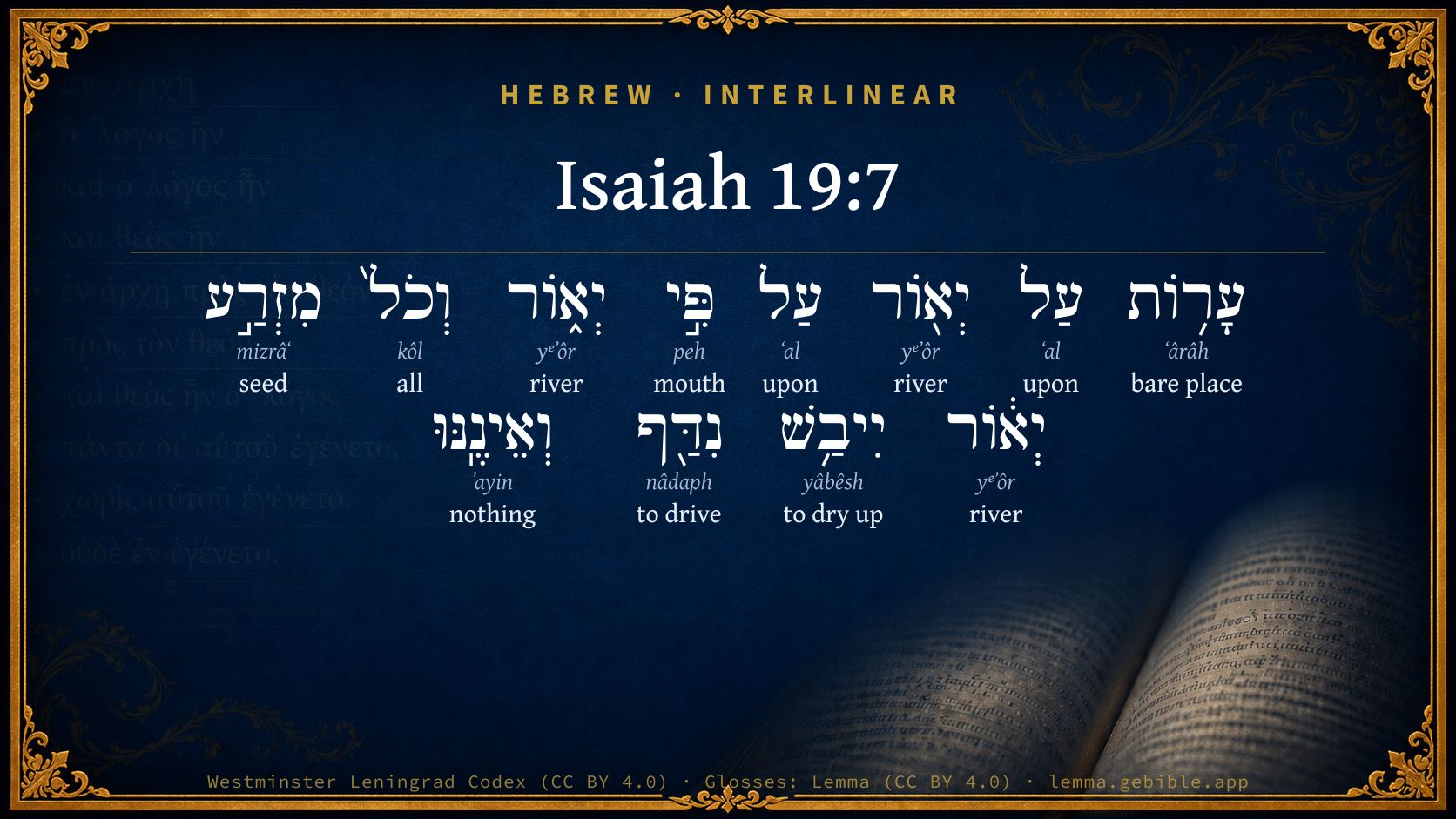
Hebrew (Westminster Leningrad Codex) Isaiah 19:7 appears in the Hebrew Old Testament. The text above is from the Westminster Leningrad Codex. Each word links to its Strong’s number, a concise gloss, and parsing drawn from the Open Scriptures Hebrew Bible morphology. Click any word for its full Brown-Driver-Briggs (BDB) entry.
Download image
Cite this verse

Isaiah 19:7 (World English Bible). Public Domain. Lemma interlinear Bible study tool, https://lemma.gebible.app/v/isaiah/19/7.

Show BibTeX & RIS
BibTeX
RIS
English Translation
The meadows by the Nile, by the brink of the Nile, and all the sown fields of the Nile, shall become dry, be driven away, and be no more.
World English Bible · Public Domain
Highlights
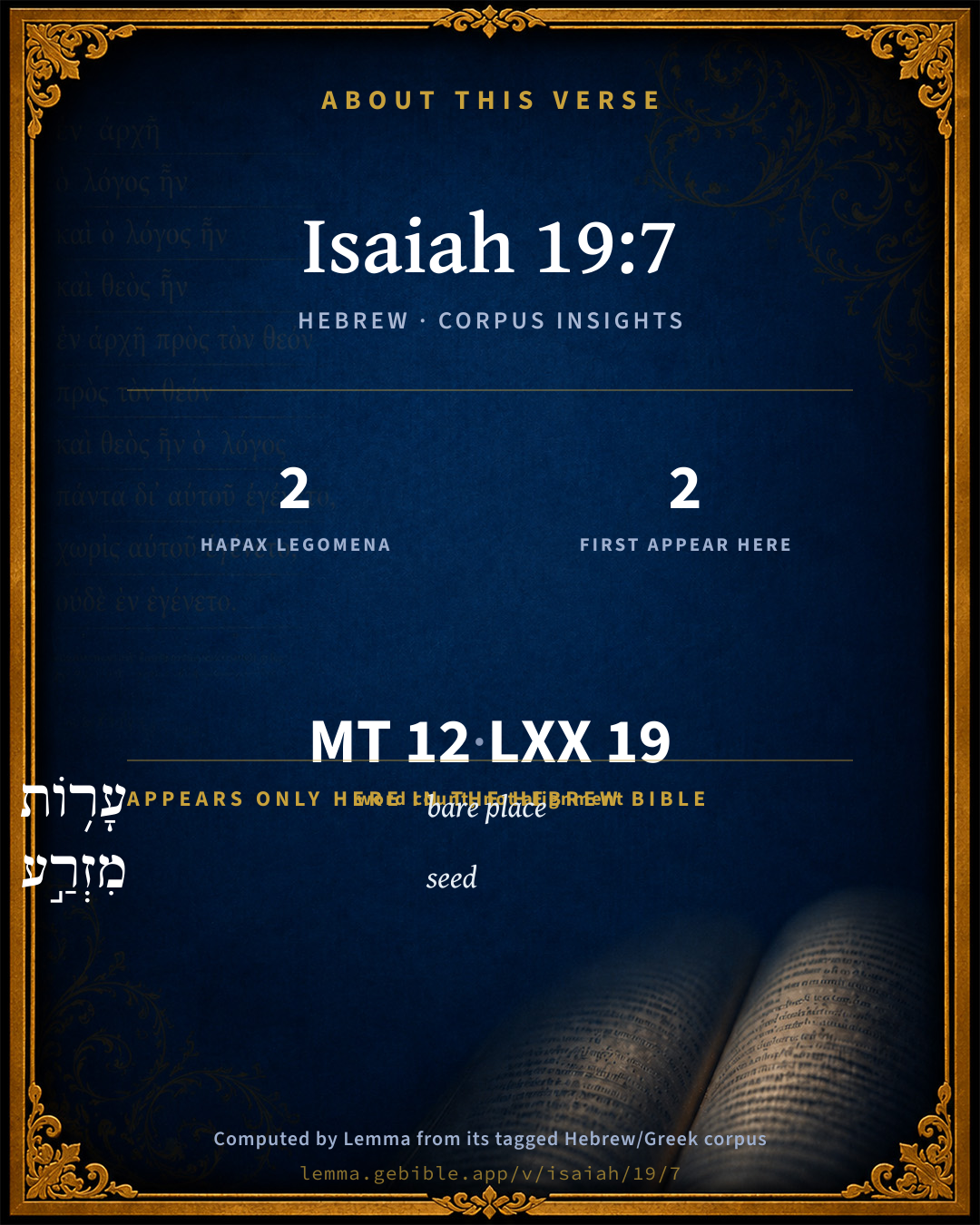
  • 2 hapax legomena — only here in the Hebrew Bible
  • 2 first appearances in the Hebrew Bible
Full analysis ↓
Download a study sheet

One document with this verse’s original text, its word-by-word gloss line, the meaning frame, cross-references with their text, attributed commentary, and full source and license credits — printable, and it pastes into notes with its structure intact.

This verse Autodidact and up

Study sheet (.html) Plain text (.txt)

A passage Seminary Student

Up to 50 verses in one chapter. A passage sheet keeps up to 6 commentary sources and 12 cross-references per verse, in the order this page ranks them, and says so on the sheet whenever that leaves anything out. Ask for a single verse and you get the Autodidact verse sheet above.

Everything on this page stays free to read, with no account — the sheet is a download of what is already on screen, not access to it.

Want to remove ads? Support Godless Engineer
Compare translations 3

The same verse in 3 English versions, stacked beneath the original-language interlinear above. Click any original word for its lexicon entry.

Each is an independent rendering of the whole verse — the interlinear is not word-aligned to these translations.

Highlighted words mark where these versions differ — a whole-verse word diff, not a word-by-word alignment.

  • World English Bible Public Domain
    The meadows by the Nile, by the brink of the Nile, and all the sown fields of the Nile, shall become dry, be driven away, and be no more.
  • King James Version Public Domain
    The paper reeds by the brooks, by the mouth of the brooks, and every thing sown by the brooks, shall wither, be driven away, and be no more.
  • unfoldingWord Literal Text CC BY-SA 4.0
    The plants along the Nile at the mouth of the Nile and every sown thing of the Nile will dry up; it will be blown away, and it not.

unfoldingWord Literal Text — © unfoldingWord, licensed CC BY-SA 4.0. Word-aligned USFM3 via Door43 (git.door43.org/unfoldingWord/en_ult).

Versions to compare (up to 4)

3 of 4 selected

Show all 18 translations

Every available English version of this verse, each an independent rendering of the whole verse.

  • World English Bible Public Domain
    The meadows by the Nile, by the brink of the Nile, and all the sown fields of the Nile, shall become dry, be driven away, and be no more.
  • Berean Standard Bible Public Domain
    The bulrushes by the Nile, by the mouth of the river, and all the fields sown along the Nile, will wither, blow away, and be no more.
  • Majority Standard Bible Public Domain
    The bulrushes by the Nile, by the mouth of the river, and all the fields sown along the Nile, will wither, blow away, and be no more.
  • King James Version Public Domain
    The paper reeds by the brooks, by the mouth of the brooks, and every thing sown by the brooks, shall wither, be driven away, and be no more.
  • American Standard Version (1901) Public Domain
    The meadows by the Nile, by the brink of the Nile, and all the sown fields of the Nile, shall become dry, be driven away, and be no more.
  • Revised Version (1885) Public Domain
    The meadows by the Nile, by the brink of the Nile, and all that is sown by the Nile, shall become dry, be driven away, and be no more.
  • Geneva Bible (1599) Public Domain
    The grasse in the riuer, and at the head of the riuers, and all that groweth by the riuer, shall wither, and be driuen away, and be no more.
  • Douay-Rheims (1899) Public Domain
    The channel of the river shall be laid bare from its fountain, and every thing sown by the water shall be dried up, it shall wither away, and shall be no more.
  • Young's Literal Translation Public Domain
    Exposed things by the brook, by the edge of the brook, And every sown thing of the brook, hath withered, It hath been driven away, and is not.
  • Literal Standard Version CC BY-SA 4.0
    Exposed things by the brook, by the edge of the brook, || And every sown thing of the brook, has withered, || It has been driven away, and is not.
  • Unlocked Literal Bible CC BY-SA 4.0
    The reeds along the Nile, at the mouth of the Nile, and every sown field beside the Nile will become parched, will be driven away, and will be no more.
  • unfoldingWord Literal Text CC BY-SA 4.0
    The plants along the Nile at the mouth of the Nile and every sown thing of the Nile will dry up; it will be blown away, and it not.
  • Darby Bible Public Domain
    The meadows by the Nile, on the banks of the Nile, and everything sown by the Nile, shall be dried up, be driven away, and be no [more].
  • World Messianic Bible Public Domain
    The meadows by the Nile, by the brink of the Nile, and all the sown fields of the Nile, will become dry, be driven away, and be no more.
  • Webster's Bible Public Domain
    The paper-reeds by the brooks, by the mouth of the brooks, and every thing sown by the brooks, shall wither, be driven away, and be no more.
  • Free Bible Version CC BY-SA 4.0
    The vegetation along the banks of the Nile, and all the plants in the cultivated land along the Nile, will dry up and be blown away. Everything will be gone.
  • Bible in Basic English Public Domain
    The grass-lands by the Nile, and everything planted by the Nile, will become dry, or taken away by the wind, and will come to an end.
  • JPS Tanakh (1917) Public Domain
    The mosses by the Nile, by the brink of the Nile, and all that is sown by the Nile, shall become dry, be driven away, and be no more.

Literal Standard Version (2020), Covenant Press — licensed CC BY-SA 4.0. Text via the HelloAO Bible API (eBible.org). Unlocked Literal Bible (unfoldingWord) — licensed CC BY-SA 4.0. Text via the HelloAO Bible API (eBible.org). unfoldingWord Literal Text — © unfoldingWord, licensed CC BY-SA 4.0. Word-aligned USFM3 via Door43 (git.door43.org/unfoldingWord/en_ult). Free Bible Version, Dr. Jonathan Gallagher — licensed CC BY-SA 4.0. Text via the HelloAO Bible API (eBible.org).

Word by word

More ways to search: Search by grammar → Find every occurrence → Compare this word →

Practice this passage: Drill this verse → Learn its vocabulary →

About this verse

These counts appear in no published source. They are computed here, from the morphology-tagged text and Lemma’s own curated glosses. What Lemma adds →

12
words
9
distinct lemmas
Prophets
section

Notable vocabulary

2 hapax legomena — words that appear only here in the entire Hebrew Bible:

  • עָר֥וֹת bare place H6169
  • מִזְרַ֣ע seed H4218

First appearance in Scripture

These words make their first canonical appearance in the Hebrew Bible here:

  • עָר֥וֹת bare place H6169
  • מִזְרַ֣ע seed H4218

Shared distinctive vocabulary

נִדַּ֖ף to drive H5086 occurs in 8 verses of the Hebrew Bible. Also found in:

Grammatical profile

  • 2 verbs
  • 7 nouns
  • 2 prepositions
  • 1 particle

Verb forms

  • יִיבַ֥שׁ Qal · Imperfect
  • נִדַּ֖ף Niphal · Perfect

Repetition

Words recur within this verse — often emphatic in Hebrew:

  • יְא֖וֹר river H2975 ×3
  • עַל upon H5921 ×2

Hebrew & Septuagint length

In English translation the verse runs 29 words from the Hebrew and 27 from the Septuagint (LXX English) — closely comparable.

A rough comparison of the two English renderings, which tokenize alike — not a word-level alignment.

Word counts can differ between the Hebrew and the Greek without any difference in meaning — e.g. the Hebrew direct-object marker אֵת has no separate Greek word, and Greek often adds the article ὁ.

In the original languages it is 12 Hebrew tokens and 19 Greek tokens — but the two are counted differently (Hebrew bundles its prefixes and suffixes into one token; the Greek is in lemma form), so that isn’t a like-for-like length.

Cross-references

5

Topical passages linked to Isaiah 19:7 in the Treasury of Scripture Knowledge — connected by theme and wording, ordered by reader-vote popularity; previews shown in the World English Bible.

  • Isaiah 23:3 On great waters the seed of the Shihor, the harvest of the Nile, was her revenue; and she was the market of nations.
  • Isaiah 32:20 Blessed are you who sow beside all waters, who send forth the feet of the ox and the donkey.
  • Jeremiah 14:4 Because of the ground which is cracked, because no rain has been in the land, the plowmen are disappointed, they cover their heads.
  • Ezekiel 19:13 Now it is planted in the wilderness, in a dry and thirsty land.
  • Joel 1:17–18 The seeds rot under their clods. The granaries are laid desolate. The barns are broken down, for the grain has withered.

Cross-references courtesy of OpenBible.info (CC BY 4.0).

Hebrew and Greek witnesses Masoretic Hebrew ↔ Greek Septuagint

The same verse in the two great witnesses to the Old Testament, shown verse-for-verse.

These are two independent witnesses, not word-aligned to each other, and the Septuagint is shown in lemma (dictionary) form.

Hebrew Isaiah 19:7 Masoretic · Westminster Leningrad Codex

עָר֥וֹת עַל יְא֖וֹר עַל פִּ֣י יְא֑וֹר וְכֹל֙ מִזְרַ֣ע יְא֔וֹר יִיבַ֥שׁ נִדַּ֖ף וְאֵינֶֽנּוּ

The meadows by the Nile, by the brink of the Nile, and all the sown fields of the Nile, shall become dry, be driven away, and be no more.

World English Bible · Public Domain

Greek LXX Isaiah 19:7 Septuagint · lemma form

καί ὁ ἄχι ὁ χλωρός πᾶς ὁ κύκλος ὁ ποταμός καί πᾶς ὁ σπείρω διά ὁ ποταμός ξηραίνω ἀνεμόφθορος

And all the green herbage round about the river, and everything sown by the side of the river, shall be blasted with the wind and dried up.

LXX2012 (modern English Septuagint) · Public Domain

On this verse, The Cambridge Bible for Schools and Colleges discusses the Septuagint’s reading. Read the note in Commentary ↓

Hebrew: Westminster Leningrad Codex (CC BY 4.0). Greek: Septuagint (public domain); English from LXX2012 (modern English Septuagint) (Public Domain). How the Septuagint differs from the Hebrew →

Targum (Aramaic paraphrase)

1

The Targum is the ancient Jewish Aramaic paraphrase of the Hebrew Scriptures — an interpretive translation, not the Hebrew text itself. Onkelos (literal) and Pseudo-Jonathan (expansive) render the Torah, and Jonathan the Prophets. Coverage is partial: where no permissively-licensed English translation exists for a verse, only the Aramaic is shown. This is verse-level text, not a word-by-word alignment to the Hebrew.

  1. Targum Jonathan Prophets (Joshua–Malachi)
    וְיִיבַשׁ רוּבֵהּ דְנַהֲרָא וִיהֵי בְכֵיפֵי וְכָל בֵּית מִזְרַע נְהַרְהוֹן יִיבַשׁ וְיֶחֱרַב וְלָא יִצְמַח:

    And the greatest part of the river shall wither, and that which is on its bank, and every sown place of their rivers shall wither, and shall be dried up, and nothing shall grow.

    Targum Jonathan — Aramaic: “Mikraot Gedolot” (public domain). English: “Sefaria Community Translation” (CC0 1.0 (public-domain dedication)); “London "Chaldee Paraphrase," 1871” (public domain). Text via Sefaria.

Commentary

Notes on Isaiah 19:7 from classic Christian and Jewish commentators (each source and its license shown beneath its notes). The classic Christian expositions comment on the surrounding passage and are grouped to its opening verse, so a note may address several verses; the Jewish commentaries on the Tanakh (Rashi and others) are per-verse, so they appear only where the commentator wrote on this verse.

Lemma curates 59 commentaries, every one of them public domain or Creative Commons licensed, each selected and text-cleaned for this edition rather than reprinted as found. About our sources →

Trapp's Complete Commentary

John Trapp

Isa 19:7 The paper reeds by the brooks, by the mouth of the brooks, and every thing sown by the brooks, shall wither, be driven away, and be no [more].

Ver. 7. The paper reeds by the brooks,] i.e., By the streams of Nile; for where this river arriveth not, is nothing but a whitish sand, bearing no grass but two little weeds called suhit and gazul, which, burnt to ashes, maketh the finest crystal glasses.

And everything sown by the brooks.] As far as Nile overflows is a black mould, so fruitful as they do but throw in the seed and have four rich harvests in less than four months.

John Trapp, A Commentary or Exposition upon All the Books of the Old and New Testament (1647–1656) — public domain. Text from a community e-Sword module.

Geneva Bible (1599)

Geneva Bible translators

The Hebrew word is mouth, whereby they mean the spring out of the which the water gusheth as out of a mouth.

Geneva Bible (1599) marginal notes — public domain. Text via Bolls.life.

Jamieson, Fausset & Brown

Robert Jamieson, A. R. Fausset & David Brown

paper-reeds--rather, pastures, literally, "places naked" of wood, and famed for rich herbage, on the banks of the Nile [GESENIUS]. Compare Gen 13:10; Deu 11:10. HORSLEY translates, "nakedness upon the river," descriptive of the appearance of a river when its bottom is bare and its banks stripped of verdure by long drought: so Vulgate.

the brooks--the river.

mouth--rather, "the source" [Vulgate]. "Even close to the river's side vegetation shall be so withered as to be scattered in the shape of powder by the wind" (English Version, "driven away") [HORSLEY].

Jamieson, Fausset & Brown — Commentary Critical and Explanatory on the Whole Bible (1871) — public domain (CC PDM 1.0). Text via the HelloAO Bible API.

Ellicott's Commentary for English Readers

(7) The paper reeds by the brooks.—Better, the meadows by the Nile. And so in the other clauses, the Hebrew word for “brooks” being used specifically for that river. For “shall wither and be driven away,” read, shall dry up and vanish. The valley of the Nile is to become as parched and barren as the desert on either side of it.

A Bible Commentary for English Readers, edited by Charles John Ellicott (1878–1897) — public domain. Text from a community e-Sword module.

The Cambridge Bible for Schools and Colleges

gen. ed. J. J. S. Perowne

7. The paper reeds by the brooks, by the mouth of the brooks] Usually rendered as in R.V., “The meadows by the Nile, by the brink of the Nile.” The word for “meadows,” which does not occur again, is supposed to mean literally “bare place,” hardly a suitable designation! A safer translation would be, Bare places are on the Nile, on the (very) brink of the Nile. The LXX. has an entirely different text, which might suggest: “Bare is all verdure on the brink of the Nile.”

every thing sown] A unique term. Perhaps “seed-field,” but note the verb “driven away” which follows. “Seed-field of the Nile” might mean the alluvial deposit produced by the inundation, which is the source of Egypt’s fertility.

The Cambridge Bible for Schools and Colleges (gen. ed. J. J. S. Perowne; Cambridge University Press, 1878–1918) — public domain. Text from a community e-Sword module.

John Gill's Exposition

The paper reeds by the brooks, by the mouth of the brooks,.... Not at the fountain or origin of the Nile and its streams, but by the sides thereof; on the banks of which grew a reed or rush, called by the Greeks "papyrus" and "biblus"; from whence come the words "paper" and "bible", or book, of which paper was anciently made; even as early as the times of Isaiah, and so, many hundreds of years before the times of Alexander the great, to which some fix the era of making it.

"According to Pliny (d), its root is of the thickness of a man's arm, and ten cubits long; from this arise a great number of triangular stalks, six or seven cubits high, each thick enough to be easily spanned. Its leaves are long, like those of the bulrush; its flowers stamineous, ranged in clusters at the extremities of the stalks; its roots woody and knotty, like those of rushes; and its taste and smell near akin to those of the cyprus.----The manner of making the Egyptian paper was this: they began with lopping off the two extremes of the "papyrus", viz. the head and root, as of no use in this manufacture; the remaining stem they slit lengthwise, into equal parts; and from each of these they stripped the thin scaly coats, or pellicles, whereof it was composed, with a point of a penknife (or needle, as some); the innermost of these pellicles were looked on as the best, and those nearest the rind or bark the worst; they were kept apart accordingly, and constituted different sorts of paper. As the pellicles were taken off, they extended them on a table; then two or more of them were laid over each other transversely, so as that their fibres made right angles; in this state they were glued together by the muddy waters of the Nilus. These being next pressed to get out the water, then dried, and lastly flatted and smoothed, by beating them with a mallet, constituted paper; which they sometimes polished further, by rubbing it with a hemisphere of glass, or the like. There were paper manufactures in divers cities of Egypt; but the greatest and most celebrated was that at Alexandria, where, according to Varro's account, paper was first made. The trade and consumption of this commodity were in reality incredible. Vopiscus relates, that the tyrant Firmus, who rebelled in Egypt, publicly declared he would maintain an army only, "papyro et glutine", with paper and glue (e).''

So that the withering and drying up of these paper reeds, here threatened, must be a great calamity upon the nation. And, besides paper, of this rush or reed were made sails, ropes, and other naval rigging, as also mats, blankets, clothes, and even ships were made of the stalk of the papyrus; and the Egyptian priests wore shoes made of it (f). It may be observed, that paper was made of the pellicles or little skins stripped off of the inside of the stem of the papyrus; which shows with what propriety the word (g) for paper reeds is here used, which comes from a root which signifies to strip or make bare, and from which also is derived a word which signifies a skin.

And everything sown by the brooks shall wither, be driven away, and be no more; all sorts of fruitful plants, and grain of every kind, hemp and flax, after mentioned, and which are opposed to reeds and rushes, which grew of themselves; and if these which were sown by the sides of brooks and rivers withered and came to nothing, then much more what was sown at a greater distance.

(d) Nat Hist. l. 13. c. 11. (e) Chambers's Cyclopaedia, in the word "Paper". (f) Herodot, Euterpe, sive l. 2. c. 37. (g) "ad" "nudari, inde" "pellis".

John Gill's Exposition of the Whole Bible (1746–1763) — public domain (CC PDM 1.0). Text via the HelloAO Bible API.

Albert Barnes' Notes on the Bible

The paper reeds - (ערות ‛ârôt). This is not the word which occurs in Isa 18:2, and which, it is supposed, means there the papyrus (see the note on that place). Interpreters have been divided in regard to the meaning of the word here. Gesenius derives it from ערה ‛ârâh, “to be naked, open, bare;” and supposes that it means an open place, a place naked of wood, and that it here denotes the pastures on the banks of the Nile. So Rosenmuller interprets it of the green pastures on the banks of the Nile; and the Hebrew commentators generally so understand it. The Vulgate renders it, ‘And the bed (alveus) of the river shall be dried up from the fountain.’ So the Chaldee, ‘And their streams shall be desolate.’ It probably denotes, not paper reeds, but the green pastures that were beside the brooks, or along the banks of the Nile.

By the brooks - Hebrew, ‘Rivers’ (יארי ye'orēy). By the ‘brooks’ here, in the plural number, the prophet probably means the artificial canals which were cut in every direction from the Nile for the purpose of conveying the waters to various parts of the land.

By the mouth of the brooks - At the mouth of the canals, or where they emptied into the Nile. Such meadows, being “near” the Nile, and most sure of a supply of water, would be more valuable than those which were remote, and are, therefore, particularly specified.

Shall wither ... - That is, there shall be utter and entire desolation. If the Nile ceased to overflow; if the streams, reservoirs, and canals, could not be filled, this would follow as a matter of course. Everything would dry up.

Albert Barnes' Notes on the Bible (1834–1885) — public domain. Text from a community e-Sword/MySword module.

Haydock's Catholic Bible Commentary

CHAPTER XIX.

Fountain. The Nile rises in Ethiopia. But the canals alone were left dry. (Calmet) --- Septuagint, "the achi, every green herb along the river, and every," &c. (Haydock)

George Leo Haydock (1774–1849), Haydock's Catholic Family Bible and Commentary, 1859 edition — public domain. Excludes Psalms (Douay-Rheims chapter numbering differs from Protestant) and Deuterocanonical books (Catholic canon only).

Matthew Poole's English Annotations

The paper reeds; which by a needle, or other fit instrument, were divided into thin and broad leaves, which being dried and fitted, were used at that time for writing, as our paper is; and consequently was a very good commodity.

Sown by the brooks; and much more what was sown in more dry and unfruitful places.

Matthew Poole's English Annotations on the Holy Bible (1683–1685) — public domain. Text from a community e-Sword/MySword module.

The Pulpit Commentary

The paper reeds by the brooks, etc.; rather, the meadows on the river, along the banks of the river, and every seed-plot by the river. The banks of the Nile were partly grass-land, (Gen_41:2, Gen_41:18) partly cultivated in grain or vegetables (Herod., 2:14), in either case producing the most luxuriant crops. All, however, depended on the inundation, and if that failed, or so far as it failed, the results predicted by the prophet would happen.

The Pulpit Commentary (1880–1919), ed. H.D.M. Spence-Jones & Joseph S. Exell — public domain. Text from a community e-Sword module.

John Wesley's Explanatory Notes

Paper-reeds - These by a needle, or other fit instrument, were divided into thin and broad leaves, which being dried and fitted, were used at that time for writing; and consequently was a very good commodity. By brooks - And much more what was sown in more dry and unfruitful places.

John Wesley, Explanatory Notes Upon the Whole Bible (1754–1765) — public domain. Text via the GEBible commentary corpus.

J. A. Alexander on Isaiah

Joseph Addison Alexander

“The meadows by the river, by the mouth of the river, and all the sown ground of the river, shall wither, being driven away, and it is not (or shall be no more).” The first word in Hebrew means bare or open places, (i.e., meadows, as distinguished from woodland). The English and some other versions treat it as the name of the papyrus, but without authority. The word translated river is the one already mentioned as the common name in Scripture for the Nile, nor is there any need of departing from this sense in the case before us. Calvin explains mouth to mean source or fountain, which is wholly arbitrary. Others regard it as synonymous with lip, used elsewhere (Gen 41:3; Exo 2:3) to denote the brink or margin of the Nile. Some of the older writers give the word its geographical sense, as denoting the place where the waters of a stream are discharged into another or the sea. The place of seed or sowing, (i.e., cultivated ground), is here distinguished from the meadows or uncultivated pastures.

Joseph Addison Alexander, The Prophecies of Isaiah (1846–1847; New York: Scribner, 1870–1878) — public domain. Text from a community e-Sword module.

unfoldingWord translationNotes

Door43 World Missions Community

every sown field beside the Nile

"the fields near the Nile where people have planted crops"

The fishermen will wail and mourn, and all who cast a hook into the Nile will mourn, and those who spread nets on the waters will grieve

These three phrases mean basically the same thing. If necessary, the reason they will grieve can be stated clearly. AT: "The fishermen who catch fish with hooks or nets will cry in despair because the fish in the Nile have died" (See: Assumed Knowledge and Implicit Information and Parallelism)

cast a hook into the Nile

In order to catch fish, some people put a little food on a hook, tie the hook to a string, and throw the hook into the water. When a fish tries to eat the food, its mouth gets stuck on the hook, and the person pulls the fish out of the water. (See: Translate Unknowns)

cast

throw

spread nets on the waters

In order to catch fish, some people toss a net on the water. When fish get caught in it, they pull the net with the fish out of the water. (See: Translate Unknowns)

translationWords

Nile River

plant

fishermen

mourn

unfoldingWord translationNotes — © Distant Shores Media and the Door43 World Missions Community, licensed CC BY-SA 4.0. Source: git.door43.org/Door43/en_tn.

Rashi

Rabbi Shlomo Yitzchaki (Rashi)

The well-rooted plants by the stream, by the brink of the stream Heb. עָרוֹת, an expression denoting something rooted very well. Comp. (Psalms 37:35) “The wicked, terrible in power, striking roots (מִתְעָרֶה) like a green tree in its native soil.” Menachem, too, equated it in this manner in his lexicon. [Menachem, however, explains both terms as an expression of growing and of freshness.] Seeds, well-rooted by the Nile, and even on its brink, and all those planted thereby, everything shall dry up and be driven away.

Rashi on the Tanakh — English translations: “The Judaica Press complete Tanach with Rashi, translated by A. J. Rosenberg” (CC BY 4.0); “Pentateuch with Rashi's commentary by M. Rosenbaum and A.M. Silbermann, 1929-1934” (public domain); “The Metsudah Tanach series, Lakewood, N.J” (CC BY 4.0); and “The Book of Joshua, Metsudah Publications, 1997” (CC BY 4.0). Text via Sefaria.

Ibn Ezra

Rabbi Abraham ibn Ezra

ערות Some compare it with מתערה spreading himself (Ps. 37:35), and say that it means green; all green herbs that grow on the banks of the river and at its mouth, and all that is sown near the river, all will dry up. Others, The banks of the river and its mouths have been stripped of every thing that had been there, for the plants may be considered as a covering to them.

Ibn Ezra on the Tanakh — English translations: “Sefaria Community Translation” (CC0 1.0 (public-domain dedication)); “Yalkut, Sifsei Chachomim Chumash, Metsudah Publications, 2009” (CC BY 4.0); and “Commentary of Ibn Ezra on Isaiah - trans. by M. Friedlander, 1873” (public domain). Text via Sefaria.

Lesson kit

Teaching starters — assembled from the data on this page, not authored interpretation. Every prompt links to the verse data it draws on. Edit before teaching.

Isaiah, in the Prophets, opens this verse with 12 words (9 distinct Hebrew lemmas). Its most distinctive word is ʻârâh (“bare place”). A historical commentator’s framing appears above. Read the whole chapter for the surrounding context.

Discussion questions

  1. How does “bare place” (ʻârâh) shape what this verse is saying?
  2. This verse holds 2 words here found nowhere else in the Hebrew Bible. What might the rare words draw attention to?
  3. 2 words here appear for the first time in Scripture. What is being introduced at this debut?
  4. Leviticus 26:36 shares the word «to drive» with this verse. How do the two illuminate each other?
  5. “river” occurs 3× in this one verse. What is the effect of the repetition?
  6. The translations on this page render this verse differently — a whole-verse word diff, not a word-by-word alignment. What might account for the different wordings?
  7. The verb «יִיבַ֥שׁ» is Qal Imperfect. How does its form color the action?
  8. Reading how Trapp's Complete Commentary and Geneva Bible (1599) read this verse, where do the two commentators agree and where do they part?

Things to notice

  • 2 words in this verse appear nowhere else in the Hebrew Bible.
  • 2 words make their first canonical appearance in Scripture here.
  • This verse counts 12 Hebrew ↔ 19 Greek words.
  • These translations choose different wording for 22 words in this verse.
  • “river” occurs 3× in this single verse.

Reading settings

Reading text

Shown beneath each verse's original-language words.

Old Testament
Old Testament edition

Read the OT as the Masoretic Hebrew (MT) or the Greek Septuagint (LXX).

English shown for the Greek Septuagint (in the Hebrew ↔ Greek comparison).

Comparing translations? Open the Compare panel on any verse page to stack up to four side by side.