Genesis 20:11

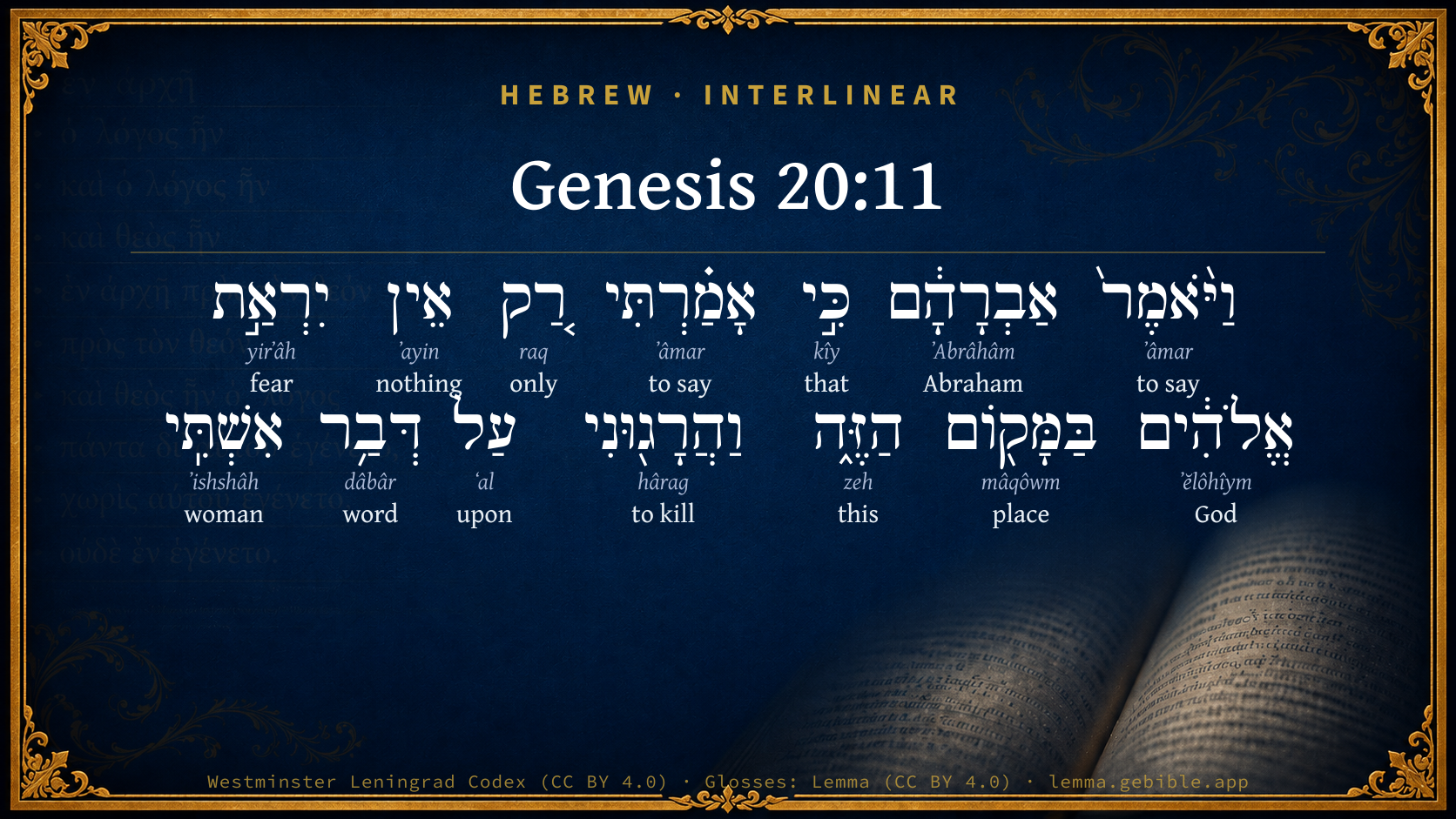
Hebrew (Westminster Leningrad Codex) Genesis 20:11 appears in the Hebrew Old Testament. The text above is from the Westminster Leningrad Codex. Each word links to its Strong’s number, a concise gloss, and parsing drawn from the Open Scriptures Hebrew Bible morphology. Click any word for its full Brown-Driver-Briggs (BDB) entry.
Download image
Cite this verse

Genesis 20:11 (World English Bible). Public Domain. Lemma interlinear Bible study tool, https://lemma.gebible.app/v/genesis/20/11.

Show BibTeX & RIS
BibTeX
RIS
English Translation
Abraham said, "Because I thought, 'Surely the fear of God is not in this place. They will kill me for my wife's sake.'
World English Bible · Public Domain
Highlights
  • 1 first appearance in the Hebrew Bible
Full analysis ↓
Download a study sheet

One document with this verse’s original text, its word-by-word gloss line, the meaning frame, cross-references with their text, attributed commentary, and full source and license credits — printable, and it pastes into notes with its structure intact.

This verse Autodidact and up

Study sheet (.html) Plain text (.txt)

A passage Seminary Student

Up to 50 verses in one chapter. A passage sheet keeps up to 6 commentary sources and 12 cross-references per verse, in the order this page ranks them, and says so on the sheet whenever that leaves anything out. Ask for a single verse and you get the Autodidact verse sheet above.

Everything on this page stays free to read, with no account — the sheet is a download of what is already on screen, not access to it.

Want to remove ads? Support Godless Engineer
Compare translations 3

The same verse in 3 English versions, stacked beneath the original-language interlinear above. Click any original word for its lexicon entry.

Each is an independent rendering of the whole verse — the interlinear is not word-aligned to these translations.

Highlighted words mark where these versions differ — a whole-verse word diff, not a word-by-word alignment.

  • World English Bible Public Domain
    Abraham said, "Because I thought, 'Surely the fear of God is not in this place. They will kill me for my wife's sake.'
  • King James Version Public Domain
    And Abraham said, Because I thought, Surely the fear of God is not in this place; and they will slay me for my wife's sake.
  • unfoldingWord Literal Text CC BY-SA 4.0
    And Abraham answered, “Because I said, ‘Surely there is no fear of God in this place, so they will kill me because of my wife.’

unfoldingWord Literal Text — © unfoldingWord, licensed CC BY-SA 4.0. Word-aligned USFM3 via Door43 (git.door43.org/unfoldingWord/en_ult).

Versions to compare (up to 4)

3 of 4 selected

Show all 18 translations

Every available English version of this verse, each an independent rendering of the whole verse.

  • World English Bible Public Domain
    Abraham said, "Because I thought, 'Surely the fear of God is not in this place. They will kill me for my wife's sake.'
  • Berean Standard Bible Public Domain
    Abraham replied, “I thought to myself, ‘Surely there is no fear of God in this place. They will kill me on account of my wife.’
  • Majority Standard Bible Public Domain
    Abraham replied, “I thought to myself, ‘Surely there is no fear of God in this place. They will kill me on account of my wife.’
  • King James Version Public Domain
    And Abraham said, Because I thought, Surely the fear of God is not in this place; and they will slay me for my wife's sake.
  • American Standard Version (1901) Public Domain
    And Abraham said, Because I thought, Surely the fear of God is not in this place. And they will slay me for my wife's sake.
  • Revised Version (1885) Public Domain
    And Abraham said, Because I thought, Surely the fear of God is not in this place; and they will slay me for my wife’s sake.
  • Geneva Bible (1599) Public Domain
    Then Abraham answered, Because I thought thus, Surely the feare of God is not in this place, and they will slay me for my wiues sake.
  • Douay-Rheims (1899) Public Domain
    Abraham answered: I thought with myself, saying: Perhaps there is not the fear of God in this place: and they will kill me for the sake of my wife:
  • Young's Literal Translation Public Domain
    And Abraham saith, `Because I said, `Surely the fear of God is not in this place, and they have slain me for the sake of my wife;
  • Literal Standard Version CC BY-SA 4.0
    And Abraham says, “Because I said, Surely the fear of God is not in this place, and they have slain me for the sake of my wife;
  • Unlocked Literal Bible CC BY-SA 4.0
    Abraham said, “Because I thought, 'Surely there is no fear of God in this place, and they will kill me because of my wife.'
  • unfoldingWord Literal Text CC BY-SA 4.0
    And Abraham answered, “Because I said, ‘Surely there is no fear of God in this place, so they will kill me because of my wife.’
  • Darby Bible Public Domain
    And Abraham said, Because I said, Surely the fear of God is not in this place, and they will kill me for my wife's sake.
  • World Messianic Bible Public Domain
    Abraham said, “Because I thought, ‘Surely the fear of God is not in this place. They will kill me for my wife’s sake.’
  • Webster's Bible Public Domain
    And Abraham said, Because I thought, surely the fear of God is not in this place; and they will slay me for my wife's sake.
  • Free Bible Version CC BY-SA 4.0
    “Well, I thought to myself, ‘Nobody respects God in this place. They'll kill me just to get my wife,’” Abraham replied.
  • Bible in Basic English Public Domain
    And Abraham said, Because it seemed to me that there was no fear of God in this place, and that they might put me to death because of my wife.
  • JPS Tanakh (1917) Public Domain
    And Abraham said: 'Because I thought: Surely the fear of God is not in this place; and they will slay me for my wife's sake.

Literal Standard Version (2020), Covenant Press — licensed CC BY-SA 4.0. Text via the HelloAO Bible API (eBible.org). Unlocked Literal Bible (unfoldingWord) — licensed CC BY-SA 4.0. Text via the HelloAO Bible API (eBible.org). unfoldingWord Literal Text — © unfoldingWord, licensed CC BY-SA 4.0. Word-aligned USFM3 via Door43 (git.door43.org/unfoldingWord/en_ult). Free Bible Version, Dr. Jonathan Gallagher — licensed CC BY-SA 4.0. Text via the HelloAO Bible API (eBible.org).

Word by word

More ways to search: Search by grammar → Find every occurrence → Compare this word →

Practice this passage: Drill this verse → Learn its vocabulary →

יִרְאַ֣ת
yirʼâh
H3374
“fear of”
Noun, Common, Feminine, Singular, Construct
Part of Speech
Noun
Type
Common
Gender
Feminine
Number
Singular
State
Construct
Full BDB Definition

Origin: from H3373

TWOT: 907b

fear, terror, fearing - fear, terror - awesome or terrifying thing (object causing fear) - fear (of God), respect, reverence, piety - revered
  1. וַיֹּ֨אמֶר֙ ʼâmar H559 “and · to say” Conjunction + Verb, Qal, Sequential Imperfect, 3rd Person, Masculine, Singular
  2. אַבְרָהָ֔ם ʼAbrâhâm H85 “Abraham” Noun, Proper
  3. כִּ֣י kîy H3588 “that” Conjunction
  4. אָמַ֗רְתִּי ʼâmar H559 “to say” Verb, Qal, Perfect, 1st Person, Common, Singular
  5. רַ֚ק raq H7535 “only” Particle, Accusative
  6. אֵין ʼayin H369 “nothing” Particle, Negative
  7. אֱלֹהִ֔ים ʼĕlôhîym H430 “God(s)” Noun, Common, Masculine, Plural, Absolute
  8. בַּמָּק֖וֹם mâqôwm H4725 “in/at the · place” Preposition, Determined + Noun, Common, Masculine, Singular, Absolute
  9. הַזֶּ֑ה zeh H2088 “the · this” Particle, Definite Article + Pronoun, Demonstrative, Masculine, Singular
  10. וַהֲרָג֖וּנִי hârag H2026 “and · to kill · me” Conjunction + Verb, Qal, Sequential Perfect, 3rd Person, Common, Plural + Suffix, Personal, 1st Person, Common, Singular
  11. עַל ʻal H5921 “upon” Preposition
  12. דְּבַ֥ר dâbâr H1697 “word of” Noun, Common, Masculine, Singular, Construct
  13. אִשְׁתִּֽי ʼishshâh H802 “woman · my” Noun, Common, Feminine, Singular, Construct + Suffix, Personal, 1st Person, Common, Singular

About this verse

These counts appear in no published source. They are computed here, from the morphology-tagged text and Lemma’s own curated glosses. What Lemma adds →

14
words
13
distinct lemmas
Pentateuch
section

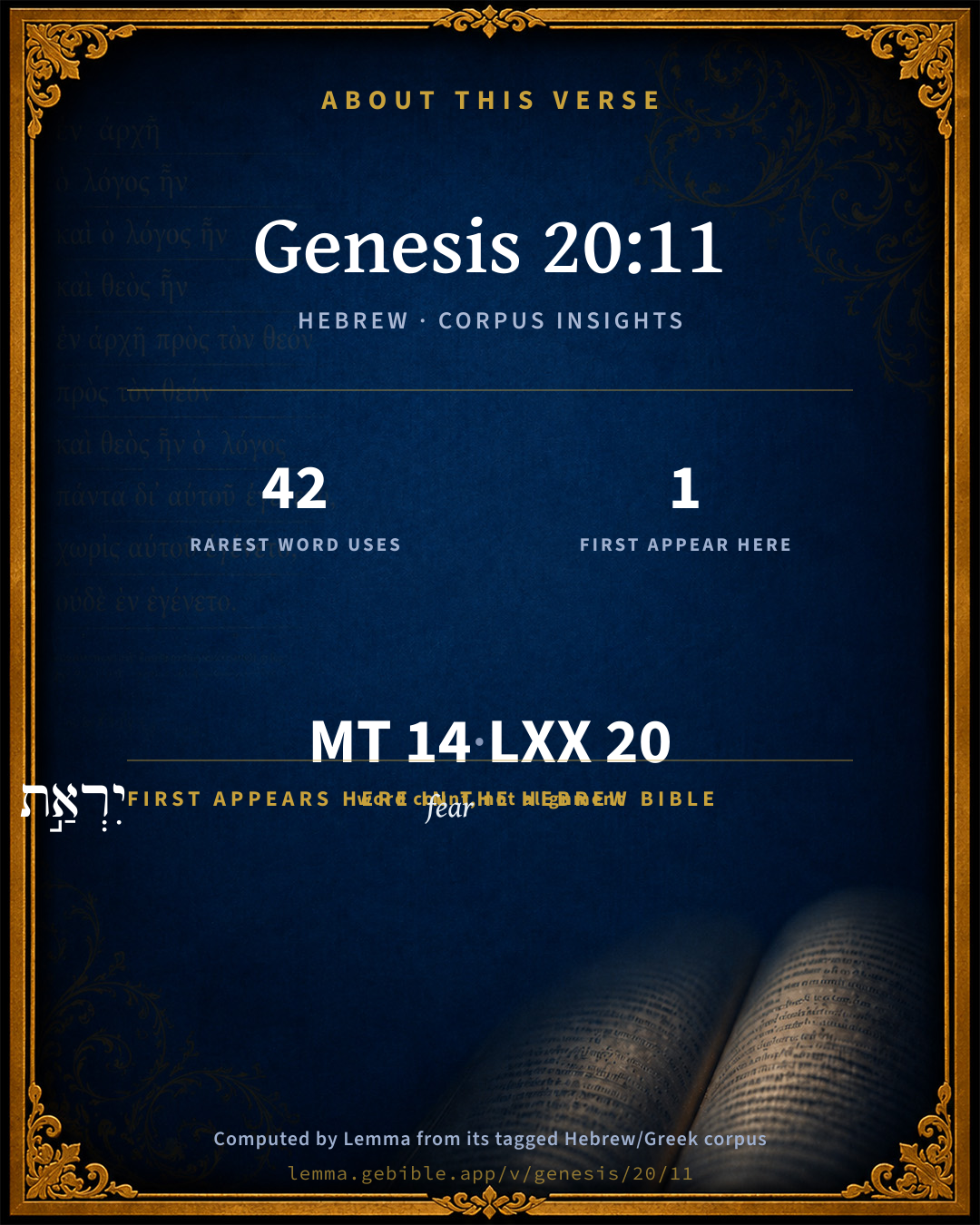
First appearance in Scripture

This word makes its first canonical appearance in the Hebrew Bible here:

  • יִרְאַ֣ת fear H3374

Shared distinctive vocabulary

יִרְאַ֣ת fear H3374 occurs in 42 verses of the Hebrew Bible. Also found in:

Grammatical profile

  • 3 verbs
  • 6 nouns
  • 1 pronoun
  • 1 preposition
  • 1 conjunction
  • 2 particles

Verb forms

  • וַיֹּ֨אמֶר֙ Qal · Sequential Imperfect
  • אָמַ֗רְתִּי Qal · Perfect
  • וַהֲרָג֖וּנִי Qal · Sequential Perfect

Repetition

A word recurs within this verse — often emphatic in Hebrew:

  • וַיֹּ֨אמֶר֙ to say H559 ×2

Hebrew & Septuagint length

In English translation the verse runs 23 words from the Hebrew and 26 from the Septuagint (LXX English) — closely comparable.

A rough comparison of the two English renderings, which tokenize alike — not a word-level alignment.

Word counts can differ between the Hebrew and the Greek without any difference in meaning — e.g. the Hebrew direct-object marker אֵת has no separate Greek word, and Greek often adds the article ὁ.

In the original languages it is 14 Hebrew tokens and 20 Greek tokens — but the two are counted differently (Hebrew bundles its prefixes and suffixes into one token; the Greek is in lemma form), so that isn’t a like-for-like length.

Cross-references

14

Topical passages linked to Genesis 20:11 in the Treasury of Scripture Knowledge — connected by theme and wording, ordered by reader-vote popularity; previews shown in the World English Bible.

  • Genesis 26:7 The men of the place asked him about his wife. He said, "She is my sister," for he was afraid to say, "My wife," lest, he thought, the men of the place might kill me for Rebekah, because she was beautiful to look on.
  • Genesis 12:12 It will happen, when the Egyptians will see you, that they will say, 'This is his wife.' They will kill me, but they will save you alive.
  • Genesis 22:12 He said, "Don't lay your hand on the boy, neither do anything to him. For now I know that you fear God, seeing you have not withheld your son, your only son, from me."
  • Genesis 42:18 Joseph said to them the third day, "Do this, and live, for I fear God.
  • Nehemiah 5:15 But the former governors who were before me were chargeable to the people, and took of them bread and wine, besides forty shekels of silver; yes, even their servants bore rule over the people: but I didn't do so, because of the fear of God.
  • Job 28:28 To man he said, 'Behold, the fear of the Lord, that is wisdom. To depart from evil is understanding.'"
  • Psalms 36:1–4 An oracle is within my heart about the disobedience of the wicked: "There is no fear of God before his eyes."
  • Proverbs 2:5 Then you will understand the fear of Yahweh, And find the knowledge of God.
  • Proverbs 16:6 By mercy and truth iniquity is atoned for. By the fear of Yahweh men depart from evil.
  • Proverbs 1:7 The fear of Yahweh is the beginning of knowledge; But the foolish despise wisdom and instruction.
  • Proverbs 8:13 The fear of Yahweh is to hate evil. I hate pride, arrogance, the evil way, and the perverse mouth.
  • Romans 3:18 "There is no fear of God before their eyes."
  • Job 1:1 There was a man in the land of Uz, whose name was Job. That man was blameless and upright, and one who feared God, and turned away from evil.
  • Psalms 14:4 Have all the workers of iniquity no knowledge, Who eat up my people as they eat bread, And don't call on Yahweh?

Cross-references courtesy of OpenBible.info (CC BY 4.0).

Hebrew and Greek witnesses Masoretic Hebrew ↔ Greek Septuagint

The same verse in the two great witnesses to the Old Testament, shown verse-for-verse.

These are two independent witnesses, not word-aligned to each other, and the Septuagint is shown in lemma (dictionary) form.

Hebrew Genesis 20:11 Masoretic · Westminster Leningrad Codex

וַיֹּ֨אמֶר֙ אַבְרָהָ֔ם כִּ֣י אָמַ֗רְתִּי רַ֚ק אֵין יִרְאַ֣ת אֱלֹהִ֔ים בַּמָּק֖וֹם הַזֶּ֑ה וַהֲרָג֖וּנִי עַל דְּבַ֥ר אִשְׁתִּֽי

Abraham said, "Because I thought, 'Surely the fear of God is not in this place. They will kill me for my wife's sake.'

World English Bible · Public Domain

Greek LXX Genesis 20:11 Septuagint · lemma form

εἶπον δέ αβρααμ εἶπον γάρ ἄρα οὐ εἰμί θεοσεβεία ἐν ὁ τόπος οὗτος ἐγώ τε ἀποκτείνω ἕνεκεν ὁ γυνή ἐγώ

And Abraam said, Why I said, Surely there is not the worship of God in this place, and they will kill me because of my wife.

LXX2012 (modern English Septuagint) · Public Domain

Hebrew: Westminster Leningrad Codex (CC BY 4.0). Greek: Septuagint (public domain); English from LXX2012 (modern English Septuagint) (Public Domain). How the Septuagint differs from the Hebrew →

Targum (Aramaic paraphrase)

2

The Targum is the ancient Jewish Aramaic paraphrase of the Hebrew Scriptures — an interpretive translation, not the Hebrew text itself. Onkelos (literal) and Pseudo-Jonathan (expansive) render the Torah, and Jonathan the Prophets. Coverage is partial: where no permissively-licensed English translation exists for a verse, only the Aramaic is shown. This is verse-level text, not a word-by-word alignment to the Hebrew.

  1. Targum Onkelos Torah (Genesis–Deuteronomy)
    וַאֲמַר אַבְרָהָם אֲרֵי אֲמָרִית לְחוֹד לֵית דַּחַלְתָּא דַּיְיָ בְּאַתְרָא הָדֵין וְיִקְטְלֻנַּנִי עַל עֵיסַק אִתְּתִי

    (no public-domain English translation for this verse)

    Targum Onkelos — Aramaic: “Onkelos Genesis” (public domain); “Onkelos Exodus” (public domain); “Onkelos Leviticus” (public domain); “Onkelos Numbers” (public domain); “Onkelos Deuteronomy” (public domain). English: “Sefaria Community Translation” (CC0 1.0 (public-domain dedication)); “J.W. Etheridge. The Targums of Onkelos and Jonathan Ben Uzziel on the Pentateuch. London: Longmans, Green, 1862” (public domain). Text via Sefaria.

  2. Targum Pseudo-Jonathan Torah (Genesis–Deuteronomy)
    וַאֲמַר אַבְרָהָם אֲרוּם אֲמָרִית בִּלְבָבִי לְחוֹד לֵית דַחַלְתָּא דַיְיָ בְּאַתְרָא הָדֵין וְיִקְטְלוּנַנִי עַל עֵיסַק אִנְתְּתִי

    And Abraham said, Because I said in my heart, The fear of the Lord is not in this place, and they will kill me for the sake of my wife.

    Targum Pseudo-Jonathan — Aramaic: “Targum Jonathan on Genesis” (public domain); “Targum Jonathan on Exodus” (public domain); “Targum Jonathan on Leviticus” (public domain); “Targum Jonathan on Numbers” (public domain); “Targum Jonathan on Deuteronomy” (public domain). English: “The Targum of Jonathan ben Uzziel, trans. J. W. Etheridge, London, 1862” (public domain). Text via Sefaria.

Commentary

Notes on Genesis 20:11 from classic Christian and Jewish commentators (each source and its license shown beneath its notes). The classic Christian expositions comment on the surrounding passage and are grouped to its opening verse, so a note may address several verses; the Jewish commentaries on the Tanakh (Rashi and others) are per-verse, so they appear only where the commentator wrote on this verse.

Lemma curates 59 commentaries, every one of them public domain or Creative Commons licensed, each selected and text-cleaned for this edition rather than reprinted as found. About our sources →

Trapp's Complete Commentary

John Trapp

Gen 20:11 And Abraham said, Because I thought, Surely the fear of God [is] not in this place; and they will slay me for my wife’s sake.

Ver. 11. Surely the fear of God, &c.] The only best curb to restrain from evil, and spur to incite to good. All honesty flows from this holy fear. It is a problem in Aristotle, why men are credited more than other creatures. The answer is, Oτι θεους νομιζει μονον; "Man only reverenceth God," therefore you may trust in him, therefore you may commit yourself to him. He that truly feareth God is like unto Cato, of whom it is said, He never did well that he might appear to do so, but because he could do no otherwise. {a} You need not fear me, said Joseph to his brethren, for I fear God, and so dare do you no harm. Ought ye not to have feared God? said Nehemiah to those usurious Jews. {Neh 5:9}

{a} Sed quia aliter facere non potuit . - Villeius.

John Trapp, A Commentary or Exposition upon All the Books of the Old and New Testament (1647–1656) — public domain. Text from a community e-Sword module.

The Biblical Illustrator

Joseph S. Exell

Gen_20:11

And Abraham said, Because I thought, surely the fear of God is not in this place

On harsh and selfish judgments

The true fear of God was at that moment in Abimelechs heart, and not in Abrahams; it was Abimelech who was playing the Christian part, that of the child of the light and of the day; Abraham was for the moment the child of fear, darkness, night.

I. CONSIDER THE ORIGIN OF THE HABIT OF HARSH JUDGMENT. TWO main sources.

1. The first a heathen Roman can illustrate for us (Act_22:27-28). The thing has cost us much; we feel it is hard to believe that it can be widely shared. Abraham had made a terrible sacrifice to assure his calling. As for those easy, jovial, prosperous heathen, surely the fear of God was not there.

2. A second source of this harshness of judgment is the predominance in all of us of the natural aristocratic principle over the Christian principle of communion. Men naturally believe in election. But, with tale exceptions, they naturally believe themselves to he the elect. It is hard indeed to believe that a private possession gains instead of loses by being shared by all mankind.

II. THE HISTORIES OF SCRIPTURE ARE A PERPETUAL WARNING AGAINST NARROW AND SELFISH JUDGMENTS OF MEN. It is as if the Spirit had resolved that the virtues of those outside the pale should be kept clearly before the eyes of men. God is no respecter of persons, and He keeps hold in ways, of which we little dream, of the most unlikely human hearts.

III. THE TRUE CHRISTIAN POLICY IN JUDGING MANKIND.

1. Let your personal fellowship be based on the clear explicit manifestation of that which is in tune with your higher life and Christs.

2. As for those who are without, believe that God is nearer to them than you wot of, and has more to do with them than you dream. (J. B. Brown, B. A.)

Morality outside the Church

I. MORALITY OUTSIDE THE CHURCH MAY ATTAIN TO GREAT EXCELLENCE.

1. Belief in a moral standard of right and wrong.

2. Belief in the moral relations of human society.

3. A sense of injured moral feeling in the presence of wrong.

4. A readiness to make restitution for faults committed against others.

II. MORALITY OUTSIDE THE CHURCH MAY HAVE LESSONS OF REPROOF FOR THOSE WHO ARE WITHIN IT.

1. For their mean subterfuges.

2. Their distrust of Providence.

3. Their religious prejudices. (T. H. Leale.)

Prejudice

1. It is often strong in those who enjoy high religious privileges. Abraham thought himself so highly favoured of God that he was unwilling to admit that any goodness could be found among those who were less favoured.

2. The evils of it are great.

(1) It limits the power of the grace of God. He is not confined to one mode of making Himself known.

(2) It is a sin against charity.

(3) It issues in committing wrong against others.

The Biblical Illustrator, edited by Joseph S. Exell (c. 1880s–1900s) — public domain. Text from a community e-Sword module.

Joseph Benson's Commentary

Gen 20:11. I thought, Surely the fear of God is not in this place, and they will slay me — There are many places and persons that have more of the fear of God in them than we think they have; perhaps they are not called by our name, they do not wear our badges, they do not tie themselves to that which we have an opinion of; and therefore we conclude they have not the fear of God in their hearts!

Joseph Benson's Commentary on the Old and New Testaments (1811–1818) — public domain. Text from a community e-Sword module.

Tyndale Open Study Notes

Tyndale Open Resources

20:11-13 Abraham’s duplicity was not a momentary loss of faith. Despite the rebuke he received in Egypt, he practiced this strategy wherever he went (cp. 12:12-13). Living by faith requires perseverance.

Tyndale Open Study Notes — © Tyndale Open Resources, licensed CC BY-SA 4.0. Text via the HelloAO Bible API.

Geneva Bible (1599)

Geneva Bible translators

He showeth that no honesty can be hoped for, where the fear of God is not.

Geneva Bible (1599) marginal notes — public domain. Text via Bolls.life.

Jamieson, Fausset & Brown

Robert Jamieson, A. R. Fausset & David Brown

And Abraham said . . . I thought, Surely the fear of God is not in this place--From the horrible vices of Sodom he seems to have taken up the impression that all other cities of Canaan were equally corrupt. There might have been few or none who feared God, but what a sad thing when men of the world show a higher sense of honor and a greater abhorrence of crimes than a true worshipper!

Jamieson, Fausset & Brown — Commentary Critical and Explanatory on the Whole Bible (1871) — public domain (CC PDM 1.0). Text via the HelloAO Bible API.

Adam Clarke's Commentary

Verse 11. And Abraham said] The best excuse he could make for his conduct, which in this instance is far from defensible.

Adam Clarke's Commentary on the Bible (1810–1826) — public domain. Text from a community e-Sword/MySword module.

John Calvin's Commentaries

11. And Abraham said. There are two points contained in this answer. For, first, he confesses that he had been induced by fear to conceal his marriage. He then denies that he had lied for the purpose of excusing himself. Now, although Abraham declares with truth, that he had not concealed his marriage with any fraudulent intention, nor for the purpose of injuring any one; yet he was worthy of censure, because, through fear, he had submitted, so far as he was concerned, to the prostitution of his wife. Wherefore, much cannot be said in his excuse: since he ought to have been more courageous and resolute in fulfilling the duty of a husband, by vindicating, the honor of his wife whatever danger might threaten him. Besides, it was a sign of distrust, to resort to an unlawful subtlety. With regard to his suspicion; although he had everywhere perceived that a monstrous licentiousness prevailed; it was, nevertheless, unjust to form a judgment so unfavourable of a people whom he had not yet known; for he supposes them all to be homicides. But as I have treated, at some length, on these subjects, in the tenth chapter (Genesis 10:1); it may now suffice to have alluded to them, by the way. Meanwhile, we come to the conclusion, that Abraham does not contend for the justice of his cause before God; but only shows his earnestness to appease Abimelech. His particular form of expression is, however, to be noticed; for wherever the fear of God does not reign, men easily rush onwards to every kind of wickedness; so that they neither spare human blood, nor restrain themselves from rapine, violence, and contumelies. And doubtless it is the fear of God alone, which unites us together in the bonds of our common humanity which keeps us within the bounds of moderation, and represses cruelty; otherwise we should devour each other like wild beasts. It will, indeed, sometimes happen, that they who are destitute of the fear of God, may cultivate the appearance of equity. For God, in order that he may preserve mankind from destruction, holds in check, with his secret rein, the lusts of the ungodly. It must, however, be always taken into the account, that the door is opened to all kinds of wickedness, when piety and the fear of God have vanished. Of this, at the present day, too clear a proof is manifest, in the horrible deluge of crime, which almost covers the whole earth. For, from what other cause than this arise such a variety of deceptions and frauds, such perfidy and cruelty, that all sense of justice is extinguished by the contempt of God? Now, whenever we have a difficult contest with the corruptions of our own age, let us reflect on the times of Abraham, which, although they were filled with impiety and other crimes yet did not divert the holy man from the course of duty.

John Calvin's Commentaries (1540-1563) — public domain. Text from the Calvin Translation Society English edition (1840s-50s) via the Christian Classics Ethereal Library (ccel.org). Calvin's coverage is partial (roughly two-thirds of the Bible); uncommented books and verses are honest gaps, never fabricated. The 19th-century editor's footnotes and remarks are omitted so the notes are faithfully Calvin's own voice.

Ellicott's Commentary for English Readers

(11) Surely the fear of God . . . —Abraham’s general condemnation of the people had some excuse in the widespread depravity of the nations in Canaan, but was nevertheless unjust. Even as regards these nations, they were not utterly corrupt (Gen_15:16), and both in Egypt and in Gerar the standard of morality was higher than Abraham supposed. His difficulty was the result of his own imperfect faith; but the fact that this artifice was arranged between man and wife when starting on their long wanderings, proves that they rather over-rated than under-rated the risks that lay before them. The expedient was indeed a sorry one, and shows that Abraham’s faith was not yet that of a martyr; but it also shows that both of them felt that Abraham might have to save his life by a means almost as bad as death. And thus, after all, it was no common-place faith, but one as firm at root as it was sorely tried and exercised.

A Bible Commentary for English Readers, edited by Charles John Ellicott (1878–1897) — public domain. Text from a community e-Sword module.

The Cambridge Bible for Schools and Colleges

gen. ed. J. J. S. Perowne

11. Because I thought] Lit. “I said”: see note on Gen_18:17.

Surely the fear of God] Abraham’s defence is that he assumed a heathen people did not fear God; and, therefore, would not be afraid of any Divine retribution, if they took the life of a stranger (gêr). The stranger had no rights; his God would not be known. He would have no “avenger of blood.” See note on Gen_4:15.

See the same idea underlying Joseph’s words, “for I fear God”(Gen_42:18).

they will slay me] He does not explain, why he feared that he would be slain for his wife’s sake. Obviously it is for the reason mentioned in Gen_12:12. Sarah’s youth and beauty are assumed: the murder of the stranger would enable the inhabitants of Gerar to seize her. For this murder there would be no redress; and, therefore, there would be little compunction.

The Cambridge Bible for Schools and Colleges (gen. ed. J. J. S. Perowne; Cambridge University Press, 1878–1918) — public domain. Text from a community e-Sword module.

John Gill's Exposition

And Abraham said,.... In defence of himself, as well as he could:

because I thought; within himself, concluding from the general depravity of the Canaanites, that this was the case of the inhabitants of Gerar:

surely the fear of God is not in this place; this is a certain truth, which he thought might be depended upon, and taken for granted, since so it was everywhere: or "only" (e), as the word used signifies; this was the only thing he had to plead, that he verily thought with himself that there was no true religion and godliness in Gerar: that the inhabitants of it were without any fear of God before their eyes, or in their hearts; and he knew, where this is the case, there is nothing to restrain from the commission of the grossest sins:

and they will slay me for my wife's sake; that they might marry her, see Gen 12:12.

(e) "tantum", Montanus; so Vatablus, Junius & Tremellius, Piscator, Drusius; so the Targums of Onkelos and Jonathan, and Ben Melech.

John Gill's Exposition of the Whole Bible (1746–1763) — public domain (CC PDM 1.0). Text via the HelloAO Bible API.

Matthew Poole's English Annotations

The fear of God is not in this place, i.e. true piety, or the knowledge of the true God, which is the only effectual restraint from the grossest wickedness.

Matthew Poole's English Annotations on the Holy Bible (1683–1685) — public domain. Text from a community e-Sword/MySword module.

Whedon's Commentary on the Bible

Daniel D. Whedon

11. Abraham said — Abraham’s answer has four points: 1) He thought the people of Gerar to be without the fear of God. 2) That they would therefore be likely to slay him, in order to obtain his wife. 3) She was, indeed, his sister. 4) They had both entered into an agreement at the beginning of their wanderings, that, for mutual safety, they would, among strange peoples, call each other brother and sister.

Fear of God — The reverence and piety due before the Holy One. Abraham had, very probably, seen things in Gerar which were contrary to his ideas of uprightness, and he was prompted to his duplicity by the same motive of fear that actuated him in Egypt. Compare Gen_12:12.

Daniel D. Whedon (gen. ed.), Commentary on the Old and New Testaments (1874–1909) — public domain. Text from a community e-Sword module.

The Pulpit Commentary

And Abraham said (offering as his first apology for his sinful behavior the fear which he entertained of the depravity of the people), Because I thought, literally, said (sc. in my heart)Surely the fear of God is not in this place; otherwise, there is not any fear of God, qr having usually a confirming sense with reference to what follows (cf. Deu_4:6; 1Ki_14:8; vide Gesenius, p. 779) and they will slay me for my wife"s sake.

The Pulpit Commentary (1880–1919), ed. H.D.M. Spence-Jones & Joseph S. Exell — public domain. Text from a community e-Sword module.

John Wesley's Explanatory Notes

I thought surely the fear of God is not in this place, and they will slay me - There are many places and persons that have more of the fear of God in them than we think they have; perhaps they are not called by our name, they do not wear our badges, they do not tie themselves to that which we have an opinion of; and therefore we conclude they have not the fear of God in their hearts!

John Wesley, Explanatory Notes Upon the Whole Bible (1754–1765) — public domain. Text via the GEBible commentary corpus.

Scofield Reference Notes

C. I. Scofield

fear

(See Scofield "Psa 19:9").

The Scofield Reference Bible (1917 edition), notes by C. I. Scofield — public domain. Text from a community e-Sword module.

Rashi

Rabbi Shlomo Yitzchaki (Rashi)

רק אין יראת אלהים SURELY THERE IS NO FEAR OF GOD — When a stranger arrives in a city do people ask him about what he would like to eat or to drink, or do they ask him about his wife—“Is this your wife?” or “Is this your sister?” (Bava Kamma 92a) (Surely if they ask at all, it is about his needs; if they ask regarding his relationship to the lady accompanying him, it is evidence that they are not God-fearing people!)

Rashi on the Tanakh — English translations: “The Judaica Press complete Tanach with Rashi, translated by A. J. Rosenberg” (CC BY 4.0); “Pentateuch with Rashi's commentary by M. Rosenbaum and A.M. Silbermann, 1929-1934” (public domain); “The Metsudah Tanach series, Lakewood, N.J” (CC BY 4.0); and “The Book of Joshua, Metsudah Publications, 1997” (CC BY 4.0). Text via Sefaria.

Radak

Rabbi David Kimhi (Radak)

ויאמר..רק אין יראת אלוקים, Avraham replied that though the land was good there was no feeling of fear of the Lord in it. This was the only drawback of that country. As a result, if I would have protested they would have killed me in order not to become guilty of the greater sin of adultery.

Radak on the Tanakh — English translations: “Sefaria Community Translation” (CC0 1.0 (public-domain dedication)); “Eliyahu Munk, HaChut Hameshulash” (CC BY 4.0); “Rabbi Mike Feuer, Jerusalem Anthology” (CC BY 4.0); and “R. David Kimhi on the first book of Psalms, Translated by R.G. Finch, London, 1919” (public domain). Text via Sefaria.

Lesson kit

Teaching starters — assembled from the data on this page, not authored interpretation. Every prompt links to the verse data it draws on. Edit before teaching.

Genesis, in the Pentateuch, opens this verse with 14 words (13 distinct Hebrew lemmas). Its most distinctive word is yirʼâh (“fear”). A historical commentator’s framing appears above. Read the whole chapter for the surrounding context.

Discussion questions

  1. How does “fear” (yirʼâh) shape what this verse is saying?
  2. The word “fear” first appears here in Scripture. What is being introduced at this debut?
  3. Exodus 20:20 shares the word «fear» with this verse. How do the two illuminate each other?
  4. “to say” occurs 2× in this one verse. What is the effect of the repetition?
  5. These translations render this verse differently; the difference is in the English rendering, not the original. What questions does that raise?
  6. The verb «וַיֹּ֨אמֶר֙» is Qal Sequential Imperfect. How does its form color the action?
  7. Reading how Trapp's Complete Commentary and The Biblical Illustrator read this verse, where do the two commentators agree and where do they part?

Things to notice

Reading settings

Reading text

Shown beneath each verse's original-language words.

Old Testament
Old Testament edition

Read the OT as the Masoretic Hebrew (MT) or the Greek Septuagint (LXX).

English shown for the Greek Septuagint (in the Hebrew ↔ Greek comparison).

Comparing translations? Open the Compare panel on any verse page to stack up to four side by side.