
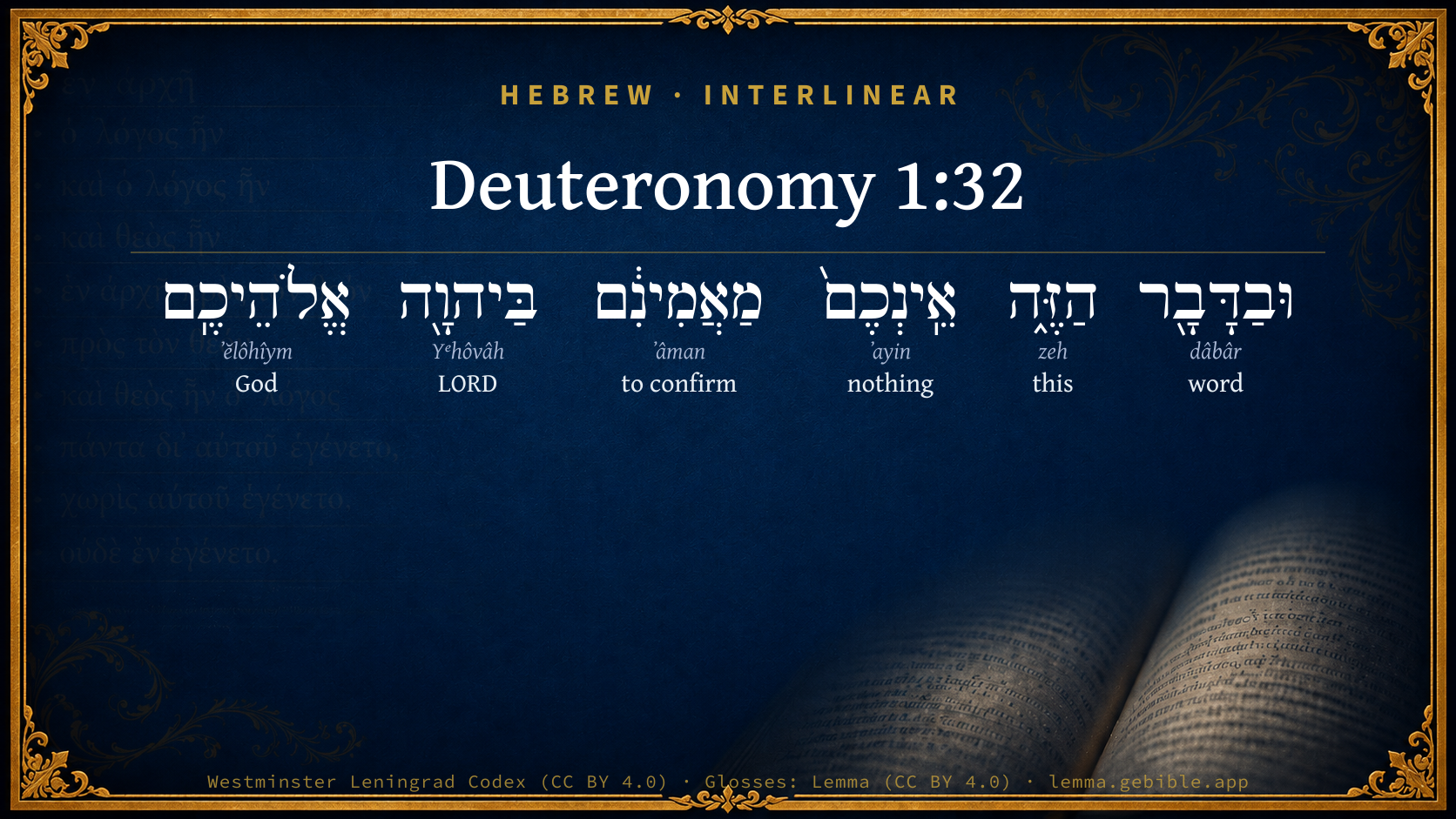
Deuteronomy 1:32

Hebrew (Westminster Leningrad Codex) Deuteronomy 1:32 appears in the Hebrew Old Testament. The text above is from the Westminster Leningrad Codex. Each word links to its Strong’s number, a concise gloss, and parsing drawn from the Open Scriptures Hebrew Bible morphology. Click any word for its full Brown-Driver-Briggs (BDB) entry.
Download image
Cite this verse

Deuteronomy 1:32 (World English Bible). Public Domain. Lemma interlinear Bible study tool, https://lemma.gebible.app/v/deuteronomy/1/32.

Show BibTeX & RIS
BibTeX
RIS
English Translation
Yet in this thing you didn't believe Yahweh your God,
World English Bible · Public Domain
Download a study sheet

One document with this verse’s original text, its word-by-word gloss line, the meaning frame, cross-references with their text, attributed commentary, and full source and license credits — printable, and it pastes into notes with its structure intact.

This verse Autodidact and up

Study sheet (.html) Plain text (.txt)

A passage Seminary Student

Up to 50 verses in one chapter. A passage sheet keeps up to 6 commentary sources and 12 cross-references per verse, in the order this page ranks them, and says so on the sheet whenever that leaves anything out. Ask for a single verse and you get the Autodidact verse sheet above.

Everything on this page stays free to read, with no account — the sheet is a download of what is already on screen, not access to it.

Want to remove ads? Support Godless Engineer
Compare translations 3

The same verse in 3 English versions, stacked beneath the original-language interlinear above. Click any original word for its lexicon entry.

Each is an independent rendering of the whole verse — the interlinear is not word-aligned to these translations.

Highlighted words mark where these versions differ — a whole-verse word diff, not a word-by-word alignment.

  • World English Bible Public Domain
    Yet in this thing you didn't believe Yahweh your God,
  • King James Version Public Domain
    Yet in this thing ye did not believe the LORD your God,
  • unfoldingWord Literal Text CC BY-SA 4.0
    But in this word you did not believe Yahweh your God,

unfoldingWord Literal Text — © unfoldingWord, licensed CC BY-SA 4.0. Word-aligned USFM3 via Door43 (git.door43.org/unfoldingWord/en_ult).

Versions to compare (up to 4)

3 of 4 selected

Show all 18 translations

Every available English version of this verse, each an independent rendering of the whole verse.

  • World English Bible Public Domain
    Yet in this thing you didn't believe Yahweh your God,
  • Berean Standard Bible Public Domain
    But in spite of all this, you did not trust the LORD your God,
  • Majority Standard Bible Public Domain
    But in spite of all this, you did not trust the LORD your God,
  • King James Version Public Domain
    Yet in this thing ye did not believe the LORD your God,
  • American Standard Version (1901) Public Domain
    Yet in this thing ye did not believe Jehovah your God,
  • Revised Version (1885) Public Domain
    Yet in this thing ye did not believe the LORD your God,
  • Geneva Bible (1599) Public Domain
    Yet for all this ye did not beleeue the Lord your God,
  • Douay-Rheims (1899) Public Domain
    The Lord God, who is your leader, himself will fight for you, as he did in Egypt in the sight of all.
  • Young's Literal Translation Public Domain
    `And in this thing ye are not stedfast in Jehovah your God,
  • Literal Standard Version CC BY-SA 4.0
    And in this thing you are not steadfast in your God YHWH,
  • Unlocked Literal Bible CC BY-SA 4.0
    Yet in spite of this word you did not believe Yahweh your God,
  • unfoldingWord Literal Text CC BY-SA 4.0
    But in this word you did not believe Yahweh your God,
  • Darby Bible Public Domain
    But In this thing ye did not believe Jehovah your God,
  • World Messianic Bible Public Domain
    Yet in this thing you didn’t believe the LORD your God,
  • Webster's Bible Public Domain
    Yet in this thing ye did not believe the LORD your God,
  • Free Bible Version CC BY-SA 4.0
    Despite all this, you didn't trust the Lord your God,
  • Bible in Basic English Public Domain
    But for all this, you had no faith in the Lord your God,
  • JPS Tanakh (1917) Public Domain
    Yet in this thing ye do not believe the LORD your God,

Literal Standard Version (2020), Covenant Press — licensed CC BY-SA 4.0. Text via the HelloAO Bible API (eBible.org). Unlocked Literal Bible (unfoldingWord) — licensed CC BY-SA 4.0. Text via the HelloAO Bible API (eBible.org). unfoldingWord Literal Text — © unfoldingWord, licensed CC BY-SA 4.0. Word-aligned USFM3 via Door43 (git.door43.org/unfoldingWord/en_ult). Free Bible Version, Dr. Jonathan Gallagher — licensed CC BY-SA 4.0. Text via the HelloAO Bible API (eBible.org).

Word by word

More ways to search: Search by grammar → Find every occurrence → Compare this word →

Practice this passage: Drill this verse → Learn its vocabulary →

מַאֲמִינִ֔ם
ʼâman
H539
“confirming”
Verb, Hiphil, Participle Active, Masculine, Plural, Absolute
Part of Speech
Verb
Stem
Hiphil
Form
Participle Active
Gender
Masculine
Number
Plural
State
Absolute
Full BDB Definition

Origin: a primitive root

TWOT: 116

to support, confirm, be faithful - (Qal) - to support, confirm, be faithful, uphold, nourish - foster-father (substantive) - foster-mother, nurse - pillars, supporters of the door - (Niphal) - to be established, be faithful, be carried, make firm - to be carried by a nurse - made firm, sure, lasting - confirmed, established, sure - verified, confirmed - reliable, faithful, trusty - (Hiphil) - to stand firm, to trust, to be certain, to believe in - stand firm - trust, believe
  1. וּבַדָּבָ֖ר dâbâr H1697 “and · in/at the · word” Conjunction + Preposition, Determined + Noun, Common, Masculine, Singular, Absolute
  2. הַזֶּ֑ה zeh H2088 “the · this” Particle, Definite Article + Pronoun, Demonstrative, Masculine, Singular
  3. אֵֽינְכֶם֙ ʼayin H369 “nothing · you” Particle, Negative + Suffix, Personal, 2nd Person, Masculine, Plural
  4. בַּיהוָ֖ה Yᵉhôvâh H3068 “in/at · LORD” Preposition + Noun, Proper
  5. אֱלֹהֵיכֶֽם ʼĕlôhîym H430 “God(s) · your” Noun, Common, Masculine, Plural, Construct + Suffix, Personal, 2nd Person, Masculine, Plural

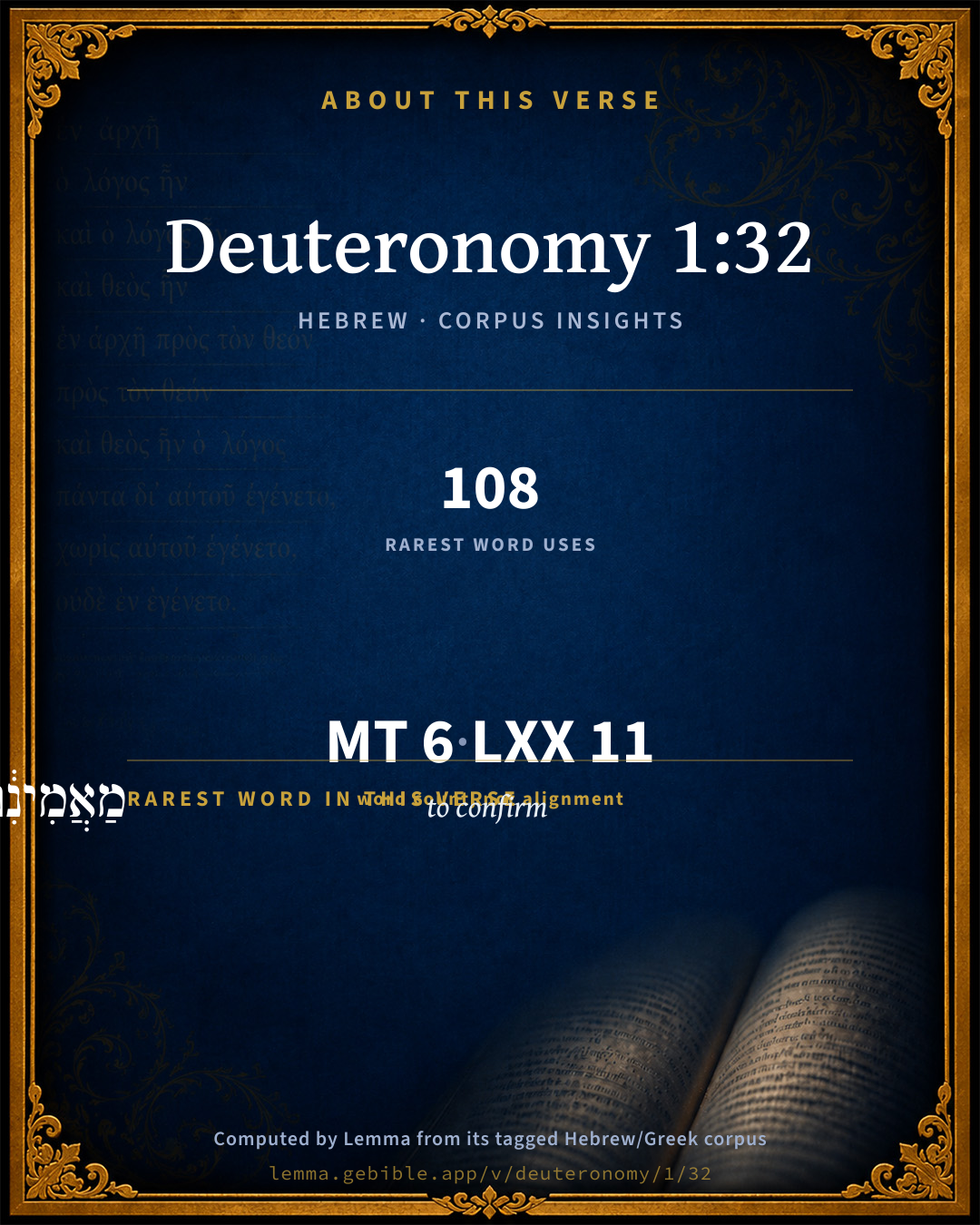
About this verse

These counts appear in no published source. They are computed here, from the morphology-tagged text and Lemma’s own curated glosses. What Lemma adds →

6
words
6
distinct lemmas
Pentateuch
section

Grammatical profile

  • 1 verb
  • 3 nouns
  • 1 pronoun
  • 1 particle

Verb forms

  • מַאֲמִינִ֔ם Hiphil · Participle Active

Hebrew & Septuagint length

In English translation the verse runs 10 words from the Hebrew and 11 from the Septuagint (LXX English) — closely comparable.

A rough comparison of the two English renderings, which tokenize alike — not a word-level alignment.

Word counts can differ between the Hebrew and the Greek without any difference in meaning — e.g. the Hebrew direct-object marker אֵת has no separate Greek word, and Greek often adds the article ὁ.

In the original languages it is 6 Hebrew tokens and 11 Greek tokens — but the two are counted differently (Hebrew bundles its prefixes and suffixes into one token; the Greek is in lemma form), so that isn’t a like-for-like length.

Cross-references

7

Topical passages linked to Deuteronomy 1:32 in the Treasury of Scripture Knowledge — connected by theme and wording, ordered by reader-vote popularity; previews shown in the World English Bible.

  • Psalms 106:24 Yes, they despised the pleasant land. They didn't believe his word,
  • Jude 1:5 Now I desire to remind you, though you already know this, that the Lord, having saved a people out of the land of Egypt, afterward destroyed those who didn't believe.
  • Hebrews 3:18–19 To whom did he swear that they wouldn't enter into his rest, but to those who were disobedient?
  • Psalms 78:22 Because they didn't believe in God, And didn't trust in his salvation.
  • Hebrews 3:12 Beware, brothers, lest perhaps there be in any one of you an evil heart of unbelief, in falling away from the living God;
  • 2 Chronicles 20:20 They rose early in the morning, and went forth into the wilderness of Tekoa: and as they went forth, Jehoshaphat stood and said, Hear me, Judah, and you inhabitants of Jerusalem: believe in Yahweh your God, so shall you be established; believe his prophets, so shall you prosper.
  • Isaiah 7:9 and the head of Ephraim is Samaria, and the head of Samaria is Remaliah's son. If you will not believe, surely you shall not be established.'"

Cross-references courtesy of OpenBible.info (CC BY 4.0).

Hebrew and Greek witnesses Masoretic Hebrew ↔ Greek Septuagint

The same verse in the two great witnesses to the Old Testament, shown verse-for-verse.

These are two independent witnesses, not word-aligned to each other, and the Septuagint is shown in lemma (dictionary) form.

Hebrew Deuteronomy 1:32 Masoretic · Westminster Leningrad Codex

וּבַדָּבָ֖ר הַזֶּ֑ה אֵֽינְכֶם֙ מַאֲמִינִ֔ם בַּיהוָ֖ה אֱלֹהֵיכֶֽם

Yet in this thing you didn't believe Yahweh your God,

World English Bible · Public Domain

Greek LXX Deuteronomy 1:32 Septuagint · lemma form

καί ἐν ὁ λόγος οὗτος οὐ ἐνπιστεύω κύριος ὁ θεός σύ

And in this matter you⌃ believed not the Lord our God,

LXX2012 (modern English Septuagint) · Public Domain

Hebrew: Westminster Leningrad Codex (CC BY 4.0). Greek: Septuagint (public domain); English from LXX2012 (modern English Septuagint) (Public Domain). How the Septuagint differs from the Hebrew →

Targum (Aramaic paraphrase)

2

The Targum is the ancient Jewish Aramaic paraphrase of the Hebrew Scriptures — an interpretive translation, not the Hebrew text itself. Onkelos (literal) and Pseudo-Jonathan (expansive) render the Torah, and Jonathan the Prophets. Coverage is partial: where no permissively-licensed English translation exists for a verse, only the Aramaic is shown. This is verse-level text, not a word-by-word alignment to the Hebrew.

  1. Targum Onkelos Torah (Genesis–Deuteronomy)
    וּבְפִתְגָמָא הָדֵין לֵיתֵיכוֹן מְהֵימְנִין בְּמֵימְרָא דַיְיָ אֱלָהֲכוֹן

    (no public-domain English translation for this verse)

    Targum Onkelos — Aramaic: “Onkelos Genesis” (public domain); “Onkelos Exodus” (public domain); “Onkelos Leviticus” (public domain); “Onkelos Numbers” (public domain); “Onkelos Deuteronomy” (public domain). English: “Sefaria Community Translation” (CC0 1.0 (public-domain dedication)); “J.W. Etheridge. The Targums of Onkelos and Jonathan Ben Uzziel on the Pentateuch. London: Longmans, Green, 1862” (public domain). Text via Sefaria.

  2. Targum Pseudo-Jonathan Torah (Genesis–Deuteronomy)
    וּבְפִתְגָמָא הָדֵין לֵיתֵיכוֹן מְהֵימְנִין בְּמֵימְרָא דַיְיָ אֱלָהָכוֹן

    But in this thing you believed not in the Word of the Lord your God,

    Targum Pseudo-Jonathan — Aramaic: “Targum Jonathan on Genesis” (public domain); “Targum Jonathan on Exodus” (public domain); “Targum Jonathan on Leviticus” (public domain); “Targum Jonathan on Numbers” (public domain); “Targum Jonathan on Deuteronomy” (public domain). English: “The Targum of Jonathan ben Uzziel, trans. J. W. Etheridge, London, 1862” (public domain). Text via Sefaria.

Commentary

Notes on Deuteronomy 1:32 from classic Christian and Jewish commentators (each source and its license shown beneath its notes). The classic Christian expositions comment on the surrounding passage and are grouped to its opening verse, so a note may address several verses; the Jewish commentaries on the Tanakh (Rashi and others) are per-verse, so they appear only where the commentator wrote on this verse.

Lemma curates 59 commentaries, every one of them public domain or Creative Commons licensed, each selected and text-cleaned for this edition rather than reprinted as found. About our sources →

Trapp's Complete Commentary

John Trapp

Deu 1:32 Yet in this thing ye did not believe the LORD your God,

Ver. 32. Ye did not believe.] Sic surdo plerunque fabulam: there was none within to make answer. "Who hath believed our report?" &c. We cannot get men to credit us.

John Trapp, A Commentary or Exposition upon All the Books of the Old and New Testament (1647–1656) — public domain. Text from a community e-Sword module.

The Biblical Illustrator

Joseph S. Exell

Deu_1:32

In this thing ye did not believe the Lord your God.

Partial truth

These are the great battles of the world. Not the clang of swords and the roar of kingdoms, but the conflict of man with God,--man calling God a liar; these are the disastrous and fatal wars. We think ourselves refined because we shrink from the taste of hot blood, and then go and secretly disobey the God that made us. We are often called upon to contemplate what may be called partial faith. We have faith in spots; we are mainly bruises of unbelief, wounds of unconfessed but deadly atheism; yet here and there, leopard-like or zebra-like, we are studded with pieces of detached piety. How true this is let every man bear witness on his own account. We do believe some things, but generally they are things of no importance. We believe things that cost us nothing. Who believes the thing that has a Cross. Wet with red blood in the middle of it? We are all partially religious, whimsically religious, religious after a very arbitrary and mechanical fashion. It is marvellous how the conscience is trained in little dots and short lines, and how the total manhood is left in a practically atheistic condition. We see what is meant by partial faith when we contemplate a vision which comes before us every day of our life, and that is the vision of partial character. Where is there a man that is all reprobate? The son of perdition occurs but now and then in the rolling transient centuries. Who is there who has not some good points about him? How we magnify those points into character. The chain is no stronger than its weakest link. Would you trust a chain thirty links long if you were sure that one of the links was very weak? You are no stronger than your weakest point; study that weak point; repair, amend, or remove it, or replace it by some point worthy of the rest of the character. That would be common sense, that would be downright logic worthy of the market place. Why not accept it and realise it? We all believe in providence. Which providence? how much providence? in what seasons do we believe in providence? We are great believers in blossoming time, but what faith have we when the snow upon our path is six feet deep and the wind a hail and frost? The Lord has many fine day followers. When a man has had ten thousand pounds unexpectedly left to him, he is prone to sing, God moves in a mysterious way. He is mayhap, notwithstanding his psalm singing, a hypocrite; he does not understand the meaning of faith, which is self-transformation into the very bosom of God. We often hear of some persons who are remarkably sound on certain doctrines. I dread to hear of any man who is particularly sound, on any one doctrine, because I have the suspicion that he is magnifying his soundness upon that doctrine that he may ingratiate himself into my confidence so far as to inoculate me with some peculiar heresy of his own. As we have said before, what would be thought of any man who was partial to certain letters of the alphabet, and remarkably sound upon the consonants, or who held two of the vowels with most pious and clinging faith, who would lay down his intellectual life for the vowel a and for the vowel o, but who would take leave to cherish his own suspicions with regard to the soundness of the other vowels? What of the man who is strong upon the letter b, but a little heretical upon the letter z? This is Gods charge against us by the mouth of His prophets and apostles--Yet in this thing ye did not believe. We must not only be careful about what we do believe, but about what we do not believe. Do we really believe in providence?--in the shepherdly God, in the fatherly God, in the motherly God, in the God of the silent step, who comes with the noiselessness of a sunbeam into the chamber of our solitude and desolation? Do we really believe in the God who fills all space, yet takes up no poor mans room, and who is constantly applying to broken or wounded hearts the balm that grows only in old sweet Gilead? Do we believe that the very hairs of our head are all numbered? I am not so old in faith as mighty Habakkuk, I could see many trees blighted without losing my faith; but there is ,one tree, if aught should happen to any single branch or twig of that tree, my souls faith would wither. What, then, can be my faith, if it is true, and it is true, that a chain is no stronger than its weakest link? We believe in prayer. How much? At what time do we believe in prayer? Are there not periods of agony in life in which we dismiss all around, and look with dumb sorrow upon the unheeding heavens? It is in vain that we say we believe in prayer, and that we lament for those who do not pray, if our prayer does not stand us in good stead in the hour and article of lifes extremest agony. Remember the possibility of our having a partial faith, a partial faith in providence, a partial faith in prayer, and remember that the chain is no stronger than its weakest point; and if in this thing or that we do not believe the Lord our God, we may strike the rest of our faith dead as with a sword stroke. Lord, save me, or I perish! What we want, then, is an all-round faith; in other words, what we want is an all-the-year-round faith. But our faith comes in fits and starts. Perhaps this may be accounted for by the fact that we have confounded the word creed with the word faith. Creed is weather, faith is climate; creed is a variable alphabet, faith is an eternal poetry. We live on faith, we walk by faith; without faith we have no life. As to our creed, take it, leave it, read it, despise it, adopt it, do what you like with it, but faith abides for ever, sometimes requiring new words and new modes, but never changing its inward and Divine substance and meaning. Let every man apply this text to himself. Let no man charge another about this merely occasional or spasmodic faith. Now and again we hear men say, My faith could not rise to that height. Sometimes I may ask for a little patience, now and again I may say, Give me time. Lord, Thou knowest all things, Thou knowest that I love Thee. That is the true faith. So long as that love lingers in the heart hell shall not have thee, nor the gates of hell prevail against the rock on which you build. This is very serious. This reflection makes life very solemn. Some of us have thought too much that we could take up our faith and set it down, that we may believe a little of this and a little of that; some of us have not thought much of the roundness of the orb of faith. Let us not give way to censoriousness upon others. You do not know how hard it is for some men to believe. It may be comparatively easy for you and me to believe. But we who are strong should bear the infirmities of the weak; we should be patient with the slow, we should desire that other men may know the joy and the blessedness and the triumph and the glory of the full life. (J. Parker, D. D.)

The Biblical Illustrator, edited by Joseph S. Exell (c. 1880s–1900s) — public domain. Text from a community e-Sword module.

The Cambridge Bible for Schools and Colleges

gen. ed. J. J. S. Perowne

32. Yet in this thing] Rather, in spite of this word, Deu_1:29-31.

ye did not believe] Heb. ye were not believing (participle), i.e. ye continued, or persisted, not to believe.

The Cambridge Bible for Schools and Colleges (gen. ed. J. J. S. Perowne; Cambridge University Press, 1878–1918) — public domain. Text from a community e-Sword module.

John Gill's Exposition

Yet in this thing ye did not believe the Lord your God. That they might go up and possess the land at once, and that he would fight for them, and subdue their enemies under them; or notwithstanding the favours bestowed upon them, and because of them, they did not believe in the Lord their God, and which was a great aggravation of their unbelief, and was the cause of their not entering into the good land, Heb 3:19.

.

Deuteronomy 1:33

deu 1:33

deu 1:33

deu 1:33Who went in the way before you, to search you out a place to pitch your tents in,.... For when the cloud was taken up they journeyed, and when that rested, there they pitched their tents; and hereby they were directed to places the most convenient for water for them and their flocks, or for safety from those that might annoy them:

in fire by night, to show you by what way ye should go; which otherwise they could not have found in dark nights, in which they sometimes travelled, and in, a wilderness where there were no tracks, no beaten path, no common way:

and in a cloud by day; to shelter them from the scorching sun, where there were no trees nor hedges to shade them, only rocky crags and hills.

John Gill's Exposition of the Whole Bible (1746–1763) — public domain (CC PDM 1.0). Text via the HelloAO Bible API.

Matthew Poole's English Annotations

In this matter which God commanded and encouraged you to do, to wit, in going in confidently to possess the land. Or, in this word, whereby God promised to fight for you, and assured you of good success.

Matthew Poole's English Annotations on the Holy Bible (1683–1685) — public domain. Text from a community e-Sword/MySword module.

The Pulpit Commentary

Vers. 32, 33. Yet in this thing ye did not believe the Lord your God; literally, With this thing or With this word ye were not believing in Jehovah your God. The Hebrew rb; d; like the Greek rhma, signifies either thing or word. If the former rendering be adopted here, the meaning will be, Notwithstanding this fact of which you have had experience, viz. how God has interposed for your protection and deliverance, ye were still unbelieving in him. If the latter rendering be adopted, the meaning will be, Notwithstanding what I then said to you, ye remained unbelieving, etc.

This latter seems the more probable meaning. In the Hebrew text there is a strong stop (athnach) after this word, as if a pause of astonishment followed this utterance Notwithstanding this word, strange to say! ye were not believing, etc. The participle ("believing") is intended to indicate the continuing of this unbelief. So also in ver. 34, the participle form is used was going in the way before you," to indicate that not once and again, but continually, the Lord went before them; and this made the sin of their unbelief all the more marked and aggravated. (For the fact here referred to, see Exo_13:21, etc.; Num_9:15, etc.; Num_10:33-36)

Vers. 32-35. The grievous consequences of unbelief.

Moses rehearses in the hearing of Israel the strange story of "their manners in the wilderness," and reminds them how their unbelief had provoked the Lord to anger, and had deprived vast numbers of them of the rest they had hoped to enjoy. We ought to be at no loss how to apply this to present day uses. The Holy Ghost, by the mouth of David, renews the warning voice. The writer of the Epistle to the Hebrews, both by argument and exhortation, repeatedly says, Take heed lest a like evil befall you. (Heb_3:7-19 Heb_4:1-11) Whence observe

I HERE IS A REMARKABLE FACT TO BE NOTED: viz. Divine arrangements apparently failing of their end through the misconduct of man.

1. God had made provision for securing the entrance of Israel into their land. Early had the promise been made. Long and patiently did the patriarchs await its fulfillment. (Heb_11:13) God had watched over his people"s wanderings. He beheld them in Egypt. When the time for liberating them was come, Moses was at hand. Israel had but to stand still, and see the salvation of the Lord, again and again. The Law was given from Sinai. Manna descended from heaven. Water gushed from the rock. The pillar of fire and of cloud was their guard, light, or shade. They knew what God intended to do for them. The promise was clear; the conditions were plain; the warnings were solemn; the threatenings were terrible. No excuse of ignorance could be pleaded by the people. Yet:

2. All were insufficient to prevent their defection of heart from God. They were perpetually doubting God. "Ten times". (Num_14:22) Unbelief led to the breaking forth of lust. They forfeited the promise; and of the many thousands who started for Egypt only two survived to enter Canaan. "So we see that they could not enter in because of unbelief.

II THERE IS GREAT DANGER LEST THE PARALLEL BETWEEN OURSELVES AND ISRAEL, ALREADY SEEN IN GREATER MERCY, SHOULD BE SEEN AGAIN IN A GREATER RUIN. There is already a parallel in mercy.

1. There is a complete arrangement for meeting all our wants on the way to a nobler rest.

2. In treading the way, we have a far better Leader than Moses.

3. We have far clearer light than Israel had.

4. We have fuller and richer promises.

5. We have a far higher rest in view.

6. Throughout the way there will be demands on our faith.

7. There is a danger from within, lest we should distrust God.

Are we not conscious of such a danger? Our hearts are sinful, and predisposed to doubt. We have doubted God very much, and thus wronged him in times gone by. Such unbelief may take or may have taken the form of presumption or of despair. For an illustration of the former, see next Homily. The latter kind of unbelief may be almost indefinitely varied. Men may doubt

(1) the power of God to bring them to the rest; or

(2) the willingness of God to do it; or

(3) the readiness of God to bring them to the rest, without questioning his care for others; or they may even go so far as to doubt

(4) whether the promises of the rest be Divine;

(5) whether there is any such rest as the one promised; and even

(6) whether there is any God of promise.

Whichever of these forms a despairing unbelief may assume, the evil of it is sufficiently manifest. It is the greatest dishonor which we can cast on God, to allow the thought to gain the mastery, that we are flung down hither without any sure destiny of blessedness being disclosed, or without any certainty of reaching it being made known. Besides, doubt prevents work; it paralyzes. Doubting God gives the rein to every lust.

8. And unless we take heed," if we suffer doubt to get the mastery, as Israel lost their rest, we shall lose ours. What present rest can we have while unbelief has the upper hand? Doubt is essentially unrest. How can we enjoy any future rest? What sympathy with God can we have? Besides, God declares, "They shall not enter into my rest." In that heavenly rest none can or will share who do not implicitly believe the promise and loyally obey the precept.

9. And how much more serious it will be to trifle with Christ, than to slight (Heb_10:28-31) But there is a very bright side to this subject. While unbelief will shut us out of heaven, nothing else will! Nothing can shut us out of heaven but doubting God! Poverty cannot. Persecution cannot. Reproach cannot. Obscurity cannot. No one shall ever sink who trusts his God. See that young and weak believer who has turned his back on the world, and set his face heavenward. A thousand difficulties bristle up in all directions. But he meets them all, saying, "God called me, God will help me, God will lead me, God will guard me.

A feeble saint shall win the day, Though death and hell obstruct the way!

Yea, even so! "Them that honor me," saith God, "I will honor." But, must we not look to him who awakened our faith, to sustain it? "Tis even so.

Ever have we to say, "Give what thou commandest, and then command what thou wilt." "Lord, we believe; help thou our unbelief." And is there not enough revealed of God and of his wondrous love in Christ to put every doubt to flight, when all that God is to us is laid home to our hearts by the Holy Ghost? Here, indeed, is a quickening, inspiring, sustaining force, of which Israel knew little or nothing. "Greater is he that is for us than all they which be against us." "He that spared not his own Son, but gave him up for us all, how shall he not with him also freely give us all things?" Let us doubt ourselves as much as we will, but our God and Savior never. He hath said, "I will never leave thee nor forsake thee." "Hath he said, and shall he not do it? Hath he spoken, and shall he not make it good?"

The Pulpit Commentary (1880–1919), ed. H.D.M. Spence-Jones & Joseph S. Exell — public domain. Text from a community e-Sword module.

John Wesley's Explanatory Notes

Ye did not believe the Lord - So they could not enter in, because of unbelief. It was not any other sin shut them out of Canaan, but their disbelief of that promise, which was typical of gospel grace: to signify that no sin will ruin us but unbelief, which is a sin against the remedy; and therefore without remedy.

John Wesley, Explanatory Notes Upon the Whole Bible (1754–1765) — public domain. Text via the GEBible commentary corpus.

unfoldingWord translationNotes

Door43 World Missions Community

General Information:

Moses continues reminding the people of Israel what the previous generation of Israelites did.

Yahweh your God ... who went before you

Moses reminds them of all the ways Yahweh had gone ahead of Israel during all their travels in the past.

make camp

"put up your tents"

translationWords

believe

Yahweh

God

fire

unfoldingWord translationNotes — © Distant Shores Media and the Door43 World Missions Community, licensed CC BY-SA 4.0. Source: git.door43.org/Door43/en_tn.

Rashi

Rabbi Shlomo Yitzchaki (Rashi)

ובדבר הזה YET IN REGARD TO THIS THING that He promised you, viz., to bring you to the Land, you did not believe in Him (because the promise has not yet been fulfilled).

Rashi on the Tanakh — English translations: “The Judaica Press complete Tanach with Rashi, translated by A. J. Rosenberg” (CC BY 4.0); “Pentateuch with Rashi's commentary by M. Rosenbaum and A.M. Silbermann, 1929-1934” (public domain); “The Metsudah Tanach series, Lakewood, N.J” (CC BY 4.0); and “The Book of Joshua, Metsudah Publications, 1997” (CC BY 4.0). Text via Sefaria.

Lesson kit

Teaching starters — assembled from the data on this page, not authored interpretation. Every prompt links to the verse data it draws on. Edit before teaching.

Deuteronomy, in the Pentateuch, opens this verse with 6 words (6 distinct Hebrew lemmas). Its most distinctive word is ʼâman (“to confirm”). A historical commentator’s framing appears above. Read the whole chapter for the surrounding context.

Discussion questions

  1. What does “to confirm” (ʼâman) contribute to the verse as a whole?
  2. How does Psalms 106:24, which shares this passage’s theme, read alongside this verse?
  3. These translations render this verse differently; the difference is in the English rendering, not the original. What questions does that raise?
  4. «מַאֲמִינִ֔ם» is a Hiphil Participle Active verb. How does that grammatical form shape the action described?
  5. Compare how Trapp's Complete Commentary and The Biblical Illustrator read this verse. Where do they agree or differ?

Things to notice

Reading settings

Reading text

Shown beneath each verse's original-language words.

Old Testament
Old Testament edition

Read the OT as the Masoretic Hebrew (MT) or the Greek Septuagint (LXX).

English shown for the Greek Septuagint (in the Hebrew ↔ Greek comparison).

Comparing translations? Open the Compare panel on any verse page to stack up to four side by side.