
1 Kings 8:23

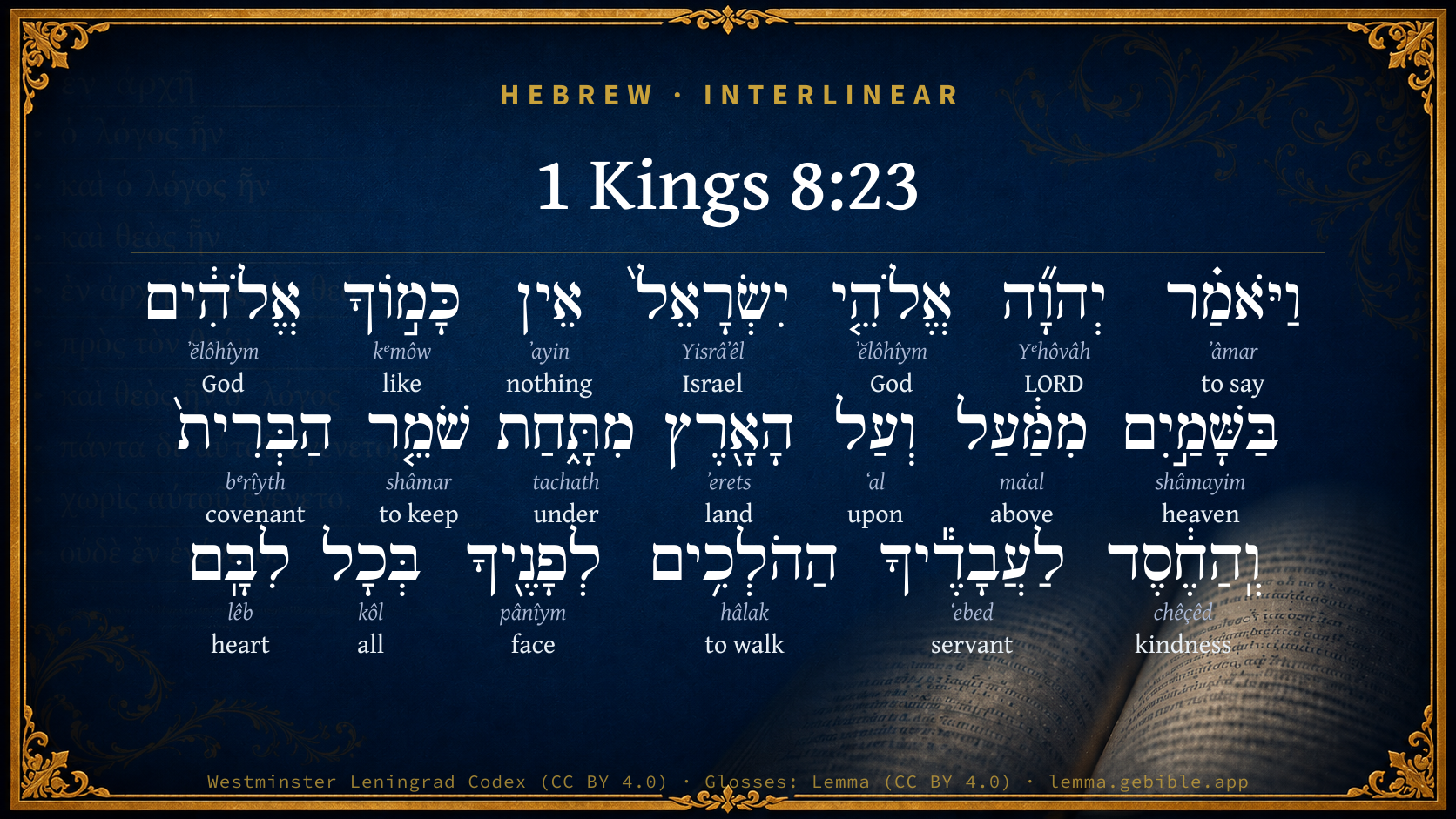
Hebrew (Westminster Leningrad Codex) 1 Kings 8:23 appears in the Hebrew Old Testament. The text above is from the Westminster Leningrad Codex. Each word links to its Strong’s number, a concise gloss, and parsing drawn from the Open Scriptures Hebrew Bible morphology. Click any word for its full Brown-Driver-Briggs (BDB) entry.
Download image
Cite this verse

1 Kings 8:23 (World English Bible). Public Domain. Lemma interlinear Bible study tool, https://lemma.gebible.app/v/1-kings/8/23.

Show BibTeX & RIS
BibTeX
RIS
English Translation
and he said, Yahweh, the God of Israel, there is no God like you, in heaven above, or on earth beneath; who keep covenant and loving kindness with your servants, who walk before you with all their heart;
World English Bible · Public Domain
Download a study sheet

One document with this verse’s original text, its word-by-word gloss line, the meaning frame, cross-references with their text, attributed commentary, and full source and license credits — printable, and it pastes into notes with its structure intact.

This verse Autodidact and up

Study sheet (.html) Plain text (.txt)

A passage Seminary Student

Up to 50 verses in one chapter. A passage sheet keeps up to 6 commentary sources and 12 cross-references per verse, in the order this page ranks them, and says so on the sheet whenever that leaves anything out. Ask for a single verse and you get the Autodidact verse sheet above.

Everything on this page stays free to read, with no account — the sheet is a download of what is already on screen, not access to it.

Want to remove ads? Support Godless Engineer
Compare translations 3

The same verse in 3 English versions, stacked beneath the original-language interlinear above. Click any original word for its lexicon entry.

Each is an independent rendering of the whole verse — the interlinear is not word-aligned to these translations.

Highlighted words mark where these versions differ — a whole-verse word diff, not a word-by-word alignment.

  • World English Bible Public Domain
    and he said, Yahweh, the God of Israel, there is no God like you, in heaven above, or on earth beneath; who keep covenant and loving kindness with your servants, who walk before you with all their heart;
  • King James Version Public Domain
    And he said, LORD God of Israel, there is no God like thee, in heaven above, or on earth beneath, who keepest covenant and mercy with thy servants that walk before thee with all their heart:
  • unfoldingWord Literal Text CC BY-SA 4.0
    and he said, “Yahweh, the God of Israel, no god like you in the heavens from above or on the earth from below, keeping the covenant and covenant faithfulness with your servants walking to your face with all of their heart,

unfoldingWord Literal Text — © unfoldingWord, licensed CC BY-SA 4.0. Word-aligned USFM3 via Door43 (git.door43.org/unfoldingWord/en_ult).

Versions to compare (up to 4)

3 of 4 selected

Show all 18 translations

Every available English version of this verse, each an independent rendering of the whole verse.

  • World English Bible Public Domain
    and he said, Yahweh, the God of Israel, there is no God like you, in heaven above, or on earth beneath; who keep covenant and loving kindness with your servants, who walk before you with all their heart;
  • Berean Standard Bible Public Domain
    and said: “O LORD, God of Israel, there is no God like You in heaven above or on earth below, keeping Your covenant of loving devotion with Your servants who walk before You with all their hearts.
  • Majority Standard Bible Public Domain
    and said: “O LORD, God of Israel, there is no God like You in heaven above or on earth below, keeping Your covenant of loving devotion with Your servants who walk before You with all their hearts.
  • King James Version Public Domain
    And he said, LORD God of Israel, there is no God like thee, in heaven above, or on earth beneath, who keepest covenant and mercy with thy servants that walk before thee with all their heart:
  • American Standard Version (1901) Public Domain
    and he said, O Jehovah, the God of Israel, there is no God like thee, in heaven above, or on earth beneath; who keepest covenant and lovingkindness with thy servants, that walk before thee with all their heart;
  • Revised Version (1885) Public Domain
    and he said, O LORD, the God of Israel, there is no God like thee, in heaven above, or on earth beneath; who keepest covenant and mercy with thy servants, that walk before thee with all their heart:
  • Geneva Bible (1599) Public Domain
    And sayd, O Lord God of Israel, there is no God like thee in heauen aboue, or in the earth beneath, thou that keepest couenant and mercie with thy seruants that walke before thee with all their heart,
  • Douay-Rheims (1899) Public Domain
    And said: Lord God of Israel, there is no God like thee in heaven above, or on earth beneath: who keepest covenant and mercy with thy servants that have walked before thee with all their heart.
  • Young's Literal Translation Public Domain
    and saith, `Jehovah, God of Israel, there is not a God like Thee, in the heavens above, and on the earth beneath, keeping the covenant and the kindness for Thy servants, those walking before Thee with all their heart,
  • Literal Standard Version CC BY-SA 4.0
    and says, “YHWH, God of Israel, there is not a God like You, in the heavens above and on the earth below, keeping the covenant and the kindness for Your servants, those walking before You with all their heart,
  • Unlocked Literal Bible CC BY-SA 4.0
    He said, “Yahweh, God of Israel, there is no God like you in the heavens above or on the earth below, who keeps his covenant faithfulness with your servants who walk before you with all their heart;
  • unfoldingWord Literal Text CC BY-SA 4.0
    and he said, “Yahweh, the God of Israel, no god like you in the heavens from above or on the earth from below, keeping the covenant and covenant faithfulness with your servants walking to your face with all of their heart,
  • Darby Bible Public Domain
    And he said, Jehovah, God of Israel! there is no God like thee, in the heavens above, or on the earth beneath, who keepest covenant and mercy with thy servants that walk before thee with all their heart;
  • World Messianic Bible Public Domain
    and he said, “LORD, the God of Israel, there is no God like you, in heaven above, or on earth beneath; who keeps covenant and loving kindness with your servants who walk before you with all their heart;
  • Webster's Bible Public Domain
    And he said, LORD God of Israel, there is no God like thee, in heaven above, or on earth beneath, who keepest covenant and mercy with thy servants that walk before thee with all their heart.
  • Free Bible Version CC BY-SA 4.0
    He said, “Lord, God of Israel, there is no God like you in heaven above or on earth below. You keep your agreement of trustworthy love with your servants, those who are totally committed to following you.
  • Bible in Basic English Public Domain
    Said, O Lord, the God of Israel, there is no God like you in heaven or on the earth; keeping faith and mercy unchanging for your servants, while they go in your ways with all their hearts.
  • JPS Tanakh (1917) Public Domain
    and he said: 'O LORD, the God of Israel, there is no God like Thee, in heaven above, or on earth beneath; who keepest covenant and mercy with Thy servants, that walk before Thee with all their heart;

Literal Standard Version (2020), Covenant Press — licensed CC BY-SA 4.0. Text via the HelloAO Bible API (eBible.org). Unlocked Literal Bible (unfoldingWord) — licensed CC BY-SA 4.0. Text via the HelloAO Bible API (eBible.org). unfoldingWord Literal Text — © unfoldingWord, licensed CC BY-SA 4.0. Word-aligned USFM3 via Door43 (git.door43.org/unfoldingWord/en_ult). Free Bible Version, Dr. Jonathan Gallagher — licensed CC BY-SA 4.0. Text via the HelloAO Bible API (eBible.org).

Word by word

More ways to search: Search by grammar → Find every occurrence → Compare this word →

Practice this passage: Drill this verse → Learn its vocabulary →

מִמַּ֔עַל
maʻal
H4605
“from · above”
Preposition + Adverb
Part of Speech
Preposition + Adverb
Full BDB Definition

Origin: from H5927

TWOT: 1624k

higher part, upper part (substantive) - above (adverb) - on the top of, above, on higher ground than (preposition) - upwards, higher, above (with locative)
  1. וַיֹּאמַ֗ר ʼâmar H559 “and · to say” Conjunction + Verb, Qal, Sequential Imperfect, 3rd Person, Masculine, Singular
  2. יְהוָ֞ה Yᵉhôvâh H3068 “LORD” Noun, Proper
  3. אֱלֹהֵ֤י ʼĕlôhîym H430 “God(s) of” Noun, Common, Masculine, Plural, Construct
  4. יִשְׂרָאֵל֙ Yisrâʼêl H3478 “Israel” Noun, Proper
  5. אֵין ʼayin H369 “nothing” Particle, Negative
  6. כָּמ֣וֹךָ kᵉmôw H3644 “like · you” Preposition + Suffix, Personal, 2nd Person, Masculine, Singular
  7. אֱלֹהִ֔ים ʼĕlôhîym H430 “God(s)” Noun, Common, Masculine, Plural, Absolute
  8. בַּשָּׁמַ֣יִם shâmayim H8064 “in/at the · heaven(s)” Preposition, Determined + Noun, Common, Masculine, Plural, Absolute
  9. וְעַל ʻal H5921 “and · upon” Conjunction + Preposition
  10. הָאָ֖רֶץ ʼerets H776 “the · land” Particle, Definite Article + Noun, Common, Both, Singular, Absolute
  11. מִתָּ֑חַת tachath H8478 “from · under” Preposition + Preposition
  12. שֹׁמֵ֤ר shâmar H8104 “keeping” Verb, Qal, Participle Active, Masculine, Singular, Absolute
  13. הַבְּרִית֙ bᵉrîyth H1285 “the · covenant” Particle, Definite Article + Noun, Common, Feminine, Singular, Absolute
  14. וְֽהַחֶ֔סֶד chêçêd H2617 “and · the · kindness” Conjunction + Particle, Definite Article + Noun, Common, Masculine, Singular, Absolute
  15. לַעֲבָדֶ֕יךָ ʻebed H5650 “to/for · servants · your” Preposition + Noun, Common, Masculine, Plural, Construct + Suffix, Personal, 2nd Person, Masculine, Singular
  16. הַהֹלְכִ֥ים hâlak H1980 “the · walking” Particle, Definite Article + Verb, Qal, Participle Active, Masculine, Plural, Absolute
  17. לְפָנֶ֖יךָ pânîym H6440 “to/for · face(s) · your” Preposition + Noun, Common, Both, Plural, Construct + Suffix, Personal, 2nd Person, Masculine, Singular
  18. בְּכָל kôl H3605 “in/at · all of” Preposition + Noun, Common, Masculine, Singular, Construct
  19. לִבָּֽם lêb H3820 “heart · their” Noun, Common, Masculine, Singular, Construct + Suffix, Personal, 3rd Person, Masculine, Plural

About this verse

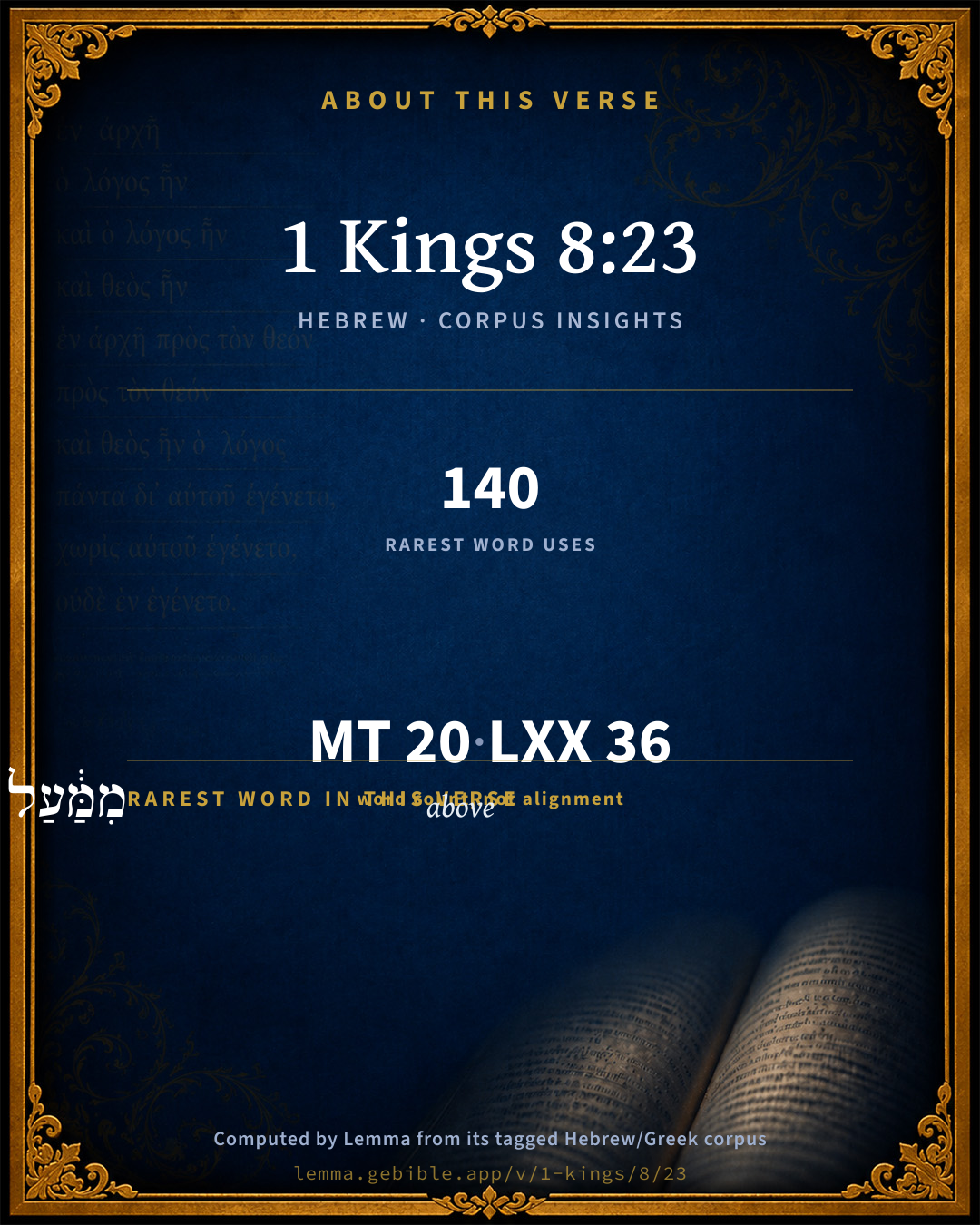
These counts appear in no published source. They are computed here, from the morphology-tagged text and Lemma’s own curated glosses. What Lemma adds →

20
words
19
distinct lemmas
Historical
section

Grammatical profile

  • 3 verbs
  • 12 nouns
  • 3 prepositions
  • 1 adverb
  • 1 particle

Verb forms

  • וַיֹּאמַ֗ר Qal · Sequential Imperfect
  • שֹׁמֵ֤ר Qal · Participle Active
  • הַהֹלְכִ֥ים Qal · Participle Active

Repetition

A word recurs within this verse — often emphatic in Hebrew:

  • אֱלֹהֵ֤י God H430 ×2

Hebrew & Septuagint length

In English translation the verse runs 38 words from the Hebrew and 36 from the Septuagint (LXX English) — closely comparable.

A rough comparison of the two English renderings, which tokenize alike — not a word-level alignment.

Word counts can differ between the Hebrew and the Greek without any difference in meaning — e.g. the Hebrew direct-object marker אֵת has no separate Greek word, and Greek often adds the article ὁ.

In the original languages it is 20 Hebrew tokens and 36 Greek tokens — but the two are counted differently (Hebrew bundles its prefixes and suffixes into one token; the Greek is in lemma form), so that isn’t a like-for-like length.

Cross-references

24

Topical passages linked to 1 Kings 8:23 in the Treasury of Scripture Knowledge — connected by theme and wording, ordered by reader-vote popularity; previews shown in the World English Bible.

  • 2 Samuel 7:22 Therefore you are great, Yahweh God: for there is none like you, neither is there any God besides you, according to all that we have heard with our ears.
  • Deuteronomy 7:9 Know therefore that Yahweh your God, he is God, the faithful God, who keeps covenant and loving kindness with them who love him and keep his commandments to a thousand generations,
  • Daniel 9:4 I prayed to Yahweh my God, and made confession, and said, Oh, Lord, the great and dreadful God, who keeps covenant and loving kindness with those who love him and keep his commandments,
  • Nehemiah 1:5 and said, I beg you, Yahweh, the God of heaven, the great and awesome God, who keeps covenant and loving kindness with those who love him and keep his commandments:
  • 1 Samuel 2:2 There is none holy as Yahweh; For there is none besides you, Neither is there any rock like our God.
  • Nehemiah 9:32 Now therefore, our God, the great, the mighty, and the awesome God, who keep covenant and loving kindness, don't let all the travail seem little before you, that has come on us, on our kings, on our princes, and on our priests, and on our prophets, and on our fathers, and on all your people, since the time of the kings of Assyria to this day.
  • Exodus 15:11 Who is like you, Yahweh, among the gods? Who is like you, glorious in holiness, Fearful in praises, doing wonders?
  • Psalms 89:3–8 "I have made a covenant with my chosen one, I have sworn to David, my servant,
  • Psalms 113:5 Who is like Yahweh, our God, Who has his seat on high,
  • Isaiah 40:25 To whom then will you liken me, that I should be equal [to him]? says the Holy One.
  • Jeremiah 10:6 There is none like you, Yahweh; you are great, and your name is great in might.
  • Jeremiah 10:16 The portion of Jacob is not like these; for he is the former of all things; and Israel is the tribe of his inheritance: Yahweh of Hosts is his name.
  • Luke 1:72 To show mercy towards our fathers, To remember his holy covenant,
  • Genesis 17:1 When Abram was ninety-nine years old, Yahweh appeared to Abram, and said to him, "I am God Almighty. Walk before me, and be blameless.
  • Genesis 33:20 He erected an altar there, and called it El Elohe Israel.
  • Exodus 3:15 God said moreover to Moses, "You shall tell the children of Israel this, 'Yahweh, the God of your fathers, the God of Abraham, the God of Isaac, and the God of Jacob, has sent me to you.' This is my name forever, and this is my memorial to all generations.
  • 1 Kings 2:4 That Yahweh may establish his word which he spoke concerning me, saying, If your children take heed to their way, to walk before me in truth with all their heart and with all their soul, there shall not fail you (said he) a man on the throne of Israel.
  • 1 Kings 3:6 Solomon said, You have shown to your servant David my father great loving kindness, according as he walked before you in truth, and in righteousness, and in uprightness of heart with you; and you have kept for him this great loving kindness, that you have given him a son to sit on his throne, as it is this day.
  • 1 Kings 6:12 Concerning this house which you are building, if you will walk in my statutes, and execute my ordinances, and keep all my commandments to walk in them; then will I establish my word with you, which I spoke to David your father.
  • 2 Kings 20:3 Remember now, Yahweh, I beg you, how I have walked before you in truth and with a perfect heart, and have done that which is good in your sight. Hezekiah wept sore.
  • Psalms 35:10 All my bones shall say, "Yahweh, who is like you, Who delivers the poor from him who is too strong for him, Yes, the poor and the needy from him who robs him?"
  • Psalms 86:8 There is no one like you among the gods, Lord, Nor any deeds like your deeds.
  • Isaiah 40:18 To whom then will you liken God? or what likeness will you compare to him?
  • Micah 7:18–20 Who is a God like you, who pardons iniquity, And passes over the disobedience of the remnant of his heritage? He doesn't retain his anger forever, Because he delights in loving kindness.

Cross-references courtesy of OpenBible.info (CC BY 4.0).

Hebrew and Greek witnesses Masoretic Hebrew ↔ Greek Septuagint

The same verse in the two great witnesses to the Old Testament, shown verse-for-verse.

These are two independent witnesses, not word-aligned to each other, and the Septuagint is shown in lemma (dictionary) form.

Hebrew 1 Kings 8:23 Masoretic · Westminster Leningrad Codex

וַיֹּאמַ֗ר יְהוָ֞ה אֱלֹהֵ֤י יִשְׂרָאֵל֙ אֵין כָּמ֣וֹךָ אֱלֹהִ֔ים בַּשָּׁמַ֣יִם מִמַּ֔עַל וְעַל הָאָ֖רֶץ מִתָּ֑חַת שֹׁמֵ֤ר הַבְּרִית֙ וְֽהַחֶ֔סֶד לַעֲבָדֶ֕יךָ הַהֹלְכִ֥ים לְפָנֶ֖יךָ בְּכָל לִבָּֽם

and he said, Yahweh, the God of Israel, there is no God like you, in heaven above, or on earth beneath; who keep covenant and loving kindness with your servants, who walk before you with all their heart;

World English Bible · Public Domain

Greek LXX 1 Kings 8:23 Septuagint · lemma form

καί εἶπον κύριος ὁ θεός ἰσραήλ οὐ εἰμί ὡς σύ θεός ἐν ὁ οὐρανός ἄνω καί ἐπί ὁ γῆ κάτω φυλάσσω διαθήκη καί ἔλεος ὁ δοῦλος σύ ὁ πορεύομαι ἐνώπιον σύ ἐν ὅλος ὁ καρδία αὐτός

and he said, Lord God of Israel, there is no God like you in heaven above and on the earth beneath, keeping covenant and mercy with your servant who walks before you with all his heart;

LXX2012 (modern English Septuagint) · Public Domain

On this verse, The Cambridge Bible for Schools and Colleges discusses the Septuagint’s reading. Read the note in Commentary ↓

Hebrew: Westminster Leningrad Codex (CC BY 4.0). Greek: Septuagint (public domain); English from LXX2012 (modern English Septuagint) (Public Domain). How the Septuagint differs from the Hebrew →

Targum (Aramaic paraphrase)

1

The Targum is the ancient Jewish Aramaic paraphrase of the Hebrew Scriptures — an interpretive translation, not the Hebrew text itself. Onkelos (literal) and Pseudo-Jonathan (expansive) render the Torah, and Jonathan the Prophets. Coverage is partial: where no permissively-licensed English translation exists for a verse, only the Aramaic is shown. This is verse-level text, not a word-by-word alignment to the Hebrew.

  1. Targum Jonathan Prophets (Joshua–Malachi)
    וַאֲמַר יְיָ אֱלָהָא דְיִשְׂרָאֵל לֵית בַּר מִנָךְ אַתְּ הוּא אֱלָהָא דִשְׁכִינְתָּךְ בִּשְׁמַיָא מִלְעֵילָא וְשַׁלִיט עַל אַרְעָא מִלְרַע נְטַר קְיָמָא וְחִסְדָא לְעַבְדָךְ דִי מְהַלְכִין קֳדָמָךְ בְּכָל לִבְּהוֹן:

    (no public-domain English translation for this verse)

    Targum Jonathan — Aramaic: “Mikraot Gedolot” (public domain). English: “Sefaria Community Translation” (CC0 1.0 (public-domain dedication)); “London "Chaldee Paraphrase," 1871” (public domain). Text via Sefaria.

Commentary

Notes on 1 Kings 8:23 from classic Christian and Jewish commentators (each source and its license shown beneath its notes). The classic Christian expositions comment on the surrounding passage and are grouped to its opening verse, so a note may address several verses; the Jewish commentaries on the Tanakh (Rashi and others) are per-verse, so they appear only where the commentator wrote on this verse.

Lemma curates 59 commentaries, every one of them public domain or Creative Commons licensed, each selected and text-cleaned for this edition rather than reprinted as found. About our sources →

Ellicott's Commentary for English Readers

(23) There is no God like Thee.—These words, often used in the Psalms (Psa_71:19; Psa_86:8; Psa_89:6), and especially found in the thanksgiving of David after the great promise (2Sa_7:22), are evidently suggested by more ancient utterances of devotion; as for example, in the first recorded Psalm at the Red Sea (Exo_15:11). In them we trace the spiritual process by which the Israelites were trained from the polytheism of their forefathers to the knowledge of the One only God. He is known to them, first, in the close personal relation of “the God of Abraham, Isaac, and Jacob,” to whom “none is like” of all gods whom others worshipped; but next, in His universal relation to the universe as the “God Almighty, and the Judge of the whole earth” (Gen_17:2; Gen_18:25); lastly, as Jehovah, “God,” indeed, “of Israel,” but, by the very meaning of the name, the One Self-existent Being, source of all other life. Thus, in the thanksgiving of David to the words, “none is like Thee,” is added at once the higher belief, “there is no God beside Thee.” In this prayer of Solomon there follows at once the striking confession that the “heaven of heavens cannot contain” His Infinity.

Who keepest covenant and mercy.—This phrase, again, familiar in prayer (see Deu_7:9; Neh_1:5; Dan_9:4), is clearly traceable to the conclusion of the Second Commandment (Exo_20:6), and the special revelation of God to Moses in the Mount (Exo_34:6-7). It is notable, not merely because it describes God as manifesting Himself “most chiefly by showing mercy and pity,” but also because it declares this manifestation of mercy to be pledged to man as a chief part of His covenant. So in the New Testament it is said that, to those who claim His covenant in Christ, “He is faithful and just to forgive sins.”

(23-53) The prayer of Solomon, uttered (see 1Ki_8:54) on his knees with hands uplifted to heaven, long and detailed as it is, is yet of extreme simplicity of idea. It begins (a), in 1Ki_8:23-25, with a thankful acknowledgment of the fulfilment of one part of the great promise to David, and a prayer for the like fulfilment of the other; next (b), in 1Ki_8:26-30, acknowledging that God’s presence can be limited to no Temple, it yet Asks that His peculiar blessing may rest on prayer uttered toward the place which He has hallowed; and then (c), in 1Ki_8:31-53, applies that petition to the various contingencies, of oath taken in His name, of rain withheld, of disaster in battle, of famine and pestilence, of captivity in a foreign land, and extends it not only to Israel, but to the stranger who shall acknowledge and invoke the Lord Jehovah. Its constantly recurring burden is, “Hear Thou from heaven thy dwelling-place, and when Thou hearest, Lord, forgive.” It is plain that before Solomon’s mind there are continually present in some form the blessing and the curse pronounced in the Law (see Leviticus 26; Deuteronomy 28); and it is most true to human nature, and especially characteristic of the thoughtfulness of his philosophic temper, that over the bright hour of exultation there seems to hover a constant foreboding of evils and trials to come.

A Bible Commentary for English Readers, edited by Charles John Ellicott (1878–1897) — public domain. Text from a community e-Sword module.

The Cambridge Bible for Schools and Colleges

gen. ed. J. J. S. Perowne

23. who keepest covenant and mercy] The phrase is found in Deu_7:9; Deu_7:12. In God’s intent, the covenant and the mercy were the same thing. It was transgression on man’s part which called forth any other character in the covenant.

with thy servants] The LXX. has the singular, thus restricting the allusion in 1Ki_8:23-26 entirely to David and his family. The Hebrew by the plural represents the spirit of the phrase in Deuteronomy, and the supplication becomes an appeal to God that He will remember towards David’s race the promise which at first was made to all Israel. See Chap. 1Ki_2:4 and 2Sa_7:12, &c.

The Cambridge Bible for Schools and Colleges (gen. ed. J. J. S. Perowne; Cambridge University Press, 1878–1918) — public domain. Text from a community e-Sword module.

Trapp's Complete Commentary

John Trapp

1Ki 8:23 And he said, LORD God of Israel, [there is] no God like thee, in heaven above, or on earth beneath, who keepest covenant and mercy with thy servants that walk before thee with all their heart:

Ver. 23. And he said, Lord God of Israel.] This was a worthy precedent for princes, who, if they would imitate Solomon in devotion, might likewise share with him in the blessing. This is a very long prayer, and full of affection to the end. So to pray is hard and happy. It is a precedental prayer, as one calleth it.

Lord God of Israel, there is no God like thee, &c.] This is a very august preface to his prayer. To begin on this sort doth notably strengthen faith, and stir up devotion.

John Trapp, A Commentary or Exposition upon All the Books of the Old and New Testament (1647–1656) — public domain. Text from a community e-Sword module.

Joseph Benson's Commentary

1Ki 8:23-24. Lord God of Israel, there is none like thee — He here acknowledges the transcendent excellences of Jehovah; and again particularly extols his faithfulness to those who serve him sincerely. Who hast kept with thy servant David that thou promisedst — That branch of thy promise concerning the building of this house by his son.

Joseph Benson's Commentary on the Old and New Testaments (1811–1818) — public domain. Text from a community e-Sword module.

Whedon's Commentary on the Bible

Daniel D. Whedon

SOLOMON’S PRAYER OF DEDICATION, 1Ki_8:23-53.

This prayer “is one of unprecedented length, and remarkable as combining the conception of the infinity of the Divine presence with the hope that the Divine mercies will be drawn down on the nation by the concentration of the national devotions, and even of the devotion of foreign nations, towards this fixed locality.” — Stanley. It is reproduced in substantially the same language and order in 2Ch_6:14-42, and is a model most appropriately read and followed in the dedication of houses of Christian worship. It consists of three parts:

1.) Adoration for the fulfilment of the promise to David. 1Ki_8:23-24.

2.) Prayer for its continued fulfilment, (1Ki_8:25-26,) and for blessings upon the concentration of worship at the temple. 1Ki_8:27-30.

3.) Supplication for specific blessings, (1Ki_8:31-53,) namely, in cases of trespass, (1Ki_8:31-32;) when smitten before enemies, (1Ki_8:33-34;) in times of drought, (1Ki_8:35-36,) famine, or plague, (1Ki_8:37-40;) for the devout stranger, (1Ki_8:41-43;) for success in battle, (1Ki_8:44-45;) for deliverance from captivity, (1Ki_8:46-53.) These prayers for specific blessings are seven, thus corresponding in number with the seven petitions of the Lord’s prayer.

25. So that thy children take heed — Better, only if thy children, etc., as in the margin. The Divine promises can be fully realized only on conditions of righteousness in the people. They comfort those who “walk uprightly.”

Daniel D. Whedon (gen. ed.), Commentary on the Old and New Testaments (1874–1909) — public domain. Text from a community e-Sword module.

Tyndale Open Study Notes

Tyndale Open Resources

8:23-26 Solomon’s prayer affirmed God’s incomparable nature and the fulfillment of his promises to David. Solomon also prayed that God would keep his promise that David’s descendants . . . will always sit on the throne.

Tyndale Open Study Notes — © Tyndale Open Resources, licensed CC BY-SA 4.0. Text via the HelloAO Bible API.

Geneva Bible (1599)

Geneva Bible translators

Unfainedly and without all hypocrisy.

Geneva Bible (1599) marginal notes — public domain. Text via Bolls.life.

John Gill's Exposition

And he said, Lord God of Israel,.... Their covenant God and Father, whereby he was distinguished from all the gods of the Gentiles:

there is no god like thee; in heaven above or on earth beneath; none among the angels in heaven, nor among kings and civil magistrates on earth, who both are sometimes called "Elohim" gods; but only in a figurative sense, and not to be compared with the one only true God, for the perfection of his nature, or the works of his hands:

who keepest covenant and mercy with thy servants that walk before thee with all their heart; performs his promises, by which he both declares his mercy or goodness and his faithfulness to such who walk before him, in his ways, and according to his word, in the sincerity and uprightness of their hearts.

John Gill's Exposition of the Whole Bible (1746–1763) — public domain (CC PDM 1.0). Text via the HelloAO Bible API.

Albert Barnes' Notes on the Bible

Compare Deu 7:9.

Albert Barnes' Notes on the Bible (1834–1885) — public domain. Text from a community e-Sword/MySword module.

The Pulpit Commentary

And he said, Lord God of Israel, there is no God like thee Similar words are found in Exo_15:11 Psa_86:8, etc. They do not at all imply the existence of other gods, but are explained by other passages (e.g., ver. 60; Deu_4:39, "the Lord He is God and none else;" 2Sa_7:22 2Sa_22:32) as meaning that the God of Israel stands alone, and alone is God. It would be strange, indeed, if the people whose great peculium was the unity of the Godhead Deuteronomy (Isa_42:8) recognized other deities. Observe: Solomon begins his prayer with an act of praise; with a recognition at once grateful and graceful of God"s past mercies. (cf. Psa_65:1, 2 Php_4:6) Exandit Dominus invocantem, quem laudantem vidit" (Augustine), in heaven above, or on earth beneath, (Jos_2:11) who keepest covenant and mercy (same words in Deu_7:9) with thy servants that walk before thee with all their heart. (cf. 1Ki_2:4)

Vers. 23-53.

The Prayer of Dedication.

In how many and varied ways is Solomon a type of the Divine Solomon, the true Son of David (see pp. 65, 77, etc.) Even in this respect they are alike that each has "taught us how to pray" (Luk_11:1 sqq.) For we may be sure that the Prayer of Dedication is for our instruction and imitation, otherwise it would hardly have been recorded, and recorded at such length, in Scripture. "After this manner therefore pray ye". (Mat_6:9)

I LAYMEN MAY OFFER PUBLIC PRAYER. This is no monopoly of priests. The Hebrew king might not sacrifice or burn incense, (2Ch_26:18) but he might lead the prayers both of priests and people, and that on the greatest day in the history of Israel. Even so, though "we give not to our princes the ministering either of God"s word or of the sacraments" (Art. 37.), still we do not deny them any "prerogative which we see to have been given always to all godly princes in Holy Scripture" (ib.), and least of all the prerogative of prayer exercised by David, Solomon, Asa, (2Ch_14:11) Jehoshaphat (ib., 20:5-12), and Hezekiah (ib., 30:18-20). It was Constantine, a layman, presided at the Council of Nice.

II KINGS SHOULD BE PROUD TO TAKE PART IN RELIGIOUS FUNCTIONS. Whatever divinity doth hedge them about, they are not greater or wiser than Solomon, and the proudest moment of his life was when he led the ark to its resting place; the happiest, when he "blessed all the congregation of Israel" (ver. 14). Never is king so great as when he takes his proper place before God. Alas! that religion should have ever been brought into such contempt that kings should be ashamed or afraid to be the "nursing fathers" of the Church. (Isa_49:23) Solomon"s prayer is "a testimony that a wisdom which can no longer pray is folly" (Bahr).

III PRAYER SHOULD BE PRECEDED BY PRAISE. It was not until Solomon had "blessed God" (ver. 15) that he prayed to God (vers. 23-53). "praemissa laude, invocatio sequi solet." This was the rule of the early Church (see Psa_65:1, Psa_65:2) for the scriptural order; cf. Php_1:3, 4 4:6, and see Howson"s Hulsean Lectures, No. 4., for the combination of thanksgiving and prayer in St. Paul"s Epistles). And Solomon not only began but ended with blessing (ver. 56).

IV TRUE PRAYER IS ASKING GOD FOR WHAT WE NEED. Not rhetorical display, not sesquepedalia verba, not a mere string of texts and hymns, but the simplest, humblest cry of the heart. Which of us has not heard prayers like the Pharisee"s without one word of prayer (i.e., petition) in them? And how many prayers are made painful by their pretentiousness. Perhaps a child has been ordained our pattern, (Mat_18:2-4) that from it we should learn to pray. "In prayer it is better to have a heart without words than words without a heart" (Bunyan).

V PRAYER SHOULD BE OFFERED FOR ALL SORTS AND CONDITIONS OF MEN. Not for self only. It is not "my Father," but "our Father." Perhaps selfishness is nowhere more conspicuous or more hateful than in our prayers. We are members one of another. It is in the Pharisee"s prayer that we find so much "I" Notice how varied were Solomon"s petitions, and cf. 1Ti_2:1, 1Ti_2:2, 1Ti_2:3. Tennyson says

"For what are men better than sheep or goats That nourish a blind life within the brain, If, knowing God, they lift not hands in prayer Both for themselves and those who call them friend?

And he does not stop there, but adds that thus

"the whole round world Is bound by golden chains around the feet of God.

This prayer of dedication was a veritable Litany (vers. 31, 33, 37, 41, 44, etc.)

VI PRAYER SHOULD BE SCRIPTURAL, i.e., conceived in the spirit and expressed in the words of Scripture. This prayer was pre-eminently so (see notes on vers. 22 sqq.) What St. Cyprian says of the Lord"s prayer, "Quanto efficacius impetramus quod petimus in Christi nomine, si petamus ipsius oratione," may suggest to us that that prayer is most likely to move God"s hand which is based on God"s Word. Supplication should be shaped by revelation.

VII PRAYERS MAY BE LITURGICAL. The Scripture references, its artificial structure, and indeed, its very preservation, prove that this prayer was a precomposed form. A form need not involve formalism. All Christians use forms of praise; why not forms of prayer? (See Hooker, V 26:2. 3.)

VIII OUTWARD FORMS ARE NOT TO BE DESPISED. Solomon "kneeled upon his knees, with his hands stretched out towards heaven" (cf. Dan_6:10 Act_7:60 Act_9:40 Act_20:6 Act_21:5 Eph_3:14, and, above all, Luk_22:41 and 24:50. Also Psa_28:2 Psa_63:4 Psa_134:2). Ritualism is a question of degree, for we all use some rites. So long as we have bodies, we can never have a purely spiritual religion, but must "glorify God in our bodies and spirits". (1Co_6:20) That forms have their foundation in human nature, and may be impressive and edifying, is proved by the fact that "no nation under heaven either doth or ever did suffer public actions which are of weight to pass without some visible solemnity" (Hooker, IV 1:8), and for this reason, that "Sounds which address the ear are lost and die In one short hour; while that which strikes the eye Lives long upon the mind: the faithful sight Graves on the memory with a beam of light.

It is only when forms usurp the place, or mar the reality, of spiritual worship (Joh_4:24) that they are really reprehensible.

The Pulpit Commentary (1880–1919), ed. H.D.M. Spence-Jones & Joseph S. Exell — public domain. Text from a community e-Sword module.

Rashi

Rabbi Shlomo Yitzchaki (Rashi)

Preserver of the covenant. He waits and stores away [reward] to keep the covenant and [is based on] mercy, to fulfill His promise.

Rashi on the Tanakh — English translations: “The Judaica Press complete Tanach with Rashi, translated by A. J. Rosenberg” (CC BY 4.0); “Pentateuch with Rashi's commentary by M. Rosenbaum and A.M. Silbermann, 1929-1934” (public domain); “The Metsudah Tanach series, Lakewood, N.J” (CC BY 4.0); and “The Book of Joshua, Metsudah Publications, 1997” (CC BY 4.0). Text via Sefaria.

Lesson kit

Teaching starters — assembled from the data on this page, not authored interpretation. Every prompt links to the verse data it draws on. Edit before teaching.

1 Kings, in the Historical, opens this verse with 20 words (19 distinct Hebrew lemmas). Its most distinctive word is maʻal (“above”). A historical commentator’s framing appears above. Read the whole chapter for the surrounding context.

Discussion questions

  1. What does “above” (maʻal) contribute to the verse as a whole?
  2. 2 Samuel 7:22 shares this passage’s theme. How do the two illuminate each other?
  3. “God” occurs 2× in this one verse. What is the effect of the repetition?
  4. These translations render this verse differently; the difference is in the English rendering, not the original. What questions does that raise?
  5. The verb «וַיֹּאמַ֗ר» is Qal Sequential Imperfect. How does its form color the action?
  6. Reading how Ellicott's Commentary for English Readers and The Cambridge Bible for Schools and Colleges read this verse, where do the two commentators agree and where do they part?

Things to notice

Reading settings

Reading text

Shown beneath each verse's original-language words.

Old Testament
Old Testament edition

Read the OT as the Masoretic Hebrew (MT) or the Greek Septuagint (LXX).

English shown for the Greek Septuagint (in the Hebrew ↔ Greek comparison).

Comparing translations? Open the Compare panel on any verse page to stack up to four side by side.