
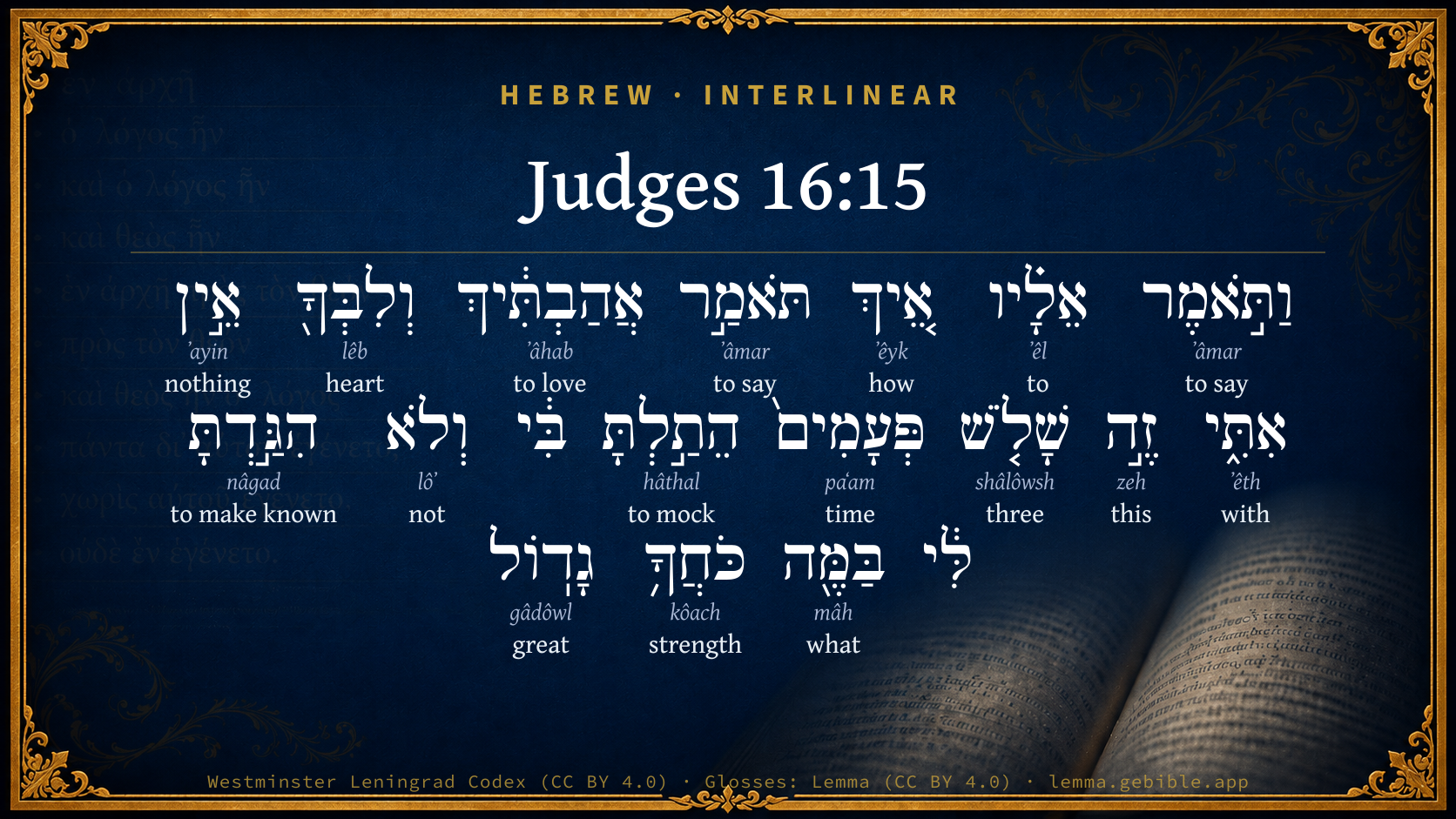
Judges 16:15

Hebrew (Westminster Leningrad Codex) Judges 16:15 appears in the Hebrew Old Testament. The text above is from the Westminster Leningrad Codex. Each word links to its Strong’s number, a concise gloss, and parsing drawn from the Open Scriptures Hebrew Bible morphology. Click any word for its full Brown-Driver-Briggs (BDB) entry.
Download image
Cite this verse

Judges 16:15 (World English Bible). Public Domain. Lemma interlinear Bible study tool, https://lemma.gebible.app/v/judges/16/15.

Show BibTeX & RIS
BibTeX
RIS
English Translation
She said to him, How can you say, I love you, when your heart is not with me? you have mocked me these three times, and have not told me in which your great strength lies.
World English Bible · Public Domain
Download a study sheet

One document with this verse’s original text, its word-by-word gloss line, the meaning frame, cross-references with their text, attributed commentary, and full source and license credits — printable, and it pastes into notes with its structure intact.

This verse Autodidact and up

Study sheet (.html) Plain text (.txt)

A passage Seminary Student

Up to 50 verses in one chapter. A passage sheet keeps up to 6 commentary sources and 12 cross-references per verse, in the order this page ranks them, and says so on the sheet whenever that leaves anything out. Ask for a single verse and you get the Autodidact verse sheet above.

Everything on this page stays free to read, with no account — the sheet is a download of what is already on screen, not access to it.

Want to remove ads? Support Godless Engineer
Compare translations 3

The same verse in 3 English versions, stacked beneath the original-language interlinear above. Click any original word for its lexicon entry.

Each is an independent rendering of the whole verse — the interlinear is not word-aligned to these translations.

Highlighted words mark where these versions differ — a whole-verse word diff, not a word-by-word alignment.

  • World English Bible Public Domain
    She said to him, How can you say, I love you, when your heart is not with me? you have mocked me these three times, and have not told me in which your great strength lies.
  • King James Version Public Domain
    And she said unto him, How canst thou say, I love thee, when thine heart is not with me? thou hast mocked me these three times, and hast not told me wherein thy great strength lieth.
  • unfoldingWord Literal Text CC BY-SA 4.0
    Then she said to him, “How do you say, ‘I love you,’ yet your heart not with me? These three times you have deceived me and you have not declared to me in what your great strength.”

unfoldingWord Literal Text — © unfoldingWord, licensed CC BY-SA 4.0. Word-aligned USFM3 via Door43 (git.door43.org/unfoldingWord/en_ult).

Versions to compare (up to 4)

3 of 4 selected

Show all 18 translations

Every available English version of this verse, each an independent rendering of the whole verse.

  • World English Bible Public Domain
    She said to him, How can you say, I love you, when your heart is not with me? you have mocked me these three times, and have not told me in which your great strength lies.
  • Berean Standard Bible Public Domain
    “How can you say, ‘I love you,’” she asked, “when your heart is not with me? This is the third time you have mocked me and failed to reveal to me the source of your great strength!”
  • Majority Standard Bible Public Domain
    “How can you say, ‘I love you,’” she asked, “when your heart is not with me? This is the third time you have mocked me and failed to reveal to me the source of your great strength!”
  • King James Version Public Domain
    And she said unto him, How canst thou say, I love thee, when thine heart is not with me? thou hast mocked me these three times, and hast not told me wherein thy great strength lieth.
  • American Standard Version (1901) Public Domain
    And she said unto him, How canst thou say, I love thee, when thy heart is not with me? thou hast mocked me these three times, and hast not told me wherein thy great strength lieth.
  • Revised Version (1885) Public Domain
    And she said unto him, How canst thou say, I love thee, when thine heart is not with me? thou hast mocked me these three times, and hast not told me wherein thy great strength lieth.
  • Geneva Bible (1599) Public Domain
    Againe shee sayde vnto him, Howe canst thou say, I loue thee, when thine heart is not with me? thou hast mocked mee these three times, and hast not tolde me wherein thy great strength lieth.
  • Douay-Rheims (1899) Public Domain
    And Dalila said to him: How dost thou say thou lovest me, when thy mind is not with me? Thou hast told me lies these three times, and wouldst not tell me wherein thy great strength lieth.
  • Young's Literal Translation Public Domain
    And she saith unto him, `How dost thou say, I have loved thee, and thy heart is not with me? these three times thou hast played upon me, and hast not declared to me wherein thy great power `is'.'
  • Literal Standard Version CC BY-SA 4.0
    And she says to him, “How do you say, I have loved you, and your heart is not with me? These three times you have played on me, and have not declared to me wherein your great power [is].”
  • Unlocked Literal Bible CC BY-SA 4.0
    She said to him, “How can you say, 'I love you,' when you do not share your secrets with me? You have mocked me these three times and have not told me how you have such great strength.”
  • unfoldingWord Literal Text CC BY-SA 4.0
    Then she said to him, “How do you say, ‘I love you,’ yet your heart not with me? These three times you have deceived me and you have not declared to me in what your great strength.”
  • Darby Bible Public Domain
    And she said to him, "How can you say, 'I love you,' when your heart is not with me? You have mocked me these three times, and you have not told me wherein your great strength lies."
  • World Messianic Bible Public Domain
    She said to him, “How can you say, ‘I love you,’ when your heart is not with me? You have mocked me these three times, and have not told me where your great strength lies.”
  • Webster's Bible Public Domain
    And she said to him, How canst thou say, I love thee, when thy heart is not with me? Thou hast mocked me these three times, and hast not told me in what thy great strength lieth.
  • Free Bible Version CC BY-SA 4.0
    Then Delilah complained to Samson, “How can you tell me, ‘I love you,’ when you don't let me into your confidence? Three times you've made me look stupid, not telling me where your incredible strength comes from!”
  • Bible in Basic English Public Domain
    And she said to him, Why do you say you are my lover when your heart is not mine? Three times you have made sport of me, and have not made clear to me the secret of your great strength.
  • JPS Tanakh (1917) Public Domain
    And she said unto him: 'How canst thou say: I love thee, when thy heart is not with me? thou hast mocked me these three times, and hast not told me wherein thy great strength lieth.'

Literal Standard Version (2020), Covenant Press — licensed CC BY-SA 4.0. Text via the HelloAO Bible API (eBible.org). Unlocked Literal Bible (unfoldingWord) — licensed CC BY-SA 4.0. Text via the HelloAO Bible API (eBible.org). unfoldingWord Literal Text — © unfoldingWord, licensed CC BY-SA 4.0. Word-aligned USFM3 via Door43 (git.door43.org/unfoldingWord/en_ult). Free Bible Version, Dr. Jonathan Gallagher — licensed CC BY-SA 4.0. Text via the HelloAO Bible API (eBible.org).

Word by word

More ways to search: Search by grammar → Find every occurrence → Compare this word →

Practice this passage: Drill this verse → Learn its vocabulary →

הֵתַ֣לְתָּ
hâthal
H2048
“to mock”
Verb, Hiphil, Perfect, 2nd Person, Masculine, Singular
Part of Speech
Verb
Stem
Hiphil
Form
Perfect
Person
2nd Person
Gender
Masculine
Number
Singular
Full BDB Definition

Origin: a primitive root

TWOT: 518

(Piel) to mock, deceive - (Pual) deceive
  1. וַתֹּ֣אמֶר ʼâmar H559 “and · to say” Conjunction + Verb, Qal, Sequential Imperfect, 3rd Person, Feminine, Singular
  2. אֵלָ֗יו ʼêl H413 “to · him” Preposition + Suffix, Personal, 3rd Person, Masculine, Singular
  3. אֵ֚יךְ ʼêyk H349 “how” Particle, Interrogative
  4. תֹּאמַ֣ר ʼâmar H559 “to say” Verb, Qal, Imperfect, 2nd Person, Masculine, Singular
  5. אֲהַבְתִּ֔יךְ ʼâhab H157 “to love · you” Verb, Qal, Perfect, 1st Person, Common, Singular + Suffix, Personal, 2nd Person, Feminine, Singular
  6. וְלִבְּךָ֖ lêb H3820 “and · heart · your” Conjunction + Noun, Common, Masculine, Singular, Construct + Suffix, Personal, 2nd Person, Masculine, Singular
  7. אֵ֣ין ʼayin H369 “nothing” Particle, Negative
  8. אִתִּ֑י ʼêth H854 “with · me” Preposition + Suffix, Personal, 1st Person, Common, Singular
  9. זֶ֣ה zeh H2088 “this” Pronoun, Demonstrative, Masculine, Singular
  10. שָׁלֹ֤שׁ shâlôwsh H7969 “three” Adjective, Cardinal number, Feminine, Singular, Absolute
  11. פְּעָמִים֙ paʻam H6471 “times” Noun, Common, Feminine, Plural, Absolute
  12. וְלֹא lôʼ H3808 “and · not” Conjunction + Particle, Negative
  13. הִגַּ֣דְתָּ nâgad H5046 “to make known” Verb, Hiphil, Perfect, 2nd Person, Masculine, Singular
  14. בַּמֶּ֖ה mâh H4100 “in/at · what” Preposition + Particle, Interrogative
  15. כֹּחֲךָ֥ kôach H3581 “strength · your” Noun, Common, Masculine, Singular, Construct + Suffix, Personal, 2nd Person, Masculine, Singular
  16. גָדֽוֹל gâdôwl H1419 “great” Adjective, Adjective, Masculine, Singular, Absolute

About this verse

These counts appear in no published source. They are computed here, from the morphology-tagged text and Lemma’s own curated glosses. What Lemma adds →

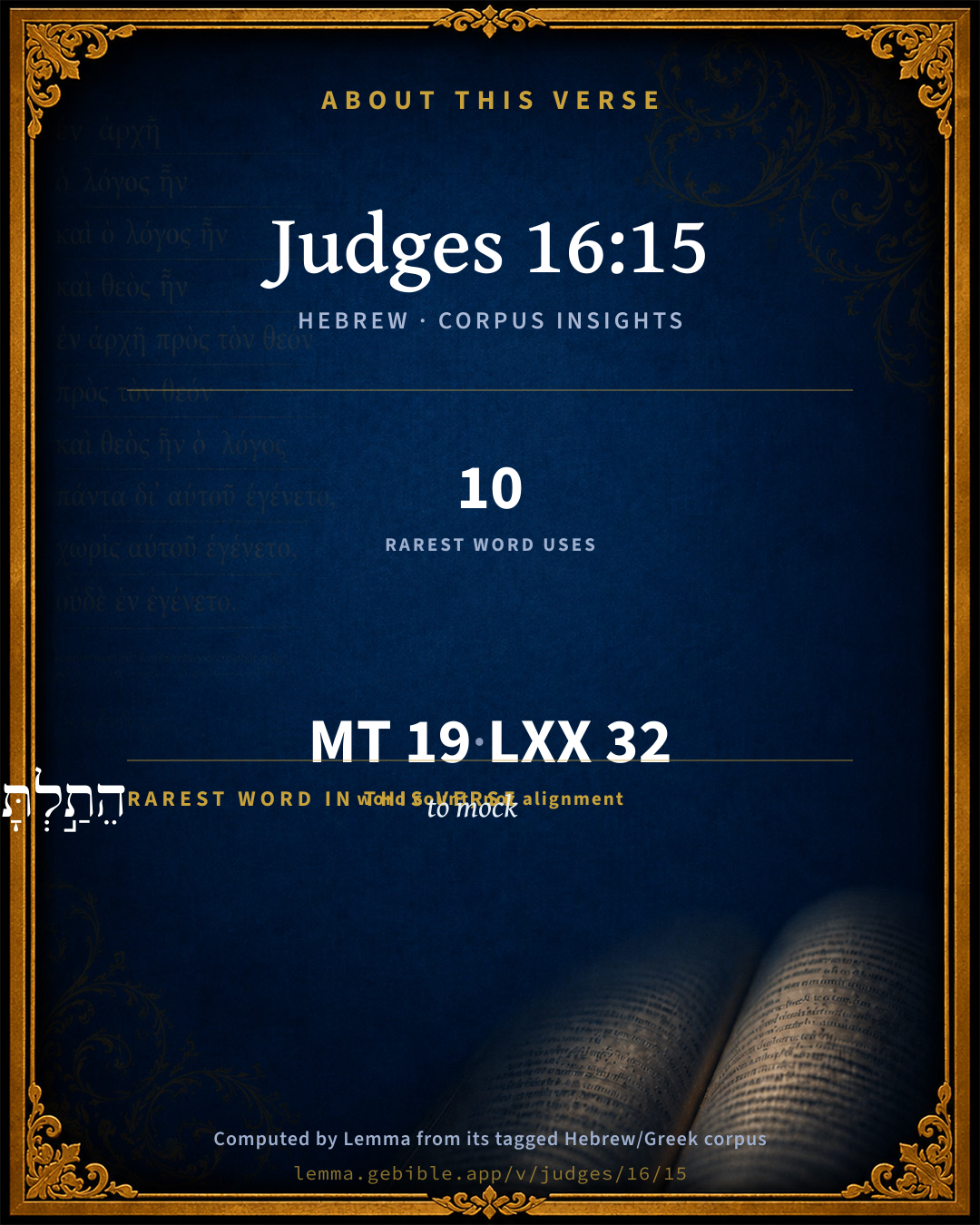
19
words
16
distinct lemmas
Historical
section

Notable vocabulary

The rarest word here is הֵתַ֣לְתָּ to mock H2048 — appearing just 10 times in the whole Hebrew Bible.

Shared distinctive vocabulary

הֵתַ֣לְתָּ to mock H2048 occurs in 9 verses of the Hebrew Bible. Also found in:

Grammatical profile

  • 5 verbs
  • 3 nouns
  • 2 adjectives
  • 1 pronoun
  • 4 prepositions
  • 4 particles

Verb forms

  • וַתֹּ֣אמֶר Qal · Sequential Imperfect
  • תֹּאמַ֣ר Qal · Imperfect
  • אֲהַבְתִּ֔יךְ Qal · Perfect
  • הֵתַ֣לְתָּ Hiphil · Perfect
  • הִגַּ֣דְתָּ Hiphil · Perfect

Repetition

A word recurs within this verse — often emphatic in Hebrew:

  • וַתֹּ֣אמֶר to say H559 ×2

Hebrew & Septuagint length

In English translation the verse runs 36 words from the Hebrew and 35 from the Septuagint (LXX English) — closely comparable.

A rough comparison of the two English renderings, which tokenize alike — not a word-level alignment.

Word counts can differ between the Hebrew and the Greek without any difference in meaning — e.g. the Hebrew direct-object marker אֵת has no separate Greek word, and Greek often adds the article ὁ.

In the original languages it is 19 Hebrew tokens and 32 Greek tokens — but the two are counted differently (Hebrew bundles its prefixes and suffixes into one token; the Greek is in lemma form), so that isn’t a like-for-like length.

Cross-references

15

Topical passages linked to Judges 16:15 in the Treasury of Scripture Knowledge — connected by theme and wording, ordered by reader-vote popularity; previews shown in the World English Bible.

  • Judges 14:16 Samson's wife wept before him, and said, You do but hate me, and don't love me: you have put forth a riddle to the children of my people, and haven't told it me. He said to her, Behold, I haven't told it my father nor my mother, and shall I tell you?
  • Proverbs 23:26 My son, give me your heart; And let your eyes keep in my ways.
  • John 15:10 If you keep my commandments, you will remain in my love; even as I have kept my Father's commandments, and remain in his love.
  • 1 John 2:15–16 Don't love the world, neither the things that are in the world. If anyone loves the world, the Father's love isn't in him.
  • Proverbs 5:3–14 For the lips of an adulteress drip honey. Her mouth is smoother than oil,
  • Song of Solomon 8:6–7 Set me as a seal on your heart, As a seal on your arm; For love is strong as death. Jealousy is as cruel as Sheol; Its flashes are flashes of fire, A very flame of Yahweh.
  • John 14:15 If you love me, keep my commandments.
  • 2 Corinthians 5:14–15 For the love of Christ constrains us; because we judge thus, that one died for all, therefore all died.
  • Genesis 29:20 Jacob served seven years for Rachel. They seemed to him but a few days, for the love he had for her.
  • Deuteronomy 6:5 and you shall love Yahweh your God with all your heart, and with all your soul, and with all your might.
  • 1 Samuel 15:13–14 Samuel came to Saul; and Saul said to him, Blessed are you by Yahweh: I have performed the commandment of Yahweh.
  • 2 Samuel 16:17 Absalom said to Hushai, Is this your kindness to your friend? Why didn't you go with your friend?
  • Proverbs 2:16 To deliver you from the strange woman, Even from the foreigner who flatters with her words;
  • John 14:21–24 One who has my commandments, and keeps them, that person is one who loves me. One who loves me will be loved by my Father, and I will love him, and will reveal myself to him."
  • 1 John 5:3 For this is the love of God, that we keep his commandments. His commandments are not grievous.

Cross-references courtesy of OpenBible.info (CC BY 4.0).

Hebrew and Greek witnesses Masoretic Hebrew ↔ Greek Septuagint

The same verse in the two great witnesses to the Old Testament, shown verse-for-verse.

These are two independent witnesses, not word-aligned to each other, and the Septuagint is shown in lemma (dictionary) form.

Hebrew Judges 16:15 Masoretic · Westminster Leningrad Codex

וַתֹּ֣אמֶר אֵלָ֗יו אֵ֚יךְ תֹּאמַ֣ר אֲהַבְתִּ֔יךְ וְלִבְּךָ֖ אֵ֣ין אִתִּ֑י זֶ֣ה שָׁלֹ֤שׁ פְּעָמִים֙ הֵתַ֣לְתָּ בִּ֔י וְלֹא הִגַּ֣דְתָּ לִּ֔י בַּמֶּ֖ה כֹּחֲךָ֥ גָדֽוֹל

She said to him, How can you say, I love you, when your heart is not with me? you have mocked me these three times, and have not told me in which your great strength lies.

World English Bible · Public Domain

Greek LXX Judges 16:15 Septuagint · lemma form

καί εἶπον δαλιδα πρός σαμψων πῶς λέγω ἀγαπάω σύ καί οὐ εἰμί ὁ καρδία σύ μετά ἐγώ οὗτος τρίτος πλανάω ἐγώ καί οὐ ἀποἀγγέλλω ἐγώ ἐν τίς ὁ ἰσχύς σύ ὁ μέγας

And Dalida said to Sampson, How say you, I love you, when your heart is not with me? this third time you have deceived me, and have not told me wherein is your great strength.

LXX2012 (modern English Septuagint) · Public Domain

Hebrew: Westminster Leningrad Codex (CC BY 4.0). Greek: Septuagint (public domain); English from LXX2012 (modern English Septuagint) (Public Domain). How the Septuagint differs from the Hebrew →

Targum (Aramaic paraphrase)

1

The Targum is the ancient Jewish Aramaic paraphrase of the Hebrew Scriptures — an interpretive translation, not the Hebrew text itself. Onkelos (literal) and Pseudo-Jonathan (expansive) render the Torah, and Jonathan the Prophets. Coverage is partial: where no permissively-licensed English translation exists for a verse, only the Aramaic is shown. This is verse-level text, not a word-by-word alignment to the Hebrew.

  1. Targum Jonathan Prophets (Joshua–Malachi)
    וַאֲמַרַת לֵיהּ אֵיכְדֵין תֵּימַר רְחִימְתִּיךְ וְלִבָּךְ לֵית עִמִי דְנַן תְּלַת זִמְנִין שַׁקַרְתָּא בִּי וְלָא חַוֵיתָ לִי בְּמָה חֵילָךְ סַגִי:

    (no public-domain English translation for this verse)

    Targum Jonathan — Aramaic: “Mikraot Gedolot” (public domain). English: “Sefaria Community Translation” (CC0 1.0 (public-domain dedication)); “London "Chaldee Paraphrase," 1871” (public domain). Text via Sefaria.

Commentary

Notes on Judges 16:15 from classic Christian and Jewish commentators (each source and its license shown beneath its notes). The classic Christian expositions comment on the surrounding passage and are grouped to its opening verse, so a note may address several verses; the Jewish commentaries on the Tanakh (Rashi and others) are per-verse, so they appear only where the commentator wrote on this verse.

Lemma curates 59 commentaries, every one of them public domain or Creative Commons licensed, each selected and text-cleaned for this edition rather than reprinted as found. About our sources →

Trapp's Complete Commentary

John Trapp

Jdg 16:15 And she said unto him, How canst thou say, I love thee, when thine heart [is] not with me? thou hast mocked me these three times, and hast not told me wherein thy great strength [lieth].

Ver. 15. How canst thou say, I love thee?] This was, it seems, a great word in Samson’s mouth, "I love thee dearly, Delilah." This she twitteth him with, as if only from the teeth outward: and that he did not Medullitus et animitus eam amare. In amore sese comitantur ερως ετ ερις.

John Trapp, A Commentary or Exposition upon All the Books of the Old and New Testament (1647–1656) — public domain. Text from a community e-Sword module.

Joseph Benson's Commentary

Jdg 16:15-16. Thy heart is not with me — Not open to me. His soul was vexed unto death — Being tormented by two contrary passions, desire to gratify her, and fear of betraying himself. So that he had no pleasure of his life.

Joseph Benson's Commentary on the Old and New Testaments (1811–1818) — public domain. Text from a community e-Sword module.

Geneva Bible (1599)

Geneva Bible translators

For this Samson used to say, I love thee.

Geneva Bible (1599) marginal notes — public domain. Text via Bolls.life.

Ellicott's Commentary for English Readers

(15) How canst thou say, I love thee . . .?—Samson had undergone all these wiles before, and experienced their hollowness (Jdg_14:16), yet he had not learnt wisdom.

A Bible Commentary for English Readers, edited by Charles John Ellicott (1878–1897) — public domain. Text from a community e-Sword module.

John Gill's Exposition

And she said unto him, how canst thou say, I love thee, when thine heart is not with me?.... She took an opportunity, when he was caressing her, to upbraid him with dissembled love, and a false heart: thou hast mocked me these three times; she had urged him to tell her where his strength lay, and by what it might be weakened, first pretending it might be done by binding him with green withs, and then with new ropes, and a third time by weaving his locks into the web:

and hast not told me wherein thy great strength lieth; the thing so frequently and so importunately requested.

John Gill's Exposition of the Whole Bible (1746–1763) — public domain (CC PDM 1.0). Text via the HelloAO Bible API.

Matthew Poole's English Annotations

When thine heart is not with me; when thy love consists only in outward expression, not in affection, and thou wilt not open thy heart to me, as one true friend doth to another.

Matthew Poole's English Annotations on the Holy Bible (1683–1685) — public domain. Text from a community e-Sword/MySword module.

The Pulpit Commentary

Thy great strength lieth as before, ver. 6, thy strength is great.

HOMILIES BY W.F. ADENEY Vers. 15-17. Samson"s weariness.

Samson"s weakness is twofold. Through lack of moral strength he reveals the secret of his physical strength, and is thus betrayed into the loss of this also.

I SAMSON"S MORAL WEAKNESS. This is the man"s great failing, apparent throughout his history, but reaching a climax in the present incident. Physical endowments are no guarantees for spiritual graces. Must not some of our young athletic barbarians of the aristocracy, adored by the multitude for chest and muscle, be condemned by true standards of judgment for contemptible weakness of character? Such weakness is far more deplorable than the bodily weakness of palsy and paralysis. St. Paul was considered miserably deficient a physical power and presence, (2Co_10:10) yet his strength of soul exalts the apostle immeasurably above Samson. The moral weakness of Samson is illustrated by the circumstances of his great defeat.

1. Sin. Samson was neglecting his duty and degrading himself with those evil communications which corrupt good manners. There is nothing so enervating as the conscious pursuit of a guilty course.

2. Pleasure. Instead of toiling, fighting, and sacrificing himself for his country, Samson was wasting his hours in pleasure. Apart from the wrongness of this conduct, the lax, self-indulgent spirit it engendered was weakening. In seasons of pleasure we are off our guard.

3. The allurements of false affection. Samson can resist a host of Philistine warriors, but he cannot resist one Philistine woman. Strong against rude violence, he is weak before soft persuasion. Pure love is the loftiest inspiration for self-sacrificing devotion; but love degraded and corrupted is the deadliest poison to purity of character and vigour and independence of action. How many saints and heroes have found their humiliation in the same snares which caught the strong Samson and the famous St. Antony!

4. The self-confidence of strength. Samson plays with the curiosity of Delilah, sure of the power which will come to his aid in the moment of danger, till by degrees he is persuaded to betray the secret of that very power. Had he been less strong, he would have been less rash. Presumption is more dangerous than conscious weakness. (1Co_10:12)

II SAMSON"S PHYSICAL WEAKNESS. This resulted from his moral weakness. In the end the faults of the inner life will bear fruit in trouble to the outer life.

1. Samson"s strength was a Divine gift. He had not attained it by self-discipline nor merited it by service. It was a talent intrusted to his care to be used for God. What God gives God can withhold.

2. Samson"s strength was derived from spiritual sources. Samson was not a mere prodigy of brute force. He was one of God"s heroes, and the glory of his strength lay in this fact, that it was the outcome of an inspiration. The most exalted powers we have for earthly work are derived from spiritual sources. If these sources are cut off, the energies which issue from them will be exhausted. Samson grows weak through the departure of the Spirit of the Lord.

3. Samson"s strength depended on his observance of the Nazarite"s vow. When the vow was broken the strength fled. God has a covenant with his people. He is always true to his side, but if we fail on ours the covenant is void and the blessings dependent on it cease.

(1) The vow of the Nazarite implied consecration to God. God bestows graces on us so long as we live to him, but our departure from him necessitates the just withholding of those graces.

(2) The vow required obedience to certain regulations. These were trivial in themselves; but the obligation of obedience is determined not by the importance of the commands given, but by the authority of the person giving them. Disobedience is shown not to the law, but to the authority. A small test may be sufficient to reveal this. Disobedience to God is the fundamental element of all sin, and, as in Samson" s case, it will be the sure cause of our ruin. A.

The Pulpit Commentary (1880–1919), ed. H.D.M. Spence-Jones & Joseph S. Exell — public domain. Text from a community e-Sword module.

John Wesley's Explanatory Notes

Not with me - Not open to me.

John Wesley, Explanatory Notes Upon the Whole Bible (1754–1765) — public domain. Text via the GEBible commentary corpus.

unfoldingWord translationNotes

Door43 World Missions Community

How can you say, 'I love you,' when you do not share your secrets with me?

Delilah asks this question to say that if Samson really loved her he would tell her his secrets. This question can be written as a statement. AT: "When you say 'I love you,' you are lying because you do not share your secrets with me." (See: Rhetorical Question)

pressed him hard ... pressured him

Here the author speaks of how Delilah tries to persuade Samson as if she were putting pressure on him to convince him to tell her what she wants to know. AT: "tried hard to persuade him ... kept trying to persuade him" (See: Idiom)

with her words

"by what she said to him"

that he wished he would die

The author used a hyperbole, an exaggeration, to emphasize how miserable Sampson felt. AT: "that he was completely miserable" or "that he was very unhappy" (See: Hyperbole and Generalization)

translationWords

love

mock

die

unfoldingWord translationNotes — © Distant Shores Media and the Door43 World Missions Community, licensed CC BY-SA 4.0. Source: git.door43.org/Door43/en_tn.

Lesson kit

Teaching starters — assembled from the data on this page, not authored interpretation. Every prompt links to the verse data it draws on. Edit before teaching.

Judges, in the Historical, opens this verse with 19 words (16 distinct Hebrew lemmas). Its most distinctive word is hâthal (“to mock”). A historical commentator’s framing appears above. Read the whole chapter for the surrounding context.

Discussion questions

  1. The word hâthal carries the sense “to mock.” How does it shape the verse?
  2. How does Genesis 31:7, which shares the word «to mock», read alongside this verse?
  3. What does the repetition of “to say” (2× in this one verse) do in this verse?
  4. These translations render this verse differently. What is at stake in choosing one wording over another?
  5. «וַתֹּ֣אמֶר» is a Qal Sequential Imperfect verb. How does that grammatical form shape the action described?
  6. Compare how Trapp's Complete Commentary and Joseph Benson's Commentary read this verse. Where do they agree or differ?

Things to notice

Reading settings

Reading text

Shown beneath each verse's original-language words.

Old Testament
Old Testament edition

Read the OT as the Masoretic Hebrew (MT) or the Greek Septuagint (LXX).

English shown for the Greek Septuagint (in the Hebrew ↔ Greek comparison).

Comparing translations? Open the Compare panel on any verse page to stack up to four side by side.