Exodus 5:11

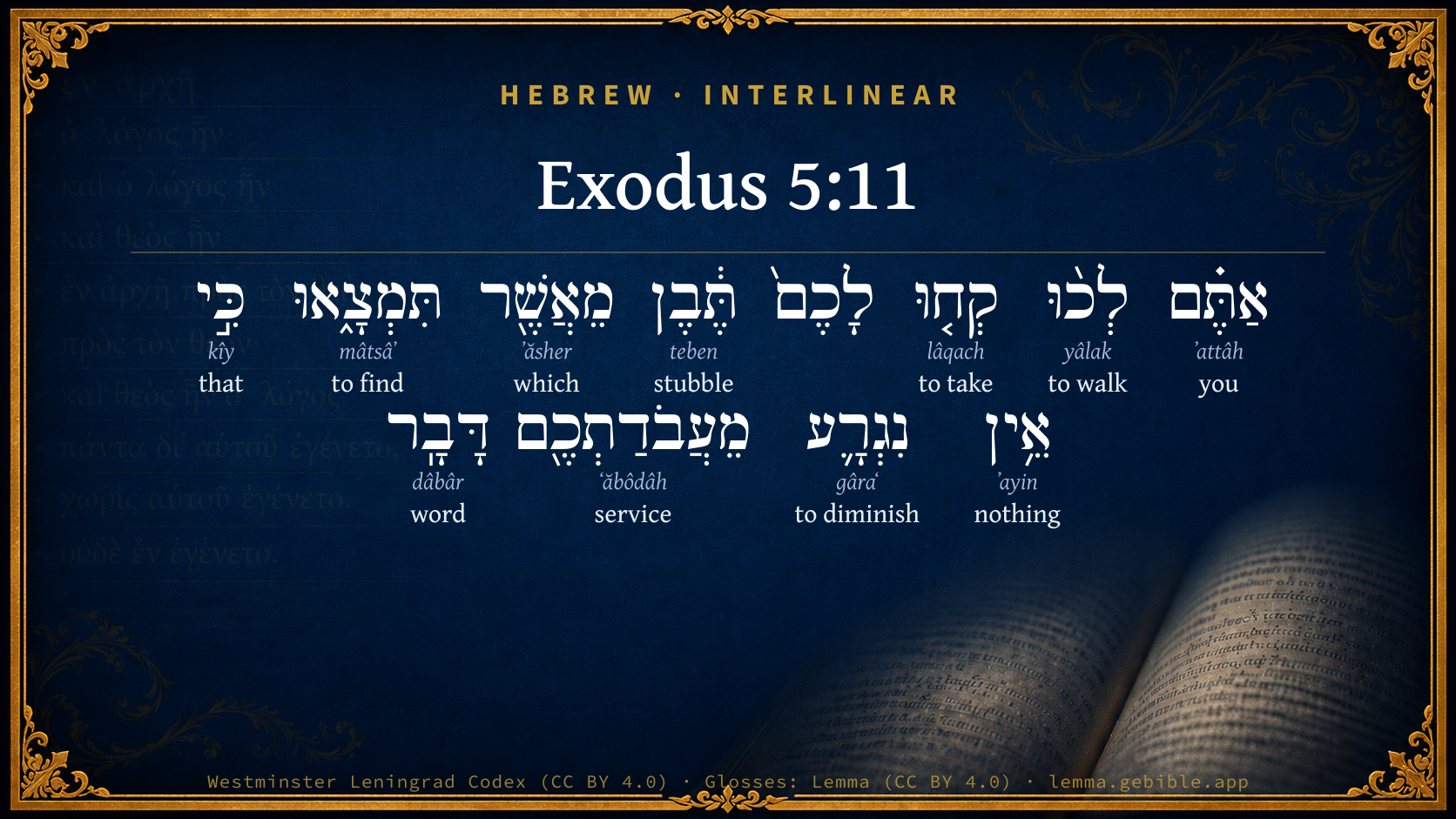
Hebrew (Westminster Leningrad Codex) Exodus 5:11 appears in the Hebrew Old Testament. The text above is from the Westminster Leningrad Codex. Each word links to its Strong’s number, a concise gloss, and parsing drawn from the Open Scriptures Hebrew Bible morphology. Click any word for its full Brown-Driver-Briggs (BDB) entry.
Download image
Cite this verse

Exodus 5:11 (World English Bible). Public Domain. Lemma interlinear Bible study tool, https://lemma.gebible.app/v/exodus/5/11.

Show BibTeX & RIS
BibTeX
RIS
English Translation
Go yourselves, get straw where you can find it, for nothing of your work shall be diminished."
World English Bible · Public Domain
Download a study sheet

One document with this verse’s original text, its word-by-word gloss line, the meaning frame, cross-references with their text, attributed commentary, and full source and license credits — printable, and it pastes into notes with its structure intact.

This verse Autodidact and up

Study sheet (.html) Plain text (.txt)

A passage Seminary Student

Up to 50 verses in one chapter. A passage sheet keeps up to 6 commentary sources and 12 cross-references per verse, in the order this page ranks them, and says so on the sheet whenever that leaves anything out. Ask for a single verse and you get the Autodidact verse sheet above.

Everything on this page stays free to read, with no account — the sheet is a download of what is already on screen, not access to it.

Want to remove ads? Support Godless Engineer
Compare translations 3

The same verse in 3 English versions, stacked beneath the original-language interlinear above. Click any original word for its lexicon entry.

Each is an independent rendering of the whole verse — the interlinear is not word-aligned to these translations.

Highlighted words mark where these versions differ — a whole-verse word diff, not a word-by-word alignment.

  • World English Bible Public Domain
    Go yourselves, get straw where you can find it, for nothing of your work shall be diminished."
  • King James Version Public Domain
    Go ye, get you straw where ye can find it: yet not ought of your work shall be diminished.
  • unfoldingWord Literal Text CC BY-SA 4.0
    You go and get your own straw from wherever you might find it, for there will be no reducing of things from your slavery.’”

unfoldingWord Literal Text — © unfoldingWord, licensed CC BY-SA 4.0. Word-aligned USFM3 via Door43 (git.door43.org/unfoldingWord/en_ult).

Versions to compare (up to 4)

3 of 4 selected

Show all 18 translations

Every available English version of this verse, each an independent rendering of the whole verse.

  • World English Bible Public Domain
    Go yourselves, get straw where you can find it, for nothing of your work shall be diminished."
  • Berean Standard Bible Public Domain
    Go and get your own straw wherever you can find it; but your workload will in no way be reduced.’”
  • Majority Standard Bible Public Domain
    Go and get your own straw wherever you can find it; but your workload will in no way be reduced.’”
  • King James Version Public Domain
    Go ye, get you straw where ye can find it: yet not ought of your work shall be diminished.
  • American Standard Version (1901) Public Domain
    Go yourselves, get you straw where ye can find it: for nought of your work shall be diminished.
  • Revised Version (1885) Public Domain
    Go yourselves, get you straw where ye can find it: for nought of your work shall be diminished.
  • Geneva Bible (1599) Public Domain
    Goe your selues, get you strawe where yee can finde it, yet shall nothing of your labour bee diminished.
  • Douay-Rheims (1899) Public Domain
    Go, and gather it where you can find it: neither shall any thing of your work be diminished.
  • Young's Literal Translation Public Domain
    ye -- go ye, take for yourselves straw where ye find `it', for there is nothing of your service diminished.'
  • Literal Standard Version CC BY-SA 4.0
    you—go, take straw for yourselves where you can find [it], for there is nothing diminished of your service.”
  • Unlocked Literal Bible CC BY-SA 4.0
    You yourselves must go and get straw wherever you can find it, but your workload will not be reduced.'”
  • unfoldingWord Literal Text CC BY-SA 4.0
    You go and get your own straw from wherever you might find it, for there will be no reducing of things from your slavery.’”
  • Darby Bible Public Domain
    go ye, get yourselves straw where ye may find it; but none of your work shall be diminished.
  • World Messianic Bible Public Domain
    Go yourselves, get straw where you can find it, for nothing of your work shall be diminished.’”
  • Webster's Bible Public Domain
    Go ye, get you straw where ye can find it: yet not aught of your work shall be diminished.
  • Free Bible Version CC BY-SA 4.0
    Go and get straw for yourselves wherever you can find it, because your work quota won't be reduced.’”
  • Bible in Basic English Public Domain
    Go yourselves and get dry stems wherever you are able; for your work is not to be any less.
  • JPS Tanakh (1917) Public Domain
    Go yourselves, get you straw where ye can find it; for nought of your work shall be diminished.'

Literal Standard Version (2020), Covenant Press — licensed CC BY-SA 4.0. Text via the HelloAO Bible API (eBible.org). Unlocked Literal Bible (unfoldingWord) — licensed CC BY-SA 4.0. Text via the HelloAO Bible API (eBible.org). unfoldingWord Literal Text — © unfoldingWord, licensed CC BY-SA 4.0. Word-aligned USFM3 via Door43 (git.door43.org/unfoldingWord/en_ult). Free Bible Version, Dr. Jonathan Gallagher — licensed CC BY-SA 4.0. Text via the HelloAO Bible API (eBible.org).

Word by word

More ways to search: Search by grammar → Find every occurrence → Compare this word →

Practice this passage: Drill this verse → Learn its vocabulary →

תֶּ֔בֶן
teben
H8401
“stubble”
Noun, Common, Masculine, Singular, Absolute
Part of Speech
Noun
Type
Common
Gender
Masculine
Number
Singular
State
Absolute
Full BDB Definition

Origin: probably from H1129

TWOT: 2493

straw, stubble - as building material - as fodder for livestock
  1. אַתֶּ֗ם ʼattâh H859 “you” Pronoun, Personal, 2nd Person, Masculine, Plural
  2. לְכ֨וּ yâlak H3212 “walk” Verb, Qal, Imperative, 2nd Person, Masculine, Plural
  3. קְח֤וּ lâqach H3947 “take” Verb, Qal, Imperative, 2nd Person, Masculine, Plural
  4. מֵאֲשֶׁ֖ר ʼăsher H834 “from · which” Preposition + Particle, Relative
  5. תִּמְצָ֑אוּ mâtsâʼ H4672 “to find” Verb, Qal, Imperfect, 2nd Person, Masculine, Plural
  6. כִּ֣י kîy H3588 “that” Conjunction
  7. אֵ֥ין ʼayin H369 “nothing” Particle, Negative
  8. נִגְרָ֛ע gâraʻ H1639 “diminishing” Verb, Niphal, Participle Active, Masculine, Singular, Absolute
  9. מֵעֲבֹדַתְכֶ֖ם ʻăbôdâh H5656 “from · service · your” Preposition + Noun, Common, Feminine, Singular, Construct + Suffix, Personal, 2nd Person, Masculine, Plural
  10. דָּבָֽר dâbâr H1697 “word” Noun, Common, Masculine, Singular, Absolute

About this verse

These counts appear in no published source. They are computed here, from the morphology-tagged text and Lemma’s own curated glosses. What Lemma adds →

12
words
11
distinct lemmas
Pentateuch
section

Notable vocabulary

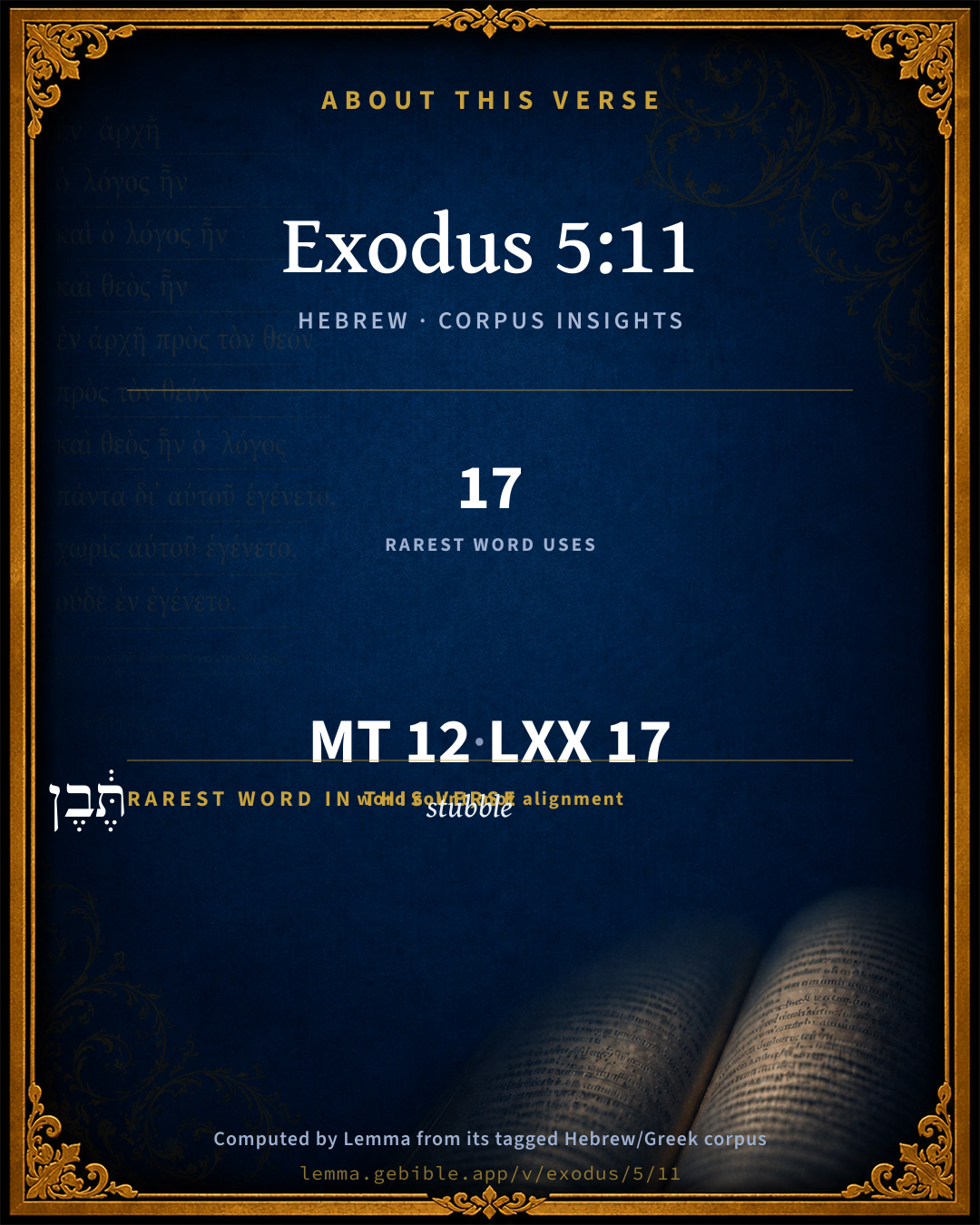
The rarest word here is תֶּ֔בֶן stubble H8401 — appearing just 17 times in the whole Hebrew Bible.

Shared distinctive vocabulary

תֶּ֔בֶן stubble H8401 occurs in 16 verses of the Hebrew Bible. Also found in:

Grammatical profile

  • 4 verbs
  • 3 nouns
  • 1 pronoun
  • 1 preposition
  • 1 conjunction
  • 2 particles

Verb forms

  • לְכ֨וּ Qal · Imperative
  • קְח֤וּ Qal · Imperative
  • תִּמְצָ֑אוּ Qal · Imperfect
  • נִגְרָ֛ע Niphal · Participle Active

Hebrew & Septuagint length

In English translation the verse runs 17 words from the Hebrew and 19 from the Septuagint (LXX English) — closely comparable.

A rough comparison of the two English renderings, which tokenize alike — not a word-level alignment.

Word counts can differ between the Hebrew and the Greek without any difference in meaning — e.g. the Hebrew direct-object marker אֵת has no separate Greek word, and Greek often adds the article ὁ.

In the original languages it is 12 Hebrew tokens and 17 Greek tokens — but the two are counted differently (Hebrew bundles its prefixes and suffixes into one token; the Greek is in lemma form), so that isn’t a like-for-like length.

Cross-references

1

Topical passages linked to Exodus 5:11 in the Treasury of Scripture Knowledge — connected by theme and wording, ordered by reader-vote popularity; previews shown in the World English Bible.

  • Exodus 5:13–14 The taskmasters were urgent saying, "Fulfill your work quota daily, as when there was straw!"

Cross-references courtesy of OpenBible.info (CC BY 4.0).

Hebrew and Greek witnesses Masoretic Hebrew ↔ Greek Septuagint

The same verse in the two great witnesses to the Old Testament, shown verse-for-verse.

These are two independent witnesses, not word-aligned to each other, and the Septuagint is shown in lemma (dictionary) form.

Hebrew Exodus 5:11 Masoretic · Westminster Leningrad Codex

אַתֶּ֗ם לְכ֨וּ קְח֤וּ לָכֶם֙ תֶּ֔בֶן מֵאֲשֶׁ֖ר תִּמְצָ֑אוּ כִּ֣י אֵ֥ין נִגְרָ֛ע מֵעֲבֹדַתְכֶ֖ם דָּבָֽר

Go yourselves, get straw where you can find it, for nothing of your work shall be diminished."

World English Bible · Public Domain

Greek LXX Exodus 5:11 Septuagint · lemma form

αὐτός σύ πορεύομαι συνλέγω ἑαυτοῦ ἄχυρον ὅθεν ἐάν εὑρίσκω οὐ γάρ ἀποαἱρέω ἀπό ὁ σύνταξις σύ οὐδείς

Go you⌃, yourselves, get for yourselves straw wherever you⌃ can find it, for nothing is diminished from your rate.

LXX2012 (modern English Septuagint) · Public Domain

Hebrew: Westminster Leningrad Codex (CC BY 4.0). Greek: Septuagint (public domain); English from LXX2012 (modern English Septuagint) (Public Domain). How the Septuagint differs from the Hebrew →

Targum (Aramaic paraphrase)

2

The Targum is the ancient Jewish Aramaic paraphrase of the Hebrew Scriptures — an interpretive translation, not the Hebrew text itself. Onkelos (literal) and Pseudo-Jonathan (expansive) render the Torah, and Jonathan the Prophets. Coverage is partial: where no permissively-licensed English translation exists for a verse, only the Aramaic is shown. This is verse-level text, not a word-by-word alignment to the Hebrew.

  1. Targum Onkelos Torah (Genesis–Deuteronomy)
    אַתּוּן אֱזִילוּ סִיבוּ לְכוֹן תִּבְנָא מֵאֲתַר דְתַשְׁכְּחוּן אֲרֵי לָא יִתִּמְנַע מִפָּלְחָנְכוֹן מִדָעַם:

    (no public-domain English translation for this verse)

    Targum Onkelos — Aramaic: “Onkelos Genesis” (public domain); “Onkelos Exodus” (public domain); “Onkelos Leviticus” (public domain); “Onkelos Numbers” (public domain); “Onkelos Deuteronomy” (public domain). English: “Sefaria Community Translation” (CC0 1.0 (public-domain dedication)); “J.W. Etheridge. The Targums of Onkelos and Jonathan Ben Uzziel on the Pentateuch. London: Longmans, Green, 1862” (public domain). Text via Sefaria.

  2. Targum Pseudo-Jonathan Torah (Genesis–Deuteronomy)
    אַתּוּן אִיזִילוּ סָבוּ לְכוֹן תִּיבְנָא מִן אָתַר דְתִשְׁכְּחוּן אֲרוּם לָא מִתְמְנַע מִפּוּלְחַנְכוֹן מִדָעַם

    you must go and take straw wherever you can find it; for your work will not in anywise be diminished.

    Targum Pseudo-Jonathan — Aramaic: “Targum Jonathan on Genesis” (public domain); “Targum Jonathan on Exodus” (public domain); “Targum Jonathan on Leviticus” (public domain); “Targum Jonathan on Numbers” (public domain); “Targum Jonathan on Deuteronomy” (public domain). English: “The Targum of Jonathan ben Uzziel, trans. J. W. Etheridge, London, 1862” (public domain). Text via Sefaria.

Commentary

Notes on Exodus 5:11 from classic Christian and Jewish commentators (each source and its license shown beneath its notes). The classic Christian expositions comment on the surrounding passage and are grouped to its opening verse, so a note may address several verses; the Jewish commentaries on the Tanakh (Rashi and others) are per-verse, so they appear only where the commentator wrote on this verse.

Lemma curates 59 commentaries, every one of them public domain or Creative Commons licensed, each selected and text-cleaned for this edition rather than reprinted as found. About our sources →

Trapp's Complete Commentary

John Trapp

Exo 5:11 Go ye, get you straw where ye can find it: yet not ought of your work shall be diminished.

Ver. 11. Yet not aught.] Such hard service puts Satan his slaves to, and yet they rejoice in their bondage.

John Trapp, A Commentary or Exposition upon All the Books of the Old and New Testament (1647–1656) — public domain. Text from a community e-Sword module.

John Gill's Exposition

Go ye, get ye straw, where you can find it,.... Before it was provided by the king, and brought to the brickkilns, but now they are bid to go and fetch it themselves, and get it where they could, whether in fields or barns; and if they were obliged to pay for it out of their labour; it was a greater oppression still:

yet not ought of your work shall be diminished; they were to do the same work, and make the same number of bricks, as when straw was brought and given them; and no allowance made for waste of time in seeking, or expenses in procuring straw, which was very hard upon them.

John Gill's Exposition of the Whole Bible (1746–1763) — public domain (CC PDM 1.0). Text via the HelloAO Bible API.

Whedon's Commentary on the Bible

Daniel D. Whedon

11. Get you straw — For the sun-baked bricks, which were made of Nile mud mixed with cut straw, as is seen in specimens still preserved. Similar oppression and a like unreasonable exaction are on record in an Egyptian papyrus of the nineteenth dynasty, wherein the writer complains, “I have no one to help me in making bricks, no straw.”

Daniel D. Whedon (gen. ed.), Commentary on the Old and New Testaments (1874–1909) — public domain. Text from a community e-Sword module.

The Pulpit Commentary

Get you straw where ye can find it. Straw was not valued in Egypt. Reaping was effected either by gathering the ears, or by cutting the stalks of the corn at a short distance below the heads; and the straw was then left almost entirely upon the ground. Grass was so plentiful that it was not required for fodder, and there was no employment of it as litter in farmyards. Thus abundance of straw could be gathered in the cornfields after harvest; and as there were many harvests, some sort of straw was probably obtainable in the Delta at almost all seasons of the year. To collect it, however, and chop it small, as required in brickmaking, consumed much time, and left too little for the actual making of the bricks.

The Pulpit Commentary (1880–1919), ed. H.D.M. Spence-Jones & Joseph S. Exell — public domain. Text from a community e-Sword module.

Rashi

Rabbi Shlomo Yitzchaki (Rashi)

אתם לכו קחו לכם תבן GO, YE, TAKE TO YOURSELVES STRAW — and you will have to go pretty quickly,

כי אין נגרע מעבודתכם דבר FOR THERE SHALL NOT BE DIMINISHED OF YOUR WORK A SINGLE THING from the whole total of bricks which you used to make daily when straw was supplied to you, ready to use, from the king’s store.

Rashi on the Tanakh — English translations: “The Judaica Press complete Tanach with Rashi, translated by A. J. Rosenberg” (CC BY 4.0); “Pentateuch with Rashi's commentary by M. Rosenbaum and A.M. Silbermann, 1929-1934” (public domain); “The Metsudah Tanach series, Lakewood, N.J” (CC BY 4.0); and “The Book of Joshua, Metsudah Publications, 1997” (CC BY 4.0). Text via Sefaria.

Lesson kit

Teaching starters — assembled from the data on this page, not authored interpretation. Every prompt links to the verse data it draws on. Edit before teaching.

Exodus, in the Pentateuch, opens this verse with 12 words (11 distinct Hebrew lemmas). Its most distinctive word is teben (“stubble”). A historical commentator’s framing appears above. Read the whole chapter for the surrounding context.

Discussion questions

  1. How does “stubble” (teben) shape what this verse is saying?
  2. How does Genesis 24:25, which shares the word «stubble», read alongside this verse?
  3. The translations on this page render this verse differently — a whole-verse word diff, not a word-by-word alignment. What might account for the different wordings?
  4. «לְכ֨וּ» is a Qal Imperative verb. How does that grammatical form shape the action described?
  5. Compare how Trapp's Complete Commentary and John Gill's Exposition read this verse. Where do they agree or differ?

Things to notice

Reading settings

Reading text

Shown beneath each verse's original-language words.

Old Testament
Old Testament edition

Read the OT as the Masoretic Hebrew (MT) or the Greek Septuagint (LXX).

English shown for the Greek Septuagint (in the Hebrew ↔ Greek comparison).

Comparing translations? Open the Compare panel on any verse page to stack up to four side by side.