
Deuteronomy 4:35

Hebrew (Westminster Leningrad Codex) Deuteronomy 4:35 appears in the Hebrew Old Testament. The text above is from the Westminster Leningrad Codex. Each word links to its Strong’s number, a concise gloss, and parsing drawn from the Open Scriptures Hebrew Bible morphology. Click any word for its full Brown-Driver-Briggs (BDB) entry.
Download image
Cite this verse

Deuteronomy 4:35 (World English Bible). Public Domain. Lemma interlinear Bible study tool, https://lemma.gebible.app/v/deuteronomy/4/35.

Show BibTeX & RIS
BibTeX
RIS
English Translation
To you it was shown, that you might know that Yahweh he is God; there is none else besides him.
World English Bible · Public Domain
Download a study sheet

One document with this verse’s original text, its word-by-word gloss line, the meaning frame, cross-references with their text, attributed commentary, and full source and license credits — printable, and it pastes into notes with its structure intact.

This verse Autodidact and up

Study sheet (.html) Plain text (.txt)

A passage Seminary Student

Up to 50 verses in one chapter. A passage sheet keeps up to 6 commentary sources and 12 cross-references per verse, in the order this page ranks them, and says so on the sheet whenever that leaves anything out. Ask for a single verse and you get the Autodidact verse sheet above.

Everything on this page stays free to read, with no account — the sheet is a download of what is already on screen, not access to it.

Want to remove ads? Support Godless Engineer
Compare translations 3

The same verse in 3 English versions, stacked beneath the original-language interlinear above. Click any original word for its lexicon entry.

Each is an independent rendering of the whole verse — the interlinear is not word-aligned to these translations.

Highlighted words mark where these versions differ — a whole-verse word diff, not a word-by-word alignment.

  • World English Bible Public Domain
    To you it was shown, that you might know that Yahweh he is God; there is none else besides him.
  • King James Version Public Domain
    Unto thee it was showed, that thou mightest know that the LORD he is God; there is none else beside him.
  • unfoldingWord Literal Text CC BY-SA 4.0
    You, you have been shown, to know that Yahweh, he is God; there is no other besides him.

unfoldingWord Literal Text — © unfoldingWord, licensed CC BY-SA 4.0. Word-aligned USFM3 via Door43 (git.door43.org/unfoldingWord/en_ult).

Versions to compare (up to 4)

3 of 4 selected

Show all 18 translations

Every available English version of this verse, each an independent rendering of the whole verse.

  • World English Bible Public Domain
    To you it was shown, that you might know that Yahweh he is God; there is none else besides him.
  • Berean Standard Bible Public Domain
    You were shown these things so that you would know that the LORD is God; there is no other besides Him.
  • Majority Standard Bible Public Domain
    You were shown these things so that you would know that the LORD is God; there is no other besides Him.
  • King James Version Public Domain
    Unto thee it was showed, that thou mightest know that the LORD he is God; there is none else beside him.
  • American Standard Version (1901) Public Domain
    Unto thee it was showed, that thou mightest know that Jehovah he is God; there is none else besides him.
  • Revised Version (1885) Public Domain
    Unto thee it was shewed, that thou mightest know that the LORD he is God; there is none else beside him.
  • Geneva Bible (1599) Public Domain
    Vnto thee it was shewed, that thou mightest knowe, that the Lord hee is God, and that there is none but he alone.
  • Douay-Rheims (1899) Public Domain
    That thou mightest know that the Lord he is God, and there is no other besides him.
  • Young's Literal Translation Public Domain
    Thou, thou hast been shewn `it', to know that Jehovah He `is' God; there is none else besides Him.
  • Literal Standard Version CC BY-SA 4.0
    You—you have been shown [it], to know that He, YHWH, [is] God; there is none else besides Him.
  • Unlocked Literal Bible CC BY-SA 4.0
    To you these things were shown, so that you might know that Yahweh is God, and that there is no one else besides him.
  • unfoldingWord Literal Text CC BY-SA 4.0
    You, you have been shown, to know that Yahweh, he is God; there is no other besides him.
  • Darby Bible Public Domain
    Unto thee it was shewn, that thou mightest know that Jehovah, he is God -- there is none other besides him.
  • World Messianic Bible Public Domain
    It was shown to you so that you might know that the LORD is God. There is no one else besides him.
  • Webster's Bible Public Domain
    To thee it was shown, that thou mightest know that the LORD he is God; there is none besides him.
  • Free Bible Version CC BY-SA 4.0
    You were shown all this so you could be certain that the Lord is God and there is no one like him.
  • Bible in Basic English Public Domain
    All this he let you see, so that you might be certain that the Lord is God and there is no other.
  • JPS Tanakh (1917) Public Domain
    Unto thee it was shown, that thou mightiest know that the LORD, He is God; there is none else beside Him.

Literal Standard Version (2020), Covenant Press — licensed CC BY-SA 4.0. Text via the HelloAO Bible API (eBible.org). Unlocked Literal Bible (unfoldingWord) — licensed CC BY-SA 4.0. Text via the HelloAO Bible API (eBible.org). unfoldingWord Literal Text — © unfoldingWord, licensed CC BY-SA 4.0. Word-aligned USFM3 via Door43 (git.door43.org/unfoldingWord/en_ult). Free Bible Version, Dr. Jonathan Gallagher — licensed CC BY-SA 4.0. Text via the HelloAO Bible API (eBible.org).

Word by word

More ways to search: Search by grammar → Find every occurrence → Compare this word →

Practice this passage: Drill this verse → Learn its vocabulary →

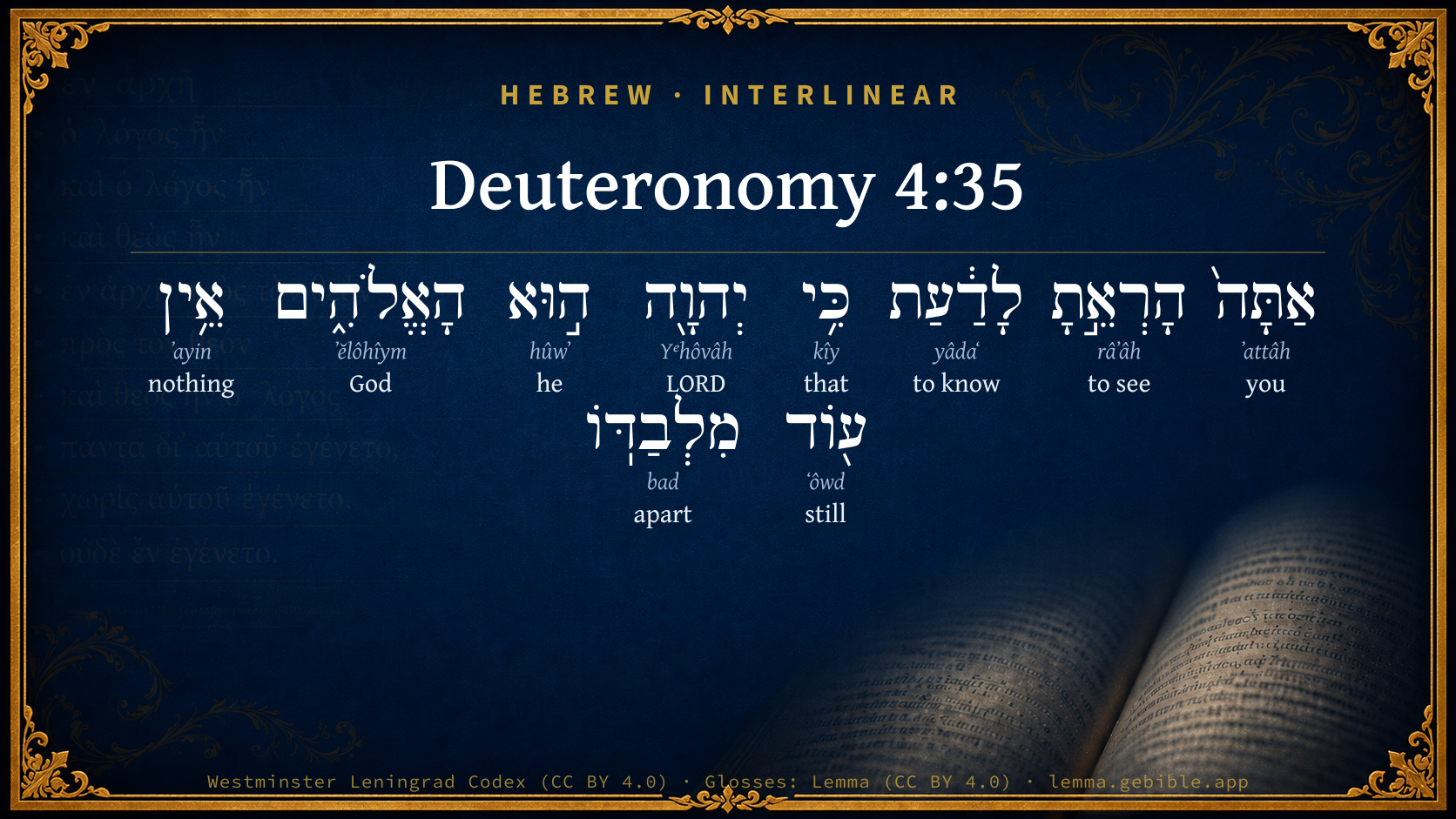
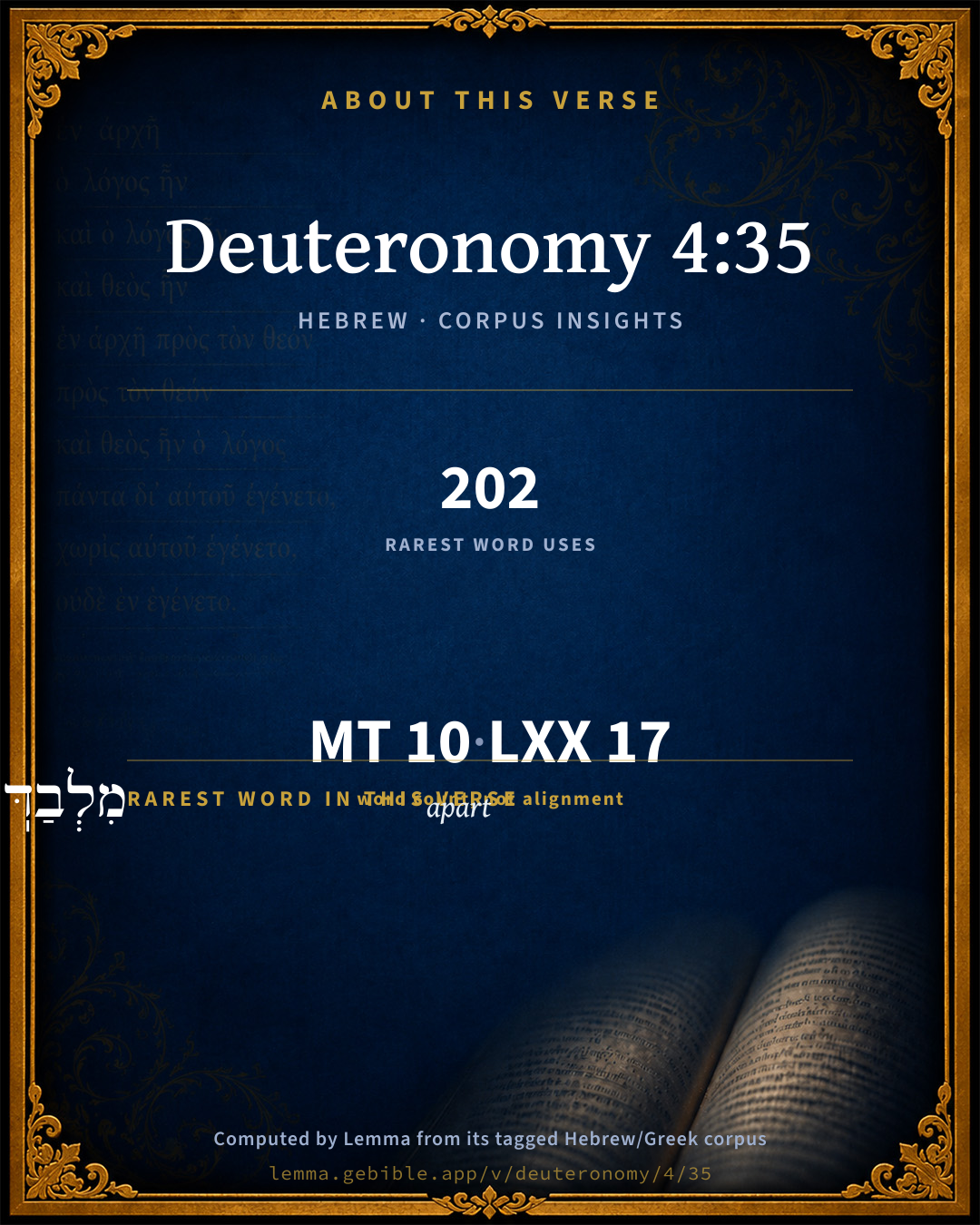
מִלְבַדּֽוֹ
bad
H905
“from · to/for · apart · his”
Preposition + Preposition + Noun, Common, Masculine, Singular, Construct + Suffix, Personal, 3rd Person, Masculine, Singular
Part of Speech
Preposition + Preposition + Noun
Type
Common
Gender
Masculine
Number
Singular
State
Construct
Full BDB Definition

Origin: from H909

TWOT: 201a

alone, by itself, besides, a part, separation, being alone - separation, alone, by itself - only (adverb) - apart from, besides (preposition) - part - parts (eg limbs, shoots), bars
  1. אַתָּה֙ ʼattâh H859 “you” Pronoun, Personal, 2nd Person, Masculine, Singular
  2. הָרְאֵ֣תָ râʼâh H7200 “to see” Verb, Hophal, Perfect, 2nd Person, Masculine, Singular
  3. לָדַ֔עַת yâdaʻ H3045 “to know” Preposition + Verb, Qal, Infinitive Construct
  4. כִּ֥י kîy H3588 “that” Conjunction
  5. יְהוָ֖ה Yᵉhôvâh H3068 “LORD” Noun, Proper
  6. ה֣וּא hûwʼ H1931 “he” Pronoun, Personal, 3rd Person, Masculine, Singular
  7. הָאֱלֹהִ֑ים ʼĕlôhîym H430 “the · God(s)” Particle, Definite Article + Noun, Common, Masculine, Plural, Absolute
  8. אֵ֥ין ʼayin H369 “nothing” Particle, Negative
  9. ע֖וֹד ʻôwd H5750 “still” Adverb

About this verse

These counts appear in no published source. They are computed here, from the morphology-tagged text and Lemma’s own curated glosses. What Lemma adds →

10
words
10
distinct lemmas
Pentateuch
section

Grammatical profile

  • 2 verbs
  • 3 nouns
  • 2 pronouns
  • 1 conjunction
  • 1 adverb
  • 1 particle

Verb forms

  • הָרְאֵ֣תָ Hophal · Perfect
  • לָדַ֔עַת Qal · Infinitive Construct

Hebrew & Septuagint length

In English translation the verse runs 20 words from the Hebrew and 19 from the Septuagint (LXX English) — closely comparable.

A rough comparison of the two English renderings, which tokenize alike — not a word-level alignment.

Word counts can differ between the Hebrew and the Greek without any difference in meaning — e.g. the Hebrew direct-object marker אֵת has no separate Greek word, and Greek often adds the article ὁ.

In the original languages it is 10 Hebrew tokens and 17 Greek tokens — but the two are counted differently (Hebrew bundles its prefixes and suffixes into one token; the Greek is in lemma form), so that isn’t a like-for-like length.

Cross-references

18

Topical passages linked to Deuteronomy 4:35 in the Treasury of Scripture Knowledge — connected by theme and wording, ordered by reader-vote popularity; previews shown in the World English Bible.

  • Isaiah 45:18 For thus says Yahweh who created the heavens, the God who formed the earth and made it, who established it and didn't create it a waste, who formed it to be inhabited: I am Yahweh; and there is no one else.
  • 1 Samuel 2:2 There is none holy as Yahweh; For there is none besides you, Neither is there any rock like our God.
  • Isaiah 45:5 I am Yahweh, and there is none else; besides me there is no God. I will gird you, though you have not known me;
  • Deuteronomy 4:39 Know therefore this day, and lay it to your heart, that Yahweh he is God in heaven above and on the earth beneath; there is none else.
  • Isaiah 44:8 Don't fear, neither be afraid: haven't I declared to you of old, and shown it? You are my witnesses. Is there a God besides me? Indeed, there is not. I don't know any Rock.
  • Deuteronomy 32:39 See now that I, even I, am he, There is no god with me: I kill, and I make alive; I wound, and I heal; There is none who can deliver out of my hand.
  • Psalms 83:18 That they may know that you alone, whose name is Yahweh, Are the Most High over all the earth.
  • Isaiah 44:6 Thus says Yahweh, the King of Israel, and his Redeemer, Yahweh of Hosts: I am the first, and I am the last; and besides me there is no God.
  • Isaiah 45:22 Look to me, and be you saved, all the ends of the earth; for I am God, and there is none else.
  • Exodus 15:11 Who is like you, Yahweh, among the gods? Who is like you, glorious in holiness, Fearful in praises, doing wonders?
  • 1 Samuel 17:45–47 Then said David to the Philistine, You come to me with a sword, and with a spear, and with a javelin: but I come to you in the name of Yahweh of hosts, the God of the armies of Israel, whom you have defied.
  • 1 Kings 18:36–37 It happened at the time of the offering of the [evening] offering, that Elijah the prophet came near, and said, Yahweh, the God of Abraham, of Isaac, and of Israel, let it be known this day that you are God in Israel, and that I am your servant, and that I have done all these things at your word.
  • Mark 12:32 The scribe said to him, "Truly, teacher, you have said well that he is one, and there is none other but he,
  • Deuteronomy 32:23 I will heap evils on them; I will spend my arrows on them:
  • Psalms 58:11 So that men shall say, "Most assuredly there is a reward for the righteous. Most assuredly there is a God who judges the earth."
  • Mark 12:29 Jesus answered, "The greatest is, 'Hear, Israel, the Lord our God, the Lord is one:
  • 2 Kings 19:19 Now therefore, Yahweh our God, save you us, I beg you, out of his hand, that all the kingdoms of the earth may know that you Yahweh are God alone.
  • 1 John 5:20–21 We know that the Son of God has come, and has given us an understanding, that we know him who is true, and we are in him who is true, in his Son Jesus Christ. This is the true God, and eternal life.

Cross-references courtesy of OpenBible.info (CC BY 4.0).

Hebrew and Greek witnesses Masoretic Hebrew ↔ Greek Septuagint

The same verse in the two great witnesses to the Old Testament, shown verse-for-verse.

These are two independent witnesses, not word-aligned to each other, and the Septuagint is shown in lemma (dictionary) form.

Hebrew Deuteronomy 4:35 Masoretic · Westminster Leningrad Codex

אַתָּה֙ הָרְאֵ֣תָ לָדַ֔עַת כִּ֥י יְהוָ֖ה ה֣וּא הָאֱלֹהִ֑ים אֵ֥ין ע֖וֹד מִלְבַדּֽוֹ

To you it was shown, that you might know that Yahweh he is God; there is none else besides him.

World English Bible · Public Domain

Greek LXX Deuteronomy 4:35 Septuagint · lemma form

ὥστε οἶδα σύ ὅτι κύριος ὁ θεός σύ οὗτος θεός εἰμί καί οὐ εἰμί ἔτι πλήν αὐτός

So that you should know that the Lord your God he is God, and there is none beside him.

LXX2012 (modern English Septuagint) · Public Domain

Hebrew: Westminster Leningrad Codex (CC BY 4.0). Greek: Septuagint (public domain); English from LXX2012 (modern English Septuagint) (Public Domain). How the Septuagint differs from the Hebrew →

Targum (Aramaic paraphrase)

2

The Targum is the ancient Jewish Aramaic paraphrase of the Hebrew Scriptures — an interpretive translation, not the Hebrew text itself. Onkelos (literal) and Pseudo-Jonathan (expansive) render the Torah, and Jonathan the Prophets. Coverage is partial: where no permissively-licensed English translation exists for a verse, only the Aramaic is shown. This is verse-level text, not a word-by-word alignment to the Hebrew.

  1. Targum Onkelos Torah (Genesis–Deuteronomy)
    אַתְּ אִתְחֲזֵיתָא לְמִדַע אֲרֵי יְיָ הוּא אֱלֹהִים לֵית עוֹד בַּר מִנֵהּ

    (no public-domain English translation for this verse)

    Targum Onkelos — Aramaic: “Onkelos Genesis” (public domain); “Onkelos Exodus” (public domain); “Onkelos Leviticus” (public domain); “Onkelos Numbers” (public domain); “Onkelos Deuteronomy” (public domain). English: “Sefaria Community Translation” (CC0 1.0 (public-domain dedication)); “J.W. Etheridge. The Targums of Onkelos and Jonathan Ben Uzziel on the Pentateuch. London: Longmans, Green, 1862” (public domain). Text via Sefaria.

  2. Targum Pseudo-Jonathan Torah (Genesis–Deuteronomy)
    אַנְתְּ אִיתְחָמֵיתָא יַת פְּרִישָׁתָא הָאִלֵּין מְטוּל לְמִנְדַע אֲרוּם יְיָ הוּא אֱלָהָא לֵית תּוּב בַּר מִינֵיהּ

    Unto thee have these wonders been shown, that thou mayest know that the Lord is God, and there is none beside Him.

    Targum Pseudo-Jonathan — Aramaic: “Targum Jonathan on Genesis” (public domain); “Targum Jonathan on Exodus” (public domain); “Targum Jonathan on Leviticus” (public domain); “Targum Jonathan on Numbers” (public domain); “Targum Jonathan on Deuteronomy” (public domain). English: “The Targum of Jonathan ben Uzziel, trans. J. W. Etheridge, London, 1862” (public domain). Text via Sefaria.

Commentary

Notes on Deuteronomy 4:35 from classic Christian and Jewish commentators (each source and its license shown beneath its notes). The classic Christian expositions comment on the surrounding passage and are grouped to its opening verse, so a note may address several verses; the Jewish commentaries on the Tanakh (Rashi and others) are per-verse, so they appear only where the commentator wrote on this verse.

Lemma curates 59 commentaries, every one of them public domain or Creative Commons licensed, each selected and text-cleaned for this edition rather than reprinted as found. About our sources →

The Biblical Illustrator

Joseph S. Exell

Deu_4:35

Unto thee it was shewed.

All national and individual responsibility to God peculiarly applicable to Britain, both as a Church and State

I. That while all nations and all people are bound to serve the lord, and are accountable to Him for so doing or not, according to the opportunities they possess and the privileges with which they are favoured for knowing His character and learning His truth and will, some nations and people are more peculiarly engaged thus to serve Him, and are under a correspondent degree of responsibility for doing so or not; because some nations and people are more highly favoured than others in all these respects, and are distinguished by greater privileges and opportunities for knowing and doing the Divine will than many others, who are, notwithstanding, all accountable unto God. Now, in order to place this truth in its proper light, let us suppose a case whose propriety and certainty few, we expect, will be disposed to dispute. And, to begin with--

1. Individuals, let us suppose the case of one man, born and bred a pure heathen; another, brought up with some degree of opportunity for gaining the true knowledge of God, etc., in civilised life; and a third, in the same condition, in full possession of the Word of truth and salvation. The great law of mans universal responsibility, amidst all this variety of condition, equally applies to them all. But the advantages which the one possesses over the other bind the one in a more powerful manner to the duty enforced. And when you arrive at the greatest measure of privilege, do you not behold its accompanying claims rising to the same point, and bearing an even requisition with the highest elevation?

2. Nations. Nations are nothing more than vast numbers of individuals, located in various parts of the earth, and cemented by certain laws and regulations in orderly and social compact. The same truths, therefore, which apply to one person will surely extend to ten thousand, or to as many millions, of the human family thus connected together.

3. Whether the doctrine we inculcate is founded upon, and stands in agreement with, the pure Word of God. Did not the very mercies and privileges which the Lord bestowed upon Israel lay them under peculiar obligations, and bind them in an especial manner to love and serve Him?

II. Where does the truth thus propounded and established fall in its full weight; and to whom does it more peculiarly apply in all its authority and aggravation? The inquiry evidently regards the past and the present time.

1. The past time. Where, in the ages that are passed, are we to look for such a nation or people? Must we not at once fix our attention upon Israel of old, and say, Thou art that nation, and thou art that people? What wonders did God work on their behalf! What large and unmerited mercies did He bestow on them! What astonishing deliverances did He vouchsafe to them! But must our inquiries terminate here?

2. The present time. Many nations are presented to our view. Some great and strong; others weak and debased. Some altogether enshrouded in heathen blindness; others groaning under Mohammedan tyranny and delusion. Some rent with internal convulsions; others sitting down in comparative quiet. Some, once mighty and renowned, merged in the general streams of rival powers, and known no more as separate kingdoms, except in the records of their ancient exploits and fame. But amidst all this national and political chaos presented to our view can we fix on no spot which in a more especial manner is more highly favoured than any other? Yes, we can. Like some tall majestic oak amidst the under wood of the forest, or like the cloud-capped mountain contrasted with the hillocks of the plain, or like the stately man-of-war amidst the wharfage of the port, there is one nation amidst all the diversified tribes of man which stands thus conspicuous in the view, and thus crowned with privileges and blessings! Oh England, my beloved place and nation, thou wearest this crown! thou standest on this elevation! Not only in common with all others, but above and beyond all others, hast thou been blessed and crowned with loving kindness and tender mercies! What hath not the Lord done for thee?

(1) As a nation. Hath He not raised thee from small beginnings to unexampled greatness? Hath He not brought thee from a poor degraded state of heathen misery, in which thy forefathers were sunk, to be at once the mistress, the envy, and the glory of the world? And in the course of thy experience, from thy low original to thy present greatness, hath not the Lord often wrought for thee by a mighty hand and by a stretched-out arm? And art thou not bound, in proportion to what He hath done for thee? Oh! beware lest thou stand as conspicuous in ingratitude and guilt as thou art in privilege and blessing! But are national distinctions and advantages all that the Lord hath done for thee? Are not thy privileges--

2. As a church, as great as thy mercies as a nation? He hath not left thee without witness; not merely, as He testified to the heathen, giving rain from heaven, and fruitful seasons, and filling our hearts with food and gladness; but as He deals with His own inheritance, sending to thee the truths of His Word and the messages of His salvation. Do we, as a nation, church, or people, live up to these privileges, and bring forth the fruit which God so justly requires at our hands? Are the mercies we possess prized as they ought to be? Are they improved as they ought to be? Is God honoured and glorified as tie ought to be? Is the Gospel of peace valued as it ought to be? Is the Word of life received as it ought to be? Do we walk in the statutes and ordinances of God as we ought to do? (R. Shittler.)

The revelation of God

I. In his name. Is it answered, That is only a word? But what are words? People do not forge and utter words as they please. They cannot be made or unmade by votes of assemblies or edicts of kings. They are chronic. They come into existence by a law of nature. They are carved out of unstable air by a supernatural power. To call Gods Word or name priest craft is itself cant. A set of priests could no more have created it than they could an ocean or a mountain range. Matthew Arnold says, God means the Brilliant in the sky. But what makes it to shine, and to wear the blue firmament for a robe? There could have been no name if no Lord,--as no names for plant, beast, earth, sea, but that these things were, and to do aught in His name is to do it by His strength and for His honour. Caesar may be a myth, and Eve in the garden a tale, but no appellations can overrate the Eternal.

II. In his work: what He does shows what He is. All the phrases which sceptics think so lightly of are but the labels of His wonders. But all the Bibles, says the denier, are human compositions written in time: show me the sacred books that not affirm a God out of us. What is out of us is not so easy to say. The whole creation is somehow in our thought. I have a feeling that fetches down from Orion. My imagination girdles the Pleiades. God is not less to me because He exists not externally but in the consciousness of my own bosom, and I cannot dismiss my guest. If no characters by Him were ever entered on a paper leaf, stone tablet from Sinai, or Egyptian column, do we not find His engraving in living organisms and on the vast layers of the globe? Providence is one of these obstinate, indestructible words in the daily discourse of mankind. A great, forthreaching, unbaffled, and unending plan, a purpose through the ages, one must be worse than colour blind not to see, with a steady accomplishment,--style it fitness, adjustment, design, as you will. Not a nook of nature but is His workshop, not an event without His procedure.

III. In his nature or image. Had He left no sign manual of His authorship in our frame all else were to us a dumb show. Why do beasts and insects not perceive the drift of the plot on this broad external stage? Because, even in their innocence, they cannot yet come to themselves, and in themselves find their Father. But what features of His face are unveiled to us?

1. First, of sincerity, the open look. Why can we not be free from this candid bond, but that the Divinity reveals within us His essence of truth, as a claim beyond convenience or uses of the hour, so infinite that no liar can be content till he has confessed? After what long and stubborn perjury, from at last being convinced by some co-conspirator that falsehood is kindest and best, a quickened conscience forces the wretched deceiver, man or woman, in mutual crime, to own at last even the forswearing, and throw off the disguise that hinders peace with God!

2. Next, the line of rectitude in this countenance we pray God to lift upon us, and which He never quite withdraws. Truth is right speech, and righteousness is true conduct. If your neighbour will not rest in any wrong you do him, you will be the last to be satisfied with your own unfairness, because Deity is equity in your vital parts.

3. There is one more lineament in that face whose glance we cannot escape: it is goodness. But the goodness must be more than doting on one person, however winsome and dear. I know an earnest love; but God save me from an exclusive one, and keep me from wishing or enduring the monopoly of a human heart! We may be partial to one person, like the sun flattering some mountain top or blazing back from some windowed tower as he rises or sets; but be we also impartial as the sun, making the whole earth his reflection and flinging his radiance through the sky.

IV. In the healthful exercise of our powers. We find God in innocent pleasures as in solemn forms, as parents are as much pleased with their childrens gambols as with their deferential requests. The little orthodox boy, repeating his prayers so punctually in his country cot, said one morning, Good-bye, God: I am going to Boston to stay a fortnight; he not having been taught how that sublime Presence would smile on him amid all the sights of the city, as when the soul was commended to Him in sleep. The small girl was pious in a more rational way who, going home from her first dance, ere she put off her pretty dress, fell on her knees to thank God for the pleasure He had given her at the childrens ball. God is the problem whose last and clearest solution is in the corollary of duty, which, as Kant says, is the practical reason piecing out the ladder to climb to Him, where the speculative ends. In this transparency of conscience all the vexing riddles conclude. With a dogged satisfaction, in dire extremity, it helps us to stand at our post and do our office, as the old Cumberland still fired her guns when sinking to her gunwale. There was something in those sailors, as in all faithful unto death, not going down! (C. A. Bartol, D. D.)

The Biblical Illustrator, edited by Joseph S. Exell (c. 1880s–1900s) — public domain. Text from a community e-Sword module.

Geneva Bible (1599)

Geneva Bible translators

He showeth the cause why God wrought these miracles.

Geneva Bible (1599) marginal notes — public domain. Text via Bolls.life.

The Cambridge Bible for Schools and Colleges

gen. ed. J. J. S. Perowne

35. Unto thee it was shewed] Heb. Thou, thyself, wast made to see it. Again an emphasis on the experimental character of Israel’s religion. Jehovah does something! The formative effect of the tradition of the Exodus on that religion cannot be overestimated.

The Cambridge Bible for Schools and Colleges (gen. ed. J. J. S. Perowne; Cambridge University Press, 1878–1918) — public domain. Text from a community e-Sword module.

John Gill's Exposition

Unto thee it was showed,.... What the Lord did in Egypt:

that thou mightest know that the Lord he is God, there is none else besides him; that he is the one only living and true God, and there is no other: this phrase is often used by the Prophet Isaiah, to express the same great article of faith.

John Gill's Exposition of the Whole Bible (1746–1763) — public domain (CC PDM 1.0). Text via the HelloAO Bible API.

The Pulpit Commentary

All this Israel was made to see, in order that they might know that Jehovah is alone God, and beside him is no other. God ( the God), the one living and true God.

The Pulpit Commentary (1880–1919), ed. H.D.M. Spence-Jones & Joseph S. Exell — public domain. Text from a community e-Sword module.

Keil & Delitzsch

C. F. Keil & F. Delitzsch

Israel was made to see all this, that it might know that Jehovah was God (האלהים, the God, to whom the name of elohim rightfully belonged), and there was none else beside Him (cf. Deu 4:39, Deu 32:39; Isa 45:5-6).

Keil & Delitzsch — Biblical Commentary on the Old Testament (1861–1891) — public domain (CC PDM 1.0). Text via the HelloAO Bible API. (Old Testament only.)

unfoldingWord translationNotes

Door43 World Missions Community

General Information:

Moses continues to speak to the people of Israel if they were one man, so all instances of "you" and "your" are singular. (See: Forms of You)

To you these things were shown

This can be stated in active form. AT: "Yahweh showed you these things" (See: Active or Passive)

he made you to hear ... made you see

"he made sure you heard ... made sure you saw"

made you ... you heard

Moses speaks as if the people to whom he was speaking were the people he had spoken to at Mount Sinai many years earlier. The people at Mount Sinai were actually the fathers of the people to whom he was speaking these words. AT: "made your fathers ... your fathers heard" (See: Metonymy)

translationWords

Yahweh

God

heaven

voice

fire

word

unfoldingWord translationNotes — © Distant Shores Media and the Door43 World Missions Community, licensed CC BY-SA 4.0. Source: git.door43.org/Door43/en_tn.

Rashi

Rabbi Shlomo Yitzchaki (Rashi)

הראת — Understand this as the Targum has it: Thou hast been shown. When the Holy One, blessed be He, gave the Torah, He rent open to them the seven heavens, and just as he rent open the higher regions so did He rend open the lower, so that they saw that He was alone (sole God). On this account it is stated, "Thou hast been shown that thou mayest know [that the Lord is God, there is none besides Him]" (Pesikta Rabbati 20 towards the end).

Rashi on the Tanakh — English translations: “The Judaica Press complete Tanach with Rashi, translated by A. J. Rosenberg” (CC BY 4.0); “Pentateuch with Rashi's commentary by M. Rosenbaum and A.M. Silbermann, 1929-1934” (public domain); “The Metsudah Tanach series, Lakewood, N.J” (CC BY 4.0); and “The Book of Joshua, Metsudah Publications, 1997” (CC BY 4.0). Text via Sefaria.

Lesson kit

Teaching starters — assembled from the data on this page, not authored interpretation. Every prompt links to the verse data it draws on. Edit before teaching.

Deuteronomy, in the Pentateuch, opens this verse with 10 words (10 distinct Hebrew lemmas). Its most distinctive word is bad (“apart”). A historical commentator’s framing appears above. Read the whole chapter for the surrounding context.

Discussion questions

  1. How does “apart” (bad) shape what this verse is saying?
  2. How does Isaiah 45:18, which shares this passage’s theme, read alongside this verse?
  3. The translations on this page render this verse differently — a whole-verse word diff, not a word-by-word alignment. What might account for the different wordings?
  4. «הָרְאֵ֣תָ» is a Hophal Perfect verb. How does that grammatical form shape the action described?
  5. Compare how The Biblical Illustrator and Geneva Bible (1599) read this verse. Where do they agree or differ?

Things to notice

Reading settings

Reading text

Shown beneath each verse's original-language words.

Old Testament
Old Testament edition

Read the OT as the Masoretic Hebrew (MT) or the Greek Septuagint (LXX).

English shown for the Greek Septuagint (in the Hebrew ↔ Greek comparison).

Comparing translations? Open the Compare panel on any verse page to stack up to four side by side.