Genesis 28:17

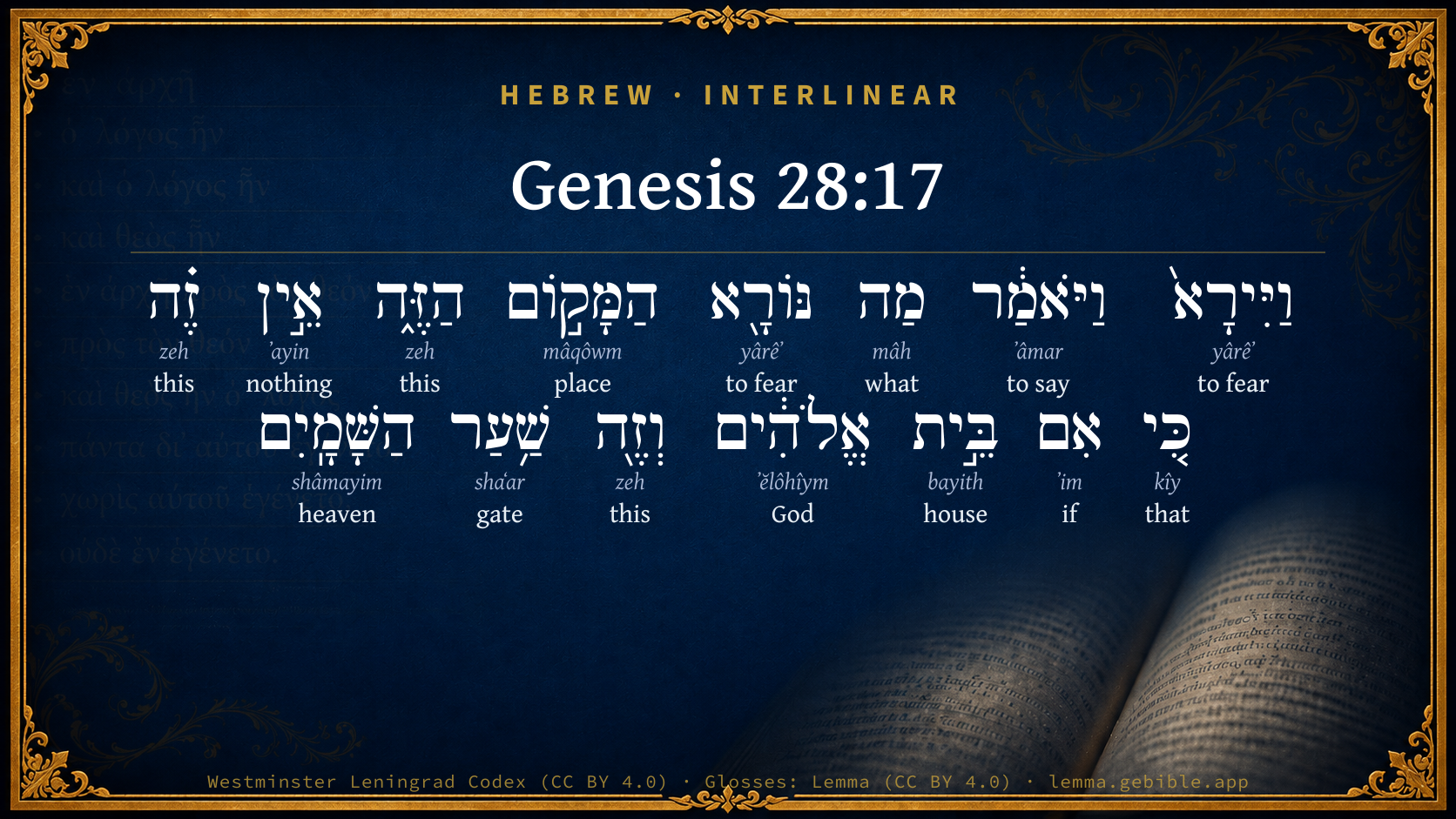
Hebrew (Westminster Leningrad Codex) Genesis 28:17 appears in the Hebrew Old Testament. The text above is from the Westminster Leningrad Codex. Each word links to its Strong’s number, a concise gloss, and parsing drawn from the Open Scriptures Hebrew Bible morphology. Click any word for its full Brown-Driver-Briggs (BDB) entry.
Download image
Cite this verse

Genesis 28:17 (World English Bible). Public Domain. Lemma interlinear Bible study tool, https://lemma.gebible.app/v/genesis/28/17.

Show BibTeX & RIS
BibTeX
RIS
English Translation
He was afraid, and said, "How dreadful is this place! This is none other than God's house, and this is the gate of heaven."
World English Bible · Public Domain
Download a study sheet

One document with this verse’s original text, its word-by-word gloss line, the meaning frame, cross-references with their text, attributed commentary, and full source and license credits — printable, and it pastes into notes with its structure intact.

This verse Autodidact and up

Study sheet (.html) Plain text (.txt)

A passage Seminary Student

Up to 50 verses in one chapter. A passage sheet keeps up to 6 commentary sources and 12 cross-references per verse, in the order this page ranks them, and says so on the sheet whenever that leaves anything out. Ask for a single verse and you get the Autodidact verse sheet above.

Everything on this page stays free to read, with no account — the sheet is a download of what is already on screen, not access to it.

Want to remove ads? Support Godless Engineer
Compare translations 3

The same verse in 3 English versions, stacked beneath the original-language interlinear above. Click any original word for its lexicon entry.

Each is an independent rendering of the whole verse — the interlinear is not word-aligned to these translations.

Highlighted words mark where these versions differ — a whole-verse word diff, not a word-by-word alignment.

  • World English Bible Public Domain
    He was afraid, and said, "How dreadful is this place! This is none other than God's house, and this is the gate of heaven."
  • King James Version Public Domain
    And he was afraid, and said, How dreadful is this place! this is none other but the house of God, and this is the gate of heaven.
  • unfoldingWord Literal Text CC BY-SA 4.0
    So he was afraid and said, “How awesome this place is! This is nothing other than the house of God, and this the gateway of heaven!”

unfoldingWord Literal Text — © unfoldingWord, licensed CC BY-SA 4.0. Word-aligned USFM3 via Door43 (git.door43.org/unfoldingWord/en_ult).

Versions to compare (up to 4)

3 of 4 selected

Show all 18 translations

Every available English version of this verse, each an independent rendering of the whole verse.

  • World English Bible Public Domain
    He was afraid, and said, "How dreadful is this place! This is none other than God's house, and this is the gate of heaven."
  • Berean Standard Bible Public Domain
    And he was afraid and said, “How awesome is this place! This is none other than the house of God; this is the gate of heaven!”
  • Majority Standard Bible Public Domain
    And he was afraid and said, “How awesome is this place! This is none other than the house of God; this is the gate of heaven!”
  • King James Version Public Domain
    And he was afraid, and said, How dreadful is this place! this is none other but the house of God, and this is the gate of heaven.
  • American Standard Version (1901) Public Domain
    And he was afraid, and said, How dreadful is this place! This is none other than the house of God, and this is the gate of heaven.
  • Revised Version (1885) Public Domain
    And he was afraid, and said, How dreadful is this place! this is none other but the house of God, and this is the gate of heaven.
  • Geneva Bible (1599) Public Domain
    And he was afraid, and said, How fearefull is this place! this is none other but the house of God, and this is the gate of heauen.
  • Douay-Rheims (1899) Public Domain
    And trembling he said: How terrible is this place! this is no other but the house of God, and the gate of heaven.
  • Young's Literal Translation Public Domain
    and he feareth, and saith, `How fearful `is' this place; this is nothing but a house of God, and this a gate of the heavens.'
  • Literal Standard Version CC BY-SA 4.0
    and he fears and says, “How fearful [is] this place; this is nothing but a house of God, and this a gate of the heavens.”
  • Unlocked Literal Bible CC BY-SA 4.0
    He was afraid and said, “How terrifying is this place! This is none other than the house of God. This is the gate of heaven.”
  • unfoldingWord Literal Text CC BY-SA 4.0
    So he was afraid and said, “How awesome this place is! This is nothing other than the house of God, and this the gateway of heaven!”
  • Darby Bible Public Domain
    And he was afraid, and said, How dreadful is this place! this is none other but the house of God, and this is the gate of heaven.
  • World Messianic Bible Public Domain
    He was afraid, and said, “How awesome this place is! This is none other than God’s house, and this is the gate of heaven.”
  • Webster's Bible Public Domain
    And he was afraid, and said, How dreadful is this place! this is no other but the house of God, and this is the gate of heaven.
  • Free Bible Version CC BY-SA 4.0
    He became frightened and said, “This is a scary place! It must be the house of God and the entrance to heaven.”
  • Bible in Basic English Public Domain
    And fear came on him, and he said, This is a holy place; this is nothing less than the house of God and the doorway of heaven.
  • JPS Tanakh (1917) Public Domain
    And he was afraid, and said: 'How full of awe is this place! this is none other than the house of God, and this is the gate of heaven.'

Literal Standard Version (2020), Covenant Press — licensed CC BY-SA 4.0. Text via the HelloAO Bible API (eBible.org). Unlocked Literal Bible (unfoldingWord) — licensed CC BY-SA 4.0. Text via the HelloAO Bible API (eBible.org). unfoldingWord Literal Text — © unfoldingWord, licensed CC BY-SA 4.0. Word-aligned USFM3 via Door43 (git.door43.org/unfoldingWord/en_ult). Free Bible Version, Dr. Jonathan Gallagher — licensed CC BY-SA 4.0. Text via the HelloAO Bible API (eBible.org).

Word by word

More ways to search: Search by grammar → Find every occurrence → Compare this word →

Practice this passage: Drill this verse → Learn its vocabulary →

וַיִּירָא֙
yârêʼ
H3372
“and · to fear”
Conjunction + Verb, Qal, Sequential Imperfect, 3rd Person, Masculine, Singular
Part of Speech
Conjunction + Verb
Stem
Qal
Form
Sequential Imperfect
Person
3rd Person
Gender
Masculine
Number
Singular
Full BDB Definition

Origin: a primitive root

TWOT: 907 , 908

to fear, revere, be afraid - (Qal) - to fear, be afraid - to stand in awe of, be awed - to fear, reverence, honour, respect - (Niphal) - to be fearful, be dreadful, be feared - to cause astonishment and awe, be held in awe - to inspire reverence or godly fear or awe - (Piel) to make afraid, terrify - (TWOT) to shoot, pour
  1. וַיֹּאמַ֔ר ʼâmar H559 “and · to say” Conjunction + Verb, Qal, Sequential Imperfect, 3rd Person, Masculine, Singular
  2. מַה mâh H4100 “what” Particle, Interrogative
  3. נּוֹרָ֖א yârêʼ H3372 “fearing” Verb, Niphal, Participle Active, Masculine, Singular, Absolute
  4. הַמָּק֣וֹם mâqôwm H4725 “the · place” Particle, Definite Article + Noun, Common, Masculine, Singular, Absolute
  5. הַזֶּ֑ה zeh H2088 “the · this” Particle, Definite Article + Pronoun, Demonstrative, Masculine, Singular
  6. אֵ֣ין ʼayin H369 “nothing” Particle, Negative
  7. זֶ֗ה zeh H2088 “this” Pronoun, Demonstrative, Masculine, Singular
  8. כִּ֚י kîy H3588 “that” Conjunction
  9. אִם ʼim H518 “if” Conjunction
  10. בֵּ֣ית bayith H1004 “house of” Noun, Common, Masculine, Singular, Construct
  11. אֱלֹהִ֔ים ʼĕlôhîym H430 “God(s)” Noun, Common, Masculine, Plural, Absolute
  12. וְזֶ֖ה zeh H2088 “and · this” Conjunction + Pronoun, Demonstrative, Masculine, Singular
  13. שַׁ֥עַר shaʻar H8179 “gate of” Noun, Common, Masculine, Singular, Construct
  14. הַשָּׁמָֽיִם shâmayim H8064 “the · heaven(s)” Particle, Definite Article + Noun, Common, Masculine, Plural, Absolute

About this verse

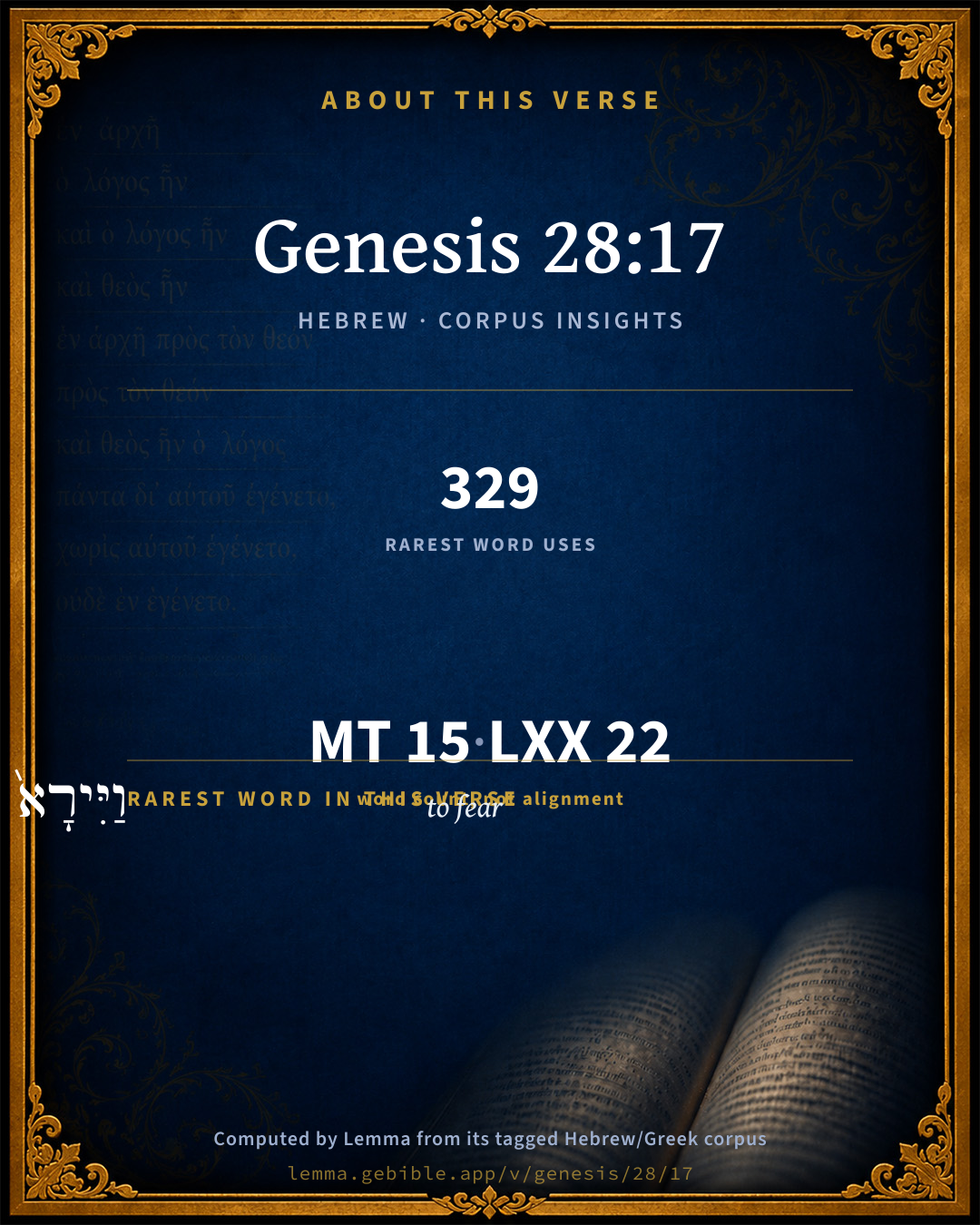
These counts appear in no published source. They are computed here, from the morphology-tagged text and Lemma’s own curated glosses. What Lemma adds →

15
words
12
distinct lemmas
Pentateuch
section

Grammatical profile

  • 3 verbs
  • 5 nouns
  • 3 pronouns
  • 2 conjunctions
  • 2 particles

Verb forms

  • וַיִּירָא֙ Qal · Sequential Imperfect
  • וַיֹּאמַ֔ר Qal · Sequential Imperfect
  • נּוֹרָ֖א Niphal · Participle Active

Repetition

Words recur within this verse — often emphatic in Hebrew:

  • וַיִּירָא֙ to fear H3372 ×2
  • הַזֶּ֑ה this H2088 ×3

Hebrew & Septuagint length

In English translation the verse runs 24 words from the Hebrew and 27 from the Septuagint (LXX English) — closely comparable.

A rough comparison of the two English renderings, which tokenize alike — not a word-level alignment.

Word counts can differ between the Hebrew and the Greek without any difference in meaning — e.g. the Hebrew direct-object marker אֵת has no separate Greek word, and Greek often adds the article ὁ.

In the original languages it is 15 Hebrew tokens and 22 Greek tokens — but the two are counted differently (Hebrew bundles its prefixes and suffixes into one token; the Greek is in lemma form), so that isn’t a like-for-like length.

Cross-references

13

Topical passages linked to Genesis 28:17 in the Treasury of Scripture Knowledge — connected by theme and wording, ordered by reader-vote popularity; previews shown in the World English Bible.

  • 1 Timothy 3:15 but if I wait long, that you may know how men ought to behave themselves in the house of God, which is the assembly of the living God, the pillar and ground of the truth.
  • Genesis 35:1–13 God said to Jacob, "Arise, go up to Bethel, and live there. Make there an altar to God, who appeared to you when you fled from the face of Esau your brother."
  • Exodus 3:6 Moreover he said, "I am the God of your father, the God of Abraham, the God of Isaac, and the God of Jacob." Moses hid his face; for he was afraid to look at God.
  • Ecclesiastes 5:1 Guard your steps when you go to God's house; for to draw near to listen is better than to give the sacrifice of fools, for they don't know that they do evil.
  • Genesis 28:22 then this stone, which I have set up for a pillar, will be God's house. Of all that you will give me I will surely give the tenth to you."
  • 2 Chronicles 5:14 so that the priests could not stand to minister by reason of the cloud: for the glory of Yahweh filled the house of God.
  • Judges 13:22 Manoah said to his wife, We shall surely die, because we have seen God.
  • Luke 2:9 Behold, an angel of the Lord stood by them, and the glory of the Lord shone around them, and they were terrified.
  • 1 Peter 4:17 For the time has come for judgment to begin at the house of God. If it begins first with us, what will happen to those who don't obey the Gospel of God?
  • Revelation 1:17 When I saw him, I fell at his feet like a dead man. He laid his right hand on me, saying, "Don't be afraid. I am the first and the last,
  • Hebrews 10:21 and having a great priest over the house of God,
  • Matthew 17:6 When the disciples heard it, they fell on their faces, and were very afraid.
  • Luke 8:35 People went out to see what had happened. They came to Jesus, and found the man from whom the demons had gone out, sitting at Jesus' feet, clothed and in his right mind; and they were afraid.

Cross-references courtesy of OpenBible.info (CC BY 4.0).

Hebrew and Greek witnesses Masoretic Hebrew ↔ Greek Septuagint

The same verse in the two great witnesses to the Old Testament, shown verse-for-verse.

These are two independent witnesses, not word-aligned to each other, and the Septuagint is shown in lemma (dictionary) form.

Hebrew Genesis 28:17 Masoretic · Westminster Leningrad Codex

וַיִּירָא֙ וַיֹּאמַ֔ר מַה נּוֹרָ֖א הַמָּק֣וֹם הַזֶּ֑ה אֵ֣ין זֶ֗ה כִּ֚י אִם בֵּ֣ית אֱלֹהִ֔ים וְזֶ֖ה שַׁ֥עַר הַשָּׁמָֽיִם

He was afraid, and said, "How dreadful is this place! This is none other than God's house, and this is the gate of heaven."

World English Bible · Public Domain

Greek LXX Genesis 28:17 Septuagint · lemma form

καί φοβέω καί εἶπον ὡς φοβερός ὁ τόπος οὗτος οὐ εἰμί οὗτος ἀλλά ἤ οἶκος θεός καί οὗτος ὁ πύλη ὁ οὐρανός

And he was afraid, and said, How fearful is this place! this is none other than the house of God, and this is the gate of heaven.

LXX2012 (modern English Septuagint) · Public Domain

On this verse, The Pulpit Commentary discusses the Septuagint’s reading. Read the note in Commentary ↓

Hebrew: Westminster Leningrad Codex (CC BY 4.0). Greek: Septuagint (public domain); English from LXX2012 (modern English Septuagint) (Public Domain). How the Septuagint differs from the Hebrew →

Targum (Aramaic paraphrase)

2

The Targum is the ancient Jewish Aramaic paraphrase of the Hebrew Scriptures — an interpretive translation, not the Hebrew text itself. Onkelos (literal) and Pseudo-Jonathan (expansive) render the Torah, and Jonathan the Prophets. Coverage is partial: where no permissively-licensed English translation exists for a verse, only the Aramaic is shown. This is verse-level text, not a word-by-word alignment to the Hebrew.

  1. Targum Onkelos Torah (Genesis–Deuteronomy)
    וּדְחִיל וַאֲמַר מָה דְחִילוּ אַתְרָא הָדֵין לֵית דֵּין אֲתַר הֶדְיוֹט אֶלָהֵין אֲתַר דְּרַעֲוָא בֵהּ מִן קֳדָם יְיָ וְדֵין תְּרַע קֳבֵל שְׁמַיָּא

    (no public-domain English translation for this verse)

    Targum Onkelos — Aramaic: “Onkelos Genesis” (public domain); “Onkelos Exodus” (public domain); “Onkelos Leviticus” (public domain); “Onkelos Numbers” (public domain); “Onkelos Deuteronomy” (public domain). English: “Sefaria Community Translation” (CC0 1.0 (public-domain dedication)); “J.W. Etheridge. The Targums of Onkelos and Jonathan Ben Uzziel on the Pentateuch. London: Longmans, Green, 1862” (public domain). Text via Sefaria.

  2. Targum Pseudo-Jonathan Torah (Genesis–Deuteronomy)
    וּדְחִיל וַאֲמַר מַה דָחִיל וּמְשַׁבַּח אַתְרָא הָדֵין לֵית דֵין אֲתַר חוֹל אֲרוּם אֱלָהֵן בֵּית מִקְדָשׁ לִשְׁמֵיהּ דַיְיָ וְדֵין כָּשַׁר לִצְלוֹ מְכֻוָון כָּל קְבֵיל תְּרַע שְׁמַיָא מְשַׁכְלַל תְּחוֹת כּוּרְסֵי יְקָרָא

    And he was afraid, and said, How dreadful and glorious is this place! This place is not common, but the sanctuary of the Name of the Lord, the proper spot for prayer, set forth before the gate of heaven and founded beneath the throne of glory.

    Targum Pseudo-Jonathan — Aramaic: “Targum Jonathan on Genesis” (public domain); “Targum Jonathan on Exodus” (public domain); “Targum Jonathan on Leviticus” (public domain); “Targum Jonathan on Numbers” (public domain); “Targum Jonathan on Deuteronomy” (public domain). English: “The Targum of Jonathan ben Uzziel, trans. J. W. Etheridge, London, 1862” (public domain). Text via Sefaria.

Commentary

Notes on Genesis 28:17 from classic Christian and Jewish commentators (each source and its license shown beneath its notes). The classic Christian expositions comment on the surrounding passage and are grouped to its opening verse, so a note may address several verses; the Jewish commentaries on the Tanakh (Rashi and others) are per-verse, so they appear only where the commentator wrote on this verse.

Lemma curates 59 commentaries, every one of them public domain or Creative Commons licensed, each selected and text-cleaned for this edition rather than reprinted as found. About our sources →

Trapp's Complete Commentary

John Trapp

Gen 28:17 And he was afraid, and said, How dreadful [is] this place! this [is] none other but the house of God, and this [is] the gate of heaven.

Ver. 17. How dreadful is this place!] The place of God’s public worship is a place of angels and archangels, saith Chrysostom; {a} it is the kingdom of God; it is very heaven. What wonder, then, though Jacob be afraid, albeit he saw nothing but visions of love and mercy? "In thy fear will I worship toward thy holy temple," saith David. {Psa 5:7} The very Turk, when he comes into his temple, lays by all his state, and hath none to attend him all the while. Omnino opertet nos, orationis tempore, curiam intrare coelestem , saith St Bernard, {b} in qua Rex regum stellato sedet solio ,& c. Quanta ergo cum reverentia, quanto timore, quanta illuc humilitate accedere debet e palude sua procedens et repens vilis ranuncula ? Our addresses must be made unto God with the greatest reverence that is possible.

{a} Tοπος ‘Aγγελων και ‘Aρχαγγελων, Bασιλεια, Yεου, αυτος ο ουρανος.

{b} Bern., De Divers., 25.

John Trapp, A Commentary or Exposition upon All the Books of the Old and New Testament (1647–1656) — public domain. Text from a community e-Sword module.

The Biblical Illustrator

Joseph S. Exell

Gen_28:17

How dreadful is this place I this is none other but the house of God, and this is the gate of heaven

Reverential awe

I.

It must have been the freshness of Jacobs sense of recent sin that made a spot so peaceful and so blessed seem to him a dreadful place. Everything takes its character from the conscience. Even a Bethel was awful, and the ladder of angels terrible, to a man who had just been deceiving his father and robbing his brother. The gates of our heaven are the places of our dread.

II. Strange and paradoxical as is this union of the sense of beauty, holiness, and fear, there are seasons in every mans life when it is the sign of a right state of mind. There is a shudder at sanctity which is a true mark of life. The danger of the want of reverence is far greater than the peril of its excess. Very few, in these light and levelling days, are too reverent. The characteristic of its age is the absence.

III. Our churches stand among us to teach reverence. There are degrees of Gods presence. He fills all space, but in certain spots He gives Himself or reveals Himself, and therefore we say He is there more than in other places. A church is such a place. To those who use it rightly it may be a gate of heaven. (J. Vaughan, M. A.)

The gate of heaven

I. GODS HOUSE IS ALWAYS WHERE THE LORDS PRESENCE IS.

1. No forms whatsoever for church organization, or Sunday service, are given in the Bible.

2. Out-of-the-way places, unusual times, and unexpected assemblages of people, have been often chosen for extraordinary manifestations of the Lords presence.

3. The Head of the Church has given blessings to all Christians alike, of every name, when they have fully kept His covenant.

II. THE LORDS PRESENCE IN GODS HOUSE MAKES IT TO BE THE GATE OF HEAVEN.

1. The figure used. Importance of gates to Eastern cities.

2. The Lords presence, so near, so splendid, so significant, made Jacob seem to himself to be at the very portal of the celestial city.

Practical thoughts:

1. Learn to prize church privileges.

2. Honour the Fourth Commandment.

3. Have done with jargon--sectarian clash and presumption.

4. Do not make the Lords house the gate of hell. Gods mercy never leaves a man where it found him. (C. S. Robinson, D. D.)

The house of God and the gate of heaven

I. THE PLACE HERE SPECIFIED.

1. It was a place distinguished by favourable circumstances.

2. It was a place of sacred instruction.

(1) Jacob was instructed by what God here exhibited to his view. This ladder represented--

(a) the mediation of Christ;

(b) the Providence of God;

(c) the ministry of angels.

(2) Jacob was also instructed by what God said to him.

3. This was a place of covenant engagement between God and man.

II. THE NAMES GIVEN TO IT.

1. The house of God.

(1) In every such place Gods family are associated in one community.

(2) In every such place God is actually present.

(3) In every such place Gods favours are obtained by devout seekers (Luk_11:9-10).

2. None other but the house of God.

(1) Not the house of amusement.

(2) Not the house of merchandise.

(3) Not the house of iniquity.

3. The gate of heaven.

III. THE REFLECTIONS SUGGESTED BY IT. How dreadful is this place! The worship of God should be attended with habitual seriousness.

1. With serious consideration.

2. With serious watchfulness against all distractions.

3. With serious concern to obtain present blessings from God.

4. With serious intercession in behalf of others.

5. With serious gratitude for favours received. (Sketches of Sermons.)

Moral aspect of the world

The world itself is a dreadful place.

I. Because the visible things that are made display an eternal power and Godhead.

II. Because the world evidences a design rising above, and superior to, the exhibition of a power capable of producing a mere physical universe.

III. Because of its occupancy by an intellectual being. Intellect employs itself in a variety of ways, but these may all be classed under--

1. Regard of the external or physical world.

2. The intellectual or spiritual.

3. The author of both. Under one of these may be placed all the subjects which have engaged man from the commencement of the world.

IV. Because man is a moral being. I cannot think of an intellectual being as other than a moral one, because I cannot well conceive how a mind free and unconstrained can, while investigating the works of God, fail to have awakened some of those moral views and feelings, which to any mind are the legitimate concomitants. I have therefore adopted the distinction merely for the sake of the different position from which it enables us to regard man.

V. Because man is a fallen being.

VI. Because of the forbearance of God and mans consequent increased criminality.

VII. Because of Gods amazing condescension in seeking mans restoration.

VIII. Because of the enormous expense at which the means of reconciliation were secured.

IX. Because of the awful consequences resulting from the neglect of these means. (F. Wright.)

Places of worship

I. IN WHAT LIGHT ARE WE TO VIEW PLACES OF WORSHIP?

1. The house of God.

(1) It originates with God.

(2) It is the place where God chooses peculiarly to dwell.

(3) It is the grand repository of Gods eternal truth.

(4) It is the theatre of Gods greatest wonders.

(5) It is the scene of Gods richest mercies and greatest blessings.

(6) It is most honourable to God.

2. The gate of heaven. It may be called so--

(1) Because it is ordinarily in places of worship, and in hearing the gospel, that men begin to think about God and saving their souls.

(2) Because it is there men enter actually on the way to heaven.

(3) Because it is there both worlds meet. In old times all meetings were held at the gates of the cities. And the house of God is the gate of heaven, the meeting place, the assembly of all the spiritual beings in existence.

3. It is said, This is none other than the house of God. And I trust this house never will be for any other purpose. I never like to see a place of worship turned to any other use, except it be for a school, for a place of instruction, or for something analogous to a place of worship.

II. WHAT OUGHT TO BE OUR SENTIMENTS AND FEELINGS AS TO THE HOUSE OF GOD--AS TO A PLACE OF WORSHIP.

1. We should reverence it. So did Jacob. How dreadful, said he, is this place! The Hebrew is, How solemn--how reverential is this place! I never like to see people enter a place of worship heedlessly, lightly, merrily.

2. We should delight to go up to the house of God.

3. We should come full of expectation. The house of God is the scene of mercy, the region of grace, the very element of salvation.

4. We should endeavour, by every means, to support places of worship to the best of our ability. (John Stephens.)

Public worship: how it is, and how it ought to be, attended

I. How DO PERSONS USUALLY ATTEND THE HOUSE OF GOD?

1. Thoughtlessly.

(1) Without sober and becoming thoughts of the great and glorious object of all religious homage and adoration.

(2) Ignorant of their spiritual necessities.

2. Prayerlessly.

3. Faithlessly.

II. How OUGHT PEOPLE TO COME THITHER?

1. With thought.

2. With prayer.

3. With faith.

It is as faith is in lively and vigorous exercise that God is apprehended and felt to be really present. It is by faith we embrace the proffered mercies of the gospel. Concluding remarks:

1. See the true reason why many profit so little from their means of grace.

2. How abundantly you might profit by a more thoughtful, prayerful, and faithful use of your means. (W. Mudge, B. A.)

Gods home, heavens gate

There are four particular remarks which we have to make upon these words.

1. First, we observe from them that intercourse with God, instead of producing levity of mind, produces serious impressions. The man who was not at all afraid to lie down in this place, surrounded with danger and enveloped in darkness, is filled with fear in the morning. At what? At the thought of a present Deity. Not that this was a slavish dread, like that which Belshazzar felt when he saw the handwriting upon the wall, and his countenance was changed in him, and the joints of his loins were loosed, and his knees smote together; but he was filled with what the apostle calls reverence or godly fear. Such the seraphim know--they cover their faces when they appear before God. Such Isaiah knew when he said, Woe is me, for I am undone; because I am a man of unclean lips, and I dwell in the midst of a people of unclean lips; for mine eyes have seen the King, the Lord of Hosts! Such Peter felt when he said, Depart from me, for I am a sinful man, O Lord. Such Job felt when he said, I heard of Thee by the hearing of the ear, but now mine eye seeth Thee; wherefore I abhor myself, and repent in dust and in ashes.

2. Secondly, we observe from these words, that wherever God meets with His people, that place may be deservedly considered His house. How does this condemn bigotry! How seldom does God receive anything more than lip service and formality from those whose attachment to any particular place or usages induces them to say, The temple of the Lord, the temple of the Lord, the temple of the Lord are we. Nothing makes a people dear to God but their conformity to Him; and nothing makes a place of worship sacred but the Divine presence.

3. The experience of Christians sometimes approximates towards heaven. Therefore said Jacob--not only, this is the house of God, but--this is the gate of heaven. There was nothing that was outwardly inviting; but oh, that land, the angels ascending and descending!--oh, his God above, standing, and looking down, and addressing him!--oh, such scenery!--oh, such language!--oh, such communion made Jacob think that, though he saw from the place it was not heaven, heaven could not be far off.

4. Lastly, the house of God and the gate of heaven are related; there Jacob mentions them together, and mentions them in their proper order--this is the house of God--this is the gate of heaven. The one precedes the other--the one affords us the earnest and foretaste of the other. Philip Henrywas accustomed to say at the close of his sabbath-days exercises, Well, if this be not heaven, it is the way to it. Those who call the sabbath a delight, the holy of the Lord, will enjoy an eternal sabbath. They who can now say, I have loved the habitation of Thy house, and the place where Thine honour dwelleth, shall serve Him day and night in His temple above, never more to go out. (W. Jay.)

Beautiful doors

Michael Angelo Buonar-rotti said of the doors of the Baptistery at Florence, executed by Lorenzo Ghiberti, when asked what he thought of them, They are so beautiful that they might stand at the gates of paradise. (Old Testament Anecdotes.)

Entrance to heaven

Al Strut is a bridge extending from this world to the next, over the abyss of hell, which must be passed by every one who would enter the Mohammedan paradise. It is very narrow, the breadth being less than the thread of the famished spider, according to some writers; others compare it to the edge of a sword or of a razor. The deceased cross with a rapidity proportioned to their virtue. Some pass with the rapidity of lightning; others with the speed of a horse at full gallop; others still slower, on account of the weight of their sins; and many fall down from it, and are precipitated into hell. (Wheeler.)

Astronomical heavens

There is a saying of Hazlitts, bold, and at first seeming wondrous true: In the days of Jacob there was a ladder between heaven and earth; but now the heavens have gone farther off, and have become astronomical. (George Dawson.)

The Biblical Illustrator, edited by Joseph S. Exell (c. 1880s–1900s) — public domain. Text from a community e-Sword module.

Joseph Benson's Commentary

Gen 28:17. He was afraid — So far was he from being puffed up with this divine vision. The more we see of God, the more cause we see for holy fear and blushing before him. Those to whom God is pleased to manifest himself, are laid and kept very low in their own eyes, and see cause to fear even “the Lord and his goodness,” Hos 3:5. And said, How dreadful is this place! — That is, the appearance of God in this place is never to be thought of but with a holy awe and reverence; I shall have a respect for this place, and remember it by this token as long as I live. Not that he thought the place itself any nearer the divine visions than any other place; but what he saw there at this time was, as it were, “the house of God,” the residence of the Divine Majesty, and “the gate of heaven,” that is, the general rendezvous of the inhabitants of the upper world, as the meetings of a city were in their gates; or, the angels ascending and descending, were like travellers passing and repassing through the gates of a city.

Joseph Benson's Commentary on the Old and New Testaments (1811–1818) — public domain. Text from a community e-Sword module.

Geneva Bible (1599)

Geneva Bible translators

He was touched with a godly fear and reverence.

Geneva Bible (1599) marginal notes — public domain. Text via Bolls.life.

Adam Clarke's Commentary

Verse 17. How dreadful is this place!] The appearance of the ladder, the angels, and the Divine glory at the top of the ladder, must have left deep, solemn, and even awful impressions on the mind of Jacob; and hence the exclamation in the text, How dreadful is this place!

This is none other but the house of God] The Chaldee gives this place a curious turn: "This is not a common place, but a place in which God delights; and opposite to this place is the gate of heaven." Onkelos seems to suppose that the gate or entrance into heaven was actually above this spot, and that when the angels of God descended to earth, they came through that opening into this place, and returned by the same way. And it really appears that Jacob himself had a similar notion.

Adam Clarke's Commentary on the Bible (1810–1826) — public domain. Text from a community e-Sword/MySword module.

John Calvin's Commentaries

17. And he was afraid, and said. It seems surprising that Jacob should fear, when God spoke so graciously to him; or that he should call that place “dreadful,” where he had been filled with incredible joy. I answer, although God exhilarates his servants, he at the same time inspires them with fear, in order that they may learn, with true humility and self-denial, to embrace his mercy. We are not therefore to understand that Jacob was struck with terror, as reprobates are, as soon as God shows himself; but he was inspired with a fear which produces pious submission. He also properly calls that place the gate of heaven, on account of the manifestation of God: for, because God is placed in heaven as on his royal throne, Jacob truly declares that, in seeing God, he had penetrated into heaven. In this sense the preaching of the gospel is called the kingdom of heaven, and the sacraments may be called the gate of heaven, because they admit us into the presence of God. The Papists, however, foolishly misapply this passage to their temples, as if God dwelt in filthy places. But if we concede, that the places which they designate by this title, are not polluted with impious superstitions, yet this honor belongs to no peculiar place, since Christ has filled the whole world with the presence of his Deity. Those helps to faith only, (as I have before taught,) by which God raises us to himself, can be called the gates of heaven.

John Calvin's Commentaries (1540-1563) — public domain. Text from the Calvin Translation Society English edition (1840s-50s) via the Christian Classics Ethereal Library (ccel.org). Calvin's coverage is partial (roughly two-thirds of the Bible); uncommented books and verses are honest gaps, never fabricated. The 19th-century editor's footnotes and remarks are omitted so the notes are faithfully Calvin's own voice.

Ellicott's Commentary for English Readers

(17) How dreadful.—The manifestation of God must always inspire awe and dread, but not fear: for where He reveals Himself, there is “the gate of heaven”—the appointed entrance for prayer now, and for admission to the glorified life hereafter.

A Bible Commentary for English Readers, edited by Charles John Ellicott (1878–1897) — public domain. Text from a community e-Sword module.

The Cambridge Bible for Schools and Colleges

gen. ed. J. J. S. Perowne

17. How dreadful] This adjective is rendered unsuitable by colloquial usage. The sense would be better given by “awesome” or “terrible.” Jacob believes that he has been in the presence of Jehovah and of the heavenly host. The belief that those who saw “the angel of the Lord” face to face would die is expressed in the terror of Jacob. Cf. Jdg_6:22-23; Jdg_13:21-22.

the house of God] Heb. bêth Elohim, i.e. “a dwelling-place of the Divine Being.” This clause contains the popular etymology of the name Bethel.

The Cambridge Bible for Schools and Colleges (gen. ed. J. J. S. Perowne; Cambridge University Press, 1878–1918) — public domain. Text from a community e-Sword module.

John Gill's Exposition

And he was afraid,.... Not with a servile but filial fear; not with a fear of the wrath and displeasure of God, but with a fear of his grace and goodness; not with a fear of distrust of it, of which he had just had such a comfortable assurance; but with an awe of the greatness and glory of God, being conscious of his own unworthiness to receive such favours from him:

and said, how dreadful is this place! not terrible and horrible, being not like Mount Sinai, but like Sion; not as the suburbs of hell, but as the gate of heaven majestic and venerable, because of the glory of God that appeared in it, whose name is holy and reverend and because of the holy angels here present: and so the church, of which this was an emblem, is a solemn assembly, awful and venerable; a city of solemnities, because of the worship of God in it, and his presence there; who is to be feared in the assembly of his saints, and to be had in reverence of all that are about him; and where persons should behave in a serious and solemn manner. The Targum of Jonathan is,"how tremendous and praiseworthy is this place! this is not a common place:"

this is none other but the house of God; wherefore he afterwards called it Bethel, which signifies the house of God; and so the church of God is often called, Psa 23:6; which is of God's building, where he dwells, and his family is, of which he is the master and governor; which he beautifies and adorns, fills, repairs, and defends:

and this is the gate of heaven: Mr. Mede renders it "the court of heaven", because of the angels; since in gates justice was administered by kings, attended with their retinue; but royal courts were not kept there, only courts of judicature: this place seems to be so called, because the heavens were opened and the glory of God was seen, attended by his angels, who were passing and repassing, as people through the streets of a city; and was an emblem of the church of Christ, who is figured by the ladder set on earth, whose top reached to heaven, the door, the gate, the way of ascent to it; here he is preached in the word as the way of salvation, the way to heaven and eternal happiness; here he is held forth in the ordinances; here he grants his presence to his people, and indulges them with communion with him, which makes it like and next to heaven unto them: and, generally speaking, though not always, God brings his people to heaven this way, through a Gospel church state, and by means of the word and ordinances; and here angels also attend, Co1 11:10.

John Gill's Exposition of the Whole Bible (1746–1763) — public domain (CC PDM 1.0). Text via the HelloAO Bible API.

Matthew Poole's English Annotations

How dreadful is this place, or venerable, both for the majesty of the Person present, and for the glorious manner of his discovery of himself!

The house of God; the habitation of God and of his holy angels.

Matthew Poole's English Annotations on the Holy Bible (1683–1685) — public domain. Text from a community e-Sword/MySword module.

Whedon's Commentary on the Bible

Daniel D. Whedon

17. House of God… gate of heaven — This thought thrills him with a sense of terror. So far from being away from house and friends and care, behold, he is in God’s house, and the very gates of heaven have been opened to his eye.

Daniel D. Whedon (gen. ed.), Commentary on the Old and New Testaments (1874–1909) — public domain. Text from a community e-Sword module.

The Pulpit Commentary

And he was afraid, so were Moses, (Exo_20:18, Exo_20:19) Job, (Gen_42:5, Gen_42:6) Isaiah, (Gen_6:5) Peter, (Luk_5:8) John, (Rev_1:17, Rev_1:18) at similar discoveries of the Divine presenceand said, How dreadful is this place!i.e. how to be feared! how awe-inspiring! foberov (LXX), terribilis (Vulgate)this is none other but the house of God, and this is the gate of heaven. Not literally, but figuratively, the place where God dwells, and the entrance to his glorious abode (Keil); the idea that Jacob was made aware by the dream that he had slept on one of those favored spots singled out for a future sanctuary, and was fearful that he had sinned by employing it for a profane purpose" (Kalisch), being fanciful.

The Pulpit Commentary (1880–1919), ed. H.D.M. Spence-Jones & Joseph S. Exell — public domain. Text from a community e-Sword module.

John Wesley's Explanatory Notes

He was afraid - So far was he from being puffed up. The more we see of God, the more cause we see for holy trembling and blushing before him. Those whom God is pleased to manifest himself to, are laid and kept very low in their own eyes, and see cause to fear even the Lord and his goodness, Hosea iii, 5. And said, How dreadful is this place! - That is, the appearance of God in this place is to be thought of, but with a holy awe and reverence; I shall have a respect for this place, and remember it by this token as long as I live. Not that he thought the place itself any nearer the divine visions than any other places; but what he saw there at this time was, as it were, the house of God, the residence of the Divine Majesty, and the gate of heaven, that is, the general rendezvous of the inhabitants of the upper world; as the meetings of a city were in their gates; or, the angels ascending and descending were like travelers passing and repassing through the gates of a city.

John Wesley, Explanatory Notes Upon the Whole Bible (1754–1765) — public domain. Text via the GEBible commentary corpus.

Rashi

Rabbi Shlomo Yitzchaki (Rashi)

כי אם בית אלהים THIS IS NONE OTHER THAN THE HOUSE OF GOD —R. Eleazar said in the name of R. José the son of Zimra: “This ladder stood in Beersheba and [the middle of]) its slope reached opposite the Temple” (Genesis Rabbah 69:7). For Beersheba is situated in the South of Judah, Jerusalem in the North of it on the boundary between Judah and Benjamin and Bethel in the North of Benjamin’s territory, on the border between the land of Benjamin and that of the children of Joseph. It follows, therefore, that a ladder whose foot is in Beersheba and whose top is in Bethel has the middle of its slope reaching opposite Jerusalem. Now as regards what our Rabbis stated (Chullin 91b) that the Holy One, blessed be He, said, “This righteous man has came to the place where I dwell (i.e., the Temple at Jerusalem, whilst from here it is evident that he had come to Luz) and shall he depart without staying here over night?”, and with regard to what they also said, (Pesachim 88a) “Jacob gave the name Bethel to Jerusalem”, whereas this place which he called Bethel was Luz and not Jerusalem, whence did they learn to make this statement (which implies that Luz is identical with Jerusalem)? I say that Mount Moriah was forcibly removed from its locality and came hither (to Luz), and that this is what is meant by the “shrinking” of the ground that is mentioned in the Treatise (Chullin 91b) — that the site of the Temple came towards him (Jacob) as far as Bethel and this too is what is meant by ויפגע במקום, “he lighted upon the place” (i.e., he “met” the place, as two people meet who are moving towards each other; cf. Rashi on Genesis 5:11). Now, since Jacob’s route must have been from Beersheba to Jerusalem and thence to Luz and Haran and consequently when he reached Luz he had passed Jerusalem, if you should ask, “When Jacob passed the Temple why did He not make him stop there?” — If it never entered his mind to pray at the spot where his fathers had prayed should Heaven force him to stop there to do so? Really he had reached as far as Haran as we say in the Chapter גיד הנשה (Chullin 91b), and Scripture itself proves this since it states, “And he went to Haran”. When he arrived at Haran he said, “Is it possible that I have passed the place where my fathers prayed without myself praying there?” He decided to return and got as far as Bethel where the ground "shrank” for him. This Bethel is not the Bethel that is near Ai (cf. Genesis 12:8) but that which is near Jerusalem, and because he said of it, “It shall be the House of God”, he called it Bethel. This, too, is Mount Moriah, where Abraham prayed, and it is also the field in which Isaac offered prayer as it is written, “[Isaac went out] to meditate (i. e., to pray; cf. Genesis 24:63) in the field”. Thus, too, do we read in the Treatise (Pesachim 88a) in a comment on the verse Micah 4:2: “[O come ye and let us go up] to the mountain of the Lord (i.e. the mountain upon which the Temple is built) and to the house of the God of Jacob”. What particular reason is there for mentioning Jacob? But the text calls the Temple not as Abraham did who called it a mount, and not as Isaac did, who called it a field, but as Jacob did who called it Beth[el]—the House of God. (To here from “This Bethel” is to be found in a certain correct Rashi-text)

מה נורא HOW FEARFUL — In the Targum it is translated by “How דחילו is this place!” דחילו is a noun, like סוכלתנו which is the Targum of תבונה “understanding” (Deuteronomy 32:28), and [וכסו [למלבש which is the Targum of ובגד ללבש “and raiment to put on”) (Genesis 28:20)

וזה שער השמים AND THIS IS THE GATE OF HEAVEN — a place of prayer where their prayers would ascend to heaven (Pirkei DeRabbi Eliezer 35). The Midrash states (Genesis Rabbah 69:7) that the Heavenly Temple is situated immediately opposite the Earthly Temple (so that the Temple at Jerusalem-Bethel may be styled “the gate” to the Heavenly Temple)

Rashi on the Tanakh — English translations: “The Judaica Press complete Tanach with Rashi, translated by A. J. Rosenberg” (CC BY 4.0); “Pentateuch with Rashi's commentary by M. Rosenbaum and A.M. Silbermann, 1929-1934” (public domain); “The Metsudah Tanach series, Lakewood, N.J” (CC BY 4.0); and “The Book of Joshua, Metsudah Publications, 1997” (CC BY 4.0). Text via Sefaria.

Ramban (Nachmanides)

Rabbi Moshe ben Nachman (Ramban / Nachmanides)

THIS IS NONE OTHER THAN THE HOUSE OF G-D, AND THIS IS THE GATE OF HEAVEN. This refers to the Sanctuary which is the gate through which the prayers and sacrifices ascend to heaven.Rashi comments, Rabbi Elazar the son of Rabbi Yosei the son of Zimra said, ‘This ladder stood in Beer-sheba and its slope reached unto the Sanctuary in Jerusalem. Beer-sheba is situated in the southern part of Judah, and Jerusalem is to its north on the boundary between Judah and Benjamin, and Beth-el was in the northern portion of Benjamin’s territory, on the boundary between Benjamin’s territory and that of the children of Joseph. It follows, therefore, that a ladder whose base is in Beer-sheba and whose top is in Beth-el has its slope reaching opposite Jerusalem. Now regarding the statement of our Rabbis that the Holy One, blessed be He, said, ‘This righteous man has come to the place where I dwell, [namely, the Sanctuary in Jerusalem, and shall he depart without spending the night?’], and with regard to what they also said, ‘Jacob gave the name Beth-el to Jerusalem’ this place which he called Beth-el was Luz and not Jerusalem! And whence did they learn to say so, [implying that Luz is identical with Jerusalem]? I therefore say that Mount Moriah [the Temple site in Jerusalem] was forcibly removed from its place and came here to Luz, and this movement of the Temple site is ‘the springing of the earth’ which is mentioned in Tractate Shechitath Chullin. It means that the site on which the Sanctuary was later to stand came towards Jacob to Beth-el. And this too is what is meant by vayiphga bamakom (and he met the place): [as two people meet, who are moving towards each other]. If you should ask, ‘When our father Jacob passed the site of the Sanctuary [on his way from Beer-sheba to Haran] why did He not detain him there?’ The answer is: If it never entered his mind to pray at the place where his fathers had prayed, should Heaven make him stop there? He had journeyed as far as Haran, as we say in the chapter of Gid Hanasheh, and Scripture itself helps us clarify this point by saying, And he went to Haran. When he arrived at Haran he said, ‘Is it possible that I have passed the place where my fathers prayed without praying there myself?’ He decided to return and had returned as far as Beth-el, whereupon the ground of the Temple site sprang for him until Beth-el.”All these are the words of the Rabbi.. But I do not agree with them at all for ‘the springing of the earth’ which the Rabbis mention in connection with Jacob is like that which they have said happened to Eliezer, the servant of Abraham, namely, that he reached Haran in one day. As they have said in Tractate Sanhedrin, “The earth sprang for three persons: Eliezer, the servant of Abraham, our father Jacob, and Abishai the son of Zeruiah.” And the Rabbis explained: “Eliezer, the servant of Abraham — for it is written, And I came this day unto the fountain, which teaches that on that very day he embarked on his journey. Jacob — for it is written, And he met the place. When he arrived at Haran he said, ‘Is it possible that I have passed the place where my fathers prayed without praying there myself?’ As soon as the thought of returning occurred to him, the earth sprang for him, and immediately he met the place.” Thus the Rabbis explicitly say that as soon as the thought to return occurred to him in Haran, the earth sprang for him and he met the place where his fathers prayed, but not that he returned to Beth-el, nor that Mount Moriah sprang and came there to Beth-el. In Bereshith Rabbah the Rabbis further equated them both [Eliezer and Jacob] with respect to “the springing of the earth.” Thus they said: “And he arose, and went to Aram-naharaim — on the very same day. And I came this day unto the fountain — this day I embarked on the journey, and this day I arrived.” With respect to Jacob the Rabbis interpreted in a similar vein: “And he went to Haran — the Rabbis say on the very same day.” And furthermore, what reason is there for Mount Moriah to “spring” and come to Beth-el, as Rashi claims, after Jacob had troubled himself to return from Haran to Beth-el, a journey of many days? Moreover, Beth-el does not lie on the border of the Land of Israel which faces towards Haran for Haran is a land which lies to the east [of the Land of Israel while Beth-el lies in its western part]. Additionally, the middle part of a ladder is not referred to as its “slope.” And, finally, what reason is there for the middle of the ladder to be opposite Beth-el, [where, according to Rashi, the side of the Sanctuary had been transported], when the middle part of an object does not possess significance beyond that of its whole?There is, however, another intent to these Midrashim. The Rabbis have said in Bereshith Rabbah, “Rabbi Hoshayah said, ‘It has already been stated, And Jacob hearkened to his father and his mother, and was gone to Paddan-aram. What then does Scripture teach by repeating, And Jacob went out from Beer-sheba? Rather, the redundancy teaches us that Jacob said, “When my father desired to leave the Land of Israel, at what location did he seek permission for it? Was it not in Beer-sheba? I, too, shall go to Beer-sheba to seek this permission. If He grants me permission, I shall leave, and if not, I shall not go.” Therefore Scripture found it necessary to state, And Jacob went out from Beer-sheba.’” The intent of this Midrash is that the Rabbis were of the opinion that Jacob was blessed by his father in Hebron, the land of his father’s sojournings, and it was to Hebron that he came when he returned to his father from Paddan-aram, as it is said, And Jacob came unto Isaac his father to Mamre, to Kiriath-arba — the same is Hebron — where Abraham and Isaac sojourned. Now if so, the verse stating, And Jacob went out from Beer-sheba teaches that when his father commanded him to go to Laban he went to Beer-sheba to receive Divine permission, and that is the place wherein he spent the night and saw visions of G-d, and it was there that He gave him permission to exit from the Land of Israel, even as He said, And I will keep thee wherever thou goest and will bring thee back unto this land. And the ladder which he saw, in the opinion of Rabbi Yosei the son of Zimra, he saw with its feet in Beer-sheba, in the very place where he lay, and with the end of its slope which is the top of the ladder reaching to a point opposite the Sanctuary. It was supported by heaven at the gate through which the angels enter and exit. The revered G-d stood over him, and therefore he knew that Beer-sheba was the gate of heaven, suitable for prayer, and the Sanctuary was the house of G-d. And in the morning Jacob continued his journey from Beer-sheba and arrived at Haran on the same day, and this was “the springing of the earth” mentioned with respect to Jacob.This is the opinion of Rabbi Yosei the son of Zimra who said in Bereshith Rabbah, “This ladder stood in Beer-sheba and its slope reached to the Sanctuary, as it is said, And Jacob went out from Beer-sheba; And he was afraid and said, How fearful is this place.” And the stone which he erected as a pillar he did not erect in the place where he slept, for Beer-sheba is not Beth-el and it was in Beth-el that he erected it, and there he went upon his return from Paddan-aram, as it is said, Arise, go up to Beth-el … and make there an altar unto G-d who appeared unto thee, etc. But he erected it [after carrying the stone from Beth-el to Jerusalem] opposite the slope, at the place where the head of the ladder stood, which he had called the house of G-d, and this is the city which had previously been called Luz. Thus in the opinion of Rabbi Yosei the son of Zimra, Luz was Jerusalem which Jacob called Beth-el. Possibly this may be so, according to the verses in the book of Joshua. It is certainly true that it is not the Beth-el near Ai for that Beth-el was originally so named in the days of Abraham and prior to that.But Rabbi Yehudah the son of Rabbi Shimon differs there with Rabbi Yosei the son of Zimra, and he says: “This ladder stood upon the Sanctuary site and its slope reached to Beth-el. What is his reason? And he was afraid, and said, etc. And he called the name of that place Beth-el.” Thus in the opinion of Rabbi Yehudah the son of Rabbi Shimon the verse stating, And he lighted upon the place, means Mount Moriah. And he tarried there all night, because the sun was set for him not at its proper time [so that he should spend the night there], for as our Rabbis have stated: “[The Holy One, blessed be He, said], ‘This righteous man has come to the place where I dwell. Shall he then depart without staying there over night?’” And so Jacob saw the ladder with its feet standing in that place, and its slope, which is its top, reached to a point which was opposite that particular Beth-el [which was mentioned in connection with Ai during Abraham’s era], and that was the city of Luz. And Jacob said that the very place where he spent the night was the house of G-d, and the slope of the ladder was the gate of heaven, thus Mount Moriah is excellent for prayer, and Beth-el also is a suitable place for the worship of G-d. And he erected the pillar in Beth-el, for in the opinion of all Rabbis he erected it opposite the slope of the ladder.The opinion of Rabbi Yehudah the son of Rabbi Shimon, [i.e., that Jacob slept on Mount Moriah, and he erected the pillar in Beth-el], is in agreement with the Midrash in the Gemara of the chapter concerning Gid Hanasheh, and that of Chapter Cheleck, which states that Jacob left Beer-sheba and came to Haran, and when he reconsidered and decided to return and pray at Mount Moriah, the place where his fathers had prayed, then the earth “sprang” for him and he lighted immediately upon Mount Moriah. Perhaps it is the Rabbis’ opinion that the earth “sprang” for him both when going from Haran to Mount Moriah and when returning from Mount Moriah to Haran. This would be in agreement with the opinion of the Rabbi who says: “And he went to Haran — on the same day. And he lighted upon the place — at once, very suddenly.”I found it more explicitly in Pirkei Rabbi Eliezer Hagadol: “Jacob was seventy-seven years of age when he left his father’s house, and he followed the well that travelled before him from Beer-sheba to Mount Moriah, a two-day journey, and he arrived there at midday, etc. The Holy One, blessed be He, said to him, ‘Jacob, you have bread in your travelling-bag, the well is before you, enabling you to eat and drink and lie down in this place.’ Jacob replied, ‘Master of all worlds, the sun has yet to descend fifty stages, and shall I lie down to sleep in this place?’ Prematurely, the sun then set in the west. Jacob looked and saw that the sun had set in the west, so he tarried there all night, because the sun was set. Jacob took twelve stones from the stones of the altar upon which his father Isaac had lain bound as a sacrifice and put them under his head. By the fact that his resting-place contained twelve stones, G-d informed him that twelve tribes were destined to be established from him. But then all twelve stones were transformed into one stone to inform him that all twelve tribes were destined to become one nation in the earth, as it is said, And who is like Thy people, like Israel, a nation one in the earth? In the morning Jacob awoke with great fright, and said, ‘The house of the Holy One, blessed be He, is in this place,’ as it is said, And he was afraid, and said: How fearful is this place! From here you learn that whosoever prays in Jerusalem is considered as if he prayed before the Throne of Glory, for the gate of heaven is open there to receive the prayer of Israel, as it is said, And this is the gate of heaven. Jacob then wanted to collect the stones [which he had used as a resting-place for his head in order to build an altar], but he found them all to be one stone, and so he set it up as a pillar in that place. Thereupon oil flowed down for him from heaven, and he poured it on top of the stone, as it is said, And he poured oil upon the top of it. What did the Holy One, blessed be He, do? With His right foot He sank the anointed stone unto the depths of the abyss to serve as the key-stone of the earth, just as one inserts a key-stone in an arch. It is for this reason that it is called Even Hashethiyah (The Foundation Stone), for there is the center of the earth, and from there the earth unfolded, and upon it stands the Temple of G-d, as it is said, And this stone, which I have set up for a pillar, shall be G-d’s house. the Temple of G-d” — may either be a reference to the remains of the ancient Sanctuary and its environs, which were still visible in the days when the Pirkei d’Rabbi Eliezer was composed, or it may preferably indicate that although the Temple is now in ruins the place thereof is still deemed sacred as in the days when the House of G-d was firmly established on the sacred mountain. From there he [Jacob] went on his journey, and in the twinkling of an eye he arrived in Haran.” Thus far [extends the quotation from the Pirkei Rabbi Eliezer Hagadol].Thus, all Midrashim — despite some minor differences among them — acknowledge that “the springing of the earth” occurred to Jacob through which he travelled a journey of many days in the twinkling of an eye. It is possible that all Midrashim concede to one another, and that on all these journeys of his — when going from Beer-sheba to Haran, when he desired to return to Mount Moriah, and when he left there to go to Haran — the earth “sprang” for him. But there is not one of all these Midrashim which says, as Rashi said, [that Mount Moriah was forcibly removed from its location and was transported to meet him in Beth-el].

Ramban (Nachmanides) on the Tanakh — English translation: “Commentary on the Torah by Ramban (Nachmanides). Translated and annotated by Charles B. Chavel. New York, Shilo Pub. House, 1971-1976” (CC BY 4.0). Text via Sefaria.

Sforno

Rabbi Ovadia Sforno

He was afraid. Because of the disrespect he had inadvertently shown by sleeping there.

This is none other. The place that he saw in his dream was the site designated for the Beis Hamikdosh.

The gate. The ladder signified that it was from that place that prayers ascend to heaven.

Sforno on the Tanakh — English translation: “Yalkut, Sifsei Chachomim Chumash, Metsudah Publications, 2009” (CC BY 4.0). Text via Sefaria.

Radak

Rabbi David Kimhi (Radak)

ויירא ויאמר, he was concerned for himself fearing that he might have done something which one is not allowed to do in a holy place. Perhaps while he had been asleep and unable to control his movements, he had behaved in a manner unbefitting such a sacred location.

ויאמר מה נורא המקום הזה, since he had seen an awe-inspiring vision here he concluded that the whole place may have been an awesome place, not to be approached except in a state of ritual purity.

אין זה כי אם בית אלוקים, this place is suitable only for becoming a House of G’d, a temple of sorts. a place wherein to pray and to offer sacrifices to G’d. Another explanation of Yaakov’s exclamation could be that he concluded that the only reason he had been shown the vision was to stimulate him to erect a House of G’d there.

וזה שער השמים, an expression analogous to Chronicles II 30,27 ותבא תפלתם למעון קדשו לשמים, “their prayer reached the residence of His Holiness, to heaven.”

Radak on the Tanakh — English translations: “Sefaria Community Translation” (CC0 1.0 (public-domain dedication)); “Eliyahu Munk, HaChut Hameshulash” (CC BY 4.0); “Rabbi Mike Feuer, Jerusalem Anthology” (CC BY 4.0); and “R. David Kimhi on the first book of Psalms, Translated by R.G. Finch, London, 1919” (public domain). Text via Sefaria.

Lesson kit

Teaching starters — assembled from the data on this page, not authored interpretation. Every prompt links to the verse data it draws on. Edit before teaching.

Genesis, in the Pentateuch, opens this verse with 15 words (12 distinct Hebrew lemmas). Its most distinctive word is yârêʼ (“to fear”). A historical commentator’s framing appears above. Read the whole chapter for the surrounding context.

Discussion questions

  1. How does “to fear” (yârêʼ) shape what this verse is saying?
  2. 1 Timothy 3:15 shares this passage’s theme. How do the two illuminate each other?
  3. “to fear” occurs 2× in this one verse. What is the effect of the repetition?
  4. These translations render this verse differently; the difference is in the English rendering, not the original. What questions does that raise?
  5. The verb «וַיִּירָא֙» is Qal Sequential Imperfect. How does its form color the action?
  6. Reading how Trapp's Complete Commentary and The Biblical Illustrator read this verse, where do the two commentators agree and where do they part?

Things to notice

Reading settings

Reading text

Shown beneath each verse's original-language words.

Old Testament
Old Testament edition

Read the OT as the Masoretic Hebrew (MT) or the Greek Septuagint (LXX).

English shown for the Greek Septuagint (in the Hebrew ↔ Greek comparison).

Comparing translations? Open the Compare panel on any verse page to stack up to four side by side.