1 Samuel 14:26

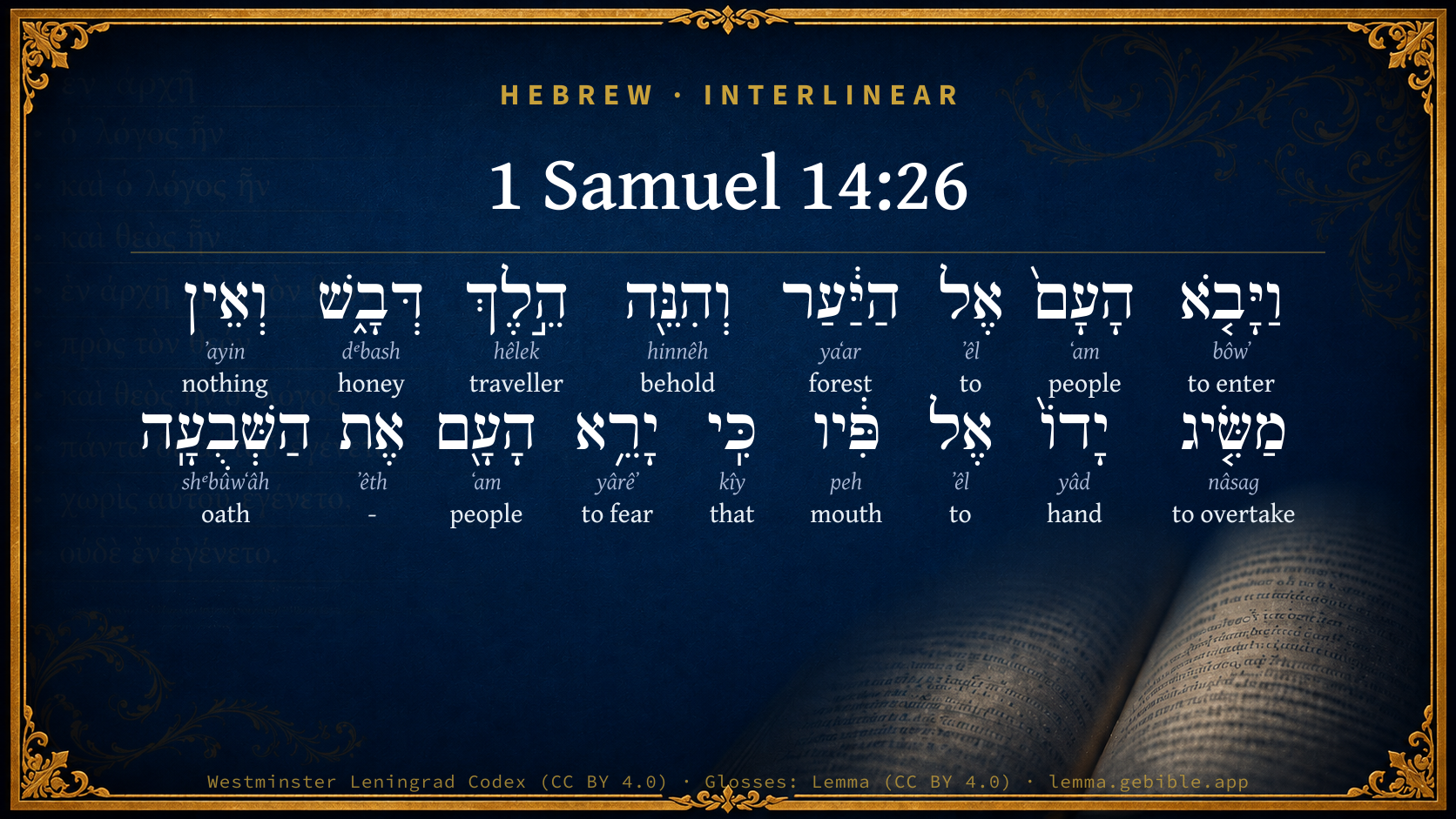
Hebrew (Westminster Leningrad Codex) 1 Samuel 14:26 appears in the Hebrew Old Testament. The text above is from the Westminster Leningrad Codex. Each word links to its Strong’s number, a concise gloss, and parsing drawn from the Open Scriptures Hebrew Bible morphology. Click any word for its full Brown-Driver-Briggs (BDB) entry.
Download image
Cite this verse

1 Samuel 14:26 (World English Bible). Public Domain. Lemma interlinear Bible study tool, https://lemma.gebible.app/v/1-samuel/14/26.

Show BibTeX & RIS
BibTeX
RIS
English Translation
When the people were come to the forest, behold, the honey dropped: but no man put his hand to his mouth; for the people feared the oath.
World English Bible · Public Domain
Highlights
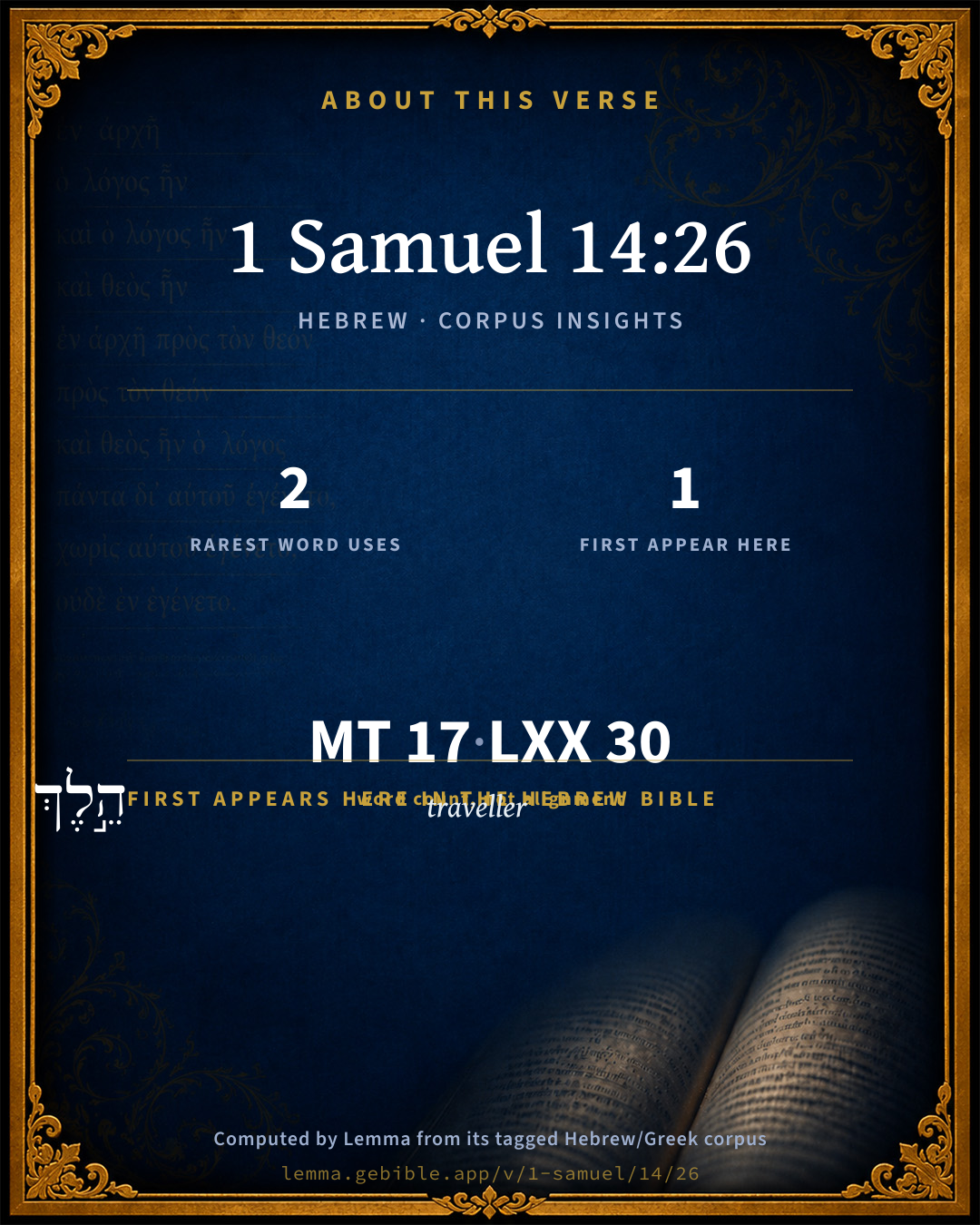
  • 1 first appearance in the Hebrew Bible
Full analysis ↓
Download a study sheet

One document with this verse’s original text, its word-by-word gloss line, the meaning frame, cross-references with their text, attributed commentary, and full source and license credits — printable, and it pastes into notes with its structure intact.

This verse Autodidact and up

Study sheet (.html) Plain text (.txt)

A passage Seminary Student

Up to 50 verses in one chapter. A passage sheet keeps up to 6 commentary sources and 12 cross-references per verse, in the order this page ranks them, and says so on the sheet whenever that leaves anything out. Ask for a single verse and you get the Autodidact verse sheet above.

Everything on this page stays free to read, with no account — the sheet is a download of what is already on screen, not access to it.

Want to remove ads? Support Godless Engineer
Compare translations 3

The same verse in 3 English versions, stacked beneath the original-language interlinear above. Click any original word for its lexicon entry.

Each is an independent rendering of the whole verse — the interlinear is not word-aligned to these translations.

Highlighted words mark where these versions differ — a whole-verse word diff, not a word-by-word alignment.

  • World English Bible Public Domain
    When the people were come to the forest, behold, the honey dropped: but no man put his hand to his mouth; for the people feared the oath.
  • King James Version Public Domain
    And when the people were come into the wood, behold, the honey dropped; but no man put his hand to his mouth: for the people feared the oath.
  • unfoldingWord Literal Text CC BY-SA 4.0
    And the people came into the forest, and behold, the flowing of honey! But no one was reaching his hand to his mouth, for the people feared the oath.

unfoldingWord Literal Text — © unfoldingWord, licensed CC BY-SA 4.0. Word-aligned USFM3 via Door43 (git.door43.org/unfoldingWord/en_ult).

Versions to compare (up to 4)

3 of 4 selected

Show all 18 translations

Every available English version of this verse, each an independent rendering of the whole verse.

  • World English Bible Public Domain
    When the people were come to the forest, behold, the honey dropped: but no man put his hand to his mouth; for the people feared the oath.
  • Berean Standard Bible Public Domain
    And when they entered the forest and saw the flowing honey, not one of them put his hand to his mouth, because they feared the oath.
  • Majority Standard Bible Public Domain
    And when they entered the forest and saw the flowing honey, not one of them put his hand to his mouth, because they feared the oath.
  • King James Version Public Domain
    And when the people were come into the wood, behold, the honey dropped; but no man put his hand to his mouth: for the people feared the oath.
  • American Standard Version (1901) Public Domain
    And when the people were come unto the forest, behold, the honey dropped: but no man put his hand to his mouth; for the people feared the oath.
  • Revised Version (1885) Public Domain
    And when the people were come unto the forest, behold, the honey dropped: but no man put his hand to his mouth; for the people feared the oath.
  • Geneva Bible (1599) Public Domain
    And the people came into the wood, and beholde, the hony dropped, and no man mooued his hand to his mouth: for the people feared the othe.
  • Douay-Rheims (1899) Public Domain
    And when the people came into the forest, behold the honey dropped, but no man put his hand to his mouth. For the people feared the oath.
  • Young's Literal Translation Public Domain
    and the people come in unto the forest, and lo, the honey dropped, and none is moving his hand unto his mouth, for the people feared the oath.
  • Literal Standard Version CC BY-SA 4.0
    and the people come into the forest, and behold, the honey dropped, and none is moving his hand to his mouth, for the people feared the oath.
  • Unlocked Literal Bible CC BY-SA 4.0
    When the people entered into the forest, the honey flowed, but no one put his hand to his mouth for the people feared the oath.
  • unfoldingWord Literal Text CC BY-SA 4.0
    And the people came into the forest, and behold, the flowing of honey! But no one was reaching his hand to his mouth, for the people feared the oath.
  • Darby Bible Public Domain
    And the people had come into the wood, and behold, the honey flowed; but no man put his hand to his mouth, for the people feared the oath.
  • World Messianic Bible Public Domain
    When the people had come to the forest, behold, honey was dripping, but no one put his hand to his mouth, for the people feared the oath.
  • Webster's Bible Public Domain
    And when the people had come into the wood, behold, the honey dropped; but no man put his hand to his mouth: for the people feared the oath.
  • Free Bible Version CC BY-SA 4.0
    While they were in the forest they saw the honey running out, but no one picked it up to eat it because they were all afraid of the oath they had taken.
  • Bible in Basic English Public Domain
    But not a man put his hand to his mouth for fear of the curse.
  • JPS Tanakh (1917) Public Domain
    And when the people were come unto the forest, behold a flow of honey; but no man put his hand to his mouth; for the people feared the oath.

Literal Standard Version (2020), Covenant Press — licensed CC BY-SA 4.0. Text via the HelloAO Bible API (eBible.org). Unlocked Literal Bible (unfoldingWord) — licensed CC BY-SA 4.0. Text via the HelloAO Bible API (eBible.org). unfoldingWord Literal Text — © unfoldingWord, licensed CC BY-SA 4.0. Word-aligned USFM3 via Door43 (git.door43.org/unfoldingWord/en_ult). Free Bible Version, Dr. Jonathan Gallagher — licensed CC BY-SA 4.0. Text via the HelloAO Bible API (eBible.org).

Word by word

More ways to search: Search by grammar → Find every occurrence → Compare this word →

Practice this passage: Drill this verse → Learn its vocabulary →

הֵ֣לֶךְ
hêlek
H1982
“traveller of”
Noun, Common, Masculine, Singular, Construct
Part of Speech
Noun
Type
Common
Gender
Masculine
Number
Singular
State
Construct
Full BDB Definition

Origin: from H1980

TWOT: 498a

traveller
  1. וַיָּבֹ֤א bôwʼ H935 “and · to enter” Conjunction + Verb, Qal, Sequential Imperfect, 3rd Person, Masculine, Singular
  2. הָעָם֙ ʻam H5971 “the · people” Particle, Definite Article + Noun, Common, Masculine, Singular, Absolute
  3. אֶל ʼêl H413 “to” Preposition
  4. הַיַּ֔עַר yaʻar H3293 “the · forest” Particle, Definite Article + Noun, Common, Masculine, Singular, Absolute
  5. וְהִנֵּ֖ה hinnêh H2009 “and · behold” Conjunction + Particle, Demonstrative
  6. דְּבָ֑שׁ dᵉbash H1706 “honey” Noun, Common, Masculine, Singular, Absolute
  7. וְאֵין ʼayin H369 “and · nothing” Conjunction + Particle, Negative
  8. מַשִּׂ֤יג nâsag H5381 “overtaking” Verb, Hiphil, Participle Active, Masculine, Singular, Absolute
  9. יָדוֹ֙ yâd H3027 “hand · his” Noun, Common, Both, Singular, Construct + Suffix, Personal, 3rd Person, Masculine, Singular
  10. אֶל ʼêl H413 “to” Preposition
  11. פִּ֔יו peh H6310 “mouth · his” Noun, Common, Masculine, Singular, Construct + Suffix, Personal, 3rd Person, Masculine, Singular
  12. כִּֽי kîy H3588 “that” Conjunction
  13. יָרֵ֥א yârêʼ H3372 “to fear” Verb, Qal, Perfect, 3rd Person, Masculine, Singular
  14. הָעָ֖ם ʻam H5971 “the · people” Particle, Definite Article + Noun, Common, Masculine, Singular, Absolute
  15. אֶת ʼêth H853 “-” Particle, Direct Object
  16. הַשְּׁבֻעָֽה shᵉbûwʻâh H7621 “the · oath” Particle, Definite Article + Noun, Common, Feminine, Singular, Absolute

About this verse

These counts appear in no published source. They are computed here, from the morphology-tagged text and Lemma’s own curated glosses. What Lemma adds →

17
words
15
distinct lemmas
Historical
section

Notable vocabulary

The rarest word here is הֵ֣לֶךְ traveller H1982 — appearing just 2 times in the whole Hebrew Bible.

First appearance in Scripture

This word makes its first canonical appearance in the Hebrew Bible here:

  • הֵ֣לֶךְ traveller H1982

Shared distinctive vocabulary

הֵ֣לֶךְ traveller H1982 occurs in 2 verses of the Hebrew Bible. Also found in:

Grammatical profile

  • 3 verbs
  • 8 nouns
  • 2 prepositions
  • 1 conjunction
  • 3 particles

Verb forms

  • וַיָּבֹ֤א Qal · Sequential Imperfect
  • מַשִּׂ֤יג Hiphil · Participle Active
  • יָרֵ֥א Qal · Perfect

Repetition

Words recur within this verse — often emphatic in Hebrew:

  • הָעָם֙ people H5971 ×2
  • אֶל to H413 ×2

Hebrew & Septuagint length

In English translation the verse runs 27 words from the Hebrew and 36 from the Septuagint (LXX English) — closely comparable.

A rough comparison of the two English renderings, which tokenize alike — not a word-level alignment.

Word counts can differ between the Hebrew and the Greek without any difference in meaning — e.g. the Hebrew direct-object marker אֵת has no separate Greek word, and Greek often adds the article ὁ.

In the original languages it is 17 Hebrew tokens and 30 Greek tokens — but the two are counted differently (Hebrew bundles its prefixes and suffixes into one token; the Greek is in lemma form), so that isn’t a like-for-like length.

Cross-references

1

Topical passages linked to 1 Samuel 14:26 in the Treasury of Scripture Knowledge — connected by theme and wording, ordered by reader-vote popularity; previews shown in the World English Bible.

  • Ecclesiastes 9:2 All things come alike to all. There is one event to the righteous and to the wicked; to the good, to the clean, to the unclean, to him who sacrifices, and to him who doesn't sacrifice. As is the good, so is the sinner; he who takes an oath, as he who fears an oath.

Cross-references courtesy of OpenBible.info (CC BY 4.0).

Hebrew and Greek witnesses Masoretic Hebrew ↔ Greek Septuagint

The same verse in the two great witnesses to the Old Testament, shown verse-for-verse.

These are two independent witnesses, not word-aligned to each other, and the Septuagint is shown in lemma (dictionary) form.

Hebrew 1 Samuel 14:26 Masoretic · Westminster Leningrad Codex

וַיָּבֹ֤א הָעָם֙ אֶל הַיַּ֔עַר וְהִנֵּ֖ה הֵ֣לֶךְ דְּבָ֑שׁ וְאֵין מַשִּׂ֤יג יָדוֹ֙ אֶל פִּ֔יו כִּֽי יָרֵ֥א הָעָ֖ם אֶת הַשְּׁבֻעָֽה

When the people were come to the forest, behold, the honey dropped: but no man put his hand to his mouth; for the people feared the oath.

World English Bible · Public Domain

Greek LXX 1 Samuel 14:26 Septuagint · lemma form

καί εἰςἔρχομαι ὁ λαός εἰς ὁ μελισσών καί ἰδού πορεύομαι λαλέω καί ἰδού οὐ εἰμί ἐπιστρέφω ὁ χείρ αὐτός εἰς ὁ στόμα αὐτός ὅτι φοβέω ὁ λαός ὁ ὅρκος κύριος

And the people went into the place of the bees, and, behold, they continued speaking; and, behold, there was none that put his hand to his mouth, for the people feared the oath of the Lord.

LXX2012 (modern English Septuagint) · Public Domain

Hebrew: Westminster Leningrad Codex (CC BY 4.0). Greek: Septuagint (public domain); English from LXX2012 (modern English Septuagint) (Public Domain). How the Septuagint differs from the Hebrew →

Targum (Aramaic paraphrase)

1

The Targum is the ancient Jewish Aramaic paraphrase of the Hebrew Scriptures — an interpretive translation, not the Hebrew text itself. Onkelos (literal) and Pseudo-Jonathan (expansive) render the Torah, and Jonathan the Prophets. Coverage is partial: where no permissively-licensed English translation exists for a verse, only the Aramaic is shown. This is verse-level text, not a word-by-word alignment to the Hebrew.

  1. Targum Jonathan Prophets (Joshua–Malachi)
    וְאָתָא עַמָא לְחוֹרְשָׁא וְהָא בְּרֵיז דוּבְשָׁא וְלֵית דְמֵיתִיב יְדֵיהּ לְפוּמֵיהּ אֲרֵי דְחֵיל עַמָא מִשְׁבוּעֲתָא:

    (no public-domain English translation for this verse)

    Targum Jonathan — Aramaic: “Mikraot Gedolot” (public domain). English: “Sefaria Community Translation” (CC0 1.0 (public-domain dedication)); “London "Chaldee Paraphrase," 1871” (public domain). Text via Sefaria.

Commentary

Notes on 1 Samuel 14:26 from classic Christian and Jewish commentators (each source and its license shown beneath its notes). The classic Christian expositions comment on the surrounding passage and are grouped to its opening verse, so a note may address several verses; the Jewish commentaries on the Tanakh (Rashi and others) are per-verse, so they appear only where the commentator wrote on this verse.

Lemma curates 59 commentaries, every one of them public domain or Creative Commons licensed, each selected and text-cleaned for this edition rather than reprinted as found. About our sources →

Trapp's Complete Commentary

John Trapp

1Sa 14:26 And when the people were come into the wood, behold, the honey dropped; but no man put his hand to his mouth: for the people feared the oath.

Ver. 26. Behold, the honey dropped.] Hence Canaan is so oft called "a land flowing with milk and honey."

But no man put his hand to his mouth.] It argued there was much power in that oath, when no man dared to touch one drop of this honey: so, to resist a strong temptation, argueth strong grace. Pliny mentioneth a certain country where the honey is poisonous, because sucked out of poisonous herbs. Such is the pleasure of sin; sweet, but deadly.

John Trapp, A Commentary or Exposition upon All the Books of the Old and New Testament (1647–1656) — public domain. Text from a community e-Sword module.

Geneva Bible (1599)

Geneva Bible translators

That is, the punishment, if they break their oath.

Geneva Bible (1599) marginal notes — public domain. Text via Bolls.life.

Adam Clarke's Commentary

Verse 26. The honey dropped] It seems to have dropped from the trees on the ground. Honey dews, as they are called, are not uncommon in most countries; and this appears to have been something of this kind. I have seen honey in considerable quantity on the trees and long grass in the fields, and have often eaten of it.

Adam Clarke's Commentary on the Bible (1810–1826) — public domain. Text from a community e-Sword/MySword module.

Ellicott's Commentary for English Readers

(26) Behold, the honey dropped.—Literally,. Behold, a stream of honey.

A Bible Commentary for English Readers, edited by Charles John Ellicott (1878–1897) — public domain. Text from a community e-Sword module.

The Cambridge Bible for Schools and Colleges

gen. ed. J. J. S. Perowne

26. behold, the honey dropped] Lit. behold a stream of honey. Palestine is literally “a land flowing with milk and honey” (Exo_3:8). Wild bees settle in vast numbers in the clefts of the limestone rocks and in the trees. Compare the statement of a traveller in India, where “the forests literally flow with honey, Large combs may be seen hanging in the trees as you pass along, full of honey.” Cp. Mat_3:4. See Tristram’s Land of Israel, p. 83. Kitto’s Bible Illustrations, p. 190.

The Cambridge Bible for Schools and Colleges (gen. ed. J. J. S. Perowne; Cambridge University Press, 1878–1918) — public domain. Text from a community e-Sword module.

John Gill's Exposition

And when the people came into the wood, behold, the honey dropped,.... Either from trees, which produced it; so Diodorus Siculus (t) speaks of trees in some countries which produce honey; or from the sugar canes, as Jarchi; or rather from the honeycombs which were framed in trees by bees; so Hesiod (u) speaks of bees making their nests or combs in trees. Ben Gersom thinks that bee hives were placed here in rows by the wayside, from whence the honey flowed; or "went" (w), or there was a going of it; perhaps the combs being pressed by the Philistines as they fled: the land of Canaan was a land flowing with milk and honey:

but no man put his hand to his mouth; that is, took not any of the honey and ate it, though it was so near at hand, and there was plenty of it:

for the people feared the oath: Saul adjured them by, or the imprecation he made on the person that should eat any food that day.

(t) Bibliothec. l. 17. p. 548. (u) Hesiod, Theogon. ver. 230. Vid. Diodor. Sic. ut supra. (Bibliothec. l. 17. p. 548.) (w) "ambulatio mellis", Montanus; "itio mellis", Drusius; so in Ovid. Metamorph. l. 1. fab. 3. "----jam flumina nectaris ibant".

John Gill's Exposition of the Whole Bible (1746–1763) — public domain (CC PDM 1.0). Text via the HelloAO Bible API.

Albert Barnes' Notes on the Bible

The honey dropped - Rather, “Behold a stream of honey.” The same thing may be seen in Spain, where in woody and rocky ground copious streams of honey are often found.

Albert Barnes' Notes on the Bible (1834–1885) — public domain. Text from a community e-Sword/MySword module.

Matthew Poole's English Annotations

The honey dropped. It hath been observed by many travellers and writers, that bees do ofttimes settle themselves, and make their hives and honey, in the trunks of trees, or clefts of rocks, or holes of the earth; and this in divers countries, but eminently in this of Canaan; as may be gathered from Deu 32:13; Psa 81:16; whence it was called a land flowing with milk and honey.

Matthew Poole's English Annotations on the Holy Bible (1683–1685) — public domain. Text from a community e-Sword/MySword module.

Whedon's Commentary on the Bible

Daniel D. Whedon

26. The honey dropped — Kitto quotes Mr. Roberts as saying: “Bees in the East are not, as in England, kept in hives; they are all in a wild state. The forests literally flow with honey; large combs may be seen hanging in the trees as you pass along, full of honey.” Dr. Thomson says: “I have explored densely wooded gorges in Hermon and in southern Lebanon where wild bees are still found both in trees and in the clefts of the rocks.”

Daniel D. Whedon (gen. ed.), Commentary on the Old and New Testaments (1874–1909) — public domain. Text from a community e-Sword module.

The Pulpit Commentary

The honey dropped. More correctly, "Behold, a stream (or a flowing) of honey."

The Pulpit Commentary (1880–1919), ed. H.D.M. Spence-Jones & Joseph S. Exell — public domain. Text from a community e-Sword module.

John Wesley's Explanatory Notes

Honey - Bees often make their hives in the trunks of trees, or clefts of rocks, or holes of the earth; and this in divers countries, but eminently in Canaan.

John Wesley, Explanatory Notes Upon the Whole Bible (1754–1765) — public domain. Text via the GEBible commentary corpus.

Rashi

Rabbi Shlomo Yitzchaki (Rashi)

And behold there was a flow of honey. Which was flowing from the canes.

Rashi on the Tanakh — English translations: “The Judaica Press complete Tanach with Rashi, translated by A. J. Rosenberg” (CC BY 4.0); “Pentateuch with Rashi's commentary by M. Rosenbaum and A.M. Silbermann, 1929-1934” (public domain); “The Metsudah Tanach series, Lakewood, N.J” (CC BY 4.0); and “The Book of Joshua, Metsudah Publications, 1997” (CC BY 4.0). Text via Sefaria.

Lesson kit

Teaching starters — assembled from the data on this page, not authored interpretation. Every prompt links to the verse data it draws on. Edit before teaching.

1 Samuel, in the Historical, opens this verse with 17 words (15 distinct Hebrew lemmas). Its most distinctive word is hêlek (“traveller”). A historical commentator’s framing appears above. Read the whole chapter for the surrounding context.

Discussion questions

  1. What does “traveller” (hêlek) contribute to the verse as a whole?
  2. This is the first place “traveller” appears in Scripture (first appears here). What does its debut here establish?
  3. How does 2 Samuel 12:4, which shares the word «traveller», read alongside this verse?
  4. What does the repetition of “people” (2× in this one verse) do in this verse?
  5. The translations on this page render this verse differently — a whole-verse word diff, not a word-by-word alignment. What might account for the different wordings?
  6. «וַיָּבֹ֤א» is a Qal Sequential Imperfect verb. How does that grammatical form shape the action described?
  7. Compare how Trapp's Complete Commentary and Geneva Bible (1599) read this verse. Where do they agree or differ?

Things to notice

Reading settings

Reading text

Shown beneath each verse's original-language words.

Old Testament
Old Testament edition

Read the OT as the Masoretic Hebrew (MT) or the Greek Septuagint (LXX).

English shown for the Greek Septuagint (in the Hebrew ↔ Greek comparison).

Comparing translations? Open the Compare panel on any verse page to stack up to four side by side.