Jeremiah 32:33

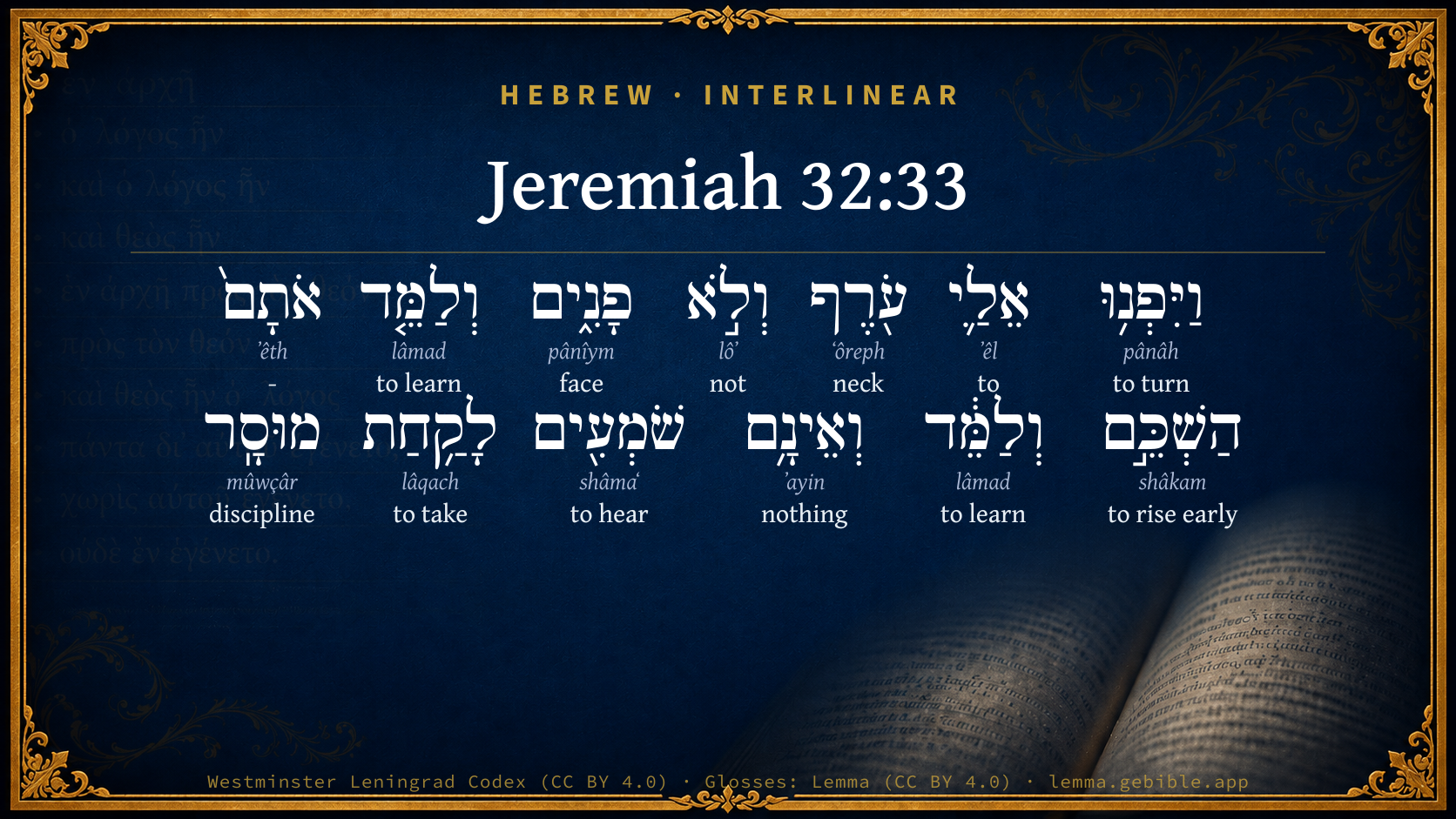
Hebrew (Westminster Leningrad Codex) Jeremiah 32:33 appears in the Hebrew Old Testament. The text above is from the Westminster Leningrad Codex. Each word links to its Strong’s number, a concise gloss, and parsing drawn from the Open Scriptures Hebrew Bible morphology. Click any word for its full Brown-Driver-Briggs (BDB) entry.
Download image
Cite this verse

Jeremiah 32:33 (World English Bible). Public Domain. Lemma interlinear Bible study tool, https://lemma.gebible.app/v/jeremiah/32/33.

Show BibTeX & RIS
BibTeX
RIS
English Translation
They have turned to me the back, and not the face: and though I taught them, rising up early and teaching them, yet they have not listened to receive instruction.
World English Bible · Public Domain
Download a study sheet

One document with this verse’s original text, its word-by-word gloss line, the meaning frame, cross-references with their text, attributed commentary, and full source and license credits — printable, and it pastes into notes with its structure intact.

This verse Autodidact and up

Study sheet (.html) Plain text (.txt)

A passage Seminary Student

Up to 50 verses in one chapter. A passage sheet keeps up to 6 commentary sources and 12 cross-references per verse, in the order this page ranks them, and says so on the sheet whenever that leaves anything out. Ask for a single verse and you get the Autodidact verse sheet above.

Everything on this page stays free to read, with no account — the sheet is a download of what is already on screen, not access to it.

Want to remove ads? Support Godless Engineer
Compare translations 3

The same verse in 3 English versions, stacked beneath the original-language interlinear above. Click any original word for its lexicon entry.

Each is an independent rendering of the whole verse — the interlinear is not word-aligned to these translations.

Highlighted words mark where these versions differ — a whole-verse word diff, not a word-by-word alignment.

  • World English Bible Public Domain
    They have turned to me the back, and not the face: and though I taught them, rising up early and teaching them, yet they have not listened to receive instruction.
  • King James Version Public Domain
    And they have turned unto me the back, and not the face: though I taught them, rising up early and teaching them, yet they have not hearkened to receive instruction.
  • unfoldingWord Literal Text CC BY-SA 4.0
    They turned their backs to me instead of their faces, though I had eagerly taught them. I tried to teach them, but not one of them listened in order to receive correction.

unfoldingWord Literal Text — © unfoldingWord, licensed CC BY-SA 4.0. Word-aligned USFM3 via Door43 (git.door43.org/unfoldingWord/en_ult).

Versions to compare (up to 4)

3 of 4 selected

Show all 18 translations

Every available English version of this verse, each an independent rendering of the whole verse.

  • World English Bible Public Domain
    They have turned to me the back, and not the face: and though I taught them, rising up early and teaching them, yet they have not listened to receive instruction.
  • Berean Standard Bible Public Domain
    They have turned their backs to Me and not their faces. Though I taught them again and again, they would not listen or respond to discipline.
  • Majority Standard Bible Public Domain
    They have turned their backs to Me and not their faces. Though I taught them again and again, they would not listen or respond to discipline.
  • King James Version Public Domain
    And they have turned unto me the back, and not the face: though I taught them, rising up early and teaching them, yet they have not hearkened to receive instruction.
  • American Standard Version (1901) Public Domain
    And they have turned unto me the back, and not the face: and though I taught them, rising up early and teaching them, yet they have not hearkened to receive instruction.
  • Revised Version (1885) Public Domain
    And they have turned unto me the back, and not the face: and though I taught them, rising up early and teaching them, yet they have not hearkened to receive instruction.
  • Geneva Bible (1599) Public Domain
    And they haue turned vnto me the backe and not the face: though I taught them rising vp earely, and instructing them, yet they were not obedient to receiue doctrine,
  • Douay-Rheims (1899) Public Domain
    And they have turned their backs to me, and not their faces: when I taught them early in the morning, and instructed them, and they would not hearken to receive instruction.
  • Young's Literal Translation Public Domain
    And they turn unto Me the neck, and not the face, and teaching them, rising early and teaching, and they are not hearkening to accept instruction.
  • Literal Standard Version CC BY-SA 4.0
    And they turn the neck to Me, and not the face, and teaching them, rising early and teaching, and they are not listening to accept instruction.
  • Unlocked Literal Bible CC BY-SA 4.0
    They turned their backs to me instead of their faces, though I had eagerly taught them. I tried to teach them, but not one of them listened in order to receive correction.
  • unfoldingWord Literal Text CC BY-SA 4.0
    They turned their backs to me instead of their faces, though I had eagerly taught them. I tried to teach them, but not one of them listened in order to receive correction.
  • Darby Bible Public Domain
    And they have turned unto me the back, and not the face; and though I taught them, rising early and teaching, they hearkened not to receive instruction.
  • World Messianic Bible Public Domain
    They have turned their backs to me, and not their faces. Although I taught them, rising up early and teaching them, yet they have not listened to receive instruction.
  • Webster's Bible Public Domain
    And they have turned to me the back, and not the face: though I taught them, rising early and teaching them, yet they have not hearkened to receive instruction.
  • Free Bible Version CC BY-SA 4.0
    They have turned their backs on me. They wouldn't even look at me. Even though I kept on trying to teach them, they refused to listen or accept instruction.
  • Bible in Basic English Public Domain
    And they have been turning their backs and not their faces to me: and though I was their teacher, getting up early and teaching them, their ears were not open to teaching.
  • JPS Tanakh (1917) Public Domain
    And they have turned unto Me the back, and not the face; and though I taught them, teaching them betimes and often, yet they have not hearkened to receive instruction.

Literal Standard Version (2020), Covenant Press — licensed CC BY-SA 4.0. Text via the HelloAO Bible API (eBible.org). Unlocked Literal Bible (unfoldingWord) — licensed CC BY-SA 4.0. Text via the HelloAO Bible API (eBible.org). unfoldingWord Literal Text — © unfoldingWord, licensed CC BY-SA 4.0. Word-aligned USFM3 via Door43 (git.door43.org/unfoldingWord/en_ult). Free Bible Version, Dr. Jonathan Gallagher — licensed CC BY-SA 4.0. Text via the HelloAO Bible API (eBible.org).

Word by word

More ways to search: Search by grammar → Find every occurrence → Compare this word →

Practice this passage: Drill this verse → Learn its vocabulary →

עֹ֖רֶף
ʻôreph
H6203
“neck”
Noun, Common, Masculine, Singular, Absolute
Part of Speech
Noun
Type
Common
Gender
Masculine
Number
Singular
State
Absolute
Full BDB Definition

Origin: from H6202

TWOT: 1700a

neck, back of the neck, back - back of the neck - of fleeing foe - of apostasy (figuratively) - stiff of neck, obstinate (figuratively)
  1. וַיִּפְנ֥וּ pânâh H6437 “and · to turn” Conjunction + Verb, Qal, Sequential Imperfect, 3rd Person, Masculine, Plural
  2. אֵלַ֛י ʼêl H413 “to · me” Preposition + Suffix, Personal, 1st Person, Common, Singular
  3. וְלֹ֣א lôʼ H3808 “and · not” Conjunction + Particle, Negative
  4. פָנִ֑ים pânîym H6440 “face(s)” Noun, Common, Both, Plural, Absolute
  5. וְלַמֵּ֤ד lâmad H3925 “and · to learn” Conjunction + Verb, Piel, Infinitive Absolute
  6. אֹתָם֙ ʼêth H853 “- · them” Particle, Direct Object + Suffix, Personal, 3rd Person, Masculine, Plural
  7. הַשְׁכֵּ֣ם shâkam H7925 “to rise early” Verb, Hiphil, Infinitive Absolute
  8. וְלַמֵּ֔ד lâmad H3925 “and · to learn” Conjunction + Verb, Piel, Infinitive Absolute
  9. וְאֵינָ֥ם ʼayin H369 “and · nothing · them” Conjunction + Particle, Negative + Suffix, Personal, 3rd Person, Masculine, Plural
  10. שֹׁמְעִ֖ים shâmaʻ H8085 “hearing” Verb, Qal, Participle Active, Masculine, Plural, Absolute
  11. לָקַ֥חַת lâqach H3947 “to take” Preposition + Verb, Qal, Infinitive Construct
  12. מוּסָֽר mûwçâr H4148 “discipline” Noun, Common, Masculine, Singular, Absolute

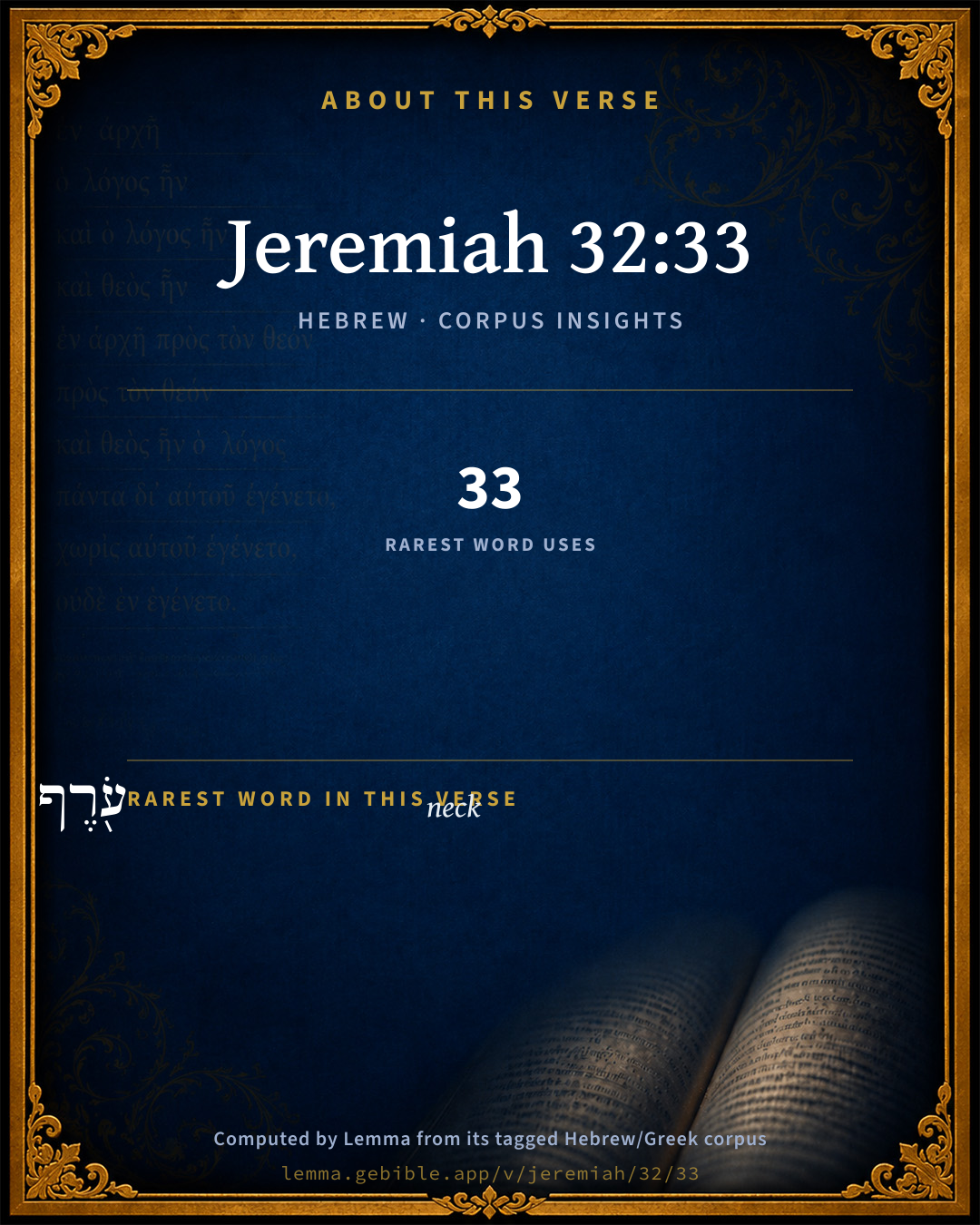
About this verse

These counts appear in no published source. They are computed here, from the morphology-tagged text and Lemma’s own curated glosses. What Lemma adds →

13
words
12
distinct lemmas
Prophets
section

Shared distinctive vocabulary

עֹ֖רֶף neck H6203 occurs in 32 verses of the Hebrew Bible. Also found in:

Grammatical profile

  • 6 verbs
  • 3 nouns
  • 1 preposition
  • 3 particles

Verb forms

  • וַיִּפְנ֥וּ Qal · Sequential Imperfect
  • וְלַמֵּ֤ד Piel · Infinitive Absolute
  • הַשְׁכֵּ֣ם Hiphil · Infinitive Absolute
  • וְלַמֵּ֔ד Piel · Infinitive Absolute
  • שֹׁמְעִ֖ים Qal · Participle Active
  • לָקַ֥חַת Qal · Infinitive Construct

Repetition

A word recurs within this verse — often emphatic in Hebrew:

  • וְלַמֵּ֤ד to learn H3925 ×2

Cross-references

13

Topical passages linked to Jeremiah 32:33 in the Treasury of Scripture Knowledge — connected by theme and wording, ordered by reader-vote popularity; previews shown in the World English Bible.

  • Jeremiah 7:13 Now, because you have done all these works, says Yahweh, and I spoke to you, rising up early and speaking, but you didn't hear; and I called you, but you didn't answer:
  • Jeremiah 2:27 who tell a stock, You are my father; and to a stone, You have brought me forth: for they have turned their back to me, and not their face; but in the time of their trouble they will say, Arise, and save us.
  • Ezekiel 8:16 He brought me into the inner court of Yahweh's house; and see, at the door of the temple of Yahweh, between the porch and the altar, were about twenty-five men, with their backs toward the temple of Yahweh, and their faces toward the east; and they were worshipping the sun toward the east.
  • 2 Chronicles 36:15–16 Yahweh, the God of their fathers, sent to them by his messengers, rising up early and sending, because he had compassion on his people, and on his dwelling-place:
  • Jeremiah 7:24 But they didn't listen nor turn their ear, but walked in [their own] counsels [and] in the stubbornness of their evil heart, and went backward, and not forward.
  • Jeremiah 26:5 to listen to the words of my servants the prophets, whom I send to you, even rising up early and sending them, but you have not listened;
  • Jeremiah 35:15 I have sent also to you all my servants the prophets, rising up early and sending them, saying, Return you now every man from his evil way, and amend your doings, and don't go after other gods to serve them, and you shall dwell in the land which I have given to you and to your fathers: but you have not inclined your ear, nor listened to me.
  • John 8:2 Now very early in the morning, he came again into the temple, and all the people came to him. He sat down, and taught them.
  • Jeremiah 18:17 I will scatter them as with an east wind before the enemy; I will show them the back, and not the face, in the day of their calamity.
  • Jeremiah 25:3–4 From the thirteenth year of Josiah the son of Amon, king of Judah, even to this day, these twenty-three years, the word of Yahweh has come to me, and I have spoken to you, rising up early and speaking; but you have not listened.
  • Jeremiah 44:4 However I sent to you all my servants the prophets, rising up early and sending them, saying, Oh, don't do this abominable thing that I hate.
  • Hosea 11:2 They called to them, so they went from them. They sacrificed to the Baals, And burned incense to engraved images.
  • Zechariah 7:11 But they refused to listen, and turned their backs, and stopped their ears, that they might not hear.

Cross-references courtesy of OpenBible.info (CC BY 4.0).

Hebrew and Greek witnesses Masoretic Hebrew ↔ Greek Septuagint

The same verse in the two great witnesses to the Old Testament, shown verse-for-verse.

These are two independent witnesses, not word-aligned to each other, and the Septuagint is shown in lemma (dictionary) form.

Hebrew Jeremiah 32:33 Masoretic · Westminster Leningrad Codex

וַיִּפְנ֥וּ אֵלַ֛י עֹ֖רֶף וְלֹ֣א פָנִ֑ים וְלַמֵּ֤ד אֹתָם֙ הַשְׁכֵּ֣ם וְלַמֵּ֔ד וְאֵינָ֥ם שֹׁמְעִ֖ים לָקַ֥חַת מוּסָֽר

They have turned to me the back, and not the face: and though I taught them, rising up early and teaching them, yet they have not listened to receive instruction.

World English Bible · Public Domain

Greek LXX Structure differs

In the Septuagint, Jeremiah is about an eighth shorter than the Hebrew and arranges its material differently — the Oracles Against the Nations (Hebrew chapters 46–51) appear in the middle of the Greek book, after 25:13. Because the chapter and verse boundaries do not line up, a verse-for-verse comparison with the Hebrew is not shown.

A verse-for-verse comparison isn’t shown here because the chapters and verses don’t line up. Switch to the LXX edition with the MT / LXX toggle above to read the Greek directly.

Hebrew: Westminster Leningrad Codex (CC BY 4.0). Greek: Septuagint (public domain); English from a public-domain English Septuagint. How the Septuagint differs from the Hebrew →

Targum (Aramaic paraphrase)

1

The Targum is the ancient Jewish Aramaic paraphrase of the Hebrew Scriptures — an interpretive translation, not the Hebrew text itself. Onkelos (literal) and Pseudo-Jonathan (expansive) render the Torah, and Jonathan the Prophets. Coverage is partial: where no permissively-licensed English translation exists for a verse, only the Aramaic is shown. This is verse-level text, not a word-by-word alignment to the Hebrew.

  1. Targum Jonathan Prophets (Joshua–Malachi)
    וְאַחְזָרוּ בְּפוּלְחָנִי קְדַל וְלָא שַׁוִיאוּ דְחַלְתִּי לָקֳבֵיל אַפֵּיהוֹן וּשְׁלָחֵית לְוַתְהוֹן יַת כָּל עַבְדֵי נְבִיַיָא מַקְדִים וּמַלִיף וְלֵית אִינוּן צָבָן לְקַבָּלָא אוּלְפַן:

    (no public-domain English translation for this verse)

    Targum Jonathan — Aramaic: “Mikraot Gedolot” (public domain). English: “Sefaria Community Translation” (CC0 1.0 (public-domain dedication)); “London "Chaldee Paraphrase," 1871” (public domain). Text via Sefaria.

Commentary

Notes on Jeremiah 32:33 from classic Christian and Jewish commentators (each source and its license shown beneath its notes). The classic Christian expositions comment on the surrounding passage and are grouped to its opening verse, so a note may address several verses; the Jewish commentaries on the Tanakh (Rashi and others) are per-verse, so they appear only where the commentator wrote on this verse.

Lemma curates 59 commentaries, every one of them public domain or Creative Commons licensed, each selected and text-cleaned for this edition rather than reprinted as found. About our sources →

Trapp's Complete Commentary

John Trapp

Jer 32:33 And they have turned unto me the back, and not the face: though I taught them, rising up early and teaching [them], yet they have not hearkened to receive instruction.

Ver. 33. And they have turned unto me.] See Jer 2:27.

Though I taught them.] See Jer 7:13; Jer 25:3; Jer 26:3.

John Trapp, A Commentary or Exposition upon All the Books of the Old and New Testament (1647–1656) — public domain. Text from a community e-Sword module.

The Biblical Illustrator

Joseph S. Exell

Jer_32:33

They have turned unto Me the back, and not the face

Human wickedness

I.

As condemning Divine authority. To turn the back upon any one, not only indicates an utter lack of interest in him, but a dislike. To turn the back upon God means--

1. An ignorement of His existence. The language of wickedness is, Depart from me, I desire not a knowledge of Thy ways. The wicked are without God in the world. They shut their eyes to the greatest fact of facts. God is not in all their thoughts.

2. A repugnance to His presence. What a monstrous sight is this, man turning his back on God.

II. As regardless of Divine instruction. God is constantly teaching men early and late--teaching them--

1. In the operations of nature.

2. In the events of their history.

3. In the monitions of their consciences.

4. In the declarations of His Word. (Homilist.)

Though I taught them, rising up early and teaching them, yet they have not hearkened to receive instruction.

Disregard of Gods teaching

I. Gods merciful instruction is given to man according to mans capacity and present situation; and is of that special and particular nature that no one need mistake it; and is so simple and yet so full and impressive in itself that a child even may comprehend it.

1. We have no cloudy pillar resting over our churches, no fire from heaven blazing forth upon an altar of sacrifice, no voice of prophecy attended with signs and wonders, no mysterious Urim and Thummim sparkling on the breastplate of a high priest, nor do we hear the voice of God speaking to us audibly from the summit of a mountain encircled with fire and with loud peals of thunder: but the Deity nevertheless teaches us by means equally potent. We have gathered into one source of Divine instruction the accumulated experience of many centuries--the Bible, and this carries with it the evidence of its own Divinity. We have the Church with her solemn sacraments, her public forms of worship, her large assemblies of believers, and her glorious history of martyrs and confessors of the faith. We have the Divine Spirit entering the hearts of the humble, and by the glory of His light piercing the darkest abodes of ignorance, and leading the teachable disciple of Christ into all truth. We have the providence of God showing us in many ways how quickly the sands of life drop away, how uncertain and how frail it is, how like the flower of the field we look for an instant bright and joyous, but the next, droop from the blight of disease, and crumble away into the ashes of the grave God teaches us also through our own everyday feelings, and the very common concerns of our daily existence

2. The words of Jeremiah express an earnestness in the Divine teaching. God is spoken of as rising up early and teaching them. He is the first among teachers. He is so desirous that His people should be guided by His counsels that He will be with them in the earliest dawn of their existence, both nationally as well as personally.

II. Mans disregard of the Divine instruction. They have turned unto Me, saith the Lord, the back and not the face: and again, they have not hearkened to receive instruction. The Jews stand not alone in this matter. We may see some such strange manifestations in our own day. The same spirit of practical infidelity is abroad now, and the same infatuation which makes the most sublime subjects of religion matters for scorn and mockery, may be witnessed in our own land of freedom and enlightenment. We are happy to say the good sense of society and the spread of intelligence keeps this spirit down within narrow boundaries; but nevertheless it may be observed publishing itself with the godless jest, with the boast of independence, and with the mocking contempt of all which bears the stamp of religious profession. (W. D. Horwood.)

The Biblical Illustrator, edited by Joseph S. Exell (c. 1880s–1900s) — public domain. Text from a community e-Sword module.

Geneva Bible (1599)

Geneva Bible translators

Read Prov. 1:24; Isa. 65:2; Jer. 7:13 and 13:3 and 26:5 and 29:19; and 2 Chron. 36:15; Jer. 35:14 and 44:4.

Geneva Bible (1599) marginal notes — public domain. Text via Bolls.life.

Jamieson, Fausset & Brown

Robert Jamieson, A. R. Fausset & David Brown

(Jer 2:27; Jer 7:13).

Jamieson, Fausset & Brown — Commentary Critical and Explanatory on the Whole Bible (1871) — public domain (CC PDM 1.0). Text via the HelloAO Bible API.

Adam Clarke's Commentary

Verse 33. Though I taught them, rising up early and teaching them] From the frequent reference to this, we may naturally conclude that morning preaching prevailed much in Judea.

Adam Clarke's Commentary on the Bible (1810–1826) — public domain. Text from a community e-Sword/MySword module.

John Calvin's Commentaries

Here the Prophet expresses more clearly the perverseness of the people, as though he had said, that they had deliberately rejected every instruction, and had shewn no regard for God; for he who turns his back on us, does this knowingly and wilfully, and indeed not without contempt. When any one addresses me, and I look another way, is it not a manifest sign of contempt or disdain? and he who speaks, does he not see that he is disregarded? Thus God then complains that the Jews had not fallen away through ignorance, but as it were through a premeditated obstinacy: they then turned to me, he says, the neck, when yet they ought to have been attentive to hear the doctrine of the Law. For God shews to us his face whenever he is pleased to prescribe what ought to be done, or to shew the way of salvation. When he looks on us, how detestable must be our pride, if we look not also on him in return? This, then, is the first thing, that the Jews had knowingly and wilfully despised God and his Law.

Then he amplifies their guilt by saying, And I taught them, I rose up early and taught them, and they hearkened not If the Law had been only once promulgated, the Jews might have objected and said, that they were for the most part illiterate; but no color of pretense remained for them, since the Prophets were continually interpreting the Law, as God had also promised by Moses,

“A Prophet will I raise up for thee from the midst of thy brethren.” (Deuteronomy 18:18)

For he intimates that this benefit would be perpetual in the Church, so that there would never be wanting Prophets to shew the right way to the people. For he sets Prophets in opposition to soothsayers, diviners, foretellers, and all other ministers of Satan, as though he had said, that there was no reason for the people to seek the fallacies of Satan, since the Prophets were sufficient. Lest the Jews then should complain that they were hardly dealt with, God here shews that he had taught them, for he ascribes to himself what he had done by his Prophets: and doubtless Prophets and teachers are nothing else but the instruments of the Holy Spirit; for no one is fit to teach, but when he is guided by the Spirit of God. Justly then does God claim for himself these offices, so that all the praise for the building up of his Church is due to him, though he employs the labors of men. In this sense it is, that he says, that he had taught them.

Then he adds, that he rose up early, that is, that he had been sedulous. As a master of a family, who is solicitous for his own, early inquires how they are, and looks around the whole house; so also God represents himself here, speaking of his care in teaching the Israelites, as though he had said, that not only his Law was set before their eyes, by which they might learn what was right, but that Prophets were also given who ceased not to admonish and exhort them.

Now this manner of speaking ought to be particularly observed, as we hence learn how base their ingratitude is who reject the teaching of the Prophets; for they not only disregarded men, but God himself, as Christ also declares,

“He who hears you, hears me; and he who rejects you, rejects me.” (Luke 10:16)

This form of speaking, then, commends the truth of the doctrine taught by the Prophets; for God comes forth and shews that he speaks by his servants. And on the other hand, we learn what an incomparable blessing it is to have faithful and true teachers; for God, through them and their labors, with certainty declares that he cares for our salvation, as though he watched over us, as though he rose up early, as though he visited us; and the preaching of the Gospel is not without reason called the visitation of God. There is, then, no reason for us to seek anything better, when God is present with us by his word; for we have a sure testimony of his presence whenever true and faithful teachers rise up.

He adds, to receive correction He intimates by the word מוסר musar, that the Jews had not sinned through ignorance, but that they had been intractable, for they refused to be corrected. The word is, indeed, taken sometimes for doctrine, but it means here correction, even when any one, who generally holds a right course, deviates from the right way, but being warned, repents. We hence see what the Prophet means, even that the Jews had not only closed their eyes against the clear light which shone forth in the Law, but that they had been wholly refractory, so that they could not be subdued when God called them to repentance, that when he sought to heal their diseases, they showed such stubbornness that they cast aside all correction and discipline. We hence learn that the time of vengeance had come, because God had tried all means to promote their welfare, and had lost, as the common saying is, both pains and cost. It follows, —

John Calvin's Commentaries (1540-1563) — public domain. Text from the Calvin Translation Society English edition (1840s-50s) via the Christian Classics Ethereal Library (ccel.org). Calvin's coverage is partial (roughly two-thirds of the Bible); uncommented books and verses are honest gaps, never fabricated. The 19th-century editor's footnotes and remarks are omitted so the notes are faithfully Calvin's own voice.

Ellicott's Commentary for English Readers

(33) They have turned unto me the back . . .—It will be remembered that this image was more or less a favourite one with the prophet. (See Notes on Jer_2:27; Jer_7:24.) The same holds good of the “rising up early.” (See Notes on Jer_7:13; Jer_7:25.)

A Bible Commentary for English Readers, edited by Charles John Ellicott (1878–1897) — public domain. Text from a community e-Sword module.

The Cambridge Bible for Schools and Colleges

gen. ed. J. J. S. Perowne

33. though I taught them, etc.] This verb and the two participles following are infinitives in the Heb. (as in ch. Jer_7:9, where see note), and there was a teaching of them, etc.

The Cambridge Bible for Schools and Colleges (gen. ed. J. J. S. Perowne; Cambridge University Press, 1878–1918) — public domain. Text from a community e-Sword module.

John Gill's Exposition

But they set their abominations,.... Their idols, which were abominable to the Lord, and ought to have been so to them: these they placed

in the house (which is called by my name), to defile it; in the temple; as by Ahaz, Manasseh, and others: see Jer 7:30.

John Gill's Exposition of the Whole Bible (1746–1763) — public domain (CC PDM 1.0). Text via the HelloAO Bible API.

Matthew Poole's English Annotations

They have behaved themselves against me contemptuously, like men who, when they are spoken to, admonished, or instructed, instead of looking towards those who instruct or admonish them, turn their back upon them. Yet their sin had not been so great and heinous, if I by my prophets had not diligently instructed them, and they as stubbornly refused to be taught or amended by their instruction.

Matthew Poole's English Annotations on the Holy Bible (1683–1685) — public domain. Text from a community e-Sword/MySword module.

Whedon's Commentary on the Bible

Daniel D. Whedon

33. Back, and not the face — Thus expressing contemptuous indignity. In the latter part of the verse the construction is impersonal; literally, there was a teaching of them, etc.

Daniel D. Whedon (gen. ed.), Commentary on the Old and New Testaments (1874–1909) — public domain. Text from a community e-Sword module.

The Pulpit Commentary

Man"s neglect of God"s teaching.

I GOD"S ATTITUDE AS A TEACHER TOWARDS MAN. God"s complaint is that man turns to him the back and not the face. Hence we are (o understand that God turns his face to us, full of meaning and very earnestly. Consider that expression, "I will guide thee with mine eye." Of course all such expressions are purely anthropomorphic, but behind them there is the truth that, when God speaks to us, it is in the same way as we do when we are most earnest and concerned in speaking. We speak then in every feature.

II GOD"S ASSIDUITY AS A TEACHER. Rising early and teaching them. The effort to make the people understand truth and duty is continuous and unremitting. Nothing was left undone that could be done, so far as the Teacher"s side was concerned. Laws and symbols, great providences, great deliverances, great punitive visitations on other peoples, punishments of men like Korah and Achan and Saul, chastisements like those of David, thus Israelite history abounded in lessons from God. Here is instruction from the great Teacher to all teachers. God was ready to seize on every opportunity to give a lesson, for opportunity is a great part of success. And seeing that God is thus declared among his people as a great Teacher, we should look on the Old Testament as a lesson book, and study how far it may be useful to us. For though we have our own peculiar lesson-book in the New Testament, yet even the New Testament becomes clearer the better we understand the Old.

III MAN"S ATTITUDE AS SCHOLAR TOWARDS GOD. His proper attitude is with the face, eyes looking on the Teacher, an expression of interest manifested, ready with the lip to ask further instruction and explanation.

IV THE FACES OF THESE PEOPLE WERE TURNED TO OTHER TEACHERS. The fact is, man must ever be learning from somebody; and Israel, with the hack to God, had its face towards the priests of idolatry, the ministers of cruelty, and was obedient to all their worst instructions. Let every one who has truth to teach and heavenly light to give remember that he is a rival of those who teach falsehood, error, cruelty, vice, superstition. If he is not successful in teaching the principles that liberate the spirit, then others will be successful in leading it into the worst of bondage. Y.

The Pulpit Commentary (1880–1919), ed. H.D.M. Spence-Jones & Joseph S. Exell — public domain. Text from a community e-Sword module.

unfoldingWord translationNotes

Door43 World Missions Community

General Information:

Yahweh continues speaking to Jeremiah about what the people of Israel had done.

They turned their backs to me instead of their faces

One turns one's face to someone to show that one is listening, and one's back to show that one refuses to listen. AT: "Instead of listening carefully to me, they refused to listen at all" or "They refused to listen" (See: Symbolic Action)

to receive correction

"to learn how to act correctly"

their abominable idols

"their idols which I hate"

the house that is called by my name

Here "name" represents Yahweh. This can be translated in active form. AT: "the house that belongs to me" or "the building in which they worship me" (See: Active or Passive and Metonymy)

Valley of Ben Hinnom

See how you translated this in Jeremiah 7:31.

It never entered my mind

Here "mind" refers to Yahweh's thoughts. AT: "I never thought at all" (See: Metonymy)

translationWords

turn

receive

house of God

call

high place

Baal

Molech

command

sin

unfoldingWord translationNotes — © Distant Shores Media and the Door43 World Missions Community, licensed CC BY-SA 4.0. Source: git.door43.org/Door43/en_tn.

Rashi

Rabbi Shlomo Yitzchaki (Rashi)

I taught them lit., and teaching them. This is a participle, (apprenant in French).

Rashi on the Tanakh — English translations: “The Judaica Press complete Tanach with Rashi, translated by A. J. Rosenberg” (CC BY 4.0); “Pentateuch with Rashi's commentary by M. Rosenbaum and A.M. Silbermann, 1929-1934” (public domain); “The Metsudah Tanach series, Lakewood, N.J” (CC BY 4.0); and “The Book of Joshua, Metsudah Publications, 1997” (CC BY 4.0). Text via Sefaria.

Lesson kit

Teaching starters — assembled from the data on this page, not authored interpretation. Every prompt links to the verse data it draws on. Edit before teaching.

Jeremiah, in the Prophets, opens this verse with 13 words (12 distinct Hebrew lemmas). Its most distinctive word is ʻôreph (“neck”). A historical commentator’s framing appears above. Read the whole chapter for the surrounding context.

Discussion questions

  1. How does “neck” (ʻôreph) shape what this verse is saying?
  2. Genesis 49:8 shares the word «neck» with this verse. How do the two illuminate each other?
  3. “to learn” occurs 2× in this one verse. What is the effect of the repetition?
  4. The translations on this page render this verse differently — a whole-verse word diff, not a word-by-word alignment. What might account for the different wordings?
  5. The verb «וַיִּפְנ֥וּ» is Qal Sequential Imperfect. How does its form color the action?
  6. Reading how Trapp's Complete Commentary and The Biblical Illustrator read this verse, where do the two commentators agree and where do they part?

Things to notice

Reading settings

Reading text

Shown beneath each verse's original-language words.

Old Testament
Old Testament edition

Read the OT as the Masoretic Hebrew (MT) or the Greek Septuagint (LXX).

English shown for the Greek Septuagint (in the Hebrew ↔ Greek comparison).

Comparing translations? Open the Compare panel on any verse page to stack up to four side by side.