
Job 3:21

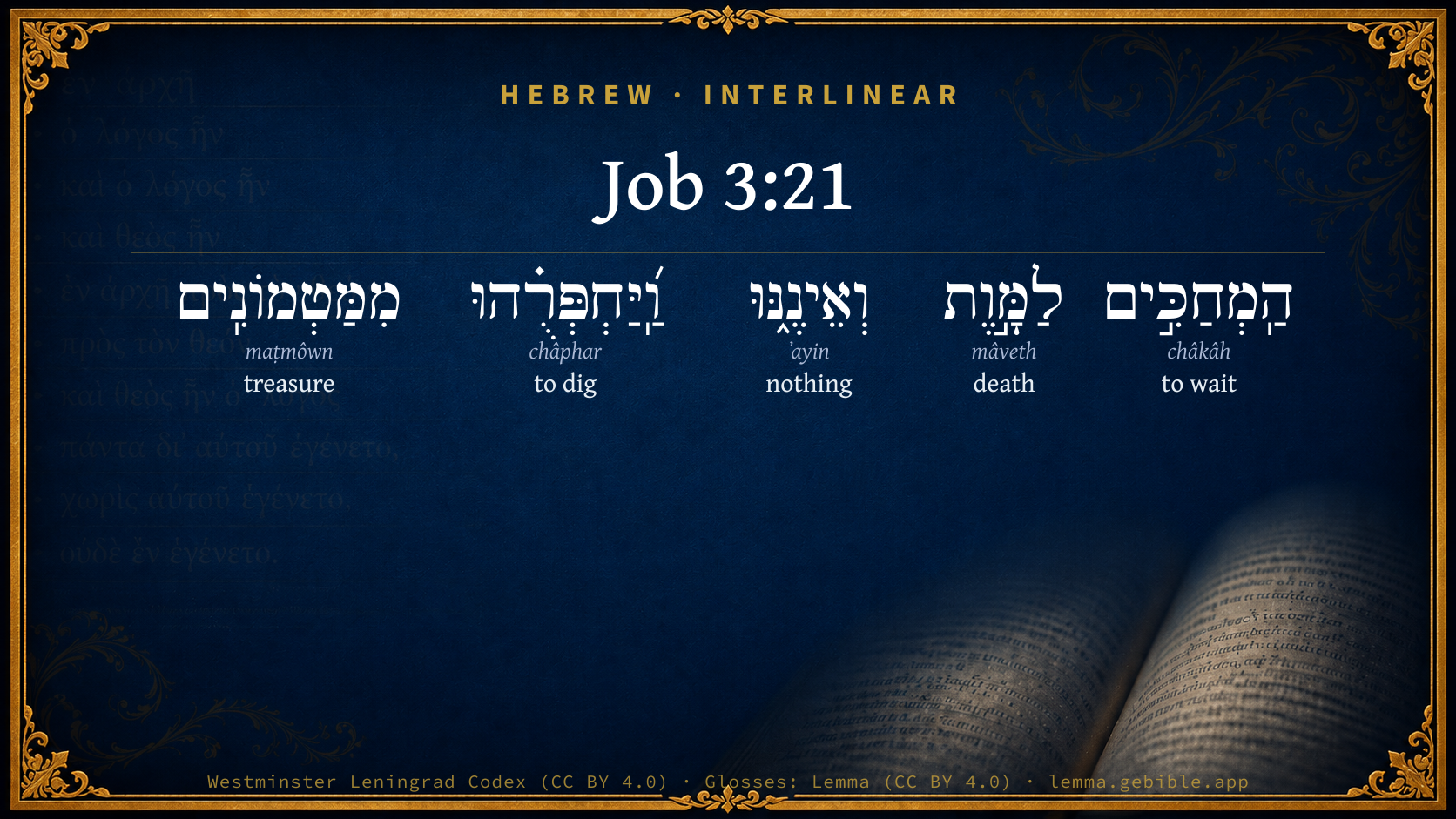
Hebrew (Westminster Leningrad Codex) Job 3:21 appears in the Hebrew Old Testament. The text above is from the Westminster Leningrad Codex. Each word links to its Strong’s number, a concise gloss, and parsing drawn from the Open Scriptures Hebrew Bible morphology. Click any word for its full Brown-Driver-Briggs (BDB) entry.
Download image
Cite this verse

Job 3:21 (World English Bible). Public Domain. Lemma interlinear Bible study tool, https://lemma.gebible.app/v/job/3/21.

Show BibTeX & RIS
BibTeX
RIS
English Translation
Who long for death, but it doesn't come; Dig for it more than for hidden treasures,
World English Bible · Public Domain
Download a study sheet

One document with this verse’s original text, its word-by-word gloss line, the meaning frame, cross-references with their text, attributed commentary, and full source and license credits — printable, and it pastes into notes with its structure intact.

This verse Autodidact and up

Study sheet (.html) Plain text (.txt)

A passage Seminary Student

Up to 50 verses in one chapter. A passage sheet keeps up to 6 commentary sources and 12 cross-references per verse, in the order this page ranks them, and says so on the sheet whenever that leaves anything out. Ask for a single verse and you get the Autodidact verse sheet above.

Everything on this page stays free to read, with no account — the sheet is a download of what is already on screen, not access to it.

Want to remove ads? Support Godless Engineer
Compare translations 3

The same verse in 3 English versions, stacked beneath the original-language interlinear above. Click any original word for its lexicon entry.

Each is an independent rendering of the whole verse — the interlinear is not word-aligned to these translations.

Highlighted words mark where these versions differ — a whole-verse word diff, not a word-by-word alignment.

  • World English Bible Public Domain
    Who long for death, but it doesn't come; Dig for it more than for hidden treasures,
  • King James Version Public Domain
    Which long for death, but it cometh not; and dig for it more than for hid treasures;
  • unfoldingWord Literal Text CC BY-SA 4.0
    the ones longing for death, but not to them, and they dig for it more than for hidden treasure,

unfoldingWord Literal Text — © unfoldingWord, licensed CC BY-SA 4.0. Word-aligned USFM3 via Door43 (git.door43.org/unfoldingWord/en_ult).

Versions to compare (up to 4)

3 of 4 selected

Show all 18 translations

Every available English version of this verse, each an independent rendering of the whole verse.

  • World English Bible Public Domain
    Who long for death, but it doesn't come; Dig for it more than for hidden treasures,
  • Berean Standard Bible Public Domain
    who long for death that does not come, and search for it like hidden treasure,
  • Majority Standard Bible Public Domain
    who long for death that does not come, and search for it like hidden treasure,
  • King James Version Public Domain
    Which long for death, but it cometh not; and dig for it more than for hid treasures;
  • American Standard Version (1901) Public Domain
    Who long for death, but it cometh not, And dig for it more than for hid treasures;
  • Revised Version (1885) Public Domain
    Which long for death, but it cometh not; and dig for it more than for hid treasures;
  • Geneva Bible (1599) Public Domain
    Which long for death, and if it come not, they would euen search it more then treasures:
  • Douay-Rheims (1899) Public Domain
    That look for death, and it cometh not, as they that dig for a treasure:
  • Young's Literal Translation Public Domain
    Who are waiting for death, and it is not, And they seek it above hid treasures.
  • Literal Standard Version CC BY-SA 4.0
    Who are waiting for death, and it is not, || And they seek it above hid treasures.
  • Unlocked Literal Bible CC BY-SA 4.0
    to one who longs for death without it coming; to one who digs for death more than for hidden treasure?
  • unfoldingWord Literal Text CC BY-SA 4.0
    the ones longing for death, but not to them, and they dig for it more than for hidden treasure,
  • Darby Bible Public Domain
    Who long for death, and it [cometh] not, and dig for it more than for hidden treasures;
  • World Messianic Bible Public Domain
    who long for death, but it doesn’t come; and dig for it more than for hidden treasures,
  • Webster's Bible Public Domain
    Who long for death, but it cometh not; and dig for it more than for hid treasures;
  • Free Bible Version CC BY-SA 4.0
    those who are waiting for death that does not come and who are looking for death more desperately than hunting for treasure?
  • Bible in Basic English Public Domain
    To those whose desire is for death, but it comes not; who are searching for it more than for secret wealth;
  • JPS Tanakh (1917) Public Domain
    Who long for death, but it cometh not; and dig for it more than for hid treasures;

Literal Standard Version (2020), Covenant Press — licensed CC BY-SA 4.0. Text via the HelloAO Bible API (eBible.org). Unlocked Literal Bible (unfoldingWord) — licensed CC BY-SA 4.0. Text via the HelloAO Bible API (eBible.org). unfoldingWord Literal Text — © unfoldingWord, licensed CC BY-SA 4.0. Word-aligned USFM3 via Door43 (git.door43.org/unfoldingWord/en_ult). Free Bible Version, Dr. Jonathan Gallagher — licensed CC BY-SA 4.0. Text via the HelloAO Bible API (eBible.org).

Word by word

More ways to search: Search by grammar → Find every occurrence → Compare this word →

Practice this passage: Drill this verse → Learn its vocabulary →

About this verse

These counts appear in no published source. They are computed here, from the morphology-tagged text and Lemma’s own curated glosses. What Lemma adds →

5
words
5
distinct lemmas
Wisdom
section

Notable vocabulary

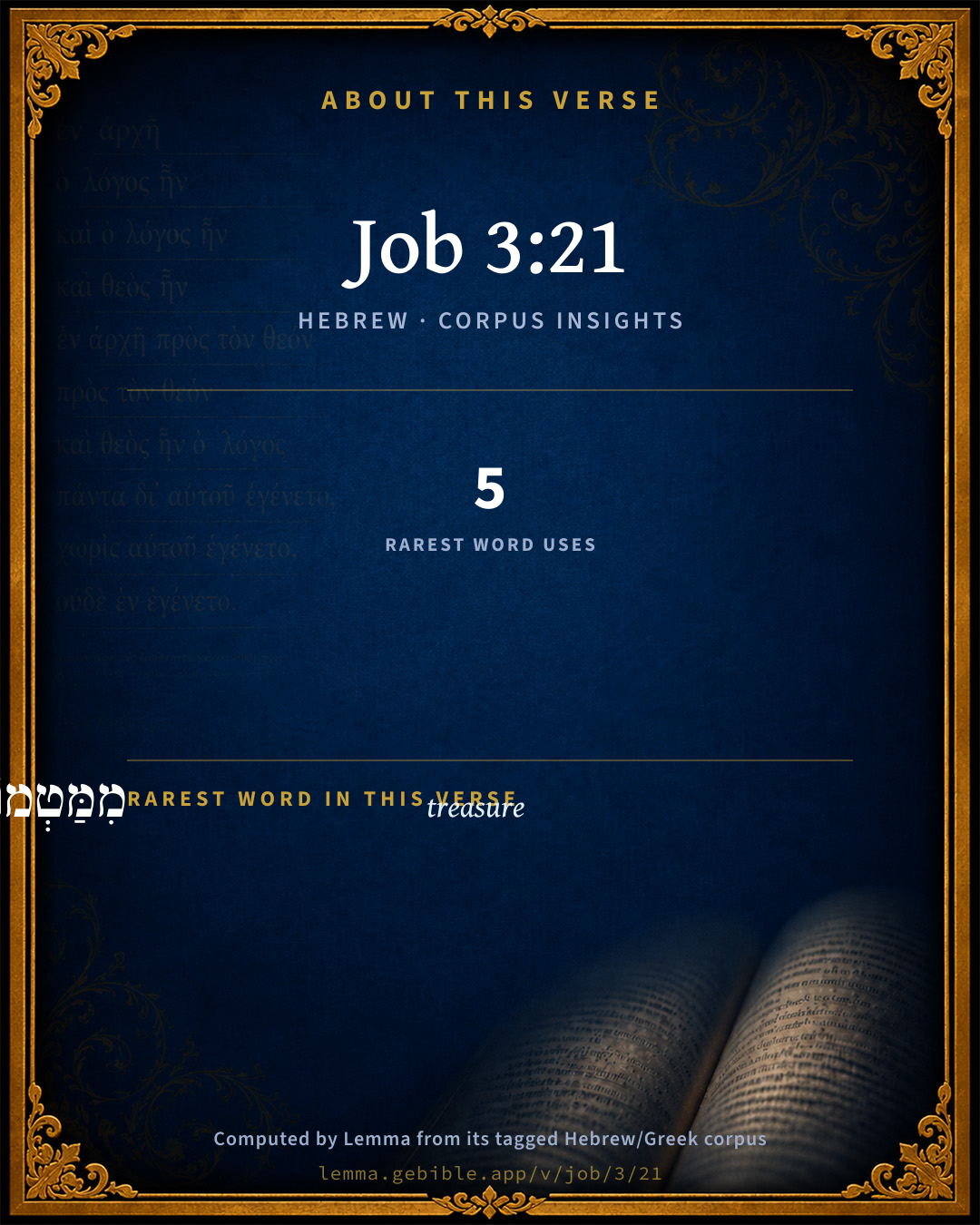
The rarest word here is מִמַּטְמוֹנִֽים treasure H4301 — appearing just 5 times in the whole Hebrew Bible.

Shared distinctive vocabulary

מִמַּטְמוֹנִֽים treasure H4301 occurs in 5 verses of the Hebrew Bible. Also found in:

Grammatical profile

  • 2 verbs
  • 2 nouns
  • 1 particle

Verb forms

  • הַֽמְחַכִּ֣ים Piel · Participle Active
  • וַֽ֝יַּחְפְּרֻ֗הוּ Qal · Sequential Imperfect

Hebrew & Septuagint length

In English translation the verse runs 16 words from the Hebrew and 13 from the Septuagint (LXX English) — closely comparable.

A rough comparison of the two English renderings, which tokenize alike — not a word-level alignment.

Word counts can differ between the Hebrew and the Greek without any difference in meaning — e.g. the Hebrew direct-object marker אֵת has no separate Greek word, and Greek often adds the article ὁ.

Cross-references

6

Topical passages linked to Job 3:21 in the Treasury of Scripture Knowledge — connected by theme and wording, ordered by reader-vote popularity; previews shown in the World English Bible.

  • Revelation 9:6 In those days people will seek death, and will in no way find it. They will desire to die, and death will flee from them.
  • Proverbs 2:4 If you seek her as silver, And search for her as for hidden treasures:
  • Numbers 11:15 If you deal thus with me, please kill me out of hand, if I have found favor in your sight; and let me not see my wretchedness.
  • 1 Kings 19:4 But he himself went a day's journey into the wilderness, and came and sat down under a juniper tree: and he requested for himself that he might die, and said, It is enough; now, O Yahweh, take away my life; for I am not better than my fathers.
  • Jonah 4:3 Therefore now, Yahweh, take, I beg you, my life from me; for it is better for me to die than to live."
  • Jonah 4:8 It happened, when the sun arose, that God prepared a sultry east wind; and the sun beat on Jonah's head, so that he fainted, and requested for himself that he might die, and said, "It is better for me to die than to live."

Cross-references courtesy of OpenBible.info (CC BY 4.0).

Hebrew and Greek witnesses Masoretic Hebrew ↔ Greek Septuagint

The same verse in the two great witnesses to the Old Testament, shown verse-for-verse.

These are two independent witnesses, not word-aligned to each other, and the Septuagint is shown in lemma (dictionary) form.

Hebrew Job 3:21 Masoretic · Westminster Leningrad Codex

הַֽמְחַכִּ֣ים לַמָּ֣וֶת וְאֵינֶ֑נּוּ וַֽ֝יַּחְפְּרֻ֗הוּ מִמַּטְמוֹנִֽים

Who long for death, but it doesn't come; Dig for it more than for hidden treasures,

World English Bible · Public Domain

Greek LXX Job 3:21 Septuagint · lemma form

ὅς ὁμείρομαι ὁ θάνατος καί οὐ τυγχάνω ἀναὀρύσσω ὥσπερ θησαυρός

who desire death, and obtain it not, digging for it as for treasures;

LXX2012 (modern English Septuagint) · Public Domain

Hebrew: Westminster Leningrad Codex (CC BY 4.0). Greek: Septuagint (public domain); English from LXX2012 (modern English Septuagint) (Public Domain). How the Septuagint differs from the Hebrew →

Commentary

Notes on Job 3:21 from classic Christian and Jewish commentators (each source and its license shown beneath its notes). The classic Christian expositions comment on the surrounding passage and are grouped to its opening verse, so a note may address several verses; the Jewish commentaries on the Tanakh (Rashi and others) are per-verse, so they appear only where the commentator wrote on this verse.

Lemma curates 59 commentaries, every one of them public domain or Creative Commons licensed, each selected and text-cleaned for this edition rather than reprinted as found. About our sources →

Trapp's Complete Commentary

John Trapp

Job 3:21 Which long for death, but it [cometh] not; and dig for it more than for hid treasures;

Ver. 21. Which long for death, but it cometh not] The bitter in soul long for death, those that are in pain or penury are apt to desire to be dispatched upon any terms, and would freely pardon them, they say, that would give them their passport. But these, for the most part, consider not the unsupportableness of the wrath to come, that eternity of extremity in hell, that death usually baleth at the heels of it; so that by death, whereof they are so desirous, they would but leap out of the frying pan into the fire, as Judas did: they do so, as the ass in the fable, who desired to die, that he might be no more beaten; at post mortem factus est tympanum, but when he was dead he was made a drum head of, and so was ten times more laid on than ever in his lifetime before.

And dig for it more than for hid treasures] Covetousness is παντολμος, all daring, saith an ancient; and men, for love of wealth, will dig to hell, light a candle at the devil, as they say: with such an eagerness of desire do some (that have little reason for it, all things reckoned) long and labour after death, not to be rid of sin, or to be with Christ, as Php 1:23, but to be freed from misery incumbent or impendent. Thus Cato (having first read Plato’s book of the soul’s immortality) committed suicide, that he might not fall into the hands of the conqueror. Thus Adrian the emperor, having lain long sick (and could get no help by physicians, but was the worse for them, as he complained at his death, πολλοι ιατροι κατεκτειναν τον βοσιλεα), would gladly have slain himself, if those about him would have suffered it. It is said that Severianus, whom this emperor injuriously put to death, wished of God, ut Adrianus, quamvis mortem obire percupiat, tamen non possit, that Adrian might desire to die, and not be able, or find opportunity. There is an epistle of his extant, saith the historian, wherein is set forth what a misery it is to desire to die, and yet to be denied it (Dio Cass. in Adrian). This was the case of those popelings, Rev 9:6. And in particular of Roger, bishop of Salisbury in King Stephen’s time; who, through long and strait imprisonment, was brought to that evil pass, ut vivere noluerit, mori nescierit, live he would not, and yet die he could not. This is a very typical hell, and a foretaste of eternal torment.

John Trapp, A Commentary or Exposition upon All the Books of the Old and New Testament (1647–1656) — public domain. Text from a community e-Sword module.

Joseph Benson's Commentary

Job 3:21. Who long for death — With eagerness and impatience, as the Hebrew means. Who calls aloud for death, as Heath translates it. Qui ægre expectant, inhiant morti, who anxiously long and gasp for death; but it cometh not — They long and gasp in vain. And dig for it more than for hid treasures — Whose thoughts and wishes are so intent on their dissolution, that they expect it with as much earnestness as miners look for their golden treasures, who, being indefatigable in their pursuit, spare neither time nor labour, but penetrate still further into the deep caverns of the earth, to find out and enrich themselves with the secret, wished-for gain. It is observable, that Job durst not do any thing to hasten or procure his death. Notwithstanding all his miseries, he was contented to wait all the days of his appointed time till his change should come, Job 14:14.

Joseph Benson's Commentary on the Old and New Testaments (1811–1818) — public domain. Text from a community e-Sword module.

Tyndale Open Study Notes

Tyndale Open Resources

3:21 People in misery long for death with the desperation of those who dig for hidden treasure.

Tyndale Open Study Notes — © Tyndale Open Resources, licensed CC BY-SA 4.0. Text via the HelloAO Bible API.

Adam Clarke's Commentary

Verse 21. Which long for death] They look to it as the end of all their miseries; and long more for a separation from life, than those who love gold do for a rich mine.

Adam Clarke's Commentary on the Bible (1810–1826) — public domain. Text from a community e-Sword/MySword module.

John Gill's Exposition

Which long for death, but it cometh not,.... Who earnestly desire, wistly look out, wish for, and expect it, and with open mouth gape for it, as a hungry man for his food, or as the fish for the bait, or the fishermen for the fish, as some (a) observe the word may signify; but it comes not to their wish and expectation, or so soon as they would have it; the reason is, because the fixed time for it is not come, otherwise it will certainly come at God's appointed time, and often in an hour not thought of; death is not desirable in itself, being a dissolution of nature, or as it is the sanction of the law, or the wages of sin, or a penal evil; and though it is and may be lawfully desired by good men, that they may be free from sin, and be in a better capacity to serve the Lord, and that they may be for ever with him; yet such desires should be expressed with submission to the divine will, and the appointed time should be patiently waited for, and should not be desired merely to be rid of present afflictions and troubles, which was the case of Job, and of those he here describes; see Rev 9:6,

and dig for it more than for hid treasures; which are naturally hid in the earth; as gold and silver ore, with other metals and precious stones; or which are of choice concealed there from the plunder of others; the former seems rather to be meant, and in digging for which great pains, diligence, and industry, are used, see Pro 2:4; and is expressive of the very great importunity and strong desire of men in distressed circumstances after death, seeking diligently and pressing importunately for it; the sin of suicide not being known, or very rare, in that early time, or however was shunned and abhorred even by those that were most weary of their lives: some render it, "who dig for it out off hid treasures" (b); out of the bowels of the earth, and the lowest parts of it, could they but find it there: but the Targum, Jarchi, and others, understand it comparatively, as we do.

(a) So Junius & Tremellius, Piscator. vid. Schultens in loc. (b) "e thesauris", Cocceius; "ex imis terrae latebris", Mercerus: "ex locis absconditis", Schmidt.

John Gill's Exposition of the Whole Bible (1746–1763) — public domain (CC PDM 1.0). Text via the HelloAO Bible API.

Albert Barnes' Notes on the Bible

Which long for death - Whose pain and anguish are so great that they would regard it as a privilege to die. Much as people dread death, and much as they have occasion to dread what is beyond, yet there is no doubt that this often occurs. Pain becomes so intense, and suffering is so protracted, that they would regard it as a privilege to be permitted to die. Yet that sorrow “must” be intense which prompts to this wish, and usually must be long continued. In ordinary cases such is the love of life, and such the dread of death and of what is beyond, that people are willing to bear all that human nature can endure rather than meet death; see the notes at Job 2:4. This idea has been expressed with unsurpassed beauty by Shakespeare:

For who would bear the whips and scorns of time,

The oppressor’s wrong, the proud man’s contumely

The pangs of despised love. the law’s delay,

The insolence of office. and the spurns

That patient merit of the unworthy takes,

When be himself might his quietus make

With a bare bodkin? Who would fardels bear,

To grunt and sweat under a weary life,

But that the dread of something after death -

The undiscovered country, from whose bourne

No traveler returns-puzzles the will;

And makes us rather bear those ills we have,

Than fly to others that we know not of.

Hamlet.

And dig for it - That is, express a stronger desire for it than people do who dig for treasures in the earth. Nothing would more forcibly express the intense desire to die than this expression.

Albert Barnes' Notes on the Bible (1834–1885) — public domain. Text from a community e-Sword/MySword module.

Haydock's Catholic Bible Commentary

Not. The feel the same eagerness for death as those who seek for a treasure; (Calmet) and when death is at hand, they rejoice no less than those who discover a grave, in which they hope to find some riches, ver. 15, 22.

George Leo Haydock (1774–1849), Haydock's Catholic Family Bible and Commentary, 1859 edition — public domain. Excludes Psalms (Douay-Rheims chapter numbering differs from Protestant) and Deuterocanonical books (Catholic canon only).

Matthew Poole's English Annotations

i.e. Desire and pray for it with as much earnestness as men dig for treasure. But it is observable that Job durst not lay violent hands upon himself, nor do any thing to hasten or procure his death; but notwithstanding all his miseries and complaints, he was contented to wait all the days of his appointed time, till his change came, Job 14:14.

Matthew Poole's English Annotations on the Holy Bible (1683–1685) — public domain. Text from a community e-Sword/MySword module.

Whedon's Commentary on the Bible

Daniel D. Whedon

21. Which long for death — Of the sufferings of the miserable slaves anciently employed in the Egyptian mines, to whom Hitzig and others think Job refers, Diodorus Siculus gives a long and most painful description. It contains a passage strikingly similar to that of the text: “so that these miserable creatures always expect worse to come than that which they then at present endure, and therefore long for death, as far more desirable than life.” — BOOTH’S Edit., 1:159.

Hid treasures — Such is the instability of eastern governments, and the rapacity of monarchs, that it has ever been common for the wealthy to hide their treasures beneath the ground. There are many engaged, even at the present day, in digging for treasures supposed to have been concealed in the remote past. The fortunate finder, Dr. Thomson (Land and the Book, 1:195) tells us, often swoons away. The digger “becomes positively frantic, digs all night with desperate earnestness, and continues to work till utterly exhausted. There are at this hour hundreds of persons thus engaged all over the country.” The figure sets before us the ardour and persistence of the search for death, and the overwhelming joy of discovery, and is one of the most powerful within the compass of literature. The antithesis of death to hidden treasures leads Ewald to remark that death, like such treasures, seems to come out of earth’s most secret womb, even as Pluto is the god of both. Dr. Evans bases upon the “Vav consecutive,” used here, the just observation that the digging for death is consequent upon waiting for it — the passive waiting and longing being succeeded by the more active digging and searching for it. A terrible picture of the progress of human misery. (Compare the address of Eleazar, in JOSEPHUS, Wars of the Jews, b. vii, chap. viii, sec. 7.)

Daniel D. Whedon (gen. ed.), Commentary on the Old and New Testaments (1874–1909) — public domain. Text from a community e-Sword module.

The Pulpit Commentary

Which long for death, but it cometh not; literally, which wait for death"anxiously and longingly. (comp. Psa_33:20) And dig for it more than for hid treasures; i.e. "seek it more earnestly than even they seek who dig for hid treasures." As Professor Lee remarks, "From the great instability of all Eastern governments, treasures were in Eastern countries often hid away" ("Book of Job," pp. 200, 201). And hence treasure-seeking became a profession, which was pursued with avidity by a large number of persons. Even at the present day Orientals are so possessed with the idea, that they imagine every European, who is eager to unearth antiquities, must be seeking for buried treasure.

The Pulpit Commentary (1880–1919), ed. H.D.M. Spence-Jones & Joseph S. Exell — public domain. Text from a community e-Sword module.

John Wesley's Explanatory Notes

Dig - Desire with as much earnestness as men dig for treasure: but it is observable, Job durst not do anything to hasten or procure his death: notwithstanding all his miseries, he was contented to wait all the days of his appointed time, 'till his change came, chap. xiv, 14.

John Wesley, Explanatory Notes Upon the Whole Bible (1754–1765) — public domain. Text via the GEBible commentary corpus.

Rashi

Rabbi Shlomo Yitzchaki (Rashi)

Who await death to those of bitter spirit, who long for and desire death and complain, saying, “it is not here.”

and they spy after it Heb. ויתפרהו, and they spy after it.

more than after hidden treasures More than people spy after hidden treasures.

Rashi on the Tanakh — English translations: “The Judaica Press complete Tanach with Rashi, translated by A. J. Rosenberg” (CC BY 4.0); “Pentateuch with Rashi's commentary by M. Rosenbaum and A.M. Silbermann, 1929-1934” (public domain); “The Metsudah Tanach series, Lakewood, N.J” (CC BY 4.0); and “The Book of Joshua, Metsudah Publications, 1997” (CC BY 4.0). Text via Sefaria.

Lesson kit

Teaching starters — assembled from the data on this page, not authored interpretation. Every prompt links to the verse data it draws on. Edit before teaching.

Job, in the Wisdom, opens this verse with 5 words (5 distinct Hebrew lemmas). Its most distinctive word is maṭmôwn (“treasure”). A historical commentator’s framing appears above. Read the whole chapter for the surrounding context.

Discussion questions

  1. How does “treasure” (maṭmôwn) shape what this verse is saying?
  2. How does Genesis 43:23, which shares the word «treasure», read alongside this verse?
  3. These translations render this verse differently. What is at stake in choosing one wording over another?
  4. «הַֽמְחַכִּ֣ים» is a Piel Participle Active verb. How does that grammatical form shape the action described?
  5. Compare how Trapp's Complete Commentary and Joseph Benson's Commentary read this verse. Where do they agree or differ?

Things to notice

Reading settings

Reading text

Shown beneath each verse's original-language words.

Old Testament
Old Testament edition

Read the OT as the Masoretic Hebrew (MT) or the Greek Septuagint (LXX).

English shown for the Greek Septuagint (in the Hebrew ↔ Greek comparison).

Comparing translations? Open the Compare panel on any verse page to stack up to four side by side.