Numbers 22:26

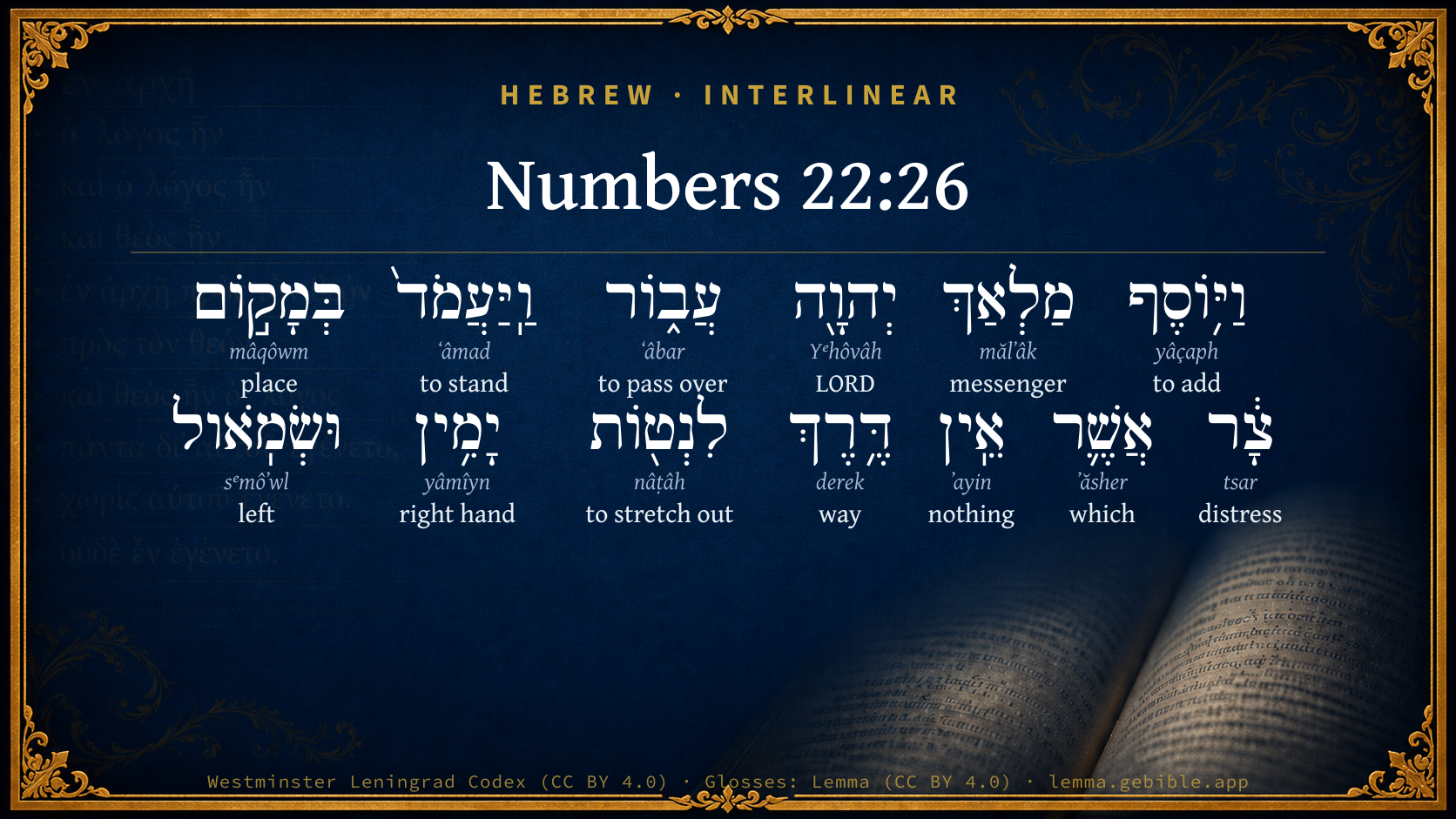
Hebrew (Westminster Leningrad Codex) Numbers 22:26 appears in the Hebrew Old Testament. The text above is from the Westminster Leningrad Codex. Each word links to its Strong’s number, a concise gloss, and parsing drawn from the Open Scriptures Hebrew Bible morphology. Click any word for its full Brown-Driver-Briggs (BDB) entry.
Download image
Cite this verse

Numbers 22:26 (World English Bible). Public Domain. Lemma interlinear Bible study tool, https://lemma.gebible.app/v/numbers/22/26.

Show BibTeX & RIS
BibTeX
RIS
English Translation
The angel of Yahweh went further, and stood in a narrow place, where was no way to turn either to the right hand or to the left.
World English Bible · Public Domain
Download a study sheet

One document with this verse’s original text, its word-by-word gloss line, the meaning frame, cross-references with their text, attributed commentary, and full source and license credits — printable, and it pastes into notes with its structure intact.

This verse Autodidact and up

Study sheet (.html) Plain text (.txt)

A passage Seminary Student

Up to 50 verses in one chapter. A passage sheet keeps up to 6 commentary sources and 12 cross-references per verse, in the order this page ranks them, and says so on the sheet whenever that leaves anything out. Ask for a single verse and you get the Autodidact verse sheet above.

Everything on this page stays free to read, with no account — the sheet is a download of what is already on screen, not access to it.

Want to remove ads? Support Godless Engineer
Compare translations 3

The same verse in 3 English versions, stacked beneath the original-language interlinear above. Click any original word for its lexicon entry.

Each is an independent rendering of the whole verse — the interlinear is not word-aligned to these translations.

Highlighted words mark where these versions differ — a whole-verse word diff, not a word-by-word alignment.

  • World English Bible Public Domain
    The angel of Yahweh went further, and stood in a narrow place, where was no way to turn either to the right hand or to the left.
  • King James Version Public Domain
    And the angel of the LORD went further, and stood in a narrow place, where was no way to turn either to the right hand or to the left.
  • unfoldingWord Literal Text CC BY-SA 4.0
    And the angel of Yahweh passed on again and stood in a narrow place where there was no road to turn right or left.

unfoldingWord Literal Text — © unfoldingWord, licensed CC BY-SA 4.0. Word-aligned USFM3 via Door43 (git.door43.org/unfoldingWord/en_ult).

Versions to compare (up to 4)

3 of 4 selected

Show all 18 translations

Every available English version of this verse, each an independent rendering of the whole verse.

  • World English Bible Public Domain
    The angel of Yahweh went further, and stood in a narrow place, where was no way to turn either to the right hand or to the left.
  • Berean Standard Bible Public Domain
    And the angel of the LORD moved on ahead and stood in a narrow place where there was no room to turn to the right or left.
  • Majority Standard Bible Public Domain
    And the angel of the LORD moved on ahead and stood in a narrow place where there was no room to turn to the right or left.
  • King James Version Public Domain
    And the angel of the LORD went further, and stood in a narrow place, where was no way to turn either to the right hand or to the left.
  • American Standard Version (1901) Public Domain
    And the angel of Jehovah went further, and stood in a narrow place, where was no way to turn either to the right hand or to the left.
  • Revised Version (1885) Public Domain
    And the angel of the LORD went further, and stood in a narrow place, where was no way to turn either to the right hand or to the left.
  • Geneva Bible (1599) Public Domain
    Then the Angel of the Lord went further, and stoode in a narowe place, where was no way to turne, either to the right hand, or to the left.
  • Douay-Rheims (1899) Public Domain
    And nevertheless the angel going on to a narrow place, where there was no way to turn aside either to the right hand or to the left, stood to meet him.
  • Young's Literal Translation Public Domain
    and the messenger of Jehovah addeth to pass over, and standeth in a strait place where there is no way to turn aside -- right or left --
  • Literal Standard Version CC BY-SA 4.0
    and the Messenger of YHWH adds to pass over, and stands in a narrow place where there is no way to turn aside [to] the right or left,
  • Unlocked Literal Bible CC BY-SA 4.0
    The angel of Yahweh went further and stood in another narrow place where there was no way to turn to either side.
  • unfoldingWord Literal Text CC BY-SA 4.0
    And the angel of Yahweh passed on again and stood in a narrow place where there was no road to turn right or left.
  • Darby Bible Public Domain
    Then the Angel of Jehovah went still further, and stood in a narrow place, where was no way to turn either to the right hand or to the left.
  • World Messianic Bible Public Domain
    The LORD’s angel went further, and stood in a narrow place, where there was no way to turn either to the right hand or to the left.
  • Webster's Bible Public Domain
    And the angel of the LORD went further, and stood in a narrow place, where was no way to turn either to the right hand or to the left.
  • Free Bible Version CC BY-SA 4.0
    Then the angel of the Lord went ahead and stood in a narrow place where there was no room to get past, either on the right or the left.
  • Bible in Basic English Public Domain
    Then the angel of the Lord went further, stopping in a narrow place where there was no room for turning to the right or to the left.
  • JPS Tanakh (1917) Public Domain
    And the angel of the LORD went further, and stood in a narrow place, where was no way to turn either to the right hand or to the left.

Literal Standard Version (2020), Covenant Press — licensed CC BY-SA 4.0. Text via the HelloAO Bible API (eBible.org). Unlocked Literal Bible (unfoldingWord) — licensed CC BY-SA 4.0. Text via the HelloAO Bible API (eBible.org). unfoldingWord Literal Text — © unfoldingWord, licensed CC BY-SA 4.0. Word-aligned USFM3 via Door43 (git.door43.org/unfoldingWord/en_ult). Free Bible Version, Dr. Jonathan Gallagher — licensed CC BY-SA 4.0. Text via the HelloAO Bible API (eBible.org).

Word by word

More ways to search: Search by grammar → Find every occurrence → Compare this word →

Practice this passage: Drill this verse → Learn its vocabulary →

וּשְׂמֹֽאול
sᵉmôʼwl
H8040
“and · left”
Conjunction + Noun, Common, Masculine, Singular, Absolute
Part of Speech
Conjunction + Noun
Type
Common
Gender
Masculine
Number
Singular
State
Absolute
Full BDB Definition

Origin: a primitive word [rather perhaps from the same as H8071 (by insertion of the aleph) through the idea of wrapping up]

TWOT: 2267a

the left, the left hand, the left side - left - left hand - north (as one faces east)
  1. וַיּ֥וֹסֶף yâçaph H3254 “and · to add” Conjunction + Verb, Hiphil, Sequential Imperfect, 3rd Person, Masculine, Singular
  2. מַלְאַךְ mălʼâk H4397 “messenger of” Noun, Common, Masculine, Singular, Construct
  3. יְהוָ֖ה Yᵉhôvâh H3068 “LORD” Noun, Proper
  4. עֲב֑וֹר ʻâbar H5674 “to pass over” Verb, Qal, Infinitive Construct
  5. וַֽיַּעֲמֹד֙ ʻâmad H5975 “and · to stand” Conjunction + Verb, Qal, Sequential Imperfect, 3rd Person, Masculine, Singular
  6. בְּמָק֣וֹם mâqôwm H4725 “in/at · place” Preposition + Noun, Common, Masculine, Singular, Absolute
  7. צָ֔ר tsar H6862 “distress” Adjective, Adjective, Masculine, Singular, Absolute
  8. אֲשֶׁ֛ר ʼăsher H834 “which” Particle, Relative
  9. אֵֽין ʼayin H369 “nothing” Particle, Negative
  10. דֶּ֥רֶךְ derek H1870 “way” Noun, Common, Both, Singular, Absolute
  11. לִנְט֖וֹת nâṭâh H5186 “to stretch out” Preposition + Verb, Qal, Infinitive Construct
  12. יָמִ֥ין yâmîyn H3225 “right hand” Noun, Common, Feminine, Singular, Absolute

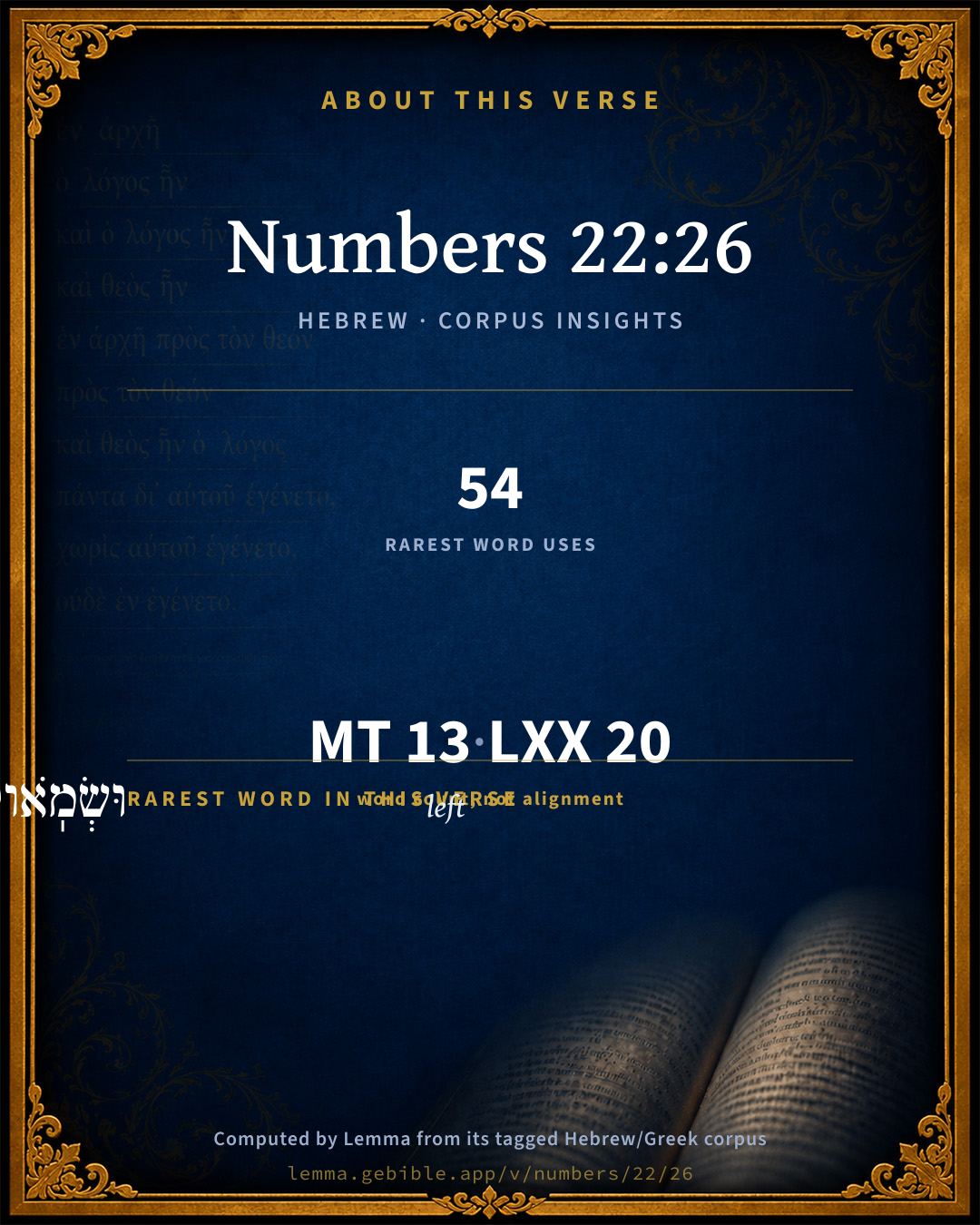
About this verse

These counts appear in no published source. They are computed here, from the morphology-tagged text and Lemma’s own curated glosses. What Lemma adds →

13
words
13
distinct lemmas
Pentateuch
section

Shared distinctive vocabulary

וּשְׂמֹֽאול left H8040 occurs in 53 verses of the Hebrew Bible. Also found in:

Grammatical profile

  • 4 verbs
  • 6 nouns
  • 1 adjective
  • 2 particles

Verb forms

  • וַיּ֥וֹסֶף Hiphil · Sequential Imperfect
  • עֲב֑וֹר Qal · Infinitive Construct
  • וַֽיַּעֲמֹד֙ Qal · Sequential Imperfect
  • לִנְט֖וֹת Qal · Infinitive Construct

Hebrew & Septuagint length

In English translation the verse runs 27 words from the Hebrew and 28 from the Septuagint (LXX English) — closely comparable.

A rough comparison of the two English renderings, which tokenize alike — not a word-level alignment.

Word counts can differ between the Hebrew and the Greek without any difference in meaning — e.g. the Hebrew direct-object marker אֵת has no separate Greek word, and Greek often adds the article ὁ.

In the original languages it is 13 Hebrew tokens and 20 Greek tokens — but the two are counted differently (Hebrew bundles its prefixes and suffixes into one token; the Greek is in lemma form), so that isn’t a like-for-like length.

Cross-references

2

Topical passages linked to Numbers 22:26 in the Treasury of Scripture Knowledge — connected by theme and wording, ordered by reader-vote popularity; previews shown in the World English Bible.

  • Isaiah 26:11 Yahweh, your hand is lifted up, yet they don't see: but they shall see [your] zeal for the people, and be disappointed; yes, fire shall devour your adversaries.
  • Hosea 2:6 Therefore, behold, I will hedge up your way with thorns, And I will build a wall against her, That she can't find her way.

Cross-references courtesy of OpenBible.info (CC BY 4.0).

Hebrew and Greek witnesses Masoretic Hebrew ↔ Greek Septuagint

The same verse in the two great witnesses to the Old Testament, shown verse-for-verse.

These are two independent witnesses, not word-aligned to each other, and the Septuagint is shown in lemma (dictionary) form.

Hebrew Numbers 22:26 Masoretic · Westminster Leningrad Codex

וַיּ֥וֹסֶף מַלְאַךְ יְהוָ֖ה עֲב֑וֹר וַֽיַּעֲמֹד֙ בְּמָק֣וֹם צָ֔ר אֲשֶׁ֛ר אֵֽין דֶּ֥רֶךְ לִנְט֖וֹת יָמִ֥ין וּשְׂמֹֽאול

The angel of Yahweh went further, and stood in a narrow place, where was no way to turn either to the right hand or to the left.

World English Bible · Public Domain

Greek LXX Numbers 22:26 Septuagint · lemma form

καί προςτίθημι ὁ ἄγγελος ὁ θεός καί ἀποἔρχομαι ὑποἵστημι ἐν τόπος στενός εἰς ὅς οὐ εἰμί ἐκκλίνω δεξιός οὐδέ ἀριστερός

And the angel of the Lord went farther, and came and stood in a narrow place where it was impossible to turn to the right or the left.

LXX2012 (modern English Septuagint) · Public Domain

Hebrew: Westminster Leningrad Codex (CC BY 4.0). Greek: Septuagint (public domain); English from LXX2012 (modern English Septuagint) (Public Domain). How the Septuagint differs from the Hebrew →

Targum (Aramaic paraphrase)

2

The Targum is the ancient Jewish Aramaic paraphrase of the Hebrew Scriptures — an interpretive translation, not the Hebrew text itself. Onkelos (literal) and Pseudo-Jonathan (expansive) render the Torah, and Jonathan the Prophets. Coverage is partial: where no permissively-licensed English translation exists for a verse, only the Aramaic is shown. This is verse-level text, not a word-by-word alignment to the Hebrew.

  1. Targum Onkelos Torah (Genesis–Deuteronomy)
    וְאוֹסֵף מַלְאָכָא דַיְיָ לְמֶעְבָּר וְקָם בַּאֲתַר עָק דִי לֵית אֹרַח לְמִסְטֵי לְיַמִינָא וְלִשְׂמָאלָא

    (no public-domain English translation for this verse)

    Targum Onkelos — Aramaic: “Onkelos Genesis” (public domain); “Onkelos Exodus” (public domain); “Onkelos Leviticus” (public domain); “Onkelos Numbers” (public domain); “Onkelos Deuteronomy” (public domain). English: “Sefaria Community Translation” (CC0 1.0 (public-domain dedication)); “J.W. Etheridge. The Targums of Onkelos and Jonathan Ben Uzziel on the Pentateuch. London: Longmans, Green, 1862” (public domain). Text via Sefaria.

  2. Targum Pseudo-Jonathan Torah (Genesis–Deuteronomy)
    וְאוֹסִיף מַלְאָכָא דַיְיָ לְמֵעִיבַּר וְקָם בַּאֲתַר דָחִיק דְלֵית אוֹרַח לְמִיסְטֵי לְיַמִינָא וְלִשְמָאלָא

    And the angel of the Lord yet passed on, and stood in a distant place, where there was no way to turn either to the right or left.

    Targum Pseudo-Jonathan — Aramaic: “Targum Jonathan on Genesis” (public domain); “Targum Jonathan on Exodus” (public domain); “Targum Jonathan on Leviticus” (public domain); “Targum Jonathan on Numbers” (public domain); “Targum Jonathan on Deuteronomy” (public domain). English: “The Targum of Jonathan ben Uzziel, trans. J. W. Etheridge, London, 1862” (public domain). Text via Sefaria.

Commentary

Notes on Numbers 22:26 from classic Christian and Jewish commentators (each source and its license shown beneath its notes). The classic Christian expositions comment on the surrounding passage and are grouped to its opening verse, so a note may address several verses; the Jewish commentaries on the Tanakh (Rashi and others) are per-verse, so they appear only where the commentator wrote on this verse.

Lemma curates 59 commentaries, every one of them public domain or Creative Commons licensed, each selected and text-cleaned for this edition rather than reprinted as found. About our sources →

Adam Clarke's Commentary

Verse 26. And the angel - stood in a narrow place] In this carriage of the angel says Mr. Ainsworth the Lord shows us the proceedings of his judgments against sinners:

First he mildly shakes his rod at them but lets them go untouched.

Secondly he comes nearer and touches them with an easy correction as it were wringing their foot against the wall.

Thirdly, when all this is ineffectual, he brings them into such straits, that they can neither turn to the right hand nor to the left, but must fall before his judgments, if they do not fully turn to him.

Adam Clarke's Commentary on the Bible (1810–1826) — public domain. Text from a community e-Sword/MySword module.

John Gill's Exposition

And Balaam said unto the ass, because thou hast mocked me,.... Or rather "defiled me", as the word is rendered in Job 16:15 by running with him against a wall, and by lying down with him in the dust and dirt, and so the Arabic version renders it,"because thou hast rolled me in the dirt;''the sense of mocking is not easy to be understood, unless it be that it exposed him to be mocked and laughed at by others, by turning aside, and lying down, and being so unruly; but then there were only his servants with him, to whom only he could be exposed in such a manner, which one would think would not have given him so much concern, and put him into such a passion: the word sometimes is used for seeking occasion, and such a sense it may have here, as that it sought an opportunity or occasion to throw him, and so to kill him, or at least to do him harm, see Dan 6:4.

I would there were a sword in my hand, for now would I kill thee: so enraged was he, and his passion was so great, that he was not at all frightened and amazed to hear the ass speak, though Josephus (q) represents him as disturbed and astonished at it; but some think, he being used to converse with spirits in the shapes of various creatures, it was no surprise to him to hear it speak.

(q) Antiqu. l. 4. c. 6. sect. 3.

John Gill's Exposition of the Whole Bible (1746–1763) — public domain (CC PDM 1.0). Text via the HelloAO Bible API.

Whedon's Commentary on the Bible

Daniel D. Whedon

26. No way to turn — This narrowing way between two walls fitly represents the dealings of God with wicked men — first threatening them with his rod, yet sparing them; then touching them mildly, as in the case of the bruised foot; and at last bringing them into such a strait that escape is impossible.

Daniel D. Whedon (gen. ed.), Commentary on the Old and New Testaments (1874–1909) — public domain. Text from a community e-Sword module.

Keil & Delitzsch

C. F. Keil & F. Delitzsch

The angel moved still farther, and stationed himself in front of him, in so narrow a pass, that there was no room to move either to the right or to the left. As the ass could neither turn aside nor go past this time, she threw herself. down. Balaam was still more enraged at this, and smote her with the stick (בּמקּל, which he carried; see Gen 38:18).

Keil & Delitzsch — Biblical Commentary on the Old Testament (1861–1891) — public domain (CC PDM 1.0). Text via the HelloAO Bible API. (Old Testament only.)

unfoldingWord translationNotes

Door43 World Missions Community

Balaam's anger was kindled

The increase in Balaam's anger is spoken of as if it was a fire starting to burn. This can be stated in active form. See how you translated a similar phrase in Numbers 22:22. AT: "Balaam became very angry" (See: Idiom and Active or Passive)

translationWords

Balaam

staff

unfoldingWord translationNotes — © Distant Shores Media and the Door43 World Missions Community, licensed CC BY-SA 4.0. Source: git.door43.org/Door43/en_tn.

Rashi

Rabbi Shlomo Yitzchaki (Rashi)

ויוסף מלאך ה' עובר AND THE ANGEL OF THE LORD WENT FURTHER — went further in front of him — it went on so as to be before him in another spot. It is similar to, (Genesis 33:3) “And he passed in front of them”. — And there is a Midrashic explanation in Tanchuma: What reason had he to stand in three places? He (the Angel) showed him (Balaam) symbols referring to the three patriarchs (Midrash Tanchuma, Balak 8).

Rashi on the Tanakh — English translations: “The Judaica Press complete Tanach with Rashi, translated by A. J. Rosenberg” (CC BY 4.0); “Pentateuch with Rashi's commentary by M. Rosenbaum and A.M. Silbermann, 1929-1934” (public domain); “The Metsudah Tanach series, Lakewood, N.J” (CC BY 4.0); and “The Book of Joshua, Metsudah Publications, 1997” (CC BY 4.0). Text via Sefaria.

Lesson kit

Teaching starters — assembled from the data on this page, not authored interpretation. Every prompt links to the verse data it draws on. Edit before teaching.

Numbers, in the Pentateuch, opens this verse with 13 words (13 distinct Hebrew lemmas). Its most distinctive word is sᵉmôʼwl (“left”). A historical commentator’s framing appears above. Read the whole chapter for the surrounding context.

Discussion questions

  1. The word sᵉmôʼwl carries the sense “left.” How does it shape the verse?
  2. Genesis 13:9 shares the word «left» with this verse. How do the two illuminate each other?
  3. The translations on this page render this verse differently — a whole-verse word diff, not a word-by-word alignment. What might account for the different wordings?
  4. The verb «וַיּ֥וֹסֶף» is Hiphil Sequential Imperfect. How does its form color the action?
  5. Reading how Adam Clarke's Commentary and John Gill's Exposition read this verse, where do the two commentators agree and where do they part?

Things to notice

Reading settings

Reading text

Shown beneath each verse's original-language words.

Old Testament
Old Testament edition

Read the OT as the Masoretic Hebrew (MT) or the Greek Septuagint (LXX).

English shown for the Greek Septuagint (in the Hebrew ↔ Greek comparison).

Comparing translations? Open the Compare panel on any verse page to stack up to four side by side.